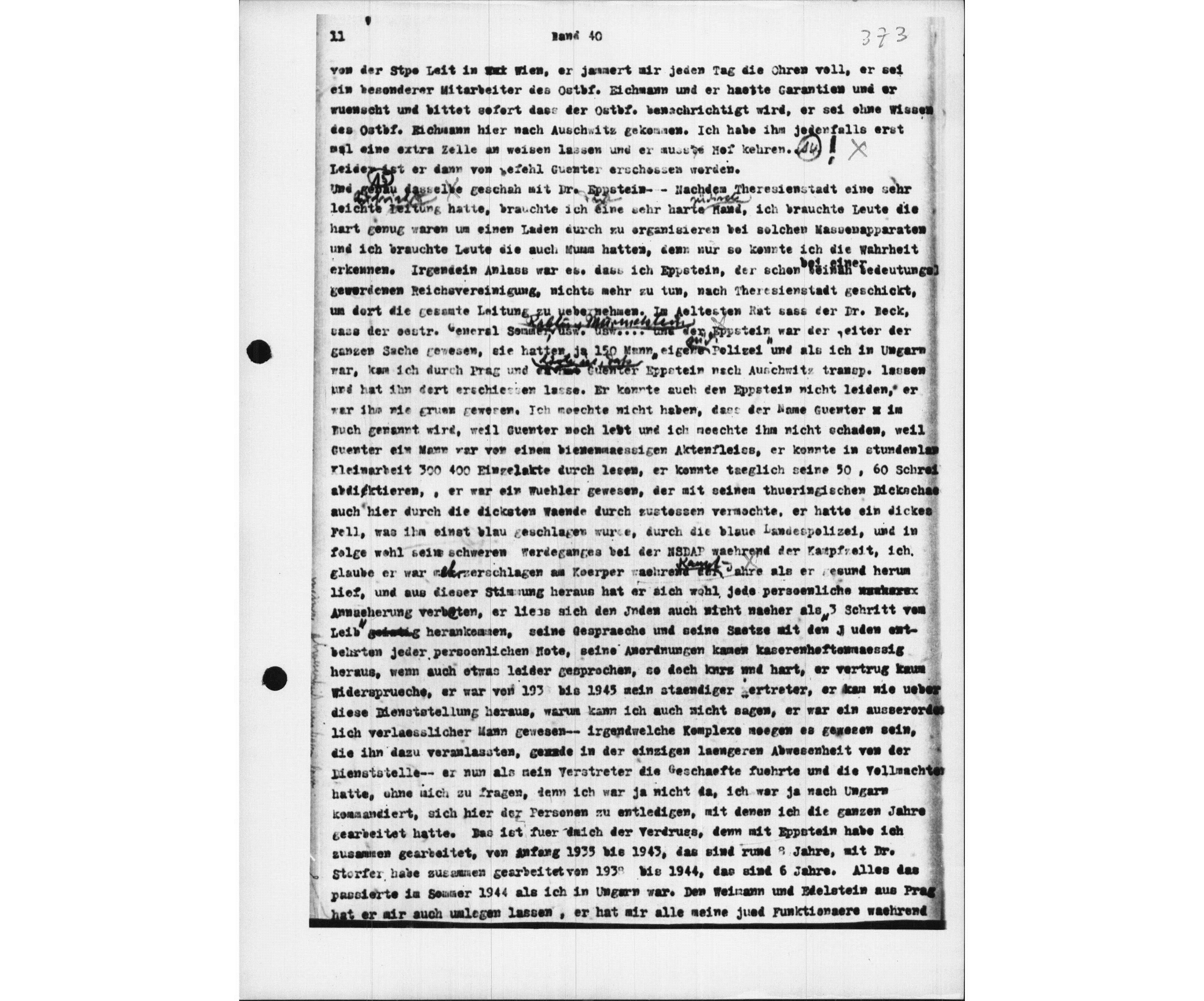
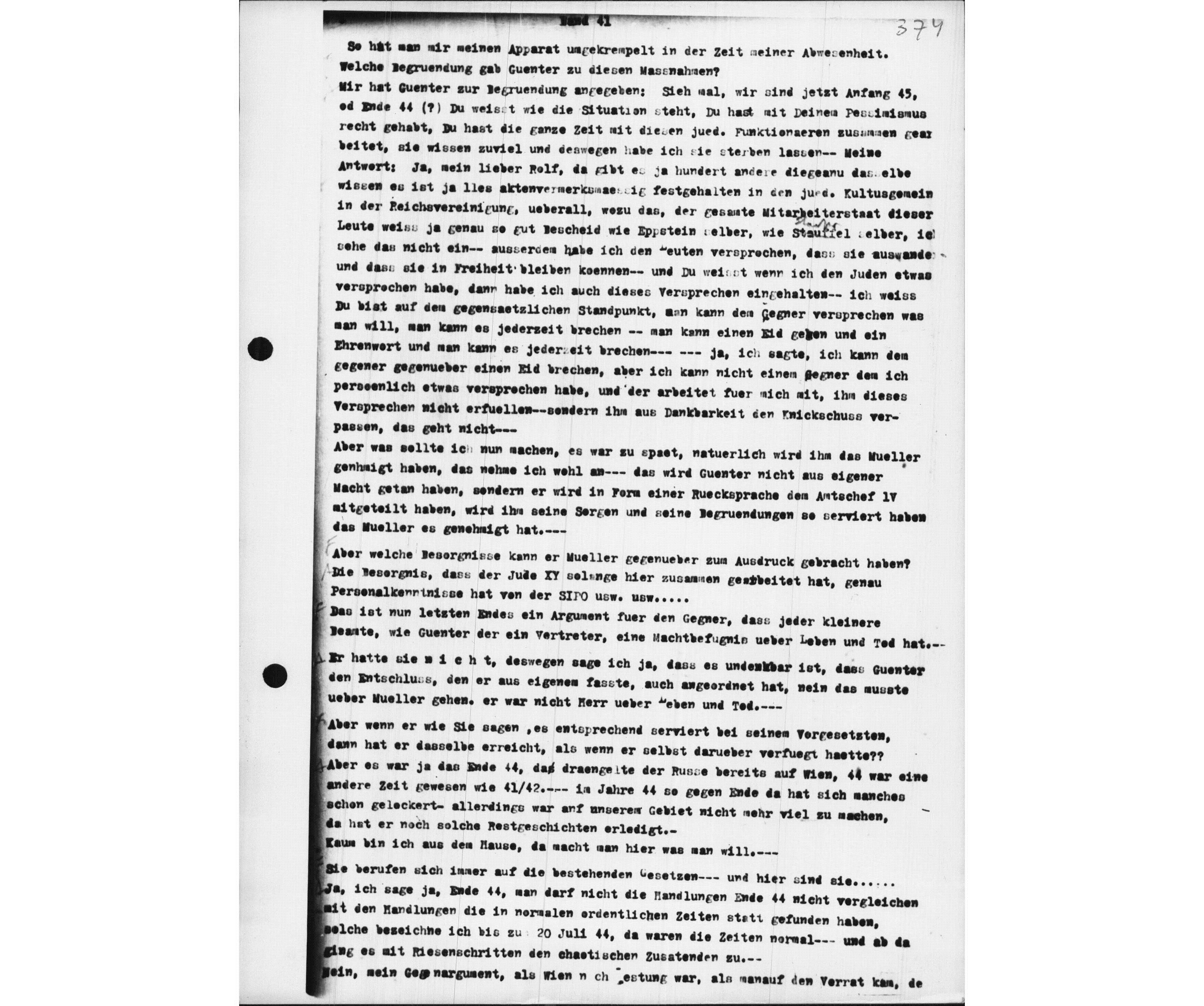
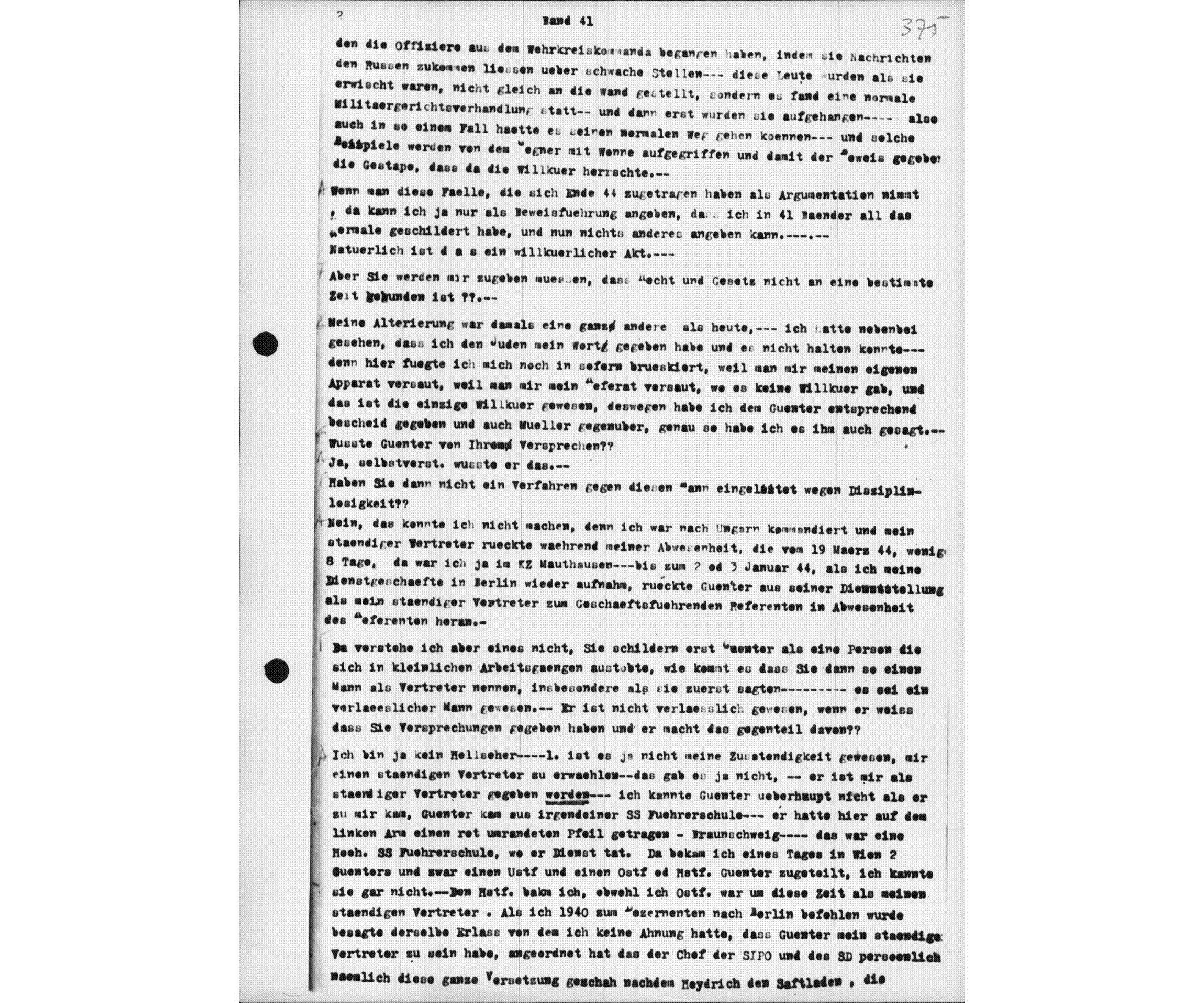
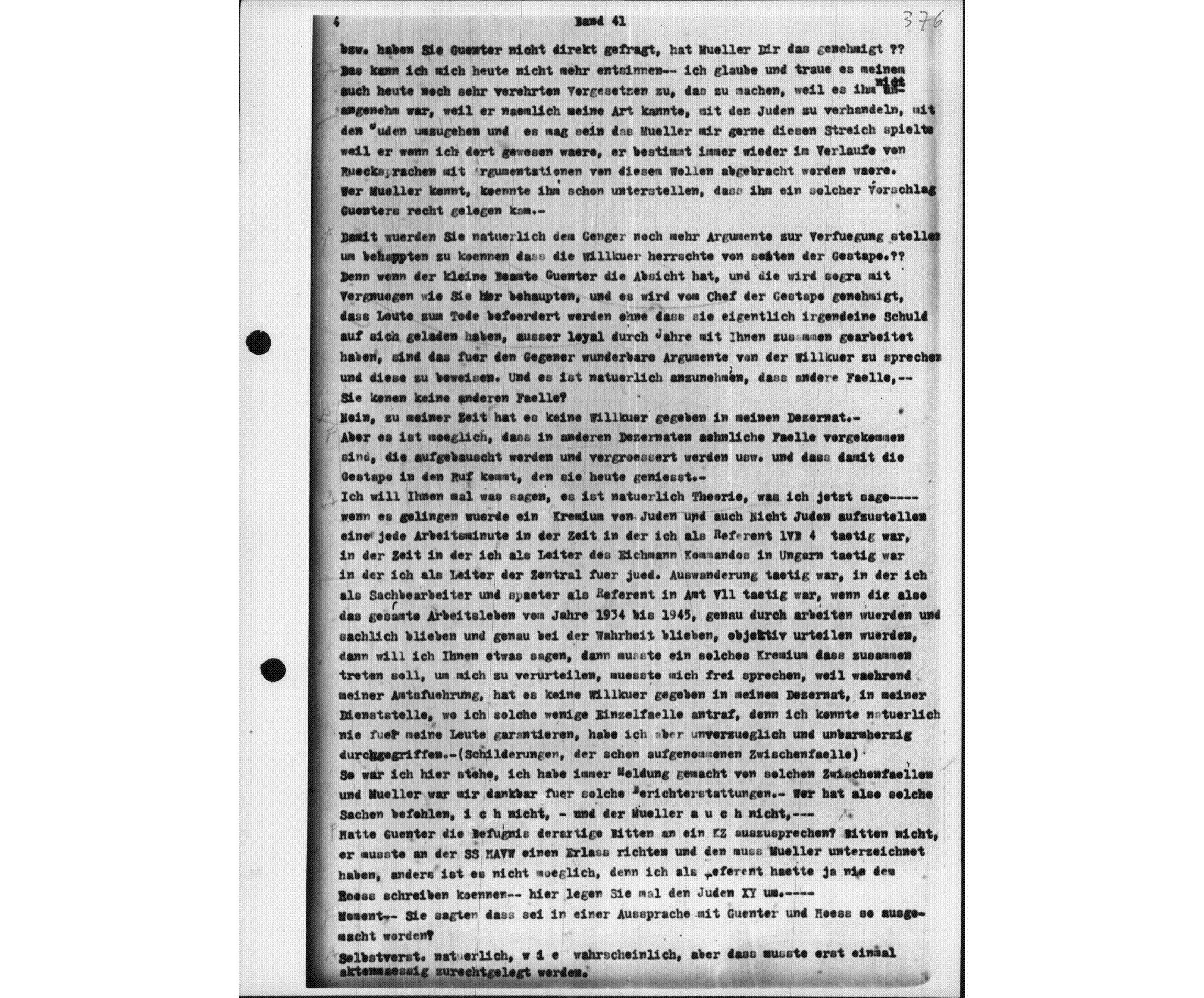
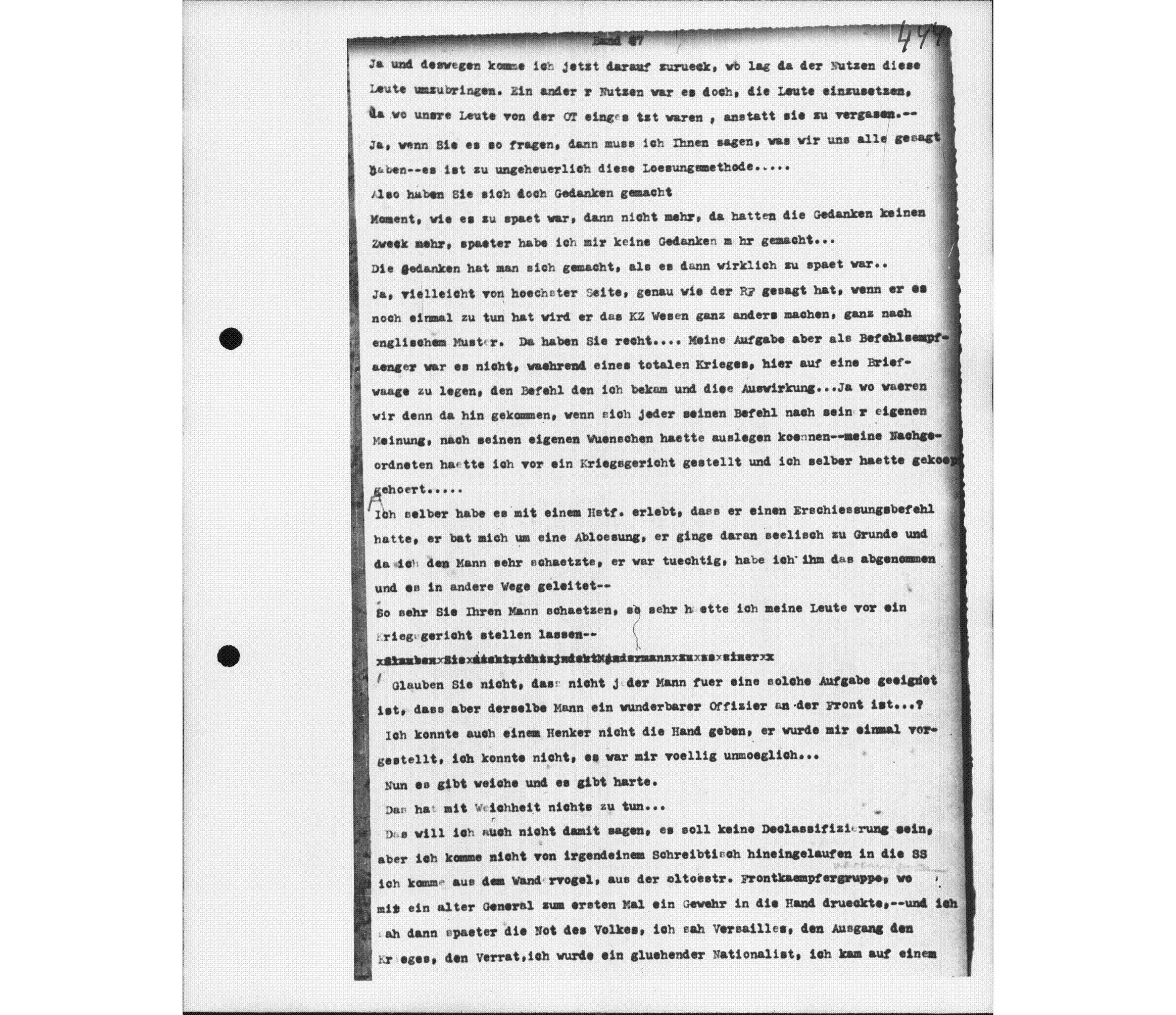
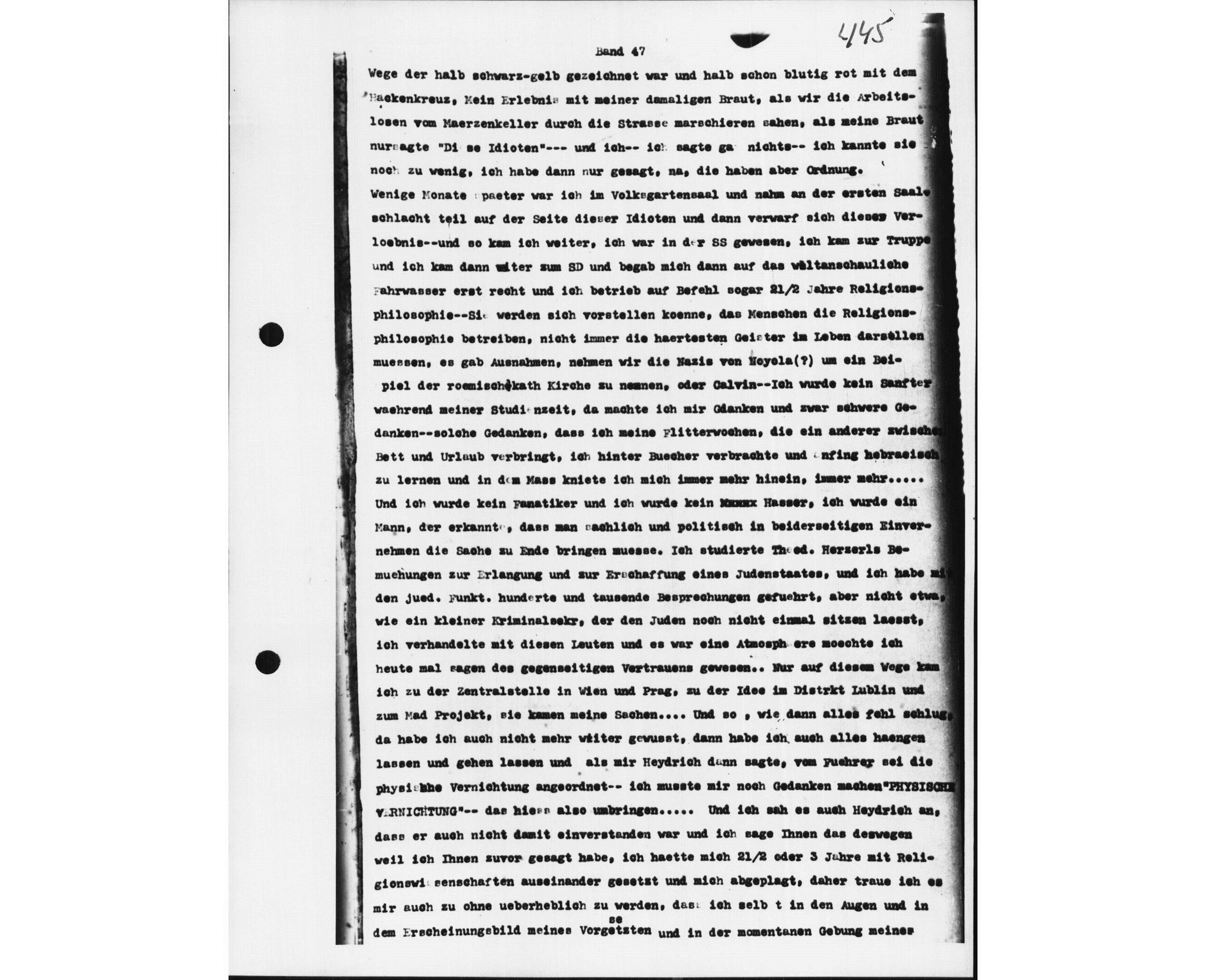
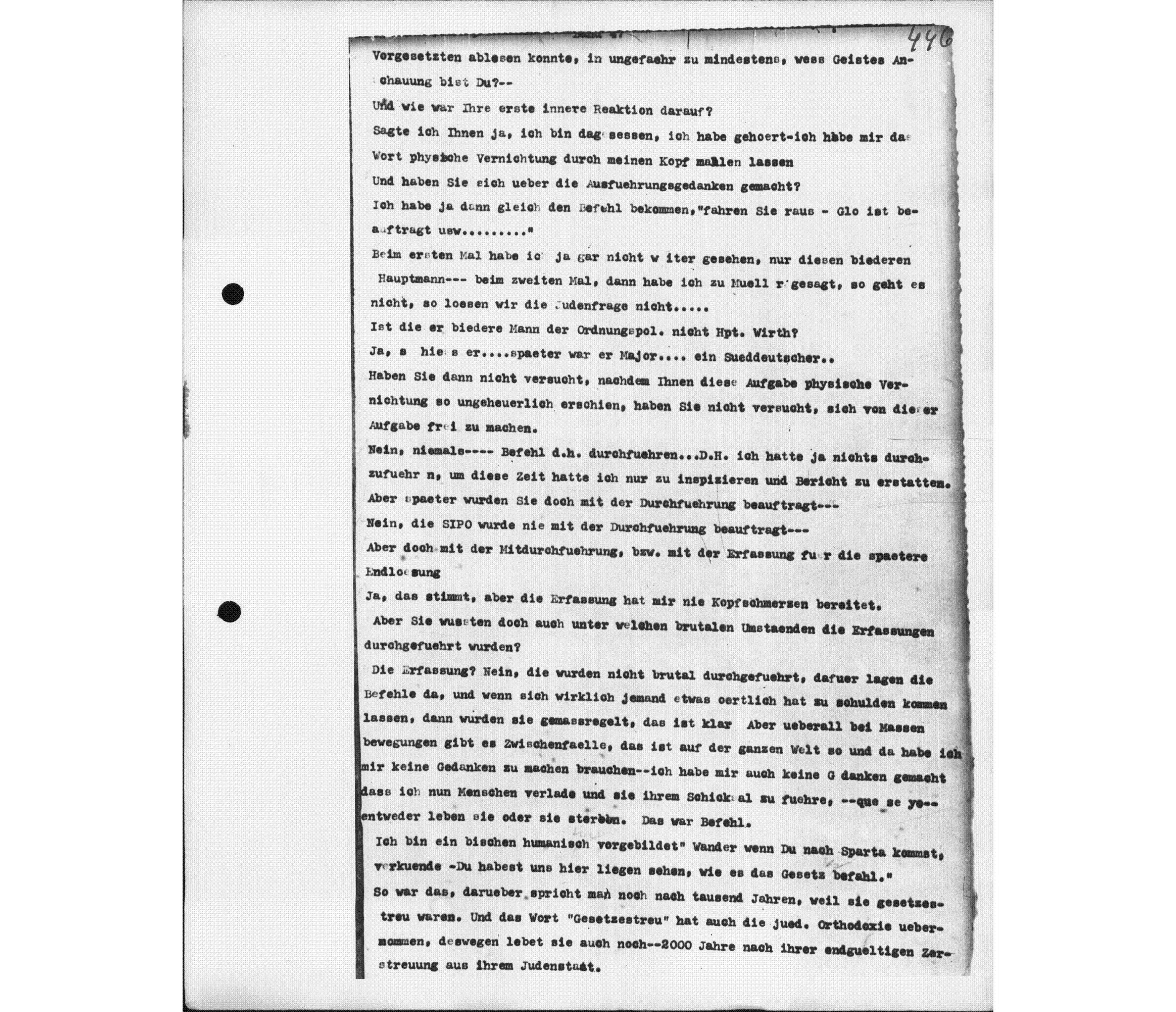
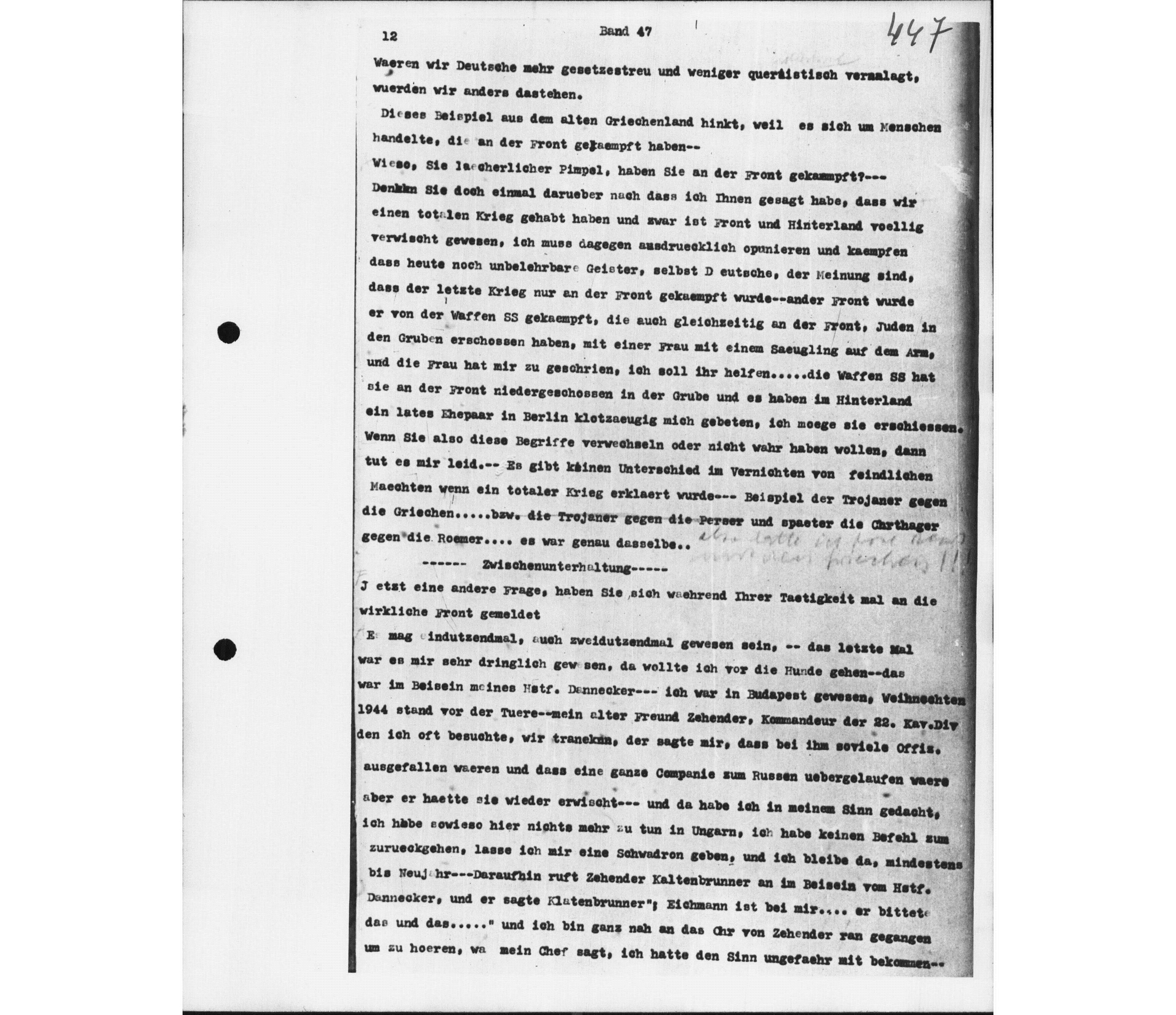
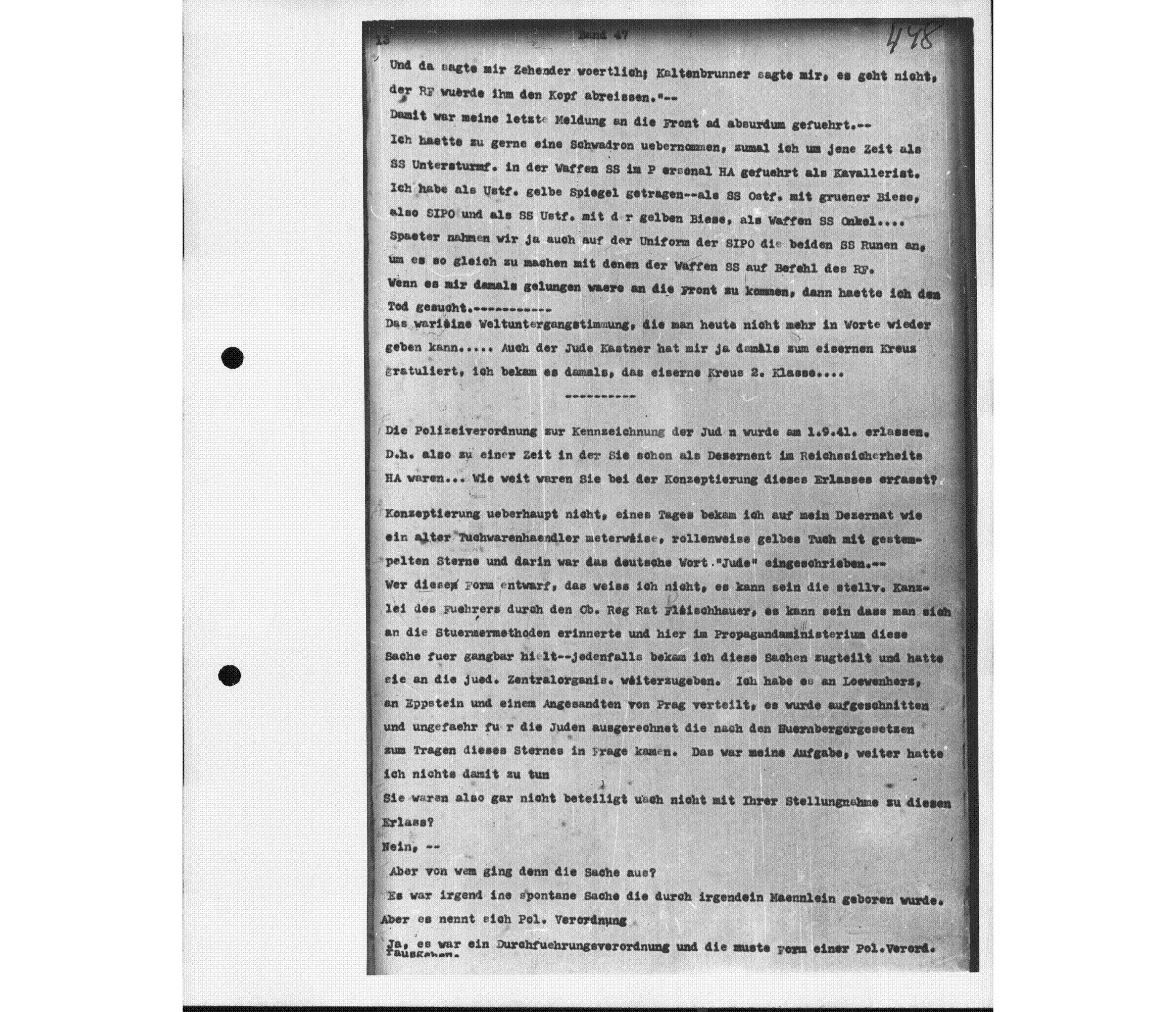
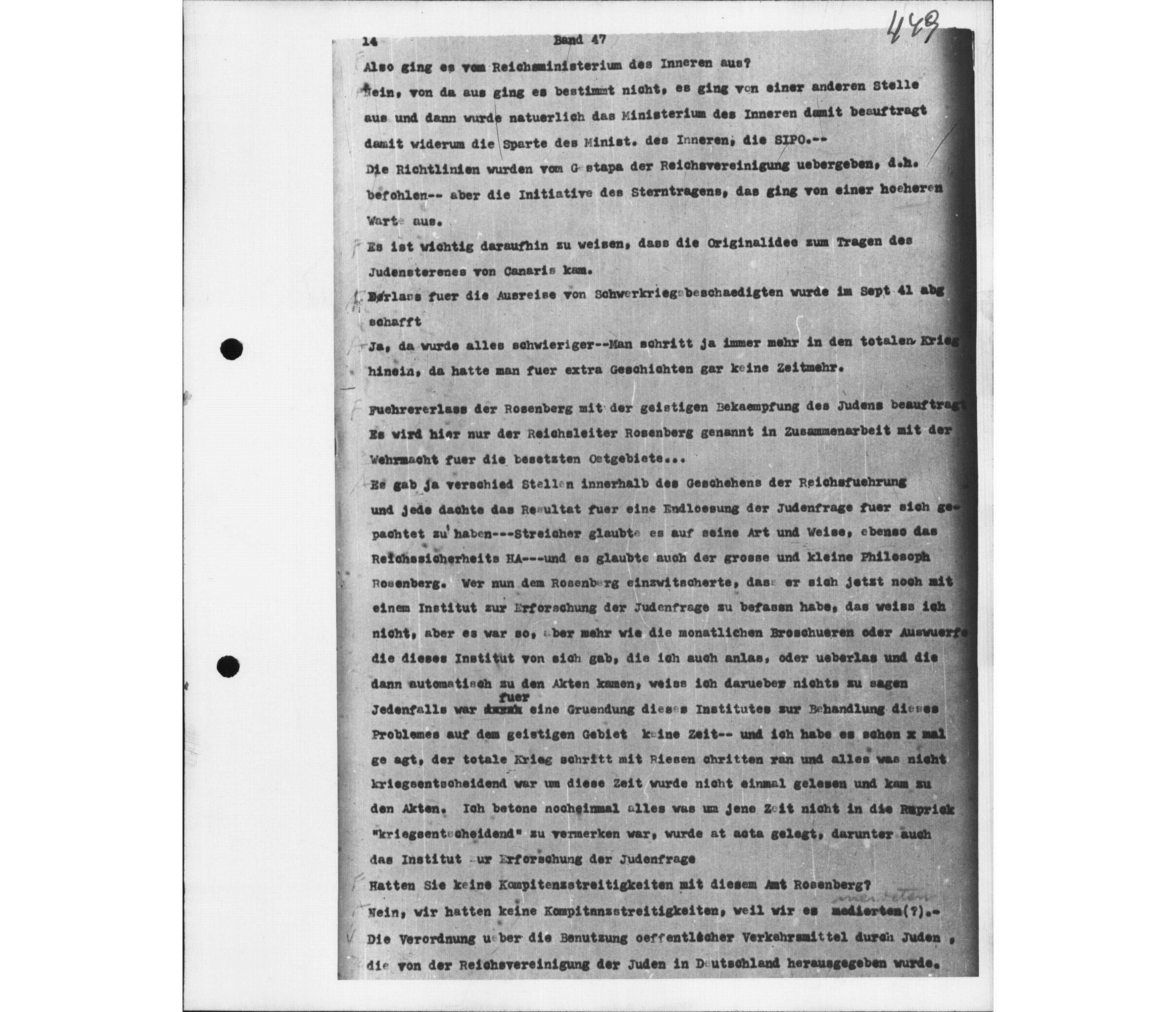
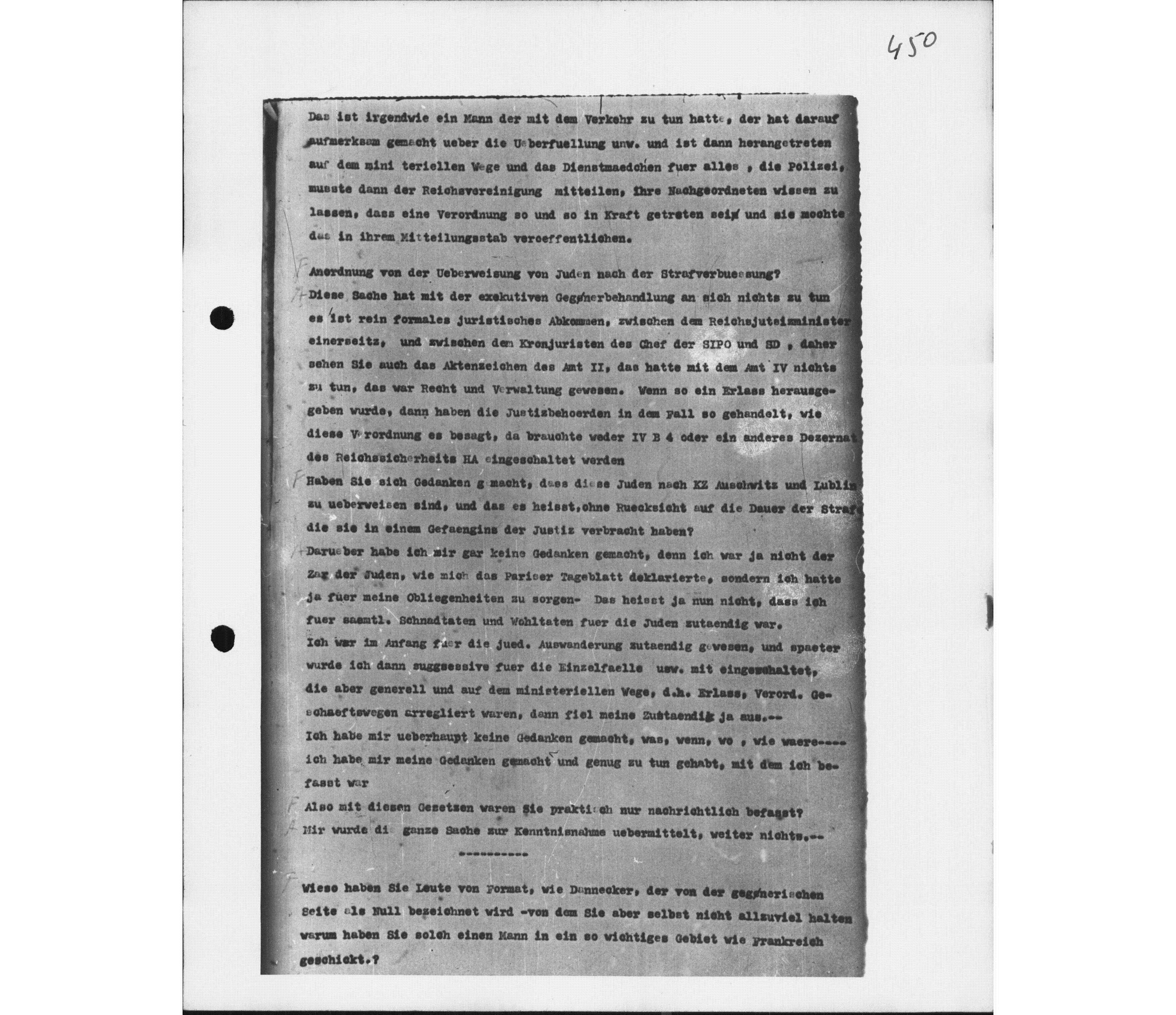
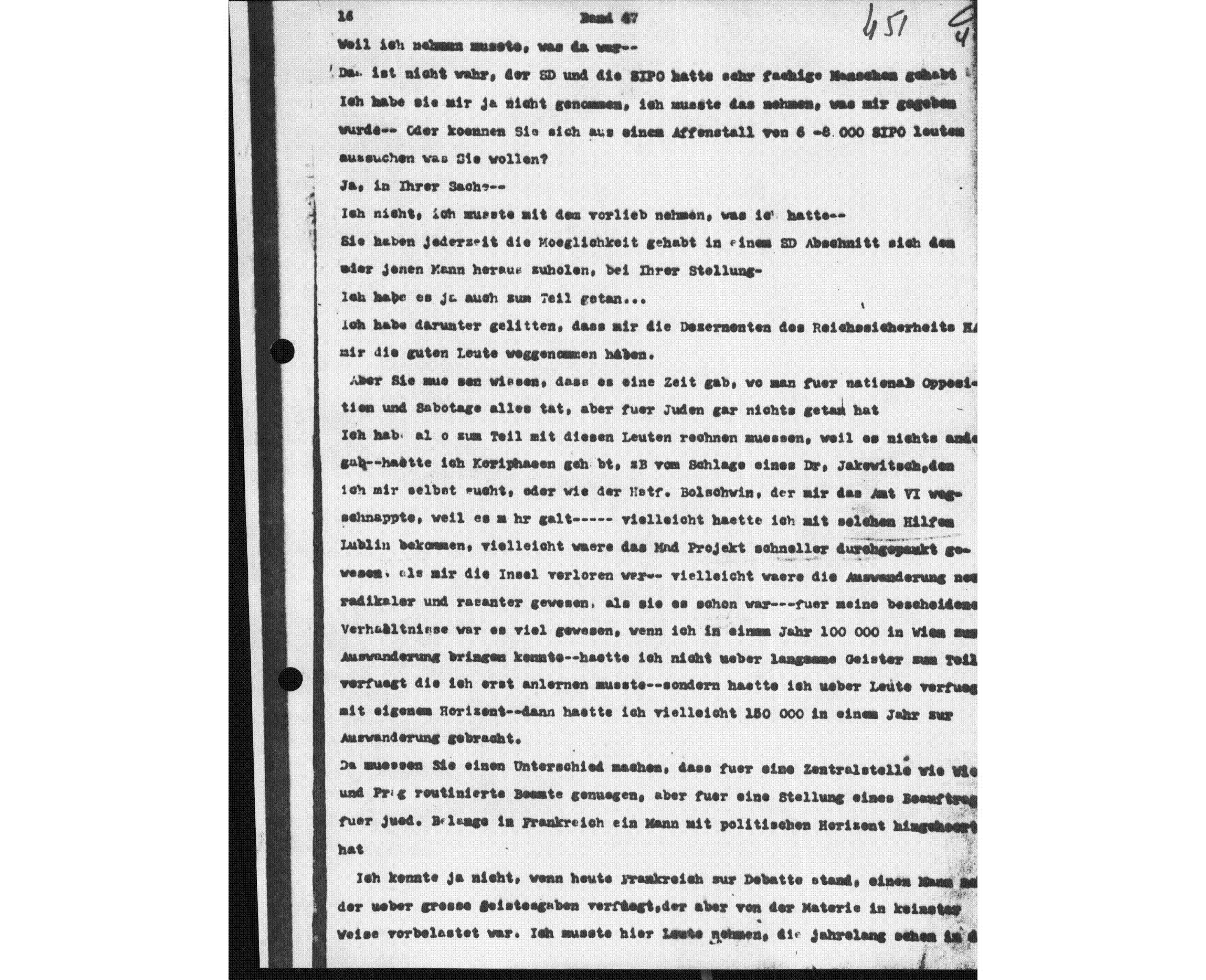
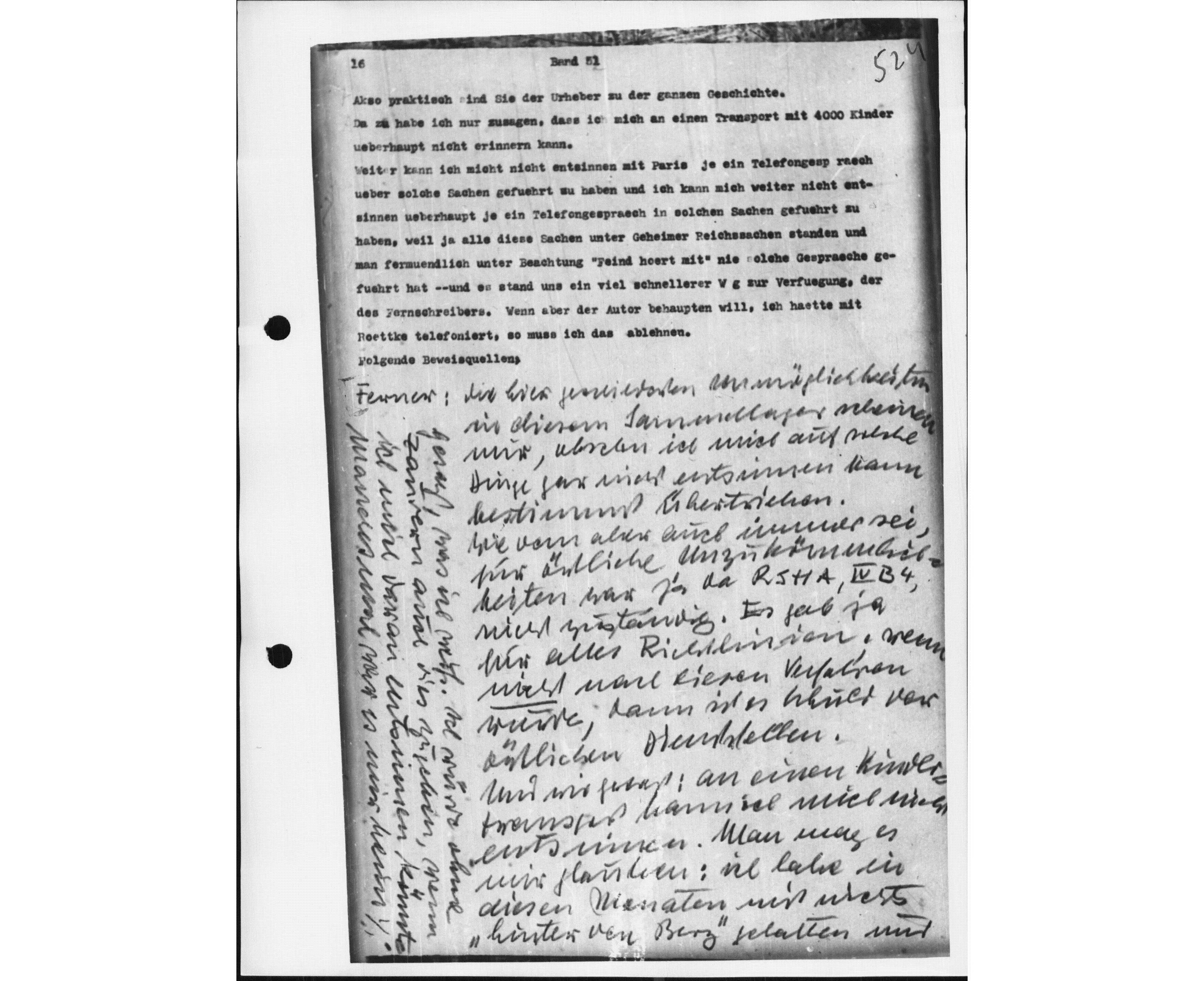
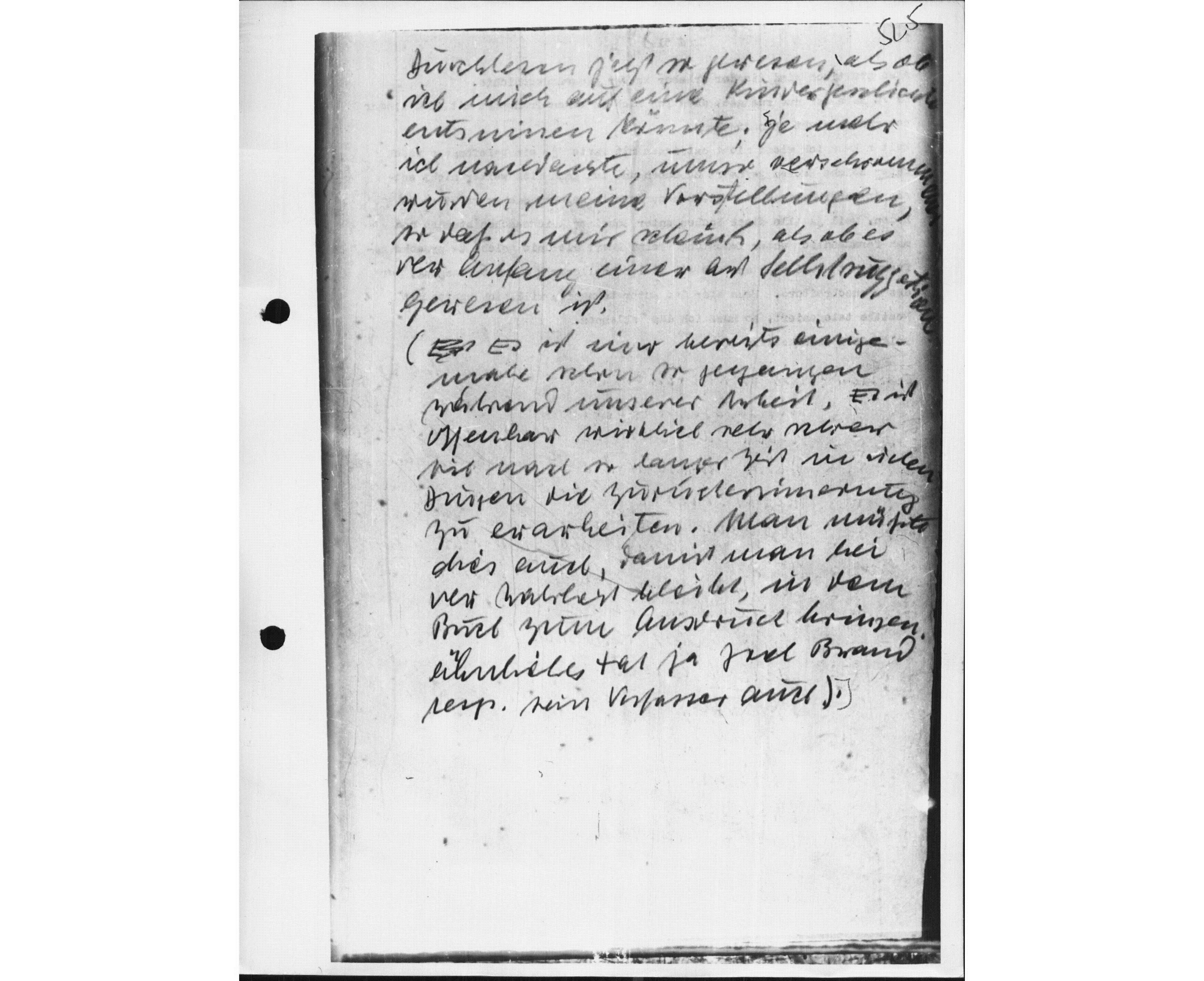
Page 1
of 716

Eichmann and Sassen interview, file 87

It was the time when the public offices of the Security Police and the Security Service sometimes had to fight the fiercest battles with the armaments industry offices, because those offices stood up for the Jews in the factories and secured certificates declaring them indispensable. In painstaking individual proceedings the Gestapo and its regional headquarters then provided evidence in some cases, and separate correspondence had to be sent to the Reich Security Main Office even over individual Jews.

We in turn had to approach the armaments authorities, or Minister Speer, and they had to approach their Gau district to get rid of Jew x or y. One director had been very stubborn, but Mutschmann also wanted his Gau clear of Jews. The initiative did not come so much from the Gestapo or the local Gestapo regional headquarters; they were driven by the Party offices, here by the Gau leadership. Every Gauleiter wanted to report his Gau to Bormann or the Führer as free of Jews. It was just the same race as when factories could not hurry fast enough to report to the German Labour Front that the whole plant belonged to the Labour Front.

Then they received some award they were allowed to display on their flag or …. In short, Mutschmann took this director, had a placard hung around his neck, and had him marched through Dresden with some policemen, with writing on it saying that he was Dresden's greatest protector of Jews. After that Mutschmann very quickly succeeded in making Dresden completely free of Jews. That was the time when Jews who had made themselves indispensable in the individual armaments industries were prised loose case by case, but then sent to armaments industries attached to the individual concentration camps. The VWHA (SS Economic and Administrative Main Office) had various armaments branches, and they were put into those.

Now I must point out that all the decrees, regulations, laws and so on concerning Jews originated with individual police offices, this Party office or that other administrative office. One gets the impression that there was no central direction of the Jewish question.

That is why we once had a difference of opinion. Nobody can really believe that Jewish affairs were not centrally directed. Everyone imagines, as the literature since '45 also describes it, that a ‘pope of Jewish affairs’ sits up here, holding all the strings and supplying everything with the relevant documents, regulations and orders. Perhaps he obtains them from his immediate superior, but otherwise he directs everything centrally, like a spider in its web. The former official believes that, the man who served in uniform believes that, the people believe it, the opponent believes it, and the world believes it.

The world believes it, just as the majority of people on earth, insofar as they concern themselves with the Jewish problem, believe that international Jewry is equally tightly directed: a spider sits up there in its web, steering, leading and directing everything. The one idea is just as much nonsense as the other. In our Third Reich too, the Jewish question was by no means centrally directed. This collection of laws compiled by the Jewish lawyer Dr. Blau is direct proof that it was not.

Open page image and German
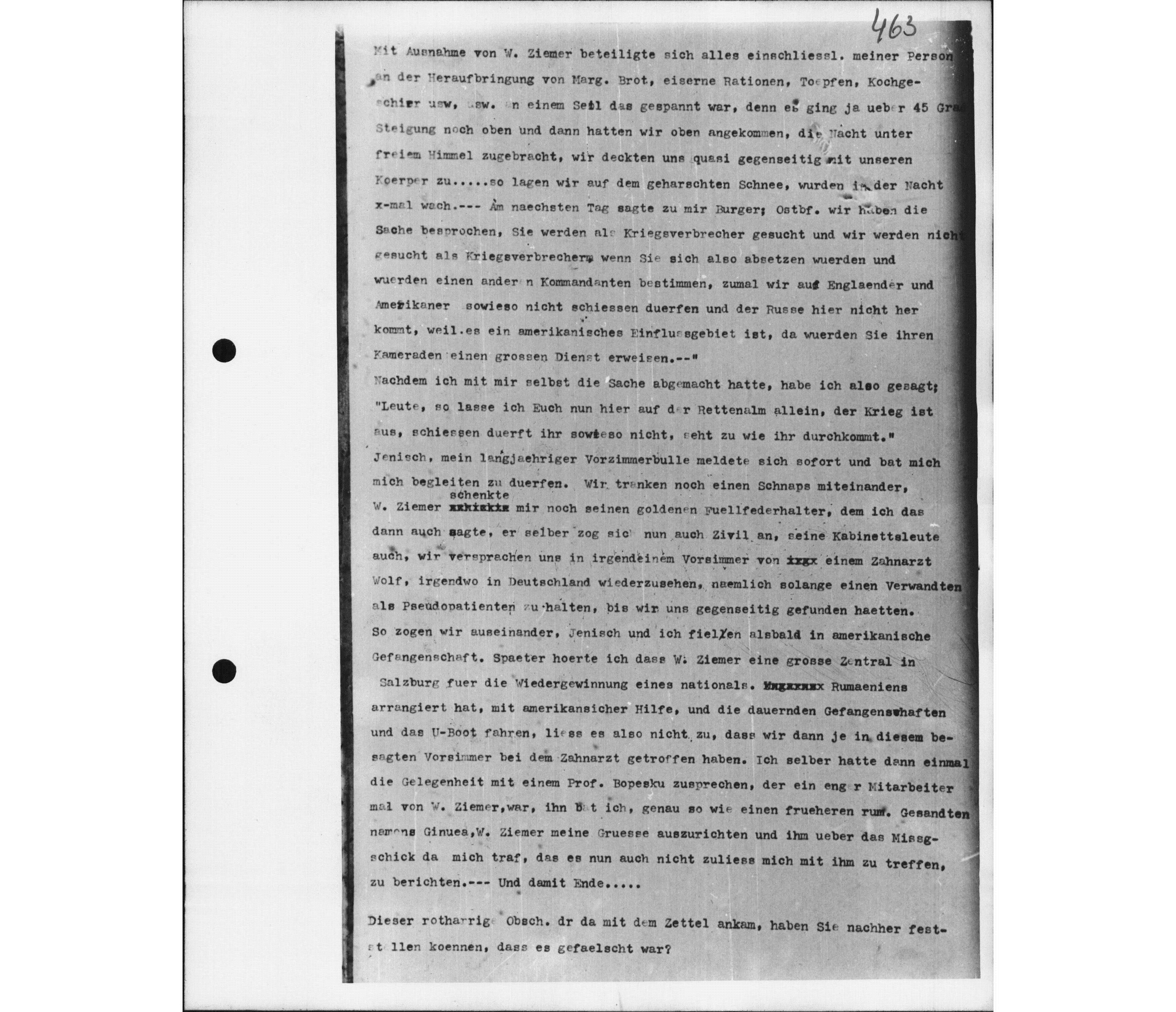
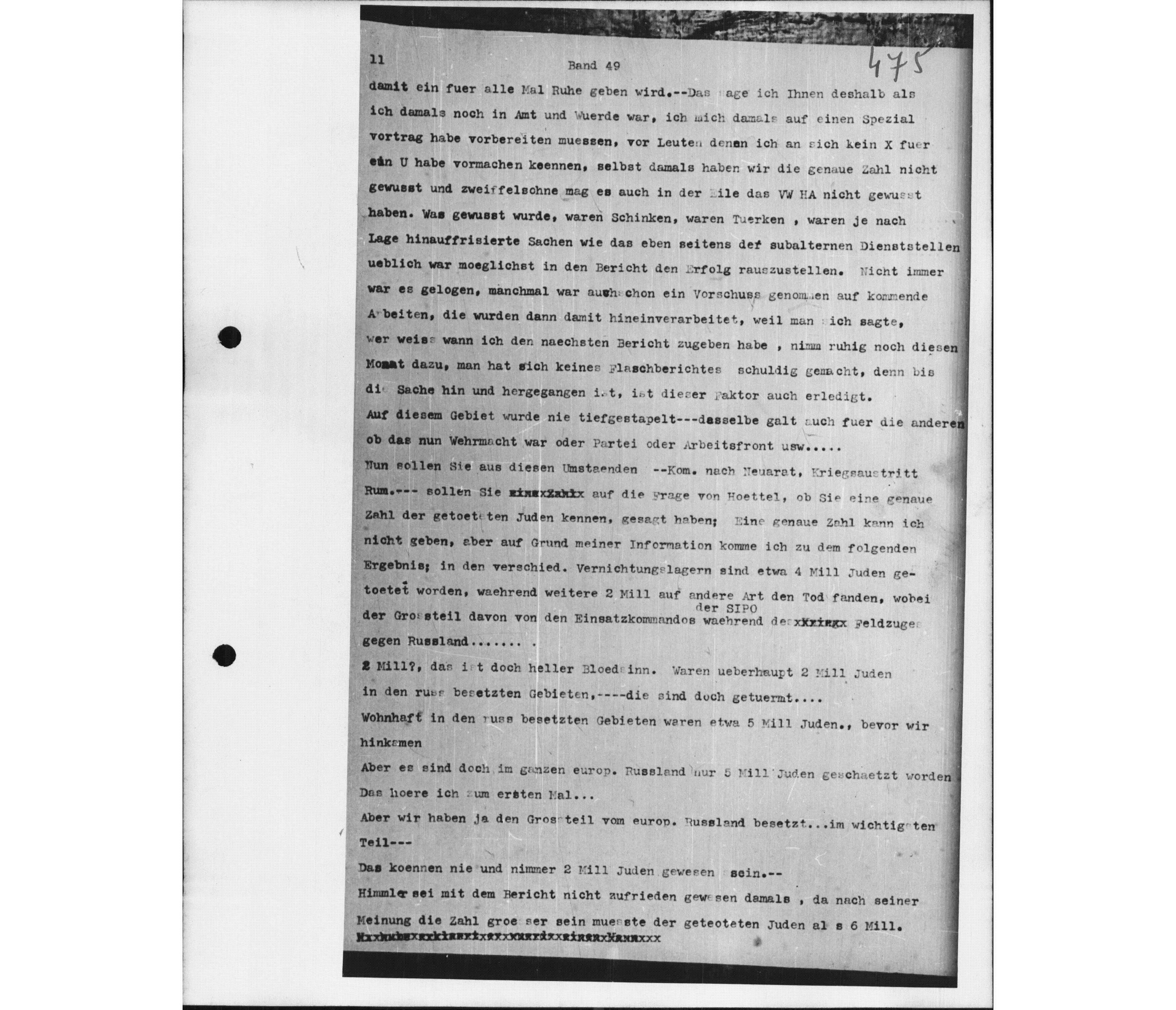
Page 363 of the typescript, O.65 file 87.
Page 363 · Yad Vashem Archives, O.65/87

German transcription

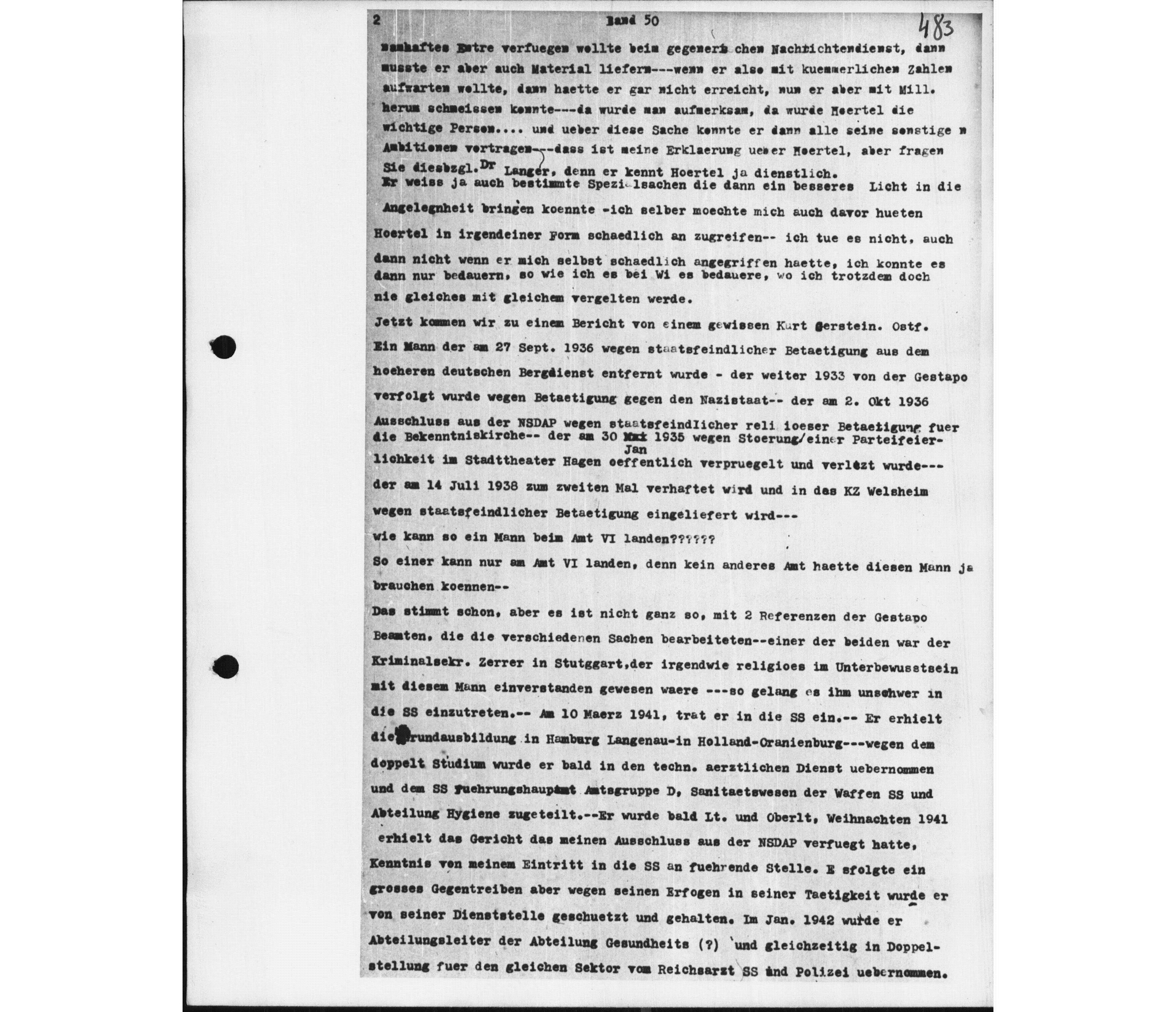
Es war die Zeit wo die öffentlichen Stellen der SIPO und des SD zum Teil härteste Kämpfe mit den Stellen der Rüstungsindustrien zu führen hatten, weil die Stellen für die Juden in den Fabriken sich einsetzten und für die Unabkömmlichkeitsbescheinigungen sorgten und in mühseligen Einzelverfahren haben dann die Stapo und d… Stapo Leitstellen zum Teil hier nachgewiesen und es mußten auch wegen Einzeljuden extra Korrespondenz geführt werden an das Reichssicherheitshauptamt und es mußte von uns wieder an die Rüstung, bzw. an den Minister Speer herantreten und die mußten wieder an ihren Gaukreis herantreten um den Juden x oder y loszubekommen. Nun war ein Direktor sehr hartnäckig gewesen und Mutschmann wollte aber auch seinen Gau rein haben von Juden, wie denn die Initiative dazu nicht sehr die Stapo oder di… örtl. Stapo Leitstelle machte, sondern sie wurden getrieben von den Parteidienstst… hier von der Gauleitung, denn jeder Gauleiter wollte seinen Gau dem Bormann oder dem Führer als judenfrei melden. Es war genau dasselbe Rennen als mal die Fabriken sich nicht schnell genug beeilen konnten, um der deutschen Arbeitsfront zu melden, der Betrieb steht hundertprozentig in der Arbeitsfront und dann bekamen sie etwas verliehen daß sie auf ihrer Fahne oder … führen durften. Kurz und gut, Mutschmann hat diesen Direktor genommen, hat ihm einen Zettel um den Hals hängen lassen und hat ihn durch Dresden marschieren lassen, mit irgendwelchen Schutzmannsch. und draufgeschrieben, daß er der größte Judenbeschützer sei von Dresden… Daraufhin gelang es Mutschmann sehr schnell, Dresden völlig judenfrei zu machen. Das war die Zeit wo die Juden in den einzelnen Rüstungsindustrien wo sie sich unabkömmlich gemacht hatten, und nun in Einzelfällen losgeeist wurden und dann aber zu Rüstungsindustrien kamen die die einzelnen Kz angegliedert waren, das VWHA hatte verschied. Rüstungszweige und da wurden sie hinein gesteckt. – Nun muß ich bemerken, daß alle Erlasse, Verordnungen, Gesetze usw. di… die Juden betreffen, auf die Initiative der einzelnen Pol. Stellen, jener Parteistell… jener and. Verwaltungsstelle zurückgehen und man den Eindruck bekommt, daß eine zentrale Steuerung der Judenfrage nicht bestanden hat. Das ist es ja warum wir einmal eine Meinungsverschiedenheit hatten, es vermag wirklich niemand zu glauben daß die Judenangelegenheit nicht zentral gesteuert worden wäre, denn ein jeder stellt sich vor, wie das ja auch in der Literatur seit 45 geschildert wird, daß nun hier oben ein Judenpabst sitzt, und dieser hat nun alles an seinen Strippen und er versorgt alles mit seinen einschlägigen Unterlagen, Verordnungen und Befehle, holt sich die vielleicht noch von seinem unmittelbaren Vorgesetzten ein, im übrigen aber leitet er alles zentral wie eine Spinne im Netz. Das glaubt der Beamtetgewesene, das glaubt der in Uniformgestandene, das glaubt das Volk, das glaubt der Gegner und das glaubt die Welt, das glaubt die Welt genauso wie die Mehrzahl unserer Erde, soweit sie sich mit dem Judenproblem auseinandersetzen sie glauben daß das internationale Judentum ebenso straff geleitet wird, das da oben eine Spinne im Netz sitzt und nun alles lenkt, leitet und dirigiert. Es ist das eine genau so ein großer Blödsinn wie das andere. Auch bei uns im dritten Reich wurde die Judenfrage keinesfalls zentral gesteuert, die Gesetzessammlung die die hier der jüd. Rechtsanwalt Dr. Blau zusammen gestellt hat, ist geradezu ein Beweis dafür, daß dem nicht so war.

Draft translation

It was the time when the public offices of the SIPO and the SD in part had to wage the harshest struggles with the offices of the armaments industries, because the offices championed the Jews in the factories and saw to the indispensability-certificates, and in laborious individual proceedings the Stapo and Stapo control-centers in part demonstrated [/proved] this here, and extra correspondence also had to be conducted on account of individual Jews to the Reich Security Main Office, and we in turn had to approach the armaments [ministry], respectively Minister Speer, and they in turn had to approach their Gau-district in order to get Jew x or y released. Now a director had been very stubborn, and Mutschmann however also wanted to have his Gau clean of Jews, since the initiative for it was not so much made by the Stapo or the local Stapo control-center, but rather they were driven by the Party service-offices, here by the Gauleitung, for every Gauleiter wanted to report his Gau to Bormann or to the Führer as free of Jews. It was exactly the same race as when the factories once could not hurry quickly enough to report to the German Labor Front, "the enterprise stands one-hundred-percent in the Labor Front," and then they got something conferred [on them] that they were permitted to carry on their banner or ....... Long and short, Mutschmann took this director, had a placard hung around his neck and had him marched through Dresden, with some kind of police-guards[?] and written on [it] that he was the greatest Jew-protector of Dresden...' Thereupon Mutschmann succeeded very quickly in making Dresden completely free of Jews. That was the time when the Jews in the individual armaments industries where they had made themselves indispensable, and now in individual cases were pried loose and then however came to armaments industries to which the individual KZ[concentration camps] were attached; the WVHA had various armaments branches and there they were stuck in..-- Now I must remark that [DEL: the whole] [HW: all] decrees, [DEL: the] regulations, [DEL: the] laws etc. which concern the Jews go back to the initiative of the individual police offices, that Party office, that other administrative office, and one gets the impression that a central steering of the Jewish question did not exist.-- That is indeed why we once had a difference of opinion; no one is really able to believe that the Jewish matter would not have been centrally steered, for everyone imagines, as it is also depicted in the literature since '45, that up here there now sits a Jew-pope, and he now has everything on his strings and he supplies everything with his relevant documents, regulations and orders, perhaps still obtains them from his immediate superior, but otherwise directs everything centrally like a spider in the web. That the one-who-was-an-official believes, that the one-who-stood-in-uniform believes, that the people believe, that the enemy believes and that the world believes; the world believes it just as the majority of our earth [does], insofar as they concern themselves with the Jewish problem; they believe that international Jewry is likewise tightly led, that up there sits a spider in the web and now steers, leads and directs everything.. The one is just exactly as great a nonsense as the other. Also with us in the Third Reich the Jewish question was by no means centrally steered; the collection of laws which the Jewish lawyer Dr. Blau here compiled is downright a proof of the fact that it was not so.

Rather, each central authority issued some Jewish regulation of its own. Yes, it went so far that whenever AH (Adolf Hitler) had once again made a speech in which he particularly denounced Jewry, and when, from 1939 to his last speech, did he ever give a speech without particularly addressing this international opponent, a week later, sure enough, one would find that some central authorities or a Party authority had issued another supplementary regulation or done something or other.

I have established here that, although the Reich Citizenship Laws were issued in 1935, three or four years later somebody thinks: hold on, we have forgotten to lay down in law that Jews are forbidden to join the Hitler Youth. And years later an implementing regulation to the Reich Citizenship Laws was issued. It was like that everywhere. Two or three ministers conferred with one another, a minister with a Gauleiter, some Reichsleiter with another commissioner. In the course of their conversation they concluded that Jews would have to be excluded from this sector as well, or: I would have to bring this matter within my jurisdiction.

So it was discussed and settled over a little glass of cognac. An exchange of letters followed, confirming the agreement, and the central authority concerned issued a decree laying down for its subordinate offices how they were to proceed. A typical example in this collection of laws was the meeting between the Reichsführer-SS and the Reich Minister of Justice, Dr. Thierack, where some matter was discussed, I think the transfer of Jews from penal custody to the custody of the concentration camps of the SS VWHA (Economic and Administrative Main Office).

Questioner

It concerns notifying the Gestapo of Jews released from the criminal justice system.

Eichmann

Yes, and now this. Just as it happened in the legislative sphere, laws, regulations, decrees and so on, they had exactly the same decentralization in the Ex… work. Nobody can say or claim that the Gestapo Office, the Reich Security Main Office under Müller, had the matter centrally in its hands. Or that I, as his desk officer IV B 4, had it centrally in my hands. Even the hostile literature notes in one place that, for example, I officially had nothing to do with, and was not responsible for, the work of combating opponents in the occupied Russian territories, the General Government, Lithuania, Estonia and so on and so on.

I also had nothing to do with the Ex operations in Hungary and in the various other countries. The local military forces did that. It is hard to believe, but the evidence makes it possible to establish that the Reich Security Main Office was not always the office taking the lead here. We were, as I was once able to explain to you very clearly, we were the maid of all work. Only when matters were taken out of our hands by an order, a directive or a command from very senior superiors did we simply have to look on.

Of course that is not to say that the Security Police and the Security Service forces in the General Government and the occupied Russian territories had no hand in the solution of the Jewish question. Of course they had a hand in it, and the Waffen-SS and some of the Wehrmacht were involved as well. No, the Reich Security Main Office, Section IV B 4, had nothing to do with it. Instead, other, higher local commands were ordered to do it by the Reichsführer-SS, without an obligation to report to the Reich Security Main Office, IV B 4.

Open page image and German
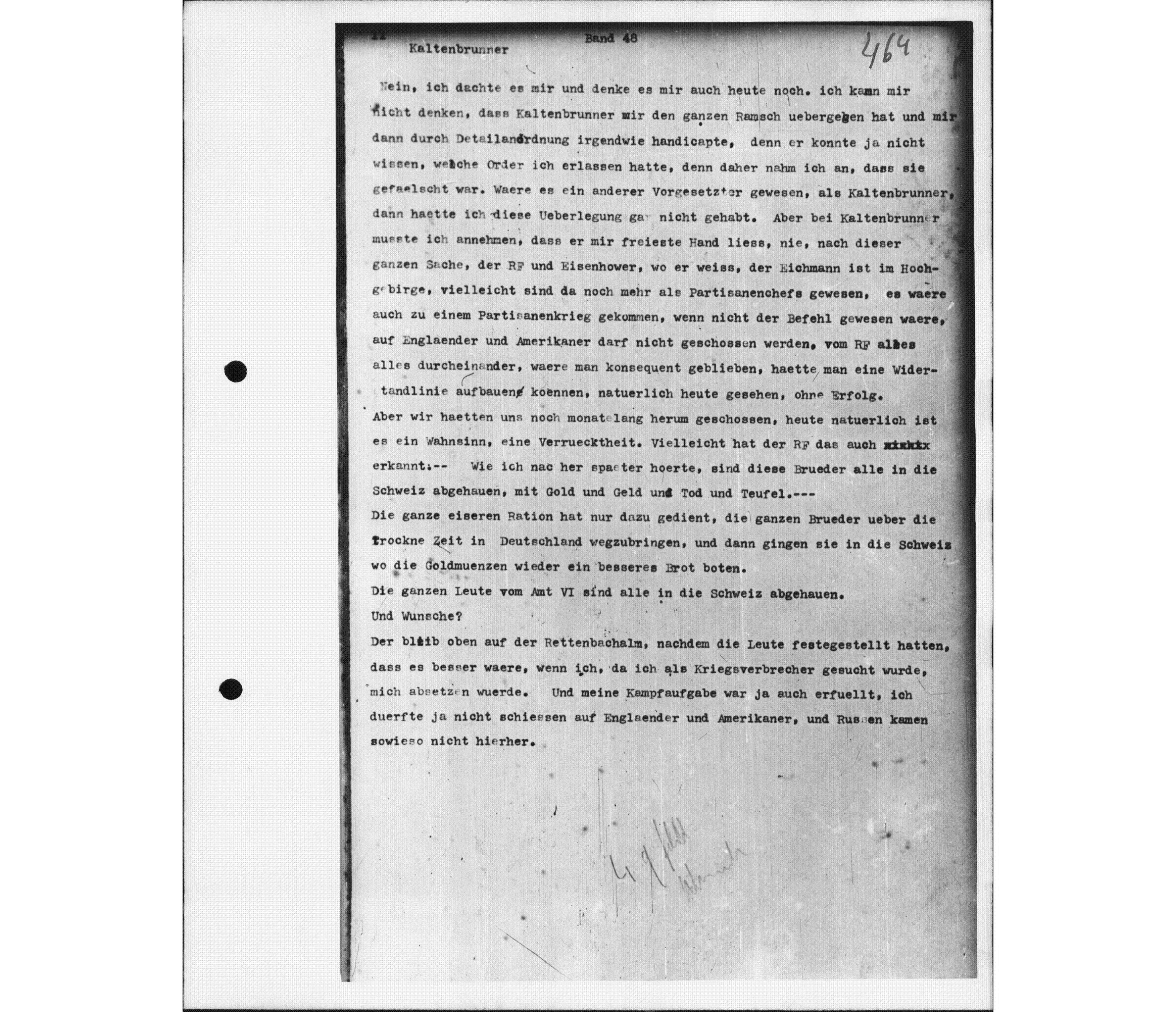
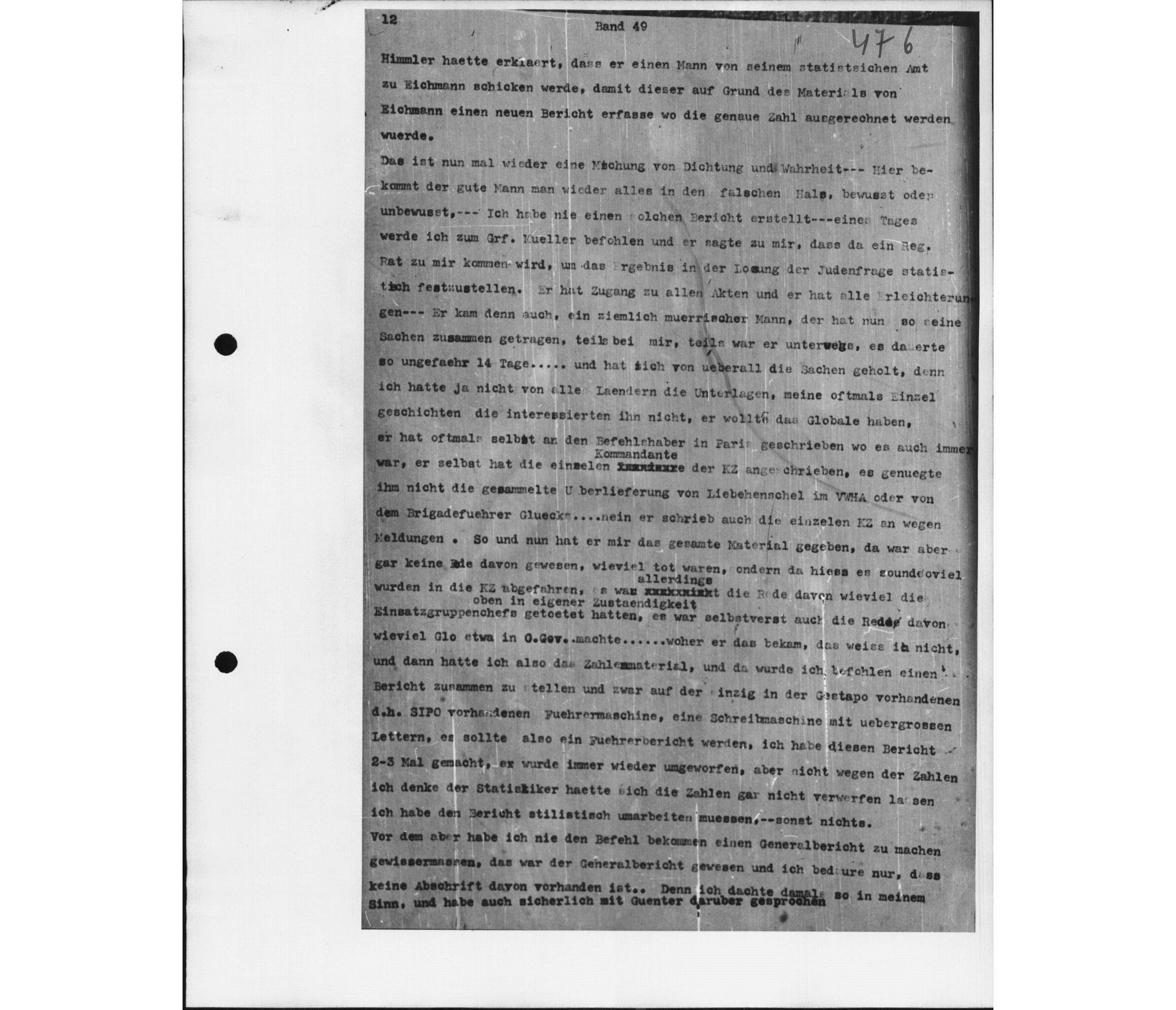
Page 364 of the typescript, O.65 file 87.
Page 364 · Yad Vashem Archives, O.65/87

German transcription

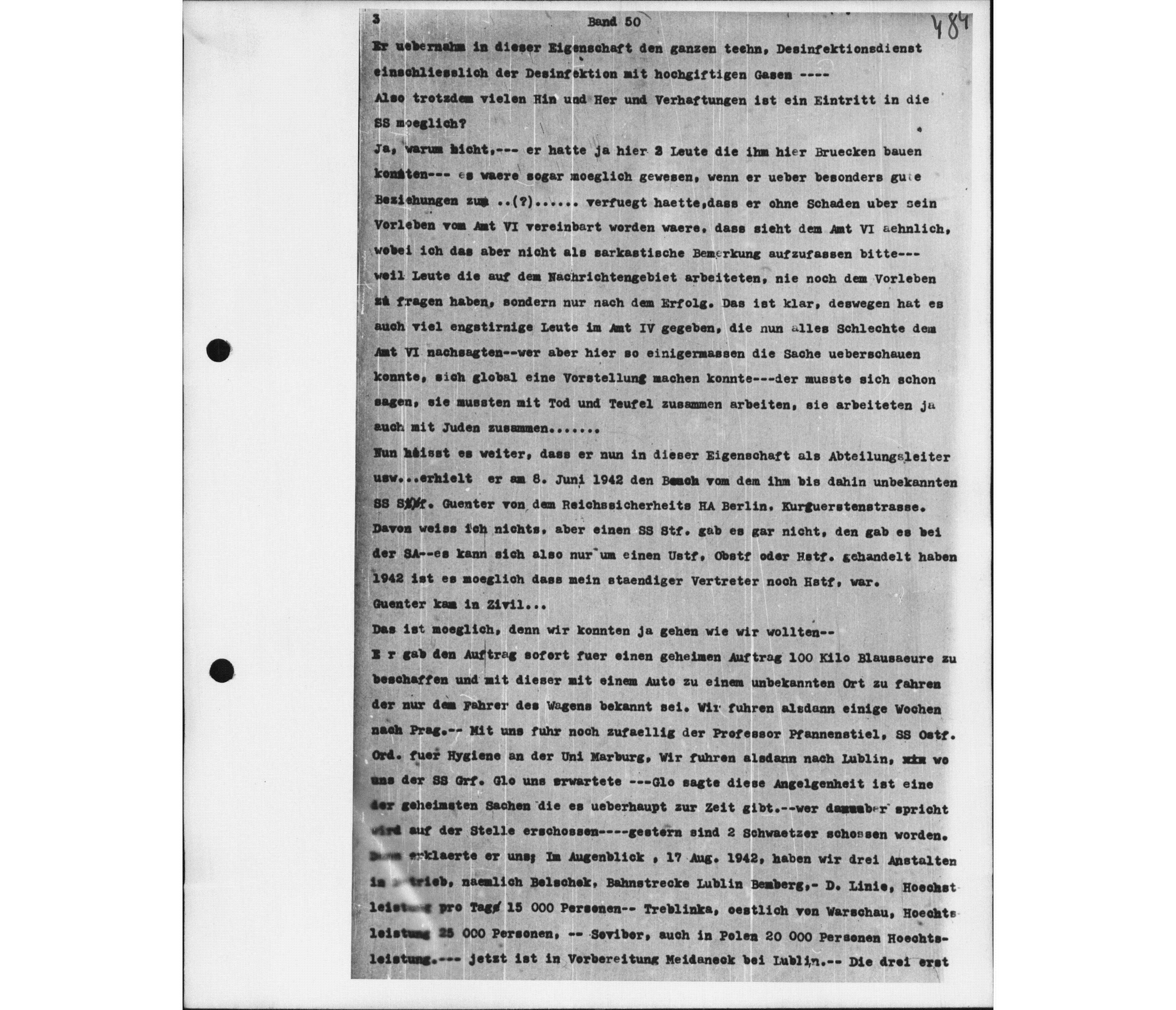
Sondern das jede Zentralinstanz irgend eine Judenverordnung für sich erließ. Ja es ging soweit, daß wenn AH wieder einmal eine Rede gehalten hat, wo er das Judentum wieder besonders anprangerte und wann wurde überhaupt eine Rede gehalten von 1939 bis zu seiner letzten Rede wo er sich nicht besonders mit diesem internationalen [unleserlich] Gegner auseinandersetzte, prompt darauf war eine Woche später zu verzeichnen daß irgendwelche Zentralinstanzen oder eine parteiliche Instanz irgendwie wieder eine neu Zusatzverordnung erließen, irgend etwas machten, – ich habe hier festgestellt obwohl die Reichsbürgergesetze im Jahre 1935 erlassen, daß 3 od 4 Jahre später es irgend jemand einfällt, halt, wir haben ja vergessen gesetzlich festzulegen, daß Juden der Zutritt zur Hitlerjugend verboten ist und da wurde Jahre später eine Durchführungsverordnung zu den Reichsbürgergesetzen erlassen – so war es überall. Es besprachen sich 2 od 3 Minister miteinander, ein Minister mit einem Gauleiter, irgendein Reichsleiter mit einem anderen Beauftragten und sie kamen im Laufe des Gespräches darauf daß man aus diesem Sektor die Juden auch noch ausschalten müßte, oder ich müßte mir diese Sache unter mein Zuständigkeitsbereich einvernehmen, so wurde das bei einem Gläschen Cognac besprechen und festgelegt, es folgte ein Briefwechsel wo diese Abmachung bestätigt wird und diese entsprechende Zentralinstanz hat einen Erlaß herausgegeben, der hier für die Nachgeordneten festlegte, so und so ist hier zu verfahren. Das war in dieser Gesetzessammlung ein typisches Beispiel die Zusammenkunft zwischen dem RF und dem Reichsjustizminister Dr. Therak, wo irgendeine Sache verhandelt wurde, ich glaube Übergabe der Juden aus dem Strafvollzug in die Gewahrsamkeit der KZ des SS VWHA. Es handelt sich um die Meldung der aus der Strafjustiz entlassenen Juden an die Gestap… Ja, und nun folgendes – genau so wie das auf dem Sektor der Legislative erfolgte also Gesetz, Verordnung, Erlaß usw., genau so eine Dezentralisierung hatten sie in der Ex… Arbeit, nie kann jemand sagen oder behaupten, daß das Gestapo Amt, das Reichssicherheits HA unter Müller die Sache zentral in den Händen hatte. Oder ich als sein Referent IV B 4 zentral in den Händen hatte, denn auch die gegneri… Literatur bemerkt es auch an einer Stelle, habe ich zB von Amtswegen nichts zu tun gehabt und war nicht zuständig für die Arbeiten auf dem Gebiet der Gegnerbekämpfung in den besetzten russ Gebieten, Generalgovern, Litauen, Estland usw. usw. Ich habe auch nichts zu tun gehabt mit den Ex Vorgängen in Ungarn und in den verschie… anderen Ländern, dort machten das die örtlichen militärischen Ex – Kräfte. Es ist schwer zu glauben, aber an Hand von Beweisen kann man es feststellen, daß das Reichssicherheits HA hier nicht immer die federführende Stelle gewesen. Wir waren, wie ich es Ihnen einmal sehr deutlich auseinandersetzen konnte, wir waren das Mädchen für alles. Nur dort wo man uns die Sachen auf Grund einer Anordnung, einer Weisung, eines Befehles sehr hoher Vorgesetzter aus den Händen nahm, da hatten wir eben zuzusehen. Natürlich soll das nicht heißen, das in dem Generalgovern. und in den besetzten russ. Gebieten die Kräfte der SIPO und des SD die Hände etwa nicht in der Lösung der Judenfrage drin hatten, natürlich hatten sie sie drin, es kamen noch Waffen SS dazu und Wehrmacht zum Teil, nein das Reichssicherheits HA, das Dezernat IV B 4 hatte damit nichts zu tun, sondern dafür wurden andere örtlich höhere Kommandos von RF befohlen, ohne Pflicht zur Berichterstattung an das Reichssicherheits HA, IVB 4.

Draft translation

But that each central authority issued some Jewish regulation for itself. Yes it went so far, that when AH once again gave a speech, where he again especially denounced Jewry — and when was a speech ever given at all from 1939 up to his last speech where he did not especially engage with this international [HW: [illegible]] adversary — promptly thereupon it was to be recorded a week later that some central authorities or a Party authority somehow again issued a new supplementary regulation, made some thing or other, — I have here determined, although the Reich Citizenship Laws [were] issued in the year 1935, that 3 or 4 years later it occurs to someone, stop, we have indeed forgotten to establish legally that Jews are forbidden entry to the Hitler Youth, and there years later an implementing regulation to the Reich Citizenship Laws was issued——so it was everywhere. 2 or 3 ministers conferred with one another, one minister with a Gauleiter, some Reichsleiter or other with another commissioner, and in the course of the conversation they came to [the point] that one would have to eliminate the Jews also from this sector too, or I would have to bring this matter into agreement under my area of jurisdiction, so that was discussed and established over a little glass of cognac, there followed a correspondence where this arrangement is confirmed and this corresponding central authority issued a decree, which here for the subordinates laid down, thus and thus is to be proceeded here. That was in this collection of laws a typical example, the meeting between the RF and the Reich Justice Minister Dr. Therak, where some matter was negotiated, I believe transfer of the Jews from penal custody into the custody of the concentration camps of the SS VWHA. It concerns the reporting of the Jews released from the criminal justice [system] to the Gestapo. Yes, and now the following——exactly the way that occurred in the sector of the legislative, that is law, regulation, decree etc., exactly such a decentralization they had in the ex.... work, never can anyone say or claim, that the Gestapo Office, the Reich Security Main Office under Mueller had the matter centrally in [its] hands. Or [that] I as his desk officer IV B 4 had [it] centrally in [my] hands, for even the opposing literature notes it too at one place, I had for instance officially nothing to do [with it] and was not responsible for the works in the field of adversary-combating in the occupied Russian territories, General Government, Lithuania, Estonia etc. etc. I also had nothing to do with the ex proceedings in Hungary and in the various other countries, there the local [HW: [?military?]] ex-forces did it. It is hard to believe, but on the basis of proofs one can determine, that the Reich Security Main Office here was not always the leading office. We were, as I could once set out to you very clearly, we were the maid-of-all-work. Only there where one took the matters out of our hands on the basis of an order, an instruction, a command of very high superior, there we just had to watch. Naturally that shall not mean, that in the General Government and in the occupied Russian territories the forces of the SIPO and the SD did not have their hands, so to speak, in the solution of the Jewish question, naturally they had them in [it], there came in addition Waffen SS and Wehrmacht in part, no, the Reich Security Main Office, the section IV B 4 had nothing to do with it, but rather for that other local higher commands were ordered by the RF, without obligation to report to the Reich Security Main Office, IVB 4. [HW: 4]

Without any supply of guidelines from the Reich Security Main Office. These guidelines were given as orders by the Reichsführer-SS, because as desk officer IV B 4 I was never allowed to issue an order. That would have contradicted all the principles of a police authority, a central authority. I could only give the local Gestapo offices instructions, never orders. You cannot command an official; you issue an instruction to an official. Whereas the operational detachments (Einsatzkommandos) in the occupied Russian territories were military; they had to take orders. In the General Government it was something in between.

[Typed as notes in the transcript: Example from the book discussed, with the relevant documents; letterhead with Waffen-SS.]

They too were involved in it, although Wikingruf, for example, claims the opposite. Anyone who reads Wikingruf will not believe it, but here we see it in black and white. And if you ask an honest man of the Waffen-SS today, he will be able to confirm it. I remember a member of the LAH (Leibstandarte Adolf Hitler) being here once who openly admitted that his unit, from the LAH, had also been deployed in such Jewish affairs in the occupied Russian territories.

Questioner

Within Reich territory, how were responsibilities divided between the Security Police and the Order Police? In my opinion various orders and decrees were not matters for the Security Police, in this case the Gestapo, at all: for example, the ban on Jews visiting cinemas, theatres and so on.

Eichmann

The precinct captains monitored that, or it was done through the reporting obligation imposed on them.

Questioner

The wearing of the Jewish star?

Eichmann

Monitoring that was of course the responsibility of the Order Police, that is, the competent precinct captain. In Austria it was called the police commissariat, and the Ra- inspectors and senior Ra- inspectors worked there. In the Old Reich they were called precinct captains, and there were also the sergeants and senior police sergeants. Then, after all, there were the surveillance agents, and arrest was not exclusively the task of the Security Police, the local Gestapo or the Gestapo regional headquarters. In towns the precinct captains dealt with that; in the countryside it was the rural constables, the gendarmerie.

Questioner

It says here that

Questioner reads from Bruno Blau's book

the supervisory authority for the Reich Association of Jews was the Reich Security Main Office, a particular office of the Gestapo

Questioner

?

Eichmann

That is correct. That was me; that was Desk IV B 4. I was the supervisory authority.

Questioner

How was the Reich Association of Jews in Germany founded? Have we already discussed that?

Eichmann

No, I cannot say exactly. When I was still in Office VII in Berlin, Desk IV B had long existed. At that time the desk was staffed by a Sturmbannführer Langer (R.R.). He was there for a long time, and a Sturmbannführer Lischka (R.R.) succeeded him. SS Obersturmführer Eichmann succeeded him. So when I took over Desk IV B 4 in the autumn of 1940 as section head, with my permanent deputy Stf. Günther, the Reich Association of Jews was a long-established body that worked well. In the preceding years, under those two government councillors I have just named,

Open page image and German
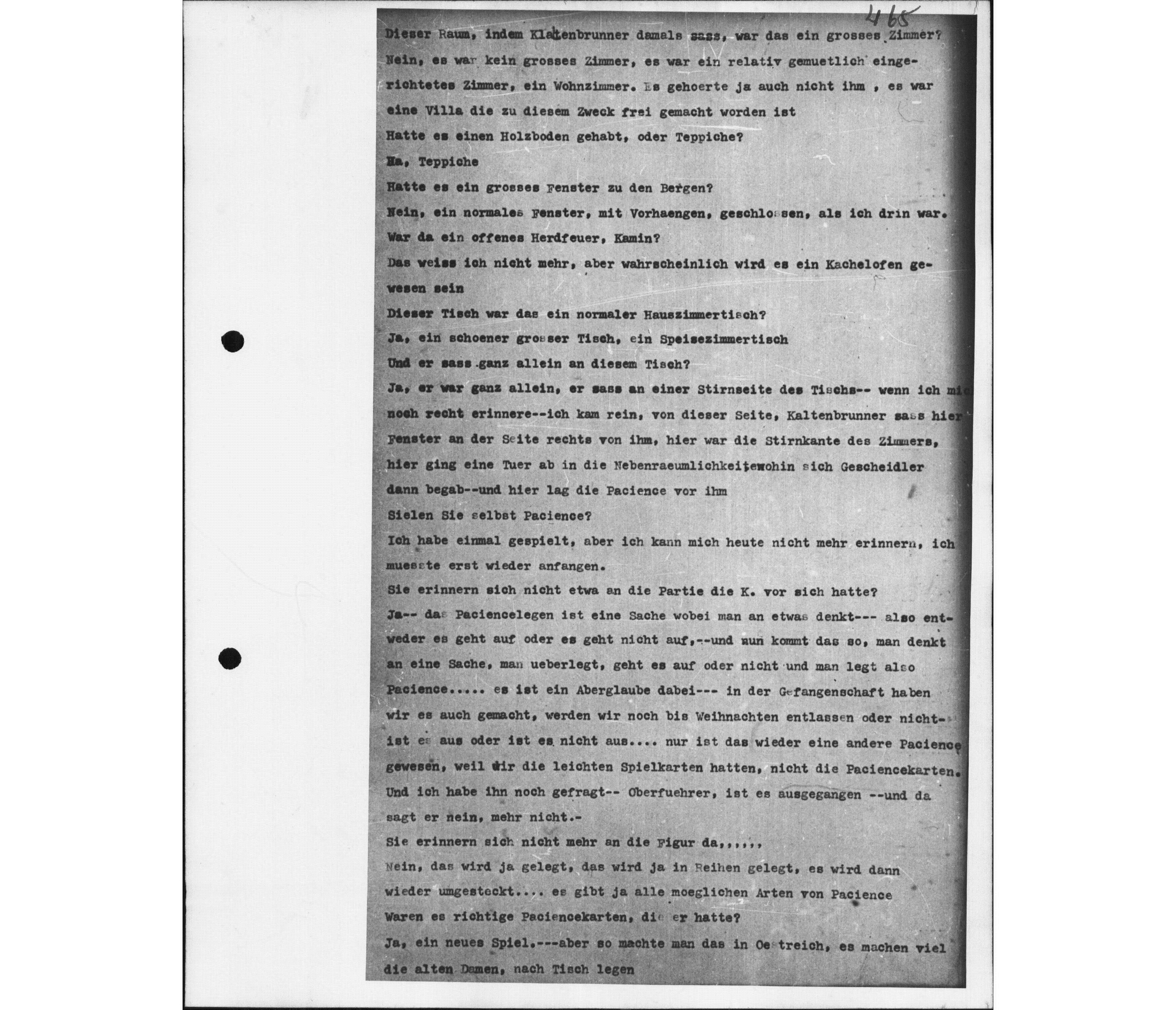
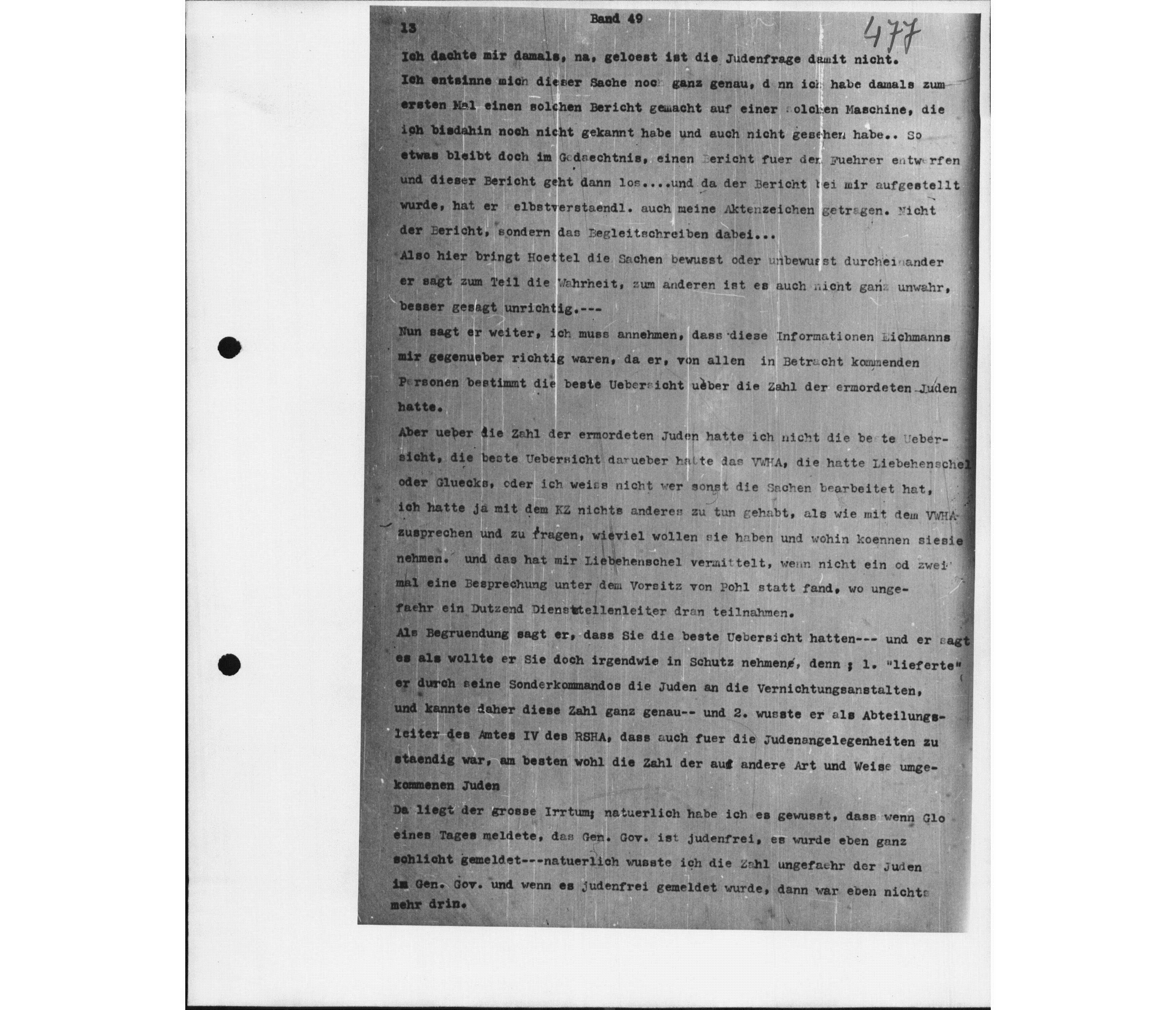
Page 365 of the typescript, O.65 file 87.
Page 365 · Yad Vashem Archives, O.65/87

German transcription

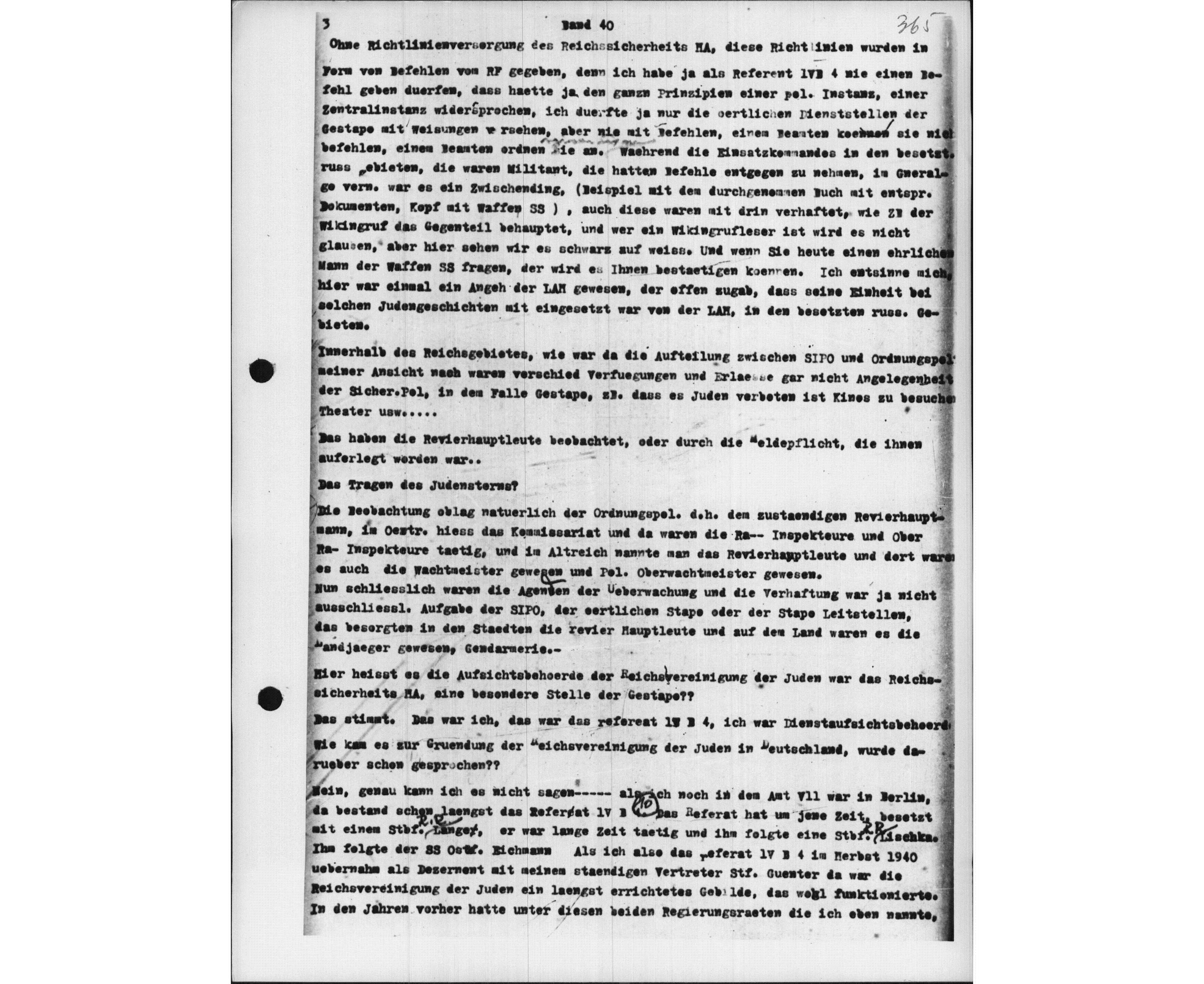
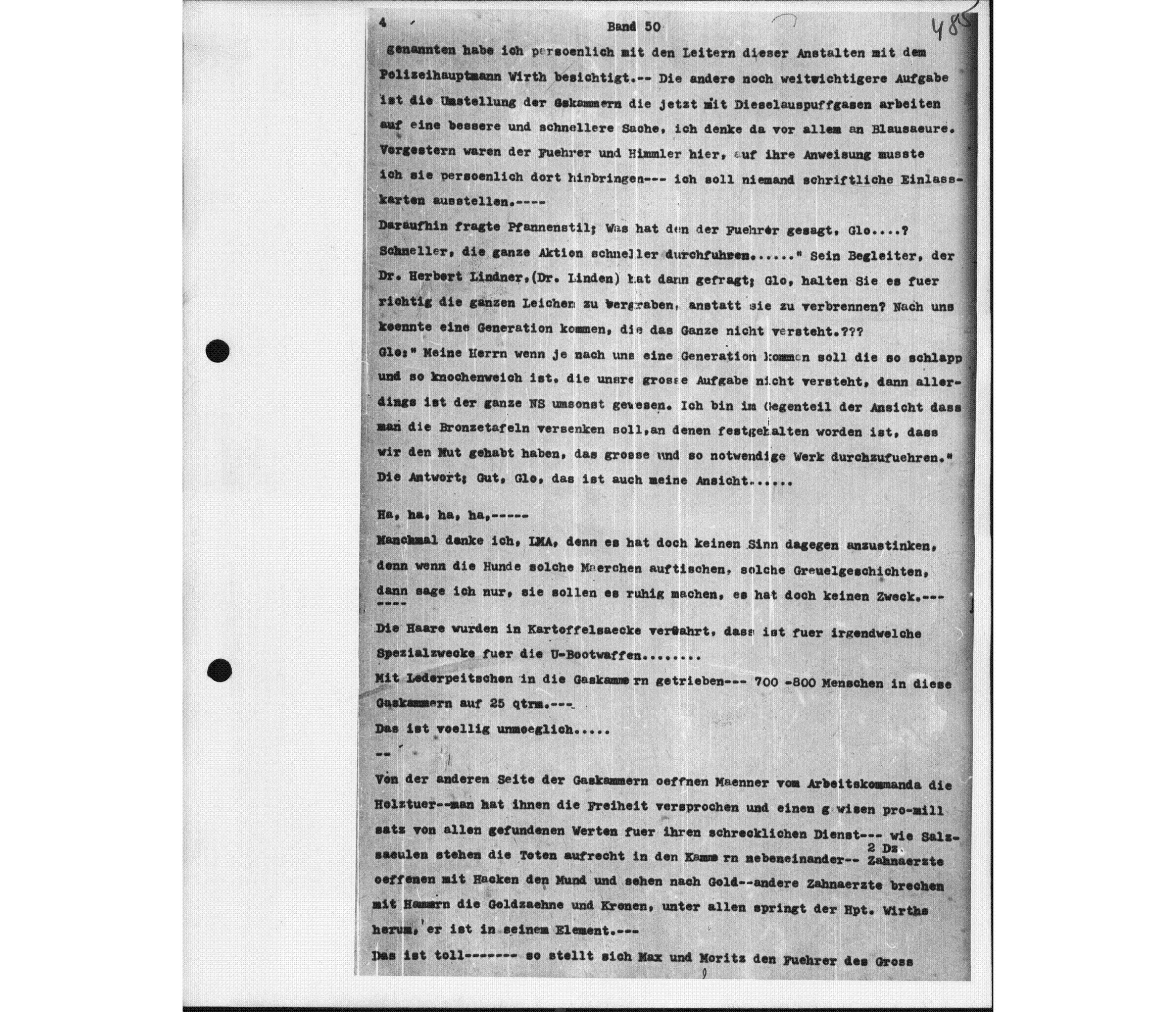
Ohne Richtlinienversorgung des Reichssicherheits HA, diese Richtlinien wurden in Form von Befehlen vom RF gegeben, denn ich habe ja als Referent IVB 4 nie einen Befehl geben dürfen, daß hätte ja den ganzen Prinzipien einer pol. Instanz, einer Zentralinstanz widersprochen, ich dürfte ja nur die örtlichen Dienststellen der Gestapo mit Weisungen versehen, aber nie mit Befehlen, einem Beamten können sie nicht befehlen, einem Beamten ordnen sie an. Während die Einsatzkommandos in den besetzt. russ. Gebieten, die waren Militant, die hatten Befehle entgegen zu nehmen, im Generalgevern. war es ein Zwischending, (Beispiel mit dem durchgenommen Buch mit entspr. Dokumenten, Kopf mit Waffen SS), auch diese waren mit drin verhaftet, wie ZB der Wikingruf das Gegenteil behauptet, und wer ein Wikingrufleser ist wird es nicht glauben, aber hier sehen wir es schwarz auf weiß. Und wenn Sie heute einen ehrlichen Mann der Waffen SS fragen, der wird es Ihnen bestätigen können. Ich entsinne mich, hier war einmal ein Angeh der LAH gewesen, der offen zugab, daß seine Einheit bei solchen Judengeschichten mit eingesetzt war von der LAH, in den besetzten russ. Gebieten. Innerhalb des Reichsgebietes, wie war da die Aufteilung zwischen SIPO und Ordnungspol… meiner Ansicht nach waren verschied Verfügungen und Erlässe gar nicht Angelegenheit der Sicher.Pol, in dem Falle Gestapo, zB. daß es Juden verboten ist Kinos zu besuchen Theater usw. … Das haben die Revierhauptleute beobachtet, oder durch die Meldepflicht, die ihnen auferlegt worden war. Das Tragen des Judensterns? Die Beobachtung oblag natürlich der Ordnungspol. d.h. dem zuständigen Revierhauptmann, in Östr. hieß das Kommissariat und da waren die Ra- Inspekteure und Ober Ra- Inspekteure tätig, und im Altreich nannte man das Revierhauptleute und dort waren es auch die Wachtmeister gewesen und Pol. Oberwachtmeister gewesen. Nun schließlich waren die Agenten der Überwachung und die Verhaftung war ja nicht ausschließl. Aufgabe der SIPO, der örtlichen Stapo oder der Stapo Leitstellen, das besorgten in den Städten die revier Hauptleute und auf dem Land waren es die Landjäger gewesen, Gendarmerie. Hier heißt es die Aufsichtsbehörde der Reichsvereinigung der Juden war das Reichssicherheits HA, eine besondere Stelle der Gestapo?? Das stimmt. Das war ich, das war das referat IV B 4, ich war Dienstaufsichtsbehörd… Wie kam es zur Gründung der Reichsvereinigung der Juden in Deutschland, wurde darüber schon gesprochen?? Nein, genau kann ich es nicht sagen – als ich noch in dem Amt VII war in Berlin, da bestand schon längst das Referat IV B Das Referat hat um jene Zeit, besetzt mit einem Stbf. Langer, er war lange Zeit tätig und ihm folgte eine Stbf. Lischka. Ihm folgte der SS Ostuf. Eichmann Als ich also das referat IV B 4 im Herbst 1940 übernahm als Dezernent mit meinem ständigen Vertreter Stf. Günter da war die Reichsvereinigung der Juden ein längst errichtetes Gebilde, das wohl funktionierte. In den Jahren vorher hatte unter diesen beiden Regierungsräten die ich eben nannte,

Draft translation

3 Volume 40 [HW: 365] Without directive-provisioning of the Reich Security Main Office, these directives were given in the form of orders by the RF, for as a desk officer [Referent] IVB4 I was of course [not] permitted to give an order, that would after all have contradicted the whole principles of a pol[itical] authority, a central authority; I was after all only permitted to furnish the local offices of the Gestapo with instructions [Weisungen], but never with orders; you cannot order [befehlen] an official, you direct [ordnen an] an official. Whereas the Einsatzkommandos in the occupied russ[ian] territories, they were militant, they had to receive orders; in the Gener­al­gov[ernment] it was an in-between thing, (example gone through with the book with corresp[onding] documents, letterhead with Waffen SS), these too were caught up in it, as for example the Wikingruf claims the opposite, and whoever is a Wikingruf reader will not believe it, but here we see it in black and white. And if you today ask an honest man of the Waffen SS, he will be able to confirm it to you. I recall, there was once here a member of the LAH, who openly admitted that his unit had been deployed along in such Jew-affairs by the LAH, in the occupied russ[ian] terri­tories. Within the Reich territory, how was the division there between SIPO and Ordnungspol[izei]? in my opinion various decrees and edicts were not at all a matter of the Sicher[heits]pol[izei], in that case the Gestapo, e.g. that it is forbidden to Jews to visit cinemas, theaters etc..... That the precinct captains [Revierhauptleute] observed, or through the reporting-duty that had been imposed on them.. The wearing of the Jewish star? The observation lay of course with the Ordnungspol[izei], i.e. with the responsible precinct captain [Revierhauptmann], in Austr[ia] that was called the Kommissariat and there the Ra-- Inspectors and Senior Ra- Inspectors were active, and in the Altreich one called that precinct captains [Revierhauptleute] and there it was also the Wachtmeister and Pol[ice] Oberwachtmeister. Now finally the agents of the surveillance and the arrest was after all not exclusively [the] task of the SIPO, of the local Stape or of the Stape control-centers [Leitstellen], that was seen to in the cities by the precinct captains and in the countryside it was the Landjäger, gendarmerie.- Here it says the supervisory authority of the Reich Association of the Jews was the Reich Security Main Office, a special office of the Gestapo?? That is correct. That was I, that was the desk [Referat] IV B 4, I was [the] duty-supervisory-authority [Dienstaufsichtsbehörd(e)] How did it come about that the Reich Association of the Jews in Germany was founded, has that already been spoken about?? No, exactly I cannot say it------ when I was still in Amt VII in Berlin, the Referat IV B [HW: 10] already existed long since. The Referat at that time [was] staffed with a Stbf. Langex, [HW: R.G.] he was active for a long time and him there followed a Stbf. Lischka. [HW: L.R.] Him there followed the SS Ostuf. Eichmann. So when I took over the Referat IV B 4 in autumn 1940 as Dezernent [officer-in-charge] with my permanent deputy Stf. Günter, the Reich Association of the Jews was a long-since erected structure, which functioned well. In the years before, under these two Regierungsräte [government councillors] whom I just named,

the Reich Association had taken shape and form. Legal permission was laid down for such a Reich Association to be formed at all, and the Chief of the Security Police was designated as the supervisory authority. Further new regulations kept being issued for this Reich Association. It was a Jewish institution, just as I created it with the Israelite Religious Community in Vienna in 1938, or with the Israelite Religious Community in Prague.

There it was the decree of the Reich Commissioner for the Reunification of the German Reich; here it was the Reich Protector for Bohemia and Moravia's decree approving its establishment. The supervisory authority in Vienna was the Commander of the Security Police and the Security Service, and in Prague it was likewise the Commander of the Security Police and the Security Service. In the Old Reich it was the Reich Security Main Office. The head of this Reich Association in Germany came just as his colleague Dr. R. Löwenherz did, or the Prague men Dr. Weidmann and Edelstein.

They often came daily, or … a week, gave their report and asked for a decision, and the decision was conveyed to them. I made it my practice that whenever someone came to obtain my decision, or told me of his measures and instructions, or submitted proposals that I either approved or rejected, the Jew recorded every such discussion in a file memorandum, a duplicate of which he had to send me soon after the discussion. As a rule, to avoid so much unnecessary running about, he would hand me the note of the previous discussion at the next meeting.

I then briefly went through it with him and immediately made marginal notes on what had been dealt with in the meantime and what was still particularly noteworthy. The Jewish side had to incorporate the original in its own files. I remember that in Vienna Dr. Löwenherz had assembled a whole Leitz binder of such file notes. I saw it once when I visited the Israelite Religious Community. It began when I still held the rank of Obstf. and ended when I held the rank of Obersturmbannführer.

That is to give you an idea of how many memoranda were in this binder, though there may also have been two or three Leitz binders. Of course I also made it my duty to arrange meetings in the Israelite Religious Community's building in Vienna or Prague. Sitting there beside the office director, surrounded by that institution's desk officers and department heads, and in the presence of a particular case officer from my own office, I conducted and led the discussion. It was a purely factual working conference. So what I mean is that supervision rested with the Chief of the Security Police and the Security Service.

Questioner

Who was the head of the Reich Association of Jews in Germany?

Eichmann

Dr. Eppstein.

Questioner

Were you on closer terms with him? Did he come to you more often?

Eichmann

Yes, I had known Eppstein for a long time. I dealt with him when I was still in Office VII. As the case officer for the Zionist World Federation I had a great many questions to ask for my own information. An M. district secretary named Kuchmann summoned Eppstein. He was an official of Desk IV B 4 in the Gestapo Office, with which I had nothing to do at the time, because I was still

Open page image and German
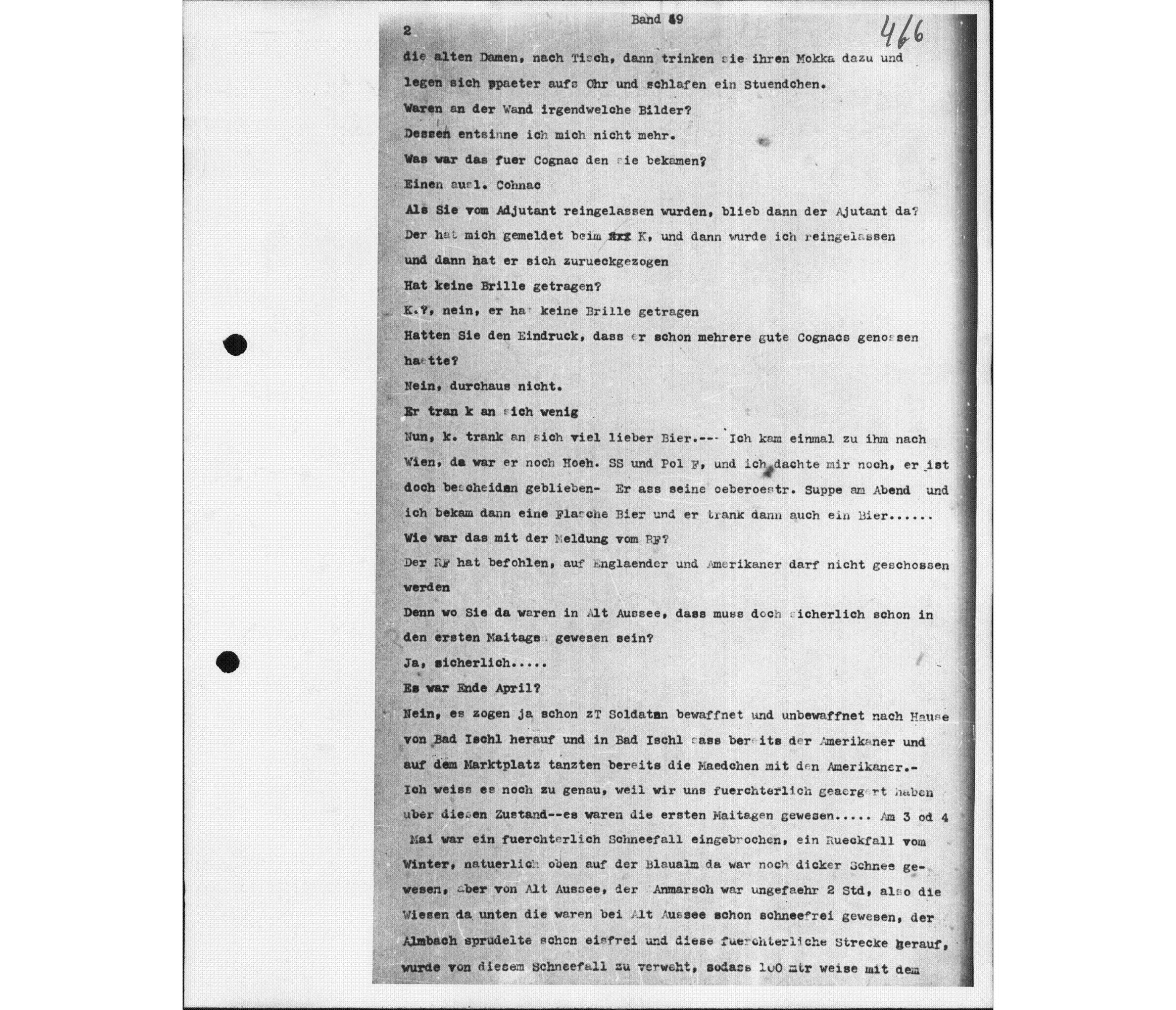
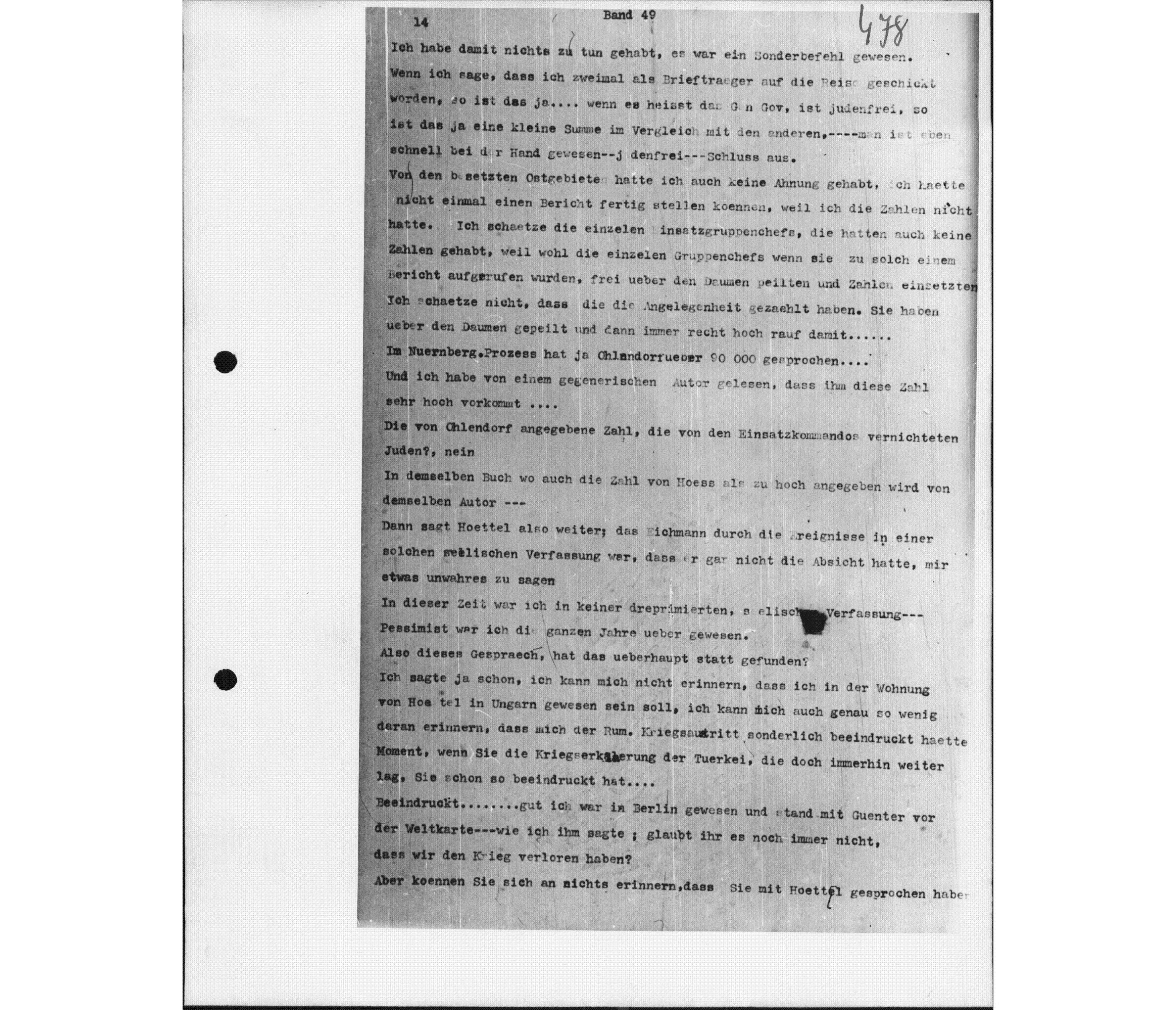
Page 366 of the typescript, O.65 file 87.
Page 366 · Yad Vashem Archives, O.65/87

German transcription

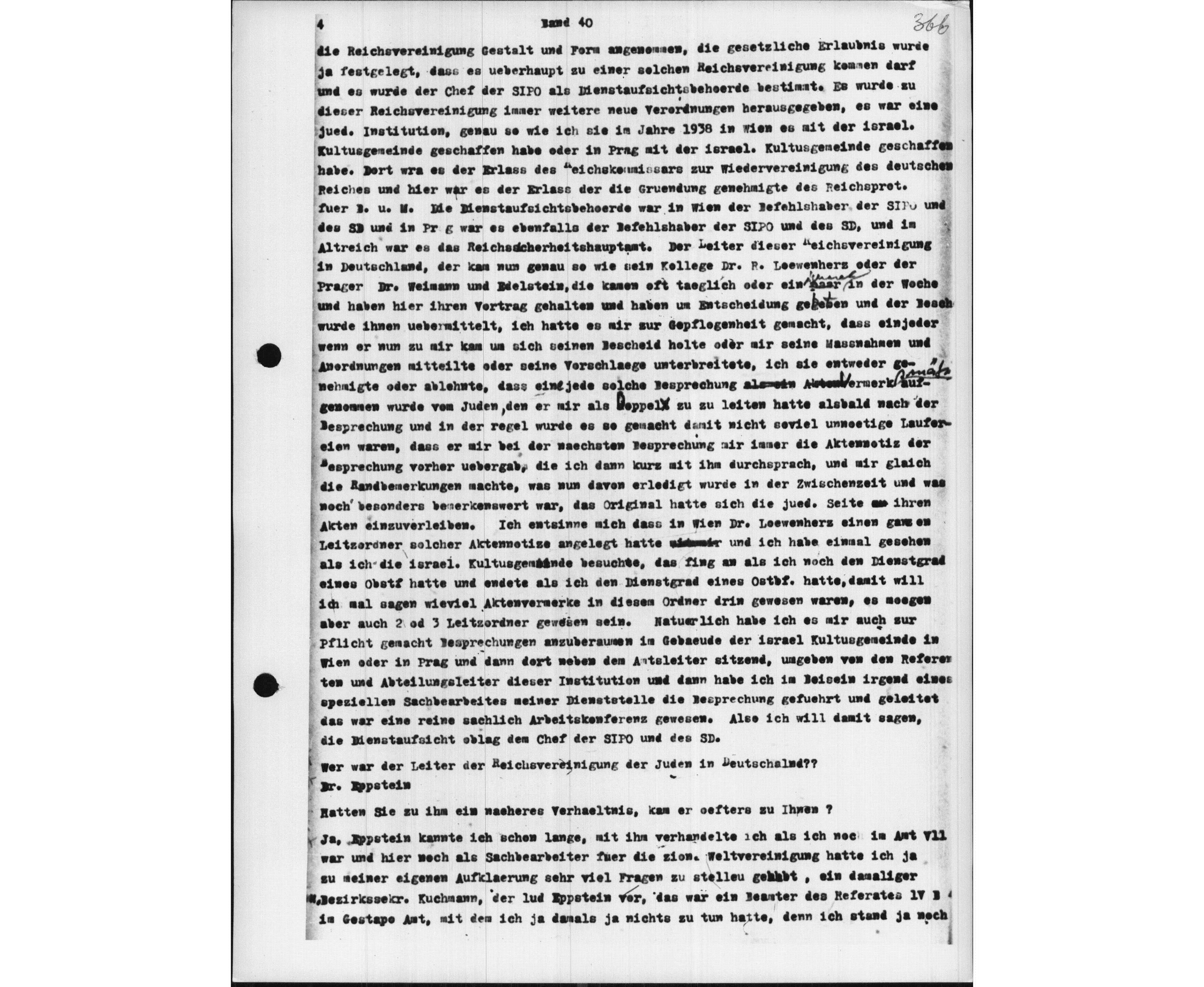
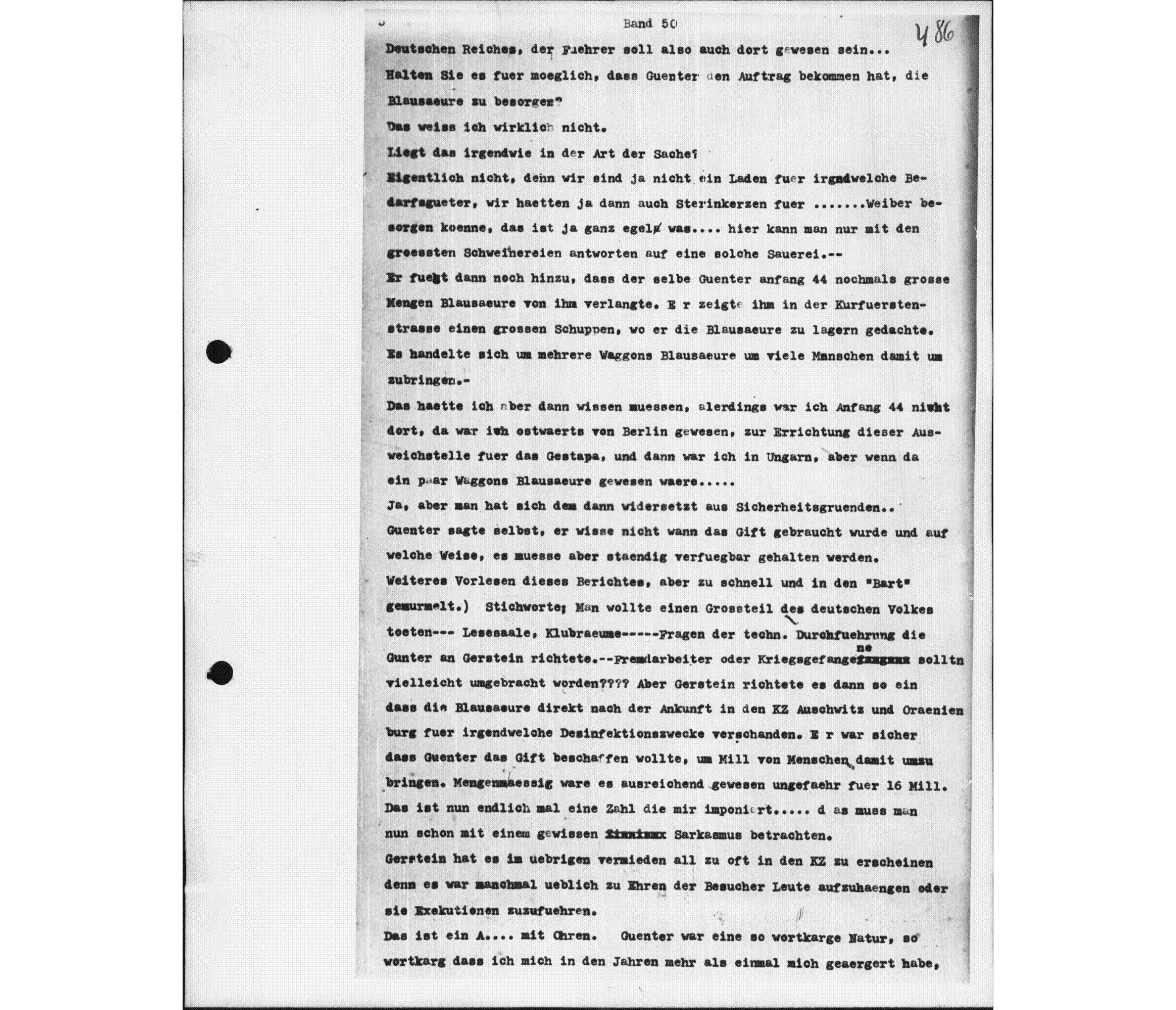
die Reichsvereinigung Gestalt und Form angenommen, die gesetzliche Erlaubnis wurde ja festgelegt, daß es überhaupt zu einer solchen Reichsvereinigung kommen darf und es wurde der Chef der SIPO als Dienstaufsichtsbehörde bestimmt. Es wurde zu dieser Reichsvereinigung immer weitere neue Verordnungen herausgegeben, es war eine jüd. Institution, genau so wie ich sie im Jahre 1938 in Wien es mit der israel. Kultusgemeinde geschaffen habe oder in Prag mit der israel. Kultusgemeinde geschaffen habe. Dort war es der Erlaß des Reichskommissars zur Wiedervereinigung des deutschen Reiches und hier war es der Erlaß der die Gründung genehmigte des Reichspret. für B. u. M. Die Dienstaufsichtsbehörde war in Wien der Befehlshaber der SIPO und des SD und in Prag war es ebenfalls der Befehlshaber der SIPO und des SD, und im Altreich war es das Reichssicherheitshauptamt. Der Leiter dieser Reichsvereinigung in Deutschland, der kam nun genau so wie sein Kollege Dr. R. Leewenherz oder der Prager Dr. Weimann und Edelstein, die kamen oft täglich oder ein jene Paar in der Woche und haben hier ihren Vortrag gehalten und haben um Entscheidung gebeten und der Besch… wurde ihnen übermittelt, ich hatte es mir zur Gepflogenheit gemacht, daß ein jeder wenn er nun zu mir kam um sich seinen Bescheid holte oder mir seine Maßnahmen und Anordnungen mitteilte oder seine Vorschläge unterbreitete, ich sie entweder genehmigte oder ablehnte, daß ein jede solche Besprechung als Vermerk aufgenommen wurde vom Juden, den er mir als Doppel zuzuleiten hatte alsbald nach der Besprechung und in der Regel wurde es so gemacht damit nicht soviel unnötige Laufereien waren, daß er mir bei der nächsten Besprechung mir immer die Aktennotiz der Besprechung vorher übergab, die ich dann kurz mit ihm durchsprach, und mir gleich die Randbemerkungen machte, was nun davon erledigt wurde in der Zwischenzeit und was noch besonders bemerkenswert war, das Original hatte sich die jüd. Seite in ihren Akten einzuverleiben. Ich entsinne mich daß in Wien Dr. Leewenherz einen ganzen Leitzordner solcher Aktennotizen angelegt hatte und ich habe einmal gesehen als ich die israel. Kultusgemeinde besuchte, das fing an als ich noch den Dienstgrad eines Obstf hatte und endete als ich den Dienstgrad eines Ostbf. hatte, damit will ich mal sagen wieviel Aktenvermerke in diesem Ordner drin gewesen waren, es mögen aber auch 2 od 3 Leitzordner gewesen sein. Natürlich habe ich es mir auch zur Pflicht gemacht Besprechungen anzuberaumen im Gebäude der israel Kultusgemeinde in Wien oder in Prag und dann dort neben dem Amtsleiter sitzend, umgeben von den Referenten und Abteilungsleiter dieser Institution und dann habe ich im Beisein irgend eines speziellen Sachbearbeiters meiner Dienststelle die Besprechung geführt und geleitet das war eine reine sachlich Arbeitskonferenz gewesen. Also ich will damit sagen, die Dienstaufsicht oblag dem Chef der SIPO und des SD. Wer war der Leiter der Reichsvereinigung der Juden in Deutschland?? Dr. Eppstein Hatten Sie zu ihm ein näheres Verhältnis, kam er öfters zu Ihnen? Ja, Eppstein kannte ich schon lange, mit ihm verhandelte ich als ich noch im Amt VII war und hier noch als Sachbearbeiter für die zion. Weltvereinigung hatte ich ja zu meiner eigenen Aufklärung sehr viel Fragen zu stellen gehabt, ein damaliger M.Bezirkssekr. Kuchmann, der lud Eppstein vor, das war ein Beamter des Referates IV B 4 im Gestapo Amt, mit dem ich ja damals ja nichts zu tun hatte, denn ich stand ja noch

Draft translation

the Reich Association took shape and form, the legal permission was indeed established that such a Reich Association may come about at all, and the Chief of the SIPO was designated as the supervisory authority (Dienstaufsichtsbehörde). For this Reich Association ever more new ordinances were issued; it was a Jewish institution, exactly as I created it in the year 1938 in Vienna with the Israelite Religious Community (Kultusgemeinde), or created it in Prague with the Israelite Religious Community. There it was the decree of the Reich Commissar for the Reunification of the German Reich, and here it was the decree that approved the founding, of the Reich Protector (Reichspret.) for B[ohemia] and M[oravia]. The supervisory authority in Vienna was the Commander of the SIPO and the SD, and in Prague it was likewise the Commander of the SIPO and the SD, and in the Altreich it was the Reich Security Main Office (Reichssicherheitshauptamt). The head of this Reich Association in Germany, he now came just like his colleague Dr. R. Loewenherz or the Prague [ones] Dr. Weimann and Edelstein, they came often daily or a [HW: [?those?]] couple [of times] in the week and gave their report (Vortrag) here and asked for a decision, and the decision (Besch[eid]) was conveyed to them; I had made it my custom that each one, whenever he now came to me to obtain his decision (Bescheid) or communicated to me his measures and orders or submitted his proposals, [and] I either approved or rejected them, that every such discussion was recorded as a [DEL: a files-]memorandum [HW: [?according to?]] by the Jew, which he had to convey to me as a duplicate [HW: X] soon after the discussion, and as a rule it was done this way so that there were not so much unnecessary running-around (Lauferei), that at the next discussion he always handed me beforehand the file-note (Aktennotiz) of the discussion, which I then briefly discussed through with him, and immediately made the marginal notes for myself, [as to] what of it had now been dealt with in the meantime and what was still especially noteworthy; the original the Jewish side had to incorporate into their files. I recall that in Vienna Dr. Loewenherz had set up a whole Leitz-binder of such file-notes [DEL: [?nichmer?]] and I once saw, when I visited the Israelite Religious Community — this began when I still had the rank of an Obstf[ührer] and ended when I had the rank of an Ostbf[ührer], by which I mean to say how many file-memoranda had been in this binder, but there may also have been 2 or 3 Leitz-binders. Naturally I also made it my duty to arrange discussions in the building of the Israelite Religious Community in Vienna or in Prague, and then sitting there next to the office head, surrounded by the desk-officers (Referenten) and department heads of this institution, and then in the presence of some special case-officer (Sachbearbeiter) of my office I conducted and led the discussion; that had been a purely factual work-conference. So, by this I mean to say, the supervision (Dienstaufsicht) lay with the Chief of the SIPO and the SD. Who was the head of the Reich Association of the Jews in Germany?? Dr. Eppstein Did you have a closer relationship with him, did he come to you more often? Yes, I had known Eppstein for a long time, I negotiated with him when I was still in Office VII, and here, still as case-officer for the Zionist World Federation, I did have very many questions to put for my own enlightenment; a then M[?] district-secretary Kuchmann, he summoned Eppstein — that was an official of the Referat IV B 4 in the Gestapo Office, with whom I at that time indeed had nothing to do, for I was still

under Six, in the office for scholarly evaluation. There I talked about the subject with Eppstein, or with the Chief Rabbi Dr. Baeck, whom I had summoned as required. With Baeck it was mostly about questions of orthodoxy, about Orthodoxy; with Eppstein I discussed current practical questions of Zionist politics. How far the opponent was keeping me in the dark for substantive reasons was something I generally knew how to judge. I had the reports of our confidential informers and agents, which I wanted to check through the Jew; conversely, I had the Jew checked through our informers' and agents' reports.

That was the Security Service's game, a double means of checking. That was where I got to know Eppstein. He was an exceptionally skilful, well-bred, educated lawyer. Eppstein, just like Dr. Loewenhers, had nothing servile about him whatever. His speech was free and open, one might say courageous, even though one also knew that these Jewish negotiating partners never came to the slightest harm. In my dealings with them, I instructed my guards and my outer office always to arrange these Jewish functionaries' visits so that they did not have to wait. They arrived and were treated politely and courteously by the guards.

Then they came up to me, without much escort, since they were regular visitors. They sat down, and we negotiated as gentlemen do. They knew me; they knew my attitude from conversations that from time to time reached into it. That is unavoidable when you deal with an opponent for a long time: one occasionally … developed a personal connection. I with them, and vice versa. There was no more trembling in the knees, no more uncertainty. If I could read their faces, they could read mine just as well, especially since I never approached them with underhanded intentions.

They may have been cautious at first, but later they knew perfectly well that they could say anything in the negotiations. How else could I have managed such a matter as the supervisory authority if I could not also hear the truth? How else could I have expected productive work from these Jewish functionaries if I had not dealt with them openly? They also knew, and I have never made any secret of it, that I have no prejudice at all against the individual Jew. I know no hatred of Jews. I do not share the views of the Streicher idea. Rather, I see the necessity of the struggle and its inevitability, but in the political sphere.

Questioner

Surely the Reich Security Main Office would naturally appoint people as presidents of this Reich Association, or of the Central Office in Vienna, who were decidedly compliant tools of the Reich Security Main Office?

Eichmann

Anyone else would probably have done it that way, and it was done that way locally. The local Gestapo or Gestapo regional headquarters' section heads naturally exchanged the ‘material’ supplied to them by the Reich Association of Jews as its local representatives over the years, for people they could get along with easily. But that is wrong. In subordinate offices it might not have had the same effect, because they are supplied anyway by their Jewish central office,

Open page image and German
Page 367 of the typescript, O.65 file 87.
Page 367 · Yad Vashem Archives, O.65/87

German transcription

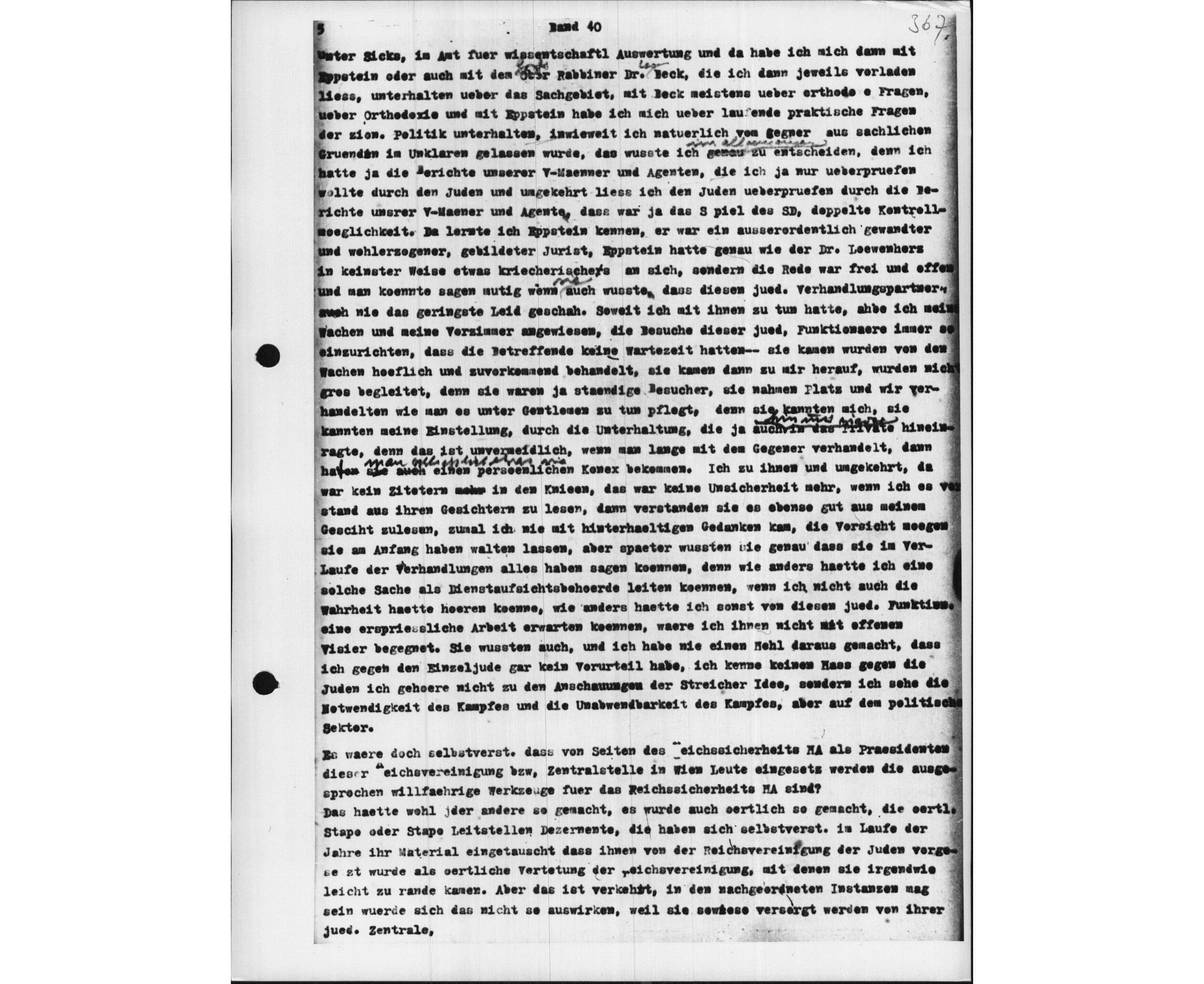
Unter Sicks, im Amt für wissenschaftl Auswertung und da habe ich mich dann mit Eppstein oder auch mit dem Obsr Rabbiner Dr. Beck, Leo die ich dann jeweils vorladen ließ, unterhalten über das Sachgebiet, mit Beck meistens über orthodoxe Fragen, über Orthodexie und mit Eppstein habe ich mich über laufende praktische Fragen der zion. Politik unterhalten, inwieweit ich natürlich vom Gegner aus sachlichen Gründen im Unklaren gelassen wurde, das wußte ich im allgemeinen genau zu entscheiden, denn ich hatte ja die Berichte unserer V-Männer und Agenten, die ich ja nur überprüfen wollte durch den Juden und umgekehrt ließ ich den Juden überprüfen durch die Berichte unser V-Männer und Agente, das war ja das Spiel des SD, doppelte Kontrollmöglichkeit. Da lernte ich Eppstein kennen, er war ein außerordentlich gewandter und wohlerzogener, gebildeter Jurist, Eppstein hatte genau wie der Dr. Löwenhers in keinster Weise etwas kriecherisches an sich, sondern die Rede war frei und offen und man könnte sagen mutig wenn [unleserlich] auch wußte, daß diesen jüd. Verhandlungspartner, auch nie das geringste Leid geschah. Soweit ich mit ihnen zu tun hatte, habe ich meine Wachen und meine Vorzimmer angewiesen, die Besuche dieser jüd. Funktionäre immer so einzurichten, daß die Betreffende keine Wartezeit hatten – sie kamen wurden von den Wachen höflich und zuvorkommend behandelt, sie kamen dann zu mir herauf, wurden nicht groß begleitet, denn sie waren ja ständige Besucher, sie nahmen Platz und wir verhandelten wie man es unter Gentlemen zu tun pflegt, denn sie kannten mich, sie kannten meine Einstellung, durch die Unterhaltung, die ja auch [unleserlich] hineinragte, denn das ist unvermeidlich, wenn man lange mit dem Gegner verhandelt, dann haben [unleserlich] sie auch einen persönlichen Konex bekommen. Ich zu ihnen und umgekehrt, da war kein Zittern mehr in den Knieen, das war keine Unsicherheit mehr, wenn ich es verstand aus ihren Gesichtern zu lesen, dann verstanden sie es ebenso gut aus meinem Gesicht zu lesen, zumal ich nie mit hinterhältigen Gedanken kam, die Vorsicht mögen sie am Anfang haben walten lassen, aber später wußten sie genau daß sie im Verlaufe der Verhandlungen alles haben sagen können, denn wie anders hätte ich eine solche Sache als Dienstaufsichtsbehörde leiten können, wenn ich nicht auch die Wahrheit hätte hören können, wie anders hätte ich sonst von diesen jüd. Funktinm. eine ersprießliche Arbeit erwarten können, wäre ich ihnen nicht mit offenem Visier begegnet. Sie wußten auch, und ich habe nie einen Hehl daraus gemacht, daß ich gegen den Einzeljude gar kein Verurteil habe, ich kenne keinen Haß gegen die Juden ich gehöre nicht zu den Anschauungen der Streicher Idee, sondern ich sehe die Notwendigkeit des Kampfes und die Unabwendbarkeit des Kampfes, aber auf dem politische Sektor. Es wäre doch selbstverst. daß von Seiten des Reichssicherheits HA als Präsidenten dieser Reichsvereinigung bzw, Zentralstelle in Wien Leute eingesetz werden die ausgesprochen willfährige Werkzeuge für das Reichssicherheits HA sind? Das hätte wohl jeder andere so gemacht, es wurde auch örtlich so gemacht, die örtl. Stape oder Stape Leitstellen Dezernente, die haben sich selbstverst. im Laufe der Jahre ihr Material eingetauscht daß ihnen von der Reichsvereinigung der Juden vorgesetzt wurde als örtliche Vertretung der Reichsvereinigung, mit denen sie irgendwie leicht zu rande kamen. Aber das ist verkehrt, in den nachgeordneten Instanzen mag sein würde sich das nicht so auswirken, weil sie sowieso versorgt werden von ihrer jüd. Zentrale,

Draft translation

Under Six, in the office for scientific evaluation, and there I then, with Eppstein or also with the Chief Rabbi Dr. Beck, [HW: [illegible]] whom I then in each case had loaded/transported away, conversed about the subject area, with Beck mostly about orthodo[x] questions, about orthodox[y], and with Eppstein I conversed about current practical questions of Zionist politics; to what extent I was of course, from the opponent's side, for factual reasons left in the dark — that I knew [HW: [?in general?]] exactly how to decide, for I did after all have the reports of our V-men and agents, which I after all only wanted to verify through the Jew, and conversely I had the Jew verified through the reports of our V-men and agents; that was after all the game of the SD, a double check-possibility. There I got to know Eppstein; he was an extraordinarily adroit and well-bred, educated jurist. Eppstein, exactly like Dr. Loewenherz, had in no way anything servile/fawning about him, but rather the speech was free and open and one could say courageous, even when [HW: [illegible]] one also knew that to these Jewish negotiating partners not even the slightest harm ever came. Insofar as I had to do with them, I have instructed my guards and my anterooms/outer-offices always to arrange the visits of these Jewish functionaries so that the persons concerned had no waiting time — they came, were treated by the guards politely and obligingly, they then came up to me, were not much escorted, for they were after all constant visitors, they took a seat and we negotiated as one is accustomed to do among gentlemen, for they knew me, they knew my attitude, through the conversation, which after all also [DEL: into the private] [HW: [illegible]] extended, for that is unavoidable when one negotiates a long time with the opponent, then [HW: [illegible]] they also acquired a personal connection. I to them and vice versa, there was no more trembling in the knees, that was no more insecurity, when I understood how to read from their faces, then they understood it just as well [how] to read from my face, especially since I never came with underhanded/insidious thoughts; the caution they may have let prevail at the beginning, but later they [bie=sie] knew exactly that in the course of the negotiations they could have said everything, for how else could I have conducted such a matter as a supervisory authority [Dienstaufsichtsbehörde] if I could not also have heard the truth; how else could I otherwise have expected fruitful/profitable work from these Jewish functionaries [Funktinm.] if I had not met them with open visor. They also knew, and I have never made any secret of it, that I have no prejudice at all against the individual Jew, I know no hatred against the Jews, I do not belong to the views of the Streicher idea, but rather I see the necessity of the struggle and the inevitability of the struggle, but on the political sector. It would surely be self-evident that on the part of the Reich Security Main Office, as presidents of this Reich Association or Central Office in Vienna, people were installed who are decidedly willing/compliant tools for the Reich Security Main Office? That anyone else would probably have done likewise, it was also done so locally; the local Stapo or Stapo control-center desk officers [Dezernenten], they have of course in the course of the years exchanged their material [/traded around the material] that was placed before them by the Reich Association of the Jews as local representation of the Reich Association, with whom they somehow easily got along. But that is wrong; in the subordinate instances/agencies it may be that it would not work out that way, because they are in any case provided for by their Jewish central office,

with instructions and guidelines. They are therefore only executing bodies. But suppose I had appointed a Jewish office director in the person of a Dr. R. Löwenherz who said ‘Yes, sir’ to everything I said, or even ‘At your command’. If I had had a man in Dr. Eppstein who said yes to everything, or in Prague, then that Jewish organization would have been a pigsty where no swine could have found its way around any more. It would not have worked, and the offices attached to the Jewish agencies would probably have needed ten or twenty times as much staff. As it was, the operation was orderly. The Israelite Religious Community consisted of around 400 Jewish officials. They had their own Matr. register, birth and death registers; hence the office directors too. I protect them from abuses.

[Typed as notes in the transcript: Example: Night of Broken Glass.]

I want to tell you about the treatment of Jews within Germany, about the support for those who had been pushed out of the German people's spheres of life. A certain proportion would undoubtedly have turned to crime if they had not received at least enough support to fill their stomachs, to buy a pair of boots, to buy a pair of trousers. All of that was handled by the welfare department of the Religious Community in Vienna. I had to raise the money for it, that is, raise it by allowing the Jewish functionaries to travel abroad so they could make their begging rounds in England.

There they scraped together and collected foreign currency, which they also continued to receive in subsequent remittances. They offered it to the foreign-exchange office (Devisenstelle, handwritten correction of struck Reisestelle) in Vienna and could convert it into Reichsmarks at up to twenty times the exchange-rate value. The Reich Economics Ministry once took me to task because I was endangering the international exchange rate of the Reichsmark when I sold the Reichsmark, the rate was then 2.50 or 2.…0 to one dollar, when I sold the dollar for 20 Reichsmarks, among Jews, of course.

The Jew had to pay 250 dollars in the country of immigration, so he had to pay 20 times 250 dollars, 500 Reichsmarks, instead of 6 00 Reichsmarks. The difference first cost the Religious Community itself; then it pocketed the difference, or, if the dollars were given to it, it pocketed the whole 5,000 Reichsmarks. From that the organization paid its employees, from that it paid for welfare, from that it paid for the emigration of Jews without means. So if a compliant man had been in the leading position, whether in Vienna, Berlin or Prague, the Religious Community could not possibly have coped with that enormous volume, with the thousands of matters that had to be dealt with in twenty-four hours.

Even if I had had to assign police personnel to it, those personnel would not have been able to do it, because you have to be a specialist too. And the tougher the particular director, the better he kept his operation in order. And if you have a man of stature in some position, and that man knows from the outset that he and his whole family and his whole clan are in … (?) for the supervisory authority, and therefore of course for all the subordinate authorities too, then, as a rule, he is a man of that stature in his office and in his dealings with the supervisory authority. Indeed, he positively wants to make that evident.

Open page image and German
Page 368 of the typescript, O.65 file 87.
Page 368 · Yad Vashem Archives, O.65/87

German transcription

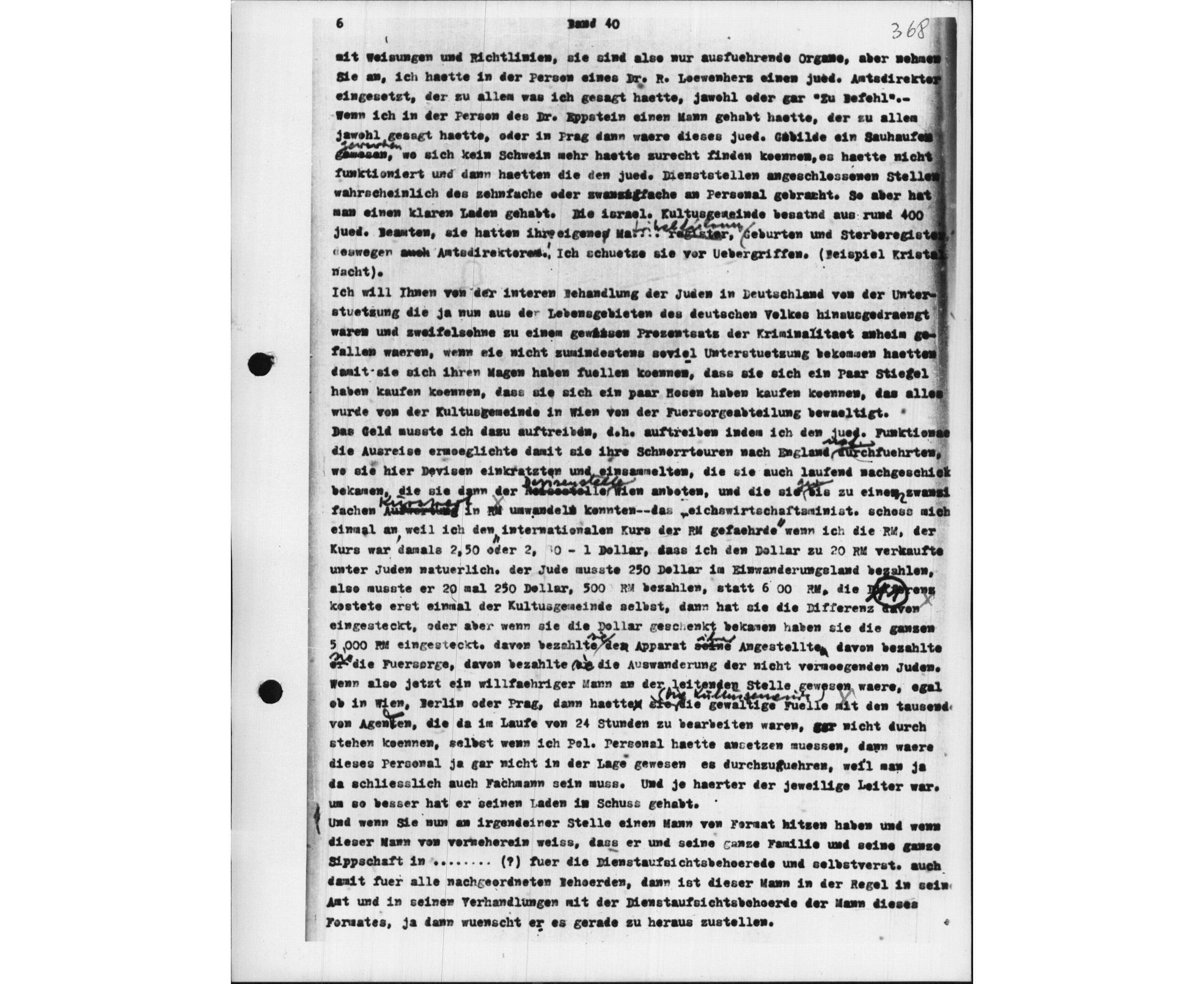
mit Weisungen und Richtlinien, sie sind also nur ausführende Organe, aber nehmen Sie an, ich hätte in der Person eines Dr. R. Löwenherz einen jüd. Amtsdirektor eingesetzt, der zu allem was ich gesagt hätte, jawohl oder gar "Zu Befehl". Wenn ich in der Person des Dr. Eppstein einen Mann gehabt hätte, der zu allem jawohl gesagt hätte, oder in Prag dann wäre dieses jüd. Gebilde ein Sauhaufen [unleserlich] gewesen, wo sich kein Schwein mehr hätte zurecht finden können, es hätte nicht funktioniert und dann hätten die den jüd. Dienststellen angeschlossenen Stellen wahrscheinlich des zehnfache oder zwanzigfache an Personal gebracht. So aber hat man einen klaren Laden gehabt. Die israel. Kultusgemeinde bestand aus rund 400 jüd. Beamten, sie hatten ihr eigenes Matr[unleserlich]register, Geburten und Sterberegister deswegen auch Amtsdirektoren. Ich schütze sie vor Übergriffen. (Beispiel Kristallnacht). Ich will Ihnen von der inneren Behandlung der Juden in Deutschland von der Unterstützung die ja nun aus der Lebensgebieten des deutschen Volkes hinausgedrängt waren und zweifelsohne zu einem gewissen Prozentsatz der Kriminalität anheim gefallen wären, wenn sie nicht zumindestens soviel Unterstützung bekommen hätten damit sie sich ihren Magen haben füllen können, daß sie sich ein Paar Stiefel haben kaufen können, daß sie sich ein paar Hosen haben kaufen können, das alles wurde von der Kultusgemeinde in Wien von der Fürsorgeabteilung bewältigt. Das Geld mußte ich dazu auftreiben, d.h. auftreiben indem ich den jüd. Funktionä… die Ausreise ermöglichte damit sie ihre Schnorrtouren nach England [unleserlich] durchführten, wo sie hier Devisen einkratzten und einsammelten, die sie auch laufend nachgeschick… bekamen, die sie dann der Devisenstelle Wien anboten, und die sie bis zu einem zwanzigfachen Kurswert in RM umwandeln konnten – das Reichswirtschaftsminist. schoß mich einmal an, weil ich den internationalen Kurs der RM gefährde wenn ich die RM, der Kurs war damals 2,50 oder 2,30 – 1 Dollar, daß ich den Dollar zu 20 RM verkaufte unter Juden natürlich. der Jude mußte 250 Dollar im Einwanderungsland bezahlen, also mußte er 20 mal 250 Dollar, 500 RM bezahlen, statt 600 RM, die Differenz kostete erst einmal der Kultusgemeinde selbst, dann hat sie die Differenz davon eingesteckt, oder aber wenn sie die Dollar geschenkt bekamen haben sie die ganzen 5 000 RM eingesteckt. davon bezahlte [unleserlich] dem Apparat seine Angestellte, davon bezahlte er die Fürsorge, davon bezahlte sie die Auswanderung der nicht vermögenden Juden. Wenn also jetzt ein willfähriger Mann an der leitenden Stelle gewesen wäre, egal ob in Wien, Berlin oder Prag, dann hätten sie die Kultusgemeinde die gewaltige Fülle mit den tausend von Agenden, die da im Laufe von 24 Stunden zu bearbeiten waren, gar nicht durchstehen können, selbst wenn ich Pol. Personal hätte ansetzen müssen, dann wäre dieses Personal ja gar nicht in der Lage gewesen es durchzuführen, weil man ja da schließlich auch Fachmann sein muß. Und je härter der jeweilige Leiter war. um so besser hat er seinen Laden im Schuß gehabt. Und wenn Sie nun an irgendeiner Stelle einen Mann von Format sitzen haben und wenn dieser Mann von vorneherein weiß, daß er und seine ganze Familie und seine ganze Sippschaft in … (?) für die Dienstaufsichtsbehörde und selbstverst. auch damit für alle nachgeordneten Behörden, dann ist dieser Mann in der Regel in sein Amt und in seiner Verhandlungen mit der Dienstaufsichtsbehörde der Mann dieses Formates, ja dann wünscht er es gerade zu heraus zustellen.

Draft translation

6 Volume 40 [HW: 368] with instructions and directives, so they are only executive organs, but suppose I had installed in the person of a Dr. R. Loewenherz a Jewish office director who, to everything I had said, [said] "yes indeed" or even "at your command".- If I had had in the person of Dr. Eppstein a man who had said yes to everything, or in Prague, then this Jewish structure would have been a pigsty [HW: [illegible]] where no swine could have found its way around any more, it would not have functioned and then the offices attached to the Jewish agencies would probably have brought in ten times or twenty times the personnel. But as it was, one had a clear-run shop. The Israelite Religious Community consisted of around 400 Jewish officials, they had their own regis[HW: [illegible]] register, birth and death registers, and therefore also office directors. I protect them from encroachments. (Example Kristal night). I want to [tell] you about the internal treatment of the Jews in Germany, about the support [for those] who had now been pushed out of the spheres of life of the German people and who without doubt would to a certain percentage have fallen prey to criminality, if they had not received at least enough support so that they could fill their stomachs, that they could buy themselves a pair of boots, that they could buy themselves a pair of trousers, all of this was handled by the Religious Community in Vienna by the welfare department. The money I had to drum up for it, that is, drum up by making emigration possible for the Jewish functionar[ies] so that they carried out their sponging tours to England [HW: [illegible]], where they scraped together and collected foreign currency here, which they also had continually forwarded to them, which they then offered to the [DEL: [?travel office?]] [HW: [illegible]] Vienna, and which they could convert up to a twenty-fold [DEL: [?utilization?]] [HW: [?exchange rate?]] into RM--the Reich Economics Minist[ry] once jumped on me because I endanger the international exchange rate of the RM when I [sell] the RM, the rate was then 2.50 or 2.30 - 1 dollar, that I sold the dollar at 20 RM among Jews of course. the Jew had to pay 250 dollars in the immigration country, so he had to pay 20 times 250 dollars, 500 RM, instead of 6 00 RM, the difference first of all cost the Religious Community itself, then it pocketed the difference from it, or else if they got the dollars as a gift they pocketed the whole 5 000 RM. from that [HW: [illegible]] the apparatus paid its employees, from that it paid the welfare, from that it paid the emigration of the non-propertied Jews. So if now a compliant man had been at the leading position, no matter whether in Vienna, Berlin or Prague, then they [HW: [?the Religious Community?]] would not have been able at all to get through the enormous abundance with the thousands of agents that had to be dealt with there in the course of 24 hours, even if I had had to deploy police personnel, then this personnel would not have been at all in a position to carry it out, because one ultimately also has to be a specialist there. And the harder the respective leader was, the better he had his shop in order. And if you now have a man of stature sitting at some position and if this man knows from the outset that he and his whole family and his whole clan in ........ (?) for the supervisory authority and self-evident[ly] also thereby for all subordinate authorities, then this man is as a rule in his office and in his negotiations with the supervisory authority the man of this stature, yes then he wishes precisely to make it stand out.

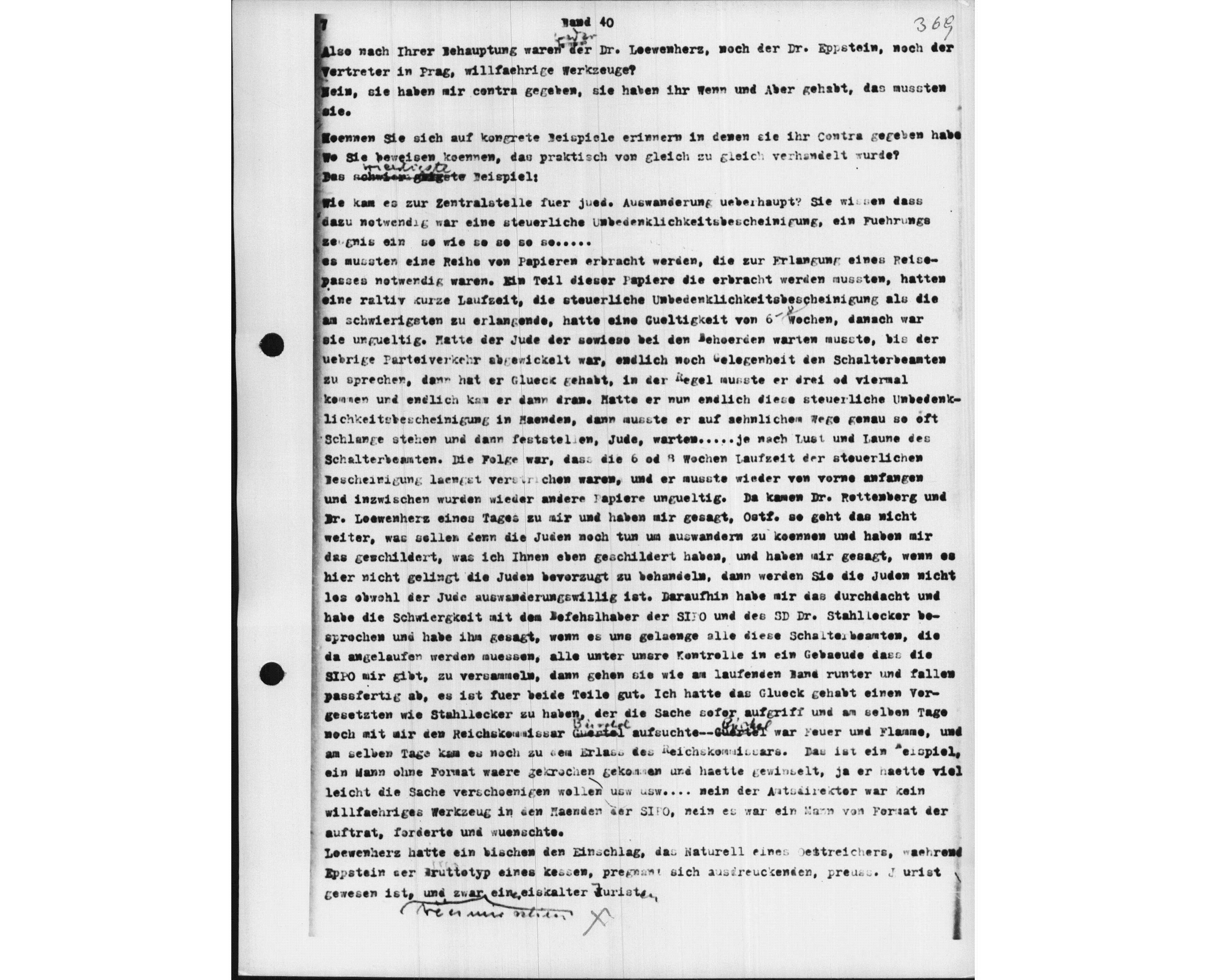
Questioner

So, according to your assertion, neither Dr. Löwenherz nor Dr. Eppstein nor the representative in Prague was a compliant tool?

No, they contradicted me. They had their ifs and buts. They had to.

Questioner

Can you remember concrete examples of them contradicting you, where you can show that the negotiations were in practice between equals?

Eichmann

The … example:

How did the Central Office for Jewish Emigration come into being in the first place? You know that you needed a tax clearance certificate, a certificate of good conduct, a such-and-such, and so on and so on. A series of documents had to be produced to obtain a passport. Some of those documents were valid for a relatively short time. The tax clearance certificate, the hardest to obtain, was valid for six to eight weeks; after that it was invalid. The Jew already had to wait at the authorities until the rest of the public had been dealt with. If he finally got an opportunity to speak to the official at the counter, he was lucky.

As a rule he had to come three or four times before he finally got his turn. Once he finally had that tax clearance certificate in his hands, he then had to queue just as often elsewhere, only to be told: ‘Jew, wait’, depending on the counter official's whim. The result was that the tax certificate's six or eight weeks of validity had long since expired, and he had to start again from the beginning. In the meantime other documents became invalid too. One day Dr. Rothenberg and Dr. Löwenherz came to me and said: ‘Obersturmführer, this cannot go on. What else are Jews supposed to do to be able to emigrate?’

They described to me what I have just described to you, and said: ‘Unless you can arrange preferential treatment for the Jews here, you will not get rid of them, even though the Jew is willing to emigrate.’ I thought that over and discussed the difficulty with the Commander of the Security Police and the Security Service, Dr. Stahlecker. I told him: ‘If we could gather all those counter officials who have to be approached under our control in one building provided by the Security Police, then they would go down as if on a conveyor belt and drop off with their passports ready. It is good for both sides.’

I was fortunate to have a superior like Stahlecker, who immediately took up the matter and went with me that same day to see Reich Commissioner Bürckel. Bürckel was full of enthusiasm, and the Reich Commissioner's decree was issued that very day. That is an example. A man without stature would have come crawling and whining; he might even have tried to gloss things over, and so on and so on. No, the office director was not a compliant tool in the hands of the Security Police. He was a man of stature who came forward, demanded things and expressed his wishes. Löwenherz had something of an Austrian's character and temperament, whereas Eppstein was the very type (Bruttotyp) of a cheeky, incisively spoken Prussian lawyer, and an ice-cold lawyer at that.

Open page image and German
Page 369 of the typescript, O.65 file 87.
Page 369 · Yad Vashem Archives, O.65/87

German transcription

Also nach Ihrer Behauptung waren weder der Dr. Leewenherz, noch der Dr. Eppstein, noch der Vertreter in Prag, willfährige Werkzeuge? Nein, sie haben mir contra gegeben, sie haben ihr Wenn und Aber gehabt, das mußten sie. Können Sie sich auf konkrete Beispiele erinnern in denen sie ihr Contra gegeben habe… Wo Sie beweisen können, das praktisch von gleich zu gleich verhandelt wurde? Das nächste Beispiel: Wie kam es zur Zentralstelle für jüd. Auswanderung überhaupt? Sie wissen daß dazu notwendig war eine steuerliche Unbedenklichkeitsbescheinigung, ein Führungszeugnis ein so wie so so so so … es mußten eine Reihe von Papieren erbracht werden, die zur Erlangung eines Reisepasses notwendig waren. Ein Teil dieser Papiere die erbracht werden mußten, hatten eine relativ kurze Laufzeit, die steuerliche Unbedenklichkeitsbescheinigung als die am schwierigsten zu erlangende, hatte eine Gültigkeit von 6 Wochen, danach war sie ungültig. Hatte der Jude der sowieso bei den Behörden warten mußte, bis der übrige Parteiverkehr abgewickelt war, endlich noch Gelegenheit den Schalterbeamten zu sprechen, dann hat er Glück gehabt, in der Regel mußte er drei od viermal kommen und endlich kam er dann dran. Hatte er nun endlich diese steuerliche Unbedenklichkeitsbescheinigung in Händen, dann mußte er auf ähnlichem Wege genau so oft Schlange stehen und dann feststellen, Jude, warten … je nach Lust und Laune des Schalterbeamten. Die Folge war, daß die 6 od 8 Wochen Laufzeit der steuerlichen Bescheinigung längst verstrichen waren, und er mußte wieder von vorne anfangen und inzwischen wurden wieder andere Papiere ungültig. Da kamen Dr. Rottenberg und Dr. Leewenherz eines Tages zu mir und haben mir gesagt, Ostf. so geht das nicht weiter, was sollen denn die Juden noch tun um auswandern zu können und haben mir das geschildert, was ich Ihnen eben geschildert habe, und haben mir gesagt, wenn es hier nicht gelingt die Juden bevorzugt zu behandeln, dann werden Sie die Juden nicht los obwohl der Jude auswanderungswillig ist. Daraufhin habe mir das durchdacht und habe die Schwierigkeit mit dem Befehlshaber der SIPO und des SD Dr. Stahllecker besprechen und habe ihm gesagt, wenn es uns gelänge alle diese Schalterbeamten, die da angelaufen werden müssen, alle unter unsre Kontrolle in ein Gebäude daß die SIPO mir gibt, zu versammeln, dann gehen sie wie am laufenden Band runter und fallen paßfertig ab, es ist für beide Teile gut. Ich hatte das Glück gehabt einen Vorgesetzten wie Stahllecker zu haben, der die Sache sofort aufgriff und am selben Tage noch mit mir den Reichskommissar Bürckel aufsuchte – Bürckel war Feuer und Flamme, und am selben Tage kam es noch zu dem Erlaß des Reichskommissars. Das ist ein Beispiel, ein Mann ohne Format wäre gekrochen gekommen und hätte gewinselt, ja er hätte vielleicht die Sache verschönigen wollen usw usw … nein der Amtsdirektor war kein willfähriges Werkzeug in den Händen der SIPO, nein es war ein Mann von Format der auftrat, forderte und wünschte. Leewenherz hatte ein bischen den Einschlag, das Naturell eines Östreichers, während Eppstein der Bruttotyp eines kessen, pregnant sich ausdrückenden, preuß. Jurist gewesen ist, und zwar ein eiskalter Jurist.

Draft translation

7 Volume 40 [HW: 369] So according to your assertion [HW: neither] Dr. Löwenherz, nor Dr. Eppstein, nor the representative in Prague were compliant tools? No, they gave me contra, they had their ifs and buts, they had to. Can you remember concrete examples in which they gave their contra Where you can prove that in practice it was negotiated on equal terms? The [DEL: most diffi[?cult?]] [HW: [?next?]] example: How did the Central Office for Jewish Emigration come about at all? You know that for this a tax clearance certificate was necessary, a certificate of good conduct, a such-and-such and so on..... a series of papers had to be produced, which were necessary for obtaining a travel passport. A part of these papers that had to be produced had a relatively short period of validity, the tax clearance certificate as the most difficult to obtain, had a validity of 6 [HW: 8] weeks, after that it was invalid. If the Jew, who anyway had to wait at the authorities until the rest of the party traffic had been dealt with, finally still had opportunity to speak to the counter official to speak, then he had luck, as a rule he had to come three or four times and finally then it was his turn. Had he now finally this tax clearance certificate in hand, then he had to in a similar way just as often stand in line and then find out, Jew, wait.....according to the mood and whim of the counter official. The consequence was that the 6 or 8 weeks period of validity of the tax certificate had long since elapsed, and he had to start again from the beginning and meanwhile other papers again became invalid. Then Dr. Rottenberg and Dr. Löwenherz came to me one day and said to me, Ostf. this does not go on like this, what then are the Jews still supposed to do to be able to emigrate, and described to me that which I have just described to you, and said to me, if it does not succeed here to treat the Jews preferentially, then you will not get the Jews rid of although the Jew is willing to emigrate. Thereupon I thought this through and discussed the difficulty with the Commander of the SIPO and of the SD Dr. Stahlecker and said to him, if we succeeded in gathering all these counter officials, who must be run to there, all under our control in a building that the SIPO gives me, to assemble, then they go down like on a conveyor belt and fall off ready-with-passport, it is good for both parts. I had had the luck to have a superior like Stahlecker, who took up the matter immediately and on the same day still sought out with me the Reich Commissioner [DEL: Güstel] [HW: [?Bürckel?]]--[DEL: Güstel] [HW: [?Bürckel?]] was fire and flame, and on the same day still came about the decree of the Reich Commissioner. That is an example, a man without stature would have come crawling and would have whimpered, yes he would have per- haps wanted to embellish the matter etc etc.... no the office director was no compliant tool in the hands of the SIPO, no it was a man of stature who appeared, demanded and wished. Löwenherz had a bit of the strain, the temperament of an Austrian, whereas Eppstein was the gross type of a bold, pregnantly expressing himself, Prussian jurist was, and indeed an ice-cold jurist. [HW: [illegible]] X

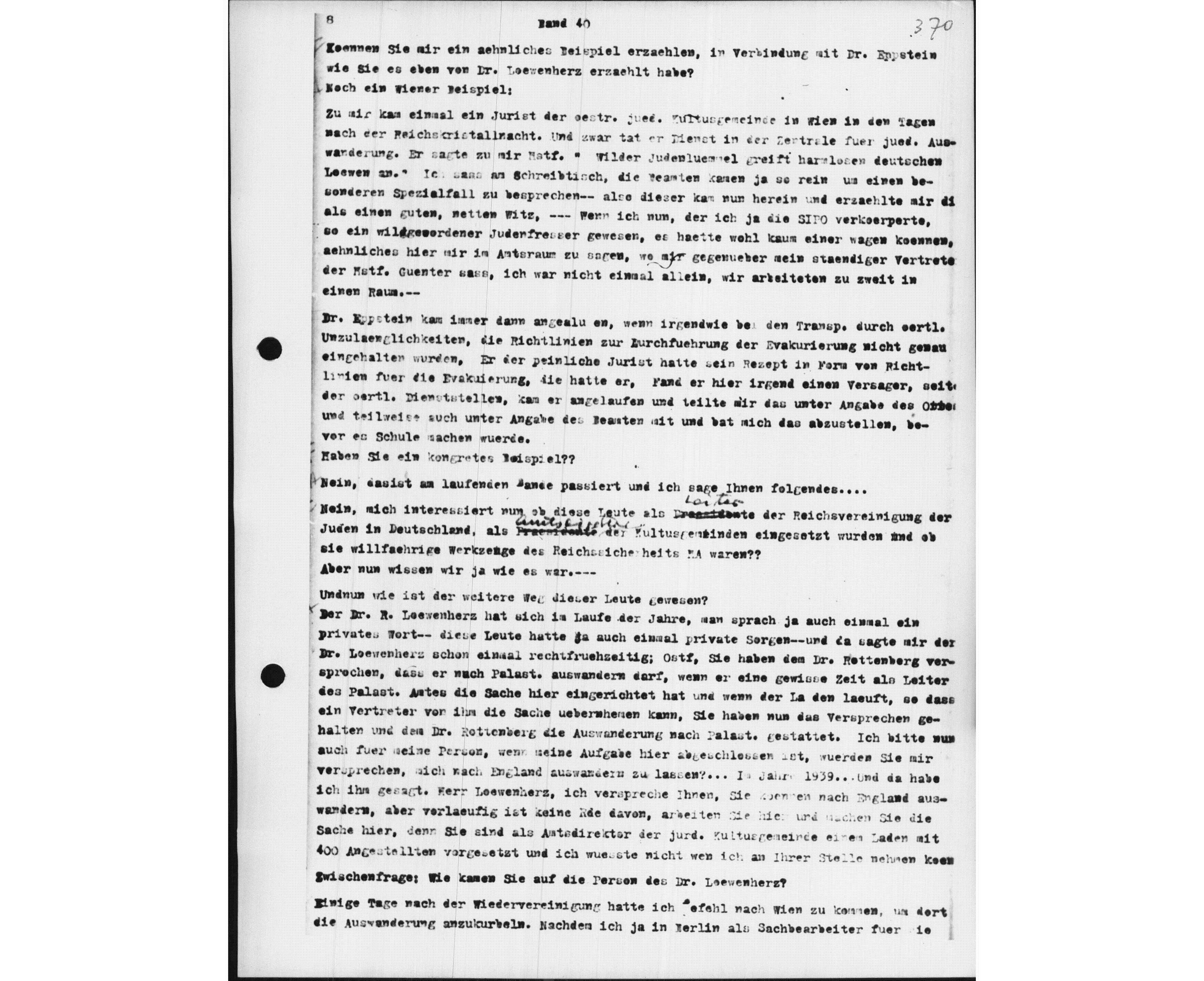
Questioner

Can you tell me a similar example involving Dr. Eppstein, like the one you have just told me about Dr. Löwenherz?

Another Viennese example.

A lawyer from the Austrian Jewish Religious Community in Vienna once came to me in the days after the Reich Night of Broken Glass (Reichskristallnacht). He worked in the Central Office for Jewish Emigration. He said to me: ‘Hauptsturmführer, wild Jewish lout attacks harmless German lion.’ I was sitting at my desk. The officials would simply come in to discuss some particular special case. So this man came in and told me that as a good, nice joke. If I, who embodied the Security Police, had been such a rabid Jew-devourer, hardly anyone would have dared to say anything like that to me in my office, where my permanent deputy Hauptsturmführer Günther sat opposite me. I was not even alone; the two of us worked in one room.

Dr. Eppstein always came running when, through local shortcomings in the transports, the guidelines for carrying out the evacuation were not followed exactly. The meticulous lawyer had his prescription in the form of the evacuation guidelines; he had those. If he found a failure on the part of a local office, he came running and reported it to me, identifying the place and sometimes the official too, and asked me to put a stop to it before it set a precedent.

Questioner

Do you have a concrete example?

Eichmann

No, it happened all the time, and I will tell you this…

Questioner

No, I am interested only in whether these people were installed as heads of the Reich Association of Jews in Germany, as [? office directors] of the Religious Communities, and whether they were compliant tools of the Reich Security Main Office?

Unknown speaker

But now we know how it was.

Questioner

And what happened to these people afterwards?

Eichmann

Dr. R. Löwenherz, over the years, one did occasionally exchange a private word; these people had their private worries too. Quite early on, Dr. Löwenherz said to me: ‘Obersturmführer, you promised Dr. Rothenberg that he could emigrate to Palestine after he had spent a certain time as head of the Palestine Office setting things up here, and once the operation was running so that a deputy could take over. You have kept that promise and allowed Dr. Rothenberg to emigrate to Palestine.

Now I ask for myself as well: when my task here is finished, would you promise to let me emigrate to England?’ In 1939. I told him: ‘Mr. Löwenherz, I promise you that you can emigrate to England, but for the time being there is no question of it. Work here and get on with the job. As director of the Jewish Religious Community you are in charge of an operation with 400 employees, and I would not know whom to put in your place.’

[Interjected question:]

Questioner

How did you come to choose Dr. Löwenherz?

Eichmann

A few days after the reunification I had orders to come to Vienna to get emigration moving there. Since I had been working in Berlin as the case officer for the

Open page image and German
Page 370 of the typescript, O.65 file 87.
Page 370 · Yad Vashem Archives, O.65/87

German transcription

Können Sie mir ein ähnliches Beispiel erzählen, in Verbindung mit Dr. Eppstein wie Sie es eben von Dr. Löwenherz erzählt habe? Noch ein Wiener Beispiel: Zu mir kam einmal ein Jurist der östr. jüd. Kultusgemeinde in Wien in den Tagen nach der Reichskristallnacht. Und zwar tat er Dienst in der Zentrale für jüd. Auswanderung. Er sagte zu mir Hstf. "Wilder Judenlümmel greift harmlosen deutschen Löwen an." Ich saß am Schreibtisch, die Beamten kamen ja so rein um einen besonderen Spezialfall zu besprechen – also dieser kam nun herein und erzählte mir di… als einen guten, netten Witz, – Wenn ich nun, der ich ja die SIPO verkörperte, so ein wildgewordener Judenfresser gewesen, es hätte wohl kaum einer wagen können, ähnliches hier mir im Amtsraum zu sagen, wo mir gegenüber mein ständiger Vertrete… der Hstf. Günter saß, ich war nicht einmal allein, wir arbeiteten zu zweit in einen Raum. Dr. Eppstein kam immer dann angelaufen, wenn irgendwie bei den Transp. durch örtl. Unzulänglichkeiten, die Richtlinien zur Durchführung der Evakuierung nicht genau eingehalten wurden. Er der peinliche Jurist hatte sein Rezept in Form von Richtlinien für die Evakuierung, die hatte er, Fand er hier irgend einen Versager, seit der örtl. Dienststellen, kam er angelaufen und teilte mir das unter Angabe des Orte… und teilweise auch unter Angabe des Beamten mit und bat mich das abzustellen, bevor es Schule machen würde. Haben Sie ein kongretes Beispiel?? Nein, das ist am laufenden Bande passiert und ich sage Ihnen folgendes … Nein, mich interessiert nur ob diese Leute als Leiter der Reichsvereinigung der Juden in Deutschland, als Amtsleiter der Kultusgemeinden eingesetzt wurden und ob sie willfährige Werkzeuge des Reichssicherheits HA waren?? Aber nun wissen wir ja wie es war. Und nun wie ist der weitere Weg dieser Leute gewesen? Der Dr. R. Löwenherz hat sich im Laufe der Jahre, man sprach ja auch einmal ein privates Wort – diese Leute hatte ja auch einmal private Sorgen – und da sagte mir der Dr. Löwenherz schon einmal rechtfrühzeitig; Ostf, Sie haben dem Dr. Rottenberg versprochen, daß er nach Palast. auswandern darf, wenn er eine gewisse Zeit als Leiter des Palast. Amtes die Sache hier eingerichtet hat und wenn der Laden läuft, so daß ein Vertreter von ihm die Sache übernehmen kann, Sie haben nun das Versprechen gehalten und dem Dr. Rottenberg die Auswanderung nach Palast. gestattet. Ich bitte nun auch für meine Person, wenn meine Aufgabe hier abgeschlossen ist, würden Sie mir versprechen, mich nach England auswandern zu lassen? … Im Jahre 1939 … Und da habe ich ihm gesagt. Herr Löwenherz, ich verspreche Ihnen, Sie können nach England auswandern, aber vorläufig ist keine Rede davon, arbeiten Sie hier und machen Sie die Sache hier, denn Sie sind als Amtsdirektor der jüd. Kultusgemeinde einen Laden mit 400 Angestellten vorgesetzt und ich wüßte nicht wen ich an Ihrer Stelle nehmen kön… Zwischenfrage: Wie kamen Sie auf die Person des Dr. Löwenherz? Einige Tage nach der Wiedervereinigung hatte ich Befehl nach Wien zu kommen, um dort die Auswanderung anzukurbeln. Nachdem ich ja in Berlin als Sachbearbeiter für die

Draft translation

8 Volume 40 [HW: 370] Can you tell me a similar example, in connection with Dr. Eppstein as you have just told me about Dr. Loewenherz? Another Viennese example: There came to me once a jurist of the Austrian Jewish Religious Community [Kultusgemeinde] in Vienna in the days after the Reich Kristallnacht. And indeed he did service in the Central Office for Jewish emi- gration. He said to me, Hstf. [Hauptsturmführer], "Wild Jewish lout attacks harmless German lion." I sat at the desk, the officials came in just like that to discuss a spe- cial special case-- so this one now came in and told me this as a good, nice joke, --- If I now, I who indeed embodied the SIPO, had been such a rabid Jew-devourer, hardly anyone could have dared, to say anything similar to me here in the office room, where opposite me my permanent deputy the Hstf. Guenter sat, I was not even alone, we worked as a pair in one room.-- Dr. Eppstein always came running along when somehow with the transports through local inadequacies, the guidelines for the carrying out of the evacuation were not exactly adhered to, He the meticulous jurist had his recipe in the form of guide- lines for the evacuation, that he had, If he found here some failure, on the part of the local offices, he came running along and communicated that to me with statement of the place and partly also with statement of the official and asked me to stop that, be- fore it would set a precedent. Do you have a concrete example?? No, that happened on the running belt [i.e. continuously] and I tell you the following.... No, I am only interested whether these people were installed as [DEL: presidents] [HW: leaders] of the Reich Association of the Jews in Germany, as [DEL: presidents] [HW: [illegible]] of the Religious Communities and whether they were compliant tools of the Reich Security Main Office [Reichssicherheits HA]?? But now we do indeed know how it was.---- And now what was the further path of these people? Dr. R. Loewenherz has, over the course of the years, one did after all also speak a private word once-- these people did after all also have private worries once--and there Dr. Loewenherz said to me already once quite early on; Ostf. [Obersturmführer], you have promised Dr. Rottenberg, that he may emigrate to Palest[ine], when for a certain time as leader of the Palest[ine] Office he has set up the matter here and when the shop runs, so that a deputy of his can take over the matter, You have now kept the promise and permitted Dr. Rottenberg the emigration to Palest[ine]. I now ask also for my person, when my task here is completed, would you promise me, to let me emigrate to England?... In the year 1939...And there I said to him. Herr Loewenherz, I promise you, you can emigrate to England, but for the time being there is no talk of it, work here and do the matter here, for you are as office director of the Jewish Religious Community set over a shop with 400 employees and I would not know whom I could take in your place Interposed question: How did you come upon the person of Dr. Loewenherz? Some days after the Reunification [Anschluss] I had orders to come to Vienna, in order there to crank up the emigration. After I had indeed, in Berlin as case-officer for the

Zionist World Federation, I was the sought-after specialist on emigration whom the Chief of the Security Police had at his disposal. So I came to Vienna and conferred with a criminal police official, Dr. Ebener, who was still lugging around an Austrian commissar's uniform with a heavy sabre. That same Dr. Ebener who was later to become the permanent deputy of the head of the Gestapo regional headquarters in Vienna. The Commander of the Security Police and the Security Service, to whom I was assigned, [typed “was Dr. Dr. Rasch, SS Stf.” struck out; handwritten replacement: whose name at present …]. First I had to explain my proposed programme to the Commander of the Security Police and the Security Service.

I told him how I envisaged the procedure; he approved it. I set it out in writing as a file memorandum, had it initialled, and now had the authorization of the superior of the Vienna Gestapo regional headquarters to proceed in that way and no other. The Gestapo was instructed to accommodate all my wishes and make things easier for me, and so on. First I restored the organized Jewish life that had been smashed in those days, but only insofar as I needed it for the emigration of Jews from the Ostmark. I needed a proper, effective Jewish central instrument, which I had to provide with a head; the most important thing was the choice of that head.

I asked Dr. Ebener to have some former Jewish leaders of organized life in Austria who were in custody brought out to me. They came to an office room in the Hotel Metropil. Dr. so-and-so came, and Dr. so-and-so came. One was too old for me, another too slow and infirm, the third too polite and servile. Then a man came who had already served as an official of the Israelite Religious Community. I spoke with Dr. R. Löwenherz, coming to his personal details, questioning him factually about what he had done [?], and all the usual things. I discovered that he had told me untruths in some cases, probably out of worry and distress, since he did not know me. So I slapped him in the face.

[Typed as notes in the transcript: Very uncontrolled; not gentlemanlike.]

But I have already told you that. In all my time working on Jewish affairs I attacked a Jew only once, and that was Dr. Löwenherz, who received a slap in the face in the first hour of our acquaintance.

And so, in that very hour, I appointed Dr. Richard Löwenherz director of the Israelite Religious Community. I sent him back to his cell with a slip of paper and a pencil and instructed him to describe, first, the organizational structure he envisaged, and second, how things would function. I dictated my intentions and ideas to him in telegram style as guidelines. Then Dr. Löwenherz went back to his cell. I had instructed that he was to remain in custody but no longer counted as a prisoner.

I simply wanted to establish quickly, as quickly as possible, whether he had the intellectual stature to run such a large organization. The next day I had him brought to me again, read through it, discussed it with him, and was surprised at the contents. They corresponded completely to my ideas and to what I had discussed with the Commander of the Security Police and the Security Service, who essentially approved everything because he was not clouded by any expert knowledge of the essentials. I, on the other hand, coming from Six, was already automatically equipped with these things.

Open page image and German
Page 371 of the typescript, O.65 file 87.
Page 371 · Yad Vashem Archives, O.65/87

German transcription

zien. Weltvereinigung tätig war, war ich ja der gesuchte Fachmann über Auswanderungsfragen über den der Chef der SIPO verfügte. Ich kam also nach Wien und besprach mich mit einem noch die östr. Kommissarsuniform mit schweren Säbel herumschleppenden [unleserlich] Kriminalbeamten Dr. Ebener. Jener Dr. Ebener der später der ständ. Vertreter für die Stapo Leitstelle im Wien werden sollte. Der Befehlshaber der SIPO und des SD, dem ich kommandohalber zugeteilt war, war Dr. Dr. Rasch, SS Stf. [unleserlich] Ich hatte zuerst dem Befehlshaber der SIPO und des SD mein Programm das ich vorhatte zu entwickeln, ich erzählte ihm wie ich mir den Ablauf vorstellte, er genehmigte mir das, ich formulierte es in Form eines Aktenvermerks schriftlich, ließ sie mir abzeichnen und hatte nun die Vollmacht des Vorgesetzten [unleserlich] der Stape Leitstell… Wien, daß ich so und nicht anders zu verfahren hätte und die Stape war angewiesen hier allen meinen Wünschen Rechnung zu tragen und mir Erleichterungen usw. zu geben. Als erstes stellte ich dieses, in diesen Tagen zerschlagenen jüd. organ. Leben wieder her und zwar nur in soweit wie ich das für die Auswanderung der Juden aus der Ostmark brauchte. Ich mußte ein ordentliches, schlagkräftiges jüd. Zentrinstrument haben, daß ich mit einem Leiter zu versehen hatte und da war das wichtigste die Person des Leiters. Ich bat dem Dr. Ebener darum mir einige ehemalige in Haft gesessene, jüd. Geschickeleiter des organis. Leben in Östr. aus der Haft vorführen zu lassen. In einem Dienstzimmer des Hotels Metropil, da kamen sie nun, es kam der Dr. xy, es kam der Dr. xy, der eine war mir zu alt, der andere war mir zu langsam und zu gebrechlich, der dritte war mir zu häflich und zu servil gewesen, und da kam ein Mann der als Beamter der israel. Kultusgemeinde schon tätig gewesen war – und da habe ich mit Dr. R. Löwenherz verhandelt (über die Personalien kommend, sachlich den Getanen verhört,) und alle die üblichen Geschichten und ich kam darauf daß er mir wohl in seiner Sorge und in seiner Not, er kannte mich ja nicht, die Unwahrheit sagte in einigen Fällen, – und daraufhin knallte ich ihm eine Ohrfeige (sehr unbeherrscht – nicht gentlemanlike) – aber ich sagte Ihnen das ja schon – ich habe in meiner ganzen Zeit in der Judenarbeit nur ein einziges Mal einen Juden angegriffen und das war der Dr. Löwenherz, der in der ersten Stunde unsrer bekanntschaft eine Ohrfeige verabreicht bekam… Und so habe ich den Dr. Richard Löwenherz bestellt in dieser selben Stunde zum Amtsdirektor der israel. Kultusgemeinde – habe ihm mit Zettel und Bleistift in die Zelle zurückgeschickt und habe ihm den Auftrag gegeben, daß er mir 1. das organis. Gerippe zu schildern hätte, das ihm vorschwebe und 2. den funktionellen Ablauf der Dinge wobei ich ihm als Richtlinien mein Vorhaben und meine Ideen bereits telegrammstilmäßig diktierte. Und daraufhin marschierte der Dr. Löwenherz in seine Zelle zurück, wobei ich Anweisung gegeben hatte, daß er wohl in Gewahrsam zu verbleiben hätte, daß er aber nicht mehr als Gefangener gilt. Ich wollte mich nur schnell und schleunigst vergewissern ob der Mann auch das geistige Format hat, um einen solchen großen Apparat führen zu können. Am nächsten Tage ließ ich ihn mir wieder vorführen, las es mir durch. besprach das mit ihm, war erstaunt über den Inhalt der ganz meiner Vorstellung entsprach und auch ganz dem entsprach was ich mit dem Befehlshaber der SIPO und des SD besprochen hatte, der ja im wesentlichen alles genehmigte weil er ja von dem wesentlichen in keinster Sachkenntnis getrübt war, dagegen ich ja von Sicks aus, schon automatisch mit diesen Dingen ausgerüstet war.

Draft translation

9 Band 40 [HW: 371] ...cutt off. World Union was active, I was indeed the sought-after specialist on emigration questions at whose disposal the Chief of the SIPO stood [i.e. over whom the Chief of the SIPO had disposal]. So I came to Vienna and conferred with a criminal-police official Dr. Ebener, still dragging around the Austrian commissar's uniform with a heavy sabre [HW: [illegible]]. That Dr. Ebener who was later to become the permanent representative for the Stapo Regional Headquarters in Vienna. The Commander of the SIPO and of the SD, to whom I was attached for command purposes, was Dr. Dr. Rasch, SS-Standartenführer [HW: [illegible]]. I first presented to the Commander of the SIPO and of the SD my program that I intended to develop, I told him how I imagined the sequence of events would go, he approved this for me, I formulated it in writing in the form of a file memorandum, had it initialed off for me, and now had the authorization of the superior [HW: [illegible]] of the Stapo Regional Headquarters Vienna, that I was to proceed thus and not otherwise, and the Stapo was instructed to take account of all my wishes here and to give me facilitations etc. As the first thing I re-established this Jewish [?organizational?] life, smashed in these days, and indeed only insofar as I needed it for the emigration of the Jews out of the Ostmark. I had to have a proper, hard-hitting Jewish central instrument, which I had to provide with a leader, and there the most important thing was the person of the leader. I asked Dr. Ebener to have some formerly imprisoned Jewish skilled leaders [?Geschäftsleiter/business-leaders?] of organized life in Austria brought out to me from custody. In a duty-room of the Hotel Metropol, there they came now, there came Dr. xy, there came Dr. xy, the one was too old for me, the other was too slow and too frail for me, the third was too ugly and too servile for me, and then there came a man who had already been active as an official of the Israelite Religious Community --- and there I negotiated with Dr. R. Loewenherz [HW: (] coming to the personal particulars, [HW: ²]objectively interrogated the [HW: ²]person questioned [HW: )], and all the usual stories, and I came upon [the fact] that he probably, in his worry and in his distress -- he did not know me, after all -- told me the untruth in some cases, --- and thereupon I dealt him a slap in the face (very uncontrolled - not gentlemanlike) -- but I already told you that -- in my whole time in the Jewish work I attacked a Jew only a single time, and that was Dr. Loewenherz, who in the first hour of our acquaintance was administered a slap in the face... And so I appointed Dr. Richard Loewenherz in this same hour as Office Director of the Israelite Religious Community -- sent him back into the cell with paper slip and pencil and gave him the assignment that he was to sketch for me 1. the organizational skeleton that he envisaged, and 2. the functional sequence of things, whereby I already dictated to him telegram-style my intention and my ideas as guidelines.. And thereupon Dr. Loewenherz marched back into his cell, whereby I had given instruction that he was indeed to remain in custody, but that he no longer counts as a prisoner.. I only wanted to assure myself quickly and with all haste whether the man also has the intellectual format to be able to lead such a large apparatus. On the next day I had him brought to me again, read it through, discussed that with him, was astonished at the content which corresponded entirely to my conception and also corresponded entirely to what I had discussed with the Commander of the SIPO and of the SD, who essentially approved everything because he was in no [DEL: [?way?]] [HW: expert knowledge] clouded by the essential [i.e. was not clouded by any expert knowledge of the essentials], whereas I from Sicks [?] onward was already automatically equipped with these things.

I had him released immediately and sent him home. He also told me that his watch had gone missing; he had not got his watch back, and something else was missing too. I then spoke to Ebner: he must get his watch and his things back. I heard nothing more about it, so probably it was all put right.

And so he became office director. He then got all his racial brethren released, which cannot be held against him, and brought them into the Religious Community.

Löwenherz has survived the war. Where he is today I do not know; he will probably be in England with his married children.

Questioner

Was he in Vienna throughout the war?

Eichmann

Yes, I never heard of anyone attacking him.

Dr. Storfer, a commercial councillor who, during the First World War, was an Austro-Hungarian officer (administrative major), had somehow made his way to me very early on, together with a surgeon named Neumann, a well-known Jewish doctor, a leading authority. He interceded for imprisoned Jews. Since the Israelite Religious Community's organization was swallowing official after official, I gave him a few cases. Soon the story spread that he was the man with connections in high places and that, through those connections, Jews in prison could be released. Storfer was a wealthy man who never took a pfennig from others of his race.

Having grown familiar through these matters, Commercial Councillor Storfer came to me at every opportunity. He also managed to make friends with Dr. Löwenherz and shuttled back and forth between Dr. Rothenberg and Dr. Löwenherz. I must say that I had a certain soft spot for this Commercial Councillor Dr. Storfer, which my permanent deputy Günther could not understand. Storfer showed me a book published by his army commander, a field marshal lieutenant or the like. It was illustrated, and one page showed a photograph of Storfer as an administrative major in the Imperial-Royal Army (K.K.).

Storfer had a very pleasant, proper way of conducting negotiations, and I never turned him away. He had been useful to me. Not that he betrayed anyone; he undertook special assignments. He told me about difficulties arising out there in some of our own offices. He was, so to speak, a kind of informer, but not for Jews: an informer I could put to work to give me information about our own apparatus. He learned it from the Jews who were being dealt with out there in practice much more easily than a non-Jewish confidential informer could.

That went on for years with Storfer. While I was in Hungary, Günther, who had never been particularly well disposed towards Storfer, somehow influenced Dr. Ebner (or the other way round?). Admittedly, Storfer did something foolish. Storfer was afraid because I was no longer there, and he entertained thoughts of escape. Ebner found out, conferred with Günther, and Storfer was then sent to the Auschwitz concentration camp. I told you that during my time in Hungary I was probably in Auschwitz twice and spoke to Höss. Höss said to me: ‘I have a prisoner here

Open page image and German
Page 372 of the typescript, O.65 file 87.
Page 372 · Yad Vashem Archives, O.65/87

German transcription

Ich ließ ihn sofort entlassen, schickte ihn nach Hause, wobei er mir noch sagte, da… seine Uhr abhanden gekommen sei, er habe seine Uhr nicht bekommen und noch etwas war ihm abhanden gekommen, daraufhin habe ich mit Ebner gesprochen, er muß seine Uhr und seine Sachen wieder bekommen, ich habe dann nichts mehr davon gehört, wahrscheinlich ging das dann alles in Ordnung. Und so wurde er Amtsdirektor und seine Artbrüder die hat er sich dann alle losgeeist und das ist ihm auch nicht zu verargen und hat sie mit in die Kultusgemeinde eingebaut. Leewenherz hat nun den Krieg überstande, wo er heute ist, weiß ich nicht, wahrscheinlich wird er in England sein bei seinen verheirateten Kindern. War er während des gesamten Krieges in Wien? Ja, ich habe nie gehört daß ihn irgend jemand angegriffen hätte. Der Dr. Storfer, ein Kommerzialrat, im ersten Weltkrieg [unleserlich] (Verwaltungsmajor) gebracht, der hat sich schon sehr frühzeitig irgendwie an mich herangearbeitet mit einem Chirurgen [unleserlich] Neumann, ein bekannter jüd. Arzt eine Kapazität, und bat hier für Juden die inhaftiert waren und weil der Apparat der israel. Kultusgemeinde sowiese Beamte auf Beamte verschlang, da habe ich ihm einige Fälle gegeben und bald ging von ihm die Mär, daß er der Mann war, der über hohe Verbindungen verfügte zu den hohen Stellen, und infolge dieser Beziehungen, Juden die in Gefängnis sitzen frei gelassen werden können. Nun war Storfer ein vermöger Mann, der nie einen Pfennig von seinen Rassegenossen nahm … nun durch diese Sachen zutraulich geworden, kam der Kommerzialrat Storfer alle Augenblick zu mir und hat es dann auch verstanden sich auch mit Dr. Löwenherz anzufreunden und pendelte zwischen Dr. Rottenberg und Dr. Löwenherz her und hin, und ich muß sagen ich hatte für diesen Kommerzialrat Dr. Storfer irgendwie eine Schwäche die mein ständiger Vertreter Günter nicht verstehen konnte. Der Storfer hat mir ei… Buch gezeigt, daß sein Armeechef ein Feldmarschalllt. so wies, herausgab und das illustriert war und auf einer Seite eine Fotografie dieses Storfer als Verwaltungsmajor der K.K. Armee darstellt, dieser Storfer hatte eine sehr nette und ordentliche Art zu verhandeln und ich wies ihn nie ab, er war mir dienlich gewesen, nicht das er verriet, er machte solche Spezialaufträge, er teilte mir Schwierigkeiten mit die entstehen würden draußen bei irgendwelchen eigenen Dienststellen, er war so gewissermaßen eine Art Spitzel gewesen, aber nicht für Juden, aber ein Spitzel den ich ansetzen konnte der mir für unseren eigenen Apparat Auskunft geben konnte. Weil er es von den Juden, die draußen in der Praxis bearbeitet wurden, ja viel leichter erfuhr als der nicht jüd. V-Mann. Das ging Jahre hindurch mit dem Storfer dahin, während ich nun in Ungarn war, hat Günter, der dem Storfer nie besonders grün war, hat nun irgendwie, hat [unleserlich] wohl Ebner beeinflußt, [unleserlich] freilich hat Storfer ein Blödsinn gemacht, Storfer hatte Angst, weil ich nicht mehr da war, da hat er sich mit Fluchtgedanken getragen da kam Ebner dahinter, Ebner besprach sich mit Günter und daraufhin wurde Storfer in der KZ Auschwitz eingeliefert. Ich erzählte daß ich während meines Ungarnaufenthaltes wohl zweimal in Auschwitz war und mit Höß gesprochen habe und da sagte mir Höß, hier habe ich einen Häftling bekomm…

Draft translation

10 Volume 40 [HW: 372] I had him released immediately, sent him home, whereby he still told me that his watch had gone missing, he had not gotten his watch back and something else had gone missing from him, thereupon I spoke with Ebner, he must get his watch and his things back again, I then heard nothing more about it, probably it all then came in order. - And so he became Office Director and his kind-brothers he then detached them all for himself and that too is not to be held against him and built them into the Cultural Community. Loewenherz has now survived the war, where he is today, I do not know, probably he will be in England with his married children. Was he in Vienna during the entire war? Yes, I never heard that anyone had attacked him. The Dr. [DEL: [?Rittenberg?]] [HW: Sterfer], a Commercial Councillor, in the first World War [HW: [?lain o.?]] [DEL: he brought it up to the] [HW: [?or knife o.?]] [DEL: X] (administrative major) brought it, he already very early on somehow worked his way to me with a Churigen [HW: [?...?]] Neumann, a well-known Jew. doctor a capacity, and asked here for Jews who were imprisoned and because the apparatus of the Israel. Cultural Community anyway devoured official upon official, so I gave him a few cases and soon the tale spread from him that he was the man who commanded high connections to the high offices, and as a result of these relations, Jews who sit in prison can be set free. Now Sterfer was a [DEL: very] wealthy man, who never took a pfennig from his race-comrades.... now having become trusting through these matters, the Commercial Councillor Storfer came to me at every moment and then also understood how to befriend himself also with Dr. Loewenherz and shuttled back and forth between Dr. Rettenberg and Dr. Loewenherz, [DEL: xxxxxxxxxxxxxx] and I must say I somehow had a weakness for this Commercial Councillor Dr. Storfer which my constant deputy Guenter could not understand. The Storfer brought me a book [DEL: [?brought?]], that his army chief a [?Field Marshal Lt.?] so knew, published and which was illustrated and on one page depicts a photograph of this Storfer as administrative major of the K.K. [Imperial-Royal] Army, this Storfer had a very nice and orderly manner of negotiating and I never turned him away, he had been of service to me, not that he betrayed, he did such special assignments, he informed me of difficulties that would arise out there at any of our own service posts, he was so to speak [DEL: my] [HW: [?a kind of?]] informant, but not for Jews, but an informant whom I could deploy who could give me information for our own apparatus. Because he learned it much more easily from the Jews who were being worked on out there in practice than the non-Jew. V-man [confidential informant]. This went on for years with the Storfer, while I was now in Hungary, Guenter, who was never particularly fond of the Storfer, has now somehow, has [HW: [?...?]] probably influenced Ebner, [HW: [?...?]] admittedly Storfer did a foolishness, Storfer was afraid, because I was no longer there, so he entertained thoughts of flight [HW: 12] [DEL: X] then Ebner got wind of it, Ebner conferred with [HW: 13] Guenter and thereupon Storfer was committed to the KZ [concentration camp] Auschwitz. I recounted that during my stay in Hungary I was probably twice in Auschwitz and spoke with Hoess and there Hoess told me, here I have received a prisoner

from the Gestapo regional headquarters in Vienna. He complains in my ear every day that he is a special associate of Obersturmbannführer Eichmann, that he has guarantees, and that he wants and asks for the Obersturmbannführer to be informed immediately. He says he came here to Auschwitz without Obersturmbannführer Eichmann's knowledge. At any rate, I first had a separate cell assigned to him, and he had to sweep the yard.’ Unfortunately, he was then shot on Günther's orders.

Exactly the same thing happened with Dr. Eppstein. Theresienstadt had very lax leadership, so I needed a very firm hand. I needed people tough enough to organize an operation with such a mass apparatus, and people with guts, because only that way could I learn the truth. There was some occasion or other for my sending Eppstein, who no longer had anything to do in a Reich Association that had become insignificant, to Theresienstadt to take over the whole administration there.

Dr. Baeck sat on the Council of Elders, as did the Austrian General Sommer, and so on and so on. [Handwritten addition:? secretary +? Murmelstein] Eppstein was in charge of the whole thing. They had 150 men, their own police. While I was in Hungary, I came through Prague, and … Günther had Eppstein transported to Auschwitz and had him shot there. He could not stand Eppstein either; he had never been well disposed towards him.

I do not want Günther's name mentioned in the book, because Günther is still alive and I do not want to harm him. Günther was as industrious as a bee with paperwork. He could spend hours on detailed work, reading through 300 or 400 individual files; he could dictate his 50 or 60 letters every day. He was a relentless worker who could force his way through the thickest walls with his Thuringian thick-headedness. He had a thick hide, which the blue state police had once beaten black and blue.

Probably as a result of his difficult path in the NSDAP during the years of struggle, I think he was more often physically battered during those years than walking around in good health. In that frame of mind he probably ruled out any personal approach. He would not let Jews come within three paces of him. His conversations and remarks to Jews lacked any personal note. His instructions came out in barrack-room fashion; although spoken somewhat unfortunately, they were still curt and harsh. He could hardly bear contradiction. He was my permanent deputy from 193 … to 1945. He never advanced beyond that position; I cannot say why either.

He was an extraordinarily reliable man. Perhaps it was some sort of complexes that led him, precisely during my one longer absence from the office, when he was conducting affairs as my deputy and had full powers, without asking me, for I was not there, I had been assigned to Hungary, to get rid of the people I had worked with all those years. That is what vexes me. I worked with Eppstein from the beginning of 1935 to 1943, roughly eight years; I worked with Dr. Storfer from 1938 to 1944, six years. All of that happened in the summer of 1944 while I was in Hungary. He also had Weidmann and Edelstein from Prague bumped off. He had all my Jewish functionaries during

Open page image and German
Page 373 of the typescript, O.65 file 87.
Page 373 · Yad Vashem Archives, O.65/87

German transcription

von der Stpo Leit in Wien, er jammert mir jeden Tag die Ohren voll, er sei ein besonderer Mitarbeiter des Ostbf. Eichmann und er hätte Garantien und er wünscht und bittet sofort daß der Ostbf. benachrichtigt wird, er sei ohne Wissen des Ostbf. Eichmann hier nach Auschwitz gekommen. Ich habe ihm jedenfalls erst mal eine extra Zelle anweisen lassen und er mußte Hof kehren. Leider ist er dann von Befehl Günter erschossen worden. Und genau dasselbe geschah mit Dr. Eppstein – Nachdem Theresienstadt eine sehr [unleserlich] leichte Leitung hatte, brauchte ich eine sehr harte jüdische Hand, ich brauchte Leute die hart genug waren um einen Laden durch zu organisieren bei solchen Massenapparaten und ich brauchte Leute die auch Mumm hatten, denn nur so konnte ich die Wahrheit erkennen. Irgendein Anlaß war es. daß ich Eppstein, der schon bei einer keinen bedeutungslos gewordenen Reichsvereinigung, nichts mehr zu tun, nach Theresienstadt geschickt, um dort die gesamte Leitung zu übernehmen. Im Ältesten Rat saß der Dr. Beck, daß der sestr. General Sommer, Rabb… Murmelstein usw. usw. … und der Eppstein war der Leiter der ganzen Sache gewesen, sie hatten ja 150 Mann, eigene Polizei und als ich in Ungarn auf war, kam ich durch Prag und [unleserlich] Günter Eppstein nach Auschwitz transp. lassen und hat ihn dort erschießen lasse. Er konnte auch den Eppstein nicht leiden, er war ihm nie grün gewesen. Ich möchte nicht haben, daß der Name Günter im Buch genannt wird, weil Günter noch lebt und ich möchte ihm nicht schaden, weil Günter ein Mann war von einem bienenmäßigen Aktenfleiß, er konnte in stundenlan… Kleinarbeit 300 400 Einzelakte durch lesen, er konnte täglich seine 50, 60 Schrei… abdiktieren, er war ein Wühler gewesen, der mit seinem thüringischen Dickschä… auch hier durch die dicksten Wände durch zustoßen vermochte, er hatte ein dickes Fell, was ihm einst blau geschlagen wurde, durch die blaue Landespolizei, und infolge wohl seine schweren Werdeganges bei der NSDAP während der Kampfzeit, ich glaube er war mehr zerschlagen am Körper während Kampf Jahre als er gesund herum lief, und aus dieser Stimmung heraus hat er sich wohl jede persönliche Annäherung verboten, er ließ sich den Juden auch nicht näher als 3 Schritt vom Leib herankommen, seine Gespräche und seine Sätze mit den Juden entbehrten jeder persönlichen Note, seine Anordnungen kamen kasernenhaftenmäßig heraus, wenn auch etwas leider gesprochen, so doch kurz und hart, er vertrug kaum Widersprüche, er war von 193 bis 1945 mein ständiger Vertreter, er kam nie über diese Dienststellung heraus, warum kann ich auch nicht sagen, er war ein außerordentlich verlässlicher Mann gewesen – irgendwelche Komplexe mögen es gewesen sein, die ihn dazu veranlaßten, gerade in der einzigen längeren Abwesenheit von der Dienststelle – er nun als mein Vertreter die Geschäfte führte und die Vollmachten hatte, ohne mich zu fragen, denn ich war ja nicht da, ich war ja nach Ungarn kommandiert, sich hier der Personen zu entledigen, mit denen ich die ganzen Jahre gearbeitet hatte. Das ist für mich der Verdruß, denn mit Eppstein habe ich zusammen gearbeitet, von Anfang 1935 bis 1943, das sind rund 8 Jahre, mit Dr. Storfer habe zusammen gearbeitet von 1938 bis 1944, das sind 6 Jahre. Alles das passierte im Sommer 1944 als ich in Ungarn war. Den Weimann und Edelstein aus Prag hat er mir auch umlegen lassen, er hat mir alle meine jüd Funktionäre während

Draft translation

11 Volume 40 [HW: 373] from the Stpo Leit[ung] in [DEL: [illegible]] Vienna, he moans in my ear every day, [that] he is a special collaborator of Ostbf. Eichmann and he has guarantees and he wishes and asks immediately that the Ostbf. be notified, [that] he came here to Auschwitz without the knowledge of Ostbf. Eichmann. In any case, I first had an extra cell assigned to him and he had to sweep the yard. [HW: [?44)?]] ! [HW: X] Unfortunately he was then shot on Günter[']s order. And exactly the same happened with Dr. Eppstein-- After Theresienstadt had a very [HW: [illegible]] light management, I needed a very hard hand, I needed people who [HW: [?mitigates?]] were hard enough to organize a shop through with such mass apparatuses and I needed people who also had guts, for only thus could I recognize the truth. There was some occasion, [such] that I sent Eppstein, who already [HW: at a] with a Reichsvereinigung that had become meaningless[,] having nothing more to do, to Theresienstadt, to take over the entire management there. In the Council of Elders sat Dr. Beck, [such] that the [?sestr.?] General Sommer, etc. etc.... and Eppstein had been the head of the [HW: [?Sektor + Marmelstein?]] whole affair, they had indeed 150 men, [their] own police and when I was in Hungary [HW: on/at] I came through Prague and [DEL: [illegible]] Günter had Eppstein transp[orted] to Auschwitz [HW: [illegible]] and had him shot there. He also could not stand Eppstein, he was [as green/like poison?] to him. I would not like to have the name Günter x named in the book, because Günter is still alive and I would not like to harm him, because Günter was a man of a bee-like diligence with files, he could in hours-long detailed work read through 300[,] 400 individual files, he could daily dictate his 50, 60 letter[s], he had been a burrower, who with his Thuringian thick-skull was also able to push through here through the thickest walls, he had a thick hide, which was once beaten blue on him, by the blue provincial police, and in consequence probably of his hard course of development at the NSDAP during the time of struggle, I. believe he was [DEL: [illegible]]smashed on the body during [HW: struggle] [DEL: the] [the] years when he ran around healthy, and out of this mood he probably forbade himself any personal [DEL: human x] approach, he did not let the Jews come nearer to his body than 3 paces [DEL: [illegible]], his conversations and his sentences with the Jews lacked any personal note, his orders came out barracks-like, even if unfortunately somewhat spoken, yet short and hard, he could scarcely bear contradictions, he was from 193 to 1945 my permanent deputy, he came [as/how over] this official position, why I also cannot say, he had been an extraordinarily reliable man-- some complexes may have been it, that induced him, precisely in the single longer absence from the office-- he now conducting the business as my deputy and having the full powers, without asking me, for I was indeed not there, I was indeed commanded to Hungary, to rid himself here of the persons with whom I had worked all the years. That is for me the vexation, for with Eppstein I worked together, from the beginning of 1935 until 1943, that is roughly 8 years, with Dr. Storfer [I] worked together from 1938 until 1944, that is 6 years. All this happened in the summer of 1944 when I was in Hungary. Weimann and Edelstein from Prague he also had killed off for me, he had [killed] all my Jew[ish] functionaries during

So they turned my apparatus inside out while I was away.

Questioner

What reason did Günther give for these measures?

Eichmann

Günther gave me this as his reason: “Look, we are now at the beginning of 45, or the end of 44. You know how things stand. You were right in your pessimism. You worked with these Jewish functionaries all that time. They know too much, and that is why I let them die.”

My answer was: “Yes, my dear Rolf, there are a hundred others who know exactly the same thing. It is all recorded in file notes at the Jewish religious communities, at the Reich Association, everywhere. What is the point? These people’s entire staff knows just as much as Eppstein himself, as Stauffel himself. I do not see the point. Besides, I promised these people that they could emigrate and remain free. And you know that when I promised the Jews something, I kept that promise. I know you take the opposite view: you can promise an opponent whatever you like and break it at any time; you can swear an oath and give your word of honor and break it at any time.” Yes, I said: “I can break an oath to an opponent. But I cannot fail to keep a promise I personally made to an opponent who works for me, and instead, out of gratitude, give him a shot in the back of the neck. That will not do.”

But what was I supposed to do? It was too late. Of course Mueller will have approved it for him; that is what I assume. Günther will not have done it on his own authority. He will have reported it to the head of Office IV in a consultation and presented his concerns and his reasons in such a way that Mueller approved it.

Questioner

But what concerns could he have expressed to Mueller?

Eichmann

The concern that the Jew XY had worked here with us for so long and had detailed knowledge of the Security Police personnel, and so on and so forth.

Questioner

Ultimately that is an argument for the opponent: that every minor official, such as Günther, who is a deputy, has authority over life and death.

Eichmann

He did not have it. That is precisely why I say it is unthinkable that Günther also gave the order for the decision he took on his own. No, that had to go through Mueller. He was not master over life and death.

Questioner

But if, as you say, he presented it to his superior in the right way, then he achieved the same thing as if he had decided it himself?

Eichmann

But it was the end of 44. The Russian was already pressing toward Vienna. 44 was a different time from 41/42. Toward the end of 44, some things had already become less tightly controlled. There was admittedly not much left to do in our field, so he was still dealing with such leftover matters.

No sooner am I out of the house than they do whatever they like here.

Questioner

You always invoke the existing laws—and here they are—

Eichmann

Yes, as I say, the end of 44. You must not compare the actions at the end of 44 with those that took place in normal, orderly times. I count those as lasting until 20 July 44. Times were normal then, and from that point on things moved in giant strides toward chaos.

Unknown speaker

No, my counterargument: when Vienna was still a fortress, when the betrayal came to light, the—

Open page image and German
Page 374 of the typescript, O.65 file 87.
Page 374 · Yad Vashem Archives, O.65/87

German transcription

So hat man mir meinen Apparat umgekrempelt in der Zeit meiner Abwesenheit. Welche Begründung gab Günter zu diesen Maßnahmen? Mir hat Günter zur Begründung angegeben: Sieh mal, wir sind jetzt Anfang 45, od Ende 44 (?) Du weißt wie die Situation steht, Du hast mit Deinem Pessimismus recht gehabt, Du hast die ganze Zeit mit diesen jüd. Funktionären zusammen gearbeitet, sie wissen zuviel und deswegen habe ich sie sterben lassen – Meine Antwort: Ja, mein lieber Rolf, da gibt es ja hundert andere die genau dasselbe wissen es ist ja alles aktenvermerksmäßig festgehalten in den jüd. Kultusgemein… in der Reichsvereinigung, überall, wozu das, der gesamte Mitarbeiterstaat dieser Leute weiß ja genau so gut Bescheid wie Eppstein selber, wie Stauffel [unleserlich] selber, ic… sehe das nicht ein – außerdem habe ich den Leuten versprechen, daß sie auswande… und daß sie in Freiheit bleiben können – und Du weißt wenn ich den Juden etwas versprechen habe, dann habe ich auch dieses Versprechen eingehalten – ich weiß Du bist auf dem gegensätzlichen Standpunkt, man kann dem Gegner versprechen was man will, man kann es jederzeit brechen – man kann einen Eid geben und ein Ehrenwort und man kann es jederzeit brechen – ja, ich sagte, ich kann dem Gegner gegenüber einen Eid brechen, aber ich kann nicht einem Gegner dem ich persönlich etwas versprechen habe, und der arbeitet für mich mit, ihm dieses Versprechen nicht erfüllen – sondern ihm aus Dankbarkeit den Knickschuß verpassen, das geht nicht. Aber was sollte ich nun machen, es war zu spät, natürlich wird ihm das Müller genehmigt haben, das nehme ich wohl an – das wird Günter nicht aus eigener Macht getan haben, sondern er wird in Form einer Rücksprache dem Amtschef IV mitgeteilt haben, wird ihm seine Sorgen und seine Begründungen so serviert haben das Müller es genehmigt hat. Aber welche Besorgnisse kann er Müller gegenüber zum Ausdruck gebracht haben? Die Besorgnis, daß der Jude XY solange hier zusammen gearbeitet hat, genau Personalkenntnisse hat von der SIPO usw. usw. … Das ist nun letzten Endes ein Argument für den Gegner, daß jeder kleinere Beamte, wie Günter der ein Vertreter, eine Machtbefugnis über Leben und Tod hat. Er hatte sie nicht, deswegen sage ich ja, daß es undenkbar ist, daß Günter den Entschluß, den er aus eigenem faßte, auch angeordnet hat, nein das mußte über Müller gehen. er war nicht Herr über Leben und Tod. Aber wenn er wie Sie sagen, es entsprechend serviert bei seinem Vorgesetzten, dann hat er dasselbe erreicht, als wenn er selbst darüber verfügt hätte?? Aber es war ja das Ende 44, da drängelte der Russe bereits auf Wien, 44 war eine andere Zeit gewesen wie 41/42. – im Jahre 44 so gegen Ende da hat sich manches schon geleckert – allerdings war auf unserem Gebiet nicht mehr viel zu machen, da hat er noch solche Restgeschichten erledigt. Kaum bin ich aus dem Hause, da macht man hier was man will. Sie berufen sich immer auf die bestehenden Gesetzen – und hier sind sie … Ja, ich sage ja, Ende 44, man darf nicht die Handlungen Ende 44 nicht vergleichen mit den Handlungen die in normalen ordentlichen Zeiten stattgefunden haben, solche bezeichne ich bis zu 20 Juli 44, da waren die Zeiten normal – und ab da ging es mit Riesenschritten den chaotischen Zuständen zu. Nein, mein Gegnargument, als Wien noch Festung war, als man auf den Verrat kam, de…

Draft translation

Band 41 374 So they turned my apparatus upside down during the time of my absence. What justification did Guenter give for these measures? Guenter gave me as justification: Look, we are now at the beginning of 45, or end of 44 (?). You know how the situation stands, you were right with your pessimism, you worked the whole time together with these Jewish functionaries, they know too much and that is why I let them die-- My answer: Yes, my dear Rolf, there are a hundred others there who know exactly the same thing, it is all recorded in file-note form in the Jewish religious communities [Kultusgemein(den)], in the Reich Association [Reichsvereinigung], everywhere, what for, the entire staff of collaborators of these people knows just as well as Eppstein himself, as Stauffel [HW: [illegible]] himself, I do not see the point of it-- besides, I promised the people that they would emigrate and that they could remain in freedom-- and you know that when I have promised the Jews something, then I have also kept this promise-- I know you are of the opposite standpoint, one can promise the adversary whatever one wants, one can break it at any time -- one can [swear] an oath against [?] and a word of honor and one can break it at any time--- --- yes, I said, I can break an oath toward the adversary, but I cannot, toward an adversary to whom I have personally promised something, and who works along for me, not fulfill this promise for him--but instead out of gratitude give him the neck-shot [Knickschuss], that does not work--- But what was I supposed to do now, it was too late, of course Mueller will have approved it for him, I do assume that--- Guenter will not have done that out of his own power [authority], but rather he will, in the form of a consultation, have communicated it to the chief of Office IV, will have served up to him his worries and his justifications in such a way that Mueller approved it.--- But what concerns [Besorgnisse] can he have expressed toward Mueller? The concern that the Jew XY has worked together here for so long, has exact personnel knowledge of the SIPO etc. etc..... That is now in the final analysis an argument for the adversary, that every smaller official, like Guenter who is a deputy, has a power of authority over life and death.-- He did n o t have it, that is why I say indeed that it is unthinkable that Guenter also ordered the decision that he made on his own, no that had to go through Mueller. he was not master over life and death.--- But if he, as you say, served it up accordingly to his superior, then he achieved the same thing as if he had disposed over it himself?? But it was after all the end of 44, there the Russian was already pressing toward Vienna, 44 had been a different time from 41/42.--- in the year 44 so toward the end there many things had already become slack [?]- however in our field there was no longer much to be done, there he still settled such remnant matters [Restgeschichten].- Hardly am I out of the house, and here one does what one wants.--- You always invoke the existing laws--- and here they are...... Yes, I say indeed, end of 44, one must not compare the actions [of the] end of 44 with the actions that took place in normal orderly times, such I designate up to the 20th of July 44, there the times were normal--- and from there on it went with giant strides toward the chaotic conditions.-- No, my counter-argument, when Vienna was still a fortress, when one came upon the betrayal, the

Unknown speaker

that the officers from the military district command committed by passing information to the Russians about weak points. When these people were caught, they were not immediately put against the wall. A normal court-martial hearing took place, and only then were they hanged. So even in such a case things could have taken their normal course. Such examples are seized on with delight by the opponent and used as proof that arbitrary rule prevailed in the Gestapo.

If one uses these cases that occurred at the end of 44 as an argument, then all I can offer as evidence is that in 41 tapes I have described everything that was normal, and now I can give no other account. Of course that is an arbitrary act.

Questioner

But you will have to admit that right and law are not tied to a particular time?

Eichmann

What upset me then was quite different from what upsets me today. As a secondary matter, I had seen that I had given the Jews my word and could not keep it. I also felt affronted because they were making a mess of my own apparatus, making a mess of my section, where there had been no arbitrary rule. This was the only arbitrary act. That is why I gave Günther a piece of my mind, and Mueller as well. I told him exactly the same thing.

Questioner

Did Günther know about your promise?

Eichmann

Yes, of course he knew.

Questioner

Did you not then start proceedings against this man for breach of discipline?

Eichmann

No, I could not do that, because I had been posted to Hungary. During my absence, which ran from 19 March 44—barely eight days; I was in Mauthausen concentration camp then—until 2 or 3 January 44, when I resumed my official duties in Berlin, my permanent deputy moved up: Günther moved up from his position as my permanent deputy to acting desk officer in the desk officer’s absence.

Questioner

But there is one thing I do not understand. First you describe Günther as someone who let off steam in petty work routines. How is it that you then name such a man as your deputy, especially since you first said he had been a reliable man? He was not reliable if he knew you had made promises and did the opposite?

Eichmann

I am no clairvoyant. First, choosing a permanent deputy for myself was not within my authority. There was no such thing. He was assigned to me as my permanent deputy. I did not know Günther at all when he came to me. He came from some SS officer school. He wore a red-bordered arrow here on his left arm—Braunschweig. It was a senior SS officer school where he served. Then one day in Vienna I was assigned two Günthers, one an Ustf (Untersturmführer) and one an Ostf (Obersturmführer) or Hstf (Hauptsturmführer).

I did not know them at all. I took the Hstf (Hauptsturmführer) as my permanent deputy, although I was an Ostf (Obersturmführer) at the time. When I was ordered to Berlin in 1940 as a desk officer, the same decree, of which I had known nothing, stipulated that Günther was to be my permanent deputy. The Chief of the Security Police and the Security Service ordered that personally. This whole transfer took place after Heydrich—the ramshackle outfit, the—

Open page image and German
Page 375 of the typescript, O.65 file 87.
Page 375 · Yad Vashem Archives, O.65/87

German transcription

den die Offiziere aus dem Wehrkreiskommando begangen haben, indem sie Nachrichten den Russen zukommen ließen über schwache Stellen – diese Leute wurden als sie erwischt waren, nicht gleich an die Wand gestellt, sondern es fand eine normale Militärgerichtsverhandlung statt – und dann erst wurden sie aufgehangen – also auch in so einem Fall hätte es seinen normalen Weg gehen können – und solche Beispiele werden von dem Gegner mit Wonne aufgegriffen und damit der Beweis gegeben die Gestapo, daß da die Willkür herrschte. Wenn man diese Fälle, die sich Ende 44 zugetragen haben als Argumentation nimmt, da kann ich ja nur als Beweisführung angeben, daß ich in 41 Bänder all das normale geschildert habe, und nun nichts anderes angeben kann. Natürlich ist das ein willkürlicher Akt. Aber Sie werden mir zugeben müssen, daß Recht und Gesetz nicht an eine bestimmte Zeit gebunden ist ??. Meine Alterierung war damals eine ganze andere als heute, – ich hatte nebenbei gesehen, daß ich den Juden mein Wort gegeben habe und es nicht halten konnte – denn hier fügte ich mich noch in sofern brüskiert, weil man mir meinen eigenen Apparat versaut, weil man mir mein Referat versaut, wo es keine Willkür gab, und das ist die einzige Willkür gewesen, deswegen habe ich dem Günter entsprechend bescheid gegeben und auch Müller gegenüber, genau so habe ich es ihm auch gesagt. Wußte Günter von Ihrem Versprechen?? Ja, selbstverst. wußte er das. Haben Sie dann nicht ein Verfahren gegen diesen Mann eingeleitet wegen Disziplinlosigkeit?? Nein, das konnte ich nicht machen, denn ich war nach Ungarn kommandiert und mein ständiger Vertreter rückte während meiner Abwesenheit, die vom 19 März 44, wenig 8 Tage, da war ich ja im KZ Mauthausen – bis zum 2 od 3 Januar 44, als ich meine Dienstgeschäfte in Berlin wieder aufnahm, rückte Günter aus seiner Dienststellung als mein ständiger Vertreter zum Geschäftsführenden Referenten in Abwesenheit des Referenten heran. Da verstehe ich aber eines nicht, Sie schildern erst Günter als eine Person die sich in kleinlichen Arbeitsgängen austobte, wie kommt es daß Sie dann so einen Mann als Vertreter nennen, insbesondere als sie zuerst sagten – es sei ein verlässlicher Mann gewesen. – Er ist nicht verlässlich gewesen, wenn er weiß daß Sie Versprechungen gegeben haben und er macht das gegenteil davon?? Ich bin ja kein Hellseher – 1. ist es ja nicht meine Zuständigkeit gewesen, mir einen ständigen Vertreter zu erwählen – das gab es ja nicht, – er ist mir als ständiger Vertreter gegeben worden – ich kannte Günter überhaupt nicht als er zu mir kam, Günter kam aus irgendeiner SS Führerschule – er hatte hier auf dem linken Arm einen rot umrandeten Pfeil getragen – Braunschweig – das war eine Höh. SS Führerschule, wo er Dienst tat. Da bekam ich eines Tages in Wien 2 Günters und zwar einen Ustf und einen Ostf od Hstf. Günter zugeteilt, ich kannte sie gar nicht. Den Hstf. bekam ich, obwohl ich Ostf. war um diese Zeit als meinen ständigen Vertreter. Als ich 1940 zum Dezernenten nach Berlin befohlen wurde besagte derselbe Erlaß von dem ich keine Ahnung hatte, daß Günter mein ständiger Vertreter zu sein habe, angeordnet hat das der Chef der SIPO und des SD persönlich nämlich diese ganze Versetzung geschah nachdem Heydrich den Saftladen, die

Draft translation

Band 41 [HW: 375] that the officers from the Wehrkreis command committed, in that they let news reach the Russians about weak points--- these people, when they were caught, were not immediately stood up against the wall, but rather a normal military court proceeding took place-- and only then were they hanged----- so even in such a case it could have taken its normal course--- and such examples are seized upon with delight by the opponent, and thereby the proof is given [about] the Gestapo, that there arbitrariness prevailed.-- If one takes these cases, which occurred at the end of 44, as argumentation, then I can only give as demonstration of proof that in 41 volumes I have described all that [is] normal, and now can give nothing else.----.-- Of course t h a t is an arbitrary act.---- But you will have to grant me that right and law are not bound to a particular time??.-- My agitation [Alterierung] at that time was an entirely different one than today,--- I had incidentally seen that I had given the Jews my word and could not keep it--- for here I found myself moreover offended [brusquely treated], because they messed up my own apparatus for me, because they messed up my Referat [department] for me, where there was no arbitrariness, and that was the only arbitrariness there was, therefore I gave notice accordingly to Günter and also toward Müller, exactly so I said it to him too.-- Did Günter know of your promise?? Yes, of course he knew that.-- Did you then not initiate a proceeding against this man for lack of discipline [indiscipline]?? No, I could not do that, for I was commanded [posted] to Hungary and my permanent deputy moved up during my absence, which [was] from 19 March 44, barely 8 days, then I was in the KZ [concentration camp] Mauthausen---until the 2nd or 3rd January 44, when I resumed my official duties in Berlin, Günter moved up from his official position as my permanent deputy to acting [managing] Referent in the absence of the Referent.- But there is one thing I do not understand here, you first describe Günter as a person who let off steam in petty work processes, how does it come that you then name such a man as deputy, especially as you first said--------- he was a reliable man.-- He was not reliable, if he knows that you gave promises and he does the opposite of it?? I am no clairvoyant----1. it was indeed not my competence [responsibility] to choose a permanent deputy for myself--that did not exist,-- he was given to me as permanent deputy--- I did not know Günter at all when he came to me, Günter came from some SS officer school---- he had worn here on the left arm a red-bordered arrow - Braunschweig---- that was a Höhere [senior] SS officer school, where he did service. There one day in Vienna I got 2 Günters, namely an Ustf [Untersturmführer] and an Ostf or Hstf. Günter assigned [to me], I did not know them at all.--The Hstf. I got, although I was Ostf. at that time, as my permanent deputy. When I was ordered to Berlin in 1940 as Dezernent [desk officer], the same decree, of which I had no idea, that Günter was to be my permanent deputy, ordered that the Chief of the SIPO and the SD personally namely this whole transfer took place after Heydrich the junk-shop [Saftladen], the

Questioner

Or rather, did you not ask Günther directly, “Did Mueller approve that for you?”

I can no longer remember that today. I believe it of my superior, whom I still greatly esteem today, and I think him capable of doing it, because it was not agreeable to him. He knew my way of negotiating with the Jews, of dealing with the Jews. It may be that Mueller was glad to play this trick on me, because, had I been there, he would certainly have been talked out of this intention again and again by arguments during our consultations. Anyone who knows Mueller could well suppose that such a proposal from Günther suited him very well.

Questioner

That would of course give the opponent still more arguments for claiming that arbitrary rule prevailed on the Gestapo’s part. For if the minor official Günther has this intention, and it is even done with pleasure, as you claim here, and the Chief of the Gestapo approves people being dispatched to their deaths without having incurred any guilt, other than working loyally with you for years, then those are wonderful arguments for the opponent to speak of arbitrary rule and prove it. And of course one must assume that other cases—

You know of no other cases?

Eichmann

No, in my time there was no arbitrary rule in my section.

Questioner

But it is possible that similar cases occurred in other sections and are exaggerated and magnified, and so on, and that this is how the Gestapo has acquired the reputation it enjoys today.

Eichmann

Let me tell you something. What I am saying now is of course theoretical. If it were possible to assemble a panel of Jews and non-Jews, and if they examined every working minute of the time when I was the desk officer in IV B 4, when I headed the Eichmann Commando in Hungary, when I headed the Central Office for Jewish Emigration, and when I was a case officer and later a desk officer in Office VII—if they went through my entire working life from 1934 to 1945 in detail, remained factual, kept strictly to the truth and judged objectively—then I will tell you something: such a panel, convened to convict me, would have to acquit me. For during my tenure there was no arbitrary rule in my section, in my office. Where I encountered those few individual cases—for of course I could never vouch for my people—I intervened immediately and without mercy.

[Descriptions of incidents already recorded.]

As surely as I stand here, I always reported such incidents, and Mueller was grateful for those reports. So who ordered such things? Not I, and not Mueller either.

Questioner

Did Günther have the authority to address requests of that kind to a concentration camp?

Eichmann

Not requests. He had to send a decree to the SS HAVW, and Mueller must have signed it. There is no other possibility, because as a desk officer I could never have written to Roess, “Here, kill the Jew XY.”

Questioner

One moment. You said that had been agreed in a discussion with Günther and Hoess?

Eichmann

Of course, naturally—how, probably—but first it had to be put in order in the files.

Open page image and German
Page 376 of the typescript, O.65 file 87.
Page 376 · Yad Vashem Archives, O.65/87

German transcription

bzw. haben Sie Günter nicht direkt gefragt, hat Müller Dir das genehmigt ?? Das kann ich mich heute nicht mehr entsinnen – ich glaube und traue es meinem auch heute noch sehr verehrten Vorgesetzten zu, das zu machen, weil es ihm nicht unangenehm war, weil er nämlich meine Art kannte, mit den Juden zu verhandeln, mit den Juden umzugehen und es mag sein das Müller mir gerne diesen Streich spielte weil er wenn ich dort gewesen wäre, er bestimmt immer wieder im Verlaufe von Rücksprachen mit Argumentationen von diesem Wollen abgebracht worden wäre. Wer Müller kennt, könnte ihm schon unterstellen, daß ihm ein solcher Vorschlag Günters recht gelegen kam. Damit würden Sie natürlich dem Gegner noch mehr Argumente zur Verfügung stellen um behaupten zu können daß die Willkür herrschte von seiten der Gestapo.?? Denn wenn der kleine Beamte Günter die Absicht hat, und die wird sogar mit Vergnügen wie Sie hier behaupten, und es wird vom Chef der Gestape genehmigt, daß Leute zum Tode befördert werden ohne daß sie eigentlich irgendeine Schuld auf sich geladen haben, außer loyal durch Jahre mit Ihnen zusammen gearbeitet haben, sind das für den Gegner wunderbare Argumente von der Willkür zu sprechen und diese zu beweisen. Und es ist natürlich anzunehmen, daß andere Fälle, Sie kennen keine anderen Fälle? Nein, zu meiner Zeit hat es keine Willkür gegeben in meinen Dezernat. Aber es ist möglich, daß in anderen Dezernaten ähnliche Fälle vorgekommen sind, die aufgebauscht werden und vergrößert werden usw. und daß damit die Gestape in den Ruf kommt, den sie heute genießt. Ich will Ihnen mal was sagen, es ist natürlich Theorie, was ich jetzt sage – wenn es gelingen würde ein Kremium von Juden und auch Nicht Juden aufzustellen eine jede Arbeitsminute in der Zeit in der ich als Referent IVB 4 tätig war, in der Zeit in der ich als Leiter des Eichmann Kommandos in Ungarn tätig war in der ich als Leiter der Zentral für jüd. Auswanderung tätig war, in der ich als Sachbearbeiter und später als Referent in Amt VII tätig war, wenn die also das gesamte Arbeitsleben vom Jahre 1934 bis 1945, genau durch arbeiten würden und sachlich blieben und genau bei der Wahrheit blieben, objektiv urteilen würden, dann will ich Ihnen etwas sagen, dann mußte ein solches Kremium daß zusammen treten soll, um mich zu verurteilen, müßte mich frei sprechen, weil während meiner Amtsführung, hat es keine Willkür gegeben in meinem Dezernat, in meiner Dienststelle, wo ich solche wenige Einzelfälle antraf, denn ich könnte natürlich nie für meine Leute garantieren, habe ich aber unverzüglich und unbarmherzig durchgegriffen. (Schilderungen, der schon aufgenommenen Zwischenfälle) So war ich hier stehe, ich habe immer Meldung gemacht von solchen Zwischenfällen und Müller war mir dankbar für solche Berichterstattungen. Wer hat also solche Sachen befohlen, ich nicht, – und der Müller auch nicht, Hatte Günter die Befugnis derartige Bitten an ein KZ auszusprechen? Bitten nicht, er mußte an der SS HAVW einen Erlaß richten und den muß Müller unterzeichnet haben, anders ist es nicht möglich, denn ich als Referent hätte ja nie dem Röß schreiben können – hier legen Sie mal den Juden XY um. Moment. Sie sagten daß sei in einer Aussprache mit Günter und Höß so ausgemacht worden? Selbstverst. natürlich, wie wahrscheinlich, aber daß mußte erst einmal aktenmäßig zurechtgelegt werden.

Draft translation

Band 41 [HW: 376] or rather, did you not ask Guenter directly, did Mueller authorize that for you?? I can no longer recall that today-- I believe it, and I do credit my superior, whom I still even today greatly esteem, with doing that, because it was un-[HW: not]pleasant for him, because he namely knew my manner of negotiating with the Jews, of dealing with the Jews, and it may be that Mueller gladly played this trick on me because he, if I had been there, would certainly have been talked out of this intention again and again in the course of consultations by arguments. Whoever knows Mueller could well suppose of him that such a proposal of Guenter's came quite conveniently to him.- With that you would of course place still more arguments at the disposal of the opponent, to be able to claim that arbitrariness prevailed on the part of the Gestapo.?? For if the little official Guenter has the intention, and it is even done with pleasure as you claim here, and it is authorized by the chief of the Gestapo, that people be dispatched to death without their actually having loaded any guilt upon themselves, except for having loyally worked together with you for years, then those are wonderful arguments for the opponent to speak of arbitrariness and to prove it. And it is of course to be assumed that other cases,-- You know of no other cases? No, in my time there was no arbitrariness in my section (Dezernat).- But it is possible that in other sections (Dezernate) similar cases occurred, which are blown up and enlarged etc., and that thereby the Gestapo comes into the repute that it enjoys today.- I'll tell you something, it is of course theory, what I now say---- if it were to succeed to set up a body (Kremium) of Jews and also non-Jews, [to examine] every minute of work in the time in which I was active as desk officer (Referent) IVB 4, in the time in which I was active as leader of the Eichmann Kommando in Hungary, in which I was active as leader of the Central [Office] for Jewish Emigration, in which I was active as case-handler (Sachbearbeiter) and later as desk officer (Referent) in Amt VII, if they were then to work through exactly the entire working-life from the year 1934 to 1945, and remained factual and remained exactly with the truth, would judge objectively, then I will tell you something, then such a body which is supposed to convene in order to condemn me, would have to acquit me, because during my tenure of office, there was no arbitrariness in my section (Dezernat), in my office (Dienststelle), where I encountered such few individual cases, for I could of course never guarantee for my people, but I intervened without delay and mercilessly.-(Depictions of the incidents already recorded) As I stand here, I always made report of such incidents and Mueller was grateful to me for such reports.- Who then ordered such things, i not, - and Mueller a l s o not,--- Did Guenter have the authority to voice such requests to a concentration camp? Requests no, he had to direct a decree to the SS MAVW [WVHA?] and Mueller must have signed it, otherwise it is not possible, for I as desk officer (Referent) could never have written to Roess-- here just do away with the Jew XY.----- Moment.-- You said that had been arranged so in a discussion with Guenter and Hoess? Of course, naturally, as [was] probable, but that first had to be set right in the files (aktenmaessig).

And Günther must have done that through official channels. What he then did, how and in what form, is another matter. That follows from the decision authorizing it, recorded in the files.

You must not forget: this was a time when people were being killed nonstop in the concentration camps.

Questioner

When did this happen?

Eichmann

It was in the second half of 44, or in the final phase of 44. I cannot give you the exact date. When I came to Auschwitz and Hoess told me about it, I said, “Well then, have Storfer brought to me. I would like to speak with him.” Storfer came to me beaming with joy, and I said, “Well, my dear fellow, what are you doing here?” He said to me, “Ostf (Obersturmführer), I did something stupid. I wanted to escape because you were no longer there. I became frightened, and they caught me. But you know I never did anything.”

[Etc.]

I then told Hoess that Storfer had always been decent, that he had worked with me. I also told Hoess that Storfer had never betrayed his own Jews. That was not something you necessarily knew even when you worked together. He was important to me and had been a good colleague. As head of a Jewish central office, I was obliged to work with them all. I had Jewish officials there too, so I had to work with them and they with me.

It was a special position: that, as an employee of the Security Police and the Security Service, I could give orders to Reich finance officials and Economics Ministry officials, and so on and so forth. I said to Hoess, “Give him light work and decent food.” He promised me that, and Storfer was very grateful to me. And I said, “I will speak with Ebner about what can be done so that you can get out of this place again.” Hoess knew about it; he was present. The three of us spoke together.

And at the time when I was discussing these matters—one has to understand, once someone is in a concentration camp—you get in relatively easily, but getting out is terribly difficult. There was an order from the Reichsführer-SS that anyone in a concentration camp was not to be released. That was a standing order, which is why getting anyone out was so difficult. So I thought at the time: well, not much can happen to Storfer; a little sweeping in the yard is no great matter, and he gets decent food.

Yes, he said to me, “Ostf (Obersturmführer), it is terrible. I sleep in a room with a few hundred people. I get a tight feeling around my heart. I have never done anything like this. Could I not have somewhere, even if it were only a corner—” So I said to Hoess, “Let him sleep in some corner where he can sleep peacefully and alone. Arrange something, and let him go out with his broom whenever he feels like it and sweep up here.”

And Hoess did that. He was not the brutal concentration-camp commandant people imagine with a bulldog face. He was the father of a whole lot of children. He had human understanding for human worries. He had the orders that bound him. And had chance made it my fate to fill the post of a concentration-camp commandant, I would not have acted differently either. Had I been ordered to gas Jews and shoot them, I would have carried out those orders. And I have said before:

Open page image and German
Page 377 of the typescript, O.65 file 87.
Page 377 · Yad Vashem Archives, O.65/87

German transcription

Und das mußte Günter auf dem Dienstwege gemacht haben, was er dann machte, wie und in welcher Form, das ist eine andere Sache. Das ist eine Folge des aktenmäßige festgelegte Genehmigungsbeschmädes. Sie dürfen nicht vergessen, es war eine Zeit in der in den KZ am laufenden Band umgelegt wurde. Wann ist das Geschehen? Es war in der zweiten Hälfte von 44, od in der letzten Phase des Jahres 44, das genaue Datum kann ich Ihnen nicht sagen. – Denn als ich nach Auschwitz kam und mir Höß davon erzählte, habe ich gesagt, na dann lassen sie mir mal Storfer kommen, ich möchte mit ihm sprechen – und dann kam Storfer zu mir freudestrahlend und da sagte ich ihm, ja mein Lieber, was machen Sie denn hier, – und da sagte er mir: Ostf, ich habe ein Blödsinn gemacht, ich wollte flüchten weil Sie nicht mehr da sind, und da habe ich Angst bekommen und sie haben mich erwischt, aber Sie wissen doch, ich habe nie etwas getan … etc. Ich sagte dann zu Höß, Storfer sei immer ordentlich gewesen, er habe mit mir zusammen gearbeitet, wobei ich auch Höß sagte, daß Storfer nie seine eigenen Juden verraten hat, das wußte man auch nicht unbedingt wenn man zusammen arbeite er war mir wichtig und er war mir ein guter Mitarbeiter gewesen, denn ich war ja verhalten mit allen als Leiter einer jüd. Zentrale, ich hatte ja auch jüd beamte sitzen gehabt, also mußt ich mit ihnen zusammen arbeiten und sie mit mir, es war eine Sonderstellung. – daß ich als Angestellter der SIPO und des SD daß ich verfügen könnte über den Reichsfinanzbeamten und Wirtschaftsminister beamten usw. usw. – und ich sagte Höß, gib ihm leichte Arbeit und anständiges Essen und er versprach mir das und Storfer war mir sehr dankbar – und ich sagte, ich will mal mit Ebner sprechen, was sich hier machen läßt, daß sie wieder hieraus kommen aus diesem Laden – das wußte Höß, er war dabei gewesen, wir sprachen zu dritt. – Und in dieser Zeit, als ich die Sachen besprach – man muß wissen, wer einmal im KZ ist – man kommt verhältnismäßig leicht rein, aber man kommt furchtbar schwer raus, denn dem gegenüber stand ein Reichsführerbefehl, daß wer im KZ ist, nicht entlassen werden darf, das war ein grundsätzl. Befehl, und deshalb war es so schwer jemanden heraus zu kriegen. – So habe ich mir damals gedacht, nun dem Storfer kann nicht viel passieren, das bischen Hofkehren, das macht das kraut nicht fett, er kriegt ein anständiges Essen – ja, er sagte mir: Ostf, es ist furchtbar, ich schlafe ja in einem Raum wo ein paar hundert Menschen drin schlafen, ich bekomme Herzbeklemmungen, ich habe so etwas noch nie gemacht, kann ich nicht irgendwo, und wenn es nur eine Ecke wäre, Und da habe ich Höß gesagt, laß ihn in irgendeiner Ecke schlafen wo er ruhig und allein schlafen kann, mache irgendetwas und laß ihn ausmarschieren mit seinem Besen wann er Lust und Laune hat und laß ihn hier zusammen fegen – und das hat Höß auch gemacht, er war nicht der brutale KZ Kommandant, den man sich mit einem Bulldoggengesicht vorstellt, er war Vater von einem Haufen Kinder gewesen, er hatte menschliches Verständnis für menschliche Sorgen, er hatte die Befehle die ihn banden und hätte ich durch des Schicksals Zufall der Posten eines Kommandanten eines KZ ausfüllen müssen, ich hätte auch nicht anders gehandelt und hätte ich den Befehl bekommen Juden zu vergasen und zu erschießen, dann hätte ich die Befehle durchgeführt und ich habe schon einmal gesagt,

Draft translation

And Guenter had to have done that through official channels, what he then did, how and in what form, that is another matter. That is a consequence of the file-recorded, fixed approval [Genehmigungsbeschmädes — corrupt word, apparently "approval decree/notice"]. You must not forget, it was a time in which people were being done away with [killed] on a running conveyor belt in the concentration camps.-- When did this happen [When is the occurrence]? It was in the second half of '44, ed [=and] in the last phase of the year '44, the exact date I cannot tell you.-- For when I came to Auschwitz and Hoess told me about it, I said, well then let Sterfer be brought to me, I would like to speak with him -- and then Sterfer came to me beaming with joy and then I said to him, yes my dear fellow, what are you doing here then, --and then he said to me: Ostf [Obersturmführer], I did a stupid thing, I wanted to flee because you are no longer there, and then I got afraid and they caught me, but you do know, I never did anything....... etc. I then said to Hoess, Sterfer had always been decent, he had worked together with me, whereby I also told Hoess that Sterfer never betrayed his own Jews, that one also did not necessarily know when one works together, he was important to me and he had been a good collaborator to me, for I was after all detained [verhalten — uncertain; possibly "restrained/held" or an error for "behalten"/"verhaftet"] with all as "leader" [eiter — apparent OCR of "Leiter"] of a Jewish central office, I had after all also had Jewish officials seated [sitting], so I had to work together with them and they with me, it was a special position.-- that I as an employee of the SIPO and the SD, that I could dispose over [command] the Reich finance official and economics-ministry officials etc. etc. -- and I said to Hoess, give him light work and decent food and he promised me that and Sterfer was very grateful to me-- and I said, I want to speak with Hoener sometime, what can be done here so that they get out of here again out of this shop [establishment]-- Hoess knew that, he had been present, we spoke as three [the three of us].-- And during this time, as I discussed the matters---- one must know, whoever is once in the concentration camp---- one gets in relatively easily, but one gets out terribly hard, for against that stood a Reichsfuehrer order, that whoever is in the concentration camp may not be released, that was a fundamental order, and therefore it was so hard to get someone out.-- So I thought to myself back then, well nothing much can happen to Sterfer, that bit of courtyard-sweeping, that doesn't do the cabbage any harm [idiom: it does no real harm], he gets decent food--- yes, he said to me: Ostf, it is terrible, I sleep in a room where a few hundred people sleep in it, I get heart palpitations [tightness of the heart], I have never done anything like this before, can I not somewhere, and if it were only a corner, And then I said to Hoess, let him sleep in some corner where he can sleep quietly and alone, do something and let him march out with his broom whenever he feels like it and let him sweep up here---- and Hoess did that too, he was not the brutal concentration-camp commandant that one imagines with a bulldog face, he had been a father of a heap of children, he had human understanding for human worries, he had the orders that bound him and had I through fate's chance had to fill the post of a commandant of a concentration camp, I too would not have acted differently and had I received the order to gas and to shoot Jews, then I would have carried out the orders and I have already once said,;

And Günther must have done that through official channels. What he then did, how and in what form, is another matter. That follows from the decision authorizing it, recorded in the files.

You must not forget: this was a time when people were being killed nonstop in the concentration camps.

Questioner

When did this happen?

Eichmann

It was in the second half of 44, or in the final phase of 44. I cannot give you the exact date. When I came to Auschwitz and Hoess told me about it, I said, “Well then, have Storfer brought to me. I would like to speak with him.” Storfer came to me beaming with joy, and I said, “Well, my dear fellow, what are you doing here?” He said to me, “Ostf (Obersturmführer), I did something stupid. I wanted to escape because you were no longer there. I became frightened, and they caught me. But you know I never did anything.”

[Etc.]

I then told Hoess that Storfer had always been decent, that he had worked with me. I also told Hoess that Storfer had never betrayed his own Jews. That was not something you necessarily knew even when you worked together. He was important to me and had been a good colleague. As head of a Jewish central office, I was obliged to work with them all. I had Jewish officials there too, so I had to work with them and they with me.

It was a special position: that, as an employee of the Security Police and the Security Service, I could give orders to Reich finance officials and Economics Ministry officials, and so on and so forth. I said to Hoess, “Give him light work and decent food.” He promised me that, and Storfer was very grateful to me. And I said, “I will speak with Ebner about what can be done so that you can get out of this place again.” Hoess knew about it; he was present. The three of us spoke together.

And at the time when I was discussing these matters—one has to understand, once someone is in a concentration camp—you get in relatively easily, but getting out is terribly difficult. There was an order from the Reichsführer-SS that anyone in a concentration camp was not to be released. That was a standing order, which is why getting anyone out was so difficult. So I thought at the time: well, not much can happen to Storfer; a little sweeping in the yard is no great matter, and he gets decent food.

Yes, he said to me, “Ostf (Obersturmführer), it is terrible. I sleep in a room with a few hundred people. I get a tight feeling around my heart. I have never done anything like this. Could I not have somewhere, even if it were only a corner—” So I said to Hoess, “Let him sleep in some corner where he can sleep peacefully and alone. Arrange something, and let him go out with his broom whenever he feels like it and sweep up here.”

And Hoess did that. He was not the brutal concentration-camp commandant people imagine with a bulldog face. He was the father of a whole lot of children. He had human understanding for human worries. He had the orders that bound him. And had chance made it my fate to fill the post of a concentration-camp commandant, I would not have acted differently either. Had I been ordered to gas Jews and shoot them, I would have carried out those orders. And I have said before:

Open page image and German
Page 377, second copy of the typescript, O.65 file 87.
Page 377, second copy · Yad Vashem Archives, O.65/87

German transcription

Und das mußte Günter auf dem Dienstwege gemacht haben, was er dann machte, wie und in welcher Form, das ist eine andere Sache. Das ist eine Folge des aktenmäßige festgelegte Genehmigungsbescheides. Sie dürfen nicht vergessen, es war eine Zeit in der in den KZ am laufenden Band umgelegt wurde. Wann ist das Geschehen? Es war in der zweiten Hälfte von 44, od in der letzten Phase des Jahres 44, das genaue Datum kann ich Ihnen nicht sagen. – Denn als ich nach Auschwitz kam und mir Höß davon erzählte, habe ich gesagt, na dann lassen sie mir mal Storfer kommen, ich möchte mit ihm sprechen – und dann kam Storfer zu mir freudestrahlend und da sagte ich ihm, ja mein Lieber, was machen Sie denn hier, – und da sagte er mir: Ostf, ich habe ein Blödsinn gemacht, ich wollte flüchten weil Sie nicht mehr da sind, und da habe ich Angst bekommen und sie haben mich erwischt, aber Sie wissen doch, ich habe nie etwas getan … etc. Ich sagte dann zu Höß, Storfer sei immer ordentlich gewesen, er habe mit mir zusammen gearbeitet, wobei ich auch Höß sagte, daß Storfer nie seine eigenen Juden verraten hat, das wußte man auch nicht unbedingt wenn man zusammen arbeite er war mir wichtig und er war mir ein guter Mitarbeiter gewesen, denn ich war ja verhalten mit allen als Leiter einer jüd. Zentrale, ich hatte ja auch jüd beamte sitzen gehabt, also mußt ich mit ihnen zusammen arbeiten und sie mit mir, es war eine Sonderstellung. – daß ich als Angestellter der SIPO und des SD daß ich verfügen könnte über den Reichsfinanzbeamten und Wirtschaftsminister beamte usw. usw. – und ich sagte Höß, gib ihm leichte Arbeit und anständiges Essen und er versprach mir das und Storfer war mir sehr dankbar – und ich sagte, ich will mal mit Ebner sprechen, was sich hier machen läßt, daß sie wieder hieraus kommen aus diesem Laden – das wußte Höß, er war dabei gewesen, wir sprachen zu dritt. – Und in dieser Zeit, als ich die Sachen besprach – man muß wissen, wer einmal im KZ ist – man kommt verhältnismäßig leicht rein, aber man kommt furchtbar schwer raus, denn dem gegenüber stand ein Reichsführerbefehl, daß wer im KZ ist, nicht entlassen werden darf, das war ein grundsätzl. Befehl, und deshalb war es so schwer jemanden heraus zu kriegen. – So habe ich mir damals gedacht, nun dem Storfer kann nicht viel passieren, das bischen Hofkehren, das macht das Kraut nicht fett, er kriegt ein anständiges Essen – ja, er sagte mir: Ostf, es ist furchtbar, ich schlafe ja in einem Raum wo ein paar hundert Menschen drin schlafen, ich bekomme Herzbeklemmungen, ich habe so etwas noch nie gemacht, kann ich nicht irgendwo, und wenn es nur eine Ecke wäre, Und da habe ich Höß gesagt, laß ihn in irgendeiner Ecke schlafen wo er ruhig und allein schlafen kann, mache irgendetwas und laß ihn ausmarschieren mit seinem Besen wann er Lust und Laune hat und laß ihn hier zusammen fegen – und das hat Höß auch gemacht, er war nicht der brutale KZ Kommandant, den man sich mit einem Bulldoggengesicht vorstellt, er war Vater von einem Haufen Kinder gewesen, er hatte menschliches Verständnis für menschliche Sorgen, er hatte die Befehle die ihn banden und hätte ich durch des Schicksals Zufall den Posten eines Kommandanten eines KZ ausfüllen müssen, ich hätte auch nicht anders gehandelt und hätte ich den Befehl bekommen Juden zu vergasen und zu erschießen, dann hätte ich die Befehle durchgeführt und ich habe schon einmal gesagt,

Draft translation

And Guenter must have done that through official channels; what he then did, how and in what form, that is another matter. That is a consequence of the file-recorded [aktenmaessig] established authorization notice. You must not forget, it was a time in which people were being killed [umgelegt] on a running [conveyor] belt in the concentration camps.- [HW: /] When did this happen? [HW: △] It was in the second half of 44, [ed = "and"?] in the last phase of the year 44, the exact date I cannot tell you.-- For when I came to Auschwitz and Hoess told me about it, I said, well then let Sterfer come to me, I would like to speak with him -- and then Sterfer came to me beaming with joy, and I said to him, yes my dear fellow, what are you doing here then, --and then he said to me: Ostf [Obersturmführer], I did a stupid thing, I wanted to flee [fluechtet] because you are no longer there, and then I got afraid and they caught me, but you know of course, I never did anything....... etc. I then said to Hoess, Sterfer had always been decent [ordentlich], he had worked together with me, whereby I also told Hoess that Sterfer never betrayed his own Jews, one did not [HW: 7] necessarily know that even when one worked together [HW: 7] he was important to me and he had been a good coworker to me, for I was after all bound [verhalten] with everything as head of a Jewish central office [Zentrale], I had also had Jewish officials sitting there, so I had to work together with them and they with me, it was a special position.-- that I, as an employee of the SIPO and the SD, that I could dispose over the Reich finance officials and Ministry-of-Economics officials etc. etc. -- and I said to Hoess, give him light work and decent food and he promised me that and Sterfer was very grateful to me-- and I said, I want to speak with Ebner about what can be done here, so that they get out again out of this shop [Laden]-- Hoess knew that, he had been present, we spoke as three [zu dritt].-- And in this time, when I discussed the matters---- one must know, whoever is once in the concentration camp--- one gets in relatively easily, but one gets out terribly hard, for opposing that stood a Reichsführer order, that whoever is in the concentration camp may not be released, that was a fundamental order, and therefore it was so hard to get someone out.--- So I thought to myself back then, well nothing much can happen to Sterfer, the little bit of courtyard-sweeping [Hofkehren], that doesn't make the cabbage fat [i.e. it's no big deal], he gets decent food--- yes, he said to me: Ostf, it is terrible, I sleep after all in a room where a few hundred people sleep inside, I get heart palpitations [Herzbeklemmungen], I have never done such a thing, can I not somewhere, and if it were only a corner, And then I said to Hoess, let him sleep in some corner where he can sleep quietly and alone, do something and let him march out with his broom whenever he has the desire and mood and let him sweep together here---- and Hoess did that too, he was not the brutal concentration-camp commandant that one imagines with a bulldog face, he had been the father of a bunch of children, he had human understanding for human worries, he had the orders that bound him and had I through the chance of fate had to fill the post of a commandant of a concentration camp, I too would not have acted otherwise and had I received the order to gas Jews and to shoot them, then I would have carried out the orders and I have already said once,;

I am neither grateful nor ungrateful to fate for not having been given such a post, because I cannot piss against the wind anyway. Our oath obliged us to obey orders, and that is what I did. I was always a proper SS officer, accustomed to obeying.

Another example: I set up Tehersienstadt, and you know what Theresienstadt was. It was initially meant to be a collection center for the Jews of the Protectorate of Bohemia and Moravia, but was then converted into an old people’s home. At the time when it was initially to become this collection center, so that the deputy Protector—the word he had given the press, that in two months the Protectorate would be free of Jews—he even said to me, “Eichmann, now I have promised this, and now something has to happen.” You know Heydrich’s impulsive manner.

Well, one of the first measures in the first weeks—I was in Berlin at the time and had just dropped into Prague for a quick visit—and I discover that the commander of the Security Police and the Security Service in the Protectorate of Bohemia and Moravia had ordered that three or four Jews be publicly hanged on the gallows in Theresienstadt. In Theresienstadt, and while Theresienstadt was being established. I can no longer describe the exact circumstances to you. In any case, the supervisory authority was the commander of the Security Police and the Security Service in the Protectorate of Bohemia and Moravia.

The handling of matters was the responsibility of the head of the Central Office for Jewish Emigration in Prague, my Hstf (Hauptsturmführer) Günther, the brother of my permanent deputy. This Günther had established that some Jews had cooked up, or intended to cook up, this or that piece of dirty business, so the commander of the Security Police and the Security Service ordered the public hanging in Theresienstadt. You can imagine the panic among the Jews already brought to Theresienstadt, who had been promised that they could build up a territory of their own there, and so on.

Once, when I visited Theresienstadt, the Jewish functionaries gave me hell. I explained to them then—I naturally had to cover for the commander in front of the Jews—“Well, if people break the laws in this way, I cannot help either. Then the local commander intervenes. But I can assure you that in future no more justice will be carried out here. I also expect the Council of Elders to see to it that such things do not happen again.” I then authorized a Jewish police force of their own down there, which grew to as many as 150 men.

You can say that this too was arbitrary rule. It can be counted as such, if one chooses. But the commander for Bohemia and Moravia, Dr. Weinmann, in the same year that the Chief of the Security Police and the Security Service became deputy Reich Protector, 41—

Questioner

Were the Jews in the Protectorate not subject to the ordinary courts at that time?

Eichmann

Yes, they were subject to the courts of the Protectorate Government. The Protectorate Government reached an agreement with the Reich Protector’s administration: it would move the Czech population out of Theresienstadt, compensate them and resettle them elsewhere. In return, the Czech Protectorate Government hands over all the Jews in the Protectorate to the Reich Protector’s administration, because he assured the Protectorate Government that they would go to Theresienstadt.

Open page image and German
Page 378 of the typescript, O.65 file 87.
Page 378 · Yad Vashem Archives, O.65/87

German transcription

Ich bin dem Schicksal weder dankbar, noch undankbar, daß ich so einen Posten nicht bekommen habe, weil ich gegen den Wind sowiese nicht anschiffen kann Denn wir waren verpflichtet durch unseren Eid den Befehlen Folge zu leisten und das habe ich getan, ich war immer ein ordentlicher SS Führer, der gewöhnt war zu gehorchen. Ein anderes Beispiel: Ich richtete Theresienstadt ein und sie wissen was Theresienstadt war, es sollte erst ein Sammelbecken sein für das Judentum aus dem Prot. Böhmen und Mähren, wurde aber dann zu einem Altersheim umgemöbelt. In der Zeit nun, als es erst das Sammelbecken werden sollte, damit der stellv. Prot. Führer das Wort daß er der Presse nun einmal gegeben hat, in 2 Monaten sei das Prot. Judenfrei, – er sagte mir noch, Eichmann nun habe ich das versproc… und nun muß auch etwas geschehen, Sie kennen Heydrich in seiner impulsiven Art, gut nun, eines der ersten Maßnahmen in den ersten Wochen, ich war zur Zeit in Berlin gewesen und war nur mal so auf ein Sprung in Prag, da komme ich doch drauf daß der Befehlshaber der SIPO und des SD im Prot. Bereich Böhmen und Mähren eine Anordnung gegeben hat, daß in Theresienstadt, öffentlich, 3 od 4 Juden am Galgen zu erhängen sind und das in Theresienstadt und das als Theresienstadt in Gründung war, ich kann Ihnen nun den Sachverhalt nicht mehr genau schildert, jedenfalls Dienstaufsichtsbehörde war der Befehlshaber der SIPO und des SD im Prot. B. u. M. und mit Bearbeitungsangelegenheiten war der Leiter der Zentrale für jüd. Auswanderung in Prag, mein Hstf. Günter, der Bruder meines ständigen Vertreters und dieser Günter hat festgestellt, daß irgendwelc… Juden diese od jene Schweinerei ausgeheckt haben od aushegen wollten, sodaß der Befehlshaber der SIPO und des SD hier die öffentliche Erhängung angeordnet hat in Theresienstadt. – Sie können sich vorstellen, welche Panikstimmung unter denen schon nach Theresienstadt eingelieferten Juden ausbrach, denen doch versprochen wurden, daß sie nun in Theresienstadt sich ein eigenes Territorium aufbauen können usw. – es wurde mir einmal als ich Theresienstadt besuchte die Hölle heiß gemacht von den jüd. Funktionären und ich habe ihnen erklärt damals, ich mußte natürlich vor den Juden den Befehlshaber abdecken – ja, wenn man sich gegen die Gesetze in einer solchen Form vergeht, dann kann ich auch nicht helfen, dann schreitet eben der örtliche Befehlshaber ein, aber ich kann versichern, künftig wird hier keine Justiz mehr verübt, ich erwarte aber auch, daß künftig daß der Ältesten Rat dafür sorgt, daß so etwas nicht mehr verkommt und habe ihnen dann unten eine eigene jüd. Polizei, die bis zu einer Stärke von 150 Mann anschwoll genehmigt. Sie können nun sagen, auch daß wäre Willkür wenn man will kann es auch drunter fallen, aber der Befehlshaber für B.u. M. Dr. Weimann, in demselben Jahr als der Chef der SIPO und des SD, stellv. Reichspret. wurde, 41, Unterstanden die Juden zur damaligen Zeit im Prot. nicht der normalen Justiz? Ja, sie unterstanden der Justiz der Prot. Reg. und die Prot. Reg hat mit der Verwaltung des Reichspret. ein Übereinkommen getroffen, daß sie die tschechische Bevölkerung in Theresienstadt aussiedelt, entschädigt, anderweitig ansiedelt, dafür überliefert die tschechische Prot. Reg. sämtliche Juden im Prot. Bereich der Verwaltung des Reichspret aus, weil er der Prot Reg zugesichert hat, sie kommen nach Theresienstadt.

Draft translation

I am neither grateful nor ungrateful to fate that I did not get such a post, because I cannot piss against the wind anyway. For we were obligated through our oath to comply with the orders and that I did, I was always a proper SS Fuehrer who was accustomed to obeying. Another example: I set up Theresienstadt and you know what Theresienstadt was, it was first supposed to be a collection basin for the Jewry from the Prot[ectorate] Bohemia and Moravia, but was then remodeled into a home for the aged. In the time now, when it was first supposed to become the collection basin, so that the deputy Prot[ectorate] Fuehrer [could keep] the word that he had once given to the press, that in 2 months the Prot[ectorate] would be free of Jews,---he still said to me, Eichmann now I have promised this [word cut: versproch(en)] and now something must also happen, you know Heydrich in his impulsive manner, well now, one of the first measures in the first weeks, I had at the time been in Berlin and was just briefly popping into Prague, then I do come upon [it] that the Commander of the SIPO and of the SD in the Prot[ectorate] area Bohemia and Moravia had given an order that in Theresienstadt, publicly, 3 or 4 Jews are to be hanged on the gallows and that in Theresienstadt and while [as] Theresienstadt was being founded, I can now no longer describe to you the facts of the matter exactly, in any case the supervisory service authority was the Commander of the SIPO and of the SD in the Prot[ectorate] B[ohemia] and M[oravia] and with processing matters was the Chief of the Central Office for Jewish Emigration in Prague, my Hstf. [Hauptsturmfuehrer] Guenter, the brother of my permanent deputy and this Guenter had established that some [word cut: irgendwelc(he)] Jews had hatched this or that piece of filth or wanted to hatch [it], so that the Commander of the SIPO and of the SD here ordered the public hanging in Theresienstadt.---- You can imagine what panic mood broke out among those Jews already delivered to Theresienstadt, who had after all been promised that they could now build up their own territory in Theresienstadt etc. ---- once when I visited Theresienstadt hell was made hot for me [I was given hell] by the Jewish functionaries and I explained to them at that time, I had of course to cover for the Commander before the Jews----yes, if one violates the laws in such a form, then I too cannot help, then the local Commander simply steps in, but I can assure [you], in future no [more] justice [summary justice] will be carried out here, but I also expect that in future that the Council of Elders sees to it that such a thing no longer occurs [word: verkommt] and I then granted them down there their own Jewish police, which swells [word: anschwell(t)] up to a strength of 150 men.---- You can now say, that too would be arbitrariness, if one wants it can also fall under that, but the Commander for B[ohemia] and M[oravia] Dr. Weimann, in the same year as the Chief of the SIPO and of the SD became deputy Reich Protector, 41, -- Were the Jews at that time in the Prot[ectorate] not subject to the normal justice/judiciary? Yes, they were subject to the justice/judiciary of the Prot[ectorate] Gov[ernment] and the Prot[ectorate] Gov[ernment] made an agreement with the administration of the Reich Protector, that it resettles the Czech population in Theresienstadt, compensates [them], settles [them] elsewhere, in return the Czech Prot[ectorate] Gov[ernment] hands over all Jews in the Prot[ectorate] area to the administration of the Reich Protector, because he assured the Prot[ectorate] Gov[ernment] they would come to Theresienstadt.

Now Theresienstadt did not have enough room for all the Jews in Bohemia and Moravia. The Reich Protector could therefore order that the groups who found no place in Theresienstadt—these groups were then taken away to concentration camps in the East. From the moment they came to Theresienstadt, they were subject to the commander of the Security Police and the Security Service. He had a permanent detachment in the town of about five or six men from his office. Outside, Theresienstadt was guarded by about 15 to 20 gendarmes of the Czech Protectorate Government, that is, one man every few kilometers.

Questioner

These unlawful acts by Jews—were they committed in Theresienstadt itself?

Eichmann

Yes, they were committed in Theresienstadt itself, and the punishment was carried out in Theresienstadt itself as a deterrent example. It was wrong in this respect, and they agreed with me when I said: “If we want to build something up here in Theresienstadt, we must not start with executions. It will frighten people off.”

Questioner

But how did you want to punish the people who had committed unlawful acts?

Eichmann

They would have had to be sent to a concentration camp, but not hanged in Theresienstadt. I was against that. The order from the RF (Reichsführer-SS) said that such people were to be transferred to a concentration camp, and Theresienstadt was not a concentration camp. That was a mistake by the commander of the Security Police and the Security Service. He probably thought, in his ignorance, that it was a camp where people were concentrated, therefore a concentration camp, and carried out executions there. That was not allowed.

Theresienstadt was also, in a sense, under the supervision of the Reich Security Main Office, because I had founded it and set it up and was now leaving, since I had been transferred to Berlin. From Berlin I provided the “shots in the arm”, after the Chief of the Security Police and the Security Service, my superior, became Reich Protector and asked me for practical advice about what to do after making that promise to the journalists. I suggested it to him, which is why I was entrusted with the work of setting it up.

For the detailed work, since I still had my ramshackle outfit in Berlin, I proposed Günther. Günther was subordinate to the commander of the Security Police and the Security Service, and so that commander was the supervisory authority for Theresienstadt. It was the RF’s (Reichsführer-SS’s) intention that Theresienstadt should not be a concentration camp. Indeed, he even made it a showpiece and coined the name “Jewish old people’s home”. No more executions took place, not one. What I had told the Jews stood: “German offices will no longer punish you. Punish yourselves.”

Questioner

On what grounds was Seidl then sentenced to death?

Eichmann

The Jews themselves spoke for Seidl. All the people who served in Theresienstadt, whom I had appointed, whether it was this Seidl or—at any rate, these people were sentenced to death. Their only defense witnesses were Jews, and they all spoke for Seidl. I read it myself: the Jews did not understand why Seidl and the other people who lived in Theresienstadt were sentenced to death. That had been a form of justice; it too had been arbitrary. Arbitrary acts occur everywhere at one time or another, do they not? I have nothing further to say about it.

Open page image and German
Page 379 of the typescript, O.65 file 87.
Page 379 · Yad Vashem Archives, O.65/87

German transcription

Nun hat Theresienstadt nicht soviel Aufnahmemöglichkeiten gehabt. als Juden in B. u. M. waren, daher hat der Reichspret. anordnen könne, daß Teile die keine Aufnahme fanden in Theresienstadt, diese Teile wurden dann in östl. Kz abgefahren. Sie unterstanden also in dem Augenblick in dem sie nach Theresienstadt kamen dem Befehlshaber der SIPO und des SD, der in der Stadt ein ständige Kommando von etwa 5 bis 6 Mann seiner Dienststellenangehörigen hatte, außen wurde Theresienstadt bewacht von etwa 15 bis 20 Gendarmen der tschechischen Prot. Reg. d.h. also auf paar Kilometer kam ein Mann. F: Diese gesetzwidrige Handlungen der Juden wurden die in Theresienstadt selbst begangen? A: Ja, die wurden in Theresienstadt selbst begangen und als abschreckendes beispiel wurde der Strafvollzug in Theresienstadt selber durchgeführt. – Es war insofern nicht recht, und man hat mir auch recht gegen, als ich damals sagte, wenn wir hie in Theresienstadt eine Sache aufbauen wollen, dann dürfen wir nicht gleich mit Exekutionen anfangen, die Leute werden ja kopfscheu. F: Aber in welcher Form wollten Sie die Leute bestrafen die gesetzwidrige Handlungen begangen haben? A: Dann hätte man diese Leute einem Kz zu führen müssen, aber nicht in Theresienstadt aufhängen, dagegen war ich. – Denn der Befehl des RF besagte ja, daß solche Leute in ein Kz zu überstellen sind und Theresienstadt war ja kein KZ und das war ein Irrtum des Befehlshaber der SIPO und des SD. Er hat wahrscheinlich in Unkenntnis gedacht, es ist ein konzentriertes Lager, als ein Kz und hat darin exekutiert, und das gab es nicht, dieses Theresienstadt war dem Reichssicherheits HA, gewissermaßen aufsichtsmäßig auch unterstellt, weil ich es gegründet und eingerichtet habe und nun abrückte von dort, weil ich ja nach Berlin versetzt war und von Berlin habe ich die "Injektionsspritzen" gegeben, nach dem der Chef der SIPO und des SD, mein Vorgesetzter Reichspret, wurde und mich um sachlichen Rat angefragt hat, was zu machen ist, nachdem er den Journalisten da versprochen hatte. Und da habe ich ihm das vorgeschlagen und daher wurde ich mit d… Einrichtungsarbeiten betraut, für die Detailarbeiten, weil ich ja meinen Saftladen in Berlin auch noch hatte, den Günter vorgeschlagen, Günter unterstand dem Befehlshaber der SIPO und des SD und als war der Befehlshaber der SIPO und des SD die Dienstaufsichtstelle für Theresienstadt. Theresienstadt war kein KZ nach dem Willen des RF, ja er hat es sogar als ein Aushängeschild gemacht und hat den Namen jüd. Altersheim geprägt. Es kam dann keine Exekutionen mehr vor nicht eine, es blieb dabei was ich den Juden gesagt hatte, es wird nicht mehr von deutschen Dienststellen bestraft, bestraft ihr euch selber. F: Mit welcher Begründung wurde dann Seidel zum Tode verurteilt? A: Die Juden selber haben ja für Seidel gesprochen, alle die Leute die in Theresienstadt Dienst taten, die ich eingesetzt hatte, ob das nun dieser Seidel war oder … also jedenfalls diese Leute wurden zum Tode verurteilt und hatten als Entlastungszeugen nur Juden und sie sprachen alle für Seidel und ich habe es selber gelesen daß die Juden nicht verstanden haben, warum Seidel und die anderen leute die in Theresienstadt lebten zum Tode verurteilt wurden, es war eben eine Justiz gewesen es war auch eine Willkür, es gibt überall einmal Willkür nicht, wahr?? Ich habe nun auch nichts mehr weiter zu sagen darüber.

Draft translation

7 Volume 41 [HW: 379] Now Theresienstadt did not have as much accommodation capacity as there were Jews in B. u. M. [Bohemia and Moravia], therefore the Reichspret. [Reichsprotektor] could order that parts which found no accommodation in Theresienstadt, these parts were then hauled off to eastern Kz [concentration camps]. So at the moment they came to Theresienstadt they were subordinate to the Commander of the SIPO and the SD, who had a permanent detachment in the town of 5 to 6 men of his office personnel, on the outside Theresienstadt was guarded by 15 to 20 gendarmes of the Czech Prot. Gov. [Protectorate Government], that is, so, one man came every couple of kilometers. [HW: F] These unlawful acts of the Jews, were they committed in Theresienstadt itself? [HW: A] Yes, they were committed in Theresienstadt itself and as a deterrent example the execution of punishment was carried out in Theresienstadt itself.----- It was in that respect not right, and they also gave me right, when I said back then, if we here in Theresienstadt want to build up a thing, then we must not start right away with executions, the people become skittish, after all.-- [HW: F] But in what form did you want to punish the people who had committed unlawful acts? [HW: A] Then one would have had to take these people to a Kz[HW: u], but not hang them in Theresienstadt, I was against that.-- For the order of the RF [Reichsführer] stated, after all, that such people are to be transferred to a Kz and Theresienstadt was, after all, no KZ and that was an error of the Commander of the SIPO and the SD. He probably thought, in ignorance, it is a concentrated camp, as [being] a Kz and executed in it, and that did not exist, this Theresienstadt was to the Reich Security HA [Head Office], [HW: ,] in a manner of speaking also subordinated in supervisory terms, because I had founded and set it up and now moved away from there, because I had, after all, been transferred to Berlin and from Berlin I gave the [HW: „]injection syringes[HW: "], after which the Chief of the SIPO and the SD, my superior, became Reichspret., and asked me for factual advice on what is to be done, after he had promised the journalists there. And so I proposed that to him and therefore I was entrusted with the setting-up works, for the detail work, because I still had my mess-of-a-shop [Saftladen] in Berlin too, [I] proposed Guenter, Guenter was subordinate to the Commander of the SIPO and the SD and so the Commander of the SIPO and the SD was the service-supervisory office for Theresienstadt. Theresienstadt was no KZ according to the will of the RF, yes he even made it into a showpiece/display-sign [Aushaengeschild] and coined the name Jewish old-age home. There then occurred no more executions, not one, it remained as I had told the Jews, it will no longer be punished by German offices, punish yourselves. . [HW: F] On what grounds was Seidel then sentenced to death? [HW: A] The Jews themselves indeed spoke for Seidel, all the people who did service in Theresienstadt, whom I had installed, whether that was now this Seidel or.. so at any rate these people were sentenced to death and had as exculpatory witnesses only Jews and they all spoke for Seidel and I read it myself that the Jews did not understand why Seidel and the other people who lived in Theresienstadt were sentenced to death, it was just a [piece of] justice, it was also an arbitrariness, there is everywhere at some point arbitrariness, is there not, true?? I now also have nothing further to say about it.--

Questioner

If you had to conduct a trial today concerning the whole range of questions we have been discussing for some time, and you were the prosecutor, whom would you call as prosecution witnesses, in order of importance? And whom would you call as defense witnesses if you were conducting the defense?

In answer to your question, I have the following to say. As prosecutor, if I had the authority, I would summon AH (Adolf Hitler) and the RF (Reichsführer-SS) in connection with these matters, both of them for the overall events. For the police side, the police implementation: the Chief of the Security Police and the Security Service. For everything that happened after the police registration: the head of the SSVWHA (SS Economic and Administrative Main Office), Pohl.

I would then have all the department heads and desk officers—

[Struck out in the typescript.]

Then, for the Reich Security Main Office, I would also summon the head of Office IV, all the Einsatzgruppen chiefs in the East, the Higher SS and Police Leader in the General Government, and the head of Office VII, SS Brigadeführer Dr. Six. Then, from Office IV B 4, the desk officer Eichmann and the protective-custody desk officer; and, for the legislative side, the head of Office II and the relevant department heads or desk officers. I would also summon all the SS and Police Leaders of the General Government, the commanders of the Security Police and the Security Service in the occupied territories or territories we influenced, and all the advisers on Jewish affairs in the various European countries. With that, I think we would have covered the Security Police side.

I would then summon, from the VWHA (Economic and Administrative Main Office), the inspector of concentration camps, SS Brigadef. (Brigadeführer) Gluecks; then the head of the office within the VWHA responsible for the administrative work; all the concentration-camp commandants; and all the desk officers who formed the link between the camp commandants and the inspector of concentration camps. The Chief of the Order Police, and with him the responsible operations officer, who had to provide the transport escort detachments that accompanied the deportation trains as far as the transfer stations where they were handed over to the VWHA.

Then, from Germany, the Gauleiter and their case officers, insofar as they were involved in removing the Jews from their Gau. Then the Reich Foreign Minister, with the relevant state secretary, department heads and desk officers, to clarify the German Reich’s negotiations with the various “Sadoliken” states and the Foreign Office’s role in obtaining those countries’ consent to the removal of the Jews. Then the Reich Economics Minister, with the relevant department head, desk officers and state secretary: on the one hand, those responsible for removing the Jews from the economy; on the other, to clarify the disposal—to the Reichsbank and so on—of … Jewish property.

Then the head of the Chancellery of the Führer: for the first period, Rudolf Hess, and then Bormann, with his permanent liaison officers to the Chancellery of the Führer, Office IV of the Reich Security Main Office, the Foreign Office and the other central authorities. Acting on his instructions, he was, so to speak, the hammer that—

Open page image and German
Page 380 of the typescript, O.65 file 87.
Page 380 · Yad Vashem Archives, O.65/87

German transcription

Wenn Sie heute einen Prozeß zu führen hätten, über den ganzen Fragenkomplex den wir nun schon seit längerer Zeit besprechen und Sie wären der Anklagevertreter, wen würden Sie in der Reihenfolge der Wichtigkeit als Anklagezeugen heran holen und wen würden Sie, wenn Sie die Verteidigung zu führen hätten als Entlastungszeuge heran führen? In der Beantwortung Ihrer Frage habe ich folgendes festzustellen. Als Anklagevertreter würde ich zu dem Komplex wenn ich die Vollmachten hätte, vorladen lassen; AH, RF, und zwar beide für das Globalgeschehen. 3. a) das Polizeiliche, die poli. Durchführung, Chef der SIPO und SD 3. b) für all das was nach der poli. Erfassung passierte, den Chef des SSVWHA Pohl. Ich würde dann sämtliche Abteilungsleiter und Referenten) gestrichen Sodann würde ich für das Reichssicherheits HA noch den Amtschef IV vorladen lassen, sämtliche Einsatzgruppenchefs im Osten, den höh. SS und Pol. Führer im Generalgovern. und den Amtschef VII, SS Brigadeführer Dr. Sicks. Sodann aus dem Amt IV B 4, den Referenten Eichmann und den Schutzhaftreferente… und ferner für den legislativen Teil den Amtschef II und seine in Frage kommenden Abteilungsleiter, bzw. Referenten. Des weiteren würde ich dann noch vorladen sämtliche SS und Pol. Führer des Generalgovern., die Befehlshaber der SIPO und SD in den besetzten Gebieten oder Gebiete die wir beeinflußten, sämtl. Judenberater in den verschied. europäischen Ländern. Und damit glaube ich, hätten wir das SIPO mäßige umrissen, ich würde dann vorladen lassen aus dem VWHA den Inspekteur für KL Wesen, SS Brigadef. Glücks, dann den Amtschef im VWHA dem die verwaltungsmäßigen Arbeiten oblag, sämtl. KZ Kommandanten, und sämtl. Referenten die das Bindeglied zwischen dem KZ Kommandanten und dem Inspekteur des KZ Wesen darstellten. 3. c) den Chef der Ordnungspolizei und mit ihm den zuständigen Operationsoffizie… der für die Bereitstellung der Transportbegleitkommandos zuständig war, die die Deportierungszüge bis an die des VWHA übergebenden Übergangsbahnhöfen zu begleiten hatten. Des weiteren aus dem deutschen Kreis die Gauleiter mit ihren Sachbearbeitern, soweit sie mit der Arbeit entjudung des Gaues zu tun hatte weiter den Reichsaußenminist und mit ihm den zuständigen Staatssekr. und die zuständigen Abteilungsleiter und Referenten, zur Klärung für die Verhandlunge… des deutschen Reiches mit den verschied Sadoliken(????) Staaten, um zu beleuchten die Rolle die das ausw. Amt spielte, die Zustimmung dieser Länder für die Entjudung zu erlangen, des weiteren den Reichswirtschaftsminist mit seinem zuständig. Abteilungsleiter und Referenten und zuständig. Staatssekr. einmal für die Entjudung der Wirtschaft verantwortlichen und zum anderen zur Klärung der Verwertung an die Reichsbank usw. jüd. Eigentums. Ferner den Chef der Kanzlei des Führers, für die erste Zeit Rudolf Hess und dann Bormann mit seinen beständigen Verbindungsführer mit der Kanzlei des Füh… und dem Amte IV des Reichssicherheits HA und dem Ausw. Amt und dem übrigen zentralinstanzen, denn er war in seinem Auftrage gewissermaßen der Hammer der

Draft translation

[HW: 3] [HW: 380] If you today had to conduct a trial, about the whole complex of questions which we have now been discussing for a longer time, and you were the prosecuting counsel, whom would you, in the order of importance, bring in as prosecution witnesses, and whom would you, if you had to conduct the defense, bring forward as exculpatory witness? In answering your question I have the following to state. As prosecuting counsel I would, to the complex, if I had the authority, have summoned; AH, RF, and indeed both for the global events-- . 3. a) the police matter, the pol. execution, Chief of the SIPO and SD 3. b) for all that which happened after the pol. registration, the Chief of the SSVWHA Pohl. I would then [have summoned] all department heads and desk officers) struck----- Then I would, for the Reich Security Main Office, also have summoned the Office Chief IV, all Einsatzgruppen chiefs in the East, the Higher SS and Pol. Leader in the General Government, and the Office Chief VII, SS Brigadeführer Dr. Sicks. Then from Office IV B 4, the desk officer Eichmann and the protective-custody desk officer, and further for the legislative part the Office Chief II and his department heads, or desk officers, coming into question. Furthermore I would then also summon all SS and Pol. Leaders of the General Government, the commanders of the SIPO and SD in the occupied territories or territories which we influenced, all Jewish advisers in the various European countries. And with that I believe we would have outlined the SIPO-side matter, I would then have summoned from the VWHA the inspector for KL affairs, SS Brigadef. Glücks, then the Office Chief in the VWHA to whom the administrative work fell, all KZ commandants, and all desk officers who represented the connecting link between the KZ commandant and the inspector of the KZ affairs. 3. c) the Chief of the Order Police and with him the responsible operations officer who was responsible for the provision of the transport-escort commandos, who had to escort the deportation trains up to the transfer stations handed over to those of the VWHA. Furthermore from the German circle the Gauleiter with their desk officers, insofar as they had to do with the work of de-Jewifying the Gau, further the Reich Foreign Minister and with him the responsible State Secretary and the responsible department heads and desk officers, for the clarification of the negotiations of the German Reich with the various [Satellite?] states, in order to illuminate the role that the Foreign Office played, to obtain the consent of these countries for the de-Jewifying, furthermore the Reich Economics Minister with his responsible department head and desk officers and responsible State Secretary, on the one hand responsible for the de-Jewifying of the economy and on the other hand for the clarification of the utilization to the [?Reichsbank etc.?] of Jewish property.,---- Further the Chief of the Chancellery of the Führer, for the first period Rudolf Hess and then Bormann with his permanent liaison leader with the Chancellery of the Führ[er] and Office IV of the Reich Security Main Office and the Foreign Office and the remaining central authorities, for he was, in his commission, so to speak the hammer of the

had to break through for the Gestapo wherever objections of principle were the order of the day—objections of principle to a solution in this or that field, right down to classifying Jews as indispensable (UK) for work in armaments plants. I would even summon the Armaments Minister, who would have to answer for why, on what scale and under what conditions he employed Jews in the armaments industries.

I would also summon the Reich Minister for Popular Enlightenment and Propaganda, to clarify the role he played through his responsible case officers in the mental preparation, that is, in influencing people. I would also summon Reich Interior Minister Stukart, with his responsible department head and state secretary and his desk officers for general legislation; and, should you wish, all the Reichstag deputies who voted for the laws, the Reich citizenship laws and so on, even if only formally. That would have been the first group.

Outside the Reich: all the state functionaries who worked with the Germans in the various countries and, where there were such organizations, the party functionaries too. That is what I would do as prosecutor, and I would arrange a mammoth trial here.

Not doing that, and taking them individually at a time when the subject had not yet been understood as a whole, was a mistake. Whether it was a mistake for the other side or for us is for history to decide. It was a mistake, and I have a definite opinion about that mistake, but that is of no interest. That would be the prosecutor. Now the defense.

So the trial is now under way. The chief defense witness: history. I would summon a person who is an authority in this field, and I would also summon an authority on the disastrous effects of the Treaty of Versailles on the thinking and conduct of every German and nationally minded person. That was the attitude out of which men like AH (Adolf Hitler), HH, Goebbels, and so on and so forth, emerged. I am among them too—several million altogether. Added to them were the rest of the 75 million who had to support the seven million unemployed, who themselves had just too much to die on and already too little to live on. The culmination was 1933.

Versailles brought the question to a head: would 75 million Germans become Communists or National Socialists in 1933? Versailles no longer allowed any other solution. That is also the chief defense witness for all the people I named earlier, whom I would summon as prosecutor. It is still very difficult, in 1952, to find actual people as defense witnesses. Twelve years of influence and propaganda have so affected those who might have been considered as defense witnesses—unless they have meanwhile died a natural or an unnatural death—that some of them no longer want to know anything about it and simply no longer want to remember anything.

Open page image and German
Page 381 of the typescript, O.65 file 87.
Page 381 · Yad Vashem Archives, O.65/87

German transcription

für die Gestapo dort durchschlagen mußte, wo irgendwelche grundsätzliche Bedenken an der Tagesordnung standen, die grundsätzlichen Bedenken für eine Lösung auf diesem od jenem Gebiet, bis zur UK Stellung der Juden für den Einsatz in den Rüstungsbetrieben – ich würde sogar auch den Rüstungsminist… vorladen lassen, wobei er sich zu verantworten hätte, warum, in welcher Höhe und unter welchen Bedingungen er Juden in den Rüstungsindustrien beschäftigt hat, ferner den Reichsminister für Volksaufklärung und Propaganda vorladen lassen, um zu klären welche Rolle er durch seine zuständigen Sachbearbeiter spielte im Hinblick auf die geistige Vorbereitung d.h. die Beeinflussung, ich würde auch den Reichsinnenminist. Stukart vorladen lassen mit seinem zuständigen Abteilungsleiter und Staatssekr., mit seinen Dezernenten für die allgemeine Legislative und wenn Sie wollen, auch sämtliche Reichstagsabgeordnete, die für die Gesetze, Reichsbürgergesetze usw. wenn auch nur formal abstimmten. Das wäre die erste Garnitur gewesen. Soweit es das Reich nicht betrifft, alle die in den verschied. Ländern mit den Deutschen zusammen gearbeiteten Funktionären des Staates und wenn vorhanden auch der parteilichen Gliederung. Das würde ich als Anklagevertreter machen und hier einen Monstre Prozeß anberaumen. Das man das nicht getan hat und das man sie einzel vornahm, zu einer Zeit wo man die Materie noch gar nicht überschaut, das war ein Fehler – ob es ein Fehle… für die Gegenseite war oder ein Fehler für uns, das mag die Geschichte bestimme… Ein Fehler war, und ich habe meine bestimmte Auffassung über diesen Fehler aber das ist ja uninteressant. Das wäre also der Anklagevertreter, nun die Verteidigung; Der Prozeß läuft also jetzt; L. Hauptentlastungszeuge ; die Geschichte – ich würde eine Person vor Gericht laden, die eine Autorität auf diesem Gebiet ist und ich würde weiter eine Autorität vor Gericht laden, die die unheilvollen Auswirkungen den der Versaillesvertrag auf das Denken und Tun eines jeden deutsch und national denkender Menschen auswirkte, denn aus dieser Einstellung heraus kamen ja die Männer wie AH, HH, Goebbels, usw. usw, unter denen bin auch ich, also insgesamt einige Millionen, dazu kam der Rest auf 75 Mill die 7 Mill Arbeitslose erhalten mußten, die selber gerade noch zum sterben zu viel hatten, zum leben bereits zu wenig, Gipfelpunkt 1933. – Versailles ließ die Frage auf die Spitze stellen, werden 1933 75 Mill Deutsche Kommunisten oder Nationalsozialisten. Eine andere Lösung ließ Versailles nicht mehr zu. Das ist auch der Hauptentlastungszeuge für den ganzen Personenkreis den ich vorhin nannte, den ich als Ankläger vorladen lassen würde. Es ist noch sehr schwer, im Jahre 1952, personifizierte Entlastungszeugen zu finden, denn eine Beeinflussung und eine Propaganda in 12 Jahren hat den Teil der als Entlastungszeuge überhaupt in Frage gekommen wäre, sofern er nicht in der Zwischenzeit eines natürlichen oder auch nicht natürlichen Todes verstorben ist, so beeinflußt, daß die Leute zum Teil von gar nichts mehr wissen wollen und sich einfach an gar nichts mehr erinnern wollen.

Draft translation

for the Gestapo there had to prevail wherever any fundamental objections were on the agenda, the fundamental objections for a solution in this or that area, up to the UK-classification [reserved-occupation deferment] of the Jews for deployment in the armaments enterprises----- I would even also have the armaments minister summoned, whereby he would have to answer for himself, why, in what magnitude and under what conditions he employed Jews in the armaments industries, further have the Reich Minister for Popular Enlightenment and Propaganda summoned, in order to clarify what role he played through his responsible desk-officers with regard to the intellectual preparation, i.e. the influencing, I would also have the Reich Interior Minister Stukart [Stuckart] summoned with his responsible department head and State Secretary, with his desk-officers for the general legislation and if you like, also all Reichstag deputies who voted, even if only formally, for the laws, Reich Citizenship Laws etc. That would have been the first set. Insofar as it does not concern the Reich, all the functionaries of the state who collaborated with the Germans in the various countries and, where present, also of the party organization. That I would do as prosecuting counsel and here schedule a mo[illegible] [HW: [?monster?]] trial. That one did not do this and that one took them individually, at a time when one does not yet survey the matter at all, that was a mistake-- whether it was a mistake for the opposing side or a mistake for us, that history may determine. It was a mistake, and I have my definite view about this mistake but that is indeed uninteresting. That would then be the prosecuting counsel, now the defense; The trial is thus now running; L. Chief exculpatory witness; history-- I would summon before the court a person who is an authority in this field and I would further summon before the court an authority [concerning] the calamitous effects that the Treaty of Versailles worked upon the thinking and doing of every German and nationally thinking person, for out of this attitude there came indeed the men like AH, HH, Goebbels, etc. etc., among whom I too am, thus in total some millions, added to this came the rest to 75 million who had to support the 7 million unemployed, who themselves had just barely too much to die, already too little to live, culminating point 1933.- Versailles let the question be brought to a head, in 1933 will 75 million Germans become Communists or National Socialists. Another solution Versailles no longer permitted. That is also the chief exculpatory witness for the whole circle of persons that I named earlier, whom I would have summoned as prosecutor. It is still very difficult, in the year 1952, to find personified exculpatory witnesses, for an influencing and a propaganda over 12 years has so influenced the part that would have come into consideration as an exculpatory witness at all, insofar as he has not in the meantime died a natural or also not natural death, that the people in part no longer want to know anything at all and simply no longer want to remember anything at all.

That is still the best factor in it. But very many of those who would still have been willing in 1945/46, under pressure from the occupying powers—for every pressure produces a counter-reaction—are no longer there today. Comfortable living and democratic re-education have borne fruit, so that today, as defense counsel, I would not know, as—

[unintelligible on the recording]

—seen, I could still bring someone forward today as a defense witness who would really stand by the matter.

In 1945 I would have had all my subordinates. Today I am no longer so sure. Some of them will now be serving in the new police force again and will not be candidates for defense witnesses at all when they consider their pension entitlements. Others may have had to lead a hard life in the meantime and curse the time and the stupidity that made them become Nazis. If something gets in their way today, it is humanly understandable that they vent their anger here.

One could try, provided the Jew Loewenherz is still alive, to call him as a defense witness. I could even call Dr. Kastner as a defense witness. I believe that if I were to call Jews as defense witnesses today, I would almost fare better with them in 1952, sad as it may sound, than with my own people from those days as defense witnesses. Of course I would have to call all my superiors as defense witnesses. But if the trial takes place today, I have to say that they are no longer alive. That is my fate.

Questioner

As prosecutor, which Jews would you call—or rather, charge?

Eichmann

Yes, I would have to charge the ones I would also have to call as defense witnesses: Dr. Loewenherz, Dr. Eppstein, Dr. Rothenberg, the two leaders of the Orthodox community in Prague, Dr. Baeck, the entire Council of Elders in Teresienstadt. I would charge all of them, although they only did their duty, toward Jewry as well. They worked with the Gestapo, cooperated.

They may well have secured as much as possible for Jewry, but on the other hand they also made things relatively easy for me. Had I not had this Jewish operational apparatus—and it is not a matter of the individual, because behind them were the individual organizations with their Jewish employees and officials in Vienna, Berlin and Hungary—I would have needed a hundred times as many staff, and I still would not have managed it. I might have managed to get the staff, but that alone would not have been enough. Those people would have needed years to become familiar with the subject. Nothing would have been resolved, neither emigration nor deportation.

Questioner reads aloud

Numerous documents illuminate the details. When studying them, one should note that those charged with the extermination operation, in their efforts to keep their secret, used a special terminology. Words such as “resettled”, “evacuated” and “given special treatment” are without exception descriptions for—

Open page image and German
Page 382 of the typescript, O.65 file 87.
Page 382 · Yad Vashem Archives, O.65/87

German transcription

Das ist noch der beste Faktor davon. Aber sehr viele davon, die noch 1945/46 bereit gewesen wären unter dem Druck der Besatzungsmächte, den jeder Druck löst ja eine Gegenreaktion aus, aber die gibt es heute nicht mehr. Das Wohlleben und die demokratische Umerziehung haben da ihre Früchte getragen sodaß ich heute als Verteidiger nicht wüßte, als … (unverständlich…) gesehen, könnte ich heute noch als Entlastungszeugen heranführen, der dann aber auch wirklich zur Sache steht. 1945 hätte ich alle meine Nachgeordneten gehabt, heute bin ich mir nicht mehr so sicher, denn ein Teil davon wird heute bei der neuen Polizei wieder Dienst machen und wird als Entlastungszeuge gar nicht in Frage kommen, wenn sie sich ihre Versorgungsgebührnisse vor Augen halten. Ein anderer Teil hat in der Zwischenzeit vielleicht ein hartes Leben führen müssen, verflucht die Zeit und die Dummheit in der er Nazi wurde, und wenn ihm nun heute etwas in die Quere kommt, dann ist es menschlich verständlich, daß er hier seinen Zorn ausläßt. Man könnte versuchen, sofern der Jude Löwenherz noch lebt, ihm als Entlastungszeuge anzuführen, ich hätte sogar auch den Dr. Kastner als Entlastungszeugen anzuführen… Ich glaube wenn ich heute Juden als Entlastungszeugen anzuführen hätte, daß ich mit denen 1952 fast besser fahren würde, so traurig es klingen mag, als mit den eigenen Leuten aus jenen Tagen als Entlastungszeugen anführen würde. Natürlich müßte ich alle meine Vorgesetzten als Entlastungszeugen anführen, aber wenn der Prozeß heute statt findet, muß ich ja sagen sie leben nicht mehr. Das ist ja mein Schicksal. Als Ankläger würden Sie welche Juden aufführen? bzw. anklagen? Ja, ich müßte die anklagen, die ich auch als Entlastungszeugen anführen müßt… Dr. Löwenherz, Dr. Eppstein, Dr. Rottenberg, die beiden Führer der Orthodoxie in Prag, Dr. Beck, den gesamten Ältesten Rat in Teresienstadt, die alle würde ich anklagen, obwohl sie nur ihre Pflicht taten, auch dem Judentum gegenüber haben sie mit der Gestapo gearbeitet, cooperiert. Sie hielten wohl das höchstmögliche für das Judentum heraus, aber sie haben es auch mir auf der anderen Seit… verhältnismäßig leicht gemacht, denn hätte ich diesen jüd. Einsatzapparat nicht gehabt, es ist nicht die Einzelperson, denn hinter ihnen kommen ja die einzelnen Organis. mit den jüd. Angestellten und Beamten, in Wien, Berlin, in Ungarn, – ich hätte ja das hundertfache an Personal gebraucht und ich hätte es trotzdem nicht geschafft. Ich hätte es wohl personalmäßig klar bringen können, aber das allein hätte nicht genügt, diese Leute hätten Jahre gebraucht um mit der Materie vertraut zu werden. Nichts wäre gelöst worden, weder die Auswanderung, noch die Deportierung. S. 85 – Zahlreiche Dokumente beleuchten Einzelheiten. Bei dem Studium ist zu beachten, daß die mit der Ausrottungsaktion Beauftragten in dem Bemühungen ihr Geheimnis zu bewahren einer besonderen Terminologie (?) befleißigten, Wörter wie ausgesiedelt. evakuiert. sonderbehandelt sind ausnahmslos Beschreibungen für

Draft translation

Volume 42 [HW: 382] That is still the best factor of it. But very many of them who in 1945/46 would still have been ready under the pressure of the occupying powers — for every pressure does indeed trigger a counter-reaction — but that no longer exists today. The good living and the democratic re-education have there borne their fruits, so that today as a defense counsel I would not know, as .... (unintelligible....) seen, I could today still bring forward as an exonerating witness [one] who then, however, really does stand behind the matter. In 1945 I would have had all my subordinates, today I am no longer so sure, for a part of them will today again be doing service with the new police and will not come into question at all as an exonerating witness, if they keep their pension entitlements before their eyes. Another part has in the meantime perhaps had to lead a hard life, curses the time and the stupidity in which he became a Nazi, and if now today something crosses his path, then it is humanly understandable that he here vents his anger. One could try, insofar as the Jew Loewenherz still lives, to bring him forward as an exonerating witness; I would even have Dr. Kastner too to bring forward as an exonerating witness.. I believe that if I today had to bring forward Jews as exonerating witnesses, that I would fare almost better with them in 1952 [sic], as sad as it may sound, than if I were to bring forward my own people from those days as exonerating witnesses. Naturally I would have to bring forward all my superiors as exonerating witnesses, but if the trial takes place today, I must indeed say they are no longer alive. That indeed is my fate. As a prosecutor, which Jews would you bring forward? or rather, prosecute? Yes, I would have to prosecute those whom I would also have to bring forward as exonerating witnesses. Dr. Loewenherz, Dr. Eppstein, Dr. Rettenberg [uncertain], the two leaders of the Orthodoxy in Prague, Dr. Beck, the entire Council of Elders in Theresienstadt, all these I would prosecute, although they only did their duty, also toward Jewry [Judentum] they worked with the Gestapo, cooperated. They indeed held out the highest possible for Jewry, but they also made it relatively easy for me on the other side, for had I not had this Jewish deployment-apparatus [Einsatzapparat] — it is not the individual person, for behind them come indeed the individual organiz[ations] with the Jewish employees and officials, in Vienna, Berlin, in Hungary,---- I would indeed have needed a hundredfold in personnel and I would still not have managed it. I could probably have managed it in terms of personnel, but that alone would not have sufficed, these people would have needed years to become familiar with the material. Nothing would have been solved, neither the emigration, nor the deportation. p. 85--- Numerous documents illuminate details. In the study it is to be noted, that those charged with the extermination-action [Ausrottungsaktion], in the endeavors to preserve their secret, cultivated a special terminology (?), [words such] as resettled, evacuated, specially-treated [sonderbehandelt] are without exception descriptions for

Questioner reads aloud

descriptions of the fact that people were “murdered”.

That is not right. Evacuated meant what the word said. When groups of people were evacuated—Poles, Gypsies, Jews, ethnic Germans—they were evacuated. People were also evacuated to Theresienstadt. Evacuated or deported is exactly the same thing. Deportation is—deportation to a concentration camp. Later there was no more evacuation to those camps. Later people were no longer evacuated to Theresienstadt either; they were deported. Only in the case of ethnic Germans did people speak of evacuation, and later it was described by the expression “resettlement”.

People spoke of resettlement in the case of the Poles too. A distinction was indeed made, but that does not mean that deporting and evacuating are the same as killing. Not even the term “final solution for the Jews” (Judenendlösung) is the same as killing. It had been called that long before 1941, when this operation first began. The Madagascar project came under the heading “Final Solution of the Jewish Question”.

The project in the Lublin district, the attempt at the first settlements of Jews, the attempt to obtain large territories in the General Government that were to be designated a Jewish reservoir, also came under the heading “Final Solution of the Jewish Question”.

The six transports I had sent to western, unoccupied France under pressure from the Gauleiter also came under the heading “Final Solution of the Jewish Question”. So you can see that relatively harmless things went under “Final Solution of the Jewish Question” for years. The expression was retained later, when it really was the physical Final Solution. But even then a distinction was made between those who were exterminated in the concentration camps and those whom the VWHA (SS Economic and Administrative Main Office) held back for work in armaments plants.

Special treatment was killing.

But it was not applied only to Jews. Every section had special treatment. It was, so to speak, a decree from the RF (Reichsführer-SS). It was not said that someone would be hanged or shot, but that he would be subjected to special treatment. I also assume that this was something the RF (Reichsführer-SS) considered with his legal advisers. He had removed certain groups of people from the jurisdiction of the Reich Minister of Justice and perhaps said to himself that one could hardly pronounce a judgment saying “shoot”, “hang” or “kill”, because the Jews had been removed from the judicial system. So the term “special treatment” was coined by some lawyer, or perhaps by him himself.

I know that the word meant “killing” in every case. I cannot think of any other cases at the moment. But it also happened that prominent people in a concentration camp came under special treatment. In that case it was meant to signify that they did not live in a barrack but probably in a kind of villa, in considerably better conditions than the other inmates.

Questioner

If physical extermination had actually begun, and from then on it says “Final Solution” or “finally solved”, is that to be understood as “killed”?

Open page image and German
Page 383 of the typescript, O.65 file 87.
Page 383 · Yad Vashem Archives, O.65/87

German transcription

Beschreibungen für den Tatbestand "Ermordet" Das stimmt nicht… Evakuiert ist das gewesen, was das Wort auch besagte. Wenn Personenkreise evakuiert wurden, das waren Polen, Zigeuner, Juden Volksdeutsche, die sind evakuiert worden, man ist auch nach Theresienstadt evakuiert worden. Evakuiert oder Deportiert ist genau dasselbe. Deportation ist, – die Deportierung in ein KZ, da wurde später ja nun nicht mehr evakuiert, – Er wurde auch später nicht mehr nach Theresienstadt evakuiert, man hat deportiert. Man hat nur bei den Volksdeutschen von einer Evakuierung gesprochen und es wurde dann später mit der Umschreibung "Umsiedlung" bezeichnet. Auch bei den Polen sprach man von einer Umsiedlung, es wurde wohl schon ein Unterschied gemacht, aber das heißt nicht, daß deportieren und evakuieren gleich zu setzen ist mit töten. Es ist noch nicht einmal das Worte Judenendlösung gleichzusetzen mit töten, denn das hieß schon so lange vor 1941, als überhaupt mit dieser Aktion angefangen wurde. Madagaskarprojekt ging unter Betr: Endlösung der Judenfrage. – Das Projekt mit dem Distrikt Lublin, der Versuch mit den ersten Ansiedlungen der Juden, der Versuch zur Erreichung großer Gebiet im Generalgovernment die als Judenreservoir hätten bezeichnen werden sollen, ging auch unter Btr: Endlösung der Judenfrage. Die 6 Transp. die ich in das westl. unbesetzte Frankreich habe fahren lassen unter dem Druck der Gauleiter, ging ebenfalls unter dem Betr; Endlösung der Judenfrage. Man sieht also daraus daß die relativ harmlosen Dinge Jahre hindurch unter Endlösung der Judenfrage liefen. Es wurde dann auch später beibehalten, als es dann wirklich die physische Endlösung war, aber auch hier ist differenziert worden, zwischen denen die nun vernichtet wurden in den KZ oder denen die sich das VWHA für die Arbeit in den Rüstungsbetrieben zurückstellte. Sonderbehandlung war Tötung. – Es ist aber nicht nur für Juden in Anwendung gekommen, ein jedes Dezernat hatte Sonderbehandlung gehabt. Es war gewissermaßen ein Erlaß gewesen des RF. Es wurde hier nicht gesagt, er wird erhangen oder erschossen, sondern er wird der Sonderbehandlung zugeführt. Ich nehme auch an, daß es eine Überlegung gewesen ist, die der RF anstellte mit seinen juristischen Beratern, weil er ja bestimmte Personenkreise aus dem Bereich des Reichsjustizministers herauszog und er sich vielleicht hier sagte, man kann hier schwerlich ein Urteil fällen daß hier heißt; erschießen, erhängen oder töten, denn die Juden sind ja aus der Justiz herausgestellt, also wurde das Wort von irgendeinem Juristen oder vielleicht von ihm selber, Sonderbehandlung, geprägt. Ich weiß, daß das Wort in allen Fällen "Tötung" bedeutete, mir sind auch im Moment keine anderen Fälle bekannt. Es kam aber auch vor, das prominente Leute im KZ unter Sonderbehandlung liefen, das sollte dann aber in diesem Fall heißen, daß sie nicht in einer Baracke wohnten, sondern wohl in einer Art Villa und in einem bedeutend besseren Zustand wohnten, als die anderen Insassen. Wenn nun tatsächlich mit der physischen Vernichtung begonnen wurde und wenn es von dann an Endlösung oder Endgelöst heißt, daß es dann als Getötet aufzufassen ist.

Draft translation

Band 42 [HW: 383] Descriptions for the offence/fact-pattern "Murdered" That is not correct... Evacuated is what it was, which the word also stated. When groups of persons were evacuated, those were Poles, Gypsies, Jews, ethnic Germans, they were evacuated, one was also evacuated to Theresienstadt. Evacuated or deported is exactly the same thing. Deportation is, -- the deportation into a concentration camp, there one was later no longer evacuated, --- One was also later no longer evacuated to Theresienstadt, one deported. Only in the case of the ethnic Germans did one speak of an evacuation and it was then later designated with the paraphrase "resettlement." In the case of the Poles too one spoke of a resettlement, a distinction was probably indeed made, but that does not mean that to deport and to evacuate is to be equated with to kill. Not even the word Jewish-final-solution is to be equated with to kill, for that already meant so [long] before 1941, when this operation was begun at all. The Madagascar project ran under Re: Final Solution of the Jewish Question.-- The project with the Lublin district, the attempt at the first settlements of the Jews, the attempt to attain large territor[ies] in the General Government which should have been designated as a Jewish reservoir, also ran under Re: Final Solution of the Jewish Question. The 6 transp[orts] which I had sent into western unoccupied France under the pressure of the Gauleiter, likewise ran under the Re: Final Solution of the Jewish Question. One sees therefore from this that the relatively harmless things ran for years under Final Solution of the Jewish Question. It was then also later retained, when it then really was the physical final solution, but here too it was differentiated, between those who were now annihilated in the concentration camps or those whom the VWHA [WVHA] held back for the work in the armaments enterprise[s]. Special treatment was killing.--- But it was not only applied for Jews, every department/section had had special treatment. It had been, so to speak, a decree of the RF [Reichsführer]. It was not said here, he will be hanged or shot, but rather he is subjected to special treatment. I also assume that it was a consideration which the RF made with his legal advisers, because he indeed withdrew certain groups of persons from the sphere of the Reich Minister of Justice and he perhaps said to himself here, one can hardly render a judgment here that here reads: shoot, hang or kill, for the Jews are indeed removed from [the] justice [system], so the word, special treatment, was coined by some jurist or perhaps by himself. I know that the word in all cases meant "killing," and no other cases are known to me at the moment either. But it also occurred that prominent people in the concentration camp ran under special treatment, but that in this case was then supposed to mean that they did not live in a barrack, but rather probably in a kind of villa and lived in a considerably better condition than the other inmates. If now the physical annihilation was actually begun and if from then on it is called final solution or final-solved, that it is then to be understood as killed.

No, not at all. After 41, the words “Final Solution of the Jewish Question” by no means only meant that people were being killed. The statistics show that far more remained alive than were killed.

Questioner

Can one say that the subject area “Jewry” was not separated from the Freemasonry section until the end of 1936?

Eichmann

Around that time, yes. The end of 35, the beginning of 36.

Questioner

Can one say that priority in the Jewish question lay exclusively with the Party and its propaganda apparatus?

Eichmann

Yes, up to then, yes.

Questioner

How long did you work under von Mildenstein?

Eichmann

34, from the troops to the Security Service, until spring 1936, … Brand with Six—around that time there was a general shake-up. We had … a head of office who had a lawyer as his chief of staff, a Hstf (Hauptsturmführer), who gave a lecture every week on criminal law and civil law. Around that time Mildenstein visited the Freemasonry department where I served—the seal collection—and tried to interest me in the Jewish department he had just set up. I was glad of the change and agreed. The transfer to the other department followed soon afterward, and as a case officer I had to work on the Zionist world organization.

I worked under von Mildenstein from about the summer of 1935 until 1936. It must have been around then that von Mildenstein moved to the Speer office. He went to the USA on Speer’s behalf to study the motorway system. For a few more weeks the department was run by the senior-ranking case officer, who then transferred to the German armed forces. Wi took his place. It then became a proper department, and the case officers advanced to desk officers. In the summer of 1937 Wi was replaced as department head by SS Oberscharführer Hagen, a confidant of Dr. Six who worked with him. I then traveled with Hagen to Egypt and Palestine in the autumn of 1937. In the winter we made preparations for the Ostmark, and in the spring of 1938 I went to the Security Service main sector in Vienna.

Questioner reads from Wisliceny's report

Concerning the general difficulties—Mildenstein wrote a number of “world writings” (Weltschriften), calling on Himmler to become more involved in this question and to seek a solution to the Jewish problem in Germany through emigration on a large scale.

Questioner

Are you familiar with these writings?

Eichmann

No, I have heard nothing about them, but I would like to believe it. At that time, as the case officer under Mildenstein, I worked on the Zionist world organization. The first book I took up was by Adolf Boehm,

Open page image and German
Page 384 of the typescript, O.65 file 87.
Page 384 · Yad Vashem Archives, O.65/87

German transcription

Nein, keinster Weise, es hat keinesfalls nach 41 das Wort Endlösung der Judenfrage nur bedeutet, daß hier nun getötet wurde… es geht mir ja aus den Statistiken hervor, es sind ja weit mehr gut am Leben geblieben als getöte… worden sind. – Kann man sagen daß erst am Ende des Jahres 1936 das Sachgebiet "Judentum" vom Referat Freimaurerei getrennt wurde? Um die Zeit etwa ja, Ende 35, Anfang 36. – Kann man sagen daß die Priorität der Judenfrage ausschließl. in den Händen der Partei und ihres Propagandsapparates lag? Ja, bis dahin ja. Wie lange haben Sie unter von Mildenstein(?) gearbeitet? 34 von der Truppe zum SD, bis, Herbst, um jene Zeit eine allgemei… Umkrempelung – wir hatten [unleserlich] einen Amtshef, der als Stabsführer einen Juristen, ein Hsstf hatte, der jede Woche einen Vortrag über das Strafrecht und über das Bürgerl. Recht hielt, – um jene Zeit besuchte Mildenstein die Freimaurerabteilung in der ich Dienst tat, – Siegelsammlung – und er versuchte mein Intere… wachzumachen für seine eben aufgezogene Judenabteilung. Ich war froh über diese Ablösung, sagte zu, alsbald folgte die Versetzung zu dieser anderen Abteilung, und ich hatte als Sachbearbeiter die zion. Weltorganisation zu bearbeiten. Unter von Mildenstein arbeite ich von etwa Sommer 1935 bis 1936, den um jene Zeit muß es gewesen sein als von Mildenstein zu der Dienststelle Speer wechselte, er reiste im Auftrage für Speer um das Autobahnwesen zu studieren nach der USA ab. Wenige Wochen noch führte diese Abteilung der Rangälteste Sachbearbeiter der aber dann zu der deutschen Wehrmacht überging und an seine Stelle kam Wi, und es wurde dann auch eine richtige Abteilung, die Sachbearbeiter avancierten zu Referenten. Im Sommer 1937 wurde Wi als Abteilungsleiter abgelöst und an seine Stelle kam der SS Oberscharführer Hagen, ein Vertrauter von Dr. Sicks, der mit ihm zusammen arbeitete, mit dem ich dann zusammen im Herbst 1937 nach Ägypten und Palast. fuhr. Im Winter hatten wir dann die Vorbereitungen für die Ostmark und im Frühjahr 1938 kam ich dann zum SD Oberabschnitt Wien. Bzgl. der allgemeinen Schwierigkeiten, …, … hat Mildenstein eine Anzahl von Weltschriften verfaßt, und damit Himmler aufgefordert sich stärker in diese Frage einzuschalten um die Lösung des jüd. Problems in Deutschland in einer weitgehenden Auswanderung zu suchen. Sind Ihnen diese Textschriften bekannt? Nein, habe nichts davon gehört, aber ich möchte es glauben. – Ich bearbeite damals als der Sachbearbeiter unter Mildenstein die zion. Weltorganis. und das erste Buch, das ich mir vernahm, war von Adolf Böhm,

Draft translation

5 Volume 42 [HW: 384] No, in no way, it has in no case, after 41, the word Final Solution of the Jewish Question only meant that here now killing was done.....it is evident to me from the statistics, far more indeed remained well alive than were killed.------ Can one say that only at the end of the year 1936 was the subject-area "Jewry" separated from the "[R]eferat Freemasonry"? Around that time roughly yes, end of 35, beginning of 36.---- Can one say that the priority of the Jewish Question lay exclusively in the hands of the Party and its propaganda apparatus? Yes, up to that point yes. How long did you work under von Mildenstein(?) X [HW: Spring 1938 via [?Stülpe?] Brand near S14)] 34 from the troop to the SD, until [DEL: 35], autumn [DEL: 35 at Sicks], around that time a general reshuffling-----we had [HW: [?Grimm?]] an Office Chief, who as Staff[DEL: -leader] [HW: Leader] had a jurist, an M[a]sstf. [Hauptsturmführer?], who every w[ee]k held a lecture on criminal law and on civil law, --around that time Mildenstein visited the Freemasonry department in which I did serv[ice],----seal collection-----and he tried to awaken my interest for his newly set-up Jewish department. I was glad about this replacement, agreed, soon thereafter followed the transfer to this other department, and I had as case-officer to work on the Zion[ist] World Organization. Under von Mildenstein I work from about summer 1935 until 1936, for around that time it must have been when von Mildenstein [ch]anged to the [D]ienststelle Speer, he travelled on assignment for Speer in order to study the highway/autobahn matter, to the USA departed. For a few weeks more this department was led by the senior-ranking case-officer who however then transferred over to the German Wehrmacht and in his place came Wi, and it then also became a proper department, the case-officers advanced to referents. In summer 1937 Wi was relieved as department leader and in his place came the SS Oberscharführer Hagen, a confidant of Dr. Sicks, who worked together with him, with whom I then together in autumn 1937 travelled to Egypt and Palest[ine]. In winter we then had the prepar[a]tions for the Ostmark and in spring 1938 I then came to the SD Oberabschnitt Vienna. Regarding the general difficulties,....,............ Mildenstein composed a[DEL: [illegible]] number of world-writings [pamphlets/tracts], and thereby called upon Himmler to involve himself more strongly in this question in order to seek the solution of the Jew[ish] problem in Germany in a far-reaching emigration. Are these text-writings known to you? No, have heard nothing of it, but I would like to believe it.-- I work at that time as the case-officer under Mildenstein the Zion[ist] World organiz[ation] and the first book that I took up/perceived, was by Adolf Boehm,

“The Jewish State.” It inspired me greatly at the time and was the main tome I used, alongside newspaper clippings, brochures and so on, in order to …—

Besides the Zionist world organization, I also had to work on Orthodoxy.

I then produced the first guidance booklet on the Zionist world federation. It had about 30 to 40 pages. It was printed and sent to the training leaders of the Security Service main sectors and sectors, so that the people out there would know their opponent in the greatest detail. I produced a second booklet on “the A. of Israel” as the organization representing Orthodoxy.

I also produced a third guidance booklet on the “New Zionist World Federation”.

In those guidance booklets, I proposed the greatest possible support for Jews in their efforts to emigrate and, where there were no such efforts, promoting them by every means. At the end of all those Security Service guidance booklets, every officer handling Jewish affairs in the sectors and main sectors had to be given a work program telling him how to act. In that way the individual sectors were aligned in their thinking and steered toward the same goal, and the head of each sector could … his Gauleiter accordingly. And not only that: he could also brief the other representatives of the individual central authorities accordingly. That included the greatest possible encouragement of emigration.

Now you must understand that those guidance booklets never went out under the compiler’s name. Admittedly, their covering letters carried my case-officer code beside the book number. But that code accompanied the booklet only as long as my head of office wanted it to. It did not appear on the booklet itself, only on the covering letter. That covering letter changed very quickly, as soon as the booklet was passed on to the Chief of the Security Police. If these are the booklets you are calling memoranda here, then I can certainly remember them, because those case officers each sat on their own dungheap, just as I sat on mine. I know nothing about any separate memoranda. But I must add that I need not necessarily have known anything about them.

But … that was how it was, after the closing of the lodges, which was usually carried out after drinking alcohol by a completely disorganized mob without any specialist knowledge—

[Typed as notes in the transcript: Lengthy description of the training in knowledge of Jewish matters, specialist knowledge, Hebrew language instruction, etc.]

so, in the Jewish question too—primacy lay with the Party—

[The thread of the preceding passage is then completely lost.]

Questioner

Do you know a brochure that is said to have been issued by the Jewish-affairs section, entitled “The Jewish World Organization”, 1938?

Eichmann

Yes, that is what I have just told you. The Jewish world organization included, for example, the Zionist Association for Germany, the A… Israel, the New Zionist Association, and so on and so forth.

Questioner

Did you compile that brochure?

Open page image and German
Page 385 of the typescript, O.65 file 87.
Page 385 · Yad Vashem Archives, O.65/87

German transcription

"Der Judenstaat". – Es hat mich sehr begeistert damals, und es war der Hauptschinken den ich benützte neben Zeitungsausschnitten Broschüren usw, um die – ich hatte außer der zion. Weltorganis. auch noch die Orthodoxie zu bearbeiten. – Da stellte ich das erste Leitheft her über die zion. Weltvereinigung, das Heft hatte ungefähr 30 bis 40 Seiten, das wurde dann gedruckt und wurde an die Schulungsleiter der SD Oberabschnitte und SD Abschnitte, herausgeschickt, damit die Leute draußen über den Gegner genauestens Bescheid wußten. Ein zweites Heft habe ich erstellt über "Die A. Israels" als die Trägerin der Orthodoxie. Ein drittes Leitheft habe ich dann noch erstellt über die "…(?) Neue zion. Weltverung" In diesen Leitheften habe ich damals vorgeschlagen, die größtmögliche Unterstützung des Juden bei seinen Auswanderungsbestrebungen und so solche etwa nicht vorhanden, mit allen Mitteln zu fördern. Denn am Schluß aller dieser SD Leitheften mußten ja allen Judensachbearbeiter in den SD Abschnitten und Ober Abschnitten ein Arbeitsprogramm gegeben werden, wie er sich zu verhalten hatte. Dabei die einzelnen SD Abschnitte geistig gleich ausgerichtet auf dasselbe Ziel gesteuerten und daß der Führer des SD Abschnittes seinen Gauleiter entsprechend [unleserlich] könnte. Und nicht nur das, daß er auch die übrigen Vertreter der einzelnen Zentralinstanzen entsprechend orientieren könnte. Darunter stand größtmöglichste Förderung der Auswanderung. Nun müssen Sie wissen, daß solche Leithefte niemals mit dem Namen des Bearbeiters heraus gingen, freilich hatten diese Leithefte im Anschreiben neben der Buchnummer mein Sachbearbeiterzeichen, aber dieses Zeichen marschierte nur solange mit, als es mein Amtschef mitmarschieren lassen wollte, weil es ja nicht auf dem Leitheft seinen Niederschlag fand, sondern auf dem Begleitschreiben. und dieses Begleitschreiben wechselte sehr schnell, schon wenn das Leitheft an den Chef der SIPO weiter wanderte Wenn es diese Hefte sein sollen, die hier unter Denkschriften von Ihnen genannt werden, dann kann ich mich schon an die erinnern weil diese Sachbearbeiter genau so auf ihrem Gebiet saßen, wie ich auf dem meinigen. Aber von Extradenkschriften ist mir nichts bekannt, aber ich muß hinzufügen, daß mir davon auch nichts bekannt sein muß. Aber das so war, nach der Logeschließung die meist nach Genuß von Alkohol von einem völlig desorganisierten Haufen durchgeführt wurde, ohne jede Sachkenntnis, (Große Umschreibung der Ausbildung für die jüd. Kenntnisse, die Sachkenntnis, hebräischen Sprachunterricht usw…) so hat auch in der Judenfrage, … das Primat hatte die Partei, … (Faden hier von oben dann restlos verloren…) F: Kennen Sie eine Broschüre die vom Judenreferat raus gegeben sein soll, mit dem Titel "Die jüd. Weltorganisation" 1938 A: Ja, das ist das was ich Ihnen eben sagte. Die jüd. Weltorganis. darunter fielen zB. die zion. Vereinigung für Deutschland, die A… Israel, – Die Neu-Zion. Vereinigung, usw. usw… F: Haben Sie diese Broschüre zusammengestellt?

Draft translation

6 Volume 42 [HW: 285] "The Jewish State".--It greatly inspired me at that time, and it was the main tome that I used, alongside newspaper clippings, brochures etc., in order to [HW: ○] --- besides the Zionist World Organization I also had to work on Orthodoxy.--- Then I produced the first guidance-booklet about the Zionist World Association; the booklet had about 30 to 40 pages, that was then printed and was sent out to the training-leaders of the SD Main-Sectors and SD Sectors, [DEL: xxxxx] so that the people out there would know most precisely about the enemy. A second booklet I produced about "The A.[HW: (16)] of Israel" as the bearer of Orthodoxy. A third guidance-booklet I then also produced about the "......(?) [HW: New] Zionist World Asso[DEL: ciation]ciation" In these guidance-booklets I proposed at that time to promote by every means the greatest-possible support of the Jew in his emigration efforts and such if any not present. For at the end of all these SD guidance-booklets a work-program had to be given to all the Jewish-affairs officers in the SD Sectors and Main-Sectors, as to how he was to conduct himself. Thereby the individual SD Sectors were mentally aligned/directed [DEL: aligned] [HW: [?directed?]] steered toward the same goal, and that the leader of the SD Sector would know his Gauleiter accordingly [DEL: [illegible]] [HW: [illegible]]. And not only that, that he could also orient the remaining representatives of the individual central agencies accordingly. Under that stood: greatest-possible promotion of emigration. Now you must know that such guidance-booklets never went out with the name of the compiler; admittedly these guidance-booklets had, in the cover-letter, alongside the book-number, my case-officer's mark, but this mark marched along only as long as my office-chief wanted to let it march along, because it did not, after all, find its expression on the guidance-booklet itself, but on the accompanying letter. and this accompanying letter changed very quickly, already once the guidance-booklet passed on to the Chief of the SIPO. If these are supposed to be the booklets that are here named under memoranda of yours, then I can indeed remember those because these case-officers sat in their field just as I did in mine. But of extra-memoranda nothing is known to me, but I must add that nothing of them need be known to me either. [HW: (] But [HW: (17)] that was so, after the lodge-closing which was mostly carried out, after the enjoyment of alcohol, by a completely disorganized bunch, without any expert knowledge, (Great paraphrase of the training for the Jewish [DEL: training] [HW: knowledge], the expert knowledge, Hebrew language instruction etc...) so too in the Jewish question, ....... the primacy was held by the Party, .......... ( thread here from above then completely lost..........) [HW: T] Do you know a brochure which is supposed to have been issued by the Jewish-Desk, with the title "The Jewish World Organization" 1938 [HW: X] Yes, that is what I just told you. The Jewish World Organization, under it fell for example the Zionist Association for Germany, the A.... Israel, --- The New-Zionist Association, etc. etc.... [HW: T] Did you compile this brochure?

No, not the brochure. I only had the part on the Zionist world organization.

Questioner

When did this brochure come out?

Unknown speaker

1938.

Eichmann

Then it came out very late, because I finished my guidance booklet long before I traveled to Palestine.

Questioner

The brochure was issued under the pseudonym Dieter Schwarz. This Schwarz is supposed to be Heydrich?

Eichmann

I do not know that either.

Questioner

But the authors were Professor Six and Herbert Hagen.

Eichmann

Then that is right. They published those things later, after the Security Service sectors had them, making them available to the general public. I do not know to what extent my material was revised, because I remained factual. We had to remain factual.

Questioner

The proposal for a Central Office for Jewish Emigration in Vienna—was that your proposal?

Eichmann

Yes.

Questioner

Heydrich was the one most closely involved there personally?

Eichmann

You cannot say that. At first he knew nothing about it. I made the proposal to Stahlecker in Vienna. He took it up immediately. When things were running to everyone’s satisfaction and going well, Heydrich came to Vienna after … time and spent a whole morning looking things over. After that I was ordered to Berlin.

Questioner

How would you describe the activities and personalities of Storfer and Professor Neumann?

Eichmann

I sent them both abroad, and Loewenherz too, to look for opportunities for emigration and to obtain foreign currency.

Questioner

How high would you put the number of Jews who emigrated from Austria before 1939?

Eichmann

In almost a year, 100,000 Jews emigrated after the Central Office in Vienna was established. It was the first well-organized emigration, carried out in cooperation with German and Jewish employees. There may have been 206,000 altogether, something like that. I no longer know exactly. The work ran nonstop, as I have said. I came to Vienna in March 1938. At the beginning I had many difficulties to overcome, so it was almost the summer of 1938 before the outfit was running properly. It must have been early 39 when we reached the first 100,000. Emigration from Vienna continued into the years 40/41.

I was already in Prague with Stahlecker as a desk officer when the—

Open page image and German
Page 386 of the typescript, O.65 file 87.
Page 386 · Yad Vashem Archives, O.65/87

German transcription

Nein, die Broschüre nicht, ich habe nur den Teil zion Weltorganis. gehabt. Wann kam diese Broschüre heraus? 1938 Dann ist es aber sehr spät heraus gekommen, denn ich habe mein Leitheft fertig gestellt, lange bevor ich nach Palast gefahren bin. – Diese Broschüre ist unter dem Pseudonym Dieter Schwarz herausgegeben. Dieser Schwarz soll Heydrich sein? Das weiß ich auch nicht. – Aber der Verfasser war Prof. Sicks und Herbert Hagen Dann stimmt daß, dann haben sie diese Sachen nach dem es die SD Abschnitte hatten, später dann veröffentlicht, also der Allgemeinheit zugänglich gemacht. Inwieweit meine Sachen revidiert wurden, das weiß ich nicht, denn ich blieb sachlich, wir mußten sachlich bleiben. – Der Vorschlag zu einer Zentralstelle für jüd. Auswanderung in Wien, ist Ihr Vorschlag? Ja. – Heydrich war dort stärksten persönlich eingeschaltet? Das kann man nicht sagen. – Er wußte ja am Anfang gar nichts davon, denn ich habe Stahllecker in Wien diesen Vorschlag gemacht. Der griff die Sache sofort auf, und als die Sache dann marschierte zur allgemeinen Zufriedenheit [unleserlich] und es dann mik gut ging, kam Heydrich nach längerer Zeit nach Wien und er hat sich einen ganzen Vormittag die Sache angesehen und daraufhin wurde ich nach Berlin befohlen Wie würden Sie die Aktion und die Persönlichkeit von Storfer und Prof. Neumann beschreiben? Die habe ich beide ins Ausland geschickt, auch Löwenherz um Auswanderungsmöglichkeiten zu suchen und Devisen aufzutreiben Wie hoch würden Sie die Zahl der aus Östr. ausgewanderten Juden ansetzen vor 1939? In fast einem Jahr wanderten 100 000 Juden aus nach dem die Zentralstelle in Wien ins Leben gerufen wurde. Es war die erste wohl organisierte Auswanderung, in Zusammenarbeiten mit deutschen und jüd. Angestellten Es mögen wohl insgesamt 206 000, so etwas gewesen sein, ich weiß es nicht mehr genau, die Arbeit ging ja am laufenden Band, wie ich schon sagte. Ich kam im März 1938 nach Wien, ich hatte ja zu Anfang meiner Tätigkeit viel Schwierigkeiten zu überbrücken, so kam es fast in den Sommer 1938 bis der Laden richtig lief, und es muß dann Anfang 39 gewesen sein, daß wir die ersten 100 000 zusammen hatten. Die Auswanderung in Wien ging noch bis in die Jahre 40/41. – Ich war ja dann schon in Prag bei Stahllecker gewesen als Referent als die

Draft translation

7 Volume 42 [HW: 386] No, not the brochure, I only had the part on world [Weltergamis. — incomplete/garbled word]. When did this brochure come out? 1938 But then it came out very late, because I completed my guide-booklet [Leitheft] long before I travelled to Palest[ine].-- This brochure was published under the pseudonym Dieter Schwarz. This Schwarz is supposed to be Heydrich? That I do not know either.- But the author was Prof. Sicks [Six?] and Herbert Hagen Then that is correct, then they published these things after the SD sections had them, later then, that is, made [them] accessible to the general public. To what extent my things were revised, that I do not know, for I stayed factual, we had to stay factual.-- The proposal for a Central Office for Jewish emigration in Vienna, is that your proposal? Yes.- Heydrich was most strongly personally involved there? That one cannot say.- At the beginning he knew nothing at all about it, for I made this proposal to Stahllecker [Stahlecker] in Vienna. He took up the matter immediately, and when the matter then was marching, to general satisfaction [HW: [illegible]] and it then went well [mikx — garbled], Heydrich came to Vienna after months and he looked at the matter for a whole morning and thereupon I was ordered to Berlin How would you describe the action and the personality of [DEL: [?Staerker?]] [HW: Storfer] and Prof. Neumann? Those two I both sent abroad, also Loewenherz, in order to seek emigration possibilities and to raise foreign currency How high would you put the number of Jews who emigrated from Austria before 1939? In almost one year 100,000 Jews emigrated after the Central Office in Vienna was brought into being. It was the first well-organized emigration, in collaboration with German and Jewish employees. It may well have been altogether 206,000 or something like that, I no longer know exactly, the work went on continuously [on the assembly line], as I already said. I came to Vienna in March 1938, at the beginning of my activity I had many difficulties to bridge over, so it came almost to the summer of 1938 before the shop was running properly, and it must then have been the beginning of '39 that we had the first 100,000 together. The emigration in Vienna went on still into the years 40/41.----- I had then already been in Prague with Stahllecker [Stahlecker] as a desk officer [Referent] when the

German troops marched into Warsaw. I had already been there for over a month. At that time I held two functions there: first, as personal adviser to the commander of the Security Police and the Security Service; second, as head of the Central Office for Jewish Emigration, which I had set up in Prague on the Vienna model. After it was established I was ordered to Berlin. Stahlecker stayed on there, was later sent to the East as an Einsatzgruppe chief, and fell outside Leningrad. At that time I traveled constantly back and forth between Berlin and Prague. Günther, a brother of my permanent deputy, was in Vienna then. That was 39, and by then I had hardly any contact with Vienna. In any case I have a figure of 206,000, 210,000, something like that, in mind.

Questioner

How many got out of Prague?

Eichmann

I cannot say, but well over 100,000 there too, although the war broke out a few months later. I still remember a figure of 97,000.

Questioner

Is it true that until the summer of 1939 Heydrich’s involvement in the Jewish question was limited to Austria and Bohemia and Moravia, and that he had no say in the territory of the Reich?

Eichmann

Well, he did have a say in his police sector. Not in the economic sector; that was the Commissioner for the Four Year Plan.

Questioner reads from Wisliceny's report

At the founding of the Reich Security Main Office

Questioner

—when was it founded?

Eichmann

Before the war.

Questioner reads from Wisliceny's report

At the founding of the Reich Security Main Office, when the Security Service, the State Police and the Criminal Police were brought together organizationally, Heydrich called Eichmann, who stood in the highest favor with him, to Berlin and gave him the Jewish-affairs section IV D 4 in the Reich Security Main Office, with the task of building up, in Vienna and Prague, a similar organization for the entire territory of the Reich?

Eichmann

That is only partly correct. Heydrich was in Vienna, and a few weeks afterward I received a teleprinter message telling me to come to Berlin with my deputy. We had been to Mueller. Mueller told us how we were now to come to Berlin. I had my reservations because of Prague. Well, we went back and thought we had won, because we did not want to go to Berlin to sit behind a desk. But a few weeks later a teleprinter message instructed us to report for duty in Berlin. I went to Mueller; Mueller told me about it, and he went with me to Heydrich as well.

Heydrich told me that, besides my work as a desk officer under Mueller in IV B 4, I was to establish a Central Office for Jewish Emigration in Berlin on the Vienna and Prague model, and here the Reich Association and so on. Now, that did not work in Berlin. I did establish it, but it did not function properly, because by that time there were already hardly any immigration opportunities left. The countries closed themselves off. Bohemia and Moravia and the Ostmark, too, could not get rid of their Jews through emigration.

Open page image and German
Page 387 of the typescript, O.65 file 87.
Page 387 · Yad Vashem Archives, O.65/87

German transcription

deutschen Truppen in Warschau einmarschierten, schon über einen Monat war ich dort. Ich führte damals dort eine Doppelfunktion, erstmal als persönlicher Referent des Befehlshaber der SIPO und SD und zum anderen als Leiter der Zentralstelle für jüd. Auswanderung, die ich dem Wiener Muster in Prag aufgezogen hatte und nachdem sie eingerichtet war, wurde ich nach Berlin befohlen, Stahllecker blieb dann noch dort, wurde dann später als Einsatzgruppenchef in den Osten geschickt, fiel vor Leningrad. Ich fuhr damals dann dauernd zwischen Berlin und [unleserlich] HGf. Im Wien saß damals Günter, ein Bruder meines ständigen Vertreters. Das war damals 39 und da hatte ich dann schon kaum noch Kontakt zu Wien. Ich habe jedenfalls die Zahl 206, 210 000, so etwas im Kopf. Aus Prag, wieviel sind da weggekommen? Das kann ich nicht sagen aber auch weit über 100 000, obwohl wenige Monate später der Krieg ausbrach, denn ich entsinne mich noch an eine Zahl 97 000. Stimmt das, daß die Einschaltung Heydrichs in die Judenfrage sich bis zum Sommer 1939 beschränkte auf Östr. und Böhmen und Mähren? Und im Reichsgebiet er nichts zu sagen hatte. Ja, zu sagen hatte er schon auf seinem poliz. Sektor, nicht auf dem Sektor der Wirtschaft da war es der Beauftragte für den 4 Jahresplan. Bei der Gründung des Reichssicherheits HA, – wann war die Gründung? Sie war vor dem Kriege. Bei der Gründung des Reichssicherheits HA, bei der organis. Zusammenfassung der SD, Stapo und Kripo berief Heydrich den bei ihm in höchster Gunst stehenden Eichmann nach Berlin und übergab ihm das Judenreferat IV D 4 im Reichssicherheits HA mit dem Auftrag in Wien und Prag eine ähnliche Organis. für das gesamte Reichsgebiet aufzubauen? Das stimmt nur bedingt – Heydrich war in Wien, und alsbald wenige Wochen nachher bekam ich ein Fernschreiben mit meinem Vertretung [unleserlich] nach Berlin zukommen. Wir waren bei Müller gewesen, Müller teilte uns mit wie wir nun nach Berlin kommen sollten, ich hatte meine Bedenken wegen Prag – gut, wir gingen zurück und dachten nun wir hätten gewonnen denn wir wollten nicht hinter den Schreibtisch nach Berlin aber einige Wochen erging ein Fernschreiben, daß wir uns in Berlin zur Dienstleistung zu melden hätten. Ich ging zu Müller, Müller teilte mir das mit, er ging mit mir auch zu Heydrich, Heydrich sagte mir, daß ich neben meiner Arbeit als Dezernent bei Müller IVB 4, eine Zentralstelle für jüd. Auswanderung nach dem Muster Wien und Prag in Berlin zu errichten hätte und hier die Reichsvereinigung usw… Nun das ging in Berlin nicht, ich habe sie zwar errichtet, aber sie funktionierte nicht, recht denn um jene Zeit gab es bereits kaum mehr Einwanderungsmöglichkeiten. Die Länder sperrten sich, auch Böhmen und Mäh… und die Ostmark konnten ihre Juden nicht auf dem Wege der Auswanderung loswerden.

Draft translation

a Band 42 387 German troops marched into Warsaw, I had already been there for over a month. I then held a dual function there, first as personal adviser [Referent] to the Commander of the SIPO and SD, and second as head of the Central Office for Jewish Emigration, which I had set up in Prague on the Vienna model, and after it was established, I was ordered to Berlin, Stahllecker then still remained there, was then later sent to the East as head of an Einsatzgruppe, fell before Leningrad. I then at that time continually travelled between Berlin and [DEL: rei] [HW: [illegible]] HGf. In Vienna at that time sat Guenter, a brother of my permanent deputy. That was then 39 and by then I had scarcely any contact with Vienna anymore. In any case I have the number 206, 210,000, something like that in my head. From Prague, how many got out of there? That I cannot say but also well over 100,000, although the war broke out a few months later, for I still recall a number 97,000. Is it correct that Heydrich's involvement in the Jewish question was, until the summer of 1939, limited to Austria and Bohemia and Moravia? And that in the Reich territory he had nothing to say. Yes, to say he did have something [to say] in his police sector, not in the sector of the economy, there it was the plenipotentiary for the Four Year Plan. At the founding of the Reich Security Main Office [Reichssicherheits HA] -- when was the founding? It was before the war. At the founding of the Reich Security Main Office, at the organizational combining of the SD, Stapo and Kripo, Heydrich called the Eichmann who stood in highest favour with him to Berlin and handed over to him the Jewish section [Judenreferat] IV D 4 in the Reich Security Main Office with the order to build up in Vienna and Prague a similar organization for the entire Reich territory? That is only conditionally correct----- Heydrich was in Vienna, and forthwith a few weeks afterward I received a teleprinter message [ordering] me together with my deputy [HW: Mann.] to come to Berlin. We had been at Mueller's, Mueller informed us how we were now to come to Berlin, I had my misgivings concerning Prague----- good, we went back and thought now we had won for we did not want to go behind the desk to Berlin, but a few weeks [later] there went out a teleprinter message that we were to report in Berlin for duty. I went to Mueller, Mueller informed me of it, he also went with me to Heydrich, Heydrich told me that, alongside my work as section head [Dezernent] under Mueller IVB 4, I was to establish a Central Office for Jewish Emigration in Berlin on the model of Vienna and Prague and here the Reich Association [Reichsvereinigung] etc........ Now that did not work in Berlin, I did indeed establish it, but it did not function, [HW: [illegible]] for around that time there already were [HW: [illegible]] immigration possibilities. The countries closed themselves off, Bohemia and Moravia too and the Ostmark could get rid of their Jews [HW: [illegible]] by way of emigration.

Although the Jews wanted to emigrate and the central offices offered the necessary help. But foreign countries, instead of reducing the sums people had to show, kept raising them higher and higher. They no longer issued affidavits or any other immigration papers, and they made difficulties in other ways too.

Questioner

How many Jews would you estimate remained in Poland as of 1 September 1939?

Eichmann

Three million.

Questioner reads from Wisliceny's report

After Eichmann had taken up his post in Berlin, he formed the plan

Eichmann

One moment, that is not right. I was transferred to Berlin in 1940.

Questioner reads from Wisliceny's report

Eichmann formed the plan to deport the Jews from Reich territory, the Protectorate and Austria to Poland, on the assumption that the Polish territories would sooner or later be an independent state again. So he quickly organized a transit camp in Nisko on the San and wanted to deport the Jews from Vienna, Brünn and Mährisch Ostrau there.

Questioner

Is all that correct?

Eichmann

Yes, that is right. I still did that under Stahlecker; at that time I had nothing at all to do with Berlin. I said to myself, now we have Poland. Throughout my work I was, in a certain way, inspired by the book The Jewish State by Adolf Boehm. Somehow that book also gave me the wish to help here, not for the Jews, but because the solution to this problem lay here: to make the German people free of the Jew…

Open page image and German
Page 388 of the typescript, O.65 file 87.
Page 388 · Yad Vashem Archives, O.65/87

German transcription

Obwohl die Juden auswandern wollten, und die Zentralstellen die nötige Hilfe boten. Aber das Ausland, anstatt die Vorzeigegelder zu ermäßigen es sie immer mehr und mehr heraufschraubten. Sie erteilten auch keine Affidavits mehr und keine sonstigen Einwanderungspapiere und auch sonst machten sie Schwierigkeiten. – Wie hoch würden sie bis zum 1. Sept 39 die Anzahl der in Polen verbliebenen Juden schätzen? 3 Mill. – Eichmann nachdem er sein Amt in Berlin angetreten hatte, faßte den Plan Moment, das stimmt nicht, ich wurde 40 nach Berlin versetzt… Eichmann faßte den Plan die Juden aus dem Reichsgebiet, aus dem Prot. und aus Östr. nach Polen abzuschieben, in der Annahme daß die polnischen Gebiete doch über kurz oder lang wieder ein selbständiges Staatswesen sein würden. So organisierte er rasch ein Durchgangslager in Nisko am San(?) und wollte die Juden aus Wien, Brünn und Mährisch Ostrau(?) nach dorthin abschieben. Das stimmt alles? Ja, das stimmt, das habe ich noch gemacht unter Stahllecker, da habe ich mit Berlin noch gar nichts zu tun gehabt, da habe ich mir gesagt, Jetzt habe er wir Polen… ich wurde bei meiner ganzen Tätigkeit so gewissermaßen von dem Buch "Der Judenstaat" von Adolf Böhm inspiriert… ich hatte irgendwie durch dieses Buch auch den Wunsch hier mitzuhelfen, nicht für die Juden, aber daß hier die Lösung liegt für dieses Problem um das deutsche Volk vom Juden frei zu machen…

Draft translation

Although the Jews wanted to emigrate, and the central offices provided the necessary help. But the foreign countries, instead of lowering the show-money (funds to be presented), they screwed it up more and more. They also no longer issued [?affidavits?] nor any other immigration papers and otherwise too they made difficulties.-- How high would you estimate the number of Jews remaining in Poland up to 1 Sept 39? 3 million.-- Eichmann, after he had taken up his office in Berlin, formed the plan Moment [one moment], that is not correct, I was transferred to Berlin in 40..... Eichmann formed the plan to deport the Jews out of the Reich territory, out of the Prot[ectorate] and out of Austria to Poland, in the assumption that the Polish territories would after all sooner or later again be an independent state entity. So he quickly organized a transit camp [DEL: xxx] in Niske on the [HW: San(?)] and wanted to deport the Jews from Vienna, Brünn and Mährisch Ostrau(?) thither. Is all that correct? Yes, that is correct, that I still did under Stahllecker [Stahlecker], there I had nothing at all to do with Berlin yet, there I said to myself, now we have Poland...... in my whole activity I was in a certain manner inspired by the book "Der Judenstaat" [The Jewish State] by Adolf Boehm..... I somehow through this book also had the wish to help along here, not for the Jews, but that here lies the solution for this problem of making the German people free of the Jew....

to bring about a solution between Jewry and Germandom, and on the other hand to give the Jews a homeland in this way. “Homeland” had been a catchword of the Balfour Declaration.

Now, in Stahlecker I had a superior who listened to me, a man who was extraordinarily lively and active, who was also somewhat ambitious. Anything that was a new idea, one might also say a creative inspiration, was what he looked for. The whole of official life follows a set routine. Officials are transferred, or they have already been in place for a long time and stay there until they die or reach retirement age. New ideas are hardly ever born, except through poring over implementing ordinances, decrees and draft laws that are described in the minister’s anteroom as especially creative. But when it came to political solutions of a new kind, people were generally reserved.

Stahlecker was not, not when I proposed a central office for Jewish emigration to him, nor when I made this proposal: now we have an enormous number of square kilometres in the East. We can carve out a territory here the size of a German Gau (regional district). Its head, in relation to the Reich, will be the Chief of the Security Police and Security Service, and all the Jews will be settled here, with their own schools and administrations. Only the supervisory authority will be the Chief of the Security Police and Security Service. Stahlecker was enthusiastic about it. He will doubtless have reported it to Heydrich, because I received authorization. Not only that, Stahlecker himself drove there with me.

I came to the San. I saw a blown-up railway bridge, wide, endlessly wide country from horizon to horizon, shaped somewhat like a plateau, with the San, that mighty carrier of water, in front of me. As an initial base I had the village of Nisko, a sizeable village right on the boundary between the Russian sphere of interest and the German sphere of interest.

I thought the terrain was ideal. I drove back, made my sketches and descriptions of the terrain, and Stahlecker got into the car. We drove off together and looked at everything. Then we drove to the … line. A GPU (Soviet political police) commissar received us, and after we had talked very pleasantly for a while, a Siberian rifle unit … received orders to escort us through the Russian corridor so that we would be spared any possible unpleasantness, because we were travelling in full uniform. And so we came back onto Polish soil under German control.

I drove back and had Jewish craftsmen assembled, two thousand of them, naturally along with the rest of the personnel. I took my rabbi, Dr. Mobelstein, with me. I assigned him a certain amount of administrative work there. And after I had the best craftsmen in Mährisch Ostrau, I had the best specialists and workers assembled for me from Prague and also from Vienna, possibly also from the Old Reich, though I would almost deny that. I had material assembled from Theresienstadt, because we had a great many barracks there, and I then had a few trains put together with the two thousand people, including one veterinarian, who also asked me to let his son be his adjutant so that he would not have to work. Fine, I approved it.

Open page image and German
Page 389 of the typescript, O.65 file 87.
Page 389 · Yad Vashem Archives, O.65/87

German transcription

Um eine Lösung zwischen Judentum und Deutschtum herbeizuführen und andererseits den Juden auf diese Art und Weise eine Heimstätte zu geben. Heimstätte war ein geflügeltes Wort der Balfour Declaration gewesen. Nun hatte ich in Stahllecker einen Vorgesetzten, der auf mich hörte, ein Mann der außerordentlich lebendig und aktiv war, der auch etwas ehrgeizig war und alles was neuartige Gedanken waren, man kann auch sagen schöpferische Eingebungen waren, die suchte er. Das ganze Behördenleben spielt sich ja nach Schema F ab, die Beamten werden versetzt, oder sie sind schon lange am Platz und bleiben dort bis sie sterben oder pensionsreif werden. Neue Gedanken werden kaum geboren, es sei denn das durch das Wälzen von Durchführungsverordnungen, Erlassen, Gesetzesentwürfe die vom Minister Vorzimmer als besonders schöpferisch bezeichnet werden… Wenn es sich aber um politische Lösungen von neuartiger Struktur handelt, ist man im allgemeinen zugeknöpft gewesen. Stahllecker war es nne nicht, auch nicht als ich ihm den Vorschlag für eine Zentrale für jüd. Auswanderung machte, er war es auch nicht als ich ihm den Vorschlag machte, jetzt haben wir gewaltige Qukm im Osten, wir können uns hier ein Territorium von der Größe eines deutschen Gaues herausbröckeln, Chef davon wird der Chef der SIPO und SD dem Reich gegenüber und angesiedelt werden hier sämtliche Juden, mit eigenen Schulen und Verwaltungen, lediglich die Aufsichtsbehörde ist der Chef der SIPO und des SD. Stahllecker war begeistert davon, er wird zweifellos davon Heydrich berichtet haben, denn ich erhielt die Genehmigung, ja nicht nur das, Stahllecker fuhr mit mir selbst hin – ich kam an den San,(?) ich sah eine zersprengte Eisenbahnbrücke, weites unendlich weites Gebiet von Horizont zu Horizont, leicht Plateauartig gebildet, den San, den gewaltige Wasserträger vor mir, als Rückhalt für den ersten Moment hatte ich das Dorf Nisko, ein größeres Dorf, hart an der Grenze des russ Interessengebietes und des deutschen Interessengebietes. Ich dachte mir, das Gelände sei ideal, ich fuhr zurück, machte mir meine Geländeskizzen und Beschreibungen und Stahllecker setzte sich auf den Wagen, wir fuhren zusammen los, wir sahen uns alles an, wir fuhren dann an die (?) Linie, ein GPU Kommissar empfing uns und nachdem wir uns eine Zeitlang sehr angenehm unterhalten hatten bekam dann eine sibirische Schützen Gruppe Befehl uns durch den russ Korridor zu begleiten damit wir vom allfälligen Unliebsamkeiten verschont blieben, denn wir fuhren in voller Uniform und so kamen wir dann wieder auf polnischen Boden der unter deutscher Kontrolle stand. Ich fuhr zurück und ließ mir nun jüd. Handwerker zusammen stellen und zwar 2000, natürlich mit dem übrigen Personal. Mein Rabbiner Dr. Mobelstein nahm ich mit, der hier gewissermaßen verwaltungsmäßige Arbeiten übertragen bekam von mir und nachdem ich die besten mit Handwerker im mährisch Ostrau hatte ich ließ mir also die besten Fachleute und Arbeiter zusammen stellen aus Prag und auch aus Wien, möglicherweise auch aus dem Altreich, aber das möchte ich fast ableugnen, und so ließ ich aus Theresienstadt Material zusammen stellen, denn dort hatten wir ja sehr viele Baraken und ließ nun einige Züge mit den 2000 Personen zusammen stellen, darunter auch einen Tierärzte, bat der mich noch darum es sein Sohn, damit er nicht zu arbeiten brauche, bei ihm Adjutant sein könne, gut, ich genehmigte es…

Draft translation

In order to bring about a solution [Leesung: OCR error, likely "Lösung" = solution] between Jewry and Germandom and on the other hand to give the Jews a homestead in this way. Homestead had been a winged word [i.e. a catchphrase] of the Balfour Declaration. Now in Stahllecker [Stahlecker] I had a superior who listened to me [heerte: OCR error, likely "hörte"], a man who was extraordinarily lively and active, who was also somewhat ambitious, and everything that were novel ideas, one can also say creative [scheepferische: OCR error, likely "schöpferische"] inspirations, those he sought. The whole life of officialdom plays out after all according to Schema F [Chema F: OCR error for Schema F, i.e. routine/by-the-book], the officials are transferred, or they have already been long in place and remain there until they die or become ready for pension. New ideas are hardly born, unless through the poring over of implementing ordinances [Durchfuehrungsverodnungen: OCR/typo], decrees, draft laws which are designated by the minister [Verzimmer: illegible/uncertain] as especially creative [scheepferisch: OCR error for schöpferisch]......But when it is a matter of political solutions [Loesungen] of a novel structure, one has in general been buttoned-up [zugekneepft: OCR error, likely "zugeknöpft" = reticent]. Stahllecker was not [nnex: OCR garble] that, also not when I made him the proposal [Verschlag: OCR error, likely "Vorschlag"] for a central office for Jewish emigration, he was also not [that] when I made him the proposal, now we have enormous [Quken: illegible, uncertain] in the East, we can carve out for ourselves here a territory of the size of a German Gau [herausbreeckeln: OCR error, likely "herausbröckeln"], chief of it will be the Chief of the SIPO and SD vis-à-vis the Reich, and settled here will be all the Jews, with their own schools and administrations, only the supervisory authority is the Chief of the SIPO and of the SD. Stahllecker was enthusiastic about it, he will doubtless have reported it to Heydrich, for I received the authorization, indeed not only that, Stahllecker himself drove there with me----- I came to the San [river] (?), I saw a blown-up railway bridge, wide, endlessly wide territory [Gebiet] from horizon to horizon, formed lightly plateau-like, the San, the mighty water-bearer before me, as a fall-back for the first moment I had the village of Niske, a larger village, hard on the border of the Russian sphere of interest and the German sphere of interest. I thought to myself, the terrain [Gelände] is ideal, I drove back, made myself my terrain sketches and descriptions and Stahllecker sat himself in the car, we drove off together, we looked at everything, we then drove to the (?) line, a GPU commissar received us and after we had conversed very pleasantly for a while [HW: (18)] [HW: [illegible]] [HW: !!!] then [a?] Siberian rifleman [Schützen] got orders to accompany us through the Russian corridor [Kerrider: OCR error, likely "Korridor"] so that we would be spared from any untoward unpleasantnesses, for we drove in full uniform and thus we then came again onto [DEL: [?Russian?]] [HW: Polish] soil which stood under German control. I drove back and now had Jewish craftsmen assembled for me, namely 2000, naturally with the rest of the personnel. My rabbi Dr. [?Mobelstein?] [HW: Marmel] I took along, who here was to a certain extent transferred administrative works [i.e. was assigned administrative tasks] by me, and after I had the best [HW: with] craftsmen in Mährisch Ostrau [Moravian Ostrava] I thus had the best specialists and workers assembled for me from Prague and also from Vienna, possibly also from the Altreich [Old Reich], but that I would almost deny, and thus I had material assembled from Theresienstadt, for there we had after all very many barracks and now had a few trains assembled with the 2000 persons, among them also [DEL: several] [HW: one] veterinarian(s), [HW: [?asked the?]] me still for it [HW: it/that] his son, so that he would not need to work, could be adjutant with him, good, I approved it...
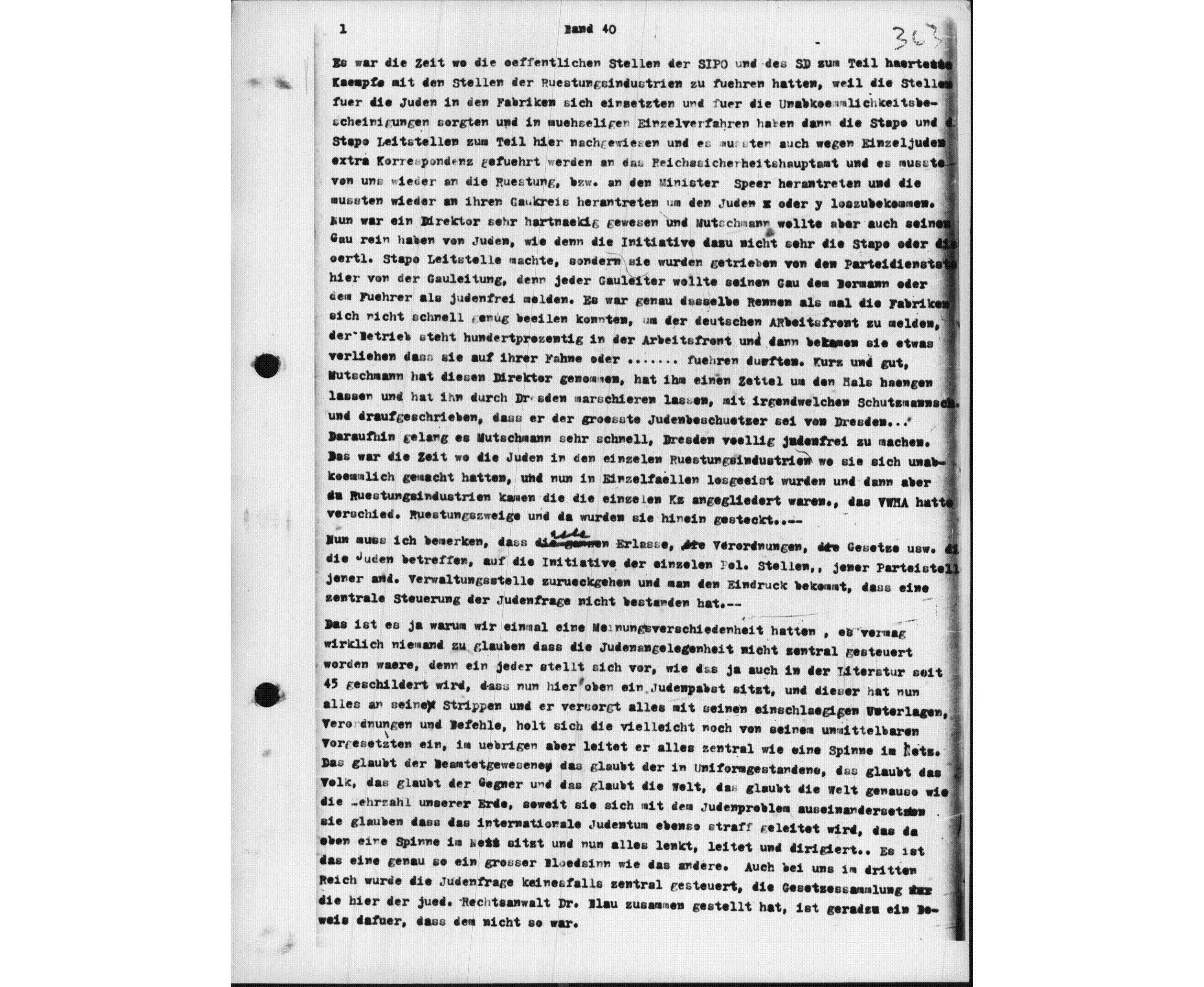
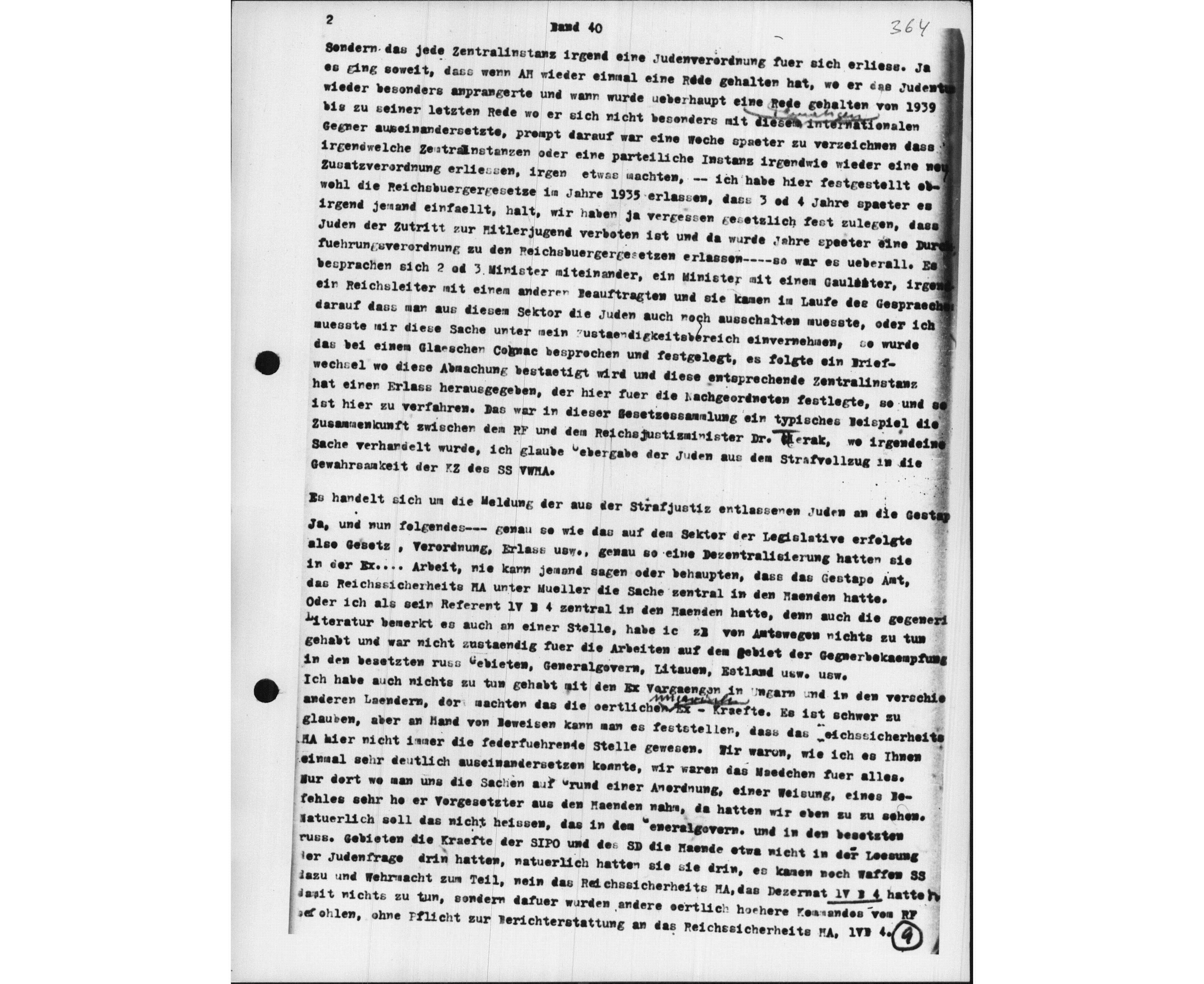
The Jews did not work under our direction. They worked under the direction of the various Jewish caseworkers or specialists, and I would only have told Mobelstein how I envisaged the settlement in terms of construction. I rode over the terrain with him and explained how I would like it. Nisko was to be the first base in this whole district, which I believed and hoped I could obtain for myself. I wanted to bring in further transports, transport trains with material, and bring the people there along with the material, so that settlement could spread from there, from that centre, radiating out in every direction. The San was the border. That was the Jewish territorial border.

And when the thing finally got going, K.H. Frank threw a spanner in the works.

Questioner reads from Wisliceny's report

Eichmann also quietly added Jews from Stettin and Pomerania to these transport trains from Vienna and Brünn.

Eichmann

I know nothing about that, but I would not have found anything wrong with it either.

Questioner reads from Wisliceny's report

The proclamation of the General Government as part of Reich territory, and a written protest by the Governor-General, Frank, to Göring, put an end to this activity of Eichmann’s in December 1939.

Eichmann

Yes. He gave an order to the commander of the Security Police and Security Service through his Higher SS and Police Leader in the General Government, Krüger, that I was to be arrested on entering the General Government. Streckenbach told me this over a small cognac. To avoid causing difficulties, I stayed the night in Krakow, drove back the next morning and then made my reports. But the situation must already have been such that the other side had won, because I myself never again received an order to go to Nisko on the San. On the contrary, after a year, once there was no hope left, I had the camp on the San dissolved and had the Jews taken back to their places of origin or to Theresienstadt.

Questioner

Did you set up this transit camp at Nisko on the San yourself?

Eichmann

Yes, but it was not a camp. Picture this country with its boundless expanse: there were perhaps fifty kilometres with nothing standing there. A little farther on there was a town, Radom. Later it was the district of Lublin. I wanted that whole district too. I wanted to make the town of Radom the capital of this Jewish territory, which would have consisted of the whole district of Lublin. Drawing on experience, I first established myself at Nisko on the San. I could not tackle Radom yet. That would have required extensive administrative regulations to remove the Polish population living there from the area, and even that would not have been enough. Instead, I tackled the matter from below and first got myself established there. Here I needed no decrees and no regulations. Unfortunately, it did not work out as I had imagined it would.

Open page image and German
Page 390 of the typescript, O.65 file 87.
Page 390 · Yad Vashem Archives, O.65/87

German transcription

Die Juden arbeiteten ja nicht unter unserer Leitung, sondern sie arbeiteten unter der Leitung der verschied. jüd. Sachbearbeiter, bzw. Fachleute und ich hätte lediglich Mobelstein gesagt, wie ich mir so die Siedlung baumäßig denke. Ich ritt mit ihm das Gelände ab und erklärte ihm nun wie es ich gerne haben möchte. Und Nisko sollte der erste Stützpunkt sein in diesem ganzen Distrikt, den ich mir anzulachen glaubte und hoffte, und ich wollte weiter Transp. auf Transpzüge mit Material bringen und mit dem Material die Menschen hinbringen, damit von dort, von diesem Ausstrahlungspunkt aus die Besiedlung erfolgen könne und zwar strahlenförmig nach allen Seiten. Der San war die Grenze, das war die jüd territorial Grenze. – Und als man die Sache endlich anlief, da hat mir der K.H. Frank einen Strich durch die Rechnung gemacht. … An diese Transpzüge aus Wien und Brünn… schloß Eichmann auch stillschweigend Juden aus Stettin und Pommern an. Es ist mir unbekannt, aber ich hätte auch keinen Fehler dabei gefunden. Die Ausrufung des Generalgovern. als Teil des Reichsgebietes und ein Protestschrieb des Generalgoverneurs des Frank bei Göring machten dieser Tätigkeit Eichmann in Dez 39 ein Ende. Ja, und zwar hat er einen Befehl gegeben und diesen gab er dem Befehlshaber der SIPO und SD, über seine höheren SS und Pol. Führer im Generalgovern, Krüger, gegeben, daß ich bei Betreten des Generalgovern. zu verhaften sei. Das teilte mir Streckenbach bei einem kleine Cognac mit und um keine Schwierigkeiten zu machen, bin ich die Nacht in Krakau geblieben bin dann am nächsten Morgen zurückgefahren und habe dann meine Berichte erstattet, aber die Sachlage muß schon so gewesen sein, daß die Gegenseite gewonnen hatte, denn ich selber bekam nie wieder den Befehl nach Nisko am San zu fahren, sondern im Gegenteil, ich habe dann nach Jahresfrist, nachdem keine Hoffnung mehr vorhanden war, das Lager am San auflösen lassen und die Juden wieder zurückfahren lassen in ihre Herkunftsorte oder nach Theresienstadt. Dieses Durchgangslager Nisko am San, das haben Sie selber eingerichtet? ? Ja, aber es war kein Lager gewesen, man sich dieses Land vorstellen mit seiner grenzenlose Weite, es waren vielleicht 50 km gewesen, wo nichts stand, es war dann etwas weiter eine Stadt Radom gewesen, es war dann später der Distrikt Lublin gewesen, ich wollte ja auch diesen ganzen Distrikt haben, ich wollte diese Stadt Radom als Hauptstadt dieses jüd. Territoriums machen und dieses hätte bestanden eben aus dem ganzen Distrikt Lublin. Und erfahrungsgemäß setzte ich mich zunächst einmal nach Nisko am San, Radom konnte ich noch nicht angreifen dazu hätte es großer Verwaltungsverordnungen bedurft um die dort ansässige polnischen Bevölkerung auszusiedeln, aber das allein hätte ja auch nicht genügt, so aber habe ich die Sache von unten angepackt und bin erst einmal rein gesessen, hier brauchte ich keine Erlasse und keine Verordnungen, aber leider ist es mir dann doch nicht so gelungen wie ich es mir gedacht hatte.

Draft translation

Band 43 The Jews did not work under our direction, but rather they worked under the direction of the various Jewish caseworkers, or [rather] specialists, and I would merely have said [to] Nobelstein how I picture the settlement to myself construction-wise. I rode along the terrain with him and now explained to him how I would like to have it. And Nisko was to be the first strongpoint in this whole district, which I believed and hoped to lay claim to for myself, and I wanted to bring further transp[orts] on transp[ort] trains with material and to bring the people there with the material, so that from there, from this radiating point, the settlement could take place, and indeed radially in all directions. The San was the border, that was the Jewish territorial border.--- And when the matter had nicely got going, then K.H. Frank threw a wrench in my plans [lit. drew a line through my reckoning]. .... To these transp[ort] trains from Vienna and Brünn....... Eichmann also tacitly attached Jews from Stettin and Pomerania. It is unknown to me, but I would also not have found any fault in it. The proclamation of the General Government as part of the Reich territory and a protest wrote of the Governor-General [i.e. a protest written by the Governor-General] Frank to Göring put an end to this activity of Eichmann's in Dec[ember] [19]39. Yes, and namely he gave an order and this he gave to the commander of the SIPO and SD, via his higher SS and Pol[ice] Leader in the General Government, Krüger, gave [it], that I was to be arrested upon entering the General Government. This Streckenbach informed me of over a small cognac, and in order to make no difficulties, I stayed the night in Kraków, then drove back the next morning and then rendered my reports, but the situation must already have been such that the opposing side had won, for I myself never again received the order to drive to Nisko am San, but on the contrary, I then, after a year's time, after there was no longer any hope, had the camp on the San dissolved and had the Jews driven back again to their places of origin or to Theresienstadt. This transit camp Nisko am San, did you set that up yourself? ? Yes, but it had been no camp, [if] one imagines this land with its boundless expanse, it had perhaps been 50 km where nothing stood, there was then somewhat further a town of Radom, there was then later the district of Lublin, I indeed wanted to have this whole district too, I wanted to make this town of Radom the capital of this Jewish territory and this would have consisted precisely of the whole district of Lublin. And as experience showed, I first of all settled myself into Nisko am San, Radom I could not yet approach, for that great administrative ordinances would have been needed in order to resettle the Polish population resident there, but that alone would indeed also not have sufficed, but this way I tackled the matter from below and first sat right in, here I needed no decrees and no ordinances, but unfortunately it then did not succeed for me as I had imagined it.

It was very much to the Jews’ regret, because we wanted to achieve a political solution with it. That is another example.

Questioner

But surely you could not have drawn up this plan down to the smallest detail, or even carried it out, without your superior being informed of it?

Eichmann

The example of the Central Office for Jewish Emigration in Vienna showed Stahlecker that there always had to be something behind a proposal of mine. I had a certain credit with him. Stahlecker was no pen-pusher who wanted to know everything exactly, down to the smallest detail. He did not bother with that. He liked to be everywhere, hovering above things. Heydrich was exactly the same. Heydrich and Stahlecker could have been siblings. Stahlecker had confidence in my work because of the really successful establishment of the Central Office in Vienna. He knew that I did not simply talk idly about things. On top of that came the crucial point, the political solution. And that was an important part of the political solution: bringing the Jews there and giving them a territory in this district of Lublin.

Questioner reads from Wisliceny's report

Eichmann turned again to his emigration plans, now having to include Polish Jewry in his calculations. It was clear that Palestine would never be able to take in the approximately three and a half million Jews from Germany, Poland, Austria and Czechia.

Questioner

That would mean that, after deducting the three million Jews for Poland, only half a million remained for Germany, Austria and Czechia?

Eichmann

Yes, that can be right. Deduct those who emigrated, and it can be exactly right.

Questioner reads from Wisliceny's report

Added to this was that, under Italian influence, the founding of a Jewish state in Palestine is regarded on the German side as undesirable out of consideration for Arab demands. Nevertheless, emigration from the Reich to Palestine continued until the end of 1940. For example, in September 1940 there were transports from Danzig via …, the Danube, to Romania. Only in 1941 did Himmler prohibit emigration to Palestine. Eichmann considered Madagascar as a country to receive people in large numbers.

This was not Eichmann’s invention. Madagascar had often been discussed as an emigration territory, by Theodor Herzl… In 1937 the French government had sent a commission there, which also included Jewish representatives, to examine the possibility of settling the island with Europeans. The first victory over France in May 194[?] gave the idea fresh impetus. People generally expected the war to end soon. In a detailed memorandum, Eichmann, supported by Heydrich, proposed the island of Madagskar as a settlement area.

Eichmann

I worked it out for Heydrich, not with his support.

Questioner reads from Wisliceny's report

This proposal met with the approval of Himmler and Hitler. Eichmann was instructed to work out a detailed plan. For this he obtained documents from the French Colonial Ministry in Paris, particularly the annual reports of the governors-general and the findings of the commission mentioned above.

Open page image and German
Page 391 of the typescript, O.65 file 87.
Page 391 · Yad Vashem Archives, O.65/87

German transcription

Es war sehr zum Leidwesen der Juden, denn wir wollten eine politische Lösung damit erreichen, das ist wieder mal ein Beispiel. – Aber Sie haben doch diesen Plan mit der Ausarbeitung bis ins kleinste nicht aufstellen oder sogar ausführen könne, ohne daß nicht Ihr Vorgesetzter davon unterrichtet war?? Durch das Beispiel der Zentralstelle für jüd Auswanderung in Wien wußte Stahllecker, daß bei einem Vorschlag von mir immer etwas dahinter sein müßte, ich hatte da eine gewisses Poudier bei ihm, Stahllecker war kein Federfuchser der nur bis in die kleinest Ausarbeitung alles genau wissen wollte, damit hat er sich nicht abgegeben, er war gerne überall, schwebte über den Dingen Heydrich war genau so, Heydrich und Stahllecker hätten Geschwister sein können. Stahllecker hatte Vertrauen zu meiner Arbeit, durch die wirklich gelungene Einrichtung der Zentralstelle in Wien, er wußte, daß ich nicht so etwas nur dahin redete, dazu kam noch der springende Punkt, die politische Lösung… Und das war ein wichtiger Punkt in der politischen Lösung, nämlich die Juden dort hin zu bringen, ihnen ein Territorium zu geben in diesem Distrikt Lublin. Eichmann wandte sich wieder seinen Auswanderungsplänen zu, wobei er nun bei seinen Berechnungen, das poln. Judentum mit einrechnen mußte. Es war klar, daß Palast niemals in der Lage sein würde die etwa 3 1/2 Mill Juden aus Deutschl. Polen, Östr. Tschechei aufzunehmen. Das würde heißen, wenn die 3 Mill Juden für polen wegkommen, daß nur noch eine halbe Mill für Deutschl. Östr. Tschechei übrigblieb? Ja, das kann stimmen, rechnen sie die Ausgewanderten ab, dann kann das genau stimmen. Hierzu kam noch das auf italienischen Einfluß hin, die Gründung des palast. Judenstaates deutscherseits als unerwünscht mit Rücksicht auf die arabischen Forderungen betrachtet wird. Trotzdem fand bis Ende 1940 noch eine Abwanderung aus dem Reich nach Palast statt. So zB im Sept 40 Transps. aus Danzig über …(?) …, Donau nach Rumänien Erst 1941 verbot Himmler die Palast Auswanderung. Als Aufnahmeland für eine Massenaufnahme wurde von Eichmann Madagaskar in Betracht gezogen. Hierbei handelt es sich nicht um eine Erfindung Eichmanns, Madagaskar war als Auswanderungsgebiet schon häufiger diskutiert werden, von Theodor Herzel… 1937 hatte die franz. Reg eine Kommission dorthin entsandt der auch jüd. Vertreter angehörten, um die Möglichkeit für eine Besiedlung der Insel durch Europäer zu prüfen. Der erste Sieg über Frankreich im Mai 194… gab dem Gedanken einen neuen Aufschwung. Ganz allgemein erwartete man ein baldiges Kriegsende. In einer ausführlichen Denkschrift schlug Eichmann, von Heydrich unterstützt, die Insel Madagaskar als Ansiedelraum vor… Ich habe es ausgearbeitet für Heydrich, nicht von ihm unterstützt. Dieser Vorschlag fand die Zustimmung Himmlers und Hitlers. Eichmann wurde beauftragt einen genauen Plan auszuarbeiten. Er besorgte sich hierfür Unterlagen aus dem franz. Kolonialminist in Paris, insbesondere die Jahresberichte der Generalgouverneure und die Ergebnisse der oben erwähnten Kommission.

Draft translation

Band 43 [HW: 391] It was very much to the sorrow of the Jews, for we wanted to achieve a political solution [Leesung — OCR for "Lösung"] thereby, that is once again an example.---- But you surely could not draw up or even carry out this plan with the elaboration down to the smallest detail, without your superior being informed of it?? Through the example of the Central Office for Jewish Emigration in Vienna, Stahllecker [Stahlecker] knew that with a proposal from me there always had to be something behind it, I had a certain [?Roudier?] with him, Stahllecker was no pen-pusher who only wanted to know everything exactly down to the smallest elaboration, he did not concern himself with that, he was gladly everywhere, hovered above things, Heydrich was exactly the same, Heydrich and Stahllecker could have been siblings. Stahllecker had confidence in my work, through the truly successful establishment of the Central Office in Vienna, he knew that I did not just talk like that into the void, added to that was the crucial point, the political solution.... And that was an important point in the political solution, namely to bring the Jews there, to give them a territory in this District Lublin. Eichmann turned again to his emigration plans, whereby he now, in his calculations, had to include Polish Jewry. It was clear that Palestine [Palast — OCR abbreviation/error for "Palästina"] would never be in a position to take in the roughly 3 1/2 million Jews from Germany [HW: (16)], Poland, Austria, Czechia [Tschechei]. That would mean, if the 3 million Jews for Poland go away, that only half a million would remain for Germany, Austria, Czechia? Yes, that can be right, deduct the emigrated ones, then it can be exactly right. To this came further that, on Italian influence, the founding of the Palestinian [palast.] Jewish state is regarded on the German side as undesirable with regard to the Arab demands. Nevertheless, up until the end of 1940 an emigration from the Reich to Palestine [Palast] still took place. Thus for example in Sept 40 transports from Danzig over ...(?)....., [DEL: [illegible]] [HW: Danube] to Romania. Only in 1941 did Himmler forbid the Palestine [Palast] emigration. As a receiving country for a mass reception, Madagascar was taken into consideration by Eichmann. In this it is not a matter of an invention of Eichmann's, Madagascar had already frequently been discussed as an emigration area, by Theeder Herzel [Theodor Herzl].... In 1937 the French government had sent a commission there, to which Jewish representatives also belonged, in order to examine the possibility for a settlement of the island by Europeans. The first victory over France in May 194[0] gave the idea a new upswing. Quite generally one expected a soon end of the war. In a detailed memorandum Eichmann, supported by Heydrich, proposed the island of Madagascar as a settlement space.... I worked it out for Heydrich, not supported by him. This proposal found the approval of Himmler and Hitler. Eichmann was commissioned to work out a precise plan. For this he procured documents from the French Colonial Ministry in Paris, in particular the annual reports of the Governors-General and the results of the above-mentioned commission.

I had even been to Hamburg, to the Tropical Institute, with Dr. Ra…. I worked all of this through down to the smallest detail.

Questioner reads from Wisliceny's report

At the same time he brought together shipping experts for consultations.

Eichmann

That too. I had an expert then named Schlie, a Reich German. He was the same man who managed that strange ship that could never reach land. I had him. But above all, through the emigration advisory office of the Reich Interior Ministry, headed by a ministerial councillor, which admittedly still based its views on the law enacted in the year ’13, I obtained the names of the necessary technical experts and worked with them too. But more important than that was that I drew up a body of legislation specifically for the settlement.

Questioner reads from Wisliceny's report

The transports were to be organized as a joint undertaking of Hapak and Norddeutscher Lord, using various European ports of embarkation. In a peace settlement, France was to be forced to hand over Madagascar as a Jewish colony, and the European states were to be called upon to accede to a convention…

[coughing]

…to join. The following conditions were necessary. First, the Jews in the individual countries had to be retrained from the intellectual professions they preferred into manual trades. Second, Jewish property had to be preserved as far as possible until resettlement, so that it could be used for that purpose. Third, the compilation of accurate Jewish statistics for all countries.

The resettlement operation was to be directed by a neutral office in Berlin. Göring was to take the formal chairmanship of the resettlement staff encompassing all Europe, while the Chief of the Security Police and Security Service was to be entrusted with the technical implementation, which in practice meant Eichmann. Eichmann worked on this plan from 1940 until the summer of 1941. In 1941 the Madagascar plan was still a subject of meetings in Berlin that Eichmann held with his representatives in the individual countries.

[Sense not entirely clear.]

These meetings were mostly concerned with the progress of retraining and its further expansion. In preparation for the Madagascar plan, from August 1940 Eichmann began sending representatives to individual countries occupied by or allied with Germany. They were either assigned to the individual commanders of the Security Police or the Security Service, or attached as assistants to the police attaché. In Slovakia and Romania they were called advisers.

Such representatives were dispatched in the order of their assignments: France first, then Slovakia, Holland, Belgium, Croatia, Romania and Bulgaria. The dispatch of detachments to Greece, Italy, southern France and Denmark was not connected with the Madagascar plan and will therefore be described later. Eichmann gave these representatives the guidelines mentioned above, which had not been rescinded by the spring of 1942. The central organization planned by Eichmann was not set up initially; people wanted to wait until the war ended.

Open page image and German
Page 392 of the typescript, O.65 file 87.
Page 392 · Yad Vashem Archives, O.65/87

German transcription

Ich war sogar in Hamburg gewesen in dem Tropeninstitut gewesen mit Dr. Ra… ich habe dies alles bis ins Kleinste durchgearbeitet. Gleichzeitig zog er Fachleute aus der Schiffahrt zu Beratungen zusammen. Auch das. – Ich hatte damals einen Fachmann namens Schlie, ein Reichsdeutscher, daß ist derselbe Mann der das komische Schiff schaukelte, daß da nie Land gewinnen konnte – den hatte ich, aber vor allen Dingen habe ich über die Auswanderberatungsstelle des Reichsinnenminist., dem ein Ministerialrat vorstand, die freilich noch ihre Gesichtspunkte nach dem Gesetz das im Jahre 13 … erlassen wurde, richteten, – da habe ich auch die nötigen techn. Fachleute genannt bekommen und habe auch damit gearbeitet. Aber wichtiger noch als das war, daß ich ein reines Gesetzeswerk erstellte, zur Besiedlung. Die Transporte sollte als eine Gemeinschaftsarbeit der Hapak und Norddeutscher Lord organisiert werden, unter zugrundelegung verschiedener europäischer Einschiffungshäfen. Bei einem Friedensschluß sollte Frankreich gezwungen werden Madagaskar als Judenkolonie herzugeben und die europäischen Staaten sollten aufgefordert werden, einer Konvention beizutreten… (Husterei) … anzuschließen. Dazu waren folgende Voraussetzungen nötig; 1. Die Juden in den einzelnen Länder mußten von denen von ihnen bevorzugten intellektuellen Berufen auf handwerkliche Berufe umgeschult werden. 2. Das jüd. Vermögen mußte nach Möglichkeit bis zu der Umsiedlung erhalten bleiben, damit es zu diesem Zweck angewendet werden kann. 3. Die Aufstellung einer genauen jüd. Statistik für alle Länder. Die Umsiedlungsaktion sollte von einer neutralen Stelle in Berlin geleitet werden. Den formellen Vorsitz des ganz Europa einziehenden Umsiedlungsstabes sollte Göring übernehmen, während der Chef der SIPO und SD mit der techn. Durchführung beauftragt werden soll, letzteres bedeutete praktisch Eichmann. An diesem Plan hat Eichmann von 1940 bis zum Sommer 41 gearbeitet. 1941 war dieser Mad. Plan sogar noch Gegenstand bei Besprechungen in Berlin, die Eichmann mit seinen Beauftragten in den einzelnen Ländern abhielt (Sinn nicht ganz klar) Es handelte sich bei diesen Besprechungen meistens um den Stand der Umschulungen und ihrem weiteren Ausbau. Zur Vorbereitung des Mad. Plan begann Eichmann ab August 1940 Beauftragte in einzelne von Deutschland besetzte oder verbündete Länder zu entsenden. Diese waren entweder bei den einzelnen Befehlshaber der SIPO oder des SD eingesetzt oder als Gehilfen den Poliz. Attache beigegeben. In der Slowakei und in Rumänien führten sie die Bezeichnung Berater. Solche Beauftragten wurden entsandt nach der Reihenfolge ihrer Beauftragungen; Frankreich als erster, Slowakei, Holland, Belgien, Kroatien, Rumänien, Bulgarien. Die Entsendung von Kommandos nach Griechenland, Italien, Süd-Frankreich und Dänemark hing nicht mit dem Mad Plan zusammen und wird daher später ausgeführt. Diesen Beauftragten gab Eichmann die eben angeführten Richtlinien, die bis Frühjahr 1942 nicht aufgehoben wurden. Die von Eichmann geplante Zentralorganis. wurde zunächst nicht geschaffen, man wollte erst das Kriegsende abwarten.

Draft translation

4 Band 43 [HW: 392] I had even been in Hamburg been in the Tropical Institute with Dr. Ra..... I worked through all of this down to the smallest detail. At the same time he brought together experts from shipping for consultations. That too.---- I had at that time an expert named Schlie, a Reich German, that is the same man who rocked the funny ship, that could there like gain land ----him I had, but above all things I have via the emigration- advisory office of the Reich Interior Ministry, which was headed by a Ministerialrat, which admittedly still oriented their viewpoints according to the law that in the year 13 ...... was issued, --there I also got the [weetigen?] technical experts named to me and worked with that too. But more important still than that was, that I established a pure body of law, for the settlement. The transports were to be organized as a joint undertaking of the Hapak and Norddeutscher Lord, taking as a basis various European embarkation ports. Upon a conclusion of peace France was to be compelled to give up Madagascar as a Jewish colony and the European states were to be called upon to accede to a convention........ (coughing) ..... to join. For this the following preconditions were necessary; 1. The Jews in the individual countries had to be retrained from the intellectual professions preferred by them to handicraft professions. 2. The Jewish property had to as far as possible until the resettlement be preserved, so that it can be applied for this purpose. 3. The drawing up of an exact Jewish statistic for all countries. The resettlement action was to be directed by a neutral office in Berlin. The formal chairmanship of the resettlement staff drawing in all Europe Goering was to take over, while the Chief of the SIPO and SD was to be entrusted with the technical execution, the latter meant practically Eichmann. On this plan Eichmann worked from 1940 until the summer of 41. In 1941 this Mad. plan was even still a subject at discussions in Berlin, which Eichmann held with his commissioned agents in the individual countries (sense not entirely clear) These discussions mostly concerned the state of the retrainings and their further expansion. For the preparation of the Mad. plan Eichmann began from August 1940 to dispatch commissioned agents into individual countries occupied by Germany or allied. These were either assigned to the individual commanders of the SIPO or of the SD or attached as assistants to the police attaché. In Slovakia and in Romania they bore the designation adviser. Such commissioned agents were dispatched according to the order of their commissioning; France as first, Slovakia, Holland, Belgium, Croatia, Romania, Bulgaria. The dispatch of commandos to Greece, Italy, Southern France and Denmark had no connection with the Mad plan and will therefore be set out later. To these commissioned agents Eichmann gave the just cited guidelines, which until spring 1942 were not rescinded. The central organization planned by Eichmann was at first not created, one wanted first to await the end of the war.

Questioner reads from Wisliceny's report

But to establish the future jurisdiction of the Chief of the Security Police and Security Service over all these resettlement problems, Göring, in his capacity as chairman of the Reich Defense Committee, issued a decree in the early summer of 1940, which, with the ……

Yes, that is right. That happened in connection with Madagascar.

Questioner reads from Wisliceny's report

This gave Eichmann the right…

[unintelligible on the recording]

Eichmann

Yes, that is right.

Questioner reads from Wisliceny's report

The word “Final Solution” appeared in this decree. The Madagascar plan came under that heading. Later, the term “Final Solution” acquired a completely different meaning and was used by Himmler and Eichmann as a cover word for the biological annihilation of European Jewry.

Eichmann

With reservations.

Questioner reads from Wisliceny's report

Eichmann did this deliberately, to deceive other agencies that had been let in on the resettlement plans by using the word previously used for resettlement.

Eichmann

That is not right, because Eichmann did not originate that. It originated higher up.

Questioner

What did that gesture just now mean?

Eichmann

That they were not assigned solely for the Madagascar project. We wanted to have them in any case; we wanted to establish ourselves there. Once you are in, you can see what comes next. The same applied to the General Government at the time. It is not my fault that I came off worse there.

Questioner

But Müller, Heydrich and Himmler came off worse too.

Eichmann

Of course, quite clearly. But I think Frank regretted it very much afterwards, because Frank was later pushed into something that he had not wanted at all. He did not want any Jews in the General Government; he wanted it free of Jews. I only wanted to pack one district of his full of Jews. But later he had the whole Final Solution business, and he was in charge of it. Just as he had driven me out of the General Government, he had to take others who then carried out the Final Solution for him. Whether that was any more pleasant, I do not know. The whole thing would have gone differently if Frank had not torpedoed Nisko on the San. Whether he torpedoed it himself or it came from another quarter, I do not know. For Frank it was a great struggle at the time, against Heydrich, against Himmler and against me too.

Questioner reads from Wisliceny's report

In Poland, the handling of all Jewish problems lay in the hands of the Higher SS and Police Leader and the SS and Police Leaders subordinate to him under the individual governors. In general, the ghettos, with their own administrations, had been sealed off. Into these ghettos, to an ever greater extent,

Open page image and German
Page 393 of the typescript, O.65 file 87.
Page 393 · Yad Vashem Archives, O.65/87

German transcription

Um aber die kommende Zuständigkeit des Chefs der SIPO und SD für alle diese Probleme der Umsiedlung festzulegen, gab Göring in seiner Eigenschaft als Vorsitzender des Reichsverteidigungsausschusses einen Erlaß im Frühsommer 1940 heraus, der mit der Vorber[unleserlich]tung… Ja, das stimmt, das geschah im Zusammenhang mit dem Mad. – Damit besaß Eichmann das Recht…(?) undeutlich… Ja das stimmt. In diesem Erlaß kam das Wort Endlösung vor, der Mad Plan lief unter diesem Stichwort, später hat der Begriff Endlösung eine völlig andere Bedeutung bekommen und wurde als Tarnwort für die biologische Vernichtung des europ. Judentums von Himmler und Eichmann benutzt. Mit Vorbehalt… Dies wurde von Eichmann bewußt gemacht, um andere Behörden, die in die Umsiedlungspläne eingeweiht werden waren, mit der d[unleserlich] Anwendung des für die Umsiedlung bisher gebrauchten Wertes, zu täuschen… Das stimmt nicht, denn Eichmann hat das nicht geboren, das wurde höheren Orts geboren. – Was bedeutete diese Geste vorhin? Das sie nicht nur wegen dem Mad Projekt abgestellt wurden, sondern wir wollten sie überhaupt haben, wir wollten uns hinein setzen, wenn man mal drin ist, wird man weiter sehen, dasselbe galt damals für das Generalgovern. Das ich da nun der Unterlegene war, ist ja nun nicht meine Schuld. – Aber es waren auch unterlegen, Müller, Heydrich, Himmler. – Natürlich, ganz klar. – Aber ich glaube, daß Frank das nachher sehr bereut hat, denn Frank ist hier in eine Sache hineingedrängt werden später, die er gar nicht hat haben wollen… Er wollte keine Juden haben im Generalgovern, er wollte judenfrei sein, aber ich wollte ihm nur einen Distrikt voll Juden packen, – aber später hat er ja die ganze Endlösungsgeschichte gehabt, er war ja federführend… genau so wie er mich aus dem Generalgovern. heraus gebissen hat, mußte er andere nehmen, die ihm dann die Endlösung machten, ob das nun angenehmer war, das weiß ich nicht. Die Sache an sich wäre anders verlaufen, wenn Nisko am San von Frank nicht torpediert werden wäre. – Ob er das nun selbst torpediert hat, oder ob es von anderer Stelle kam, das weiß ich nicht. Für Frank war es damals ein großer Kampf, gegen Heydrich, gegen Himmler und auch gegen mich. – In Polen lag die Behandlung aller jüd Probleme in den Händen des Höh. SS und Pol. Führers und den ihm unterstellten SS und Pol. Führern bei den einzelnen Governeuren. Ganz allgemein war die Absperrung der Ghettos mit eigener Verwaltung durchgeführt werden. In diese Ghettos war in immer stärkerem Maße,

Draft translation

Volume 4 393 But in order to establish the coming competence/jurisdiction of the Chief of the SIPO and SD for all these problems of the resettlement, Goering, in his capacity as Chairman of the Reich Defense Committee, issued a decree in early summer 1940, which with the preliminary consultation............. Yes, that is correct, that happened in connection with the Mad[agascar]. - With this Eichmann possessed the right.....(?) unclear..... Yes that is correct. In this decree the word Final Solution occurred, the Mad[agascar] Plan ran under this catchword/heading, later the term Final Solution acquired a completely different meaning and was used as a camouflage word for the biological annihilation of European Jewry by Himmler and Eichmann. With reservation..... This was consciously done by Eichmann, in order to deceive other authorities, which had been let in on the resettlement plans, with the [DEL: for the] application of the [word] hitherto used for the resettlement... That is not correct, for Eichmann did not give birth to that / did not originate that, that was born in higher quarters.- What did this gesture mean beforehand? That they were not only shut down/stopped because of the Mad[agascar] project, but we wanted to have them at all/anyway, we wanted to install ourselves in there, once one is in, one will see further, the same applied at that time for the General Government. That I was now the inferior/loser there, is now indeed not my fault.--- But they were also inferior/losers, Mueller, Heydrich, Himmler.-- Naturally, quite clear.--- But I believe that Frank regretted this very much afterward, for Frank was pushed into a matter here later, which he did not at all want to have.... He did not want to have any Jews in the General Government, he wanted to be free of Jews, but I wanted only to pack one district full of Jews for him, --- but later he indeed had the whole Final Solution business, he was indeed the one taking the lead / holding the pen.... exactly as he bit me out of the General Government, he had to take others, who then did the Final Solution for him, whether that was now more pleasant, that I do not know. The matter in itself would have run differently, if Niske[?] had not been torpedoed at the [Sam?] of Frank.--- Whether he now torpedoed that himself, or whether it came from another place/office, that I do not know. For Frank it was at that time a great struggle, against Heydrich, against Himmler and also against me.-- In Poland the treatment of all Jewish problems lay in the hands of the Higher SS and Pol[ice] Leader and the SS and Pol[ice] Leaders subordinate to him at the individual Governors. Quite generally the sealing-off of the ghettos with their own administration had been carried out. Into these ghettos there was in ever stronger measure,

Questioner reads from Wisliceny's report

armaments plants, especially those producing army equipment, had been moved. The Jews’ situation as regards food, clothing, accommodation and so on varied greatly, depending on the attitude of the SS and Police Leader. Until the summer of 1943, Eichmann concerned himself very little indeed with the Jews in Poland. He confined himself to issuing general guidelines on the formation of ghettos, the appointment of Jewish councils of elders and similar matters. In the occupied territories and the countries allied with Germany where Eichmann’s representatives were active, the main emphasis was on preparing the Madagascar plan. Individual measures arising from the local initiative of commanders of the Security Police and Security Service or the military administrations are deliberately left aside here, since only the broad course of development is to be set out.

People are generally inclined to see Himmler as an ice-cold, cynical politician. This view is certainly not right. In his whole outlook, Himmler was a mystic who paid homage to his ideology with religious fanaticism.

That is not far off the mark.

Questioner reads from Wisliceny's report

While, on the one hand, he consulted astronomers and turned to other sciences, the SS developed into a kind of religious sect with its own forms and customs, in which crude materialism mingled with vague … notions. Not only was personal achievement recognized; promotion was also tied to the number of children, withdrawal from the church and other things.

Eichmann

And he had to believe in God. If he did not believe in God, he could of course leave the church and be an atheist, but then he was excluded. Atheistic lines of thought were not welcome.

Questioner reads from Wisliceny's report

Against the world of the subhuman, Himmler demanded the harshest measures, and that was how the concentration camps came into being. In Himmler’s view, humanity was Christian softening of the spinal cord. Praised be whatever makes you hard. Seeking the solution to the Jewish question in emigration or colonial settlement was, in Himmler’s view, no solution, but merely a shifting of the problem, as the idea of German world domination took an ever stronger hold of him.

Eichmann

This is the first I have heard of that.

Questioner reads from Wisliceny's report

Certainly, as Eichmann has stated, he agreed to the Madagascar plan only out of regard for world opinion and for political reasons.

Eichmann

I do not remember making such a statement. I would have regarded such a statement as insubordinate.

Questioner

But do you think it possible…?

Eichmann

No, no, I do not think that possible.

Questioner

Do you think it possible that the RF (Reichsführer-SS) much preferred a dead Jew to a living Jew on Madagascar?

Open page image and German
Page 394 of the typescript, O.65 file 87.
Page 394 · Yad Vashem Archives, O.65/87

German transcription

Betriebe der Rüstungsindustrie, besonders der Heeresausrüstung verlegt worden. Die Lage der Juden war, was Ernährung, Kleidung, Unterbringung usw. an anbelangt ganz unterschiedlich, je nach der Haltung des SS und Pol. Führers. Eichmann hat sich bis zum Sommer 1943 herzlich wenig um die Juden in Polen gekümmert. Er beschränkte sich auf die Herausgabe allgemeiner Richtlinien über die Ghettobildung, Einsetzung jüd. ältesten Räte und ähnliches. In den besetzten Gebieten und mit in denen mit Deutschland verbündeten Länder in denen die Beauftragten Eichmanns tätig waren, lag das Hauptgewicht auf der Vorbereitung des Mad Planes. Von einzelnen Maßnahmen die der örtlichen Initiative der Befehlshaber der SIPO und SD oder der Militärverwaltungen entsprangen, soll bewußt hier abgesehen werden, da nur die große Linie der Entwicklung hier aufgezeichnet werden soll. Man ist meist geneigt in Himmler einen eiskalten, zynischen Politiker zu sehen diese Ansicht ist sicher nicht richtig, Himmler war seiner ganzen Haltung nach ein Mystiker der seiner Weltanschauung mit religiösem Fanatismus huldigte. Das ist nicht ganz daneben getroffen… Während er auf der einen Seite Astronomen zu Rate zog und sich andere Wissenschaften zuwandte, entstand aus der SS eine Art religiöse Sekte mit eigenen Formen und Brauchtum, in der grober Materialismus mit verschwommenen …(?) Vorstellungen vermengte. Nicht nur die persönliche Leistung wurde anerkannt, sondern die Beförderung war an Kinderzahl, Kirchenaustritten und anderen Dingen gebunden. Und gottgläubig mußte er sein… war er nicht gottgläubig, er konnte ja auch aus der Kirche austreten, und ein Atheist sein, er war aber dann ausgeschlossen. Atheistische Gedankengängen waren nicht zuträglich. Gegenüber der Welt des Untermenschen forderte Himmler schärfste Maßnahmen, so entstanden die KZ, Humanität war nach Himmlers Ansicht christliche Rückenmarckserweichung… Gelobt sei, was hart macht… Die Lösung der Judenfrage in einer Auswanderung oder in einer kolonialen Siedlung zu suchen, war nach Himmlers Ansicht keine Lösung, sondern nur eine Verlagerung des Problems, je stärker der Gedanke der deutschen Weltherrschaft Besitz von ihm ergriff… – Das höre ich zum ersten Mal… Sicherlich hat er, wie Eichmann erklärt hat, den Mad. Plan nur mit Rücksicht auf die Weltöffentlichkeit und aus politischen Motiven zugestimmt… Ich entsinne mich nicht eine solche Äußerung getan zu haben, ich würde sie ja als subordinationswidrig aufgefaßt haben eine solche Äußerung. Aber halten Sie es für möglich… Nein, nein, das halte ich nicht für möglich… Halten Sie es für möglich, daß dem RF ein toter Jude viel lieber war, als ein lebendiger Jude auf Mad?

Draft translation

plants of the armaments industry, especially of the naval outfitting/equipment, had been relocated. The situation of the Jews was, as far as nutrition, clothing, housing etc. is concerned, quite varied, depending on the attitude of the SS and Pol. leader. Eichmann concerned himself heartily little with the Jews in Poland up to the summer of 1943. He confined himself to the issuing of general guidelines regarding the ghetto formation, installation of Jewish councils of elders and the like. In the occupied territories and with [TS INS: in] those countries allied with Germany in which Eichmann's agents were active, the main emphasis lay on the preparation of the Mad[agascar] Plan. Of individual measures which sprang from the local initiative of the commanders of the SIPO and SD or of the military administrations, it shall consciously be disregarded here, since only the broad line of the development is to be recorded here. One is mostly inclined to see in Himmler an ice-cold, cynical politician, this view is surely not correct, Himmler was by his whole bearing a mystic who paid homage to his worldview with religious fanaticism. That is not entirely off the mark.... While on the one hand he consulted astronomers and turned to other sciences, out of the SS there arose a kind of religious sect with its own forms and customs, in which crude materialism mingled with vague .....(?) notions/displacements. Not only was personal achievement recognized, but the [DEL: [illegible]] promotion was tied to number of children, church withdrawals and other things. And believing-in-God he had to be..was he not believing-in-God, he could indeed also withdraw from the church, and be an atheist, but he was then excluded. Atheistic trains of thought were not conducive/beneficial. Toward the world of the subhuman Himmler demanded the sharpest measures, thus the concentration camps arose, humanity was according to Himmler's view Christian softening-of-the-spinal-marrow... Praised be what makes hard....... To seek the solution of the Jewish question in an emigration or in a colonial settlement was according to Himmler's view no solution, but only a shifting of the problem, the stronger the idea of German world domination took possession of him..-- That I hear for the first time..... Certainly he, as Eichmann has explained, agreed to the Mad[agascar] Plan only with regard to world public opinion and out of political motives... I do not recall having made such an utterance, I would indeed have understood it as insubordinate, such an utterance. But do you hold it to be possible....... No, no, that I do not hold to be possible.... Do you hold it to be possible, that to the RF[SS] a dead Jew was much dearer than a living Jew on Mad[agascar]?

No, not at all. Whoever writes that has no idea of the truth.

Questioner reads from Wisliceny's report

The events after the outbreak of the war with Russia show that the RF (Reichsführer-SS) was inwardly contemplating the annihilation of European Jewry.

Eichmann

Yes, I have already said that. Everything changed then.

Questioner reads from Wisliceny's report

He, like Heydrich, Müller and Eichmann, was determined to deal Jewry a blow from which it will not recover, as Eichmann put it to Richter in 1945 with cynical frankness.

Eichmann

If I said that to Richter, then it was certainly only something I had heard. It is completely false that Himmler, Heydrich, Müller and Eichmann decided to exterminate Jewry at the beginning of the Russian campaign. “Decided” is not the right word anyway. The RF (Reichsführer-SS) received it as an order; it was not his idea. I still remember exactly the moment when I was told, “The Führer has ordered physical annihilation.” I heard the words “physical annihilation” for the first time in my life.

That is how this situation stayed with me. I have forgotten a great deal, but I will probably never be able to forget that moment. Neither Müller nor Heydrich nor Eichmann nor anyone else was involved in it; this matter was decided directly by the Führer and the RF (Reichsführer-SS). The RF (Reichsführer-SS) then issued the necessary instructions, certainly also to the head of the VWHA (Economic and Administrative Main Office).

The Chief of the Security Police, perhaps together with Müller, because Müller was in direct contact with the individual special task force (Einsatzgruppen) chiefs, perhaps the two of them came up with the words “anti-tank ditches”. When I was summoned to Heydrich, I was already presented with a fully worked-out plan, which I was to inspect and report on to him. He told me that Glo… had received orders from the RF (Reichsführer-SS) to use the Russian anti-tank ditches to shoot the Jews there and then level the ditches. I was to go there and report to him how far the work had progressed.

With this statement I give the lie to the author’s construction. I bring it up because the author says I told Richter that it was a blow from which Jewry would not recover. I do not want to deny that sentence outright, because I cannot remember it. But if I did say it, then I had heard it and repeated it to my staff in that form.

Questioner reads from Wisliceny's report

The annihilation of Russian Jewry was carried out through mass shootings, which the so-called special task forces (Einsatzgruppen) of the Security Police were charged with carrying out.

[Typed as notes in the transcript: Ohlendorf’s explanatory testimony in Nuremberg.]

In this Commissar Order, Eichmann saw an opportunity to annihilate the rest of Jewry as well.

Eichmann

Complete nonsense.

Questioner reads from Wisliceny's report

In agreement with Müller and Heydrich, he began in the autumn of 1941 to deport Jews from Reich territory, Austria, Bohemia and Moravia to areas where the Commissar Order applied, especially Riga and Minsk.

Open page image and German
Page 395 of the typescript, O.65 file 87.
Page 395 · Yad Vashem Archives, O.65/87

German transcription

Nein, keinesfalls… der das schreibt hat keine Ahnung von der Wahrheit… Daß der RF im Inneren an eine Vernichtung des europäischen Judentums dachte zeigen die Ereignisse nach Ausbruch des Krieges mit Rußland… Ja, das sagte ich ja schon, da hat sich alles gewandelt… Er sowohl wie Heydrich, Müller und Eichmann waren entschlossen dem Judentum einen Schlag zu versetzen, von dem es sich nicht mehr erholen wird, wie es Eichmann 1945 Richter gegenüber in zynischer Offenheit aussprach… Wenn ich das Richter gegenüber gesagt habe, dann ist das sicherlich nur eine Sache gewesen die ich gehört habe. Völlig falsch ist es, daß mit Beginn des Rußlandfeldzuges Himmlers, Heydrich, Müller und Eichmann die Ausrottung des Judentums beschlossen hätten – beschlossen ist sowieso nicht das gegebene Wort, der RF hat es befohlen bekommen, es war nicht seine Idee und ich erinnere mich noch genau an den Augenblick, als man mir sagte, der Führer hat die physische Vernichtung befohlen, ich hörte das Wort physische Vernichtung zum ersten Mal in meinem Leben. So ist mir diese Situation haften geblieben, ich habe wohl viel vergessen, aber diesen Augenblick werde ich wohl nie vergessen können Weder Müller, noch Heydrich, noch Eichmann, noch irgend jemand sonst war damit befaßt, sondern diese Sache wurde vom Führer und vom RF direkt beschlossen. Daraufhin hat der RF seine nötigen Anordnungen gegeben, sicherlich auch an den Chef des VWHA. – Der Chef der SIPO hat man vielleicht mit Müller, weil Müller mit den einzelnen Einsatzgruppenchefs in unmittelbaren Konex stand, haben beide vielleicht das Wort "Panzergräben" geboren – denn als ich zu Heydrich befohlen wurde, wurde mir bereits ein fix und fertiger Plan serviert, den ich inspizierend ihm zu berichten hätte, nämlich er sagte mir, das Glo… vom RF den Befehl bekommen hat, die russ Panzergräben zu benutzen um dort die Juden zu erschießen, und dann die Gräben einzuebnen, ich solle hinfahren und ihm berichten wie weit die Arbeit gegangen sind… Mit dieser Feststellung strafe ich die Kombination des Autors Lügen. Und ich komme darauf, weil der Autor sagt, ich hätte Richter gesagt… das sei ein Schlag von dem sich das Judentum nicht erholen würde… Ich will diesen Satz nicht unbedingt in Abrede stellen, weil ich mich nicht entsinnen kann, sollte ich es aber gesagt haben, dann habe ich es gehört und habe es so meinen Mitarbeitern wiedergegeben… Die Vernichtung des russ. Judentums wurde durch Massenerschießungen durchgeführt, mit deren Ausführung die sogen. Einsatzgruppen der SIPO beauftragt waren… ausführende Aussage Ohlendorfs in Nürnberg… In diesem Kommissarerlaß sah Eichmann eine Möglichkeit auch das übrige Judentum zu vernichten… Völliger Blödsinn… Im Einverständnis mit Müller und Heydrich begann er im Herbst 1941 Juden aus dem Reichsgebiet, Östr. Böhmen und Mährenwach Gebieten zu deportieren in denen der Kommissarerlaß gültigkeit hatte, besonders nach Riga und Minsk.

Draft translation

7 Volume 43 [HW: 395] No, in no case... whoever writes that has no idea of the truth... That the RF inwardly was contemplating an annihilation of European Jewry is shown by the events after the outbreak of the war with Russia..... Yes, I already said that, everything changed there..... He as well as Heydrich, Mueller and Eichmann were determined to deal Jewry a blow from which it will never recover again, as Eichmann expressed it in 1945 to Richter in cynical openness... If I said that to Richter, then that was surely only a thing which I had heard. It is completely false that with the beginning of the Russian campaign Himmler, Heydrich, Mueller and Eichmann had decided the extermination of Jewry------decided is anyway not the given word, the RF received it as an order, it was not his idea and I still remember exactly the moment when I was told, the Fuehrer has ordered the physical annihilation, I heard the word physical annihilation for the first time in my life. Thus this situation has stuck with me, I have indeed forgotten much, but this moment I will probably never be able to forget. Neither Mueller, nor Heydrich, nor Eichmann, nor anyone else at all was concerned with it, rather this matter was decided directly by the Fuehrer and by the RF. Thereupon the RF gave his necessary directives, surely also to the chief of the VWHA.----The chief of the SIPO one has perhaps with Mueller, because Mueller stood in immediate contact with the individual Einsatzgruppen chiefs, both perhaps gave birth to the word "tank ditches"--for when I was ordered to Heydrich, a ready-made plan was already served to me, which I inspecting had to report to him, namely he told me that Glo.... has received the order from the RF to use the Russian tank ditches in order to shoot the Jews there, and then to level the ditches, I was to drive there and report to him how far the work has progressed...... With this determination I give the lie to the author's combination. And I come to it, because the author says, I supposedly said to Richter... that it be a blow from which Jewry would not recover...... I do not necessarily want to deny this sentence, because I cannot recall, but should I have said it, then I heard it and gave it to my co-workers in that way... The annihilation of Russian Jewry was carried out through mass shootings, with whose execution the so-called Einsatzgruppen of the SIPO were charged.... executive/executing testimony of Ohlendorf in Nuremberg..... In this Commissar Order Eichmann saw a possibility to annihilate also the remaining Jewry... Complete nonsense.... In agreement with Mueller and Heydrich he began in autumn 1941 to deport Jews from the Reich territory, Austria, Bohemia and Moravia [Maehrenwach] areas in which the Commissar Order had validity, especially to Riga and Minsk.

This author’s logic or argument is to be dismissed as sheer nonsense, because I would not even have had the possibility of looking there for the only way of solving the problem. My task was to send the Jews to the concentration camps, after nobody would take them any longer and the RF (Reichsführer-SS) had stopped all emigration at the beginning of the Russian campaign. The order came that anyone in a concentration camp had to remain there until the end of the war, that nobody could be released, and that all the Jews were to be sent to the concentration camps. It was completely indifferent to me where the Jews went.

As far as I was concerned, they could have marched to Madagascar, or to Glo to be gassed, or to Auschwitz, or to Riga. It was completely indifferent to me, because I could not determine where they went anyway. My timetable man had to sit down each time with the responsible official in the VWHA (Economic and Administrative Main Office), and the VWHA told me the reception stations. Or, if the VWHA was not responsible for Riga and Minsk, it is quite possible that the RF (Reichsführer-SS) himself fixed the reception stations. The RF (Reichsführer-SS) had a mania for interfering, often down to the smallest details, and made life administratively difficult that way.

Questioner reads from Wisliceny's report

At this time no Jews are being annihilated outside Russian territory. They are being annihilated on Russian territory on the basis of the Commissar Order.

Unknown speaker

Of course Jews were killed in the General Government in 1941.

Questioner reads from Wisliceny's report

In Riga was Eichmann’s friend, Stahlecker, chief of the special task forces (Einsatzgruppen). This deportation to Riga and Minsk, to bring them in this way within the scope of the Commissar Order. This deportation came from Eichmann’s own initiative, as he himself has admitted.

Eichmann

Nonsense. That is all I can say. I had nothing more to do with Stahlecker from the moment he left Prague. I had nothing to do with him either officially or privately. We never exchanged a single letter.

Questioner reads from Wisliceny's report

On the other hand, Theresienstadt was being built up as a model ghetto at this time. This alone marks out the whole development in stages. From the summer of 1941, Eichmann began to concern himself increasingly with Jewry in Poland.

Eichmann

That is rubbish. I had no business concerning myself with that at all. For me, Poland was finished after the Nisko project and after the BDS (commander of the Security Police and Security Service) in Krakow told me that he had to arrest me. After that I did not concern myself with anything further. I went there another two or three times to Glo… as a postman, but nothing else. I had no jurisdiction and no authority.

Questioner reads from Wisliceny's report

On several occasions, Eichmann carried out mass executions in Poland on Himmler’s orders?

Eichmann

No, I did not carry out a single execution.

Open page image and German
Page 396 of the typescript, O.65 file 87.
Page 396 · Yad Vashem Archives, O.65/87

German transcription

Die Logik oder die Beweisführung dieses Autors ist als glatter Blödsinn abzutun, denn ich hätte es ja gar nicht möglich gehabt, darin die einzige Möglichkeit zu suchen das Problem zu lösen. Meine Aufgabe war die Juden in die KZ zu schicken, nachdem sie nun niemand mehr angenommen hat und der RF mit Beginn des Rußlandfeldzuges jegliche Auswanderung gestoppt hat. Der Befehl kam, daß wer im KZ sitzt, drin zu bleiben hätte bis Kriegsende, keiner entlassen werden durfte und daß die Juden alle in die KZ zu überweisen sind. Mir war es völlig egal, wohin die Juden kamen, von mir aus hätten sie auch nach Mad marschieren können, von mir aus auch zu Glo zum vergasen, von mir aus auch nach Auschwitz, auch nach Riga… das ist mir völlig egal gewesen, weil ich sowieso nicht bestimmen kannte wohin… mein Fahrplanonkel hatte sich ja mit dem Zuständigen des VWHA jeweils zusammen zu setzen… und daß das VWHA mir die Aufnahmestationen sagte oder wenn für Riga und Minsk der VWHA nicht zuständig gewesen sein sollte, ist es sehr leicht möglich daß der RF selbst die Aufnahmestationen festlegte… denn der RF hatte die Sucht sich oftmals bis in die kleinsten Details sich einzumischen und machte einem damit das Leben verwaltungstechn schwer. Zu dieser Zeit werden außerhalb des russ Territoriums keine Juden vernichtet. Sie werden auf russ Territorium vernichtet, auf Grund des Kommissarerlasses. Selbstverst. sind 1941 im Generalgovern. Juden getötet worden… In Riga war Eichmanns Freund, Stahllecker, Chef der Einsatzgruppen, diese Deportation nach Riga und Minsk, um sie auf diese Weise unter die Wirkung des Kommissarerlasses zu bringen. Diese Deportation entsprach Eichmanns privater Initiative wie er selbst zu gegeben hat… Blödsinn, mehr kann ich nicht sagen… Mit Stahllecker habe ich nichts mehr zu tun gehabt, ab dem Augenblick in dem er abmarschierte von Prag. Ich hatte weder dienstlich, noch privat mit ihm zu tun, wir haben nie einen einzigen Brief gewechselt. Andererseits wurde Theresienstadt um diese Zeit als Musterghettos aufgebaut Schon allein hieraus ist die ganze Entwicklung stufenweise gekennzeichnet. Seit dem Sommer 1941 begann Eichmann sich in immer stärkeren Maße sich mit dem Judentum in Polen zu befassen… Das ist Quatsch, damit hatte ich mich ja gar nicht zu befassen… Für mich war Polen erledigt gewesen nach dem Nisko Projekt und mir der BDS in Krakau sagte, daß er mich zu verhaften habe… ich habe mich dann um nichts mehr gekümmert, ich bin noch 2 od 3 Mal hingefahren zu Glo… als Briefträger, aber sonst nichts, ich habe keine Zuständigkeit und keine Vollmacht gehabt… Verschied. Male hat Eichmann auf Befehl Himmler in Polen Massenexekutionen durchgeführt?? Nein, ich habe nicht eine einzige Exekution durchgeführt.

Draft translation

The logic or the argumentation of this author is to be dismissed as sheer nonsense, for I would not even have had the possibility of seeking therein the only possibility of solving the problem. My task was to send the Jews to the concentration camps, after no one would take them any longer and the RF [Reichsführer] with the beginning of the Russian campaign stopped all emigration. The order came that whoever sits in the KZ [concentration camp] would have to stay in until the end of the war, none was allowed to be released, and that the Jews are all to be transferred to the KZ. It was completely all the same to me where the Jews came to; as far as I was concerned they could also have marched to Mad, as far as I was concerned also to Gle [Globocnik?] for gassing, as far as I was concerned also to Auschwitz, also to Riga........that was completely all the same to me, because I anyway could not determine where... my timetable-uncle [Fahrplanonkel] had after all to sit down together with the responsible person of the VWHA [WVHA] in each case.... and that the VWHA told me the reception stations or if for Riga and Minsk the VWHA should have been responsible for me, it is very easily possible that the RF himself established the reception stations....for the RF had the addiction to meddle often down into the smallest details and thereby made life administratively-technically difficult for one. At this time no Jews are exterminated outside of Russian territory. They are exterminated on Russian territory, on the basis of the Commissar Order. Self-evidently Jews were killed in 1941 in the General Government... In Riga was Eichmann's friend, Stahllecker [Stahlecker], chief of the Einsatzgruppen, this deportation to Riga and Minsk, in order to bring them in this way under the effect of the Commissar Order. This deportation corresponded to Eichmann's private initiative as he himself has admitted.. Nonsense, more I cannot say.... With Stahllecker [Stahlecker] I had nothing more to do, from the moment in which he marched off from Prague. I had neither officially nor privately anything to do with him, we never exchanged a single letter. On the other hand Theresienstadt was around this time built up as a model ghetto. From this alone the whole development is characterized step by step. Since the summer of 1941 Eichmann began to concern himself in ever stronger measure with Jewry in Poland... That is rubbish, with that I did not have to concern myself at all... For me Poland was finished after the Nisko project and the BDS in Krakau [Cracow] told me that he had to arrest me.....I then no longer bothered about anything, I still drove there 2 or 3 times to Gle [Globocnik?]...as a letter-carrier, but otherwise nothing, I had no jurisdiction and no authority..... Various times Eichmann carried out mass executions in Poland on Himmler's order?? No, I did not carry out a single execution.

Questioner reads from Wisliceny's report

His relationship became especially close with the Higher SS and Police Leader in Lublin, the former Austrian Gauleiter O. Glo…, whom Eichmann already knew from Austria.

Yes, I knew him from Austria, but I had no close relationship with him.

Questioner reads from Wisliceny's report

According to Eichmann’s own statements to his subordinates, Glo… was the first to use gas chambers for the mass extermination of people.

Eichmann

Yes, but why are the subordinates never named?

Questioner reads from Wisliceny's report

Glo had established large labour camps in his command area. As Eichmann said, this procedure was less conspicuous for Glo than mass shootings, since various police units had refused to carry out the executions of women and children. On the other hand, there was a separate detachment to remove the traces of the executions, and it was formally subordinate to Eichmann.

Eichmann

When the retreat began on our side, I was summoned to Müller. Müller told me that the mass graves in the East had to be cleared up so that they would not fall into Russian hands, and that a Standf. (Standartenführer), Paul Blobel, would arrive in Berlin within the next few days. He had been commissioned by the Chief of the Security Police and was coming with his own detachment. Blobel had previously been chief of a special task detachment (Einsatzkommando), and before that head of a Security Service district somewhere in western Germany. Müller went on to say, “I do not know how to accommodate him. I am placing him under you for his material needs.” I received the order. Some time later a tall, heavy-boned man reported to me.

He introduced himself in a perpetually hoarse voice and coarse language. The fellow did not have five kreuzers’ worth of manners: “Ostf., you are to provide for my material needs. The substance of my assignment is none of your business. Where can I find quarters? I have my men here too.” Three or four men, just as arrogant as he was. As I said, I did nothing more than provide for his material needs. His work did not interest me, and I had no idea how things were done there. He had his own maps and worked entirely independently with his men. I had already had clashes with him before, which I have already mentioned. The detachment was simply called the “Blobel Detachment ”.

Questioner reads from Wisliceny's report

After the outbreak of war with the USA, in November 1941, came Hitler’s decision to order the biological annihilation of Jewry…

Unknown speaker

[indistinct muttering]

Questioner reads from Wisliceny's report

In August 1942 Eichmann showed Wi an order from Himmler, dated spring 1942, for physical annihilation.

Questioner

Is that right?

Eichmann

No, I never had an order from the RF (Reichsführer-SS) for physical annihilation.

Open page image and German
Page 397 of the typescript, O.65 file 87.
Page 397 · Yad Vashem Archives, O.65/87

German transcription

Besonders eng wurde sein Verhältnis mit dem Höh. SS und Pol. Führer in Lublin, dem früheren östr. Gauleiter O. Glo… dem Eichmann schon aus Östr, kannte Ja, ich kannte ihn aus Östr, aber hatte kein enges Verhältnis mit ihm… Nach Eichmanns eigenen Angaben seiner Untergebenen gegenüber hat Glo… als erster Gaskammern zu Massenextermination von Menschen angewandt… Ja, aber warum sagt man die Untergebenen nie? Glo hatte in seinem Kommandobereich große Arbeitslager errichtet. Wie Eichmann sagte, war dieses Verfahren Glo unauffälliger als die Massenerschießungen da sich verschied. die Pol. Einheiten geweigert hatten, die Exekutionen von Frauen und Kindern durchzuführen. Andererseits hatte man zur Beseitigung der Spuren der Exekutionen ein eigenes Kommando, das Eichmann formell unterstellt war. In dem Moment da bei uns der Rückzug anfing, wurde ich zu Müller befohlen und Müller sagte mir, daß die Massengräber im Osten um sie nicht in der Hände der Russen fallen zu lassen, aufgeräumt werden müssen und daß sich in den nächsten Tagen ein Standf. Paul Globel in Berlin einfinden wird, der ist vom Chef der SIPO beauftragt worden, der kommt mit einem eigenen Kommando. Globel war vorher Einsatzkommandochef gewesen und vorher war er Führer eines SD Abschnittes irgendwo in Westdeutschland… Er sagte weiter, ich weiß nicht wie ich ihn unterbringen soll, wirtschaftlich unterstelle ich ihn ihnem. Ich nahm den Befehl entgegen, einige Zeit später meldete sich bei mir ein großer derbknochiger Mann, er stellte sich mit einer ewig heiseren Stimme mit groben Worten bei mir vor, Manieren hatte der Kerl nicht für 5 Kreuzer,: Ostf. Sie haben mich wirtschaftl. zu betreuen, sachlich geht Sie meine Aufgabe nichts an, wo kann ich unterkommen, ich habe hier auch meine Leute, 3 od 4 Mann, ebenso arrogant wie er selbst, Ich war wie gesagt, weiter nichts als eine wirtschaftliche Betreuung für ihn. Seine Arbeit interessierte mich ja nicht, ich hatte auch keine Ahnung, wie es da zuging, er hatte seine eigenen Karten und arbeitete völlig selbständig mit seinen Leuten. Ich hatte ja schon früher einmal Zusammenstäße mit ihm die ich ja schon anführte… Das Kommanda hieß nur "Kommando Globel – Nach dem Kriegsbeginn mit der USA, im November 1941, kam der Bescheid Hitler die Biologische Vernichtung des Judentums zu befehlen… (Undeutliches Gemurmel) Eichmann zeigte im August 1942 Wi einen Befehl Himmlers datiert vom Frühjahr 1942? zur physischen Vernichtung. Stimmt das? Nein, ich habe nie einen Befehl vom RF zur physischen Vernichtung gehabt.

Draft translation

9 Band 43 [HW: 397] Especially [TS INS: close] was his relationship with the Higher SS and Police Leader in Lublin, the former Austrian Gauleiter O. Gle....... whom Eichmann already knew from Austria Yes, I knew him from Austria, but had no close relationship with him..... According to Eichmann's own statements to his subordinates, Gle... was the first to apply gas chambers for the mass extermination of people... Yes, but why does one say the subordinates like? Gle had erected large labor camps in his [DEL: work area] [TS INS: Kommando]. As Eichmann said, this procedure of Gle's was less conspicuous than the mass shootings since various police units had refused to carry out the executions of women and children. On the other hand, for the removal of the traces of the executions one had a special detachment, which was formally subordinated to Eichmann. At the moment when the retreat began with us, I was ordered to Mueller and Mueller told me that the mass graves in the East, in order not to let them fall into the hands of the Russians, must be cleaned up, and that in the next few days a Standartenführer Paul Globel will appear in Berlin, he has been assigned by the Chief of the SIPO, he comes with his own detachment. Globel had previously been Einsatzkommando chief and before that he was leader of an SD sector somewhere in West Germany.....He said further, I do not know how I should accommodate him, economically I subordinate him to you. I received the order, some time later a big burly-servile man reported to me, he introduced himself to me in an eternally hoarse voice with coarse words, the fellow did not have manners for 5 kreuzers, : Obersturmführer, you have to look after me economically, factually my task is none of your business, where can I lodge, I have my people here too, 3 or 4 men, just as arrogant as he himself, I was, as said, nothing further than an economic caretaker for him. His work did not interest me, I also had no idea how things went there, he had his own maps and worked completely independently with his people. I had already once earlier had clashes with him which I already cited...... The detachment was called only "Kommando Globel--- After the beginning of the war with the USA, in November 1941, came the order to command Hitler the biological annihilation of Jewry... (Indistinct murmuring) Eichmann showed Wi in August 1942 an order of Himmler's dated from spring 1942? for physical annihilation. Is that correct? No, I never had an order from the RF for physical annihilation.

Questioner reads from Wisliceny's report

Certainly Hitler’s order had been given some time earlier, since holding back the Jews fit for work was the main subject of Himmler’s order.

If that is so, I do not want to deny it, because the RF (Reichsführer-SS) very often interfered in details, and he may well have written to the Chief of the Security Police and Security Service. It should be noted that in deporting Jews from Reich territory or anywhere else, not from the General Government, because I was not responsible for that, Jews fit for labour deployment are to be exempted.

Questioner reads from Wisliceny's report

That such an order for physical annihilation can be reconstructed may be established from Eichmann’s statements to Wi, Richter and Krumey. First, the Madagascar plan was finally abandoned in the winter of 1941–42. The reasons were ideological.

Eichmann

Rubbish. The military situation, nothing else.

Questioner reads from Wisliceny's report

Second, before deportations from Europe and mass annihilations began in the summer of 1942, there were preliminary stages triggered by the Commissar Order.

Eichmann

That is possible, yes.

Questioner reads from Wisliceny's report

Third, the radical change was not recognizable until the summer of 1942. It was carefully camouflaged and explained to the public as resettlement to Poland and, at the same time, as intensified antisemitic propaganda.

Eichmann

Possible.

Questioner reads from Wisliceny's report

Fourth, on his own initiative or at Pohl’s suggestion, Himmler held back the Jews fit for work from biological annihilation because he wanted to use them as labour slaves in the large factories. He also wanted these labour slaves to carry out other projects, the planting of a forest belt to improve the climate.

Eichmann

Yes, that is right. The suggestion came from some forestry fellow.

Questioner reads from Wisliceny's report

From March 1942 Eichmann, in possession of the corresponding orders, began deporting and annihilating European Jewry. Auschwitz and several camps near Lublin were established as extermination camps. Eichmann had not specifically fixed the sequence of the individual countries. He took his time, since the annihilation of Polish Jewry and deportation from the Reich evidently seemed more urgent to him.

Eichmann

No, he had to take his time, because he could carry out his deportations only when a) the legal prerequisites had been created and enacted in territories outside the Reich or not under Reich control, b) the Reich Transport Ministry made the necessary transport trains available, and c) the SS VWHA (Economic and Administrative Main Office) … the capacity to receive them. Then I could carry out my order.

Open page image and German
Page 398 of the typescript, O.65 file 87.
Page 398 · Yad Vashem Archives, O.65/87

German transcription

Sicher ist der Befehl Hitlers schon einige Zeit vorher gegeben worden, da in dem Himmler Befehl die Zurückstellung der arbeitsfähigen Juden den Hauptgegenstand bildete Wenn das so ist, will es nicht verneinen, weil der RF sich sehr oft in Einzeldinge/ hereingemischt hat und er sehr wohl dem Chef der SIPO und SD geschrieben haben mag… es ist zu beachten daß bei der Deportierung der Juden aus dem Reichsgebiet oder irgendwo, aus dem Generalgovern. nicht, denn dafür war ich ja nicht zuständig gewesen, arbeitseinsatzfähige Juden auszunehmen sind. Daß sich so ein Befehl zur physischen Vernichtung zusammen stellen kann, auf Grund Eichmanns Angabe gegenüber Wi, Richter und Gromeid festgestellt werden, 1. der Mad. Plan wurde im Winter 41/42 endgültig fallen gelassen. Die Gründe hierfür waren ideologischer Art Quatsch, die militärische Lage, weiter nichts… 2. bis zur Einsetzung der Deportierungen aus Europa und der Massenvernichtungen im Sommer 1942, waren Vorstufen vorhanden, die vom Kommissarbefehl ausgelöst wurden. Das ist möglich, ja. – 3. Die radikale Änderung war bis zum Sommer 1942 nicht erkennbar, sie wurde sorgfältig getarnt und und der Öffentlichkeit als Umsiedlung nach Polen und gleichzeitig als verstärkte antisemitische Propaganda erklärt. Möglich… 4. Von der biologischen Vernichtung hat Himmler aus eigener Initiative oder auf Vorschlag Pohl die arbeitsfähigen Juden zurückgestellt, da er sie als Arbeitssklaven in den großen Betrieben einsetzen wollte… Auch andere Arbeitsvorhaben wollte er von diesen Arbeitsklaven ausführen lassen, die Anpflanzung eines Waldgürtels zur Klimaverbesserung Ja, das stimmt, der Vorschlag kam von irgendeinem For theini… als Forstheini Seit März 1942 begann Eichmann in Besitz der entsprechenden Befehle mit der Deportation und Vernichtung des europäischen Judentums. Als Vernichtungslager wurden Auschwitz und einige Lager bei Lublin eingerichtet. Die Reihenfolge der einzelnen Länder war von Eichmann nicht besonders festgelegt worden. Er ließ sich Zeit, da ihm offentlich die Vernichtung des polnischen Judentums und die Deportierung aus dem Reich vordringlich erschien… Nein, er mußte sich Zeit lassen weil er seine Deportationen nur dann durchführen konnte wenn a) in den Außerreichsgebieten oder nicht unter Reichskontr… stehenden Gebieten die gesetzlichen Voraussetzungen geschaffen werden und verabschiedet waren und wenn b) das reichsverkehrminist. die nötigen Transp. Züge zur Verfügung stellte und wenn C) das SS VWHA die Aufnahmemöglichkeiten zu standen. Dann konnte ich meinen Befehl durchführen.

Draft translation

10 Volume 43 [HW: 398] [TS INS: Hitler's] Certainly the order [DEL: [?Himmler's?]] was given some time earlier, since in the Himmler order the deferral of the able-to-work Jews formed the main subject. If that is so, [I] do not want to deny it, because the RF [Reichsführer] very often meddled in individual matters and he may very well have written to the chief of the SIPO and SD.... it is to be noted that in the deportation of the Jews from the Reich territory or from anywhere, from the General Government not, for that I was indeed not responsible, Jews fit for labor deployment are to be excepted. That such an order for physical annihilation can be assembled/put together, [may] be established on the basis of Eichmann's statement to Wi[sliceny], Richter and Gromeid, 1. The Mad[agascar] plan was definitively dropped in the winter of 41/42. The reasons for this were of an ideological nature. Nonsense, the military situation, nothing more... 2. Until the setting-in of the deportations from Europe and the mass annihilations in the summer of 1942, there were preliminary stages, which were triggered by the Commissar Order. That is possible, yes.-- [HW: Himmler was never [?portrayed/described?] anything of a Comm[issar] Ord[er]. Only now!!!] 3. The radical change was not recognizable until the summer of 1942, it was [HW: X] [DEL: carefully] [DEL: [?carefully?]] camouflaged and and explained to the public as resettlement to Poland and at the same time as intensified antisemitic propaganda. Possible.... 4. From the biological annihilation Himmler, on his own initiative or on Pohl's proposal, deferred the able-to-work Jews, since he wanted to deploy them as labor slaves in the large enterprises.....He also wanted to have other labor projects carried out by these labor slaves, the planting of a forest belt for climate improvement. Yes, that's right, the proposal came from some Forestry-guy.. [HW: as Forestry-guy] From March 1942 [HW: (26)] Eichmann, in possession of the corresponding orders, began the deportation and annihilation of European Jewry. As extermination camps [HW: X] Auschwitz and some camps near Lublin were set up. The sequence of the individual countries had not been particularly [HW: (23)] fixed/laid down by Eichmann. He took his time, since apparently the annihilation of Polish Jewry and the deportation from the Reich seemed to him pressing/urgent..... No, he had to take his time because he could carry out his deportations only when a) in the extra-Reich territories or territories not standing under Reich control the legal preconditions were created and passed/enacted and when b) the Reich Transport Ministry made available the necessary transport trains and when c) the SS VWHA [WVHA] [made available] the reception possibilities [?were available. Then I could carry out my order.?]

Questioner reads from Wisliceny's report

Until the autumn of 1942, Eichmann also kept the Final Solution secret from his staff. This was all the easier because they came to Berlin only very rarely, when ordered there by Eichmann. Only in November 1942, at a meeting in Berlin, did he inform individual subordinates about the extermination ….

Rubbish. If my shorthand typists wrote that and my junior staff knew it, then I had no reason not to tell my advisers, who all held the rank of captain and were out in the field and had to know how they were to conduct themselves.

Questioner reads from Wisliceny's report

In January 1943, Eichmann was to send his deputy Günther to …

[read aloud indistinctly]

…to negotiate in northern Greece. The military administration planned the formation of a ghetto, with the Jews deployed for labour within the framework of the OT (Organisation Todt)?

Eichmann

Possible.

Questioner reads from Wisliceny's report

In February 1943, Wi… received the order to go to Salonika, at the same time as Brunner and …. Since the military administration accepted Brunner’s proposals, he carried out the deportation from Macedonia from the end of March until the middle of May.

Eichmann

Possible.

Questioner reads from Wisliceny's report

After the deportation in Macedonia had been completed, Brunner, who enjoyed Eichmann’s highest favour, was sent to France with his detachment to step up the deportations there, since Eichmann accused the commander of the Security Police, Dr. Knochen, of sabotaging his measures.

Eichmann

That is rubbish.

Questioner reads from Wisliceny's report

Brunner was active in southern France and the previously occupied territory. At the same time as the transports from Macedonia, some transports came in from Bulgaria, specifically from the formerly Greek territory of …. These had been arranged by Dannecker, who was working on Eichmann’s behalf with the police attaché in Sofia.

Eichmann

That is all possible.

Questioner reads from Wisliceny's report

After Italy’s capitulation in 1943, Eichmann sent Dannecker to Rome. Despite repeated approaches by Himmler to Mussolini, the Italian government had not joined in the deportation. Indeed, in the case of Salonika, it had even repatriated its Jewish nationals to Italy.

Eichmann

Yes, that may be right. I have already told you that I had great trouble and difficulties down here.

Questioner reads from Wisliceny's report

Dannecker, and from 1944 Bosshamer, deported some transports from Italy, but…

(remainder read aloud indistinctly) …

In September 1943, Eichmann sent Wi… to Athens with orders to deport the Jews from southern Greece immediately. By January 1944, this order had not been carried out, and some transports took place in the early summer of 1944.

Eichmann

That …

Questioner reads from Wisliceny's report

In F… detachment to Copenhag…

Open page image and German
Page 399 of the typescript, O.65 file 87.
Page 399 · Yad Vashem Archives, O.65/87

German transcription

Bis zum Herbst 1942 hielt Eichmann auch die Endlösung vor seinen Mitarbeitern geheim, es war dieses um so leichter, da diese nur höchst selten, wenn sie von Eichmann befohlen wurden, nach Berlin kamen. Erst im November 1942 hat er auf ei… Tagung in Berlin einzelnen seiner Untergebenen Mitteilung von der Vernichtungsakti… gemacht. Quatsch… Wenn meine Stenotipistinen das geschrieben haben und meinen subalter… Mitarbeiter das wußten, dann hatte ich keinen Grund das meinen Beratern, die du… wegs im Range eines Hauptmanns standen und draußen waren und Bescheid wissen mußten wie sie sich zu verhalten haben, es ihnen etwa nicht zu sagen. Im Januar sollte Eichmann seinen Vertreter Günter nach … (undeutlich vergelesen) … in Nordgriechenland zu verhandeln… Die Militärverwaltung plante eine Ghettobildung mit dem Arbeitseinsatz der Jude… Rahmen der Ot…? Möglich. – Im Februar 1943 bekam Wi… den Befehl sich nach Saloniki zu begeben, gleichzeiti… mit Brunner und… da die Militärverwaltung sich Brunners Vorschlägen anschles… führte er die Deportation aus Mazedonien ab Ende März bis Mitte Mai durch. – Möglich. – Nach Abschluß der Deportation in Mazedonien wurde Brunner, der Eichmanns höchste Gunst besaß, nach Frankreich gesandt mit seinem Kommando, um da die Deportatione… zu aktivieren. Da Eichmann den Befehlshaber der SIPO Dr. Knochen der Sabotage seiner Maßnahmen beschuldigte. – Das ist Quatsch… Brunner betätigte sich in Südfrankreich und in dem früheren besetzten Gebiet. Gleichzeitig mit den Transp. aus Mazedonien liefen einige Transp. aus Bulgarien und zwar aus dem früheren griechischen Gebiet von …(?) ein. Die von dem im Auftrage Eichmann beim Polizeiattache in Sofia tätigen Dannecker veranlaßt worden waren. Das ist alles möglich… Nach der Kapitulation Italien 1943 wurde Dannecker von Eichmann nach Rom entsandt Die italienische Regierung hatte sich trotz verschiedentlicher Bemühungen Himmle… bei Mussolini der Deportation nicht angeschlossen, ja sogar im Falle Saloniki ihre jüd. Staatsangeh. nach Italien repartuiert. Ja, das kann stimmen, ich sagte Ihnen ja schon daß ich hier unten große Scherereien und Schwierigkeiten hatte. – Dannecker und seit 1944 Bosshamer haben aus Italien einige Transp. deportiert, jedoch… (rest undeutlich vergelesen) (die weny) Im Sept 1943 sandte Eichmann Wi… nach Athen mit dem Befehl, die Juden aus Südgriechenland unverzüglich zu deportieren – bis Januar 1944 wurde dieser Befehl nicht durchgeführt und im Frühsommer 1944 fanden einige Transp. statt. Das i[unleserlich] Im F[unleserlich] …ando nach Kopenhag…

Draft translation

[HW: 1] [HW: 394] Until the autumn of 1942 Eichmann also kept the Final Solution secret from his co-workers; this was all the easier since these only very rarely came to Berlin, when they were ordered [there] by Eichmann. Only in November 1942 did he, at a conference in Berlin, make communication of the extermination action[s] to individual ones of his subordinates. Nonsense... If my stenotypists wrote that and my subaltern co-workers knew it, then I had no reason not to tell it, say, to my advisers, who after all stood in the rank of a captain and were out there and had to know how they were to conduct themselves. 43 In January Eichmann was to [send] his deputy Günter to........( indistinctly misread) ........ to negotiate....... in northern Greece. The military administration planned the formation of a ghetto with the labor deployment of the Jews[,] [within] the framework of the Ot......? Possible.- In February 1943 Wi... received the order to proceed to Salonika, at the same time as Brunner and....., since the military administration joined itself to Brunner's proposals[;] he carried out the deportation from Macedonia from the end of March until mid-May.- Possible.-- After conclusion of the deportation in Macedonia, Brunner, who possessed Eichmann's highest favor, was sent to France with his commando, in order to activate the deportations there. Since Eichmann accused the commander of the SIPO Dr. Knochen of the sabotage of his measures.- That is nonsense..... Brunner became active in southern France and in the formerly occupied territory. Simultaneously with the transports from Macedonia, some transports came in from Bulgaria, namely from the former Greek territory of ..(?) . Which had been arranged by Dannecker, active on Eichmann's behalf at the police attaché in Sofia. That is all possible.... After the capitulation of Italy 1943 Dannecker was dispatched by Eichmann to Rome. The Italian government had, despite various efforts of Himmler with Mussolini, not joined the deportation, indeed in the case of Salonika had even repatriated its Jewish nationals to Italy. Yes, that can be right, I already told you that I had great troubles and difficulties down here.---- Dannecker and, since 1944, Bosshamer deported some transports from Italy, however....(rest indistinctly misread) [?(the few)?] In Sept 1943 Eichmann sent Wi... to Athens with the order to deport the Jews from southern Greece without delay ----- until January 1944 this order was not carried out, and in early ...er 1944 some transports took place. That [illegible] In F[illegible] ...ando to Copenhag[en]

Questioner reads from Wisliceny's report

to deport Danish Jews. Most of them fled to Sweden. Several hundred were arrested, but were taken not to Auschwits but to Theresienstadt. They owe this to the courageous intervention of the Danish king.

Yes, that is right.

Questioner reads from Wisliceny's report

By the spring of 1944, then, deportations had taken place in almost every country under German influence. Only two countries had so far been spared Eichmann’s measures: Hungary and Romania. Romania did not join in the deportation to Poland even by the end of the war, while Hungary’s turn came in March 1944. The farther the war progressed and the clearer it became that a German victory was out of the question, the harder Eichmann pressed for the deportation and annihilation to be carried through completely. For this reason he also went to Budapest personally with a detachment to which he had ordered most of his staff.

Eichmann

That is not right either. I was ordered by the RF (Reichsführer-SS) or by the Chief of the Security Police and Security Service to go to Budapest personally.

[Regarding Eichmann’s pressure for deportation.]

When I was pulled away from the building site I was running, x kilometres east of Berlin, to house the Gestapa, Office IV, when I was pulled away from that site on a superior’s order, it certainly was not my own wish, because I was ordered to go. But when I was ordered, see the example of Wi…, and then to Berlin, then of course I take the best men of my staff or my office with me to make things easier for myself. That is what I did in Hungary too. I took everyone with practical experience.

Questioner reads from Wisliceny's report

Only Brunner remained in France and Bosshammer in Italy?

[read aloud too quickly and indistinctly]

Günther remained in Berlin.

[Typed as notes in the transcript: Then something about Hungary; a lightning operation.]

The deportation of the Jews from Budapest did not succeed because this operation, prepared in secret, was betrayed in time, and Horthy prohibited it after intervention by neutral diplomats.

Eichmann

Yes, to try to pick this matter apart today, after twelve years… I brought pressure to bear on Budapest several times, not just once. At first, of course, I had the difficulties and the resistance, but later it was the transport problem.

It was a lightning operation, that is clear, because I could not proceed otherwise. I had orders to ensure that eastern Hungarian Jewry could not emerge as a source of partisan formations, and I could only do that through a lightning operation. That is why I began as I did, although it would have been more convenient in terms of results: I could have produced figures; it would have been much easier if I could have started in the west or southwest, where our SS divisions were stationed, for example. I could also have brought pressure to bear directly on Budapest to exploit the element of surprise. I had orders not to allow partisan formations to arise, so I had to comb through from the east, the most difficult course for me, not only because I had to send my men into completely unknown areas, not only because I had to ask E. and B.

Open page image and German
Page 400 of the typescript, O.65 file 87.
Page 400 · Yad Vashem Archives, O.65/87

German transcription

Um dänische Juden zu deportieren… Diese flüchteten zum größten Teil nach Schweden. Einige hundert wurden verhaftet, aber nicht nach Auschwitz gebracht, sondern nach Theresienstadt. Sie verdanken dies dem mutigen Eintreten des dänischen Königs. Ja, das stimmt. Bis zum Frühjahr 1944 hatten also in fast allen Länder die unter deutschem Einfluß standen, Deportationen stattgefunden. – Nur 2 Länder waren von Eichmanns Maßnahmen bisher verschont geblieben, Ungarn und Rumänien. Rumänien hat sich auch bis zum Kriegsende der Deportation nach Polen nicht angeschlossen, während Ungarn im März 1944 an die Reihe kam. Je mehr der Krieg fortschritt und je mehr es immer klarer wurde, daß ein deutscher Sieg ausgeschlossen war, um so stärker drang Eichmann auf die restlose Durchführung der Deportation der Vernichtung. – Aus diesem Grunde ging er auch persönlich nach Budapest mit einem Kommando, zu dem er die meisten seiner Mitarbeiter beordert hatte. – Das stimmt wieder nicht, ich wurde befohlen, vom RF oder vom Chef der SIPO und SD Persönlich mich nach Budapest zu begeben. Bzgl.: Eichmanns Drängen zur Deportation… Wenn ich von meiner Baustelle, die ich leitete, x Kilometer von Berlin östlich, zwecks Unterbringung der Gestapa Amt IV, also von dieser Baustelle weggezogen wurde, auf einen Befehl eines Höheren, dann lag das bestimmt nicht in meinem Wunsch, denn ich wurde befohlen. Wenn ich aber befohlen wurde, siehe Beispiel Wi[unleserlich] und dann nach Berlin, dann nehme ich mir selbstverst. die Besten meines Stabes oder meiner Dienststelle mit zu meiner eigenen Erleichterung. So habe ich es auch im Falle Ungarn gemacht, ich habe mir alles mitgenommen, was Praxis hatte. … Nur Brunner blieb in Frankreich und Bosshammer in Italien?? (Verlesen zu schnell und undeutlich…) Günter blieb in Berlin… (Dann irgendetwas bzgl. Ungarn Blitzaktion…) Die Deportation der Juden aus Budapest gelang nicht, da diese Aktion geheim vorbereitet, rechtzeitig verraten wurde und Horthy auf Intervention neutraler Diplomaten, die Aktion verbot. Ja, diese Sache heute nach 12 Jahren zerpflücken zu wollen… ich habe öfters meine Hebel an Budapest gesetzt, nicht nur einmal, im Anfang freilich hatte ich di… Schwierigkeiten, die Widerstände, später aber war es das Transp. Problem. Eine Blitzaktion war es, das ist klar, denn anders konnte ich nicht vorgehen. Ich hatte den Befehl dafür zu sorgen, daß das ost-ung. Judentum nicht Partisanenbildent in Erscheinung treten könne und das konnte ich nur durch eine Blitzaktion machen, deswegen fing ich ja auch, obwohl es für mich erfolgsmäßiger bequemer gewesen wäre, ich hätte ja mit Zahlen aufwarten können, ich hätte es viel einfacher gehabt, wenn ich hätte im Westen anfangen können oder im Südwesten, dort wo unsere SS Divisionen standen zB, ich hätte ja auch gleich den Hebel in Budapest ansetzen können, um das Überraschungsmoment ausnützen können. Ich hatte den Befehl es zu keiner Partisanenbildung kommen zu lassen, also hatte ich vom Osten her durchzukämmen, für mich am schwierigsten, nicht nur weil ich meine Leute in völlig unbekannte Gegenden senden mußte, nicht nur weil ich E. u. B.

Draft translation

placeholder

to let the gendarmerie first deploy in these areas. How vast and scattered this territory is, how difficult to traverse, and how compact and inviting western Hungary then lies before you, how invitingly the Bohemian-Moravian region lies before you. I still knew western Hungary from peacetime; I had practically been at home there. It was downright tempting, but the order bound me not to allow partisan formations to arise. How I did that was left to me. So, whether I wanted to or not, I had to forgo immediate advance credit, to put it plainly, and sacrifice a few weeks. But I told myself that it would pay off. Everyone had started in the west; everyone had started where there was the least resistance. Jewry, however, had not been prepared for that, which is why I was successful.

Questioner reads from Wisliceny's report

The efforts in Budapest since the spring of 1944 by representatives of the … Distribution Comitee then led, in October 1944, to an order from Himmler in which the Final Solution was [?]. The last operation Eichmann carried out, although he knew the state of affairs under Himmler, was the deportation of the remaining Jews from Slovakia.

Eichmann

That is nonsense, of course. I could not have done such things at my own discretion. I only did such things when I had them in black and white in my files.

Questioner reads from Wisliceny's report

Brunner, who had returned from France, was sent in September 1944 to Par… and deported, in the greatest haste, the Jews he could seize. But even after Himmler’s decree halting physical annihilation, Eichmann was still not satisfied. The decree prohibited only the annihilation of the Jews, and so he set about… Jews from Budapest as labourers…

[remainder unintelligible on the recording; coughing]

In December 1944 he had to stop this activity too, because Budapest was surrounded by Russian forces. From February 1945, Eichmann’s section was in complete dissolution. He himself went underground with some of his staff during the collapse in May 1945.

Eichmann

Possible, but all that belongs in the chapter on a mixture of fiction and truth.

Questioner reads from Wisliceny's report

Finally, the reasons why Eichmann could have such success with his operation as a whole. First, Eichmann enjoyed the fullest confidence of Himmler, Heydrich and Müller. His position of trust remained completely intact under Kaltenbrunner’s leadership as well. Second, on the basis of Göring’s decree in the summer of 1941, Eichmann could simply override objections among the offices.

Eichmann

Yes, because the Chief of the Security Police and Security Service was familiar with the tasks of the solution. That is right.

Questioner reads from Wisliceny's report

Third, with regard to the occupied territories and the allied countries, Ribbentrop and the Foreign Office in no way hindered Eichmann’s activities. The Foreign Office had subordinated itself completely to Eichmann’s initiative.

Open page image and German
Page 401 of the typescript, O.65 file 87.
Page 401 · Yad Vashem Archives, O.65/87

German transcription

zu bitten hatte, die Gend erst mal in diesen Gebieten zur Entfaltung kommen zu lassen, wie weit und wie zerstreut ist dieses Gebiet, wie unwegsam… und wie schön zusammen und einladend liegt dann Westungarn vor Ihnen, wie liegt der böhmisch-mährische Raum so einladend vor Ihnen, … Westungarn kannte ich noch aus Friedenszeiten, da war ich förmlich zu Hause gewesen – es war geradezu verlockend, aber der Befehl band mich, es zu keinen Partisanenbildung kommen zu lass… Wie ich das machte, war mir überlassen, also mußte ich, ob ich wollte oder nich… auf sofortige Vorschußlorbeeren, profan ausgedrückt, verzichten, mußte einige Wochen opfern, aber ich sagte mir, das kommt schon rein… ein jeder hätte im Westen angefangen, ein jeder hätte dort angefangen, wo sich ihm der geringste Widerstand bietet. Darauf allerdings war das Judentum nicht gefaßt gewesen, daher hatte ich den Erfolg. Seit Frühjahr 1944 in Budapest laufenden Bemühungen der Vertreter der …(? Distribution Comitee führten dann im Oktober 1944 zu einem Befehl Himmlers wo die Endlösung stamierte…(?) Die Letzte Aktion die Eichmann noch durchführte, obgleich er über den Stand der Dinge unter Himmler unterrichtet war, war die Deportierung der restlichen Juden aus der Slovakei. Das ist natürlich Quatsch… ich habe solche Sachen aus eigenem Gutdünken ja gar nicht machen können… ich habe solche Sachen nur dann gemacht, wenn ich sol… Sachen schwarz auf weiß in meinen Akten hatte. … Brunner der aus Frankreich zurückgekehrt war, wurde im Sept 44 nach Par…(?) entsandt und deportierte in größter Eile die Juden die er erfassen konnte. Aber selbst nach dem Erlaß Himmlers zur Einstellung der physischen Vernichtung, gab Eichmann sich noch nicht zufrieden. Der Erlaß verbot nämlich, nur die Vernichtung der Juden und so machte er sich daran als Budapest Juden als Arbeitskräfte… Rest undeutlich, Husterei… Im Dez. 44 mußte er auch diese Tätigkeit einstellen, da Budapest von russ. Kräften eingeschlossen wurde. Seit Februar 45 befand sich Eichmanns Referat in voller Auflösung. Er selbst ist mit einem Teil seiner Mitarbeiter beim Zusammenbruch im Mai 1945 untergetaucht. Möglich, aber das gehört alles in das Kapitel herein Mischung zwischen Dichtung und Wahrheit… Abschließend die Gründe warum Eichmann mit seiner Aktion im Ganzen einen solchen Erfolg haben konnte: 1. Eichmann besaß das vollste Vertrauen von Himmler, Heydrich und Müller. Auch unter der Amtsführung von Kaltenbrunner blieb seine Vertrauenstellung absolut erhalten. 2. Auf Grund des Görings Erlasses im Sommer 1941 konnte Eichmann die Einsprüche unter Dienststellen glatt ausschalten… Ja, weil der Chef der SIPO und SD mit den Lösungsaufgaben vertraut war. Das stimm… 3. Im Bezug auf die besetzten Gebiete u die verbündeten Länder wurde Eichm… von Ribbentrop und dem ausw. Amt in keiner Weise an seiner Tätigkeit gehindert Das ausw. Amt hatte sich völlig der Initiative Eichmanns untergeordnet.

Draft translation

[HW: 401] to ask, to let the Gend[armerie] first come to deployment in these areas, how far and how scattered is this area, how impassable...... and how nicely together and invitingly then West Hungary lies before you, how does the Bohemian-Moravian space lie so invitingly before you,......West Hungary I still knew from peacetime, there I had practically been at home---- it was downright tempting, but the order bound me, to let it come to no formation of partisans. How I did that was left to me, so I had, whether I wanted to or not, to renounce immediate advance-laurels, plainly expressed, [I] had to sacrifice a few weeks, but I said to myself, that will come out right........everyone would have started in the West, everyone would have started there where the least resistance offers itself to him. For that, however, Jewry had not been prepared, therefore I had the success.-- Since spring 1944 the ongoing efforts in Budapest of the representatives of the .....(?) Distribution Comitee then led in October 1944 to an order of Himmler where the Final Solution stamierte.....(?) The last action which Eichmann still carried out, although he was informed about the state of things under Himmler, was the deportation of the remaining Jews from Slovakia. That is of course nonsense... I could not have done such things out of my own discretion at all....I did such things only then, when I had such things black on white in my files. ... Brunner who had returned from France was in Sept 44 sent to Par......(?) and deported in the greatest haste the Jews he could apprehend. But even after Himmler's decree for the cessation of the physical annihilation, Eichmann was still not satisfied. The decree namely forbade [DEL: [illegible]] only the annihilation of the Jews and so he set about [to] u s Budapest Jews as labor-forces...... Rest indistinct, coughing...... In Dec. 44 he also had to cease this activity, since Budapest was encircled by Russ[ian] forces. Since February 45 Eichmann's section found itself in full dissolution. He himself went underground with a part of his co-workers at the collapse in May 1945. Possible, but that all belongs in the chapter of a mixture between fiction (Dichtung) and truth.... In conclusion the reasons why Eichmann could have such a success with his action as a whole: 1. Eichmann possessed the fullest trust of Himmler, Heydrich and Mueller. Also under the office-leadership of Kaltenbrunner his position of trust remained absolutely preserved. 2. On the basis of Goering's decree in summer 1941 Eichmann could smoothly eliminate the objections among departments...... Yes, because the chief of the SIPO and SD was familiar with the solution-tasks. That is corr[ect] 3. With regard to the occupied territories and the allied countries [DEL: [illegible]]Eichm[ann] was in no way hindered in his activity by Ribbentrop and the Foreign Office. The Foreign Office had completely subordinated itself to the initiative of Eichmann.

Questioner reads from Wisliceny's report

Fourth, despite all the difficulties in obtaining transport material, the Reich Transport Ministry always gave Eichmann preferential access to the necessary means of transport. The whole deportation stood or fell with the provision of transport trains. This was quite clear in the cases of Greece and Hungary. Fifth, Eichmann’s staff were accustomed to carrying out orders blindly. It was impossible, by appealing to their reason, to persuade these men to engage in quiet sabotage or to slow things down, which, with the rapid course of the war, would have meant saving thousands of people. Eichmann’s personal influence over these mostly utterly primitive people was too great.

Here the author is wrong. Many of my staff had been government councillors: Bosshammer, Wunsche, Suhr. Wi was a cut above me; Wi was certainly no intellectual nonentity. You know, when the man giving orders himself obeys and is accustomed to turning the orders he receives promptly into action, I should like to meet the subordinate who does not do the same. That is just it; that is the leadership principle (Führerprinzip) we had. It is, in itself, the duty of every officer to behave with the utmost correctness and live with the utmost correctness, in his private life and all the more so on duty: sober, clear, matter-of-fact, brief and to the point.

Then these men could never even get the idea of torpedoing the whole thing. Of course I held my lousy outfit in an iron grip. At the same time I was popular with my subordinates, because I had a personal connection with them, not for reasons of expediency. I spoke with them in their regional dialect, insofar as they came from Bavaria and down that way, and made music with them over the years. There was nothing of the ramrod Prussian about me. If one of these men, from the rank and file up, voiced objections, I listened to them.

If they were well founded, that was all right with me. If they were unfounded, I will certainly have said, “Keep your mouth shut. You do not understand this.” To the extent that I used the familiar form of “you” with them, and I did with most of them because I had worked with them for years, I could do so without committing a breach of service discipline. On the contrary, the franker the answer was on a matter that displeased me, the more harmlessly it was taken by the other side.

Questioner reads from Wisliceny's report

On the basis of numerous investigations, it must be stated once again that, although covered by orders from Hitler and Himmler, Eichmann’s personal part in this deed, in the decimation of European Jewry, is decisive and that he must be held fully responsible for it, since there were other ways of circumventing Hitler’s order.

Eichmann

Quite clearly, there were other ways. I could have sabotaged it. But then I would have become not [? merely] a scoundrel but a swine, a swine who had sworn an oath to the flag and an oath of service, but would then have had to join the ranks of the criminals of the twentieth of July.

Questioner

But would you, on the other hand, agree that your personal part in the decimation of European Jewry is indisputable?

Eichmann

Yes, I did transport them, and had I not done that, they would not have reached the butcher.

Open page image and German
Page 402 of the typescript, O.65 file 87.
Page 402 · Yad Vashem Archives, O.65/87

German transcription

4. Das Reichsverkehrsministerium hat Eichmann trotz aller Schwierigkeiten bei der Beschaffung des Transp. Materials stets bevorzugt die notwendigen Transp. Mittel zur Verfügung gestellt. Mit der Gestellung der Transp. Züge stand und fiel die ganze Deportation. Das zeigte sich ganz klar im Falle Griechenland und Ungarn. 5. Eichmanns Mitarbeiter waren gewöhnt blind Befehle auszuführen. Es war unmöglich unter Apell an die Vernunft dieser Leute zu einer stillen Sabotage oder zu einer Verlangsamung die ja bei der raschen Entwicklung des Krieges eine Rettung von tausender von Menschen bedeutete, zu bewegen. Eichmanns persönlicher Einfluß auf diese meist völlig primitiven Menschen war zu groß. Hier irrt der Einfluß Autor, viele meiner Mitarbeiter waren Regierungsräte gewesen, Bosshammer, Wunsche, Suhr, – Wi war eine Potenz höher als ich, Wi war geistig bestimmt keine Null gewesen – wissen Sie, wenn der Befehlende gehorcht, und gewöhnt ist, die Befehle die er bekommt, pünktlich zur Tat werden zu lassen, dann möchte ich den Nachgeordneten kennen, der nicht dasselbe macht. Das ist es ja, das ist ja das Führerprinzip das wir hatten und das ist ja an sich die Aufgabe eines jeden Offiziers, das er korrekst vergeht, das er korrektest lebt, im persönl. Leben, im Dienst erst recht, nüchtern, klar sachlich, kurz, prägnant. Dann kann bei diesen Leuten ja gar nicht die Idee aufkommen können, die Sache zu torpedieren. Natürlich hatte ich meinen Saftladen in eisernen Händen gehabt, – dabei war ich bei Nachgeordneten beliebt, denn ich hatte mit den Leuten einen persönlichen Konex gehabt, nicht aus Gründen der Opportunität, ich unterhielt mich mit ihnen in ihrer Landessprache, soweit sie aus Bayern und da unten her kamen, ich musizierte mit ihnen durch Jahre hindurch… ich hatte nichts an mir was etwa das zackige preußische gewesen wäre, wenn einer dieser Männer, vom Mann angefangen etwa Widersprüche geäußert hat, dann habe ich die entgegen genommen, waren sie begründet, war für mich die Sache in Ordnung – waren sie unbegründet, dann werde ich sicher gesagt haben "halten Sie den Mund" das verstehen Sie nicht"… Soweit ich mich mit ihnen duzte, und ich tat es mit den meisten, weil ich schon jahrelang mit ihnen zusammenarbeitete, ich konnte es tun, ohne hier dienst-dissiplinarmäßig Unkorrektheit habe zu Schulden kommen lassen. Im Gegenteil je offener die Antwort war auf eine Sache die mir nicht paßte, um so harmloser war sie ja dann von der anderen Seite aufgefaßt gewesen… Auf Grund zahlreicher Ermittlungen muß nochmals festgestellt werden, daß Eichmann obgleich auf Befehle von Hitler und Himmler gedeckt, persönlicher Anteil an dieser Tat an der Dezemierung (?) des europäischen Judentums entscheidend ist und er voll dafür verantwortlich gemacht werden muß, da es andere Möglichkeiten gab, den Hitlerbefehl zu umgehen. Ganz klar, gab es andere Möglichkeiten, ich hätte sabotieren können – aber dann wäre ich nicht nur ein Lump, sondern ein Schwein geworden, ein Schwein, daß wohl einen Fahneneid und Diensteid geleistet hat, daß sich aber dann in die Reihe der Verbrecher vom 20. Juli hätte einreihen müssen. Aber andererseits würden Sie damit zustimmen, daß Ihr persönlicher Anteil an der Dezemierung des europäischen Judentums unbestreitbar ist.? Ja, ich habe sie ja transp. und hätte ich das nicht getan, dann wären sie ja nicht zum Schlächter gekommen.

Draft translation

[HW: U] [HW: 402] 4. The Reich Ministry of Transport, despite all difficulties in procuring the transport material, always gave Eichmann preference in placing the necessary transport means at his disposal. The whole deportation stood and fell with the provision of the transport trains. This showed itself quite clearly in the case of Greece and Hungary. 5. Eichmann's coworkers were accustomed to carrying out orders blindly. It was impossible, by appeal to the reason of these people, to move them to a quiet sabotage or to a slowing-down, which, given the rapid development of the war, would have meant the rescue of thousands of people. Eichmann's personal influence over these mostly wholly primitive people was too great. Here the influence[?] author errs, many of my coworkers had been government councillors [Regierungsräte], Bosshammer, Wunsche, Suhr,----- Wi was one power higher than I, Wi had certainly been no zero intellectually ----- you know, when the one commanding obeys, and is accustomed to letting the orders that he receives become deed punctually, then I should like to know the subordinate who does not do the same. That is just it, that is just the leadership principle [Führerprinzip] that we had, and that is in itself the task of every officer, that he conducts himself most correctly, that he lives most correctly, in his personal life, in service all the more so, sober, clear, matter-of-fact, brief, terse. Then among these people the idea can just not even come up, of torpedoing the matter. Naturally I had held my little shop [Saftladen] in an iron grip,---and yet I was liked among my subordinates, for I had had a personal connection [Konnex] with the people, not out of reasons of opportunity, I conversed with them in their native tongue, insofar as they came from Bavaria and down there, I made music with them through the years....... I had nothing about me that was in any way the ramrod Prussian thing, if one of these men, beginning from the [common] man, expressed contradictions, then I received them, if they were well-founded, the matter was in order for me --- if they were unfounded, then I will surely have said "hold your tongue, that you do not understand.".......Insofar as I was on familiar-you [du] terms with them, and I did it with most of them, because I had already worked together with them for years, I could do it, without here letting incorrectness in terms of service discipline be charged to my account. On the contrary, the more open the answer was on a matter that did not suit me, the more harmless it was then apprehended from the other side....... On the basis of numerous inquiries it must be established once again that Eichmann, although covered by orders from Hitler and Himmler, personal share in this deed in the decimation (?) of European Jewry is decisive and he must be made fully responsible for it, since there were other possibilities of circumventing the Hitler order. Quite clearly, there were other possibilities, I could have sabotaged--but then I would not have [HW: out of?] been a scoundrel, but a swine, a swine that had indeed sworn an oath to the flag and an oath of service, but that would then have had to fall in line with the row of criminals of the 20th of July. But on the other hand would you thereby agree that your personal share in the decimation of European Jewry is indisputable? Yes, I did transport them, and had I not done that, then they would not have come to the slaughterer.

I had the order to deport.

Questioner

So that is your position on this?

Eichmann

Yes, that is my position. At most I could add that I did not want it. I did not want deportation; I wanted emigration. And if the other countries, which could not do enough to denounce the German measures, had at least opened their arms a little, drawn them, so to speak, into their protection and taken them in, I would not have assembled even half a deportation train, for lack of people. I would not have needed to arrange a single timetable conference at the Reich Transport Ministry.

I would not have needed to visit a single concentration camp to separate those fit for labor deployment from those unfit for it. The other countries did not do that. After Versailles, that is their second great guilt. Their further guilt is that at the end we gave them another chance, and the RF (Reichsführer-SS) said to them, “Take them off our hands. But you will no longer get them for nothing; now give us goods in return.” For the third time the other countries rejected the offer, and then the trains had to roll.

Questioner

And you gladly accept that responsibility?

Eichmann

Insofar as we are talking about the police measure, namely rounding them up in those areas where I, that is, the Security Police, was active, where I then provided the transport trains and they departed, or in those areas where, through my advisers, I induced the governments concerned to hand over to the German Reich the Jews who were their citizens, so that I could take them away after their own police had rounded them up: I accept responsibility for that, of course, for having done it. I was not asleep during the war years.

[Typed working instruction: We must revise these sentences individually once more. 1. What were the Security Police doing, and how much of that jurisdiction fell to my section?]

Questioner reads from Wisliceny's report

Resistance to Eichmann was offered only by Wi… and, in Hungary, by Ostbf. (Obersturmbannführer) Krumey…

Eichmann

But I never noticed that resistance. This book is a mixture of fiction and truth. I must say there is a great deal of truth in it, but the author has not investigated the matter thoroughly either. I do not know what year this potboiler was written in, because otherwise, in his childish inexperience, he could not have built my humble self up into such a mighty office as he has done. I always knew how to get my way. That is why I was in that position, why I was in the higher police service, on the higher career track. But as regards my jurisdiction, I am credited here with things for which I had no responsibility whatsoever.

I am only saying that this author too has to resort to such a portrayal if the so-called statement attributed to me about the death of six million Jews is to gain credibility. For it is quite clear: if he reduced my sphere of duties to what I actually held, there would be a great many people who would say, for one thing, the man cannot have known about that, and for another, he cannot possibly have killed six million Jews. It is physically impossible, if you work out the time. But when the author here invents an official apparatus for me and credits me with such vast powers, powers I never had at my disposal…

Open page image and German
Page 403 of the typescript, O.65 file 87.
Page 403 · Yad Vashem Archives, O.65/87

German transcription

Ich hatte den Befehl zu deportieren. – Das ist also Ihre Stellungnahme hierzu.? Ja, das ist meine Stellungnahme, ich könnte höchstens noch sagen, ich wollte es nicht, ich wollte keine Deportierung, ich wollte eine Auswanderung. Und hätte das Ausland, das sich nicht genug tun konnte, die deutschen Maßnahmen anzuprangern, die Arme wenigstens etwas ausgebreitet und die ihnen gewissermaßen in ihren Schutzbereich gezogen und aufgenommen, dann wäre nicht ein halber Deportationszug von mir aufgestellt worden, mangels Masse, dann hätte ich nicht eine einzige Fahrplankonferenz beim Reichsverkehrsminist. bestellen brauchen, dann hätte nicht ein einzigen KZ besuchen brauchen, auszuscheiden zwischen Arbeitseinsatzfähigen und Nichtarbeitseinsatzfähigen, das hat das Ausland nicht getan, das ist nach Versailles die zweite große Schuld des Ausland. Die weitere Schuld des Auslan… ist es, daß wir ihnen zum Schluß auch wieder eine Chance gegeben haben und der RF ihnen gesagt hat, "Nehmt sie uns ab" "aber umsonst bekommt ihr sie nicht mehr, jetzt gebt uns dafür Ware" Zum dritten Mal hat das Ausland das Angebot abgeschla… und da mußten Sie Züge rollen… Und diese Verantwortung nehmen Sie verantwortungsfreudig an?? Soweit es sich hier um die poliz. Maßnahme handelt, nämlich die Erfassung in jene Räumen, wo ich, d.h. die SIPO tätig war, ich dann die Transp. Züge stellte, si… dann abfuhren – oder in jenen Räumen wo ich durch meine Berater die entsprechende Regierungen dazu brachte, daß sie dem deutschen Reich die Juden ihrer Staatsangeh. überstellte. Ich sie dann abfuhren konnte, nachdem die eigene Polizei sie erfaßt hat, dafür stehe ich ein, selbstverst. das getan zu haben – ich habe nicht geschlafen während der Kriegsjahre… Wir müssen diese Sätze noch einmal einzel revidieren, 1. Wozu war die SIPO tätig und wieviel von dieser Zuständigkeit ist auf mein Dezernat verfallen. Widerstand gegen Eichmann wurde nur geleistet von Wi… und in Ungarn vom Ostbf. Gremeid… Diesen Widerstand habe ich aber nie bemerkt. Dieses Buch ist eine Mischung von Dichtung und Wahrheit, wobei ich feststellen muß, daß sehr viel Wahrheit dabei is… aber daß der Autor auch nicht gründlich der Sache nachgegangen ist, in welchem Jahr weiß ich nicht, daß dieser Schinken geschrieben wurde, denn sonst hätte er nicht in seiner kindlichen Unerfahrenheit meine Wenigkeit zu einer so gewaltigen Dienststelle ausbauen können, wie er dies getan hat. ich habe mich stets durchzusetzen gewußt, deswegen war ich ja in dieser Stellung, deswegen war ich ja im höheren Polizeidienst in der höheren Laufbahn gewesen, aber bezgl. meiner Zustän… keit unterstellt man mir hier Sachen, für die ich in keinster Weise zuständig war Ich sage nur, daß auch dieser Autor sich einer solchen Schilderung befleissigen mu… will die sogen. Erklärung die man mir unterstellt, von dem Tod der 6 Mill. Juden Glaubwürdigkeit erfahren, denn es ist ganz klar, denn würde er mein Aufgabenbereic… auf das wirklich Innegehabthaben zurückführen, es sehr viel Kreise geben würde, d… sich einmal sagen, der Mann kann das nicht gewußt haben, zum anderen der kann ja doch gar nicht 6 Mill Juden getötet haben… es ist physisch gar nicht möglich, wenn sie sich die Zeit ausrechnen, aber in dem mir hier der Auter einen Dienstappar… andichtet und Befugnisse zu erkennt, die so gewaltig sind und über die ich nie verfü… habe.

Draft translation

[HW: 5] [HW: 403] I had the order to deport.- So that is your position on this.? Yes, that is my position, at most I could still say, I did not want it, I did not want a deportation, I wanted an emigration. And had the foreign countries, which could not do enough to denounce the German measures, at least spread their arms somewhat and drawn them [the ihnenx] in a manner of speaking into their sphere of protection and taken them in, then not half a deportation train would have been assembled by me, for lack of mass [i.e. for lack of the quantity], then I would not have needed to order a single timetable conference at the Reich[xxxxx]transport ministry, then I would not have needed to visit a single concentration camp, to separate out between those fit for labor deployment and those not fit for labor deployment, that the foreign countries did not do, that is after Versailles the second great guilt of the foreign countries. The further guilt of the foreign countries is that we in the end gave them a chance again and the RF said to them, "Take them off our hands" "but you will not get them for nothing anymore, now give us goods in return for them" For the third time the foreign countries refused [abgeschla-] the offer and then the trains had to roll...... And this responsibility you take on in a responsibility-glad manner [readily / gladly accepting responsibility]?? Insofar as it is here a matter of the police measure, namely the apprehension/registration in those spaces where I, i.e. the SIPO was active, I then provided the transport trains, [si — they/which] then departed--- or in those spaces where I, through my advisers, brought the corresponding governments to the point that they handed over to the German Reich the Jews of their nationality [ueberstelltew]. I could then take them away, after the [country's] own police had apprehended them, for that I stand [I take responsibility], of course to have done that----I did not sleep during the war years.... We must revise these sentences once more individually, 1. Where [Wesu] was the SIPO active and how much of this competence/jurisdiction devolved upon my Dezernat [section].-- [HW: 2-6] Resistance against Eichmann was offered only by Wi... and in Hungary by the Eastern Jew [Ostju.] Gremeid.... But this resistance I never noticed. This book is a mixture of poetry [Dichtung — fiction/invention] and truth, whereby I must state that there is very much truth in it, but that the author also has not thoroughly pursued the matter, in which year I do not know that this potboiler [Schinken] was written, for otherwise he could not in his childish inexperience have built up my humble self [meine Wenigkeit] into so mighty an office/agency, as he has done this. I always knew how to assert myself, that is why I was in this position, that is why I had been in the higher police service in the higher career track, but regarding my competen[ce] one here imputes to me things for which I was in no way whatsoever competent/responsible. I say only that this author too had to apply himself to such a portrayal [befleissigen], will [that is to] say. Explanation that one imputes to me, of the death of the 6 million Jews [gain] credibility, for it is quite clear, for if he would trace my area of tasks back to what was really held [innegehabt], there would be very many circles/groups who would once say, the man cannot have known that, and on the other hand he cannot possibly have killed 6 million Jews at all....it is physically not possible at all, if you calculate the time, but in that the author here fabricates/attributes [andichtet] to me a service apparatus and grants [me] authorities/powers that are so mighty and over which I never disposed [never had]. [I have.]

yes, then of course one can say: this man with such enormous influence, even over the RF (Reichsführer-SS), yes, it really is credible that he killed the six million Jews. That may well have been the author’s basis.

Questioner

Now, your very first reaction?

Eichmann

Three-quarters rubbish, one-quarter truth.

Questioner

This report is by Wi…

Eichmann

What is truth? Do you know what truth is? I know; you do not.

How was he interrogated?

Questioner

You cannot credit the report with technical accuracy…

Eichmann

No, you cannot. I told you that. The inevitability is …. But I consider Wi far too shrewd not to have reduced my relationship with the Chief of the Security Police and SD (Security Service), and my relationship with the RF (Reichsführer-SS), to its proper, normal proportions at the time, if he had been able to testify freely. Now, I told you earlier, without knowing it, that there probably is nobody left today, because everyone today speaks purely from a subjective standpoint, with an eye to what he can gain, if he is incriminated, or what he can earn, if he has material things in view.

You cannot find anyone today. I am convinced that if you asked my closest colleagues from that time today, they would run me down, because that can only improve their own lives. But I tell you I am not like that. I would be a scoundrel if I ran down the RF today, or the Chief of the Security Police, or the head of Office IV. Nor will I run down my colleagues. I know that incriminates me today. I did not do it then, and I do not do it now either. That is my stubbornness.

Questioner

I can only give you my personal impression: in my view this report was made under absolutely no direct, immediate coercion, torture or anything of that kind. Instead, I read a single motive in it, a single driving force. Not the general desire to whitewash oneself, because that plays no very great part with an intellectual man such as Wi, whom I am gradually getting to know as well. He has one basic motive, and a very primitive one: he hates you like the plague.

Eichmann

Why should he hate me? … was once my superior, that is true.

Questioner

Yes, and that is why. He suppressed it for years. He did not ask whether you could help it; he sees you only as the object…

Eichmann

Otherwise all of this would probably have attached to him, this aura. It is a … aura, but let us put it that way, in today’s negative sense: he would, in a way, have gone down in history. It is possible. Although I never contributed anything to that, because I had everything except a ruthless, hard-driving ambition. I once said that to Müller too, and he thought a person ought to be ambitious. It was about entering the civil-service career. At the time I still wanted to wait until the war was over. That may have been around 1942. It is possible, but then it comes from a primitive mentality, if he acts from this motive…

Questioner

No, it need not be that at all. Precisely because he is an intellectual man

Open page image and German
Page 404 of the typescript, O.65 file 87.
Page 404 · Yad Vashem Archives, O.65/87

German transcription

ja dann freilich kann man sagen, dieser Mann mit solchen gewaltigen Einflüssen, selbst auch des RF, ja, das ist wohl wirklich glaubhaft daß der die 6 Mill Juden umgebracht hat. – Das mag sich wohl der Autor zu Grunde gelegt haben. Nun Ihre allerspontanste Reaktion: Dreiviertel Mist, einviertel Wahrheit. Dieser Bericht ist von Wi.: Was ist Wahrheit? Wissen Sie was Wahrheit ist? Ich weiß es, Sie nicht. Wie ist er verhört worden? Man kann dem Bericht nicht eine techn. Richtigkeit geben… Nein, das kann man nicht, das sagte ich Ihnen ja… die Zwangsläufigkeit ist eri… Aber ich halte Wi für viel zu schlau, als daß er nicht meine Verhältnis in de… ich zum Chef der SIPO und SD stand, indem ich zum RF stand, auf das gesunde, normale Maß von damals zurückgeführt, dann wenn er frei hätte aussagen könne… Nun sagte ich Ihnen vorhin schon, ohne daß ich es wußte, daß es heute wohl überhaupt keinen mehr gäbe, denn heute spricht jeder rein von der subjektiven Warte ausgesehen, mit dem Ausguck, was kann ich dabei gewinnen, sofern er belast… ist, was kann ich dabei verdienen, sofern er materielle Dinge als Ziel im Auge h… Sie kriegen heute keinen mehr, ich überzeugt wenn Sie heute meine engsten Mitar… von damals fragen, dann werden sie über mich herziehen, weil sie dadurch ihr Le… nur verbessern können. Ich sage Ihnen aber, daß ich nicht so bin, ich wäre ein Lump würde ich heute über den RF herziehen, würde ich über den Chef der SIPO herziehen oder über den Amtschef IV, auch nicht über meine Mitarbeiter. Ich weiß daß das mich heute belastet. – Ich habe es damals nicht getan und tue e… auch heute nicht und das ist meine Sturrheit. Ich kann Ihnen als mein persönliches Empfinden nur sagen, das m.E. dieser Bericht absolut unter keinem direktem, unmittelbaren Zwang oder Tortur odgl. erfolgt ist, sondern ich lese aus diesem Bericht heraus ein einziges Motiv, ein einziger Bewegunggrund, nicht das allgemeine Reinewaschen, denn das spielt bei dem interlektuellen Menschen, den ich nun auch langsam kenne, wie Wi es ist, keine allzu gros… Rolle – er hat ein Grundmotiv und das ist ein sehr primitives Motiv: Er haßt Si… wie die Pest. Warum sollte er mich hassen – war einmal mein Vorgesetzter, das stimmt Ja, und deshalb – das hat er jahrelang unterdrückt, er fragte auch nicht ob Sie etwas dazu konnten, er sieht in Ihnen nur das Objekt… Sonst wäre das wohl alles auf ihn gegangen, dieser Nymbus(?) – es ist ein k[unleserlich] Nymbus (?) aber sagen wir es einmal so, im heutigen Negativen, er wäre also in d… Geschichte gewissermaßen eingegangen, möglich ist es. – Obwohl ich ja nie dazu etwas beigetragen habe, denn ich habe ja alles gehabt, aber nur über keinen krankhaften Ehrgeiz verfügt, das habe ich auch einmal Müller gesagt, und der meinte, ehrgeizig müßte der Mensch sein… es ging über die Übernahme in die Beamtenlaufbahn, ich wollte damals noch dem Krieg abwarten… das mag wohl so 42 gewesen sein. Möglich ist es, aber es ist dann aus einer geistig primitiven Natur heraus, wenn er aus diesem Motiv heraus… Nein, das braucht es gar nicht zu sein, gerade weil er ein interlektueller Mensch

Draft translation

[HW: 6] No. 44 [HW: 404] yes then of course one can say, this man with such enormous influences, even also that of the RF, yes, that is indeed really believable that he killed the 6 million Jews.------That the author may well have taken as a basis. Now your very most spontaneous reaction: Three-quarters rubbish, one-quarter truth. This report is by Wi.: ; What is truth? Do you know what truth is? I know it, you do not. How was he interrogated? [HW: [illegible]] One cannot give the report a technical correctness...... [HW: [illegible]] No, that one cannot, that I did tell you...the inevitability is [er...] (word incomplete) But I hold Wi to be far too clever, than that he would not [have brought] my relationship in the [HW: 27] [position] I stood toward the Chief of the SIPO and SD, in that I stood toward the RF, back to the sound, normal measure of back then, then if he could have testified freely Now I already told you before, without my knowing it, that today there is probably none at all left, for today everyone speaks purely from the subjective vantage viewed, with the lookout, what can I gain thereby, insofar as he is incriminat[ing/ed] is, what can I earn thereby, insofar as he has material things as the aim in view You get none anymore today, I [am] convinced if you today question my closest co-work[ers] from back then, then they will run me down, because thereby their li[ves] they can only improve. But I tell you, that I am not so, I would be a scoundrel [if] I today ran down the RF, [if] I ran down the Chief of the SIPO or over the Office Chief IV, also not over my co-workers. I know that that incriminates me today.-I did not do it back then and do [it] also today not and that is my stubbornness.---- I can tell you as my personal feeling only, that in my view this report took place absolutely under no direct, immediate coercion or torture or the like, but rather I read out of this report a single motive, a single mo- tive/ground of movement, not the general washing-clean, for that plays with the intellec- tual person, whom I now also slowly know, as Wi is, no all too great role----he has a basic motive and that is a very primitive motive : He hates yo[u] like the plague. Why should he hate me---- [DEL: [illegible]] was once my superior, that is correct---- Yes, and therefore--- that he suppressed for years, he also did not ask whether you could [do] anything about it, he sees in you only the object.... Otherwise that would all probably have gone onto him, this nimbus(?)----it is a [barely?] nimbus (?) but let us say it thus, in today's Negative, he would thus have in[to] history to a certain extent entered, possible it is.---- Although I indeed like [then/back then] contributed something, for I indeed had everything, but only had no [in]sane [i.e. diseased] ambition at [my] disposal, that I also once told Mueller, and he thought, ambitious the person would have to be........it went over the taking-over into the official [civil-service] career, I wanted back then still to await the war.....that may well have been so [in] '42 been. Possible it is, but it is then out of a spiritually primitive nature, when he out of this motive....... No, that need not be at all, precisely because he is an intellectual person

Questioner

it is these emotional impulses that use all the resources of the intellect to give a primitive feeling room to breathe. That is the case with Wi. He suppressed this envy for years. With the end of the war, with defeat, with the gallows in sight, this hatred, this envy, became outright hatred, all the more because he was caught and Eichmann was not. That is the only way to explain how an intellectual man like Wi. could be led to say it. It is not something one says under pressure or torture:

Questioner reads aloud

“I guarantee that I will bring you Eichmann alive or dead, if you let me go free, if you let me live.”

Questioner

That is whimpering.

What you say is very plausible, but I do not know how to put it in human terms, since I never had the slightest difficulty with Wi and never made difficulties for him either. We had been good friends. It was exactly the same with Krumey. Although with Krumey I did notice certain things: it was difficult for him, an office head accustomed to working independently, to have me giving him orders and forcing him into the blinkered policy of a government agency, because it was not he who was responsible, but I. He was used to being responsible, and so Krumey took various unauthorized actions.

I told him once, too: that might have been possible in resettlement, but it will not do in the police apparatus, because I have to answer for it. We were both the same age and held the same service rank. He himself, however, applied and asked to go to Hungary with me. I gave people as much freedom as possible, as far as I could. It was Wi himself who asked me to take him out of Slovakia and take him along to Hungary. His particular hobbyhorse, and what he would look forward to, was the de-Jewing of the Hungarian aristocracy, and beyond that examining under the magnifying glass the whole assimilation-minded Jewish population of Hungary. He did that, too.

Questioner

What did he mean by “examining under the magnifying glass”?

Eichmann

Singling them out and working on them. He did it, after all. He was the one who introduced me to L.E.. He tracked him down, because Wi. belonged to the advance detachment along with Krumey. He opened up those channels that then proved fatal to Jewry. How does the man come to impute things to me today, things which he must know at least as well as I do, since he was my superior for a year and a half or two years? To impute things to me that I could never actually have permitted myself, because I would immediately have been called to order.

There is no police apparatus anywhere in the world in which a desk officer can override the chief of a country’s police. And what chief of a country’s police lets himself be influenced by a desk officer? A country’s police chief may have 500 or 1,000 desk officers under him. The RF (Reichsführer-SS) may have had 5,000 desk officers under him. Would he then have let himself be influenced by one desk officer? I do not believe it. Or would the RF have let himself be influenced by a regimental commander? Is there a parallel?

Open page image and German
Page 405 of the typescript, O.65 file 87.
Page 405 · Yad Vashem Archives, O.65/87

German transcription

sind es diese Gefühlsmomente, die dann die ganze interlektuelle Technik dazu benützen, um einer primitiven Gefühlsregung Raum und Luft zu schaffen und das ist der Fall Wi. – Er hat jahrelang diesen Neid unterdrückt, mit dem Kriegsende, mit der Niederlage, mit dem Galgen in Sicht, ist dieser Haß, ist dieser Neid, ist zu einem ganz klaren Haß geworden, zumal noch er erwischt worden ist, und Eichmann nicht. Denn nur so ist es zu erklären, daß ein so interlektueller Mensch, wie Wi. sich verleiten läßt, das zu sagen und das ist nicht etwas was m… unter Druck oder unter eine Tortur sagt: "Ich stehe dafür gerade, daß ich de… Eichmann lebendig oder tot zu ihnen bringe, – wenn Sie mich frei lassen, wenn S… mir das Leben lassen…" Das ist Winseln… Es ist sehr plausible, so wie Sie es sagen, aber ich weiß nicht, wie ich es men… lich in eine Form bringen kann, nachdem ich mit Wi nicht die geringste Schwierigkeit hatte, ich ihm auch nie Schwierigkeiten machte, wir waren gute Freunde gewe… Mit Gremeid genau dasselbe. Wenn gleich ich bei Gremeid doch einige Sachen spür… daß es für ihn schwer war, ihm dem selbständig arbeitenden gewohnten Dienststellenleiter, ich ihm hier die Anordnungen zu geben und ihm in die Scheuklappenpolitik einer Behörde hinein zu pressen, denn verantwortlich war nicht er, send… ich. Er war es gewöhnt verantwortlich zu sein, und so hat sich Gremeid verschie… Eigenmächtigkeiten erlaubt, und ich sagte es ihm auch einmal; bei der Umsiedlun… das vielleicht möglich gewesen, aber im Polizeiapparat geht das nicht, denn ich muß es verantworten, wir waren beide gleichaltrig und standen im selben Dienstr… Allerdings hat er selbst angesucht und hat gewünscht mit mir nach Ungarn zu geh… Ich habe den Leuten soweit es ging die größtmögliche Freiheit gelassen, auch Wi selber war es gewesen, ihauder mich bat ihn aus der Slowakei wegzunehmen. I… nach Ungarn mitzunehmen, sein besonderes Steckenpferd sei und darauf würde er sic… freuen, die Entjudung der ung. Aristokratie vorzunehmen. und darüber hinaus das ganze ung. asimil. eingestellte Judentum vor die Lupe zu nehmen und das hat auch gemacht. Was meinte er mit "vor die Lupe nehmen?" Herauszulösen und zu bearbeiten. Er hat es ja auch gemacht, er war es ja gewese… der mich L.E. bekannt machte, er hat ihn aufgetan, denn Wi. gehörte mit Gremeid zum Vorauskommande. Er hat diese Linien aufgetan, die dem Judentum dann zum Verhängnis wurden. Wie kommt der Mann dazu, mir heute Dinge zu unterstellen, ur di… er, obwohl er durch 11/2 Jahre od 2 Jahre mein Vorgesetzter war, und mindestens ebenso genau kennen muß, wie ich sie kenne, Dinge mir zu unterstellen, die ich in Wahrheit gar nicht hätte erlauben dürfen, weil an mich sofort zurecht gewie… hätte. Es gibt ja keinen Polizeiapparat in der ganzen Welt wo sich der Referent gegen den Chef der Polizei eines Landes irgendwie drüber hinwegsetzen kann, und welcher Chef einer Polizei eines Landes läßt sich von einem Referenten beeinflussen. Der Polizeichef eines Landes verfügt vielleicht über 500 od 1000 Ref… der RF hat vielleicht über 5 000 Referenten verfügt, hätte er sich dann von ein… Referenten beeinflussen lassen?? Das glaube ich nicht. Oder der RF hätte sich vo… einem Regimentskommandeur beeinflussen lassen, gibt es da eine Parallele?

Draft translation

[HW: 7] Volume 44 [HW: 405] it is these emotional moments, which then use the whole intellectual technique to create room and air for a primitive emotional impulse, and that is the case of Wi.--- For years he suppressed this envy; with the war's end, with the defeat, with the gallows in sight, this hatred, this envy, has become a completely clear hatred, all the more since he was caught and Eichmann was not. For only thus can it be explained that such an intellectual person as Wi. lets himself be induced to say that, and it is not something one says under duress or under torture: "I vouch for it that I will bring Eichmann to you alive or dead,--- if you let me go free, if you let me keep my life...." That is whimpering...... It is very plausible, the way you say it, but I do not know how I can put it into a form, humanly/personally [menschlich?/mühelos?], since I did not have the slightest difficulty with Wi, I also never made difficulties for him, we had been good friends. With Cremeid exactly the same. Though with Cremeid I did indeed sense some things, that it was hard for him, the office-section-leader accustomed to working independently, for me to give him the orders here and to press him into the blinkers-policy of an authority, for responsible was not he, but I. He was accustomed to being responsible, and so Cremeid permitted himself various acts of self-authorization/high-handedness, and I told him so once too; in the resettlement that had perhaps been possible, but in the police apparatus that does not work, for I must answer for it, we were both the same age and stood in the same duty-rank [Dienstrang?]. Admittedly he himself applied and wished to go with me to Hungary. I left the people the greatest possible freedom as far as it went, also Wi himself it had been who [ihn?/ihm?] asked me to take him away from Slovakia. To take him along to Hungary, his particular hobbyhorse being, and thereon he would look forward, to undertake the de-Jewing of the Hungarian aristocracy, and beyond that to take under the magnifying-glass [scrutinize] the whole Hungarian assimilation-minded Jewry, and that he did indeed also do.--- What did he mean by "take under the magnifying-glass"? To pick out and to work on/process. He did indeed do it too, he had indeed been the one who made me acquainted with L.E., he opened him up/tracked him down, for Wi. belonged with Cremeid to the advance-detachment [Vorauskommando]. He opened up these lines which then became the doom of Jewry. How does the man come to impute to me today things which he — although through 1 1/2 years or 2 years he was my superior, and must know them at least as exactly as I know them — to impute to me things which in truth I would not even have been permitted to allow, because [I] would have been rebuked at once. There is indeed no police apparatus in the whole world where the desk-officer [Referent] can somehow override the chief of the police of a country, and which chief of a police of a country lets himself be influenced by a desk-officer. The police chief of a country perhaps commands over 500 or 1000 desk-officers [Referenten], the RF perhaps commanded over 5,000 desk-officers, would he then have let himself be influenced by a desk-officer?? That I do not believe. Or the RF would have let himself be influenced by a regimental commander, is there a parallel to that?

Questioner

Becher had a quite personal relationship with the RF (Reichsführer-SS). If the RF tells Becher his bedroom secrets and commissions him to choose a fine gift, and he tastefully chooses a very beautiful, heavy gold chain and then tells me about it as well, the RF has certainly chosen the right man. Because if I have such a sensitive, delicate bedroom mission, I keep it inside my heart, sealed away and turned to stone. So this man worked his way in and saw how to get access to such things. But I had only a stand-at-attention relationship with the RF, and otherwise none at all. It was the same with Heydrich. It was not like that with Kaltenbrunner, and with Müller it was not like that because of the daily work. So you cannot bring in Becher as a counterexample.

I do not understand any of this, not the watch decree either. I do not understand any of it.

Questioner

Bedroom secrets are secrets because they are tied to the bed, and a bed is not a sounding board.

The founding of the Reich Security Main Office must have been before September 1939. It meant bringing together the SD (Security Service), Stapo (State Police) and Kripo (Criminal Police). After its founding, Eichmann was brought to Berlin by Heydrich and assigned to section IV B 4 in the Reich Security Main Office. That meant Eichmann was effectively detached from his previous organization, the SD. He was taken out of the SD and seconded to the Gestapa (Secret State Police Office), although the SD belonged to the Reich Security Main Office just as the Gestapa did. Until then the two had operated separately. One was purely a Party matter, the other a state matter.

In my view, you probably did not help enforce the Law for the Restoration of the Professional Civil Service in the so-called Old Reich, because the law had already been enacted in 1933. But when you took over Austria, that law was extended to Austria too, as far as I remember. To what extent were you brought in to implement the Law for the Restoration of the Professional Civil Service in Austria?

Eichmann

Not at all. In Austria I dealt with no measures concerning the Jewish question other than emigration itself. Everything else was negotiated and discussed between the hotel on Morzinplatz, later the Gestapo, and the Office of the Reich Commissioner for the Reunification of Austria with Germany.

Questioner

But that confirms you were involved in some way, because besides being head of the Central Office for Jewish Emigration, you also held the position of Jewish-affairs desk officer with the Commander of the Security Police and SD (Security Service).

Eichmann

No, I did not hold that position with the Commander of the Security Police and SD. I held it as a desk officer in the SD upper district. But I worked in the Central Office for Jewish Emigration and dealt with nothing other than Jewish emigration. [Handwritten note at the foot of the sheet: My successor in the SS upper district was SS (? Obersturmführer) G…mann, who until then had dealt only with (? church matters) …]

Open page image and German
Page 406 of the typescript, O.65 file 87.
Page 406 · Yad Vashem Archives, O.65/87

German transcription

Becher?? Becher hatte ein ganz persönliches Verhältnis zum RF, wenn Becher von RF die Be… geheimnisse mitgeteilt bekommt, und er den Auftrag hat, ein schönes Geschenk au… zu suchen und geschmackvollerweise ein sehr schöne schwere goldene Kette aussuch… und das mir noch sagt, dann hat der RF sowieso den Richtigen sich da ausgesucht, denn wenn ich schon eine so heikle, delikate Schlafzimmermission habe, dann habe ich die in meinem Herzen drin, verschlossen und versteinert… Also hat sich d… Mann hier rangeschlichen, hat gesehen wie er an solche Sachen kam… aber hatte ja mit dem RF nur ein Stillstandverhältnis, aber auch sonst keins, dasselb… hatte ich auch mit Heydrich – mit Kaltenbrunner war es nicht so und mit Müller ergab es sich aus der tägl. Arbeit als nicht so, da kann man Becher gar nicht r… ziehen als contra. Ich verstehe das alles nicht, auch den Uhrenerlaß nicht… all das verstehe ich nicht. Bettgeheimnis sind darum Geheimnis, weil sie an das Bett binden und das Bett ist kein Resonanzkasten… … Die Gründung des Reichssicherheits HA muß vor Sept 1939 liegen und bedeutete a… die Zusammenfassung von SD, Stapo und Kripo, nach dieser Gründung also wurde Eichmann von Heydrich nach Berlin und wurde in das Referat IV B 4 im Reichssicherheits HA übergeben. Dies bedeutete also, daß Eichmann praktisch losgelöst wur… aus seinem vorherigen Verband und das war der SD. Wurde also vom SD rausgenomm… und zum Gestapa kommandiert, wobei aber der SD in dem Fall genau so zum Reichssi… heits HA gehörte, als das Gestapa. Bis dahin marschierten beide getrennt, das e… war eine reine Parteiangelegenheit und das andere eine Staatsangeleg. … Gesetze: Durchsetzung M. E. haben Sie zur Wiederherstellung des Gesetztes des Berufs Beamtentums im sogen. Altreich wahrscheinlich nicht mitgewirkt, wd l das Gesetz schon 1933 erlassen wurde. Aber als Sie Östreich übernahmen, wurde dieses Gesetz soweit mi… erinnerlich ist, auch auf Östreich übertragen / Inwieweit wurden Sie eingestellt um das Gesetz zur Wiederherstellung des Berufs Beamtums in Östreich durc… zu führen? Überhaupt nicht, in Östreich wurde ich mit keinem anderen Maßnahme auf dem Gebiet der Judenfrage beschäftigt, als wie den reinen Auswanderungskomplex. All… andere wurde verhandelt, besprochen zwischen Hotel am Morzinplatz Später Gestapo un… dem Amt des Reichskommissars für die Wiedervereinigung Östreich mit Deutschla… Aber damit bestätigen Sie doch daß Sie irgendwie mit eingeschaltet waren denn außer den Leiter der Zentral für jüd. Auswanderung, hatten Sie doch die Funkti… eines Judenreferenten beim Befehlshaber der SIPO und des SD. Nein, die hatte ich nicht beim Befehlshaber der SIPO und SD, sondern ich hatte si… als Referent im SD Oberabschnitt. Ich amtierte aber in der Zentrale für jüd. Auswanderung und hatte auch mit nichts anderem zu tun als nur mit der jüd. Auswanderung. Mein Nachfolger im SS-O.A. war SS [unleserlich] …mann, der bis [unleserlich] nur Kirchen bearbeitet

Draft translation

Band 44 406 8 Becher?? Becher had a wholly personal relationship with the RF; when Becher gets the [bed] secrets communicated to him by the RF, and he has the task of picking out a nice gift and tastefully picks out a very beautiful heavy golden chain and still tells me about it, then the RF has anyway picked the right one for himself there, because if I already have such a ticklish, delicate bedroom mission, then I have it locked away inside my heart, sealed and petrified..... So the man crept up here, saw how he came by such things......... but [I] had only a standstill relationship with the RF, but otherwise none either; the same I also had with Heydrich — with Kaltenbrunner it was not so, and with Müller it did not turn out that way from the daily work, so one cannot draw Becher in as contra at all. I do not understand all of this, not the watch decree either... all of that I do not understand. Bed secrets are secrets precisely because they bind to the bed, and the bed is no resonance box...... ................. The founding of the Reich Security Main Office must lie before Sept 1939 and meant the consolidation of SD, Stapo and Kripo; after this founding, then, Eichmann was [transferred] by Heydrich to Berlin and was handed over into the department IV B 4 in the Reich Security Main Office. This meant, then, that Eichmann was practically detached from his previous formation, and that was the SD. [He] was thus taken out of the SD and seconded to the Gestapa, whereby, however, the SD in this case belonged just as much to the Reich Security Main Office as did the Gestapa. Until then the two marched separately; the one was a pure Party matter and the other a State matter. .......... Laws: [TS INS: Enforcement] In my opinion you probably did not participate in the [Law] for the Restoration of the Professional Civil Service in the so-called Old Reich, [because] the law was already issued in 1933. But when you took over Austria, this law, as far as I recall, was also transferred to Austria / To what extent were you deployed to carry out the Law for the Restoration of the Professional Civil Service in Austria? Not at all; in Austria I was not occupied with any measure in the field of the Jewish question other than the pure emigration complex. All else was negotiated, discussed between Hotel am Me [HW: [illegible]] Later Gestapo and the Office of the Reich Commissioner for the Reunification of Austria with Germany. But with that you do confirm that you were somehow switched in, for besides being the head of the Central [Office] for Jewish Emigration, you did have the function of a Jewish affairs officer with the Commander of the SIPO and the SD. No, I did not have that with the Commander of the SIPO and SD, but rather I had it as officer in the SD Oberabschnitt. But I officiated in the Central [Office] for Jewish Emigration and also had to do with nothing else than only with Jewish emigration. [HW: My successor in the 45-01A was SS [illegible] [?]mann, who until [illegible] only [?Poland?]-handled[?]]

I was given nothing else to deal with, neither legislative matters nor personnel matters nor anything else in the field of the Jewish question.

It must have been someone else, but I do not know.

Questioner

That surprises me, because at the time I was working in another SD (Security Service) district in Austria, and under this law we had the task of assessing officials, that is, establishing whether they were Jews or not.

Eichmann

That never came to me. It never passed through my field of work at all. I dealt only with Jewish emigration, nothing else.

Questioner

You had nothing to do with this law in your later work either?

Eichmann

No, not later in the Protectorate either. In the Protectorate it was handled by a desk officer with the Commander of the Security Police and SD (Security Service), a government councillor from old Austria who then became a senior government councillor.

Questioner

And the law on revoking naturalizations and withdrawing German citizenship, which was also enacted in 1933: you had nothing to do with that either?

Eichmann

I dealt with that later, when I took over section IV B 4 in 1940. I then had the part of the work that also counted toward the ex…. I had a field of work covering the withdrawal of German citizenship, that is, establishing hostility to the people and the state. That led to withdrawal of German citizenship and, in turn, of property as well: seizure of the property and its transfer to the regional finance president for confiscation, and publication in the Reich Gazette (Reichsanzeiger). But that was only from 1940 onward. Until then I had nothing to do with it.

Questioner

These laws repeatedly mention the so-called exceptions: people with decorations for bravery, those wounded in the First World War, and veterans of the First World War. Were those provisions actually observed for as long as they were in force?

Eichmann

Yes, for as long as they were in force, yes.

Questioner

Until when were they in force?

Eichmann

Well, that is to say, some of them were never abolished. Public offices sometimes overstepped the bounds through unauthorized actions, but then the matter was put right again. It is only in that sense that one can understand saying they were abolished later, because those groups were later taken to Theresienstadt. Take the Austrian General Sommer, a Jew. He was taken to Theresienstadt and had so-called accommodation for prominent people there.

He did not live in the barracks-like communal quarters but in a small house, and to my knowledge he survived the war. The public offices adhered very strictly to these provisions, which is not meant to say that exceptions occurred here and there; but they occur everywhere. I must also add that we all experienced the war, and we were all brought up with a heroic outlook and learned to respect all those who fought and bled for the German Reich. Yes, we also respected the enemy who suffered wounds for his fatherland.

Open page image and German
Page 407 of the typescript, O.65 file 87.
Page 407 · Yad Vashem Archives, O.65/87

German transcription

Ich wurde mit nichts anderen befaßt, noch mit Gesetzgeberischen Angeleg. noch mit persönlien Angeleg., noch mit irgend anderen Dingen auf dem Gebiet der Judenfrage. Es muß ein anderer gewesen sein, aber ich weiß es nicht. [handschriftlich: e… Gehmann] Das wundert mich aber, denn ich arbeitete um diese Zeit in einem anderen SD Abschni… in Östreich und wir hatten im Rahmen dieses Gesetzes die Aufgabe Beamte zu beurteilen, d.h. also auf die Feststellung ob Jude oder nicht. … Das kam nie zu mir, das durchlief mein Sachgebiet überhaupt nicht. ich hatte nur jüd. Auswanderung, sonst nichts. Auch in Ihrer späteren Tätigkeit hatten Sie mit diesem Gesetz nichts zu tun? Nein, auch im späteren Protektorat nicht. Das hat im Prot. gemacht ein Referent de… Befehlshaber der SIPO und SD ein altöstr. Regierungsrat, Brand Mayer, der dann Oberreg. Rat wurde Auch bei dem Gesetz vom Widerruf von Einbürgerungen und die Aberkennung der deuts… Staatsangeh., das auch im Jahre 1933 erlassen wurde, damit hatten Sie auch nichts zu tun? Damit hatte ich später zu tun gehabt als ich 1940 das Dezernat IV B 4 übernahm da hatte ich den Teil von Arbeit gehabt, der auch zur Ex… zählte, ich hatte ja e… Sachgebiet Aberkennung der deutschen Staatsangeh. also Feststellung der Volks-und Staatsfeindlichkeit und daraus entstand dann die Aberkennung der deutschen Staatsangeh. und da wiederum auch des Vermögens. d.h Beschlagnahme des Vermögens und die Übergabe an den Oberfinanzpräsidenten zwecks Einziehung und die Veröffentlichun… im Reichsanzeiger. Das war aber erst ab 40 gewesen, bis dahin hatte ich damit nichts zu tun. In diesen Gesetzen kommen immer wieder vor die sogen. Ausnahmen, Leute mit Tapferkei… auszeichnungen, die 1. Weltkriegsverwundeten, die Kriegsteilnehmer des 1. Weltkrieg… wurden nun diese Sachen solange sie in Geltung waren, auch beachtet? Ja, solange sie in Geltung waren, ja, Bis wie lange waren sie in Geltung? Ja, d.h. zum Teil wurden sie ja nie abgeschafft, durch als Eigenmächtigkeiten öffentl… Dienststellen wurde hier manchmal über die Stränge gehauen, aber dann wurde diese Sache wieder geregelt, nur insofern ist es verständlich wenn man sagt, sie wurde n… später abgeschafft, weil diese Teile später, nach Theresienstadt geschafft worden sind. Beispiel der östr. General Sommer, ein Jude er wurde nach Theresienstadt gebracht und hatte hier eine sogen. Prominentenunterkunft, er lebte nicht in den kasernenähnlich… Sammelquatieren, sondern in einem kleinen Häuschen und nach meinem Wissen hat er den Krieg überstanden. – Die öffentl Dienststelle hielten sich an diese Ausführungen striktens, was aber ni… besagen soll, das hier und da Ausnahmen vorgekommen sind, aber die kommen eben über… vor. Aber ich muß noch dazu sagen, wir alle haben im Kriegsgeschehen gestanden und wir alle sind och dazu erzogen werden zu einer heldischen Auffassung und haben geler… Achtung zu haben vor all denen die für das deutsche Reich kämpften und bluteten, ja wir hatten auch Achtung für den Feind der für sein Vaterland Wunden davon trug

Draft translation

[HW: 9] [HW: 407] I was not concerned with anything else, neither with legislative matters nor with personnel matters, nor with any other things in the area of the Jewish question. It must have been someone else, but I do not know it.-- [HW: [?a Gehmann?]] [HW: X] But that surprises me, because at that time I was working in a different SD sector in Austria and within the framework of this law we had the task of evaluating officials, i.e. thus for the determination of whether Jew or not. .... That never came to me, that did not pass through my area of responsibility at all. I had only Jewish emigration, nothing else.-- Also in your later activity did you have nothing to do with this law? No, also later in the Protectorate not. In the Prot. that was done by a specialist officer of the Commander of the SIPO and SD, an old-Austrian Regierungsrat, [HW: [?Brand Mayer?]] who then became Oberreg. Rat. [HW: X] Also with the law on the revocation of naturalizations and the deprivation of German citizenship, which was also issued in the year 1933, with that too you had nothing to do? With that I did have to do later when in 1940 I took over the Dezernat IV B 4, there I had had the part of work that also counted toward the Ex..., I did have a field of responsibility deprivation of German citizenship, thus determination of hostility to People and State, and out of that then arose the deprivation of German citizenship and thereby in turn also of the property, i.e. confiscation of the property and the handover to the Oberfinanzpräsident for the purpose of collection and the publication in the Reichsanzeiger. But that was only from 40 onward, until then I had nothing to do with it. In these laws there recur again and again the so-called exceptions, people with bravery decorations, the wounded of the 1st World War, the war participants of the 1st World War, were now these matters, as long as they were in force, also observed? Yes, as long as they were in force, yes, Until when were they in force? Yes, that is, in part they were as it were abolished, [TS INS: through] as arbitrary acts of public offices here sometimes one went over the traces, but then this matter was regulated again, only insofar is it understandable if one says, they were later abolished, because these parts later, were carried off to Theresienstadt. Example the Austrian General Sommer, [TS INS: a Jew] he was brought to Theresienstadt and had here a so-called prominent-persons accommodation, he did not live in the barracks-like collective quarters, but in a little house and to my knowledge he survived the war.-- The public offices held themselves strictly to these provisions, which however is supposed to say to me, that here and there exceptions did occur, but those do just occur. But I must add to this, we all stood in the war-events and we all were also raised to a heroic conception and had learned to have respect before all those who fought and bled for the German Reich, yes we had also respect for the enemy who carried away wounds for his fatherland

And we could not have acted differently toward Jews either, if that was our outlook. I have already said that we also had Jewish SS men who had taken part in the meeting-hall battles for the NSDAP (National Socialist German Workers’ Party). We did not rebuff those people either. We later smoothed their way so that they could have a decent, quiet life. We respected the Jewish front-line veterans of the First World War just as much. We also had a Jewish holder of the Pour le Mérite, named Bergtold, or something like that.

Questioner

So these Jewish SS men were… abroad…

Eichmann

No, they were treated as they wished and given what they wanted. They were not harassed. They were not shipped abroad, but they were generally glad to go so they could finally have some peace, insofar as they had not shot themselves, and so on and so on. But they could do what they wanted; they were left unmolested.

I had a Ustf. (Untersturmführer) at my office who then discovered he was a quarter-Jew. He wanted to kill himself. I stopped him. He then went into the air force (Luftwaffe) and fought magnificently there. And from what I have been told, he has again played a major role in Austria’s new national movement since the war.

Questioner

How many Jewish SS men do you estimate there were?

Dr. Langer

The number was small, though there were a few more after the proof of Aryan ancestry. You cannot put a percentage on it. There were probably more in Austria than in the Old Reich.

Eichmann

But if I absolutely have to give a figure, I have to say around 50, for the Reich and Austria. That applies to SS men. There were considerably more in the other parties, many hundreds. Some were old fighters who only discovered through genealogical research that they were of Jewish descent.

Questioner

Had the majority of the SS men taken the extreme course, suicide?

Eichmann

Yes, most of them, if they were officers. A few cases came to my attention, mainly in 1937 and 1938. In Austria it was after the annexation (Anschluss), when people began researching their ancestry; in the German cases too, of course. Sometimes it took a very long time and ran into 1940. But the way was smoothed for these people. They had their wishes, and those wishes were granted. I had an SS Oberscharf. (Oberscharführer), and I had the man brought to me myself, although I generally did not concern myself with individual cases. We discussed his case. He was not downcast. He simply said, “Bad luck, Ostbf.. It was a fine time, but that is how things are now. I cannot do anything more.” I asked what he wanted to do.

He was a musician. I gave him … hours to think about what he wanted to do. He came back and wanted to go to Switzerland to start a band. Good, I said. He had money. If he had not, I would have got him the money for the journey, but he did not need any. He received a passport, and I instructed the border-crossing posts to let him through. Everything was in order. He now reaches Switzerland, apparently does not trust the business, and crosses the … border. When he is challenged, he does not stop. The other man shoots and hits him, and the man falls dead. I received a report at once. Everything was recorded in detail, but there was nothing more to be done. The border posts were not at fault.

Open page image and German
Page 408 of the typescript, O.65 file 87.
Page 408 · Yad Vashem Archives, O.65/87

German transcription

Und wir haben auch beim Juden nicht anders handeln können, wenn wir dieser Auffassung waren, ich sagte ja schon, daß wir auch jüd. SS Männer gehabt haben, die ja die Kämpfe für die NSDAP in den Saalschlachten mitgemacht haben, wir haben diese Leute auch nicht vor den Kopf gestoßen, wir haben ihnen nachher die Wege geebnet daß sie ein ordentliches ruhiges Leben haben haben können. Genau haben wir die jüd. Frontkämpfer des 1. Weltkrieges geachtet. Wir haben auch eine jüd. Poue le Merit Träger gehabt, namens Bergtold oder so ähnlich. Diese jüd. SS Männer wurden also in Ausland… Nein, sie wurden behandelt wie sie wollten und was sie wollten, sie wurden nicht belästigt. Sie wurden nicht in Ausland verfrachtet, aber an sich gingen sie gerne damit sie endlich Ruhe hatten, soweit sie sich nicht erschossen hatten usw. usw. aber sie konnten machen was sie wollten, sie blieben aber ungehelligt. Ich hatte auf meiner Dienststelle einen Ustf. der kam dann darauf daß er viertel Jude sei, er wollte sich umbringen, ich habe ihn davon abgehalten, er kam dann zur Luftwaffe, er hat sich dort fantastisch geschlagen… und wie man mir erzählt hat er in der neuen nationalen Bewegung in Östr. jetzt nach dem Kriege wieder in Östr. eine große Rolle gespielt. Wech groß schätzen Sie die Anzahl der jüd. SS Männer? Er war gering, nach dem Ariernachweis allerdings ein paar mehr, man kann da keinen Prozentsatz festlegen, in Östreich gab es wahrscheinlich mehr als im Altreich Wenn ich aber nun unbedingt eine Zahl nennen muß, so muß ich sagen um die 50, für Reich und Östr. das gilt für SS Männer, während bei den anderen Parteien bedeutend mehr waren, da geht es in die vielen hunderte, es waren zT alte Kämpfer, die erst durch die Ahnenforschung darauf kamen, daß sie jüd. Abstammung waren. War die Mehrzahl der SS Männer zur extremen Lösung geschritten, zum Selbstmord? Ja, die meisten, wenn es Offiziere waren, es sind mir einige Fälle bekannt geworden, hauptsächlich in den Jahren 37/38, in Östreich war es nach dem Anschluß, als die Leute begannen Ahnenforschung zu betreiben, in deutschen Fällen natürlich auch, und es dauerte manchmal sehr lange und kam in das Jahr 1940 herein. Aber diesen Leute wurden die Wege geebnet, sie hatten ihre Wünsche und sie wurden ihnen erfüllt. Ich hatte einen SS Oberscharf., den Mann habe ich mir selbst kommen lassen obwohl ich mich im allgemeinen mit Einzelfälle nicht abgegeben habe, wir haben über seinen Fall gesprochen, er war nicht bedrückt, – er meinte nur: "Pech gehabt. Ostuf, es war ne schöne Zeit, aber es ist nun so, ich kann nichts mehr machen Ich frug ihn was er machen wollte, er war Musiker… ich gabe ihm 24 Stunden Zeit zum Überlegen was er nun machen wollte, er kam dann wieder, wollte in die Schweiz um dort eine Kapelle zu gründen – gut sagte ich, Geld hatte er gehabt, hätter er keins gehabt, hätte ich ihm das Geld für die Reise besorgt, aber er brauchte kein er bekam einen Reisepaß, die Gren… gangsstellen wurden von mir angewiesen, ihn passieren zu lassen, alles in Ord… kommt nun an die Schweiz, traute wohl der Sache nicht, und geht über die …ere Grenze, und wie er nun angerufen wird, bleibt er nicht stehen, der andere schießt und trifft und der Mann bleibt tot liegen Ich bekam sofort Bericht, es wurde alles genau aufgenommen, aber es war nichts mehr zu machen, die Grenzstellen hatten keine Schuld.

Draft translation

And we could not have acted otherwise with the Jew either, if we were of this conviction; I already said that we also had Jewish SS men who had taken part in the fights for the NSDAP in the hall-battles, we did not rebuff these people either, we afterwards smoothed the ways for them so that they could have a decent quiet life. We equally respected the Jewish front-fighters of the 1st World War. We also had a Jewish Pour le Mérite bearer, by the name of Bergtold or something similar. --- These Jewish SS men were thus [sent] abroad...,...... No, they were treated as they wished and [given] what they wanted, they were not molested. They were not shipped abroad, but in themselves they went gladly so that they finally had peace, insofar as they had not shot themselves etc. etc., but they could do what they wanted, they however remained unmolested.---- I had at my office an Ustf. [Untersturmführer] who then came upon [the fact] that he was a quarter Jew, he wanted to kill himself, I dissuaded him from it, he then went to the Luftwaffe, he fought fantastically there... and as I was told he [played] in the new national movement in Austria now after the war again in Austria played a large role. [HW: this was said by Dr. Langer [?by me?]] [HW: X] How large [Wech = Wie] do you estimate the number of the Jewish SS men? It was small, according to the Aryan certificate however a few more, one cannot fix any [HW: Dr. Langer] percentage there, in Austria there were probably more than in the Altreich [Old Reich]. But if I now absolutely have to name a number, then I must say around 50, for [the] Reich and Austria, that holds for SS men, while among the other parties there were significantly more, there it goes into the many hundreds, they were partly old fighters who only came upon [it] through the ancestry research that they were of Jewish descent. Had the majority of the SS men proceeded to the extreme solution, to suicide? Yes, most, if they were officers, some cases became known to me, mainly in the years 37/38, in Austria it was after the Anschluss, when the people began to pursue ancestry research, in German cases naturally too, and it sometimes lasted very long and came into the year 1940. But for these people the ways were smoothed, they had their wishes and they were fulfilled for them. I had an SS Oberscharf. [Oberscharführer], I had this man sent to me myself although in general I did not concern myself with individual cases, we spoke about his case, he was not depressed, -- he only opined: "Had bad luck. Ostuf [Obersturmführer], it was a nice time, but it is now so, I can do nothing more." I asked him what he wanted to do, he was a musician.....I gave him [HW: ?] 24 [HW: ?] hours' time to consider what he now wanted to do, he then came back, wanted [to go] to Switzerland to found a band there---good, I said, he had had money, had he had none, I would have procured the money for the journey for him, but he did not need any, he got a passport, the border [cross]ing stations were instructed by me to let him pass, all in ord[er] now comes to the Switzerland [border], evidently did not trust the matter, and goes over the ...er border, and as he is now called [challenged], he does not stop, the other one shoots and hits and the man remains lying dead. I received a report immediately, everything was recorded exactly, but there was nothing more to be done, the border stations had no guilt.

Questioner

Do you remember whether any of these former Jewish SS men worked against the Reich, in Europe or outside it, perhaps out of bitterness?

No, I do not know of a single case. The man in the case I just described was of the most decent disposition. He was a full Jew. He was an Oberscharführer. What else were you supposed to do? I addressed him as “my friend”. His being a Jew receded into the background; this was a comrade from the old meeting-hall battles…

Questioner

You had nothing to do with the Editors’ Law?

Eichmann

No. I must tell you something fundamental about all these laws. Until 1940 I had absolutely nothing to do with them. When I was still in the SD (Security Service) Main Office, I was the case officer for the Zionist world organization and for Orthodoxy. When drafts circulated from a ministry taking the lead to other ministries, some of those regulations, implementing measures, laws and decrees could certainly reach the SD Main Office too, and through its distribution list reach the responsible department head. In that case the department head countersigned them, not the case officer. The case officer was assigned to a Jewish political matter on the research side, and that was the work of the SD Main Office at the time. To what extent Ohlendorf’s Office III took the lead…

Open page image and German
Page 409 of the typescript, O.65 file 87.
Page 409 · Yad Vashem Archives, O.65/87

German transcription

Ist Ihnen in Erinnerung daß einer dieser ehem. jüd SS Männer im europ. oder außer europ. Bereich vielleicht aus Erbitterung gegen das Reich gearbeitet hat? Nein, das ist mir nicht ein einziger Fall bekannt. Dieser eben geschilderte Fall war ein Mann anständigster Gesinnung, er war Volljude gewesen. Er war Oberscharführer. Was wollten Sie anderes machen, ich redete ihn mit mein Freund an, das trat eben der Jude zurück, es ging um einen Kameraden der ehem. Saalschlachten… Mit dem Schriftleitergesetz hatten Sie nichts zu tun? Nein, zu all den Gesetzen muß ich Ihnen grundsätzliches sagen, bis zum Jahre 1940 hatte ich damit überhaupt nichts zu tun, denn als ich noch im SD HA war, war ich Sachbearbeiter gewesen für die zion. Weltorganis und für die Orthodoxie wenn hier im Circulationsverfahren irgendwelche Entwürfe von irgendwelchen federführenden Minist an andere Minist. umliefen, so konnte es sicherlich passie… daß ein Teil dieser Verordnungen und Durchführungen, Gesetze und Erlasse auch das SD HA anliefen und hier durch den Verteiler den zuständigen Abteilungsleiter trafen, dann hat der Abteilungsleiter diese Mitzeichnung vollzogen, nicht aber der Sachbearbeiter. Der war ausgerichtet für eine jüd. pol. Angelg. die sich in der Forschung befand und das war um jene Zeit das SDHA gewesen. Inwieweit das Amt3 Ohlendorf federführend gewesen ist …

Draft translation

11 . Volume 44 [HW: 409] Do you recall that one of these former Jewish SS men in the European or extra-European sphere perhaps worked out of bitterness against the Reich? No, not a single such case is known to me. This case just described was a man of the most decent disposition, he had been a full Jew. He was Oberscharführer. What else were you supposed to do, I addressed him as my friend, that is precisely when the Jew stepped back, it was a matter of a comrade of the former hall- brawls..... You had nothing to do with the Editors' Law? No, regarding all these laws I must tell you something fundamental, up to the year 1940 I had absolutely nothing to do with it, for when I was still in the SD HA, I had been the desk officer for the Zionist World Organization and for the Orthodoxy if here in the circulation procedure any drafts from any lead ministry circulated to other ministries, then it could certainly happen that a part of these ordinances and implementations, laws and decrees also circulated to the SD HA and here through the distributor reached the responsible department head, then the department head carried out this co-signature, but not the desk officer. He was set up for a Jewish political matter that was in research, and that at that time had been the SDHA. To what extent Office III Ohlendorf was lead-responsible ......

Questioner

[Written marginal remarks: For this work it is of the utmost importance to be able to build up the origin of the Jewish people, Eretts Israel, to extract billions from Germany as so-called reparations, and to hammer a sense of guilt into the German people. That suits the Jewish cause morally, but it is also important because the money to come is supposed to be a kind of atonement payment, and the greater the sense of guilt, the easier it is to demand that money. The basis of all these efforts and all these successes is ultimately the legend of the six million murdered Jews. It is of the utmost importance for us to examine this thesis closely, both in its origin and in its significance. If one looks closely, there are actually two Jewish theses in conflict with one another. The first is the well-known one of Bu…, who speaks of more than six million. The other is Reitlinger’s far more serious work, “The Final Solution”. That work asserts that the six million cannot possibly be right and that the figure must be around four million. Neither Reitlinger nor Bu… nor the Israeli government has even remotely attempted, for example, to provide a list by name of those six million murdered people. Yet they know how to list exactly what damage individual Jews suffered in the Third Reich; it is itemized in minute detail. But no attempt has yet been made to provide this list of the six million Jews by name, not even leaving out the uncertain factors, such as the Jews in Russia, whom Israel and Jewry can easily claim cannot be counted, and therefore certainly cannot be listed by name. Nor has such a list been compiled for European Jewry. They work only with large numbers: they claim that before the war there were so many, and after the war only so many Jews remained, so the rest disappeared and the Germans murdered them. They take no account whatever of migration, of the movement of Jews from one place to another. They simply say that there were so many Jews in Belgium before the war and only so many afterward; the difference between the two numbers must therefore be the number of Jews from Belgium murdered by the Germans. If we now draw the conclusion, calling for a register of the victims by name, and if, on the other hand, we see how precisely the Germans worked, how the murder was carried out with the most meticulous bookkeeping methods, and if we also see the enormous quantities of documentary material that, there is no other way to put it, were passed to Jewry by people from the Third Reich and afterward, then compiling a list of the victims by name does not seem so crazy at all. After all, those victims ultimately form the basis for claims, demands and so on that cannot be overlooked. So, if one demands a list of names, it would already be a useful attempt in that direction if the Jewish population of Holland or France, precisely recorded by name by the Jewish organizations before the war, could now be accounted for exactly: these are the victims who fell here and there. That would at least make the matter somewhat more credible. But if we take the core of this]

Open page image and German
Page 410 of the typescript, O.65 file 87.
Page 410 · Yad Vashem Archives, O.65/87

German transcription

Es ist für diese Arbeit von höchster Bedeutung den Ursprung des jüd. Volkes, Eretts Israel aufbauen zu können, aus Deutschland Millardenbeträge als sogen Reparationen heraus zu bekommen, dem deutschen Volk ein Schuldbewußtsein einzuhämmern, daß sowohl moralisch der jüd Sache paßt, aber was andererseits auch wichtig ist, weil die Gelder, die kommen sollen, auch eine Art Sühnegelder sein sollen und je höher das Schuldbewußtsein ist, um so leichter kann man diese Gelder fordern, also die Basis aller dieser Bestrebun… und aller dieser Erfolge ist letzten Endes die Legende der 6 Mill. ermordeten Juden. Es ist für uns von höchster Bedeutung diese These genau zu untersuchen, sowohl wie in ihrer Entstehung, als auch in ihrer Bedeutung. Es sind natürlich 2 jüd. Thesen, wenn man es genau betrachtet, im Kampf miteinander die erste ist die bekannte von Bu…(?) der über mehr als über 6 Mill. spricht, die andere ist das weit seriösere Werk von Reitlinger, "Die Endlösung". In diesem Werk wird die Behauptung aufgestellt, daß diese 6 Mill nie stimmen können, daß die Zahl um etwa rund 4 Mill liegen muß. Weder Reitlinger, noch Bu…, noch die israelitische Regierung hat auch nur annähernd versucht, zB namentliche Aufführung zu geben von diesen 6 Mill Ermordeten, man weiß aber genau aufzuführen, welcher Schaden entstanden ist bei den einzelnen Juden im dritten Reich, es wird haargenau deteiliert, aber man machte noch nicht den Versuch, um diese namentliche Aufführung der 6 Mill Juden zu geben, auch nicht unter Ausschaltung der vagen Faktoren, wie es das Judentum in Rußland ist, von dem Israel und das Judentum leicht behaupten könne, das es zahlenmäßig nicht zu erfassen ist, also heißt das namenmäßig schon gar nicht. Aber auch bei dem europäischen Judentum ist diese Aufstellung der Namen nicht geschehen, denn man arbeitet nur mit großen Zahlen, man behauptet vor dem Krieg waren soviel da und nachdem Kriege sind es nur noch soviele Juden, der Rest also ist verschwunden und den haben die Deutschen ermordet. Man hält überhaupt keine Rechnung mit der Migration, also mit der migratorischen Bewegung der Juden, man sagt einfach in Belgien befanden sich vor dem Krieg soviel Juden, nach dem Kriege waren nur noch soviel da, also muß die Differenz zwischen den beiden Zahlen die Anzahl der Juden sein, die von den Deutschen ermordeten aus Belgien stammenden Juden in. Wenn wir nun die Folgerung aufstellen, nach einer namentlichen Führung der Opfer und wenn wir andererseits sehen, mit welcher Genauigkeit gearbeitet wurde deutscherseits, also mit penibelster, buchhalterischer Methotik wurde der Mord betrieben, wenn aber andererseits die unheimlichen Mengen von Unterlagenmateri… sieht, das man, anders kann man es nicht sagen, das dem Judentum zugespielt wurde, von Leute aus dem dritten Reich und nachher, dann erscheint es überhaupt nicht so wahnsinnig eine namentliche Aufführung der Opfer aufzustellen. Diese Opfer bilden doch letzten Endes die Basis für Claims, Forderungen usw. die nicht zu übersehen sind. Wenn man also die Forderung zur Aufführung der Namen stellt, so würde es doch schon ein guter Versuch in dieser Richtung sein, wenn das namentlich vor dem Kriege genau festgehaltene, von den jüd. Organis., Judentum, in Holland oder Frankreich p daß man da nun genau sagen könnte, daß sind nun die Opfer die da und da gefallen sind. Damit würde die Sache doch wenigstens etwas glaubhafter, wenn wir aber den Kern in dieser

Draft translation

1 Marginal Remarks Volume 45 [HW: 410] It is of the highest importance for this work to be able to build up the origin of the Jewish people, Eretz Israel, to get billion-sums out of Germany as so-called reparations, to hammer into the German people a consciousness of guilt, which suits the Jewish cause both morally, but which on the other hand is also important, because the monies that are supposed to come are also supposed to be a kind of atonement-money, and the higher the consciousness of guilt is, the more easily one can demand these monies, so the basis of all these endeavors and of all these successes is in the last analysis the legend of the 6 million murdered Jews. It is of the highest importance for us to examine this thesis exactly, both as regards its origin and as regards its significance. There are of course 2 Jewish theses, if one looks at it exactly, in struggle with each other, the first is the well-known one by Bu......(?) who [DEL: [?marx?]] speaks of more than 6 million, [DEL: [illegible]] [HW: the] other is the far more serious work by Reitlinger, "The Final Solution." In this work the assertion is put forward that these 6 million can never be correct, that the number must lie at around roughly 4 million. Neither Reitlinger, nor Bu...., nor the Israelite government has even approximately attempted, e.g., to give a naming listing of these 6 million murdered, but one knows exactly how to list what damage arose to the individual Jews in the Third Reich, it is detailed down to a hair, but one did not yet make the attempt to give this naming listing of the 6 million Jews, not even under exclusion of the vague factors, such as the Jewry in Russia is, of which Israel and the Jewry can easily claim that it cannot be captured numerically, so that means by name certainly not at all. But also with the European Jewry this drawing-up of the names has not happened, for one works only with large numbers, one asserts before the war there were so many present and after the war there are only so many Jews, the rest thus has vanished and the Germans murdered them. One keeps no account at all with the migration, that is, with the migratory movement of the Jews, one simply says in Belgium there were before the war so many Jews, after the war there were only so many present, so the difference between the two numbers must be the number of the Jews murdered by the Germans originating from Belgium. If we now set up the conclusion, according to a by-name keeping of the victims, and if we on the other hand see with what exactness was worked on the German side, that is, with the most meticulous, bookkeeperly methodology the murder was carried on, but if on the other hand one sees the uncanny quantities of documentation material, which — one cannot say it otherwise — was played into the hands of Jewry, by people from the Third Reich and afterwards, then it appears not so insane at all to draw up a by-name listing of the victims. These victims form after all in the last analysis the basis for claims, demands etc. which are not to be overlooked. So if one makes the demand for the listing of the names, it would after all already be a good attempt in this direction, if that which was precisely recorded by name before the war, by the Jewish organizations, Jewry, in Holland or France, so that one could now say exactly, those are now the victims who fell here and there. Thereby the matter would after all become at least somewhat more credible, but if we the core in this

Questioner

[Written marginal remarks, continued: matter, the six million murdered, then one must establish that this thesis is derived solely from one remark by Eichmann, who is said to have said: “If it comes to that… then I will jump laughing into the pit, for with me there are also five million enemies of the Reich…” But here they have said “Jews” instead of “enemies of the Reich”. The principal witness for the statement is Wi….]

[Written marginal remarks: Wi was handed over to Czechoslovakia suspiciously quickly by the Allies. And I say suspiciously quickly because, in Eichmann’s absence, he was an absolutely crucial witness. It is incomprehensible that Jewry did not insist that he should not remain available, especially since he had declared himself willing to talk freely, probably out of old personal resentments against Eichmann, and was eager to say exactly what people wanted to hear. So, as I have said, it remains incomprehensible that this man was handed over to Czechoslovakia so quickly, when one could say with deadly certainty that he would immediately be hanged behind the Iron Curtain. In other words, what did they do? They put forward this thesis, but immediately silenced its principal witness. In any run-of-the-mill detective story such a circumstance would immediately arouse suspicion; it would be a clear ground for suspicion. Further statements, such as those made by Höss, who said he had killed two and a half million Jews in his camp, are doubted even by Jewish authors and described as gross exaggerations. Höss is no longer here either, yet his two and a half million are eagerly included in the thesis of six million. One must therefore conclude that something is wrong. First, despite the presentation of extensive documentary material, no attempt has ever been made to compile a list by name. Nor is there any document or other evidence beyond a single sentence from Eichmann. And the principal witness for that sentence, also the principal witness for Office IV B 4, Wi…, was very quickly sent away, practically pushed into the grave. Personally, however, I would like to say that I do not believe Wi is actually dead. He is probably being held in reserve as long as there is no certainty about Eichmann. Third, on the basis of this thesis and its generality, demands are made whose end cannot be foreseen and whose outcome could have a downright tragic significance for Eretts Israel. That is probably why it can hardly be expected that a list of the victims of Nazism by name will be produced for the time being. This also makes clear what tactic should be followed: the continual demand for such a list. Only on that basis will it be possible to cast doubt on this thesis of six million for an ever wider public.]

Open page image and German
Page 411 of the typescript, O.65 file 87.
Page 411 · Yad Vashem Archives, O.65/87

German transcription

Angelegenheit, die 6 Mill Ermordeten, nehmen, so muß man festellen, daß diese These nur einem Wort Eichmanns entnommen wird, der gesagt haben s[unleserlich] wenn schon… dann werde ich lachend in die Grube springen, denn mit mir sind auch 5 Mill Reichsfeinde… man hat aber hier statt Reichsfeinde Juden gesagt… Hauptzeuge für die Erklärung ist Wi… Wi wurde verdächtig schnell von den Alliierten der Tschechei ausgeliefert und ich sage verdächtig schnell, denn er war schließl. durch die Abwesenheit Eichmanns, ein absoluter Kronzeuge und es ist unverständlich, daß nicht das Judentum darauf gedrungen hat, daß er nicht zur Verfügung bleibt, zumal er doch erklärt hat, wahrscheinlich aus alten persönlichen Resentimen… Eichmanns gegenüber, schön zu plaudern und genau das gerne sagen wollte, was man gerne hörte, es bleibt also wie gesagt unverständlich, daß dieser Mann so schnell der Tschechei ausgeliefert wurde, wobei man mit tödlicher Sicherheit sagen könnte, daß er hinter dem eisernen Vorhang sofort aufgehängt wird. Mit anderen Worten, was hat man gemacht, man hat diese These aufgestellt, aber man hat trotzdem den Kronzeugen für diese These sofort mundtot gemacht. In der erstbesten Detektiv-Story würde ein solcher Umstand sofort Verdacht erweckend sein, es wäre ein klarer Verdachtsmoment. Die weiteren Erklärungen, wie sie von Höß ab abgegeben wurden, der gesagt hat, er hätte 2 1/2 Mill Juden umgebracht, in seinem Lager, werden sogar von jüd. Aureren angezweifelt und zwar als grobe Übertreibungen dargestellt. Höß ist nun auch nicht mehr da, trotzdem werden seine 2 1/2 Mill in der These der 6 Mill eifrigst einkalkuliert. So muß man also zu der Folgerung kommen, das da irgend etwas nicht stimmt. Erstens hat man trotz Vorlage eines umfangreichen Unterlagenmaterial nie den Versuch gemacht einer namentlichen Aufführung, es ist auch weiter kein Dokument oder eine sonstige Unterlage vorhanden, als nur ein Satz von Eichmann vorhanden und der Kronzeuge für diesen Satz und gleichzeitig auch der Kronzeuge für das Amt IV B 4, Wi… hat man sehr schnell abgeschoben, praktisch in das Grab geschoben. Aber persönlich möchte ich hierzu bemerken, daß ich es nicht glaube, daß Wi tatsächlich tot ist. Er wird wohl in Reserve gehalten, solange man keine Sicherheit hat, über Eichmann. Drittens kommt hinzu, auf Grund dieser These und der Allgemeinheit dieser These macht man Forderungen deren Ende nicht übersehen ist und deren Ende geradezu eine tragische Bedeutung haben könnte für Eretts Israel. Es ist wohl aus diesem Grunde kaum anzunehmen daß es vorläufig zu einer solchen namentlichen Aufstellung der Opfer des Nazismus kommen wird. Hieraus geht auch klar hervor, welcher Taktik man folgen soll, nämlich die dauernde Forderung für eine solche namentliche Aufstellung, denn nur auf dieser Basis wird es möglich sein, diese These der 6 Mill fragwürdig zu machen, für ein mehr und mehr breiteres Publikum.

Draft translation

2 Remarks in the Margin Volume 4[?5?] [HW: 411] matter, the 6 million murdered, take [it], then one must ascertain that this thesis is derived only from a single word of Eichmann's, who is said to have said s[illegible] if it must be........ then I will jump laughing into the pit, for with me there are also 5 million enemies of the Reich..... but here one has said Jews instead of enemies of the Reich..... The chief witness for the statement is Wi..... Wi was handed over suspiciously quickly by the Allies to Czechia and I say suspiciously quickly, for he was after all, through the absence of Eichmann, an absolute crown witness and it is incomprehensible that Jewry pressed for it that he not remain available, especially since he had after all declared, probably out of old personal resentment toward Eichmann, that he would gladly chat away and wanted to say exactly that which one gladly heard [wished to hear], it thus remains, as said, incomprehensible, that this man was handed over to Czechia so quickly, whereby one could say with deadly certainty that behind the iron curtain he would be immediately hanged. In other words, what has one done, one has put forward this thesis, but one has nonetheless immediately silenced [made mute] the crown witness for this thesis. In the first best [any run-of-the-mill] detective story such a circumstance would immediately be suspicion-arousing, it would be a clear moment of suspicion. The further statements, as they were given by Höss, who said, he had killed 2 [HW: 1/2] million Jews, in his camp, are even doubted by Jewish authors [Autoren] and indeed presented as gross exaggerations. Höss too is now no longer here [alive], nonetheless his 2 1/2 million are most eagerly calculated into the thesis of the 6 million. So one must thus come to the conclusion that something there is not right. Firstly, despite the submission of an extensive body of documentary material [there has been] no attempt made at a nominal listing [listing by name], there is also further no document or other record present, than only a single sentence from Eichmann present, and the crown witness for this sentence and at the same time also the crown witness for the Office IV B 4, Wi... one has deported very quickly, practically pushed into the grave. But personally I should like to remark on this, that I do not believe that Wi is actually dead. He is probably being held in reserve, as long as one has no certainty, about Eichmann. Thirdly there comes in addition, on the basis of this thesis and the generality of this thesis one makes demands whose end is not foreseeable [not to be overlooked] and whose end could downright have a tragic significance for Eretz Israel [Eretts Israel]. It is probably for this reason hardly to be assumed that provisionally there will come about such a nominal listing of the victims of Nazism. From this it also emerges clearly, which tactic one should follow, namely the continual demand for such a nominal listing, for only on this basis will it be possible to make this thesis of the 6 million questionable, for a more and more broader public.

I can no longer tell how far Ohlendorf was involved in countersigning. But I am inclined to think his apparatus had more of the leading responsibility within the SD (Security Service) Main Office than, for example, Office I or the later Office VII for the scholarly assessment and study of opponents.

When I was transferred from the SD Main Office to Vienna and Prague, I had nothing to do with these matters either, insofar as we are discussing legislation here, because I had to concentrate exclusively, in the truest sense of the word, on emigration alone.

When I was transferred back to Berlin in 1940, this time to the Gestapo, of course, whenever some central authority produced new implementing regulations, these went round for circulation. Those authorities first approached our Office II, Legal Affairs and Administration, as it was called. From there I too received the matters for countersigning. That was my only involvement in these affairs. As I have already said, apart from the draft law concerning Madagascar, I personally did nothing else in this field.

Questioner

The initiative always came from the competent central authorities.

Eichmann

Yes, that is how it is.

Questioner

The Reich Citizenship Law and the Law for the Protection of German Blood and German Honor, generally known as the “Nuremberg Laws”: who took the initiative?

Eichmann

At that time I was sitting in the museum of Office VII, and in a museum one learns nothing of what is happening in practice. My work under the museum director Richter from Berlin was to arrange and organize my seal collection and record it in a card index. We were quite separate and had nothing to do with the SD’s activities. Occasional visitors came from the HJ (Hitler Youth), BM, and so on to look at the museum. But I believe those two laws arose from a discussion at the highest level between Goebbels, Göring, the RF (Reichsführer-SS) and the Führer, and that Frick was brought in because he had to develop the matter through his state secretary Stukart. I also believe that one stimulus was the constant propaganda hammering by Streicher and Goebbels, and that the Führer’s Chancellery was involved in providing the impetus.

Questioner

The Führer’s Chancellery had to be involved in every piece of legislation. But the question remains: did the initiative come from the Führer’s Chancellery, or was it merely asked to deal with the matter?

Eichmann

All these things were enacted at a time when I had absolutely nothing to do with them. It was only in 1940 that I dealt with the ex-consequences of these laws.

Questioner

Do you remember any cases that would illustrate your work in this area?

Eichmann

By that time, 1940, the major clean-up of individual cases was already over. From 1940 onward there were only follow-up skirmishes by the individual State Police offices and regional headquarters. The procedure was then that, for example, a State Police office or regional headquarters would report

Open page image and German
Page 412 of the typescript, O.65 file 87.
Page 412 · Yad Vashem Archives, O.65/87

German transcription

Inwieweit Ohlendorf hier an der Mitzeichnung beteiligt war, das vermag ich heute nicht mehr zu erkennen, ich möchte aber glauben daß sein Apparat federführender zuständig war im Rahmen des SDHA, als zB. das Amt I oder das spätere Amt Vll, zur wissenschaftl. Auswertung und Erforschung der Gegner. Als ich nun vom den SDHA wegversetzt wurde nach Wien und Prag, hatte ich mit diese Angeleg. auch nichts zu tun, soweit es sich hier um die legislative Abgeleg… dreht und hier zur Debatte steht, weil ich mich hier ausschließl. im wahrsten Sinne des Wortes, mich nur auf das Auswanderungswesen zu konzentrieren hatte. Als ich nun im Jahre 1940 nach Berlin rückversetzt wurde, diesmal aber zum Gestapo da wurde ich selbstverst., wenn hier neue Durchführungsverord, wieder geboren wurden von irgendwelchen Zentralinstanzen, auf dem Wege des Umlaufes, als erste liefen diese Stellen unser Amt 11 an, nämlich Recht und Verwaltung, so hieß es u… von dort aus, bekam ich diese Sachen nun ebenfalls zum mitsignieren. Das war meine einzige Beteiligung an diesen Angelegenheiten, ich sagte schon mit Ausnahme des Gesetzentwurfes, Madagaskar betr. habe ich selbst sonst nichts auf diesem Gebiet gemacht. Die Initiative ging ja jeweilig von den zuständigen Zentralinstanzen aus. Ja, so ist das… Das Reichsbürgergesetz und das Gesetz zum Schutz des deutschen Bldes und der deutschen Ehre, allgemein bekannt unter "Nürnberger Gesetze". Wer hat die Initiative dabei gehabt? Ich saß um jene Zeit im Museum des Amtes Vll und in einem Museum erfährt man nichts von dem weiß In der Praxis sich abspielt, ich hatte meine Arbeit unter dem Museumsdirektor Richter aus Berlin, meine Siegelsammlung zu gestalten und zu ordnen und karteimäßig zu erfassen. Wir saßen ja ganz separat und hatten mit dem Geschehen des SD nichts zu tun, zu uns kamen allfällige Besucher seitens der HJ, BM usw… die sich hier das Museum ansehen. Ich glaube aber daß diese beiden Gesetze entstanden sind auf Grund einer Besprechung au höchster Ebene zwischen Goebbels, Göring, RF und Führer und das zugezogen wurde Frick, und zwar deswegen weil er ja diese Sache auszubauen hatte, über seinen Staatssekr. Stukart Ich glaube auch, daß zu diesen Sachen Anstoß gegeben hat, einmal, das dauernde propagandistische Hineinhämmern seitens Streicher und auch Goebbels. und das hier die Kanzlei des Führers anstösslich beteiligt war. Die Kanzlei des Führers mußte ja bei jeder Gesetzgebung erfaßt werden… aber es bleibt die Frage, ging die Initiative von der Kanzlei des Führers aus oder wurde sie nur damit befaßt? Diese Sachen sind ja alle zu einer Zeit erlassen worden, wo ich damit überhaupt nichts zu tun hatte. Ich hatte erst 1940 mit diesen Ex-Folgen dieser Gesetze zu tun. Erinnern Sie sich an irgendwelche Fälle, um Ihre Tätigkeit in diesem Raum zu illustrieren? Um diese Zeit 1940 war das große Reinemachen in den Einzelfällen bereits erledigt. Es handelte sich ab 1940 nur noch um Nachzugsgefechte der einzelnen Stape und Stape Leitstellen. Der Lauf der Dinge war dann so gewesen, daß zB eine Stape oder Stape Leit mitteilte

Draft translation

To what extent Ohlendorf was involved here in the co-signing, that I am no longer able to discern today, but I would like to believe that his apparatus was more responsibly in charge within the framework of the SDHA, than e.g. the Office I or the later Office VII, for the scholarly evaluation and research of the opponents.-- When I was now transferred away from the SDHA to Vienna and Prague, I also had nothing to do with this matter, [DEL: [illegible]] insofar as it here concerns the legislative matter and stands here up for debate, because I here had exclusively, in the truest sense of the word, only to concentrate on emigration affairs. When I was now in the year 1940 transferred back to Berlin, this time however to the Gestapo, then I was of course, when new implementing decrees were here born again by some central instances, by way of circulation, these offices first ran to our Office II, namely Law and Administration, so it was called, and from there I now likewise received these matters for co-signing. That was my only participation in these matters; I already said, with the exception of the draft law concerning Madagascar, I myself otherwise did nothing in this field. The initiative always proceeded from the competent central instances. Yes, that is so... The Reich Citizenship Law and the Law for the Protection of German Blood and German Honor, generally known under "Nuremberg Laws".: Who had the [HW: II] initiative in this? I sat at that time in the museum of Office VII, and in a museum one learns nothing of what plays out in practice; I had my work under the museum director Richter from Berlin, to design and order my seal collection and to record it in card-index form. We sat quite separately and had nothing to do with the doings of the SD; occasional visitors came to us on the part of the HJ, BM etc.... who look at the museum here. But I believe that these two laws came into being on the basis of a discussion at the highest level between Goebbels, Goering, RF and Führer, and that Frick was drawn in, and indeed for the reason that he had to build out this matter, through his State Secretary Stuka[HW: [?rt?]] I also believe that impetus was given to these matters, for one, by the constant propagandistic hammering-in on the part of Streicher and also Goebbels, and that here the Chancellery of the Führer was objectionably involved. The Chancellery of the Führer had to be brought in with every piece of legislation.... but the question remains, did the initiative proceed from the Chancellery of the Führer, or was it only occupied with it?.. These matters were all enacted at a time when I had nothing whatsoever to do with it.-- I only in 1940 had to do with the after-consequences of these "laws. Do you recall any cases, to illustrate your activity in this area? By this time 1940 the great "putting-in in the individual cases was already dealt with. From 1940 on it was only a matter of follow-up skirmishes of the individual Stapo and Stapo control-centers. The course of things had then been such that e.g. a Stapo or Stapo control-center communicated

that Jew XY employs a German housemaid, although he has a young rascal over eighteen in the family. The Jew was therefore taken into custody under the Law for the Protection of German Blood and German Honor, and instructions are requested as to whether he should be transferred to a concentration camp under the RF (Reichsführer-SS) decree of …. That came to me. It then went either to the government administrative officer Woern or Police Chief Inspector Mees, depending on the Jew’s initial letter, because one handled A–K and the other K–Z. They then checked which regulation applied.

Penalty: Dachau concentration camp. Prepared. File note concerning Jew XY: 1. …, what I have just said. 2. To the State Police regional headquarters in Munich, concerning Jew XY, with reference to the letter of …. In reply to the letter cited, you are informed that Jew XY is to be committed to Dachau concentration camp under RF decree No. …, pursuant to the law ….

[Typed routing note: III – IV B – Protective-custody section: forwarded for information and further instructions.]

[Typed routing note: IV – ZDA – or resubmission for review of the detention date; the interval was three months each time.]

The last item can be omitted if the protective-custody section itself registered the matter for automatic resubmission. With that, the case was settled. That is the bureaucratic handling, the ex-handling of this case.

Questioner

You do not know of any particular cases?

Eichmann

No, no particular cases.

Questioner

Do you remember any cases of the opposite kind, interventions on behalf of prominent Jews? Influence from higher up to exempt them from prosecution under the Reich Citizenship Laws or the Law for the Protection…?

Eichmann

Yes, that happened all the time. Those were the so-called interventions, but I cannot remember individual cases. They ranged from Göring himself, through the Waffen-SS General Wolff, down to the present Provost of Berlin, who was then Pastor Grüber, with dozens and hundreds of people intervening in between. It was actually forbidden to intervene. But what are you to do when the Commissioner for the Four-Year Plan intervenes, when an SS general intervenes? You cannot then be more of a stickler with the other people than circumstances require.

Questioner

And how did you conduct yourself in such cases?

Eichmann

I did not dare take on Göring. Göring did not call me himself, nor did his office. Göring discussed these things with the RF (Reichsführer-SS). The RF then sometimes came along with things directly contrary to what he had just ordered. I had a row with Wolff, but Müller put that right again. I did repeatedly admonish the pastor and ask him to stop intervening. I gave him three State Police warnings. When Grüber still had not had enough after the third State Police warning, I told him I would now have to order his transfer to a concentration camp if he intervened again after that third warning. He did it again, so I simply had him committed to a concentration camp, and then I

Open page image and German
Page 413 of the typescript, O.65 file 87.
Page 413 · Yad Vashem Archives, O.65/87

German transcription

das. bei dem Juden XY, obwohl er über einen Lausebengel über 18 Jahren in der Familie hat, ein deutsches Dienstmädchen angestellt ist, daraufhin wurde der Jude gemäß des Gesetzes zum Schutz des deutschen Blutes und der deutschen Ehre in Haft genommen und es wird um Weisung gebeten ob der Jude laut Erlaß des RF vom in ein KZ überführt werden soll? – Das kam zu mir, das bekam dann entweder der Regierungsamtmann Wörn oder der Pol. Oberinsp. Mees, je nachdem welche Anfangsbuchstaben der Jude hatte, denn von a-k hat es der eine bearbeitet und von k-z der andere… es wurde dann nachgesehen, welche Verordnung lag ver… KZ Dachau. – Fertiggemacht. Briefvermerk bter. Jude XY: 1… was ich eben schon sagte. 2. An die Stpo Leit München, betr. Jude XY, Bezugnahme auf Schreiben von … Auf das in Bezug angeführte Schreiben wird mitgeteilt, daß der Jude XY gemäß des Erlasses vom RF Nr…. gemäß des Gesetzes… in das KZ Dachau einzuweisen ist. III – 1V B – Schutzhaftdezernat: Bitten um Kenntnisnahme und zur weiteren Weisung übersandt IV – ZDA – oder Vorlage zwecks Überprüfungs Haftungstermin, es waren jeweils 3 Monate. Das letztere kann wegfallen, wenn das Schutzhaftdezernat diese Sache der automatischen Wiedervorlage selbst registrierte und damit war der Fall erledigt gewesen, das ist die bürokratische Behandlung, die ex.-Behandlung dieses Falles. Sie Kennen nicht irgendwie besondere Fälle? Nein, besondere Fälle nicht. Erinnern Sie sich an irgendwelche Fälle in gegenteiligen Sinn, an Interventionen für irgendwelche prominente Juden? Seitens höhere Beeinflussung um diese Strafverfolgungen der Reichsbürgergesetze bzw. des Gesetzes zum Schutz… heraus zu nehmen? Ja, das ist am laufenden Bande geschehen, das waren die sogen. Interventionen, aber an Einzelfälle kann ich mich nicht erinnern. Da kamen runter von Göring selber über den General der WaffenSS Wolf, bis zum heutigen Probst von Berlin, dem damaligen Pfarrer Krüger und hatten dazwischen Dutzende und Hunderte von Interventionisten. Es war an sich verboten zu intervenieren, aber was wollen sie machen, wenn der Beauftragte für den 4 Jahresplan interveniert, ein SS General interveniert, dann können sie mit den anderen Leuten nicht päbstlicher zu gericht gehen, als man eben in solchen Fällen zu sein hat. Und wie haben Sie sich in solchen Fällen verhalten? Ich habe es nicht gewagt mich mit Göring an zu binden und Göring hat mich auch nicht selbst angerufen, auch seine Dienststelle rief mich nicht an, Göring hat diese Sachen mit dem RF besprechen Und der RF kam dann manchmal mit Sachen an, die er gerade vorher gegenteilig angeordnet hatte. Ich hatte mich mit Wolf in die Wolle gekriegt, das hat aber Müller wieder ins Ordnung gebracht. Ich habe wohl den Pfarrer öfters ermahnt und ihm gebeten, er möchte nicht mehr intervenieren, ich habe ihm dreimal stapel. verwarnt und als Krüger bei der dritten staatspol Verwarnung noch nicht genug hatte und ich ihm sagte, ich müsse nun eine Überstellung in das KZ anordnen, wenn er nach der dritten Stapo Verwarnung wieder intervenieren würde, und er es wieder getan hat, habe ich ihn kurzerhand in ein KZ einweisen lassen und habe ihn dann [unleserlich] [unleserlich]

Draft translation

Band 45 [HW: 413] that. in the case of the Jew XY, although he has a rascal over 18 years old in the family, a German maidservant is employed, thereupon the Jew was taken into custody in accordance with the law [DEL: xmxr] for the protection of German blood and German honor and instruction is requested as to whether the Jew is to be transferred into a concentration camp pursuant to the decree of the RF of xxxxxx?-- That came to me, that was then received either by the Regierungsamtmann Woern or the Pol. Oberinsp. Mees, depending on which initial letter the Jew had, for from a-k the one processed it and from k-z the other... it was then looked up which regulation applied ver...... [?bueme?] KZ Dachau.- Made ready. Letter note conc. Jew XY: 1............ what I just now said. 2. To the Stpo Leit Munich, conc. Jew XY, reference to letter of ,,...... In reference to the letter cited it is communicated that the Jew XY is to be committed into the KZ Dachau pursuant to the decree of the RF No....... pursuant to the law....... III - 1V B --- Protective Custody Department (Schutzhaftdezernat): Requested to take note and forwarded for further [DEL: xxxxx] instruction IV - ZBA - or submission for the purpose of review-of-detention date, they were in each case 3 months. The latter can be dispensed with, if the Protective Custody Department [DEL: zxxxkxxxixxxxx] itself registered this matter for automatic re-submission and thereby the case would have been settled, that is the bureaucratic handling, the ex.-handling of this case. You don't somehow know any special cases? No, special cases no. Do you remember any cases in the opposite sense, of interventions for any prominent Jews? On the part of higher influence in order to take these [DEL: from the] out from the prosecutions of the Reich Citizenship Laws or the law for the protection.....? Yes, that happened continuously (on the running belt), those were the so-called interventions, but individual cases I cannot remember. There came down from Goering himself, via the ,eneral of the WaffenSS Wolf, up to the present-day Provost of Berlin, the then Pastor Krueger and had dozens and hundreds of interventionists in between. It was as such forbidden to intervene, but what are you to do, when the Commissioner for the 4 Year Plan intervenes, an SS General intervenes, then you cannot go to court more popish with the other people than one just has to be in such cases.-- And how did you conduct yourself in such cases? I did not dare to tie myself up with Goering and Goering also did not call me himself, his office also did not call me, Goering discussed these matters with the RF And the RF then sometimes came along with matters which he had just previously ordered to the contrary. I had gotten into a wrangle with [DEL: Wolf], but Mueller put that back in order again. [HW: 7] I did indeed admonish the pastor often and asked him, he should not intervene anymore, I warned him three times by state police (stapel.), and when Krueger at the third state police warning still did not have enough and I told him, I must now order a transfer into the KZ, if after the third Stapo warning he were to intervene again, and he did it again, I had him committed into a KZ without further ado and then had him [illegible] [illegible]

did not let him out again either, however much his wife pressed me. Once she even caught me personally on the telephone. She booked a long-distance call from Magedburg and got me on the line. I gave her a refusal, however, and left it to her to approach the RF (Reichsführer-SS). She will have done so, but Grüber nevertheless remained in the concentration camp until the end of the war. Grüber was an ordinary pastor whose hobbyhorse was caring for non-Aryan Christians.

If he had confined himself to that, since those people occupied a kind of special position, it would have been all right. But as these things happen, and Grüber certainly did not recognize this either, that was why I gave all those many, many admonitions, which could almost be interpreted as forbearance if one did not know the facts. I had to do it because I knew that, in practice, care for non-Aryan Christians too often extends, through a man like that, to relatives of those non-Aryan Christians who are not entitled under the law to be placed in a privileged position. Is that clear?

[Regulation on professional assistance in foreign-exchange matters.]

[Reading of this decree; enactment on 29 June 1936.]

[Statement.]

[Typed as notes in the transcript: I came to Vienna; Central Office founded, and so on.]

Now I had indeed seen that I had all the responsible officials sitting here along the production line, together with the Jewish officials of the religious community in Vienna, that the paperwork was running properly, and that no document expired before the others had also been issued. Then it turned out that the immigration countries were making their admission requirements increasingly difficult. The amounts of the so-called show money were raised each time. In short, those countries made every effort to keep the Jews off their hands. We made every effort to get the Jews out as quickly as possible. Yes, the Jews helped the authorities do that, and in this way we supported one another. That took a great deal of money. North America, for example, demanded show money of 250 dollars a head; other countries required even more. The money had to be raised.

I did this without knowing that a law existed on assistance in foreign-exchange matters. You must understand that at the Central Office for Jewish Emigration I did not have a single lawyer who could have helped me, or a single lawyer who knew the body of legislation as such. Nor did I know what had been enacted in the meantime. I did not concern myself with it and simply forced my way through, stubbornly, and did one thing: I went to the foreign-exchange office in Vienna. A Reichsbank councillor named Wolf was there, an open-minded, unbureaucratic gentleman.

I described my difficulties to him and said: “Look, here I have obtained the papers for Jew XY, and there I have these difficulties with the countries. These people keep raising the per-head sums and will not admit the Jews. I send my people out, Löwenherz, Storfer, Rette berg and so on, to raise foreign currency. Now I have the currency. I want to give the Jews the currency as show money so they can march out. But I also want to use it, because I have to maintain the religious community in Vienna, the four hundred officials and

Open page image and German
Page 414 of the typescript, O.65 file 87.
Page 414 · Yad Vashem Archives, O.65/87

German transcription

auch dann nicht mehr heraus gelassen, so sehr mich auch seine Frau bedrängte, sie hatte auch einmal mich persönlich am Telefon erwischt, sie meldete ein Ferngespräch aus Magdeburg an und bekam mich an die Strippe… ich teilte ihr allerding… eine abschlägige Antwort mit und stellte ihr anheim sich an den RF zu wenden, sie wird es auch getan haben, aber Krüger blieb trotzdem bis zum Kriegsende im Kz sitzen. Krüger war ein normaler Pfarrer, der [unleserlich] ein Steckenpferd hatte, Betreuung von nicht-arischen Christen. Wäre er dabei verblieben, denn jene hatte ja eine Art Sonderstellung eingenommen, dann wäre es ja gut gewesen, aber wie es so kommt und das hat Krüger sicher auch nicht erkannt, deswegen hatte ich ja dies… vielen, vielen Ermahnungen, die man fast als Langmut auslegen könnte, wenn man nicht den Sachverhalt wüßte. Ich mußte das machen weil mir bekannt war, daß bei einer solchen Sache Betreuung von nicht-arischer Christen hier in der Praxis zu oft der Fall ist, daß aus der Verwandtschaft dieser nicht-arischen Christen hier auch Personenskreise miterfaßt werden, durch so einen Mann, die an sich nach dem Gesetz nicht in einen previligierten Stand zu rücken sind… – Ist das klar Verordnung in der geschäftmäßigen Hilfeleistung in Devisensachen; Verlesung dieses Erlasses; Gesetberlassung am 29.6.1936. Stellungnahme; Ich kam nach Wien, Zentralstelle gegründet usw… Jetzt habe ich zwar gesehen, daß ich hier alle zuständigen Beamten am laufenden Bande hocken habe samt den jüd. Funktionären der Kultusgemeinde in Wien, daß die papiermäßige Sache in Ordnung ging, daß mir nicht mehr ein Dokument verfällt ohne daß die übrigen auch ausgestellt sind, da stellte sich dann heraus daß die Einwanderungsländer ihre Aufnahmebestimmungen in zunehmenden Masse erschwerten. Die Höhe der sogen. Vorzeigegelder wurden jeweils erhöht, kurz und gut, die Länder machten alle Anstrengungen, um sich die Juden vom Halse zu halten Wir machten alle Anstrengungen um die Juden so schnell wie möglich raus zu bekom… ja die Juden halfen den Behörden darin und so unterstützen wir uns auf diese Art und Weise gegenseitig. Dazu gehörte nun eine ganze Menge Geld, wenn zB Nordamerika ein Vorzeigegeld von 250 Dollar pro Kopf verlangte, andere Länder hatten noch höhere Vorzeigegelder. Das Geld mußte aufgebracht werden. Ich habe hier in Unkenntnis das hier ein Gesetz bestand für Hilfeleistungen in Devisengeschichten, denn Sie müssen wissen, denn ich hatte damals auf der Zentralstelle für jüd. Auswanderung nicht einen einzigen Juristen sitzen, der mir dabei geholfen hätte, oder einen einzigen Juristen, der das Gesetzeswerk als solches gekannt hätte, ich kannte auch nicht was unterdessen erlassen wurde, habe mich auch nicht darum gekümmert und bin einfach stur mit dem Kopf durch die Wand gegangen und habe eines gemacht, ich bin zur Devisenstelle in Wien gegangen, dort saß ein Reichsmakrat Wolf, der war ein aufgeschlossener, unbürokratischer Herr, und diesem Mann habe ich meine Nöte geschildert und habe ihm gesagt, "Sehen Sie hie… habe ich dem Juden XY die Papiere besorgt, dort habe ich die Schwierigkeiten bei den Ländern, diese Leute erhöhen mir dauernd die Kopfgelder und wollen die Juden nicht aufnehmen, ich schicke meine Leute raus, Löwenherz, Storfer, Rette berg usw, um Devisen aufzutreiben, die Devisen habe ich jetzt, ich will den Juden die Devisen geben als Vorzeigegelder damit sie rausmarschieren können, ich möchte abe… damit, weil ich die Kultusgemeinde in Wien zu erhalten habe, die 400 Beamte und

Draft translation

3 Volume 45 [HW: 414] [HW: [illegible]] not let out even then, however much his wife also pressed me, she had also once caught me personally on the telephone, she registered a long-distance call from Magdeburg and got me on the line... I did however give her a corresponding[?] answer and left it to her to turn to the RF, she will also have done so, but Krueger nevertheless remained sitting until the end of the war in the concentration camp. Krueger was a normal parson, who [illegible] had a hobbyhorse, the pastoral care of non-Aryan Christians. Had he remained at that, for those had indeed taken up a kind of special position, then it would have been good, but as it so comes about, and Krueger surely also did not recognize this, that is why I had this many, many admonitions, which one could almost interpret as forbearance, if one did not know the state of affairs. I had to do that because it was known to me that in such a matter, pastoral care of non-Aryan Christians, here in practice it is too often the case, that from the kinship of these non-Aryan Christians here also circles of persons are co-registered, through such a man, who are in themselves according to the law not to be moved into a privileged status..-- Is that clear Ordinance in the commercial rendering of assistance in foreign-exchange matters; Reading-aloud of this decree; Enactment of law on 29.6.1936. Position/opinion; I came to Vienna, Central Office founded etc........ Now I had indeed seen, that here I have all the competent officials squatting on the assembly[?] line together with the Jew. functionaries of the religious community in Vienna, that the paper-wise matter went in order, that not one more document lapses[?] for me without the others also being issued, then it turned out that the immigration countries were making their admission[?] regulations increasingly harder. The amount of the so-called show-money[?] was in each case raised, in short and good, the countries made all efforts, to keep the Jews off their necks We made all efforts to get the Jews out as quickly as possible yes the Jews helped the authorities in it and so we supported one another in this manner reciprocally. To this belonged now a whole lot of money, when e.g. North America demanded a show-money of 250 dollars per head, other countries had still higher show-monies. The money had to be raised. I here, in ignorance that here a law existed for renderings of assistance in foreign-exchange stories[?], for you must know, for I had at that time at the Central Office for Jew. emigration not a single jurist sitting, who would have helped me in it, or a single jurist, who would have known the legislative work as such, I also did not know what was in the meantime being decreed, also did not concern myself about it and simply went stubbornly with the head through the wall and did one thing, I went to the foreign-exchange office in Vienna, there sat a Reichs-[makrat?] Wolf, he was an open-minded, unbureaucratic gentleman, and to this man I described my troubles and said to him, "See, here I have procured the papers for the Jew XY, there I have the difficulties with the countries, these people keep raising the head-monies for me and do not want to take the Jews in, I send my people out, Loewenherz, Storfer, Rette[n]berg etc, to raise foreign exchange, the foreign exchange I now have, I want to give the Jews the foreign exchange as show-money so that they can march out, but I want with it, because I have to maintain the religious community in Vienna, the 400 officials and

employees. The Jews who have been thrown out and pushed out of German spheres of life are practically out on the street. The medical services of the religious community’s welfare office need help, need money. The state allocates them no funds. What am I to do? I am supposed to get the Jews to emigrate, and people handicap me. Give me permission to sell dollars or Reichsmarks to Jews within the country at whatever rate I can get, up to the amount the Jew still has available. For example, if a Jew still has a hundred thousand schillings, I will sell him five hundred or a thousand dollars for a hundred thousand schillings.” I received permission. Whether he asked the Reich Economics Ministry, I do not know. That was none of my concern. I dictated my file note and, as I said, I was covered.

So I said to my friend Löwenherz: “Here, flog the foreign currency. Hand it over, deliver it to Wolf. It will not be taken from you there, only deposited, and you will control it. You can say: I have ten families here, and each family now needs five hundred or a thousand dollars in show money. That makes ten thousand dollars in show money. But you have ten thousand dollars lying with Wolf, which you can use. You must provide me with proof that you exchanged those ten thousand dollars not for thirty thousand marks but for three hundred thousand marks, in one case for six hundred thousand Reichsmarks. That was the highest case.”

Then Löwenherz came to me once. He had another Jew who still had money and was prepared to pay twenty marks for one dollar if only he could get the dollars. He desperately wanted to leave. I approved it, so the matter went through. But when it happened, it came out and there was a row. The Reich Economics Ministry took the view that Eichmann in Vienna was undermining the mark’s value abroad. A great bureaucratic steamroller was set going. It went through Heydrich to the RF (Reichsführer-SS), who was alarmed.

But I did not receive a single reproach from my superior. I still remember Heydrich laughing heartily at this prank and encouraging me to push through ruthlessly wherever necessary. That pleased me very much. My superiors then ironed the matter out, with the result that Eichmann’s tactic does not undermine the Reichsmark’s value. What the Reich Economics Ministry did about it, I naturally do not know. That is what I have to say on the subject of assisting Jews to obtain foreign currency.

Questioner reads from a collection of Nazi laws

Upper Silesia had a special position under the legislation on Jews. There was an agreement between Germany and Poland under which the minority was to be guaranteed a certain protection until a specified date.

Questioner

Were you involved in that?

Eichmann

Yes, I can tell you more precisely about that. In 1937 I slipped on the parquet floor while holding a yellow pencil and fell on my right hand in such a way that I broke it in two places. It was put in plaster, and I then got into the habit of signing with my left hand and writing with it whatever I had to write.

Open page image and German
Page 415 of the typescript, O.65 file 87.
Page 415 · Yad Vashem Archives, O.65/87

German transcription

Angestellte, die Juden die herausgeschmissen worden sind und herausgedrängt worden sind aus den deutschen Lebensgebieten, die sitzen hier praktisch auf der Straße, die ärztliche Hilfe der Fürsorgestelle der Kultusgemeinde braucht Hilfe braucht Geld, vom Staat kriegen sie keine Gelder zugewiesen, was soll ich machen, ich soll die Juden zur Auswanderung bringen und man handicap mich, geben Sie mir die Genehmigung daß ich die Dollar oder die Reichsmark zu einem solchen Kurs den Juden im Inland verkaufen kann, wie ich sie anbringen kann und über eine solche Höhe über die der Jude gerade noch verfügt. Wenn es sich zB um einen Juden handelt, der noch über hunderttausend Schilling verfügt, dann werde ich ihm 500 Dollar oder 1000 Dollar zu 100 000 Schilling verkaufen. Da bekam ich die Genehmigung, ob er nun angefragt hat beim Reichswirtschaftsminist das weiß ich nicht, das ging mich nichts an, ich habe meinen Vermerk abdiktiert und war wie gest… gedeckt. Ich habe daher meinem Freund, dem Löwenherz gesagt, hier verscheuer die Devisen, gib sie ab, liefer sie ab an Wolf, dort werden sie aber nicht kassiert, dort werden sie nur deponiert und darüber verfügst Du… Du kannst also sagen, ich habe hier 10 Familien und jede Familie braucht jetzt 500 oder 1000 Dollar Vorzeigegelder, gibt 10 000 Dollar Vorzeigegelder, 10 000 Dollar hast Du aber liegen bei Wolf, darüber kannst Du verfügen, mir mußt Du den Nachweis erbringen, daß Du die 10 000 Dollar, nicht zu 30 000 Mark sondern zu 300 000 Mark in einem Fall zu 600 000 R.M., das war der höchste Fall, eintauschtest. – Da kam der Löwenherz einmal zu mir, er hatte noch einen Juden der noch über Geld verfügte und der ist bereit 20 Mark für einen Dollar zu zahlen, wenn er nur die Dollar bekäme, er will unbedingt weg… ich genehmigte das, die Sache ging also in Ordnung, als aber das nun geschah, kam es raus und es gab einen Krach, das Reichswirtschaftsminist hatte sich auf den Standpunkt gestellt, daß der Eichmann in Wien den Wert der Mark im Ausland untergräbt – und es wurde eine große Walze gestartet sie lief über Heydrich den RF an, er wurde alarmiert, ich bekam aber von meinem Vorgesetzten nicht einen einzigen Vorwurf, ich weiß noch daß Heydrich herzhaft gelacht hat über diesen Streich und mich ermuntert hat, wo immer es notwendig war rücksichtslos durchzugehen, es hat mich sehr gefreut, meine Vorgesetzten haben diese Sache dann ausgebügelt, mit dem Erfolg, daß die Taktik des Eichmanns den Wert der Reichsmark nicht untergräbt. Was das Reichswirtschaftsminist dagegen unternommen hat, das weiß ich natürlich nicht, soviel habe ich zu dem Kapitel zu sagen zu Hilfeleistung der Juden beim Devisenerwerb. In der Judengesetzgebung hatte Oberschlesien eine Sonderstellung; Ein Abkommen zwischen Deutschland und Polen nachdem der Minderheit ein gewisser Schutz zu gewährleisten sei bis zu einem bestimmten Termin. Sind Sie damit befaßt worden? Ja, dazu kann ich Ihnen genaueres sagen; Im Jahre 1937, bin ich auf dem Parkettboden, einen gelben Bleistift in der Hand halten ausgerutscht und fiel mit der rechten Hand so auf, daß ich mir die Hand zweimal brach, ich wurde darauf in Gips gelegt und habe mir dann angewöhnt mit der linken Hand meine Unterschriften zu machen und das zu schreiben, was ich zu schreiben hatte.

Draft translation

Band 45 [HW: 415] 4 employees, the Jews who have been thrown out and pushed out of the German living-areas, they are sitting here practically on the street, the medical assistance of the welfare office of the Religious Community [Kultusgemeinde] needs help needs money, from the State they get no monies allocated, what am I to do, I am supposed to bring the Jews to emigration and they handicap me, give me the permission that I can sell the dollars or the Reichsmark to the Jews within the country at such a rate as I can dispose of them and above such an amount above which the Jew just still has at his disposal. If it is a matter e.g. of a Jew who still has over a hundred thousand schillings at his disposal, then I will sell him 500 dollars or 1000 dollars for 100,000 schillings. There I got the permission, whether he then inquired at the Reich Economics Ministry that I do not know, that was none of my concern, I dictated my note [Vermerk] and was covered as [before]. I therefore said to my friend, to Loewenherz, here sell off the foreign exchange, hand it over, deliver it to Wolf, but there they are not collected, there they are only deposited and over that you dispose..... So you can say, I have here 10 families and each family now needs 500 or 1000 dollars show-money [Vorzeigegelder], makes 10,000 dollars show-money, but you have 10,000 dollars lying at Wolf, over that you can dispose, to me you must furnish the proof that you exchanged the 10,000 dollars, [HW: [DEL: [?1257?]]] not for 30,000 marks but for 300,000 marks in one case for 600,000 [DEL: dollars], that was the highest case.----- Then Loewenherz came to me once, he had one more Jew who still had money at his disposal and who is prepared to pay 20 marks for one dollar, if he only got the dollars, he absolutely wants to get away..... I approved that, so the matter went in order, but when this now happened, it came out and there was a row, the Reich Economics Ministry had taken the standpoint that the Eichmann in Vienna undermines the value of the mark abroad--- and a big steamroller was started, it ran up over Heydrich to the RF, he was al[armed], but I got from my superior not a single reproach, I still know that Heydrich laughed heartily over this prank and encouraged me, wherever it was necessary, to go through ruthlessly, it pleased me very much, my superiors then ironed this matter out, with the success that the tactic of the Eichmann does not undermine the value of the Reichsmark. What the Reich Economics Ministry undertook against it, that I naturally do not know, that much I have to say on the chapter of the assistance to the Jews in the acquisition of foreign exchange. In the Jewish legislation Upper Silesia had a special position; an agreement between Germany and Poland according to which a certain protection was to be guaranteed to the minority up to a certain date. Were you dealt with [involved with] that? Yes, on that I can tell you more precisely; In the year 1937, I slipped on the parquet floor, holding a yellow pencil in the hand, and fell onto the right hand in such a way that I broke the hand twice, I was thereupon put in plaster and then accustomed myself to make my signatures with the left hand and to write that which I had to write.

I was a case officer then. I still remember Dannecker sitting beside me as the case officer for purely assimilation-minded Jewry. We were laughing at my clumsy left-handed writing when the order came that I was to report to Six. I went with Wi to Six. It was just when Wi was changing over with Hagen; Wi was no longer really doing anything. Six ordered me to go to Breslau immediately, for eight days to begin with, to discuss the whole business with a Jewish-affairs case officer, Ustf. (Untersturmführer) Roesner, at the SD (Security Service) upper district in Breslau. I took the extensive material I was given and had to explain to him how things were to be done and what he had to observe. Until then nothing at all could be done, until 15 July 1937.

I reported to the office, which was headed by a Stf. XY. Stbf. (Sturmbannführer) XY kept me waiting three days. I was an Oberscharführer at the time. The first thing he did was thunder at me: “Even if you come from the HA (Main Office) with the aim of spying on me here, I will have you put against the wall.” A friendly gentleman.

I told him: “Sturmbannführer, I know nothing about that. Nobody has given me the task of spying on you. I have come with instructions to instruct your officer for Jewish affairs and give him the tools so that, from the moment the Reich laws take effect here in the East Upper Silesian area, he will be thoroughly familiar with this field. I have no other order.” He then rather went around it [?]. On my way out I had to salute with my left hand, as my right hand was still bandaged. I met one of his Hstf. (Hauptsturmführer) and he took me to task over that. In a word, they made one difficulty after another for me at the SD upper district in Breslau.

I got through those eight days as best I could. I wrote Wi a letter every day, since there was no possibility of oversight there; this Sturmbannführer was known as all-powerful. After exactly eight days I cleared out, without having managed to accomplish much there at all. I reported everything. Proceedings were brought against the man, and he was ordered to Berlin. I was questioned as a witness in his presence and in the presence of an Ostf.

(Obersturmführer) Albrechts from the personnel department, with Streckenbach also present, and had to relate everything. The man was then removed from his post. Much later I met him again at some lecture. By then I was an Ostbf. (Obersturmbannführer); he was still a Stbf. (Sturmbannführer). He tried to ingratiate himself, saying, “But we know each other.” I simply said, “Yes, yes, we know each other.” That settled it. I had nothing in mind for the man.

I remember the matter very well because the head of the SD upper district handicapped me so that I could get nowhere with the actual work. Roesner too was very reserved toward me, and they more or less tried to keep me occupied at the office without my being able to get my business across. That was why there was a complete reshuffle of personnel. I cannot tell you any more about it. What I mean is that the Reich government did considerable preparatory work long before the laws took effect in Upper Silesia. I was there before July 1937, because at the end of September I went to Palestine.

[Now on the regulation concerning the registration of Jewish property, of 26 April 1938.]

I remember the regulation, but I had nothing to do with it.

Open page image and German
Page 416 of the typescript, O.65 file 87.
Page 416 · Yad Vashem Archives, O.65/87

German transcription

…ch war damals Sachbearbeiter gewesen, ich weiß noch, neben mir saß Dannecker als Sachbearbeiter für sein asimil. eingestelltes Judentum und wir belustigten uns über das ungeschickte Schreiben mit der linken Hand, da kam der Befehl, daß ich mich bei Sicks zu melden hatte und ich ging mit Wi zu Sicks, das war gerade die Zeit als Wi mit Hagen wechselte, Wi tat an sich nichts mehr, und Sicks gab mir den Befehl mich unverzüglich nach Breslau zu begeben und zwar auf die Dauer von 8 Tagen vorläufig um dort einen Judensachbearbeiter Ustf. Rösner beim SD Oberabschnitt Breslau die ganzen Angelegenheiten zu besprechen, habe mir umfangreiches Material mitgenommen, das ich mitbekam und habe ihm das zu erklären gehabt wie das nun zu geschehen hätte und wie er die Dinge nun zu beachten hätte, denn bis dahin durfte ja gar nichts gemacht werden, bis zum 15 Juli 1937. Ich meldete mich auf der Dienststelle, die wurde geleitet durch einen Stf. XY, der Stbf. XY ließ mich drei Tage warten und ich war damals Oberscharf, das erste war, daß er mich andonnerte und mir sagte, wenn Sie auch vom HA kommen, mit dem Ziel mich hier auszuspionieren, dann lasse ich Sie an die Wand stellen (freundlicher Herr) da sagte ich zu ihm; Stbf. mir ist das fremd, mir hat kein Mensch den Auftrag gegeben Sie hier auszuspionieren, ich komme hierher mit der Weisung Ihren Referenten für Judenangelegenheiten zu instruieren und ihm das Rüstzeug zu geben, um ab dem Augenblick an dem hier die Reichsgesetze in Kraft treten, in dem Ost Oberschlesisch Raum, die Möglichkeit gegeben, daß er auf diesem Gebiet firm ist. Einen weiteren Befehl habe ich nicht, er wurde dann etwas umgehen, beim Rausgehen mußte ich mit der linken Hand, ich hatte die rechte Hand immer noch verbunden, grüßen, ich traf einen seiner Hstf. und wurde dann von ihm zur Rede gestellt wegen dieser Sache man hat mir mit einem Wort Schwierigkeiten über Schwierigkeiten im SD Oberabschnit… in Breslau gemacht. Ich habe diese 8 Tage recht und schlecht verbracht, ich Wi jede Tag einen Brief geschrieben, da da keine Kontrollmöglichkeit da war, denn dieser Stbf war als allgewaltig bekannt gewesen, nach 8 Tage pünktlich haute ich ab, ohne daß ich überhaupt viel dort erledigen können, ich habe das alles gemeldet, es kam zu einem Verfahren gegen diesen Mann, er wurde nach Berlin befohlen, ich wurde in seiner Gegenwart und in Gegenwart eines Ostf. Albrechts von der Personalabteilung und Streckenbach war zugegen wurde ich als Zeuge vernommen, mußte alles sagen, der Mann wurde dann abgelöst, viel später traf ich ihn dann wieder, ich war den schon Ostbf, er war immer noch Stbf, auf irgendeinem Vortrag, und er versuchte sich dann anzubiedern, er sagte wir kennen uns doch und ich sagte nur, ja, ja wir kennen uns. – und damit war es dann erledigt, ich hatte mit dem Mann nichts vor. Ich erzähle mich sehr gut an diese Sache, weil ich durch die handicap seitens des Leiters des SD Oberabschnittes hier an sich sachlich nicht zum Zuge kam. Rösner war auch mir gegenüber voller Zurückhaltung und man hat mich mehr oder weniger zu beschäftigen versucht auf der Dienststelle ohne das ich hier irgendwie meine Sache los wurde. Wessentwegen ja dann auch eine totale Personalumbesetzung erfolgte, mehr kann ich Ihnen dazu nicht sagen. Ich will damit sagen, daß hier von der Reichsregierung lange vor dem Inkrafttretung der Gesetze im Oberschlesischen Raum ziemlich vorgearbeitet wurde. Ich war vor Juli 1937 dort, denn Ende Sept fuhr ich nach Palast. Nun über die Verordnung über die Anmeldung des Vermögens der Juden; Vom 26 April 1938; Erinnerlich ist mir die Verordnung, aber ich habe nichts damit zu tun gehabt.

Draft translation

5 Volume 45 [HW: 416] [i] had been case officer/desk officer at that time, I still remember, next to me sat Dannecker as case officer for his assimilation-oriented Jewry and we amused ourselves about the clumsy writing with the left hand, then came the order that I had to report to Sicks and I went with Wi to Sicks, that was just the time when Wi was switching over with Hagen, Wi actually no longer did anything, and Sicks gave me the order to proceed without delay to Breslau, namely for the duration of 8 days provisionally in order to discuss the whole matters there with a Jewish case officer Ustf. Roesner at the SD Oberabschnitt Breslau, [I] took extensive material with me, which I was given, and had to explain to him how this was now to happen and how he now had to observe the things, for until then nothing at all was permitted to be done, until 15 July 1937. I reported at the office, which was led by a Stf. XY, the Stbf. XY made me wait three days and I was Oberscharf. at the time, the first thing was that he thundered at me and told me, if you too are coming from the RA, with the aim of spying on me here, then I will have you put up against the wall (friendly gentleman) then I said to him; Stbf., that is foreign/unknown to me, no person has given me the order to spy on you here, I am coming here with the instruction to instruct your officer for Jewish affairs and to give him the tools, in order that from the moment at which the Reich laws come into force here, in the East Upper Silesian area, the possibility is given that he is well-versed in this field. A further order I do not have, he then became somewhat accommodating/came around a bit, on going out I had to salute with the left hand, I still had the right hand bandaged, I met one of his Hstf. and was then taken to task by him regarding this matter, in a word they made difficulties upon difficulties for me at the SD Oberabschnitt in Breslau. I spent these 8 days well and badly [i.e. as best I could], I wrote Wi a letter every day, since there was no possibility of control there, for this Stbf. had been known as all-powerful, after 8 days punctually I cleared out, without being able to accomplish much there at all, I reported all of this, it came to proceedings against this man, he was ordered to Berlin, I was — in his presence and in the presence of an Ostf. Albrecht from the personnel department, and Streckenbach was present — I was examined as a witness, had to say everything, the man was then relieved [of his post], much later I then met him again, I was already Ostbf. by then, he was still Stbf., on some contract, and he then tried to ingratiate himself, he said we do know each other and I said only, yes, yes we know each other. --- and with that it was then settled, I had nothing planned with the man [OCR: "ann"]. I remember this matter very well, because through the handicap on the part of the head of the SD Oberabschnitt I actually did not get anywhere here on a factual level. Roesner too was full of reserve toward me and one more or less tried to keep me occupied at the office without my getting my matter accomplished here in any way. On account of which then also a total personnel reshuffle took place, more than that I cannot tell you about it. I mean to say by this that here much groundwork was done by the Reich government long before the [DEL: Ixxxtzx] entry into force of the laws in the Upper Silesian area. I was there before July 1937, for at the end of Sept. I traveled to Palast[ine]. Now about the ordinance on the registration of the property of the Jews; Of 26 April 1938; The ordinance is [something] I recall, but I had nothing to do with it.

For at that time I was working in Vienna as head of Jewish emigration. But in Vienna we had a property matter under the control of Fischbeck, the Property Transfer Office, where the matter was recorded centrally. I had nothing to do with it later either.

[Compulsory identity cards; introduced in 1938.]

I had nothing further to do with that.

[Regulation on carrying out changes of surnames and first names; 17 August 1938.]

This matter was also put before the SD (Security Service) Main Office, and I believe before Office VII. Who wrote down the names, I do not know. I was simply very surprised at the time by the quite exhaustive selection of names, some of which were no longer current at all, dug up from the most ancient times, from the time of the Jewish kings. In compiling these names there must have been involved, first, the Führer’s Chancellery. Streicher will have taken pains and hurried to send names to Berlin. No doubt the Jewish associations themselves will also have been asked to supply names. I can imagine that the Jewish Reich Association was asked to supply names.

Questioner

Who was responsible for drafting this law?

Eichmann

The Gestapa (Secret State Police Office) certainly took the lead. The office of Six was involved too, but only as a participant. Office IV [?]. I believe I can vaguely remember that Stbf. (Sturmbannführer) Lischka, my predecessor as the officer for Jewish affairs in the Gestapa, even showed me that list. That is why I think so; it is not unfamiliar to me. But as I said, I had nothing to do with it, because I had the Central Office in Vienna at the time.

Questioner

The atonement payment by Jews of German citizenship, over one billion Reichsmarks: were you involved in that?

Eichmann

No. I was involved in the whole affair, the Night of Broken Glass (Reichskristallnacht), only to the extent that I let a number of Jews camp and sleep in my office under the protection of the guards, and the next day they went home again. That was the only thing I had to do with it. I mention it because this whole Night of Broken Glass was contrary to our wishes, our aim. The Jews must have recognized that, for why else would they have fled to the offices of the Chief of the Security Police and the SD (Security Service)? They crawled into the lion’s jaws, so to speak, and they must have known that the Security Police and the SD were against it. It must have become known to them that quickly, even more quickly than to me as head of the office, because I knew absolutely nothing. I had received no instruction, no order, nothing, absolutely nothing.

Questioner

Did you have anything to do with Hinkel’s order excluding Jews from the cinema, the theater, public concerts and so on and so forth?

Eichmann

I had nothing to do with that. Hinkel did it within his own jurisdiction. Only this: when I was running the Central Office in Vienna, Hinkel came one day in person…

Open page image and German
Page 417 of the typescript, O.65 file 87.
Page 417 · Yad Vashem Archives, O.65/87

German transcription

Denn um jene Zeit war ich als Leiter für jüd. Auswanderung in Wien tätig. Aber in Wien hatten wir eine Vermögenssache die unter der Kontrolle von Fischbeck stand Vermögensverkehrstelle, da ist diese Sache zentral erfaßt worden. Auch später habe ich damit nichts zu tun gehabt. Kennkartenzwang; Einführung im Jahre 1938 Ich hatte damit nichts weiter zu tun… Verordnung über die Durchführung von Veränderungen der Familien und Vornamen; 17.8.38. Diese Sache ist auch dem SDHA vorgelegen und zwar glaube ich dem Amt VII, wer die Namen aufgeschrieben hat, das weiß ich nicht, ich habe mich nur damals sehr gewundert über die recht erschöpfende Auswahl dieser Namen, die zT. gar nicht mehr aktuell waren, die aus der ältesten Zeit aus der Zeit der jüd. Könige heraus gekramt wurden, an dieser Namensaufstellung muß beteiligt gewesen sein. 1. die Kanzleistelle des Führers, Streicher wird sich bemüht und beeilt haben, hier Namen nach Berlin zu melden, es werden zweifelsohne auch die jüd Vereinigungen selbst aufgefordert worden sein, Namen zu nennen, ich kann mir vorstellen, daß di… jüd. Reichsvereinigung aufgefordert wurde Namen zu nennen. Wer war verantwortlich bei der Ausarbeitung dieses Gesetzes? Da war sicherlich das Gestapa federführend, auch das Amt Sicks, aber nur beteilig… Amt IV,?, ich glaube mich dunkel entsinnen können, daß der Stbf. Lischka, mein Vorgänger der Referent für Judenangeleg. im Gestapa, daß der mir sogar diese Liste gezeigt hat, ich glaube deswegen, mir ist es nicht unbekannt. Aber wie gesagt ich hatte damit nichts zu tun, denn um jene Zeit hatte ich die Zentralstelle in Wien. Sühneleistung von Juden mit deutscher Staatsangeh, über 1 Millard RM, waren Sie daran beteiligt? Nein… ich war an der ganzen Sache, Reichskristallnacht, insoweit beteiligt, daß ich eine Anzahl Juden in meiner Dienststelle im Schutze der Wachen habe kampieren und schlafen lassen und am nächsten Tage gingen sie wieder nach Hause. Das war das einzige das ich damit zu tun hatte und ich erzähle es deswegen, weil diese ganze Reichskristallnacht contra unserem Wollen, unserem Ziel gewesen. Und das müssen die Juden erkannt haben wie denn hätten sie sich sonst auf die Dienst des Chef der SIPO und SD geflüchtet, sie sind gewissermaßen dem Löwen in den Rachen gekrochen und sie müssen es gewußt haben, daß die SIPO und der SD dagegen war. So schnell muß ihnen das bekannt geworden sein, schneller noch als mir als Dienststellenleiter, denn ich wußte von gar nichts, ich hatte keine Weisung, keinen Befehl bekommen, nichts gar nichts. Mit der Anordnung von Hinkel, daß die Juden ausgeschlossen sind an der Teilnahme an Kino, Theater und öffentlichen Konzerten usw, usw, hatten Sie damit etwas zu tun? Damit hatte ich nichts zu tun gehabt, daß hat Hinkel in eigener Zuständigkeit gemacht, nur folgendes als ich die Zentrale in Wien leitete, kam Hinkel eines Tages persönl.

Draft translation

Band 45 [HW: 417] For at that time I was active in Vienna as head of Jewish emigration. But in Vienna we had a property matter which was under the control of Fischbeck, Property Transfer Office, there xxxx this matter was centrally recorded. Also later I had nothing to do with it.- Identity-card requirement; introduction in the year 1938 I had nothing further to do with it.... Ordinance concerning the carrying out of changes of family and first names; 17.8.38. This matter was also presented to the SDHA and indeed I believe to Amt VII, who wrote down the names, that I do not know, I only wondered greatly at the time about the quite exhaustive selection of these names, which in part were no longer at all current, which were dug up out of the oldest time from the time of the Jewish kings, in this compilation of names must have been involved. 1. the Chancellery of the Führer, Streicher will have taken pains and hurried to report names here to Berlin, undoubtedly the Jewish associations themselves will also have been called upon to name names, I can imagine that the Jewish Reich Association was called upon to name names. Who was responsible in the drafting of this law? There the Gestapa was certainly leading, also Amt Sicks, but only involved Amt IV, ?, I believe I can dimly recall that the Stbf. Lischka, my predecessor the desk officer for Jewish affairs in the Gestapa, that he even showed me this list, I believe therefore, it is not unknown to me. But as said I had nothing to do with it, for at that time I had the Central Office in Vienna. Atonement payment by Jews with German citizenship, over 1 billion RM, were you involved in that? No.... I was involved in the whole matter, Reich Crystal Night, to the extent that I let a number of Jews camp and sleep in my office under the protection of the guards and on the next day they went home again. That was the only thing I had to do with it and I relate it for the reason that this whole Reich Crystal Night was contrary to our will, our aim. And the Jews must have recognized this, for how else would they otherwise have fled to the offices of the Chief of the SIPO and SD, they crept as it were into the jaws of the lion and they must have known it, that the SIPO and the SD were against it. So quickly must it have become known to them, quicker even than to me as office head, for I knew nothing at all, I had no directive, received no order, nothing at all. With the ordinance of Hinkel, that the Jews are excluded from participation in cinema, theater and public concerts etc, etc, did you have anything to do with that? I had nothing to do with that, that Hinkel did in his own competence, only the following as I led the Central Office in Vienna, one day Hinkel came personally --

Hinkel, with Party number 9, as he introduced himself everywhere, the man who wrote the book One Among a Hundred Thousand (Einer unter Hunderttausend). He looked over the shoddy outfit and was absolutely delighted. He was accompanied by a Stf. Roth and a Hstf. (Hauptsturmführer) Kualkofski (?). In the period that followed, Roth and Kualkofski came to me in Vienna very often, less because I could have helped them in their efforts to reach their goal than because they recognized my office as a welcome treasure trove, where they could perfect their knowledge of everything concerning Jewish [? life] in Austria, even better than at the State Police headquarters.

There was a bustling stream of Jewish callers at my office. When I tell you that for a number of weeks we got 1,000 Jews a day completely ready to leave, that means at least 2,000 Jews could come marching up every day: some to submit the application to obtain a passport, the others to collect the passport for signing. As a rule, though, there were more than 2,000 Jews a day, because at that time I demanded that Löwenherz provide me with at least 12,000 to 14,000 Jews every day. We were lucky then: we had foreign currency, other countries were taking people in, so there was a coming and going all day long.

Into this came Party comrade number 9, Hinkel, with whom I developed an extraordinarily cordial relationship over time. In his own field Hinkel was stubborn and intolerant and recognized nobody except Goebbels. He respected the RF (Reichsführer-SS); he was an honorary Gruppenführer, after all. He was one of the first to have an SS tailcoat made for himself, and at that time he had organized the film ball in Vienna, which took place in the rooms of the castle (Burg). I was invited too, and at gatherings of that kind such things were done and worked out.

That same night I drove with some Slovak officers to a place called Engerau, along with other people from the Security Service upper district, to discuss the details there. A little revolution was starting there around that time. I think it was around the time when Slovakia was making itself independent and withdrawing from the territory of Czechoslovakia. It must have been at the time of the 1938 film ball. Beyond that I had nothing to do with Reich culture administrator Hinkel. He will have described his affairs to me, or his assistants Roth and Kualkofski will have.

Listen · The Vienna office · 0:36

Questioner reads from a collection of Nazi laws

The Führer's decree to SS Grf. (Gruppenführer) Heydrich on the solution of the Jewish question, dated 24 January 1939. The Führer assigns Heydrich the task of “bringing the Jewish question, in the form of emigration or evacuation, to a solution appropriate to the times and as favorable as possible.”

Eichmann

That was the Madagascar project. In presenting that Madagascar project, the chief of the Security Police and Security Service obtained from Reich Marshal Göring all the powers relating to Jewish affairs.

Questioner

Oddly enough, the following ordinance under the Hitler Youth law was issued in 1939:

Questioner reads from a collection of Nazi laws

Jews are not admitted to the Hitler Youth; persons of mixed descent may be members.

Questioner

This ordinance is dated 23 March 1939.

Eichmann

The Jew, that is clear, but we courted the person of mixed descent (Mischling). Today's quarter-Jew was tomorrow's German-blooded person. And there were a considerable number of them. You could not treat blood in such a way that you simply threw out the baby with the bathwater. We needed them, including the half-Jew, provided the half-Jew was not a Jew within the meaning of the legislation, that is, if he was not circumcised

Open page image and German
Page 418 of the typescript, O.65 file 87.
Page 418 · Yad Vashem Archives, O.65/87

German transcription

Hinkel mit der Parteinummer 9, wie er sich überall vorstellte, der das Buch geschrieben hat, "Einer unter Hunderttausend", der sah sich den Saftladen an und war hell begeistert gewesen, er war in Begleitung eines Stf. Roths und eines Hstf. Kualkofski (?) in der Folgezeit kamen Roth und Kualkofski sehr oft zu mir nach Wien, weniger weil ich ihnen hätte behilflich sein können auf dem Weg ihrer Bemühungen zur Zielerreichung, sondern weil sie meine Dienststelle als eine willkommene Fundgrube erkannten, wo sie sich alles was jüd. Leben in Östr. betraf, ve… vollkommen konnten besser noch als bei der Stapo Leit, denn bei mir pulsierte ein jüd. Parteiverkehr, wenn ich ihnen sage, daß wir eine Reihe von Wochen jeden Tag 1000 Juden zur Ausreise fix und fertig gemacht haben, so heißt das, daß mindestens 2 000 Juden täglich anmarschieren konnten, die einen nämlich um den Antrag zu stellen um den Paß zu erreichen, und die anderen den Reisepaß zum Unterschreiben abzuholen. In der Regel aber waren es mehr wie 2000 Juden täglich, denn ich verlangte von Löwenherz damals daß er mir täglich mindestens 12-14 000 Juden zu stellen habe – wir hatten damals Glück gehabt, wir hatten Devisen, das Ausland nahm auf, also war ein Kommen und Gehen den ganzen Tag. Dahinein stieß nun der Parteigenosse Nr. 9, Hinkel, mit dem ich im Laufe der Zeit ein außerordentlich herzliches Verhältnis bekam. Hinkel war ein Mann der auf seinem Gebiet stur und intolerant und niemand außer Goebbels anerkannte, er schätzte den RF, er war ja Ehrengruppenf., er war einer d… ersten der sich einen SS Frack bauen ließ, und er hatte in Wien damals den Filmball arrangiert, der in den Räumen der Burg statt fand, ich wurde dann auch dazu geladen und bei solchen Zusammenkünften wurden dann solche Sachen gemacht und gedeichselt. Im derselben Nacht fuhr ich mit einigen slowakischen Offiz. nach einem Ort Engerau, auch mit anderen Leuten des SD Oberabschnitts, um dort Näheres zu besprechen, denn um jene Zeit startete dort ein kleines Revolutiönchen, ich glaube es war um die Zeit als sich die Slowakei selbständig macht und sich aus dem gebiet der Tschechoslowakei ausschaltete. Es muß zZt des Filmballs 1938 gewesen sein. Weiter aber hatte ich mit dem Reichskulturwalter Hinkel nichts zu tun gehabt, er wird mit seine Sachen geschildert haben oder seine Gehilfen Roth und Kualkofski. Erlaß des Führers an den SS Grf. Heydrich zur Lösung der Judenfrage vom 24.1.39. Der Führer überträgt Heydrich die Aufgabe;" Die Judenfrage in Form der Auswanderung oder Evakuierung einer der Zeit entsprechenden, möglichst günstigen Lösung zuzuführen." Das war das Madagaskarprojekt gewesen, und da hat sich über dieses Mad. Projekt vortragend der Chef der SIPO und SD vom Reichsmarsch. Göring sämtl. Vollmachten für die Judenangelegenheiten geben lassen. Sonderbarerweise wurde 1939 folgende Verordnung zum Gesetze der HJ erlassen; Juden werden in der HJ nicht aufgenommen, Mischlinge können Mitglieder sein. Diese Verordnung ist vom 23. März 1939. Der Jude, das ist klar, aber der Mischling wurde ja von uns umworben. Der Vierteljude von heute, war ja der Deutschblütige von morgen. Und das war eine stattliche Anzahl gewesen, so konnte man ja nicht mit dem Blut umgehen, daß man einfach das Kind mit dem Bad ausschüttete, wir brauchten sie, auch der Halbjude, wenn der Halbjude nicht Jude im Sinne der Gesetzgebung gewesen ist, d.h. wenn er nicht beschnitten war

Draft translation

[HW: 418] Hinkel with Party number 9, as he introduced himself everywhere, who wrote the book, "One Among a Hundred Thousand", he looked at the junk-shop/racket [Saftladen] and had been brightly enthusiastic, he was in the company of a Stf. [Sturmbannführer] Roth and a Hstf. [Hauptsturmführer] Kualkofski (?); in the period thereafter Roth and Kualkofski came to me in Vienna very often, less because I could have been helpful to them on the path of their efforts toward reaching their goal, but rather because they recognized my office as a welcome treasure-trove, where everything that concerned Jews in Austria they could [ve] completely [do?], even better than at the Stapo Leit [State Police headquarters], for with me a Jewish party-traffic pulsed; when I tell you that for a number of weeks we made 1000 Jews ready and finished for emigration every day, then that means that at least 2,000 Jews could march up daily, the ones namely to submit the application in order to obtain the passport, and the others to pick up the travel passport for signing. As a rule, however, it was more than 2000 Jews daily, for I demanded of Loewenherz at that time that he had to provide me daily at least 12-14,000 Jews-- - we had been lucky at that time, we had foreign currency [Devisen], the foreign countries took [them] in, so there was a coming and going the whole day. Into this now pushed party-comrade No. 9, Hinkel, with whom in the course of time I got an extraordinarily cordial relationship. Hinkel was a man who in his field was stubborn and intolerant and recognized no one except Goebbels, he esteemed the RF [Reichsführer], he was indeed Ehrengruppenf. [honorary Gruppenführer], he was one of the first who had an SS dress-coat [Frack] built for himself, and he had arranged the Film Ball in Vienna at that time, which took place in the rooms of the Burg [castle], I was then also invited to it and at such gatherings such things were then done and wangled/finagled [gedeichselt]. In the same night I drove with some Slovak officers to a place Engerau, also with other people of the SD Oberabschnitt, in order to discuss further matters there, for around that time a little revolution started there, I believe it was around the time when Slovakia makes itself independent and switches itself out of the territory of Czechoslovakia. It must have been at the time of the Film Ball 1938. But further I had nothing to do with the Reich Culture Warden [Reichskulturwalter] Hinkel, he will have depicted his matters or his assistants Roth and Kualkofski. Decree of the Führer to SS Grf. [Gruppenführer] Heydrich for the solution of the Jewish question of 24.1.39. The Führer transfers to Heydrich the task; "To bring the Jewish question, in the form of emigration or evacuation, to a solution as favorable as possible corresponding to the times [der Zeit entsprechenden]." That had been the Madagascar project, and there, giving a report on this Mad. project, the Chief of the SIPO and SD had all authorizations [Vollmachten] for the Jewish affairs given to him by the Reichsmarschall Goering.-- Strangely, in 1939 the following ordinance was issued as a law of the HJ [Hitler Youth]; Jews are not admitted into the HJ, half-breeds/mixed-race [Mischlinge] can be members. This ordinance is of 23 March 1939. The Jew, that is clear, but the Mischling [mixed-race person] was indeed courted/wooed by us. The quarter-Jew of today was indeed the German-blooded of tomorrow. And that had been a considerable number, so one could not deal with the blood in such a way that one simply threw out the child with the bath [i.e. the baby with the bathwater], we needed them, also the half-Jew, if the half-Jew was not a Jew in the sense of the legislation, i.e. if he was not circumcised

if he did not belong to a Jewish religious community, then he counted as a Jew within the meaning of the legislation. But a half-Jew as such was also 50 percent German blood, which tomorrow was already 75 percent, and by the next generation it was full-blooded.

[Typed as notes in the transcript: But he could also marry a Jew? What then?]

Hence the provision that they could also be persons of mixed descent. Persons of mixed descent in the Hitler Youth: that might well offend many a Party comrade and seem incomprehensible. But one has to have a standard to be able to sort such great masses into certain channels; hence this business. And you cannot offend people like that either. How many persons of mixed descent were there in the armed forces? There were even officers. That would have stirred up a hornets' nest like no other. It was not a matter of thrashing everything out neatly with a sledgehammer. No, it came gradually, as things developed with the legislation on Jews. Nothing at all had been prepared long in advance, as people would like to believe.

Questioner

Did you help issue an ordinance under the Reich Citizenship Law or not, given that the Reich Association later came under the Reich Security Main Office? This ordinance came out on 4 July 1939.

Eichmann

No, that was still done by Lischka, my predecessor.

Questioner

Confiscation of radio sets, II B 4. Which department was that? The decree of 29 September 1939. The Reich Security Main Office existed by then, and Office II at that time dealt with legislation, so Office IV was only marginally involved in this matter.

Eichmann

Yes, Office II was responsible for legislation.

Open page image and German
Page 419 of the typescript, O.65 file 87.
Page 419 · Yad Vashem Archives, O.65/87

German transcription

wenn er nicht einer jüd. Religionsgemeinschaft angehörte, derr dann galt er als Jude im Sinne der Gesetzgebung. Aber ein Halbjude als solcher war ja auch 50 % deutsches Blut, das morgen schon 75 % war, und bei der nächsten Generation war es vollblütig (konnte aber auch einen Juden heiraten?? was dann) daher der Passus, es könne auch Mischlinge sein. Mischlinge bei der HJ das mag wohl manchen Parteigenossen vor den Kopf stoßen und nicht begreiflich erscheinen… aber man muß nun einmal eine Norm haben, um so große Massen in gewissen Bahnen einteilen zu können, daher diese Geschichte. Und man kann doch auch nicht die Leute so vor dem Kopf stoßen, wieviel Mischlinge gab es denn bei der Wehrmacht? Es gab sogar Offz., das wäre ja ein Stich ins Wespennest gewesen ohnegleichen. Es ist nicht so daß in einer Holzhammermethode nun alles schön abgedroschen wurde, nein, das kam nach und nach, wie sich das eben ergab mit der jüd. Gesetzgebung, es ist gar nichts von langer Hand vorbereitet gewesen, wie man das gerne wahrhaben möchte. Zur Herausgabe einer Verordnung zum Reichsbürgergesetz erfolgte Ihre Mitarbeit oder nicht? Nachdem die Reichsvereinigung später dem Reichssicherheits HA unterstand. Am 4.7.39. kam diese Verordnung heraus. Nein, das hat noch Lischka gemacht, mein Vorgänger. Beschlagnahmung von Radioapparate, II, B 4, welche Abteilung war das, Erlaß vom 29.9.39., da bestand das Reichssicherheits HA. und Amt II war zu dieser Zeit, Gesetzgebung, also das Amt IV war in dieser Angelegenheit nur am Rande beteiligt. Ja, für Gesetzgebung war das Amt II zuständig.

Draft translation

Band 45 419. if he did not belong to a Jewish religious community, [TS INS: then] then he was considered a Jew in the sense of the legislation. But a half-Jew as such was also 50% German blood, which tomorrow was already 75%, and by the next generation it was full-blooded (but could he also marry a Jewess?? what then), hence the clause, that they could also be Mischlinge (persons of mixed descent). Mischlinge in the HJ (Hitler Youth) — that may well take some Party comrades aback and not appear comprehensible... but one must after all have a norm, in order to be able to divide such great masses into certain channels, hence this business. And one cannot after all rebuff people like that either, how many Mischlinge were there then in the Wehrmacht? There were even officers, that would indeed have been a poke into the wasp's nest without equal. It is not so that in a sledgehammer method now everything was nicely thrashed out, no, that came gradually, as it just came about with the Jewish legislation, nothing at all was prepared long in advance, as one would gladly have it be. For the issuance of a decree to the Reich Citizenship Law, did your collaboration take place or not? After the Reichsvereinigung (Reich Association) later came under the Reich Security Main Office. On 4.7.39. this decree came out. No, that was still done by Lischka, my predecessor. Confiscation of radio sets, II, B 4, which department was that, decree of 29.9.39., at that time the Reich Security Main Office existed. and Amt II was at that time, legislation, so Amt IV was in this matter only marginally involved. Yes, for legislation Amt II was responsible.

Questioner

[Topic cue: Exceptional law applying to the Jews in Germany.]

Did the Reich Association of Jews in Germany have the right to issue ordinances for the Jews?

Yes, the Reich Association had that right, but of course only if those ordinances had been agreed in advance with the responsible section in Office IV and approved. In practice it worked like this: before 1940 the head of the Reich Association of Jews in Germany, Dr. Eppstein, went to my predecessor Professor Lischka and presented his request. Or else it was prompted by the Gestapo, worked out by him, and submitted in summary. After 1940 he submitted it to me; it was approved or rejected. If it was approved, it was a lawful ordinance of the Jews in Germany, valid and binding for all Jews under the Nuremberg law code.

Questioner

So the emigration levy ordinance of the Reich Association of Jews in Germany was issued on 2 February 1940. That means this ordinance had already been agreed with you.

Eichmann

No, I did not come until the autumn of 1940. Just as the Jewish religious community in Vienna had also fixed an amount, exactly the same applied to the Reich Association in Germany. Only in the old Reich (Altreich) it was handled a little more formally and strictly. In Austria, that is, in the Ostmark, it was done rather more easily: Dr. Löwenherz came to me, presented the matter, and I told him, “Yes, yes, do it that way.” Then Löwenherz ordered it. In the old Reich, Eppstein first had to make the pilgrimage to the State Police with the exact draft.

It was laboriously worked through there in bureaucratic fashion, and after weeks and days the man got the papers back and had to change them on certain points. It was more meticulous, more complicated, more bureaucratic. In the Ostmark and in Bohemia and Moravia, by contrast, the matter was handled roughly by rule of thumb, and the responsible heads could act fairly freely at their own discretion, knowing that in any event they had the backing of their supervisory authority.

Questioner

How did the order come about that all members of the German police had to see the film Jew Süss (Jud Suess)?

Eichmann

I can only imagine that Goebbels, who initiated the matter with Veit Harlan, was trying to reach as large an audience as possible, and through the man with whom he got on well and was in ideological agreement, he tried to recruit that man's enormous corps as viewers too. I myself, at the time when I

Open page image and German
Page 420 of the typescript, O.65 file 87.
Page 420 · Yad Vashem Archives, O.65/87

German transcription

Ausnahmerecht der Juden in Deutschland; Hatte die Reichsvereinigung der Juden in Deutschland das Recht Verordnungen für die Juden herauszugeben? Ja, das Recht hatte die Reichsvereinigung, natürlich nur dann wenn diese Verordnungen mit dem zuständigen Dezernat im Amt IV vorher abgesprochen war und genehmigt war. In der Praxis trug sich das so zu, der der Leiter der Reichsvereinigung der Juden in Deutschland, Dr. Eppstein, vor 1940 zu meinem Vorgänger Prof. Lischak ging, ihm sein Anliegen vortrug, oder aber von der Gestapo inspiriert und von ihm ausgearbeitet im Extrakt vorgelegt wurde, nach 1940 bei es mir vorlegte, es wurde genehmigt oder verworfen. War es genehmigt dann war es eine rechtsmäßige Verordnung der Juden in Deutschl. gültig und bindet für alle Juden im Nürnbergergesetzbuch. Also die Auswanderungabgabeverordnung der Reichsvereinigung der Juden in Deutschland wurde erlassen am 2.2.40 – also wurde diese Verordnung bereits mit Ihnen abgesprochen. Nein, ich kam erst im Herbst 1940 – Genauso wie die israel. Kultusgemeinde in Wien hat ebenfalls einen Betrag festgesetzt… genau das traf auch für die Reichsvereinigung in Deutschland zu. – nur im Altreich wurde das ein bischen formeller und straffer gehandhabt, während das in Östreich, d.h. in der Ostmark wurde die Sache auf etwas leichtere Art durchgeführt, indem Dr. Lowenherz zu mir kam, mir das vorgetragen hat und ich ihm dann gesagt habe, ja, ja, das machen Sie so… dann hat der Lowenherz das angeordnet. Im Altreich mußte Eppstein erst mit dem genauen Entwurf zur Stapo pilgern, es wurde dort beamtenmäßig durchgeochst, und nach Wochen und Tagen bekam dann der Mann die Sachen zurück, mußte sie ändern in einigen Punkten, es war penibler, diffiziler, es war bürokratischer, dagegen in der Ostmark und in B.u.M. wurde die Sache frei über den Daumen geschält und die zuständigen Leiter konnten hier ziemlich freisu gig nach eigenem Ermessen verfahren und wußte, daß er auf alle Fälle die Deckung seiner Aufsichtsbehörde hatte. Wie kam es zu dem Erlaß das sämtliche Angehörige der deutschen Polizei den Film "Jud Süß" ansehen müssen? Ich kann mir nur vorstellen daß Goebbels, der die Sache mit Veit Harlan entrierte hier bemüht war, eine möglichst große Ressonanz zu finden und mit dem Mann mit dem r gut und idiologisch gleichkam versuchte, dessen gewaltiges Corps mit als Zuseher zu werben. Mir selbst ist es damals als ich

Draft translation

Band 40 [HW: 420] Exceptional law of the Jews in Germany; Did the Reich Association of Jews in Germany have the right [DEL: kxxix] to issue ordi- nances for the Jews? Yes, the Reich Association had that right, naturally only if these ordinances had beforehand been agreed upon with the competent section in Amt IV and were approved. In practice it happened thus, that the head of the Reich Association of Jews in Germany, Dr. Eppstein, before 1940 went to my predecessor Prof. Lischak, presented his request to him, or else, inspired by the Gestapo and worked out by him, it was submitted in extract, after 1940 to [DEL: [illegible]] it was submitted to me, it was approved or rejected. If it was approved then it was a lawful ordinance of the Jews in Germany valid and binding for all Jews in the Nuremberg law-book. [HW: (1)] [HW: X] Thus the emigration-levy-ordinance of the Reich Association of Jews in Germany was issued on 2.2.40 -- so this ordinance was already [HW: 2] [HW: X] agreed upon with you .- [HW: to Berlin] [HW: X] No, I came only in autumn 1940 -- Just as the Israelite Religious Community in Vienna likewise fixed an amount......exactly the same applied also for the Reich Association in Germany. --- only in the Altreich this was handled a little more formally and more strictly, while in Austria, that is in the Ostmark the matter was carried out in a somewhat easier manner, in that Dr. Löwenherz came to me, presented it to me and I then said to him, yes, yes, you do it that way...then Löwenherz ordered it. In the Altreich Eppstein had first to make a pilgrimage to the Stapo with the exact draft, it was there processed in official bureaucratic manner, and after weeks and days then the man got the things back, had to change them in several points, it was more meticulous, more difficult, it was more bureaucratic, whereas in the Ostmark and in B.u.M. the matter was worked out roughly by rule of thumb and the com- petent heads could here proceed rather freely at their own discretion and knew that in all cases he had the cover of his supervisory authority. [HW: (2)] How did it come to the decree that all members of the German police must watch the film "Jud Süss"? I can only imagine that Goebbels, who initiated the matter with Veit Harlan, was here endeavoring to find as great a resonance as possible and with the man with whom he was on good terms and ideologically alike tried to enlist that man's mighty corps as viewers too. To myself at the time when I

watched the film, did not know that there had been pressure from above. I read here for the first time in the collection of laws that any pressure had been exerted at all. Perhaps it was in the individual branches of the SS or the SA.

Questioner

Above all in the police.

Eichmann

I know nothing about that. I had so many police officials of junior and the very lowest ranks; nobody was forced. I am convinced that most of them did not go at all, perhaps because most of them baulked at the expense. I know of no pressure, not even of a recommendation having been made. I could imagine that, through Dr. Goebbels' agreement with the RF (Reichsführer-SS), it was recommended to sections of the General SS, the black SS and the SA, perhaps by the training officers. With the best will in the world, I could not get any more out of it than that.

Questioner

Were you informed about the Führer's decree of 29 May 1941 concerning the confiscated assets of enemies of the Reich?

Eichmann

Yes, I dealt with it. I was not involved in drafting it; somehow I took it over. By mysterious routes it eventually reached the final stop where it had to be handled in practice, and landed with my section. For this purpose I had government councillor Suhr, whom I had to take over from the chief of Office 4. After he was transferred to the commander of the Security Police and Security Service in France, I put in charge the man who had already been working with me for some time as an assessor and then became a government councillor, Hunsche.

As his assistant I assigned him the later government councillor Bosshammer (and then government assessor). This business first involved establishing hostility to the people and the state. Once that was established, confiscation of the assets was ordered, all of it by my section. The whole file was then sent to the Reich Gazette (Reichsanzeiger) for publication, because it also entailed the revocation of German citizenship.

Then the file was sent in duplicate to the Foreign Office, or rather the Foreign Office read it in the Reich Gazette anyway, as did the various heads of mission in the various foreign countries. The file was then handed over at the same time to the chief finance president, with a request to confiscate the assets. Publication took place every 14 days in the Reich Gazette. That was the practical procedure. Of course we could not establish who in Munich, Stuttgart and so on had been guilty of activities hostile to the state. The responsible State Police offices and State Police headquarters had doubtless, on

Open page image and German
Page 421 of the typescript, O.65 file 87.
Page 421 · Yad Vashem Archives, O.65/87

German transcription

den Film ansah, nicht bekannt gewesen, daß es in Druck von oben gewesen wäre, ich habe es hier zum ersten Mal in der Gesetzessammlung gelesen, daß überhaupt ein Druck ausgeübt wurde. Vielleicht war es in den einzelnen Gliederungen der SS oder der SA In der Polizei vor allen Dingen Mir ist davon nichts bekannt, ich habe soviele Polizeibeamte des subalternen und subalternsten Dienstgrades gehabt, niemand ist gezwungen, worden, ich bin davon überzeugt, die meisten sind gar nicht gegangen, weil die meisten vielleicht die Ausgaben gescheut haben….Mir ist nicht davon bekannt daß irgendein Druck, ja nicht einmal eine Empfehlung ausgesprochen war. Ich könnte mir vorstellen daß durch das Agreement von Dr. Goebbels mit dem RF hier auf die Teile der allgemeinen SS, auf die schwarze SS und die SA, vielleicht von den Schulungsleitern diese Sache rekommendadiert wurde. Mehr könnte ich dem beim besten Willen nicht abnötigen. Waren Sie über den Erlaß des Führers über die eingezogenen Werte von Reichsfeinden, vom 29.5.41. unterrichtet? Ja, ich war damit befaßt, an der Ausarbeitung war ich nicht beteiligt, ich habe es irgendwie übernommen – es kam auf mysteriösen Wegen endlich zu der Endstation wo es praktisch zu bearbeiten war und landete dann bei meinem Dezernat. Ich hatte zu diesem Zweck den Regierungsrat Surr, den ich vom Amtschef 4 übernehmen mußte und nachdem der zum Befehlshaber der SIPO und SD nach Frankreich versetzt wurde, hatte ich den der schon seit längerer Zeit bei mir als Assessor tätig war und dann Regierungsrat wurde, Hunsche, den hatte ich dann beauftragt und zu seinem Helfer hatte ich ihm den Regierungsrat Bosshammer dazu gegeben. Diese Sache behandelte einmal die Feststellung der Volks und Staatsfeindlichkeit, war diese dann getroffen, dann wurde die Beschlagnahmung der Vermögen ausgesprochen, das alles von meinem Dezernat. Dann wurde die ganze Akte an den Reichsanzeiger gebracht zur Veröffentlichung, denn damit war auch verbunden die Aberkennung der deutschen Staatszugehörigkeit dann wurde die Akte in doppel an das ausw. Amt gegeben, resp. das ausw. Amt las es sowieso in dem Reichsanzeiger, ebenso die verschied. Missionschefs in den verschied. ausländischen Staaten, dann wurde die Akte gleichzeitig dann abgetreten an den obersten Finanzpräsidenten mit der Bitte um Einziehung der Vermögenschaften. Die Veröffentlichung geschah alle 14 Tage im Reichsanzeiger der praktische Lauf war dieser. Wir konnten natürlich nicht feststellen wer sich in München, Stuttgart usw. sich staatsfeindlicher Umtriebe schuldig gemacht hat…. Die zuständigen Stapo und Stapo Leit haben zweifellos auf

Draft translation

[?Band 46?] 424 when [I] watched the film, it was not known [to me] that it had been under pressure from above, I read here for the first time in the collection of laws that any pressure at all was exerted. Perhaps it was in the individual subdivisions of the SS or the SA In the police above all I am not aware of anything about that, I had so many police officials of subaltern and most subaltern rank, no one was forced, I am convinced [of this], most did not go at all, because most perhaps shied away from the expenditures.....I am not aware that any pressure, indeed not even a recommendation was expressed. I [HW: 3] could imagine that through the agreement of Dr. Goebbels with the RF [DEL: [illegible]] here upon the parts of the general SS, upon the black SS and the SA, perhaps this matter was recommended by the training leaders. More than that I could not, with the best will, wring from it. Were you informed about the decree of the Führer concerning the confiscated valuables of enemies of the Reich, of 29.5.41.? Yes, I was engaged with it, in the drafting I was not involved, I somehow took it over--it came by mysterious routes finally to the end station where it was practically to be worked on and then landed with my desk/section. I had for this purpose the Regierungsrat [DEL: [?Manzahn?]] [HW: [?Sürr?]], whom I had to take over from the Chief of Office 4, and after he was transferred to the Commander of the SIPO and SD to France, [HW: (4)] I had the one who had already for a longer time [HW: [?Meronn?] (4)] been active with me as an assessor and then became Regierungsrat, Wunsche, whom [HW: [?wahren?]] I then charged and as his helper [DEL: [illegible]] I gave him the Regierungsrat [HW: [?and at the time Reg.-Assess?]] Bosshammer. This matter dealt on the one hand with the determination of enmity to the people and state; once this was established, then the confiscation of the assets was pronounced, all of that from my desk/section. Then the whole file was brought to the Reichsanzeiger [HW: 4] for publication, for with that was also connected the deprivation of German nationality, then the file was given in duplicate to the Foreign Office, resp. the Foreign Office read it anyway in the Reichsanzeiger, likewise the various heads of mission in the various foreign states, then the file was simultaneously [HW: then] handed over to the highest Finance President with the request for confiscation of the assets. The publication occurred every 14 days in the Reichsanzeiger, the practical course was this. We could naturally not determine who in Munich, Stuttgart etc. had made himself guilty of enemy-of-the-state machinations.... The competent Stapo and Stapo-Leit[stellen] have doubtless upon

the basis of their cooperation with the Security Service and its upper districts, and so on, established that the Reich President's emergency decree for the protection of the state, the various other implementing provisions, and the supplementary laws were to be applied to this or that person within their jurisdiction. A comprehensive file was then opened. If the man was still in Reich territory, which was seldom the case, he was summoned. If not, every possible inquiry was set in motion to establish the evidence.

This summary was then sent to Berlin with a request to revoke German citizenship on grounds of hostility to the people and the state, and a request for the chief finance president to confiscate the property. In the section we did not have to examine the person or the personal details. The final authority on that was the State Police office or State Police headquarters, unless an appeal was lodged against it. In my section we only had to establish whether there was a legal basis for the case. The individual was of no interest to the central authority. The matter was simply passed on, as I explained in detail at the beginning.

Questioner

Under what file reference was it listed in the Reich Gazette?

Eichmann

In every case, IV B 4, my section.

Questioner

The decree of the Commissioner for the Four-Year Plan to SS Grf. (Gruppenführer) Heydrich concerning the overall solution of the Jewish question, dated July 1941, that is, at a time when you were already a section head in the Reich Security Main Office.

Questioner reads from a collection of Nazi laws

Referring to the Führer's decree of 24 January 1939, Göring instructs Heydrich to make all the necessary preparations of a substantive and material nature for an overall solution of the Jewish question in the German spheres of influence, Europe. Heydrich is to submit an overall draft.

Questioner

What do you know about these two things?

Eichmann

Too many years have passed for me to have been able to recall these things immediately a few weeks ago, but in the meantime I have read some things. Around that same time I was building up and delving into the Madagascar project. You know that it was not something I worked on in a quiet retreat. It was something that stirred all the central authorities and mobilized them, because I drummed them together once or twice a week. There were 20, 30, 40 section heads at the meetings of the individual central authorities. And Heydrich, who had a very receptive mind for matters concerning the primacy of the Security Police, saw

Open page image and German
Page 422 of the typescript, O.65 file 87.
Page 422 · Yad Vashem Archives, O.65/87

German transcription

Grund ihrer Zusammenarbeit mit dem SD und den SD Oberabschnitten, usw. festgestellt, daß die Notverordnung des Reichspräsidenten zum Schutze des Staates, die verschied. sonstigen Durchführungsbestimmungen, mit den zusätzlichen Gesetzen auf die und die betr. Person ihres Dienstbereiches in Anwendung zu bringen sei. – Daraufhin wurde eine umfassende Akte aufgenommen, wenn der Mann noch im Reichsgebiet war, was selten der Fall gewesen ist,wurde er vorgeladen, wenn nicht, wurde alle Erörterungen die möglich waren in die Wege geleitet um die Beweiskraft durchzuführen, und dann wurde dieses Extrakt nach Berlin gegeben, mit der Bitte um Aberkennung der deutschen Staatszugehörigkeit wegen Volk und Staatsfeindlichkeit und die Bitte um Einziehung des Vermögens durch den obersten Finanzpräsidenten. Wir im Dezernat hatten nicht die Person oder das Personelle zu überprüfen, da war die letzte Instanz die Stapo oder die Stapo Leit, außer es wurde hier gegen rekurriert. Wir hatten in meinem Dezernat lediglich festzustellen, ob die gesetzliche Grundlage für diesen Fall vorhanden war. Die Person interessierte nicht in der Zentralinstanz. Da wurde eben die Sache weitergeleitet, wie ich anfangs ausführlich schilderte. Im Reichsanzeiger, unter welchem Aktenzeichen wurde das angeführt? Für alle Fälle IV B 4,mein Dezernat. Erlaß des Beauftragten des 4 Jahresplanes an den SS Grf. Heydrich bzgl. der Gesamtlösung der Judenfrage vom Juli 1941, also zu einer Zeit als Sie bereits als Dezernent im Reichssicherheits HA saßen. Unter Bezugnahme des Erlasses vom Führer vom 24.1.39. wird Heydrich vom Göring beauftragt alle erforderlichen Vorbereitungen in sachlicher und materieller Art zu treffen für eine Gesamtlösung der Judenfrage in deutschen Einflußgebieten, Europa. Heydrich soll einen Gesamtentwurf vorlegen. Was ist Ihnen bekannt von diesen beiden Dingen? Es sind viele Jahre vergangen, als daß ich mich vor Wochen auf Anhieb auf diese Sachen habe entsinnen können,doch nun habe ich in der Zwischenzeit einige Sachen gelesen; Um dieselbe Zeit baute ich und stöberte ich am Mad. Projekt herum. Sie wissen daß es eine Sache gewesen ist, die ich nicht in einer stillen Klause bearbeitete, sondern es war eine Sache die sämtliche Zentralinstanzen bewegte und sie mobilisierte,weil ich sie wöchentlich ein bis zweimal zusammentrommelte, es waren 20, 30, 40 Dezernente gewesen in den Versammlungen der einzelnen Zentralinstanzen, und hier hatte Heydrich der einen sehr aufnahmefähigen Kopf für Sachen hatte was die Priorität der SIPO anging und er sah

Draft translation

[HW: 4.22] reason for their collaboration with the SD and the SD Upper Sectors, etc., established that the Emergency Decree of the Reich President for the Protection of the State, the various other implementing provisions, together with the additional laws, was to be brought into application against the person in question of their area of jurisdiction.-- Thereupon a comprehensive file was taken up; if the man was still in Reich territory, which was seldom the case, he was summoned; if not, all discussions [Eroerterungen] that were possible were set in motion in order to carry out the evidentiary force [Beweiskraft], and then this extract was given to Berlin, with the request for revocation of German nationality on grounds of hostility to Volk and State, and the request for confiscation of the property through the Supreme Finance President. We in the section [Dezernat] did not have to examine the person or the personal matters; there the last instance was the Stapo or the Stapo Leit[stelle], unless it was appealed [rekuriert] against here. In my section we had merely to establish whether the legal basis for this case was present. The person was of no interest at the central instance. There the matter was simply passed on, as I described in detail at the beginning. In the Reichsanzeiger, under what file reference [Aktenzeichen] was that entered? For all cases IV B 4, my section. Decree of the Deputy [Beauftragten] for the 4th Year Plan to the SS Grf. Heydrich concerning the total solution [Gesamtloesung] of the Jewish question, of July 1941, thus at a time when you were already sitting as a section head [Dezernent] in the Reich Security Main Office [Reichssicherheits HA]. With reference to the decree from the Führer of 24.1.39., Heydrich is instructed by Göring to make all necessary preparations of a factual and material kind for a total solution of the Jewish question in the German spheres of influence, Europe. Heydrich is to submit an overall draft [Gesamtentwurf]. What is known to you of these two things? Many years have passed, [too many] for me to have been able to recall these matters straight off weeks ago, but now in the meantime I have read some things; Around the same time I was building and rummaging around at the Mad[agascar] Project. You know that it was a matter that I did not work on in a quiet hermitage [stillen Klause], but rather it was a matter that moved all the central instances and mobilized them, because I drummed them together once or twice weekly; there were 20, 30, 40 section heads [Dezernente] in the assemblies of the individual central instances, and here Heydrich, who had a very receptive mind for matters concerning the priority of the SIPO, and he saw

here, just as at the Jewish central offices in Vienna and Prague, a second opportunity to extend his powers. With this Madagascar project, over which all the authorities had been fighting and scrambling until then, he simply approached Göring and obtained a general authorization (Generalboudoir) for the Final Solution of the Jewish questions. What was meant by this decree was the Madagascar project. And Göring had here, as a special report or overall draft… this Madagascar draft, after the authorized section heads sent to me by the central authorities had initialled it, was forwarded as a ministerial draft through the chief of the Security Police and Security Service to the individual ministries, naturally first to the Reich Marshal. I always addressed it: “To the Reich Marshal G.” Underneath: “Commissioner for the Four-Year Plan.” But that is not important at the moment.

Questioner

So by the overall draft you mean the Madagascar project?

Eichmann

Yes, the Madagascar project.

Questioner

And not, as one might read into it, the physical elimination of the Jews?

Eichmann

No. No draft for that was ever requested or supplied at all. I would have had to know about that too, because I was just as surprised as everybody else.

Questioner

Did a reply then come to this overall draft sent to Göring?

Eichmann

Heydrich was then appointed commissioner with the …. In any event, from that time on no central authority could interfere in any way with Heydrich's arrangements concerning the Jewish question, or reproach him or lay down rules for him.

Questioner

Yes, but this overall draft refers only to the Madagascar project, so surely the reply would have to refer only to that project?

Eichmann

Yes, that was how it was arranged. He was charged with the overall solution of the Jewish question, on the basis of the Madagascar project. At that time nobody yet knew that one day the Madagascar project would fall through and different directives would be issued from high and still higher quarters. But Heydrich, and Himmler too, derived from this instrument of appointment the right to go on doing or leaving undone whatever they pleased. For this instrument of appointment had undoubtedly not been issued specifically for the Madagascar project alone. Rather, the Madagascar project had been the occasion for Heydrich to obtain such a general commission.

Open page image and German
Page 423 of the typescript, O.65 file 87.
Page 423 · Yad Vashem Archives, O.65/87

German transcription

hier ebenso wie in Wien und Prag bei den jüd. Zentralstellen eine zweite Gelegenheit, seine Befugnisse zu erweitern. Um dieses Mad Projekt, um das sich bis dahin alle Instanzen kämpften und rauften, hat er kurzerhand Göring angesprochen und hat sich hier Generalboudoir für die Endlösung der Judenfragen geben lassen – gemeint war hier mit diesem Erlaß das Mad. Projekt. Und Göring hat sich hier als einen Spezialbericht, oder Gesamtentwurf, war dieser Mad Entwurf, nachdem ihn die zu mir gesandten bevollmächtigten Dezernenten der Zentralinstanzen abgezeichnet hatten,als Ministerentwurf über den Chef der SIPO und SD weitergeleitet an die einzelnen Ministerien, natürlich zuerst an den Herrn Reichsmarschall. Meine Anschrift lautete immer; An den Herrn Reichsmarschall G. Untertitel Beauftragter für den 4 Jahresplan Das ist aber nicht wichtig im Moment Also unter Gesamtentwurf verstehen Sie das Mad Projekt? Ja, das Mad Projekt. Und nicht wie man etwa durchblicken könnte die physische Ausscheidung der Juden? Nein – da wurde überhaupt nie ein Entwurf gefordert, noch gegeben. Das müßte ich ja auch wissen, denn ich war ja genau so überrascht wie jeder andere Auf diesen Gesamtentwurf an Göring kam dann eine Antwort? Heydrich ist dann als Beauftragter bestallt worden mit der…?… Jedenfalls konnte ab dieser Zeit keine Zentralinstanz Heydrich irgendwie in seinem Arreglement bzgl der Judenfrage reinsprechen oder ihm irgendwelche Vorhaltungen oder Vorschriften machen. Ja aber dieser Gesamtentwurf bezieht sich doch nur auf das Mad, Projekt, da mußte sich doch die Antwort nur auf dieses Projekt beziehen? Ja, das war schon so abgestellt, er war für die Gesamtlösung der Judenfrage beauftragt – Grund das Mad. Projekt. – ,das nun eines Tages dieses Mad. Projekt ins Wasser fiel und von hoher und höherer Warte aus andere Direktiven erteilt werden würden, wußte man um jene Zeit noch nicht, aber Heydrich resp. auch Himmler hat aus dieser Bestallungsurkunde für sich die Rechte abgeleitet, nun mehr auch weiter alles zu tun und lassen zu können, denn es war ja zweifelsohne nicht nur definitiv für das Mad. Projekt gegeben, diese Bestallungsurkunde, sondern das Mad. Projekt war für Heydrich der Anlaß gewesen sich eine solche Generalbestallung zu beschaffen

Draft translation

[HW: 423] ...er just as in Vienna and Prague at the Jewish central offices a second opportunity to expand his powers. About this Mad. project, about which [TS INS: With] up to then all authorities fought and scuffled, he simply approached Goering and had himself given here a general-power-of-attorney [Generalpouqoir] for the Final Solution of the Jewish questions--what was meant here with this decree was the Mad. project. And Goering has himself here as a special report, or overall draft, this Mad draft was, after the plenipotentiary section-officers [Dezernenten] of the central authorities sent to me had initialed it, as ministerial-draft forwarded via the Chief of the SIPO and SD to the individual ministries, naturally first to the Herr Reichsmarschall. My address always read; To the Herr Reichsmarschall G. [HW: #] Subtitle Commissioner for the 4 Year Plan But that is not important at the moment So by overall draft you understand the Mad project? Yes, the Mad project. And not, as one might perhaps allow to be glimpsed, the physical elimination of the Jews? No--there was never any draft demanded, nor given, at all. That I would have had to know too, for I was just as surprised as everyone else To this overall draft to Goering there then came an answer? Heydrich was then appointed as commissioner with the .......?..... In any case, from this time on no central authority could in any way interfere in Heydrich's arrangement [Arreglement] regarding the Jewish question or make him any remonstrances or prescriptions. Yes but this overall draft refers only to the Mad, project, so the answer would have had to refer only to this project? Yes, that was already so arranged, he was commissioned for the overall solution of the Jewish question --reason the Mad. project.--, that now [HW: (5)] one day this Mad. project fell into the water and from high and higher vantage other directives would be issued, one did not yet know at that time, but Heydrich resp. Himmler too has from this deed of appointment derived for himself the rights [HW: much/many] now moreover also to be able to do and leave everything, for it [HW: [illegible]] was indeed without doubt not only definitively given for the Mad. project, this deed of appointment, but the Mad. project had been for Heydrich the occasion to procure for himself such a general appointment

Questioner

Do you not think it was a trick by Heydrich and also by the RF (Reichsführer-SS) to put such a humane project before Göring, knowing that Göring was somewhat soft on the Jewish question, and then derive a general authorization from his reply?

I do not think so, because at that time we had the island of Madagascar, and this whole solution was too fine and elegant to leave room for any crooked ulterior motive. No. Even with all the seriousness of battling through the many, many difficulties, no, I cannot imagine that.

Questioner

Yes, but when you speak of the appropriate seriousness… if the Reich Marshal had suitable staff and something was put before him, it had to be properly thought through.

Eichmann

It was such a convenient and cheap solution. Not only the party that wanted it, the German Reich government, but also the party affected had gladly promised to cooperate, since it was already a familiar undertaking for them too. In a sense, the conservatively minded felt it was their duty to help.

Questioner

You never saw Göring's letter of reply?

Eichmann

No [? no longer knowingly].

Questioner

The one from which Heydrich then derived the general authorization, you never saw that?

Eichmann

No, but (I assume) I was told that he now had the general authorization.

Questioner

Following the submission of this Madagascar project?

Eichmann

Yes. The whole Madagascar project, with its many paragraphs and so on, was the overall draft, together with a … and an outgoing letter. I undoubtedly drafted the letter to Göring myself; there was no other one. It must also bear the file reference IV B 4. And I do dimly remember doing it. It was a hell of a lot of work.

Questioner

Is it not possible that this decree then followed it, the one saying that Heydrich may take all the measures of a substantive and material nature…

Eichmann

Of course. After the entire Madagascar project had been submitted, Göring appointed Heydrich, that is, the chief of the Security Police, to carry out the whole undertaking, that is, the Final Solution of the Jewish question in Europe. But a physical solution was never meant by Final Solution. Never. Because if Heydrich had really planned that, he would not have said to me one day: “The Führer has ordered the physical

Open page image and German
Page 424 of the typescript, O.65 file 87.
Page 424 · Yad Vashem Archives, O.65/87

German transcription

Glauben Sie nicht daß es ein Trick von Heydrich und auch vom RF war, Göring ein solches humanes Projekt vorzulegen, wissend das Göring in jüd. Frage etwas weich ist, um aus einer Antwort dann eine Generalvollmacht hervorzuleiten. Das glaube ich nicht, denn um diese Zeit war es ja so, daß wir die Insel Mad hatten, und es war ja zu schön und elegant diese ganze Lösung. als daß da irgendwie ein krummer Hintergedanke hätte Platz gehabt. Nein, – auch bei dem ganzen Ernst des Durchpaukens der vielen vielen Schwierigkeiten, nein, das kann ich mir nicht vorstellen. Ja, aber wenn Sie so sagen mit entspr. Ernst…. wenn der Reichsmarschall schon entspr. Mitarbeiter hatte und ihm etwas vorgelegt wurde, dann mußte das schon Hand und Fuß haben. Es war ja eine so bequeme und billige Lösung, wobei nicht nur der wollende Teil, die deutsche Reichsregierung – sondern auch der betroffene Teil gerne seine Mitarbeit zugesagt hatte, da es ja für ihn auch schon ein vertrautes Werk war gewissermaßen für die konservativ Eingestellten es hier eine Pflicht bedeutete hier mitzuhelfen. In das Antwortschreiben von Göring haben Sie nie Einsicht genommen? Nein, nicht mehr wissentlich. Aus dem dann Heydrich die Generalvollmacht hervorleitete, das haben Sie nie gesehen? Nein – aber es wurde mir mitgeteilt, daß er nun die Generalvollmacht hat. Anschließend an die Vorlage dieses Mad. Projektes? Ja. das ganze Mad Projekt mit seinen vielen Paragraphen usw. das war der Gesamtentwurf nebst einer Präambel….(?)…. und einem Ausgang, denn das Schreiben an Göring habe zweifelsohne ich entworfen, da gab es kein anderes, das muß auch das Aktenzeichen IVB 4 tragen. – und ich entsinne mich auch dunkel, daß ich es gemacht habe, es war eine Mordsarbeit gewesen. Ist es nicht möglich daß dann dieser Erlaß im Anschluß daran kam, indem es heißt, Heydrich kann die gesamten Maßnahmen in sachlicher und materieller Art… Natürlich, nachdem das gesamte Mad Projekt gegeben war, hat Göring, Heydrich, d.h. der Chef der SIPO bestallt für die Gesamtdurchführung, d.h Endlösung der Judenfrage in Europa. Wobei aber Endlösung niemals gedacht war an eine physische Lösung. Nie, denn hätte Heydrich das wirklich geplant, dann hätte er mir nicht eines Tages gesagt;"Der Führer hat die physische

Draft translation

5 Volume 46 [HW: 424] Don't you believe that it was a trick by Heydrich and also by the RF, to present Goering such a humane project, knowing that Goering is somewhat soft in the Jewish question, in order to then derive from an answer a general authorization. That I do not believe, for around this time it was so, that we had the island of Mad[agascar], and this whole solution was too beautiful and elegant, that some crooked ulterior motive could have had a place in it. No,--- also with the whole seriousness of hammering through the many many difficulties, no, that I cannot imagine. Yes, but if you say it so with corresponding seriousness.... if the Reichsmarschall already had corresponding co-workers/staff and something was presented to him, then it had to have hand and foot [i.e. be well-founded]. It was such a convenient and cheap solution, whereby not only the willing party, the German Reich government--but also the affected party had gladly promised its cooperation, since it was for it too already a familiar work in a way; for the conservatively minded it here meant a duty to help along here. Into the reply letter from Goering you never took a look? No, [HW: [?also not knowingly?]]. [HW: X] From which Heydrich then derived the general authorization, that you never saw? [HW: [?I assume?]] No--but it was communicated to me that he now has the general authorization. Following upon the presentation of this Mad[agascar] project? Yes. the whole Mad[agascar] project with its many paragraphs etc. that was the overall draft together with a [HW: [?preamble?]] ...(?)...... and a conclusion, for the letter to Goering I doubtless drafted, there was no other, that must also bear the file reference IVB 4.--and I also dimly recall that I made it, it had been a hell of a lot of work [lit.: a murderous work]. [HW: (6)] Is it not possible that this decree then came subsequently thereto, in which it says, Heydrich may [carry out] the entire measures of a factual and material kind.......... Naturally, after the entire Mad[agascar] project had been given, Goering appointed [DEL: [illegible]] Heydrich, i.e. the Chief of the SIPO, for the overall execution, i.e. Final Solution of the Jewish question in Europe. Whereby however by [DEL: xxxxx] [TS INS: under] Final Solution a physical solution was never thought of. Never, for had Heydrich really planned that, then he would not have said to me one day; "The Fuehrer has ordered the physical

extermination of the Jews.” So what was the point of this whole appointment, then? All that work had been in vain anyway, the whole Madagascar business.

Questioner

Is it not possible that Heydrich made suggestions along those lines to the Führer?

Eichmann

Heydrich to the Führer?

Questioner

Once he had the assignment for the Final Solution of the Jewish question… the Madagascar project had to be dropped for foreign-policy reasons, and another solution of the Jewish question had to be found. Heydrich, as the man appointed to the task, put a corresponding proposal to the Führer.

Eichmann

I am not sure whether that was Heydrich. Perhaps it was another Reichsleiter.

Questioner

Could it not have been Bormann?

Eichmann

I do not know.

Questioner

You worked with Heydrich on this matter, after all. Perhaps you yourself once answered Heydrich along those lines, and Heydrich passed it on to the Führer?

Eichmann

No, that is wrong. I do not even believe Heydrich did it. I would reject that outright. Not even the RF (Reichsführer-SS). I would rather think that some “arranged people” (Arrangierten), who had no conception at all of the gravity of the task, Reichsleiter of the kind we had, I do not want to name any names, that they said it to the Führer. If anybody said it to the Führer at all. Nobody ever had to stiffen the Führer's backbone before his speeches to get him to speak particularly sharply against the Jews yet again. He did that on his own.

And if you follow his speeches, it would be a task for a psychiatrist, and if you establish their increasing vehemence, while we can always establish that he had no adviser when drafting and composing his speeches, then you could readily infer from that indication that this order must have occurred to the Führer himself at some moment. I have said before that I knew Heydrich. The way he told me was such that he too had not expected a consequence like that. He will undoubtedly have noticed that at that moment I had no idea of its implications. These are weighty words and sentences, whose significance one cannot even grasp at the moment they are uttered. One can grasp it only afterwards. Only later can one gauge that burden weighing tons. [Handwritten addition: Because that precedent was lacking.]

Questioner

Was it not Heydrich's task, after the Madagascar project fell away, to put new proposals for solving the Jewish question to the Führer? And your

Open page image and German
Page 425 of the typescript, O.65 file 87.
Page 425 · Yad Vashem Archives, O.65/87

German transcription

Vernichtung der Juden befohlen"…. Wozu also dann diese ganze Bestallung, dann war die ganze Arbeit sowieso umsonst gewesen, die ganze Mad. Geschichte. Ist es nicht möglich, daß Heydrich dem Führer entsprechende Suggestionen gegeben hat Heydrich dem Führer? Nachdem er den Auftrag hat mit der Endlösung der Judenfrage – das Mad – Projekt muest aus außenpolit. Gründen fallen gelassen werden und es mußte eine andere Lösung der Judenfrage getroffen werden. Heydrich, als der damit Bestallte, hat dem Führer einen entsprechenden Vorschlag unterbreitet. Ich bin nicht sicher ob das Heydrich gewesen war, vielleicht ist es auch ein anderer Reichsleiter gewesen. Ob es nicht Bormann gewesen sein konnte? Ich weiß es nicht, Sie arbeiteten ja in dieser Sache mit Heydrich. Es ist vielleicht möglich, daß Sie selbst einmal Heydrich in dieser Richtung anworteten und Heydrich gab es dem Führer weiter?? Nein, das ist falsch. Ich glaube nicht einmal daß Heydrich es getan hat. Das möchte ich glattweg ablehnen. Nicht einmal der RF – ich möchte hier vielmehr glauben daß irgendwelche Arrangierten, die sich von der Schwere des Aufgabe gar keinen Begriff machen, Reichsleiter, die wir hatten, ich will gar keine Namen nennen, daß die hier es dem Führer gesagt haben. – Wenn es überhaupt jemand dem Führer gesagt hat, denn nie hat man dem Führer vor seinen Reden ein besonders Rückrat verpassen müssen, um heute mal wieder besonders scharf gegen die Juden zu sprechen, das hat er von sich aus getan und wenn Sie seine Reden verfolgen, es wäre die Aufgabe eines Psychiaters und wenn Sie hier feststellen die zunehmende Vehimenz, wobei wir immer feststellen könne, daß er bei dem Konzept, bei dem Herstellen seiner Rede keinen Berater gehabt hat,dann könnte man aus dieser Indizie heraus ohne weiteres entnehmen, daß dieser Befehl dem Führer in irgendeiner Stunde selbst gekommen sein muß. Ich sagte schon einmal, ich kannte Heydrich, die Art wie er es mir mitteilte war so gewesen, daß auch er mit einer solchen Konsequenz nicht gerechnet hat. Er wird auch zweifellos bei mir gemerkt haben, daß ich momentan über die Tragweite gar nicht Bescheid wußte. Das sind Worte und Sätze die inhaltschwer sind, die man im Augenblick des Gebens gar nicht einmal ermißt, die kann man erst nachher ermessen. Die tonnenschwere Last kann man erst später ermessen. Weil jenes Vorbild fehlte. War es nicht die Aufgabe Heydrichs, nachdem das Mad Projekt wegfiel dem Führer neue Vorschläge zur Lösung der Judenfrage zu unterbreiten? Und Ihre

Draft translation

extermination of the Jews ordered"... So what then was the point of this whole appointment/commission, then the whole work had been in vain anyway, the whole Mad[agascar] affair. Is it not possible that Heydrich gave the Führer corresponding suggestions Heydrich to the Führer? After he had the assignment with the Final Solution of the Jewish question—the Mad[agascar] project had to be abandoned for foreign-policy reasons and another solution of the Jewish question had to be arrived at. Heydrich, as the one charged with it, submitted a corresponding proposal to the Führer. I am not sure whether it was Heydrich, perhaps it was also another Reichsleiter. Whether it could not have been Bormann? I do not know it, you did after all work on this matter with Heydrich. It is perhaps possible that you yourself once answered Heydrich in this direction and Heydrich passed it on to the Führer?? No, that is false. I do not even believe that Heydrich did it. That I would flatly reject. Not even the RF[SS]--- I would here rather believe that some arranged persons/go-betweens, who make no conception at all of the gravity of the task, Reichsleiter that we had, I do not want to name any names at all, that these here said it to the Führer.--- If anyone at all said it to the Führer, for one never had to give the Führer a special backbone before his speeches, in order today once again to speak especially sharply against the Jews, that he did of himself/on his own and if you follow his speeches, it would be the task of a psychiatrist and if you here ascertain the increasing vehemence, whereby we can always ascertain that in the concept, in the composing of his speech he had no advisor, then one could from this indication readily infer that this order must have come to the Führer himself in some hour. I already said once, I knew Heydrich, the way in which he communicated it to me was such that he too had not reckoned with such a consequence. He will also doubtless have noticed in me that I at the moment did not at all know the significance/extent. These are words and sentences that are heavy in content, that one at the moment of giving does not even gauge, one can gauge them only afterward. The ton-heavy burden one can gauge only later. [HW: because that [?model/precedent?] was lacking.] Was it not Heydrich's task, after the Mad[agascar] project fell away, to submit to the Führer new proposals for the solution of the Jewish question? And your

Questioner

task in working with Heydrich on the Jewish question was to take a position, make proposals, and so on. Did Heydrich never say to you, “What can we do now that the Madagascar project is no longer valid?”

Heydrich never did that, not once, and neither did Müller. I conceived my own individual projects: the Central Office for Jewish Emigration, and the Madagascar project too. I also conceived the project for a Jewish state in the Lublin district. But I conceived nothing beyond that. The other thing was brought to us, the Security Police, from outside, and that is physical extermination. The Security Police had nothing to do with it.

Questioner

But surely the man charged with the Jewish question, after he had to abandon the project for which he had been appointed, had to put forward new proposals?

Eichmann

Then you have a poor understanding of the civil service.

Questioner

Heydrich was not a civil servant. He was a creative man, and as such he surely thought, “What do I propose now that the other thing has gone wrong?”

Eichmann

If that had been his only task, he would certainly have thought about it. But since he had other tasks, he did not, because in those days he was Reich Protector for Bohemia and Moravia. And I remember very clearly that it was precisely because of this Hermann Göring proposal that I had to go to Prague several times. Now, the date: he was appointed in '41. If Heydrich told me that Glo was to use the anti-tank ditches on the Russian side for physical extermination, then that means we must have been in possession of those ditches. From that I conclude that at least eight weeks must have passed since the twin battles of Minsk and Białystok.

It must have been even longer, because I was sent there after reporting to Heydrich. I went to Minsk and still saw remains of T-34s. I even dismantled an electrical (Schaltung, circuit) from one of them for myself. The salvage units had long since done their work. Of the 400 or 600 tanks which, according to the armed forces report, were supposed to have been left along the route, I perhaps no longer saw any. So clearing units were already at work. Not a single corpse was to be seen any more. So let us say eight or ten weeks (after the twin battle). Then Heydrich sent me to Glo. so that I could report to him on how far Glo had progressed with his work.

Questioner

Right, so Heydrich received his appointment in July. In July the Madagascar

Open page image and German
Page 426 of the typescript, O.65 file 87.
Page 426 · Yad Vashem Archives, O.65/87

German transcription

Aufgabe als Mitarbeiter von Heydrich in der Judenfrage war es doch Stellung zu nehmen oder Vorschläge zu machen und ähnliches. Sprach Heydrich nie mit Ihnen; "was können wir jetzt machen,nachdem das Mad Projekt nicht mehr gilt"? Das hat Heydrich nicht ein einziges Mal gemacht, auch nicht Müller – ich habe selbst meine einzelnen Sachen geboren – Zentralstelle für Jüd. Auswanderung und eben auch das Mad Projekt, – ich habe auch das Projekt des Judenstaates im Distrikt Lublin geboren – aber mehr habe ich nicht geboren, das kam von außerhalb an uns, die SIPO, herangetragen und das ist die physische Vernichtung. Mit dem hatte die SIPO nichts zu tun. Nun der Beauftragte für die Judenfrage, nachdem er nun das Projekt nach dem er bestellt wurde, hat fallen lassen müssen, mußte doch neue Vorschläge unterbreiten? Aber da kennen Sie das Beamtenwesen schlecht, – Heydrich war kein Beamter, er war eine schöpferische Natur und als solche hat er sich nun bestimmt Gedanken gemacht, was schlage ich vor, nachdem nun das andere schief gegangen ist. – Wenn er nur diese Aufgabe gehabt hätte, dann hätte er sich bestimmt Gedanken gemacht, nachdem er aber noch andere Aufgaben hatte, hat er sich diese Gedanken nicht gemacht, denn er war in diesen Tagen Reichsprot. für B. u. M. – und ich entsinne mich sehr genau, daß ich gerade wegen diesem Hermann Göring Vorschlag einige Male nach Prag fahren mußte. Nun das Datum, er ist 41 bestallt worden – Wenn Heydrich mir gesagt hat, daß Glo die Panzergräben auf russ. Seite für die physische Vernichtung heranzunehmen, daß besagt dann, daß wir im Besitz der Panzergräben gewesen sein mußten. Daraus schließe ich daß nach den Doppelschlachten, Minsk-Bialistok, daß da mindestens 8 Wochen vergangen sein müssen – es müssen noch mehr vergangen sein, denn ich wurde hingeschickt, nach dieser Meldung bei Heydrich, fuhr nach Minsk, sah noch Reste von T 34, aus einem hab ich mir noch ein kleine elektr. Schaltung….(?) herausmontiert, – die Beutekommandos hatten längst schon ihre Arbeit getan, denn von den vielen 400 oder 600 Panzer die auf der Strecke liegen geblieben sein sollen, laut Wehrmachtsbericht, habe ich vielleicht keine mehr gesehen – es waren also schon Aufräumungskommandos an der Arbeit – nicht eine einzige Leiche hat man mehr gesehen. Also sagen wir einmal 8 oder 10 Wochen, da schickte mich also Heydrich nach der Doppelschlacht zu Glo., um ihm Bericht zu erstatten, wieweit Glo vorwärts gekommen sei mit seiner Arbeit. – Gut lasg Heydrich hat im Juli seine Bestallung bekommen, im Juli war das Mad.

Draft translation

[HW: 426] [?no 4?] Your task as a collaborator of Heydrich in the Jewish question was after all to take a position or to make proposals and the like. Did Heydrich never speak with you; "what can we do now, after the Madagascar project no longer applies"? Heydrich did not do that a single time, nor did Mueller—I myself gave birth to my individual matters—Central Office for Jewish Emigration and also precisely the Madagascar project,—I also gave birth to the project of the Jewish state in the District of Lublin------but more than that I did not give birth, that was brought to us from outside, to the SIPO, carried to us, and that is the physical extermination. The SIPO had nothing to do with that. Now the person charged with the Jewish question, after he now had to let the project drop after he was appointed to it, still had to submit new proposals? But there you know the civil-service system badly,--- Heydrich was not a civil servant, he was a creative nature and as such he certainly did think about, what do I propose, now that the other thing has gone wrong.-- If he had had only this task, then he would certainly have thought about it, but since he still had other tasks, he did not make these considerations, for in those days he was Reich Protector for B. and M.--and I recall very precisely that precisely because of this Hermann Goering proposal I had to travel to Prague several times. Now the date, he was appointed in '41-- If Heydrich told me that Glo[bocnik] was to take up the tank-ditches on the Russian side for the physical extermination, that then means that we must have been in possession of the tank-ditches. From that I conclude that after the double-battles, Minsk-Bialystok, that at least 8 weeks must have passed there--even more must have passed, for I was sent there, after this report at Heydrich's, drove to Minsk, still saw remnants of T 34, from one I still dismounted a small electr. ......(?) [HW: circuit/switching] [HW: X] for myself,--the booty-commandos had long since done their work, for of the many 400 or 600 tanks that are said to have been left lying along the route [HW: X], according to the Wehrmacht report, I saw perhaps [DEL: still] 400--so there were [HW: [?saw no more?]] already clean-up-commandos at work--not a single corpse [HW: X] was seen any more. So let us say 8 or 10 weeks, so Heydrich sent me [HW: [?once?]] [HW: [?some corpses?]] to Glo[bocnik], to make him a report, how far Glo[bocnik] had come with his work.-- Good let us say Heydrich received his appointment in July, in July was the Madagascar.

Questioner

project was no longer current. That can easily be established from all the business in France. It must have been around that time, and then this other matter came along.

The only question now is who put it to the Führer.

Not Heydrich. He was in Prague at that time as Reich Protector.

Questioner

But that does not rule out his thinking about it in Prague as well: “What do I propose now?”

Eichmann

How often do you think the deputy Reich Protector concerned himself with the work of the Security Police? How often? Just to give you an idea of the time involved in those days.

Questioner

I cannot say.

Eichmann

Half a day a week. For the entire Security Police.

Questioner

I do not believe that. The signatures alone took up his time.

Eichmann

You do not believe it? Then I must say you were lucky to have been in the Security Service. His office chiefs were responsible for the signatures. The deputy Reich Protector, in his simultaneous capacity as chief of the Security Police and Security Service, signed personally only in very important cases. Otherwise, at that time Müller signed everything in Office IV.

Questioner

In Office IV. But I remember very well that we received many things bearing his signature. Besides, he did make time when I visited him in Prague…

Eichmann

I visited him in Prague too.

Questioner

But that does not mean he was not racking his brains: “What am I to do with the Jews now that I cannot send them to Madagascar?”

Eichmann

Within four weeks.

Questioner

But one can arrive at a solution within an hour, find a way…

Eichmann

You will have to ask a clairvoyant about that. Now I have just about had enough. This is a factual discussion…

[Animated overlapping talk]

Questioner

But the point is that Heydrich may well have asked once, “What can I do now?”

Eichmann

But I have said that it was not like that, and that I assume Heydrich had nothing at all to do with the whole Final Solution…

Questioner

Now that the thought had occurred to the Führer, from his own head or from another quarter, now there is another solution than the extermination

Open page image and German
Page 427 of the typescript, O.65 file 87.
Page 427 · Yad Vashem Archives, O.65/87

German transcription

Projekt nicht mehr aktuell, das läßt sich sehr leicht feststellen durch die ganzen Sachen in Frankreich, das muß um diese Zeit gewesen sein, dann kam diese andere Sache. Es fragt sich jetzt nur, wer hat es dem Führer angetragen? Heydrich nicht, er war ja um diese Zeit in Prag als Reichsprot. Das hat aber nichts damit zu tun, daß er sich nicht auch in Prag Gedanken darüber gemacht hat, was schlage ich jetzt vor? – Was glauben Sie wie oft sich der stellvertr. Reichsprot. Sorgen gemacht hat um die Arbeit der SIPO? Wie oft? Nur um einen Begriff zu geben über die Zeitmasse in jener Zeit. Das kann ich nicht sagen… In der Woche einen halben Tag. Für die gesamte SIPO. Das Glaube ich nicht, er hat allein für die Unterschriften Zeit gebraucht. Das glauben Sie nicht, dann muß ich sagen, dann haben Sie glück gehabt, daß Sie in dem SD waren – für die Unterschriften waren seine Amtschef zuständig, Unterschriften hat der stellvertr. Reichsprot. in seiner Eigenschaft in der Personalunion als Chef der SIPO und SD nur in ganz wichtigen Fällen persönl. getan, sonst hat alles im Amt IV, Müller, unterschrieben um jene Zeit. Im Amt IV, aber ich kann mich sehr wohl erinnern, daß wir vieles mit seiner Unterschrift bekommen habe – außerdem nahm er sich schon Zeit, wenn ich bei ihm in Prag war… Ich war auch bei ihm in Prag gewesen… Aber das sagt nicht, daß er sich nicht den Kopf zerbricht, was mache ich nur mit den Juden, nachdem ich sie nun nicht nach Mad. schicken kann. Innerhalb von 4 Wochen Man kann aber innerhalb einer Stunde zu einer Lösung kommen, einen Weg zu finden… Da müssen Sie einen Hellseher fragen…. jetzt reicht es mir langsam…. es handelt sich hier um eine sachliche Debatte… (Eifriges Durcheinander – ) Aber es geht doch darum, daß Heydrich vielleicht doch einmal gefragt hat, was kann ich nun tun… Aber ich habe gesagt, es ist nicht so an dem, und daß ich überhaupt unterstelle daß Heydrich überhaupt nichts damit zu tun hat mit der ganzen Endlösung…. Nachdem nun dem Führer der Gedanken entsprungen ist, aus seinem eigenen Kopf oder von anderer Seite, nun gibt es eine andere Lösung als die Vernichtung

Draft translation

8 [?Band 40?] [HW: 427] Project no longer current, that can be established very easily through the whole affairs in France, that must have been around this time, then came this other matter. The only question now is, who put it forward to the Führer? Not Heydrich, he was after all around this time in Prague as Reich Protector. [HW: [?(cf. on this: not?]] But that has nothing to do with [the fact] that he did not also give thought to it in Prague, what do I propose now?--- What do you think how often the deputy Reich Protector worried about the work of the SIPO? How often? Just to give an idea of the time-quantities in that period. That I cannot say.. Half a day per week. For the entire SIPO. That I do not believe, he needed the time for the signatures alone. You do not believe that, then I must say, then you were lucky that you were in the SD --for the signatures his office chiefs were responsible, signatures the deputy Reich Protector did in his capacity in the personal union as chief of the SIPO and SD only in very important cases personally, otherwise everything was signed in Office IV, Müller, around that time. In Office IV, but I can very well remember that we received many things with his signature--besides he did take time when I was with him in Prague....... I too had been with him in Prague.. But that does not say that he does not rack his brains, what am I to do with the Jews, now that I cannot send them to Mad. [Madagascar]. Within 4 weeks But one can arrive at a solution within an hour, find a way... For that you would have to ask a clairvoyant...... now it is slowly getting to be enough for me.... this here is a factual debate....... (Eager confusion-----) But the point is after all that Heydrich perhaps did once ask, what can I now do... But I have said, it is not so [thus], and that I altogether assume that Heydrich has nothing at all to do with the whole Final Solution... Now that the thought has sprung from the Führer, out of his own head or from another side, now there is no other solution than annihilation

Questioner

of the Jews, that he then asked Heydrich, “What do you think? There is now only this one way left,” and Heydrich said yes. Or did he simply give him the order?

The Führer, yes indeed, that I do believe. Read through the speeches and ask a psychiatrist; you will see that I am right. I can say it only by instinct, with the experience of the years now added to that, and I must tell you again: neither Heydrich nor the RF (Reichsführer-SS) originated the physical extermination of the Jews. I tell you that. Take the Führer's speeches as indications and have a psychiatrist examine them from that point of view. And you will see that, with so many speeches available, the psychiatrists' tests generally turn out right.

Questioner

Wait a moment. These tests have already been carried out a hundred thousand times by the enemy side. They have examined everything down to the smallest detail, analyzed it, put it together, and so on. Nobody has yet given a professionally responsible psychiatric explanation, that is, direct circumstantial evidence that this idea originated directly with the Führer and was passed on by him. Besides, you do not have to be a psychiatrist, or work in the so-called teams, to know that fundamentally the physical extermination of the Jews is absolutely at odds with the Führer's nature. Absolutely.

Eichmann

Then why did he describe it so precisely and bluntly in his speeches years beforehand…?

Questioner

Speeches are matters of propaganda. But apart from that, fundamentally the question is only who, besides the Führer… Let us assume that the Führer originated the idea. But that he originated it alone, that there were no influences that helped him in any way at that time and in that matter, I do not believe. A man like the Führer, in particular, must have thought: “If I give the order for physical extermination, I must also have the necessary apparatus at my disposal.” So I am asking who could have contributed to this inner decision so as to turn it into an order.

Eichmann

Not Heydrich and not the Reichsführer-SS. Perhaps the political people.

Questioner

Do you not think that, if he has to consider the apparatus for the purely technical side, he must appoint the man who is to be put in charge of it?

Open page image and German
Page 428 of the typescript, O.65 file 87.
Page 428 · Yad Vashem Archives, O.65/87

German transcription

der Juden, daß er nun Heydrich gefragt hat, was glauben sie, es gibt jetzt nur noch diesen einen Weg, – und das Heydrich gesagt hat, ja – oder hat er ihm einfach den Befehl erteilt Der Führer, aber sehr wohl, das glaube ich.Lesen Sie die Reden durch, befragen Sie einen Fhysanhter und Sie werden merken, daß ich recht habe. ich kann es nur fingerspitzengefühlsmäßig sagen und daß hier nun noch die Erfahrung der Jahre hinzu kommt und ich Ihnen wieder sagen muß, weder Heydrich noch der Rf haben die physische Vernichtung der Juden geboren. Das sage ich Ihnen und nehmen sie die Reden des Führers als Indizien dazu und lassen sie sie von einem Phaychater auf diese Sache hin überprüfen. und Sie werden sehen daß die Teste der Phaychater bei soviel Reden die vorliegen in der Regel stimmen. – Momentmal, diese Teste sind von feindlicher Seite hunderttausendmal schon durchgeführt, sie haben alles bis ins kleinste untersucht, analysiert und zusammengefügt usw…. Keiner hat bis jetzt die phsychater techn. verantwortliche Erklärung gegeben, also direkte Indizienbeweise gegeben, daß diese Idee von Führer direkt geboren und weitergegeben worden ist. Außerdem braucht man gar kein Physechter zu sein, man braucht gar nicht in den sogen. Teams zu arbeiten, um zu wissen, daß im Grunde genommen die physische Vernichtung der Juden dem Wesen des Führers absolut nicht entspricht. Absolut nicht… Warum hat er denn schon Jahre vorher haarscharf und nackt in seinen Reden geschildert… Reden sind Propagandaangelegenheiten – aber abgesehen davon, es geht im Grunde genommen doch nur darum, wer neben dem Führer – wir wollen also mal die These annehmen, der Führer hat diese Idee geboren – daß er sie alleine geboren hat, daß da keine Einflüsse gewesen sind, die ihm in der Zeit und in der Sache irgendwie geholfen haben – das glaubs ich nicht – denn gerade ein Mann wie der Führer muß sich überlegt haben,wenn ich den Befehl zur physischen Vernichtung gebe, dann muß ich auch den nötigen Apparat verfügen. – darum meine ich, wer könnte nun zu dieser innere Entscheidung beigetragen haben um diese in einen Befehl umzusetzen? Nicht Heydrich und nicht der Rf, vielleicht die politischen Leute… Glauben Sie nun nicht, wenn er sich die Frage stellen muß um den Apparat für das rein technische, daß er den Mann bestellen muß, der damit beauftragt wird?

Draft translation

[HW: 428] of the Jews, that he now asked Heydrich, what do you think, there is now only this one way left,--and that Heydrich said, yes--or did he simply issue him the order The Führer, but very well, that I believe. [Re]ad the speeches through, ask a psychiatrist and you will notice that I am right. I can only say it on a fingertip-feeling [intuitive] basis and that here now the ex- perience of the years is added and I must tell you again, neither Heydrich nor the Rf [Reichsführer] gave birth to the physical annihilation of the Jews. That I tell you and take the speeches of the Führer as indications thereof and have them checked by a psychiatrist on this matter. And you will see that the tests of the psychiatrists, with so many speeches that are available, as a rule are correct.--- One moment, these tests have been carried out a hundred thousand times already by the enemy side, they have investigated everything down to the smallest detail, analyzed and put together etc..... No one up to now has given the psychiatr. techn. respon- sible explanation, that is, given direct circumstantial evidence, that this idea was born directly from [the] Führer and passed on. Besides one does not need to be a psychiatr[ist] at all, one does not need to work in the so-called teams at all, in order to know that fundamentally the physical annih- ilation of the Jews absolutely does not correspond to the nature of the Führer. Absolutely not..... Why then did he already years before, sharply and nakedly, depict [it] in his speeches... Speeches are propaganda matters ---but apart from that, fundamentally it is after all only a matter of who beside the Führer----- so let us for once adopt the thesis, the Führer gave birth to this idea---that he gave birth to it alone, that there were no influences that helped him in the time and in the matter somehow---that I do not believe--for precisely a man like the Führer must have considered, if I give the order for physical annihilation, then I must also allocate the necessary apparatus.--- therefore I mean, who now could have contributed to this inner decision in order to convert it into an order? Not Heydrich and not the Rf, perhaps the political people.... Do you now not believe, if he must pose himself the question about the apparatus for the purely technical [matter], that he must appoint the man who is charged with it?

In the second place, of course.

Questioner

No, in the first place. I cannot give an order without knowing whether it is possible to carry it out.

Eichmann

But the initiative has to come first. Who took the initiative?

Questioner

We are not clear about that.

But you know the Führer well enough not to believe that he would issue an order before the apparatus for killing people was there…

Eichmann

Of course not.

Questioner

So he will have discussed it with the RF (Reichsführer-SS) and Heydrich before issuing the order.

Eichmann

Yes, the Reichsführer-SS gave the order to Heydrich. That is quite clear.

But for me the primary question is: who was the initiator?

Questioner

Yes, we are not clear about that.

Eichmann

But surely that ought to be possible to establish? Who was it supposed to have been? My feeling is that it was neither the Reichsführer-SS nor the chief of the Security Police.

Questioner

That is why I come to the idea that Heydrich, as the man charged with the Jewish questions, has to propose solutions. Once one solution does not work, he has to propose another. From that I conclude that it came from Heydrich or Himmler.

Now let us put it melodramatically: issuing an order simply to bump off defenseless people corresponds to a categorical imperative of the circumstances, but it also cannot be conceived by a person capable of setting aside all sentimental mush and saying, “This is a task… datidata… it has to be carried out.”

Now tell me, do you know a colder bastard than Heydrich within the Reich Security Main Office, within the political body?

Eichmann

No.

Questioner

Since that time, since your conversation about this order, when you think about Heydrich from that time on, do you consider it possible or impossible in this very cold, purposeful, calculating, but at the same time energetic man? Do you consider it impossible that such a man could have such an idea, when there is no other solution left? Is it so impossible that Heydrich came up with this idea? Is it so impossible that, out of loyalty to the Führer, Heydrich took this whole problem off his hands? And there is not the slightest proof that such a Führer order ever existed at all, in writing…

Open page image and German
Page 429 of the typescript, O.65 file 87.
Page 429 · Yad Vashem Archives, O.65/87

German transcription

In zweiter Linie selbstverständlich Nein, in erster Linie, ich kann ja nicht einen Befehl geben, ohne zu wissen ob die Möglichkeit zur Durchführung vorhanden ist? Aber es muß erst einmal die Initiative vorhanden sein. Wer hat die Initiative gegeben. Darüber sind wir uns ja nicht im Klaren – Aber Sie kennen doch nun den Führer auch gut, um nicht zu glauben, daß er einen Befehl ausspricht, bevor der Apparat zur Menschentötung da ist…. Natürlich nicht – Und das wird er also mit dem RF und Heydrich durchgesprochen haben, bevor er den Befehl herausgegeben hat… Ja, der Befehl hat der RF dem Heydrich gegeben, das ist ja ganz klar. Für mich ist aber der primäre Teil, wer war der Initiator? Ja, darüber sind wir uns nicht im Klaren Das müßte man aber doch feststellen können? Wer soll es gewesen. Meinem Gefühl nach weder RF noch der Chef der SIPO Deswegen komme ich ja auf die Idee, daß Heydrich als Beauftragter für die Judenfragen Lösungen vorschlagen muß und nachdem die eine Lösung nicht geht, muß er eine andere Lösung vorschlagen und daraus schließe ich, daß es von Heydrich oder Himmler kam. – Jetzt mal melodramatisch – einen Befehl heraus zu geben, um Wehrlose einfach abzumurksen, entspricht einem kategorischen Imperativ der Umstände, kann aber auch nicht gefaßt werden von einem Menschen der im Stande ist von sämtl. Gefühlsduselei abzusehen und zu sagen, das ist eine Aufgabe…. datidata die muß durchgeführt werden. Nun sagen Sie mir, kennen Sie innerhalb des Reichssicherheits HA, innerhalb des poli. Organes, einen kälteren Hund als Heydrich? A: Nein F: Seit dieser Zeit, seit Ihrer Unterredung bzgl dieses Befehls, wenn Sie seit dieser Zeit über Heydrich nachdenken, halten sie es für möglich, oder unmöglich gerade in diesem kalten, zielbewußten, rechnerisch veranlagten aber auch gleichzeitig tatkräftigen Mann, halten Sie es für unmöglich, daß so ein Mann auf eine solche Idee kommt? Wenn es keine andere Lösung mehr gibt? Ist es so unmöglich, daß Heydrich auf diese Idee gekommen ist, ist es so unmöglich daß Heydrich aus Treue dem Führer gegenüber ihm diesen Komplex abgenommen hat….und es gibt auch nicht den geringsten Beweis das überhaupt so ein Führerbefehl vorhanden gewesen ist, schriftlich…

Draft translation

[HW: 10] B[a]nd 46 [HW: 429] In the second place, of course No, in the first place, I cannot after all give an order without knowing whether the possibility for carrying it out exists? But first of all the initiative has to be present. Who gave the initiative. About that we are not clear--- But you do now know the Führer well enough not to believe that he pronounces an order before the apparatus for killing people is there.... Naturally not--- And so he will have talked this through with the RF and Heydrich before he issued the order.. Yes, the order was given by the RF to Heydrich, that is quite clear. But for me the primary part is, who was the initiator? Yes, about that we are not clear [HW: λ] But that ought to be possible to establish? Who is it supposed to have been. According to my feeling neither the RF nor the Chief of the SIPO That is why I come to the idea that Heydrich as the one charged with the Jewish questions must propose solutions and, after the one solution does not work, he must propose another solution and from that I conclude that it came from Heydrich or Himmler.--- Now let's be melodramatic----to issue an order simply to bump off defenseless people, corresponds to a categorical imperative of the circumstances, but can also not be conceived by a person who is capable of setting aside all sentimental mush and of saying, that is a task.... datidata it must be carried out. Now tell me, do you know within the Reich Security Main Office, within the political organ, a colder dog than Heydrich? [HW: A]No [HW: F] Since that time, since your conversation regarding this order, if since that time you think about Heydrich, do you consider it possible, or impossible, precisely in this cold, purposeful, calculating but at the same time also energetic man, do you consider it impossible that such a man comes upon such an idea? When there is no other solution any more? Is it so impossible that Heydrich came upon this idea, is it so impossible that Heydrich out of loyalty toward the Führer took this complex off him.....and there is also not the slightest proof that such a Führer order ever existed at all, in writing.....

No, it is as you say: Heydrich was a cold bastard, and the RF (Reichsführer-SS) was equally unflinching when it concerned his own people. But I tell you, both of them had to reckon not only with SS members but also with their civil servants, and that would not work. And I tell you that the initiative must have come from the political sector. Must have. And I tell you that the initiator is probably, in my opinion even quite certainly, to be sought in the Goebbels–Bormann circle.

Once the Führer, from this standpoint… once everything was at an impasse, and Goebbels and Bormann had been present at the dozens of discussions about the Madagascar project, once he was listening more to those advisers… He hardly listened to the Reichsführer-SS, and Heydrich was with the Führer very rarely indeed. I remember only a single occasion. Now, once the Führer had decided on this order, he naturally sent for Heydrich. That is clear. For one must not forget that the Reichsführer-SS was always the second-level authority in this administrative field, until the time when he became commander of the Replacement Army and Reich Minister of the Interior.

Unknown speaker

He was a Reichsleiter, but not a minister. He was also a state secretary, but that means nothing at all in such matters. You could have sent for Stukart, since he had even been the Reichsführer-SS's superior: he was first state secretary.

Eichmann

No, no, it is as I say: naturally the Reichsführer-SS was charged with this order. What did the Reichsführer-SS say? He will have said, “It is the only solution, my Führer. We have tried everything.” Perhaps he put it in telegram style. In part he heard it from me; he had summoned me several times. In part he heard it through the continuing reports.

Questioner

What did he hear from you? That this was the only solution?

Eichmann

From me he heard about the difficulties. The Reichsführer-SS will have been summoned to the Führer. The Führer will have told him his advisers' opinion. The Reichsführer-SS will have told the Führer that it was the only possible solution, because we had exhausted all the other possibilities. The Reichsführer-SS knew that the possibilities had been exhausted: a) through my presentations, through the continuing reports; c) through his office chiefs, and through the chief of the Security Police. Perhaps he also knew it from the other heads of the German central authorities. So when Heydrich summoned me, he could say: “The Reichsführer-SS has told me that the Führer has ordered the physical extermination of the Jew.” Glo was assigned, and so on, and so on.

[Typed as notes in the transcript: Assignment to inspect the Russian anti-tank ditches.]

With that I can close the matter. I have already said the rest.

Open page image and German
Page 430 of the typescript, O.65 file 87.
Page 430 · Yad Vashem Archives, O.65/87

German transcription

Nein, es stimmt schon wie Sie sagen, Heydrich wär ein kalter Hund und der RF war wenn es sich um sein Volk handelte, ebenfalls ohne jeden Nerv – Ich sage Ihnen aber, daß beide hier nicht mit SS Angeh. zu rechnen hatten allein, sondern mit ihren Beamten zu rechnen hatten – und da ging das nicht. Und ich sage Ihnen, daß die Initiativ aus dem politischen Sektor gekommen sein muß – muß – und ich sage Ihnen, daß der Initiator wahrscheinlich meiner Meinung nach (sogar ganz sicher, auf dem Sektor Goebbels-Bormann zu suchen ist. Nachdem nun der Führer hier von dieser Warte aus – nachdem nun alles verfahren war, sowie Goebbels und Bormann waren ja zugegen bei den Dutzenden von Besprechungen über das Mad. Projekt – nachdem er nun diese Ratgeber mehr hörte – er hörte ja kaum den RF und selten daß Heydrich ja mehr als selten beim Führer gewesen ist, – ich entsinne mich nur an ein einziges Mal – nun da der Führer nun zu diesem Befehl entschlossen war, hat er sich selbstverst. Heydrich geholt – das ist klar. – Denn man darf nicht vergessen, daß der RF immer auf diesem Gebiet des Verwaltungsmäßigen die 2. Instanz gewesen, bis zu jener Zeit als er Befehlshaber des Ersatzheeres wurde und Reichsinnenminister Er war wohl Reichsleiter, aber kein Minister – Er war auch Staatssekr, aber das besagt überhaupt nichts in solchen Fragen, da hätte man noch den Stukart holen können, denn er war sogar noch Vorgesetzter gewesen vom RF, er war 1. Staatssekr. – nein, nein, es ist schon so, da wurde natürlich der RF mit diesem Befehl beauftragt. – Was hat der RF gesagt? – "Er wird gesagt haben, es ist die einzig Lösung mein Führer, wir haben alles versucht". – Vielleicht hat es telegrammstilmäßig aufgezogen, zT. hörte er es durch mich, er hatte mich einige Male zu sich befohlen, zT. hörte er es durch die laufende Berichterstattung F: Was hat er von Ihnen gehört – das das die einzige Lösung ist? A: Von mir hat er die Schwierigkeiten gehört – Der RF wird zum Führer befohlen worden sein, – der Führer wird ihm die Meinung seiner Ratgeber mitgeteilt haben – der RF wird dem Führer gesagt haben es ist die einzige mögliche Lösung – denn wir haben sämtl. andere Möglichk. erschöpft.- Der RF wußte von den erschöpften Möglichkeiten; a) durch meine Vorträge – durch die laufende Berichterstattung – c) durch seine Amtschefs – und durch den Chef der SIPO – er wußte es vielleicht auch von den übrigen Leitern der deutschen Zentralinstanzen.- So also konnte Heydrich, als er mich zu sich befahl,sagen, der RF hat mir mitgeteilt, daß der Führer die physische Vernichtung des Juden befohlen hat. Glo wurde beauftragt usw, usw….Auftrag zur Besichtigung der russ Panzergräben…. Damit kann ich die Sache abschließen, das andere habe ich schon gesagt

Draft translation

[HW: 430] No, it is quite so as you say, Heydrich was a cold dog and the RF, when it concerned his people, was likewise without any nerve--- But I tell you that both here did not have to reckon with SS members alone, but had to reckon with their officials--- and there that did not work. [HW: [?supplement etc.?]] And I tell you that the initiative must have come from the political sector--must----and I tell you that the initiator probably in my opinion [HW: one] (indeed quite certainly, is to be sought in the Goebbels-Bormann sector. After now the Fuehrer here from this vantage point--- after now everything had been dealt with, since Goebbels and Bormann were indeed present at the dozens of discussions about the Mad[agascar]. Project--after he now heard these advisers more--he indeed hardly heard the RF and seldom that Heydrich indeed more than seldom had been with the Fuehrer,-I recall only a single time---now that the Fuehrer was now resolved upon this order, he of course fetched himself Heydrich--that is clear.--For one must not forget that the RF had always in this field of the administrative been the 2nd instance, until that time when he became Commander of the Replacement Army and Reich Interior Minister. He was indeed Reichsleiter, but no minister--- He was also State Secretary, but that says nothing at all in such questions, there one could have fetched even Stuckart, for he had even still been superior to the RF, he was 1st State Secretary.---no, no, it is quite so, there of course the RF was entrusted with this order.--- What did the RF say?-- "He will have said, it is the only solution my Fuehrer, we have tried everything".-- Perhaps he laid it out in telegram-style, in part he heard it through me, he had summoned me to him a few times, in part he heard it through the ongoing reporting [HW: F] What did he hear from you---that this is the only solution? [HW: A] From me he heard the difficulties--- The RF will have been summoned to the Fuehrer,--the Fuehrer will have communicated to him the opinion of his advisers--the RF will have said to the Fuehrer it is the only possible solution----for we have exhausted all other possibilities.- The RF knew of the exhausted possibilities; a) through my reports----through the ongoing reporting--c) through his office chiefs----and through the chief of the SIPO---he knew it perhaps also from the remaining leaders of the German central instances.- So thus Heydrich could, when he summoned me to him, say, the RF has communicated to me that the Fuehrer has ordered the physical annihilation of the Jew. Glo[bocnik] was entrusted etc, etc.....Order for the inspection of the Russian tank ditches........ With that I can conclude the matter, the other I have already said

Questioner

There is nothing at all in the available evidence to support the claim that Goebbels was the father of this idea of extermination. Goebbels' private diary was found. In that diary the first indication that Goebbels knows about the extermination operations comes in mid-August 1942. Around the time when the Führer order is supposed to have been given, before that time, during it, and immediately afterwards, there is only a single suggestion to that effect in the Goebbels papers. Bormann is a possibility, of course, although I think the picture one generally gets of Bormann is that of a creative, resourceful man who, with an epoch-making decision such as the extermination of Jewry, that the man somehow comes up with the idea. I think we are on the wrong track with Goebbels and Bormann.

Then who ordered the Night of Broken Glass (Reichskristallnacht)?

Questioner

That was something that came from the Party.

Eichmann

Yes, but that was the first, the first major thing that shocked us.

Questioner

But a Night of Broken Glass and something so far-reaching…

Eichmann

That is a small step. We are outside the law, so it is a small step. Or rather, it lies outside normal administrative rules. The Night of Broken Glass lay outside administrative rules; the physical extermination of a people lies outside administrative rules. So if something outside administrative rules, take the Night of Broken Glass, has an originator, and if in case B the originator of physical extermination is unknown, since it too lies outside any administrative rules, I have to tell myself that, from the standpoint of official procedure, the indications point more to that side than the other.

I would have had to find a note somewhere in a file, or take it into my own files, if it had been a Security Police matter. I had a file for everything in these fields. Without a file you simply could not do anything, and nobody would have done anything either. Everyone from top to bottom, down to the lowliest nobody, would have demanded the file.

Questioner

That has nothing to do with it. The point is that it was suggested to Hitler by the Reichsführer-SS or Heydrich. But when I think of Bormann, if you tell me Bormann said it in 1944, then I believe it, because at that time Bormann's influence on Hitler was great and malign. In 1941, by contrast, his influence on Hitler was still vanishingly small, while the Reichsführer-SS's had always been great. Bormann's decrees about the Church were all harsh, but that was all much later.

Open page image and German
Page 431 of the typescript, O.65 file 87.
Page 431 · Yad Vashem Archives, O.65/87

German transcription

daß Goebbels der Vater dieses Vernichtungsgedankens sein soll, gibt es nach alldem vorliegenden Beweisen überhaupt nicht. Man hat von Goebbels das Privattagbuch gefunden – in diesem Privattagbuch gibt es Mitte August 1942 die erste Andeutung, daß Goebbels über die Vernichtungsaktionen Bescheid weiß. Um die Zeit herum in der der Führerbefehl erfolgt sein soll, noch vor der Zeit, noch in der Zeit und noch unmittelbar nachher, gibt es nur eine einzige Suggestion diesbzgl. in dem Goebbelschen Nachlaß; Bormann ist natürlich eine Möglichkeit, obwohl ich glaube, daß das Bild daß man allgemein von Bormann erhält, das eines schöpferischen, ideenreichen Mannes ist, der nun, eine immerhin epochale Entscheidung wie die Vernichtung des Judentums es ist, das der Mann da irgendwie auf die Idee kommt, Ich glaube, daß wir mit Goebbels und Bormann auf dem Holzweg sind. Wer hat denn die Reichskristallnacht befohlen? Das ist etwas was von der Partei ausgegangen ist… Ja, das ist aber das erste, das erste Große was uns schokierte Aber eine Reichskristallnacht und eine so tiefgehende… Das ist ein kleiner Schritt – wir stehen außerhalb des Gesetzlichen, da ist es ein kleiner Schritt – besser gesagt es steht außerhalb der normalen behördlichen Norm – außerhalb einer behördlichen Norm stand die Reichskristallnacht – außer halb der behördlichen Norm tscht die physische Vernichtung eines Volke's. – Wenn also außerhalb der behördlichen Norm, siehe Reichskrista… nacht, ein Urheber da ist – wenn also im Falle B der Urheber nicht bekannt ist für eine physische Vernichtung, da es ja auch außerhalb einer jeglichen behördlichen Norm steht, muß ich mir sagen,.die Indizien lauten für mich, wenn ich von Amtswegen spreche, mehr zu jener Seite als zur anderen Seite – ich hätte ja auch irgendwie in irgendeiner Akte eine Notiz finden müssen, oder ich hätte sie zu meinen Akten nehmen müssen, wenn es sich um SIPO Angelegenheit gehandelt hätte. Denn ich hatte ja für alles, auf diesen Sektoren eine Akte gehabt. und ohne Akte konnte man nun einfach nichts tun und es hätte auch niemand was getan – es hätte ja jeder von oben nach unten bis zum kleinsten Piesepampel die Akte verlangt. Das hat ja damit nichts zu tun, es geht ja darum daß es Hitler suggeriert wurd… von seiten des RF oder Heydrich….aber wenn ich an Bormann denke – wenn Sie mir sagen, Bormann hätte das im Jahre 44 gesagt,dann glaube ich es, denn damal war der Einfluß Bormanns auf Hitler ein unheilvoller und großer. Während 1941 der Einfluß Bormanns auf Hitler noch verschwindend klein war, dagegen der vom RF schon immer groß war. Bormanns ganze Erlässe bzgl. der Kirche waren hart, aber das war alles viel später.

Draft translation

[HW: 431] that Goebbels is supposed to be the father of this idea of extermination, according to all the evidence available, there is no such thing at all. One found Goebbels's private diary — in this private diary there is, in mid-August 1942, the first hint that Goebbels knows about the extermination actions. Around the time in which the Führer order is supposed to have taken place, still before the time, still during the time and still immediately afterward, there is only one single suggestion in this respect in the Goebbels estate/papers; Bormann is of course a possibility, although I believe that the picture one generally gets of Bormann is that of a creative, idea-rich man, who now, an after all epochal decision such as the extermination of Jewry is, that the man there somehow hits upon the idea, I believe that with Goebbels and Bormann we are on the wrong track. Who then ordered the Reichskristallnacht? That is something that emanated from the Party.. Yes, but that is the first, the first big thing that shocked us But a Reichskristallnacht and one so deep-reaching... That is a small step — we stand outside of the legal, there it is a small step — better said it stands outside of the normal official/administrative norm — outside of an official/administrative norm stood the Reichskristallnacht — outside of the official/administrative norm [tscht] the physical extermination of a people. — So if outside of the official/administrative norm, see Reichskristallnacht, an originator/author is there — so if in case B the originator/author is not known for a physical extermination, since it too stands outside of any official/administrative norm, I must say to myself, the indications read for me, when I speak in an official capacity, more toward that side than toward the other side — I would after all somehow have had to find a note in some file, or I would have had to take it into my files, if it had been a matter of a SIPO affair. For I did after all have a file for everything, in these sectors. and without a file one simply could do nothing now and no one would have done anything either — after all everyone from top to bottom down to the smallest little nobody would have demanded the file. That has nothing to do with it, the point is after all that it was suggested to Hitler by the side of the RF or Heydrich.... but when I think of Bormann — when you tell me Bormann would have said that in the year 44, then I believe it, for at that time Bormann's influence on Hitler was a baleful and great one. Whereas in 1941 Bormann's influence on Hitler was still vanishingly small, whereas that of the RF was always already great. Bormann's whole decrees regarding the Church were hard, but that was all much later.

Questioner

At that time Bormann was still more of a minor Party official. I rule out your suppositions about Bormann and Goebbels, but it is difficult to rule out Heydrich and B. entirely, as against the other people in the Party. As Reich Protector, Heydrich visited Hitler fairly often. He was directly subordinate to him at that time, and it is entirely possible that he made Hitler a proposal on the matter.

No, Heydrich is not the initiator. That is my opinion, and not because I was his subordinate. He is dead; it can neither harm him nor help him.

Questioner

Yes, of course claro, but do you know anyone tougher than Heydrich?

Eichmann

When it came to carrying things out, no.

Questioner

Name the inner circle around Hitler at that time. The armed forces are ruled out. Göring is out. Probably not Goebbels either. Which of the Reichsleiter? Bormann? No, unlikely.

Eichmann

All right bueno, then it was Hitler himself. Heydrich and Himmler were not the initiators. No, that is my conviction, and I can say nothing else. Given the facts and what I knew of my highest superiors, no. Heydrich was not an actor. He always spoke openly; he never concealed anything from me. I was on very good terms with Heydrich. Then he would probably have said to me, “At last, Eichmann, the time has come. Now we have done it. Now we have got all the a…holes (A…loecher) from the ministries out of the way. Now we can finally do as we please.” That is how Heydrich would probably have spoken to me. But Heydrich did not do that.

Questioner

Or do you think he did not do it because the matter was rather too much for him after all?

Eichmann

No, I noticed that Heydrich too had been handed something new here. I was astonished as well, and Müller noticed it too when I told him, “This will not do. We cannot carry out the Jewish question this way.” No, no, no, no, the Security Police could not have originated something like that. No, Heydrich did not propose it.

Questioner

Let us take the Führer's standpoint for a moment. If the Führer had toyed with this idea, he would immediately have seen the implementing body in his mind's eye and presumably said to himself, “Whom do I entrust this to?” Do you believe, on the other hand, that the Führer, who always held the ethic of comradeship in such high regard and knew that carrying out his orders required real men who could simply ride roughshod over everything

Open page image and German
Page 432 of the typescript, O.65 file 87.
Page 432 · Yad Vashem Archives, O.65/87

German transcription

In dieser Zeit war Bormann mehr noch ein kleiner Parteibeamter. Ich schließe Ihre Vermutungen bzgl. Bormann und Goebbels aus, es ist aber schwer Heydrich und RF ganz auszuschließen, gegenüber dem anderen Personenkreis der Partei. Heydrich kam als Reichsprot öfters zu Hitler, er war im zu jener Zeit direkt unterstellt und es ist absolut möglich, daß er Hitler diesbzgl. einen Vorschlag gemacht hat… Nein, Heydrich ist nicht der Initiator – das ist meine Meinung, – nicht weil ich sein Untergebener war – er ist ja tot, es kann ihm weder schaden noch helfen… Ja, claro, aber kennen Sie einen härteren als Heydrich? In der Durchführung, nein. Nennen Sie doch den engeren Kreis der damaligen Zeit um Hitler, Wehrmacht schließt aus; Göring fällt aus; Goebbels wohl auch nicht; Wer von den Reichsleitern; Bormann? nein – unwahrscheinlich Bueno, dann war es Hitler selbst – Heydrich und Himmler waren nicht die Initiatoren, nein – das ist meine Überzeugung und da kann ich nichts anderes sagen. Nach der Lage des Sachverhaltes, nach der Kenntnis meiner obersten Vorgesetzten – nein – Heydrich war ja kein Schauspieler, er hat ja immer offen gesprochen, er hat ja nie etwas verborgen vor mir – ich stand mit Heydrich sehr gut – dann hätte er wohl zu mir gesagt – endlich, Eichmann ist es soweit jetzt haben wir es geschafft, jetzt haben wir die ganzen A–löcher von Ministerien weggeräumt, jetzt können wir endlich schalten und walten…. So hätte Heydrich wohl zu mir gesprochen – das hat Heydrich aber nicht getan Oder glauben Sie, er hat es nicht getan, weil ihm die Sache doch etwas zu schwer war? Nein, ich habe gemerkt, daß Heydrich hier auch etwas Neues verpaßt bekommen hat – ich war auch erstaunt – und Müller hat es auch gemerkt, als ich ihm sagte, so geht das nicht, so können wir die Judenfrage nicht durchführen. Nein, nein, nein, nein, soetwas konnte die SIPO nicht geboren haben. Nein, Heydrich hat es nicht vorgeschlagen Gehen wir einmal vom Führerstandpunkt aus – wenn der Führer mit dieser Idee kokettiert hat, dann hat er doch sofort das Ausführungsorgan vor seinem geistigen Auge gesehen, und hat sich wohl gesagt, wem vertraue ich das an?? Glauben Sie nun andererseits, daß der Führer, der doch immer die Ethik der Kameradschaft sehr hoch gehalten hat und er wußte daß die Ausführung seiner Befehle, ganze Kerle erforderten, die einfach über alles hinwegschreiten konnten.

Draft translation

[?Band 4?] [HW: 432] At this time Bormann was even more a minor Party official. I rule out your suppositions regarding Bormann and Goebbels, but it is difficult to entirely rule out Heydrich and B., as against the other circle of persons in the Party. Heydrich came as Reich Protector more often to Hitler, he was at that time directly subordinate to him and it is absolutely possible that he made Hitler a proposal in this regard... No, Heydrich is not the initiator-- that is my opinion,--not because I was his subordinate--he is after all dead, it can neither harm nor help him... Yes, claro, but do you know anyone harder than Heydrich? In the execution, no. Do name the inner circle around Hitler of that time, the Wehrmacht is ruled out; Goering drops out; Goebbels probably not either; Who among the Reich Leaders; Bormann? no-improbable Bueno, then it was Hitler himself--Heydrich and Himmler were not the initiators, no- that is my conviction and I can say nothing else there. According to the state of the facts, according to the knowledge of my highest superiors--no-- Heydrich after all was no actor, he always spoke openly, he never concealed anything from me--I stood very well with Heydrich--then he would probably have said to me-- finally, Eichmann it has come this far now we have managed it, now we have cleared away all the a--holes of Ministries, now at last we can rule and manage as we please..... Thus Heydrich would probably have spoken to me---but Heydrich did not do that [HW: See Wannsee debate [?BD?] 50, T 12,13, !!!] Or do you believe he did not do it because the matter was after all somewhat too [HW: X] hard for him? No, I noticed that Heydrich here too had gotten something new handed to him--I too was astonished--and Mueller noticed it too, when I said to him, that will not do, we cannot carry out the Jewish question that way. No, no, no, no, something like that the SIPO could not have given birth to. No, Heydrich did not propose it Let us proceed once from the Fuehrer standpoint--if the Fuehrer flirted with this idea, then he surely at once saw the executing organ before his mind's eye, and probably said to himself, to whom do I entrust this?? Do you now on the other hand believe that the Fuehrer, who after all always held the ethic of comradeship very high and he knew that the execution of his orders required whole fellows, who could simply step over everything.

Questioner

and solely to fulfill a task important to the Reich, could at the same time take on a hideous task too. And do you believe that, out of this comradely ethic, he virtually seated himself on a throne and said: I give you the order, Heydrich or the Reichsführer-SS; you carry it out—and that is the end of it?

No, I do not believe that either. It was probably like this: the Führer summoned the Reichsführer-SS and presumably then discussed the matter with him. Yes, at heart the Reichsführer-SS was a soft, kindly man. Nobody knows that; only someone who knew how to deal with this man knows it. The Reichsführer-SS cannot have originated this. Sometimes this man left me baffled—for example, the watch decree. I still do not know how to reconcile that.

Questioner

Well, you say ‘How disgusting!’ about this watch decree. Let us turn the clock back twenty years. Somebody comes along and says to you: ‘Jews—men, women and children—away with them!’ You would probably have said exactly the same thing: ‘How disgusting!’?

Eichmann

Yes, but back then there was no emergency facing the people and the state either. But it does not relieve a people's distress if I hang a hanged man's property on a particularly deserving officer as a decoration.

Questioner

That is true too. But it is far too important for us to establish how this order came about. We must be clear about one thing: the physical annihilation of Jewry, as it was ordered and carried out, surely does not accord with the German spirit or the German mentality. One surely cannot say that it is characteristic.

Eichmann

It is typical of the German spirit when that same enemy has first slaughtered defenseless German women, children and old people.

Questioner

In what way?

Eichmann

With the bombing raids.

Questioner

But we did the same thing ourselves.

Eichmann

But not in this form.

[Typed as notes in the transcript: Description of the shooting of the Jews—report to Müller—men are trained to become sadists—solving the problem on this basis is not right.]

Heydrich said the same words: that the men had to be replaced.

Open page image and German
Page 433 of the typescript, O.65 file 87.
Page 433 · Yad Vashem Archives, O.65/87

German transcription

und nur für die Erfüllung für das Reich wichtige Aufgabe, zur selben Zeit aber auch eine scheußliche Aufgabe auf sich nehmen konnten, und glauben Sie daß er nun aus dieser kameradschaftlichen Ethik heraus, sich nun auf den Thron gewissermaßen gesetzt hat, und nun sagte; ich gebe Euch den Befehl, Heydrich oder RF, Ihr führt ihn aus – aus Bart ab???? Nein, das glaube ich auch nicht, es wird wohl so sein, daß der Führer den RF zu sich befohlen hat, mit ihm dann auch die Sache besprochen haben wird. Ja, der RF ist im Grunde seines Herzens ein weicher gütiger Mensch gewesen, das weiß niemand, das weiß nur der, der mit diesem Mann hat umgehen können Der RF kann das nicht geboren haben – manchmal bin ich mir irr geworden über diesen Mann – zB. der Uhrenerlaß – wie ich diese Sache zusammen reimen soll, weiß ich heute noch nicht – Bueno zu diesem Uhrenerlaß sagen Sie "pfuiteufel", schalten wir einmal 20 Jahre zurück – nun kommt da jemand und sagt Ihnen;" Juden, Männer, Frauen und Kinder weg – " da werden Sie wahrscheinlich genauso gesagt haben, "pfuiteufel" ?? Ja, aber damals herrschte auch nicht ein Volks und Staatsnotstand, aber es lindert die Not eines Volkes nicht wenn ich das Gut eines gehangten an einem besonders verdienten Offizier als Dekorations hänge – Das stimmt auch wieder – es ist aber viel zu wichtig für uns festzustellen wie dieser Befehl zustande gekommen ist – denn über eine Sache müssen wir uns im Klaren sein – die physische Vernichtung des Judentums, wie sie angeordnet wurde und wie sie durchgeführt wurde – entspricht doch nicht etwa dem deutsch Geiste oder der deutschen Mentalität – mexn man kann doch nicht sagen, daß Charakterbezeichnend ist – Es ist typisch für den deutschen Geist, wenn der derselbe Gegner wehrlose deutsche Frauen, Kinder und Greise vorher abgeschlachtet hat. In welcher Form? Mit den Bombenangriffe – Aber dasselbe haben wir ja auch gemacht – Aber nicht in dieser Form – (Schilderung von der Erschießung der Juden – Bericht an Müller – Männer werden zu Sadisten erzogen – Lösung des Problems auf dieses Basis nicht richtig) Heydrich hat dieselben Worte gesagt, daß man die Männer auswechseln müsse

Draft translation

14 Volume 46 [HW: 439] and only for the fulfillment for the Reich important task, at the same time however could also take upon themselves a heinous task, and do you believe that he now out of this comradely ethic has now to a certain extent seated himself on the throne, and now said; I give you the order, Heydrich or RF, you carry it out--- out of hand [aus Bart ab????] N in [No], that I don't believe either, it will probably be that the Führer summoned the RF to him, will then have oh discussed the matter with him. Yes, the RF was at the bottom of his heart a soft, kind human being, that nobody knows, that only the one knows who was able to deal with this man The RF cannot have given birth to that ---sometimes I became confused about this man--e.g. the watch-decree---how I am to make sense of this matter, I do not know even today--- Bueno [Well/Good] to this watch-decree you say "pfuiteufel [ugh/for shame]", let us switch back 20 years for once---now someone comes there and says to you;" Jews, men, women and children away---" then you will probably likewise have said, "pfui- teufel" ?? Yes, but back then there did not prevail a people's and state emergency either, but it does not ease the distress of a people if I hang the property of a hanged man on a particularly deserving officer as decoration---- That is right again-- it is however much too important for us to establish [fest?zy? su stelle] how this order came about--for about one thing we must be clear--the physical annihilation of the Jewry, as it was ordered and as it was carried out--does not after all correspond, say, to the German spirit or to the German mentality--[?mexn?] one cannot after all say that it is character-designating [characteristic]--- It is typical for the German spirit, when the same opponent has previously slaughtered defenseless German women, children and old people. In what form? With the bombing raids-- But we did the same thing too----- But not in this form--- (Depiction of the shooting of the Jews-- Report to Müller--Men are educated into sadists--Solution of the problem on this basis not correct) Heydrich said the same words, that one must exchange the men Volume 46

then came the year ’43, the bombing raids on Berlin. What I saw there defies all description. I said to myself: and the Führer was right after all with the annihilation order; this enemy must be annihilated. That thought had never come to me in this way before. But when I saw all that misery, then yes.

[Typed as notes in the transcript: Description of the aerial mine in the diplomats' cellar—these people too, for once, saw how these dogs treated us—guests of a foreign diplomat, all dead.]

Yes, it went against our mentality, but only up to a certain point, and then no longer.

Questioner

Yes, but that was November ’43—two years later.

Eichmann

Yes, that makes no difference. Good leaders must foresee that.

Questioner

But to what extent can one say that other countries knew about these annihilation operations—and they did know—and said to themselves: now we need have no moral inhibitions either?

Eichmann

It is not my task to judge that.

Questioner

If our air force had been sufficiently equipped, we probably would not have had these raids on Berlin. I understand your hatred over these raids; I experienced them too. But as a matter of principle, it is un-German. The enemy airman somehow does his work in a hygienic way: he drops his bombs from 5,000 km up. But pushing the people in—

Eichmann

The Security Police did not do that. The Security Police is comparable to an air-wing commander who flies towards some German city with his wing. Was he convicted of crimes against humanity? Why do they convict the Security Police? We did not kill anybody! Just as the ground personnel loaded the bombs, we only transported the Jews away. In many cases it was the auxiliary personnel of other countries. We had nothing to do with their subsequent fate.

Questioner

But you knew what happens to these people?

Eichmann

But not all of them were killed. As a member of the Security Police, I had my duty to do: to load them. Anything beyond that did not interest me. The Security Police had no other task to undertake. The rest was the task of the VWHA (SS Economic and Administrative Main Office).

Questioner

But it was precisely the troops of the SPO (Security Police) and the SD (Security Service) that had to carry out the task in the East about which you said: ‘This will not do’—these shooting operations.

Eichmann

We were not responsible for what the Einsatzgruppen did in the East. That was a direct order from the Reichsführer-SS. The office had nothing to do with it, not even by way of reporting—not even that.

Open page image and German
Page 434 of the typescript, O.65 file 87.
Page 434 · Yad Vashem Archives, O.65/87

German transcription

dann kam das Jahr 43 – die Bombenangriffe auf Berlin – was ich da gesehen habe spottet jeder Beschreibung – da habe ich mir gesagt, und der Führer hat doch recht gehabt mit dem Vernichtungsbefehl, dieser Gegner muß vernichtet werden. Vorher kam mir nie dieser Gedanke so – aber wie ich all dieses Elend gesehen habe dann ja (Schilderung der Luftmine im Diplomatenkeller, auch diese Leute haben es einmal gesehen, wie diese Hunde uns behandelten – Gäste eines ausl. Diplomaten, alle tot – ) Ja, es hat unsere Mentalität widersprochen aber nur bis zu einem gewissen Zeitpunkt und dann nicht mehr Ja, aber das war ja November 43 – also 2 Jahre nachher – Ja, das ist egal, gute Führer müssen das voraussehen Aber wie weit kann man sagen, daß das Ausland von diesen Vernichtungsaktionen gewußt hat, und sie haben es gewußt, daß sie sich gesagt haben, jetzt brauchen wir auch keine moralischen Hemmungen zu haben Das ist nicht meine Aufgabe, dies zu beurteilen – Wenn unsre Luftwaffe genug gerüstet gewesen wäre, dann hätte wir wohl diese Angriffe auf Berlin nicht gehabt. – ich verstehe Ihren Haß bzgl. dieser Angriffe ich habe es auch erlebt, aber grundsätzlich gesehen, ist es undeutsch. – Der feindliche Flieger macht seine Arbeit irgendwie auf hygienische Art, er läßt 5000 km hoch seine Bomben fallen – aber – die Leute hereinschieben – Hat die SIPO nicht gemacht – die SIPO ist vergleichbar mit irgendeinem Kommodore der mit seinem Geschwader irgendeine deutsche Stadt anfliegt – ist er verurteilt worden, wegen Verbrechen an der Menschlichkeit? Warum verurteilt man die SIPO, wir haben doch niemand getötet?? – Genau wie das Personal am Boden die Bomben einlegte – genau so haben wir nur die Juden abtransportiert, in vielen Fällen waren es die Hilfskräfte anderer Länder, wir haben mit ihrem weiteren Schicksal nichts zu tun gehabt… Aber Sie wußten doch, was mit diesen Menschen geschieht? Aber nicht alle wurden getötet – aber ich habe als Angeh. der SIPO mein Pflicht zu tun gehabt – sie zu verladen – weiteres interessierte mich nicht. und keine andere Tätigkeit hatte die SIPO zu übernehmen gehabt. Das andere war Aufgabe des VWHA. Aber gerade die Truppen der SPO und des SD hatten die Aufgabe im Osten zu erfül… von der Sie sagten; So geht das nicht….diese Erschießungsaktionen – Was die Einsatzgruppen im Osten machten, dafür waren wir nicht zuständig, das war ein direkter Befehl vom RF, damit hatte das Amt nichts zu tun gehabt, nicht einmal berichterstattungsweise, nicht einmal das…

Draft translation

then came the year 43--the bombing raids on Berlin- what I saw there defies all description-- there I said to myself, and the Führer was after all right with the extermination order, this enemy must be exterminated. Before, this thought never came to me like this--but when I saw all this misery then yes (description of the aerial mine in the diplomats' cellar, these people too have seen it once, how these dogs treated us---- guests of a foreign diplomat, all dead--) Yes, it contradicted our mentality but only up to a certain point in time and then no longer Yes, but that was after all November 43--so 2 years afterward-- Yes, that doesn't matter, good leaders must foresee that But how far can one say that the foreign countries knew about these extermination actions, and they knew it, that they said to themselves, now we too need have no moral inhibitions That is not my task, to judge this-- If our air force had been sufficiently armed, then we would probably not have had these raids on Berlin.--I understand your hatred regarding these raids I too experienced it, but seen fundamentally, it is un-German.-- The enemy airman does his work somehow in a hygienic manner, he drops his bombs from 5000 km high --but--to push the people in---- The SIPO did not do that-- the SIPO is comparable to some commodore who flies with his squadron toward some German city--was he sentenced, for crimes against humanity? Why does one sentence the SIPO, we did after all kill no one??--Exactly like the personnel on the ground who loaded the bombs--exactly so we only transported away the Jews, in many cases it was the auxiliary forces of other countries, we had nothing to do with their further fate.. But you did after all know what happens to these people? But not all were killed---but I as a member of the SIPO had my duty to do--to load them-- further did not interest me. and no other activity did the SIPO have to take over. The other was the task of the VWHA. But precisely the troops of the SPO and of the SD had the task in the East to fulfil- of which you said; That won't do.....these shooting actions--- What the Einsatzgruppen did in the East, for that we were not responsible, that was a direct order from the RF, with that the office had nothing to do, not even in a reporting capacity, not even that......

Questioner

But we do not want to confine ourselves to the office. We are talking about the matter in principle. And when we say that it does not accord with the German spirit, and you then draw the comparison with the air-wing commander as far as the Security Police's task in the various territories is concerned—but excepting the way the Einsatzkommandos came into play. Those Einsatzkommandos cannot be compared with the air-wing commander at all. In my view, they have the most un-German task of all.

No, they are comparable to the parachutes that were dropped. They were not under the air-wing commander either. Those Einsatzgruppen chiefs received their order directly from the Reichsführer-SS. We, the office, received different orders from the Reichsführer-SS.

Open page image and German
Page 435 of the typescript, O.65 file 87.
Page 435 · Yad Vashem Archives, O.65/87

German transcription

Aber wir wollen uns nicht auf das Amt beschränken, sondern wir reden über die Angelegenheit im Prinzip.- Und wenn wir sagen, es entspricht nicht dem deutschen Geist – und wie Sie dann den Vergleich machen mit dem Kommodore, was die Aufgabe der SIPO betrifft in den verschied. Gebieten, aber mit Ausnahme wie die Einsatzkommandos zur Geltung kamen, aber diese Einsatzkommandos sind gar nicht zu vergleichen mit dem Kommodore. Die haben meiner Ansicht nach die deutschwidrigste Aufgabe – Nein, die sind vergleichbar mit den Fallschirmen die abgesetzt wurden – die unterstanden ja auch nicht dem Kommodore – die haben ihren direkt Befehl vom RF bekommen, diese Einsatzgruppenchefs – Wir, das Amt, haben vom RF andere Befehle bekommen. –

Draft translation

But we do not want to limit ourselves to the office, rather we are talking about the matter in principle.- And when we say, it does not correspond to the German spirit--and how you then make the comparison with the Commodore, as regards the task of the SIPO in the various territories, but [DEL: xxxxxxxxxxx] with the exception of how the Einsatzkommandos came into effect, but these Einsatzkommandos are not at all to be compared with the Commodore. In my view they had the most un-German task-- N o, they are comparable to the parachutists who were dropped--they were not subordinate to the Commodore either--they got their direct order from the RF, these Einsatzgruppen chiefs-- We, the office, received other orders from the RF.-----

Yes, as a comparison I said that the enemy air fleet that flies in to murder women and children goes about it differently. It does not know whether its bomb hits or whether there is a dud among them, or something of that sort. The member of the Security Police who had the loading done here, with his own personnel or with the personnel of other countries, did not know whether these Jews would be killed or put to work, or something of that sort.

But other air fleets dropped paratroopers, and these men—they knew this—had a very specific assignment: to kill X or blow up factory XY with 10,000 men, and so on. That is surely comparable to the Einsatzgruppen. They were deployed in the East; very specific orders were given by the same chief, who, like the air-wing commander, gave his orders to these troops. So here the order was passed down by the Reichsführer-SS to the Einsatzgruppen chiefs on the one hand and to the chief of Office IV on the other.

Questioner

Yes, but I do not know whether the comparison applies.

Eichmann

These Einsatzgruppen chiefs in the East did not only fight against the Jews. They also fought against the partisans.

Questioner

Yes, but that is not really what we are talking about.

Eichmann

But they did everything in the East, the Einsatzgruppen chiefs.

Questioner

But we do not want to talk about that at all.

Eichmann

Yes, but if you do not want to talk about it, it must still be said: I had nothing to do with these Einsatzgruppen chiefs in the East, and that has been officially established.

Questioner

Yes, but we do want to discuss whether it accords with the German character. According to your theory and your view, it would be exactly the same if, after an attack on England, the English suddenly shot the German prisoners out of hatred.

Eichmann

Does that not fit with Morgenthau?

Questioner

That was after the war.

Eichmann

How do you mean, after the war?

Questioner

One moment: no German internees were killed.

Eichmann

Why? Because they themselves were afraid of the pig they had already slaughtered. Otherwise they would have done it.

Questioner

Whether they would have done it or not, we did do it.

Eichmann

Yes, but they wanted to turn us into a nation of goatherds. In practice that means genocide.

Questioner

But that was a plan that was never carried out.

Open page image and German
Page 436 of the typescript, O.65 file 87.
Page 436 · Yad Vashem Archives, O.65/87

German transcription

Ja, ich sagte als Vergleich, die feindliche Luftflotte die einfliegt um Frauen Kinder zu ermorden, hat eine andere Art – sie weiß es nicht, trifft ihre Bombe oder ist ein Blindgänger dabei – oder dgl. – der Angeh. der SIPO der hier verladen hat lassen, mit eigenen Kräften oder mit den Kräften anderer Länder der wußte ja nicht ob diese Juden nun getötet werden oder ob sie zum Arbeitseinsatz kommen odgl…. andere Luftflotten aber haben Fallschirmjäger abgesetzt und diese, das wußten sie, hatten einen ganz bestimmten Auftrag zu erfüllen, den X umzubringen oder das Werk XY in die Luft zu sprengen mit 10 000 Mann usw. – das ist wohl vergleichbar mit den Einsatzgruppen, die sind eingesetzt worden im Osten, es wurden ganz bestimmte Befehle gegeben, vom selben Chef, der gleich wie der Kommodore seine Befehle dieser Truppe gab – so hier es vom RF einmal dem Einsatzgruppenchefs und andererseits dem Amtschef IV übergeben worden ist.- Ja, aber ich weiß nicht ob der Vergleich zutrifft – Diese Einsatzgruppenchefs im Osten haben ja nicht nur gegen die Juden gekämpft sie haben ja auch gegen die Partisanen gekämpft. – Ja, aber davon sprechen wir ja eigentlich nicht – Aber sie haben alles gemacht im Osten die Einsatzgruppenchefs – Aber darüber wollen wir ja gar nicht sprechen – Ja aber wenn Sie nicht darüber sprechen wollen, so muß doch gesagt werden, ich habe mit diesen Einsatzgruppenchefs im Osten nichts zu tun gehabt und das ist amtlich festgestellt. – Ja, aber wir wollen doch darüber sprechen ob es dem deutschen Wesen entspricht denn nach Ihrer Theorie und nach Ihrer Ansicht würde es genau dasselbe sein, wenn nach einem Angriff auf England die Engländer nun plötzlich aus Haß die deutschen Gefangenen einfach abschießen würden… Haut das nicht hin mit Morgenthau? Das war nach dem Krieg – Wieso nach dem Krieg? Ein Moment, es wurden keine Deutsche internierte umgebracht… Warum, weil sie selbst Angst hatten vor ihrem vorher geschlachteten Schwein sonst hätten sie es ja getan. Ob sie es getan hätten, wir haben es aber getan – Ja, aber man wollte aus uns ein Ziegenhältervolk machen, das heißt praktisch Volksmord… Das war aber ein Plan, der nie zur Ausführung kam –

Draft translation

Band 47 [HW: 436] Yes, I said as a comparison, the enemy air fleet that flies in to murder women [and] children, has a different manner—it does not know [her/it], hits its bomb or there is a dud among them—or the like—the member of the SIPO who had [things/people] loaded here, with his own forces or with the forces of other countries, he did not know whether these Jews are now killed or whether they come to labor deployment or the like...... but other air fleets have dropped paratroopers and these, that they knew, had a very particular assignment to fulfill, to kill X or to blow up the plant XY into the air with 10,000 men etc.——that is probably comparable to the Einsatzgruppen, they were deploy[ed?] in the East, very particular orders were given, from the same chief, who just like the Commodore gave his orders to this troop——so here it has been handed over by the RF once to the Einsatzgruppe chiefs and on the other hand to the office chief IV.- Yes, but I do not know whether the comparison applies—— These Einsatzgruppe chiefs in the East did not only fight against the Jews, they also fought against the partisans.-- Yes, but of that we are actually not speaking--- But they did everything in the East, the Einsatzgruppe chiefs---- But about that we do not want to speak at all---- Yes but if you do not want to speak about it, then it must nevertheless be said, I had nothing to do with these Einsatzgruppe chiefs in the East and that is officially established.-- Yes, but we do want to speak about whether it corresponds to the German character, for according to your theory and according to your view it would be exactly the same, if after an attack on England the English would now suddenly out of hatred simply shoot down the German prisoners....... Doesn't that work out with Morgenthau? That was after the war-- How after the war? One moment, no German internees were killed.. Why, because they themselves were afraid of their previously slaughtered pig, otherwise they would indeed have done it. Whether they would have done it, but we did do it--- Yes, but they wanted to make of us a goat-herder people, that means practically genocide.... But that was a plan that never came to execution-----

That is no concern of mine. What was decided was decided.

Questioner

Not decided. That was proposed by a Mr. Morgenthau. It was not an order. It was a personal plan worked out by Mr. Morgenthau, but Morgenthau had nothing to do with it, because he was Secretary of State for Finance. It had been a privately worked-out plan of Morgenthau's. It was discussed on all sides, and they said there was only one way to smash Germany: take away its economic potential and make it a … state. And that was in 1943. But there was not even a draft law, let alone one of the states—in this case the USA—having announced the plan as its own.

Eichmann

Yes, but in practice they did make us feel it.

Questioner

But where did they shoot and gas people?

Eichmann

They let us starve. Gassing and shooting are then far more humane.

Questioner

Now, you are absolving your conscience on various matters.

Eichmann

I have no need whatever to absolve my conscience. Number one: I state that here and now.

Questioner

You justify your measures by what you experienced in Berlin. Against that I have put the point that, according to your theory, the English could just as well have done the same thing because of the bombing raids. At that time there was no talk at all of a Morgenthau Plan.

Eichmann

But they did do it.

Questioner

When the physical annihilation began, there was still no talk at all of a Morgenthau Plan.

Eichmann

I said that earlier.

Questioner

On the contrary, there was still talk of the Atlantic (Pact?), which was very humane. That was the political aim at the time. There was no talk at all of a Morgenthau Plan.

Eichmann

Yes, that plan was very humane.

So, to conclude this controversy, I stand by it. First: the Reichsführer-SS is not the initiator in this direction, and of course neither is his main-office chief Heydrich, nor any of his main-office chiefs. The initiative must have come from a third quarter. Nor do I have to justify myself in any way, and I have no need whatever to unburden my conscience. I do not need that. I feel no burden and no

Open page image and German
Page 437 of the typescript, O.65 file 87.
Page 437 · Yad Vashem Archives, O.65/87

German transcription

Das geht mich nichts an, was beschlossen war, war beschlossen – Nicht beschlossen, das war von einem Herrn Morgenthau vorgeschlagen, das war kein Befehl – das war ein persönlicher Plan von Herrn Morgenthau ausgearb… tet, aber Morgenthau hatte damit nichts zu tun, denn er war Staatssekr. für Finanzen Das war ein privat ausgearbeiteter Plan von Morgenthau gewesen – er wurde beredet von allen Seiten, und die sagten es gibt nur eine Möglichkeit Deutschland zu zerschlagen und das ist sein wirtschaftliches Prodenzial wegzunehmen und davon einen Agrar…. Staat zu machen, und das war im Jahre 1943 – aber es ist noch nicht einmal ein Gesetzentwurf da gewesen, geschweige denn das einer der Staaten, in diesem Fall die USA diesen Plan als seinen Plan bekannt gemacht hätte… Ja, aber praktisch haben sie es uns doch fühlen lassen Wo aber haben sie erschossen und vergast Sie haben uns verhungern lassen…. vergasen und erschießen ist dann noch viel humaner Nun Sie sprechen Ihr Gewissen in verschied Dingen frei – Ich habe mein Gewissen überhaupt nicht frei zu sprechen – Nr.1 das stelle ich hiermit fest – Sie rechtfertigen Ihre Maßnahmen mit dem Erlebnis, daß Sie in Berlin hatten und dem habe ich gegenüber gestellt, daß genau so gut die Engländer auf Grund der Bombenangriffe, dasselbe hätten machen können, nach Ihren Theorie. Damals war von einem Morgenthauplan überhaupt nicht die Rede – Aber sie haben es ja gemacht – Als die Angelegenheit begonnen wurde mit der physischen Vernichtung, war von einem Morgenthauplan überhaupt noch nicht die Rede – Das sagte ich vorhin schon, – Im Gegenteil es war noch die Rede von der Atlantik. Pakt (?), die sehr human war., das war damal… s das politische Ziel, von einem Morgenthauplan war überhaupt nicht die Rede… Ja, dieser Plan war sehr human… Also ich sage zu dieser Contraverse abschließend…. ich bleibe dabei; 1. der RF ist nicht Initiator, in dieser Richtung, und selbstverst auch nicht sein HA Chef Heydrich, wie überhaupt keiner seiner HA Chefs….Die Initiative muß von einer dritten Seite gekommen sein. Dann habe ich mich in keinster Weise zu rechtfertigen und ich habe in keinster Weise mein Gewissen zu entlasten, das habe ich nicht notwendig, ich fühle keine Bedrückung und kein

Draft translation

2 Volume 4[?8?] 437 That is none of my concern, what was decided was decided--- Not decided, that was proposed by a Mr. Morgenthau, that was not an order --that was a personal plan worked out by Mr. Morgenthau, but Morgenthau had nothing to do with it, for he was State Secr. for Finance That had been a privately worked-out plan by Morgenthau-- it was discussed from all sides, and they said there is only one possibility to smash Germany and that is to take away its economic potential and make of it a ....[HW: [?agrarian?]] . state, and that was in the year 1943---but there was not even a draft law there yet, let alone that one of the states, in this case the USA, had made this plan known as its plan.... Yes, but practically they did make us feel it after all But where did they shoot and gas They let us starve...... gassing and shooting is then still much more humane Now you speak your conscience free on various matters--- I do not have to speak my conscience free at all-- No.1 that I hereby establish-- You justify your measures with the experience that you had in Berlin and to that I have contrasted, that just as well the English on the basis of the bombing raids, could have done the same thing, according to your theory. At that time there was no talk at all of a Morgenthau plan-- But they did do it---- When the matter was begun with the physical annihilation, there was no talk at all yet of a Morgenthau plan-- That I already said before,--- On the contrary there was still talk of the Atlantic.[HW: [illegible]] , which was very human ., that was at that time the political goal, of a Morgenthau plan there was no talk at all.... Yes, this plan was very human..... So I say concludingly to this controversy... I stand by it; 1. the RF is not the initiator, in this direction, and self-evidently also not his HA Chief Heydrich, as indeed none of his HA Chiefs.......The initiative must have come from a third side. Then I have in no way to justify myself and I have in no way to unburden my conscience, that I do not need, I feel no oppression and no

sense of guilt in me. For me, as a German who had sworn his oath to the flag, doing my duty to the people and the fatherland was a matter of course, the most elementary duty. And I did my duty by carrying out and obeying the orders I received. Insofar as I had to work out their details, I had to give those orders force. Wherever I can be connected with what happened in the physical annihilation of the Jews, I have admitted it freely and without evasion. But what does ‘admitted’ mean? I have nothing to confess; I have stated it. Where I cannot be connected with it, I do not take upon myself things that do not concern me. The reason I do not is that I cannot impose that on my subordinates. Even though, like someone running amok, I could say: take all this shit on yourself and the whole thing will be put to rest. I do not do it, and I have said my piece.

Questioner

When you received the orders, did you think about their meaning and how they were to be carried out?

Eichmann

No, I carried them out. That was no concern of mine at all. Where would we have got to if everyone back then had thought about it, if my subordinates had thought about it? You can do that today in the German federal army, but not with us. For me, an order was an order.

Questioner

And yet you did think about it. When you said to Müller, ‘This will not do’, you were thinking about whether an order could be carried out.

Eichmann

But I did not receive that order. I was sent there to inspect and report. Then I came back and had to report. I reported, and included my own thinking too, and what I thought was: ‘This will not do.’ I was not assigned to carry it out. That was quite different people. It was the Waffen-SS that did that, not even the Security Police, not even the POL police.

Questioner

When you said at the time, ‘This will not do’, did you think about some other way of solving the matter? Or make proposals?

Eichmann

Politically, always only politically. I never sought a solution by force. It formed no part of my thinking.

Questioner

So, at bottom, you were in favor of physical annihilation then, if that is what you are saying? So you were, after all—

Open page image and German
Page 438 of the typescript, O.65 file 87.
Page 438 · Yad Vashem Archives, O.65/87

German transcription

Schuldbewußtsein in mir – denn für mich als einen Deutschen, der seinen Fahneneid geleistet hat, galt es als die selbstverst. und primitivste Pflicht dem Volk und Vaterland gegenüber seine Pflicht zu tun…. und die Pflicht tat ich indem ich die Befehle die ich bekam ausführte und gehorchte,und den Befehlen soweit ich sie detailieren mußte, Nachdruck zu verleihen hatte. Wo ich mit dem Geschehen der physischen Vernichtung der Juden in Zusammenhang zu bringen bin, habe ich das frei und unumwunden zugestanden, aber was heißt zugestanden, ich habe nichts zu gestehen, da habe ich es gesagt – we nicht,, nehme ich diese Dinge die mich nichts angehen, nicht auf mich, deswegen nicht, weil ich das meinen Nachgeordneten nicht zu muten kann. wenn gleich ich als eine Art Amokläufer sagen könnte – nimm den ganzen Scheißdreck auf dich und alles hat seine Ruhe – ich tue es nicht und damit habe ich gesprochen… F: Haben Sie bei Erhalten der Befehle Gedanken gemacht, über den Sinn und über die Durchführung? Nein, ich habe sie durchgeführt – das ging mich ja gar nichts an – wo kämen wir hin, wenn sich jeder damals Gedanken gemacht hätte, wenn meine Untergebenen sich Gedanken gemacht hätten, – das können Sie heute in der deutschen Bundesarmee machen, aber nicht bei uns….Befehl war für mich Befehl Und Sie haben sich doch Gedanken gemacht – denn als Sie Müller sagten, so geht das nicht – dann haben Sie sich Gedanken gemacht über die Durchführbarkeit eines Befehles… Ich habe ja diesen Befehl nicht bekommen – ich wurde ja hingeschickt zur Inspektion zur Berichterstattung – dann kam ich zurück und ich mußte berichten, dann habe ich berichtet und auch mit meinem Denken, und mein Denken war "so geht es nicht"….ich wurde ja nicht mit der Durchführungs beauftragt, das waren ja ganz andere gewesen – das war Waffen SS gewesen die das machte nicht einmal SIPO, nicht einmal POL. F: Als Sie damals sagten so geht das nicht, haben Sie sich damals Gedanken gemacht in welcher anderer Form man die Sache lösen könnte ? Oder Vorschläge gemacht? Politisch, immer nur politisch – eine Gewaltlösung habe ich nie angestrebt, sie bildete keine Bestandteil meines Denkens F: Also waren Sie im Grunde damals doch für die physische Vernichtung wenn sie das sagen? Also doch –

Draft translation

3 Volume 47 [HW: 438] consciousness of guilt in me---for for me as a German, who has sworn his oath to the flag, it was regarded as the self-evident and most primitive duty toward the people and fatherland to do one's duty..... and the duty I did in that I carried out and obeyed the orders I received, and to the orders, insofar as I had to detail them, had to lend emphasis. Where I am to be brought into connection with the event of the physical annihilation of the Jews, I have admitted this freely and frankly, but [DEL: [illegible]] what does admitted mean, I have nothing to confess, there I said it-- where not,, I do not take these things which do not concern me upon myself, for that reason not, because I cannot expect that of my subordinates. even though I as a kind of amok-runner could say--take the whole shit- crap upon yourself and everything has its peace-- I do not do it and with that I have spoken..........([DEL: [?Amok?]]) [HW: F] Did you, upon receiving the orders, form thoughts, about the sense and about the execution? No, I carried them out--that was none of my concern at all-- where would we get to, if everyone back then had formed thoughts, if my sub- ordinates had formed thoughts, --that you can do today in the German Federal Army, but not with us....an order was for me an order And yet you did form thoughts--for when you said to Mueller, that won't work like that--- then you formed thoughts about the practicabil- ity of an order.... But I did not receive this order--I was sent there to the in- spection for reporting--then I came back and I had to report, then I reported and also with my thinking, and my thinking was "it won't work like that"....I was not entrusted with the execution, those were quite others--that had been Waffen SS who did that not even SIPO, not even POL. [HW: [illegible]] [HW: F] When you said back then that won't work like that, did you back then form thoughts in what other form one could solve the matter? Or make pro- posals? Politically, always only politically--a violent solution I never sought, it formed no component[HW: part]solution of my thinking [HW: F] So were you at bottom back then in fact for the physical annihilation if you say that? So indeed---

I could jump in your face with my bare arse, but I want to keep calm and ask you: now explain your impudent assertion to me.

Questioner

If you now claim that you wanted to solve the Jewish question only by political means and not by force, you are saying that you were against physical annihilation, because physical annihilation is a solution by force. Against physical annihilation—then you misspoke, yes, of course.

Eichmann

Yes, that is what I said: against physical annihilation.

[See the bottom of page 438: is this answer correct?]

Unknown speaker

Yes.

Questioner

But then you contradict what you first said: that after the bombing raids the Führer was right after all about physical annihilation.

Eichmann

Yes, you heard very well. ‘AFTER ALL’ is the important expression. The one was in 1941 and the other was in November 1943.

Questioner

Was that just a passing reaction—‘and the Führer is right after all’—after you had seen all that? And after you had slept on it, did you think differently again?

Eichmann

No, I did not change my attitude, and I still say that today.

Questioner

And what do you say about the way it was carried out?

Eichmann

Not my task. I had nothing to do with it.

Questioner

But you did think about it?

Eichmann

Well, in this respect, especially today, I am like a private citizen who can think back over a matter. In 1941, when I saw that, I felt as though I had been torn out of seventh heaven, and I said that. And then I said—and you heard quite correctly, and you have captured my whole attitude—after that experience in Berlin with that old married couple, I said to myself: and the Führer was right after all to have all these dogs killed. When you see such horror—that is our own blood, those are our children, that is me! That is when sacred egoism breaks out—nationalism. That is why I was a nationalist.

Questioner

Yes, but what did the Jew from Greece have to do with it—or from the other countries?

Open page image and German
Page 439 of the typescript, O.65 file 87.
Page 439 · Yad Vashem Archives, O.65/87

German transcription

A: Ich könnte Ihnen ja mit dem nackten A…. ins Gesicht springen, aber ich will die Ruhe bewahren und Sie fragen, jetzt erklären Sie mir Ihre freche Behauptung? F: Wenn Sie jetzt behaupten, Sie wollten die Judenfrage nur auf dem politischen Weg lösen und nicht mit Gewalt, damit sagen Sie, Sie waren gegen die physische Vernichtung, denn die physische Vernichtung ist doch eine Gewaltlösung…. Gegen die physische Vernichtung, dann haben Sie sich versprochen, ja selbstverst. – A: Ja, das sagte ich so gegen die physische Vernichtung ( Siehe Seite 3 unten stimmt diese Antwort) Ja, – F: Dann aber widersprechen Sie sich mit dem, was Sie zuerst gesagt haben – das nach den Bombenangriffen – daß der Führer doch recht hat mit der physischen Vernichtung. A: Ja, Sie haben sehr gut gehört, das Wort "DOCH" ist das wichtige, das eine war im Jahre 1941 und das andere war im November 1943 gewesen F: War das nun ein momentaner Einfluß, – und der Führer hat doch recht, nach dem Sie das alles gesehen haben – und nach dem Sie darüber geschlafen haben dachten Sie wieder anders? A: Nein, da habe ich an meiner Einstellung nichts geändert. und das sage ich auch heute noch… F: Und was sagen Sie zu der Form der Durchführung? A: Nicht meine Aufgabe, ich hatte nichts damit zu tun gehabt… F: Aber Sie haben sich doch Gedanken darüber gemacht? A: Nun ich bin in dieser Beziehung, besonders heute, wie ein Privatmann. Der über eine Sache zurückschauend nachdenken kann. 1941 als ich das sah, war ich wie aus dem 7. Himmel herunter gerissen und sagte das….und ich sagte dann, und Sie haben sehr richtig gehört und Sie haben auch damit meine ganze Einstellung getroffen – nach diesem Erlebnis in Berlin mit diesem alten Ehepaar da habe ich mir gesagt – und der Führer hat doch recht gehabt, daß er alle diese Hunde hat umbringen lassen. Wenn Sie ein solches Grauen sehen, – das ist ja unser eigenes Blut, das sind ja unsere Kinder – das bin ja ich…. da kommt der heilige Egoismus zum Ausbruch – der Nationalismus – deswegen bin ich ja Nationalist gewesen – Ja aber was hat der Jude aus Griechenland damit zu tun gehabt….oder aus den anderen Länder?

Draft translation

Band 47 [HW: 439] [HW: A] I could indeed jump into your face with the bare A... , but I want to keep calm and ask you, now explain to me your insolent assertion? [HW: F] If you now assert that you wanted to solve the Jewish question only by the political way and not with force, thereby you say, you were against the physical annihilation, for the physical annihilation is after all a force-solution... Against the physical annihilation, then you have misspoken, yes of cour--- [HW: A] Yes, I said that so against the physical annihilation ( See page 3 below, is this answer correct) Yes, --- [HW: F] But then you contradict yourself with what you first said-- that after the bombing raids----- that the Führer is after all right with the physical annihilation. [HW: A] Yes, you heard very well, the word "DOCH" [after all/indeed] is the important one, the one was in the year 1941 and the other had been in November 1943 [HW: F] Was that now a momentary influence, ---and the Führer is after all right, after you had seen all that --and after you had slept on it, did you think differently again? [HW: A] No, there I changed nothing in my attitude. and that I still say today... [HW: F] And what do you say to the form of the carrying-out? [HW: A] Not my task, I had had nothing to do with it.. [HW: F] But you did after all give thought to it? [HW: A] Well I am in this respect, especially today, like a private man. Who can think back reflecting about a matter. 1941 when I saw that, I was as if torn down from the 7th heaven and said that...and I said then, and you heard very correctly and you have also thereby hit my whole attitude--after this experience in Berlin with this old married couple there I said to myself--and the Führer was after all right, that he had all these dogs killed. When you see such a horror, -- that is after all our own blood, that is after all our children-- that is after all me....there the holy egoism comes to eruption-- the nationalism-- that is why I was indeed a nationalist--- Yes but what did the Jew from Greece have to do with it....or from the other countries?

No interview speech on this page.

Open page image and German
Blank sheet of the typescript, O.65 file 87.
Blank sheet · Yad Vashem Archives, O.65/87

German transcription

This sheet is blank.

Draft translation

No usable literal translation is stored for this sheet.

I did not give a damn. He had declared war on us; he was an enemy. Total war had been declared, and it made no difference to me who it was. Every enemy who declared war on me, who declared war on my people, deserved annihilation. That is why I also said at the end: I do not care, I leap joyfully into the pit, knowing that five million enemies of the Reich have croaked along with me. That is how I said it, and not otherwise.

Questioner

Then it would also have accorded with your attitude and temperament if, for example, the Jews had gained the power after the war, through some combination of circumstances, to gas one or two million Germans, and had done so? That would also have accorded with your conception of justice?

Eichmann

I already wanted to have 500,000 Germans shot. I recommended that to Müller, recommended it most urgently.

Questioner

So it would accord with your conception of justice if the Jews, had they had the opportunity, had simply gassed two million Germans chosen at random?

Eichmann

Why? I am no cosmopolitan (Cosmolit); I am a German. For me, everything that serves the German people is good and useful.

Questioner

And for the Jew, that is good and useful too.

Eichmann

Possibly, but I do not accept it if he does it after the war. He is my enemy, quite clearly. Has anyone ever heard that I wanted to ingratiate myself with a Jew? I would have had an opportunity now. I could have sold Goldmann the whole thing. I would only have had to inflate the numbers. I have been promised large sums for that. I would only have had to say eight million Jews instead of six million, nothing more, and say the necessary things to go with it—not at nearly such length as here. No, I am first and foremost a German, and whatever serves my German people is right and sacred to me.

Questioner

You think the whole affair benefited the German people at the time?

Eichmann

Yes, at the time it did.

Questioner

How did it benefit them?

Eichmann

Killing enemies. Enemies ought to be killed. What did the commander of the 6th Army in Korea say to the journalists when the peace terms became known? ‘Gentlemen, I cannot tell you anything about that. My task is to kill enemies.’

Open page image and German
Page 440 of the typescript, O.65 file 87.
Page 440 · Yad Vashem Archives, O.65/87

German transcription

Das war mir wurscht gewesen, er hat uns ja den Krieg erklärt, er war ein Gegner gewesen – es war ein totaler Krieg angesagt, für mich war das ganz egal wer das war… Jeder Gegner der mir den Krieg, der meinem Volk den Krieg angesagt hat, war vernichtungswürdig – und deswegen habe ich ja auch gesagt, zum Schluß, mir ist es egal, ich springe freudig in die Grupp?, in dem Bewußtsein, mit mir sind 5 Mill. Reichsfeinde verreckt… So und nicht anders habe ich es gesagt Es hätte denn auch Ihrer Einstellung und Ihrem Temperament entsprochen – wenn nun zB die Juden nach dem Krieg durch irgendwelche zusammenlaufende Umstände die Macht gehabt hätten um 1 oder 2 Mill Deutsche zu vergasen, daß sie es dann auch gemacht hätten… Das hätte dann auch Ihrer Rechtsauffassung entsprochen? Ich wollte ja schon 500 000 Deutsche an die Wand stellen lassen, das habe ich ja Müller empfohlen, dringendst empfohlen…. Es würde also Ihrer Rechtsauffassung entsprechen, wenn die Juden wenn sie die Gelegenheit gehabt hätten, wahllos genommen, einfach 2 Mill Deutsche vergast hätten? wieso ich bin ja kein Cosmolit, ich bin ja Deutscher – für mich ist alles gut und nützlich, was dem deutschen Volke dient.. Und dem Juden ist auch das gut und nützlich… Möglich, aber ich akzeptiere es nicht, wenn er es nach dem Kriege macht Er ist mein Feind… ganz klar, hat je einer schön gehört, daß ich mich einem Juden hätte anbiedern wollen, ich hätte jetzt eine Gelegenheit gehabt – ich hätte dem Goldmann den ganzen Schinken verkaufen können, ich hätte nur die Zahl n rauf schrauben müssen – ich habe große Beträge versprochen bekommen dafür – ich hätte statt 6 Mill Juden nur 8 Mill Juden zu sagen brauchen, nichts weiter und das nötige drum und dran zu sagen brauchen gar nicht solange wie hier. – Nein, ich bin in erster Linie Deutscher und was meinen deutschen Volk dient, ist recht und heilig für mich…. Sie glauben es hat ihm genützt damals die Angelegenheit? Ja, damals ja – Was hat es ihm genützt… Feinde umzubringen, Feinde gehören getötet – Was hat der Chef der 6. Armee in Korea gesagt zu den Journalisten, als die Friedensbestimmungen durchdringen – "Meine Herren, ich kann Ihnen gar nichts darüber sagen, meine Aufgabe ist es, Feinde zu töten."

Draft translation

That was all the same to me, he did after all declare war on us, he had been an enemy--a total war was declared, for me it was quite all the same who that was....Every enemy who declared war on me, who declared war on my people, was worthy of annihilation--and that is also why I said, at the end, it is all the same to me, I leap joyfully into the grave(?), in the awareness that with me 5 million enemies of the Reich have croaked.....Thus and not otherwise did I say it It would then also have corresponded to your attitude and your temperament--if now for example the Jews after the war through some converging circumstances had had the power to gas 1 or 2 million Germans, that they would then also have done it...That would then also have corresponded to your conception of justice? [HW: [illegible]] I did after all already want to have 500,000 Germans stood against the wall, that I did after all recommend to Mueller, most urgently recommended.... [HW: [?]!!] It would then correspond to your conception of justice, if the Jews if they had had the opportunity, taken indiscriminately, had simply gassed 2 million Germans? how so I am after all no cosmopolitan, I am after all a German-- for me everything is good and useful that serves the German people.. And to the Jew that is also good and useful... Possible, but I do not accept it, if he does it after the war He is my enemy...quite clear, has anyone ever indeed heard that I would have wanted to ingratiate myself with a Jew, I would now have had an opportunity---I could have sold Goldmann the whole ham(?), I would only have had to screw the number up--I have been promised large sums for that --I would have needed to say instead of 6 million Jews only 8 million Jews, nothing further and would not have needed to say the necessary this-and-that at all as long as here.--No, I am first and foremost a German and what serves my German people is right and holy for me.... You believe it benefited him at the time, the matter? Yes, at the time yes--- What did it benefit him... To kill enemies, enemies belong killed(?)---What did the chief of the 6th Army in Korea say to the journalists, when the peace terms broke through--"Gentlemen, I can tell you nothing at all about it, my task is to kill enemies."

Those were the Reds he had to kill. This lieutenant general had his duty; he did his duty. It was not for him to ask questions.

Questioner

He was a Jew.

Eichmann

That makes no difference. I have never heard of this respectable lieutenant general being brought before a war tribunal.

Questioner

No, he did it in the sense that he had to destroy enemies while fighting at the front. That is an entirely different matter, which you are wrongly comparing with the measures against the Jews that we took.

Eichmann

In a war there is neither front nor hinterland. In total war everything is a front.

Questioner

But in what way did this measure against the Jews benefit us? Would it not have been better to put these Jews properly to work? Why were the boys from Organisation Todt put to digging ditches and building roads, rather than the Jews, instead of gassing them?

Eichmann

That would have benefited us. You must ask the Führer about that.

Questioner

But I do not know how it is supposed to have benefited us.

Eichmann

It benefited us insofar as we said: good, enemies are biting the dust too, when our own people have to bite the dust as well.

Questioner

That is what is un-German: saying that enemies bite the dust, not talking about bombing raids here and bombing raids there, the reprisals.

Eichmann

But ask a Germanic man of old, or perhaps old Frits. He will tell you exactly the same: only in that way could Germany become great. That is why I told Müller: first have 500,000 Germans shot, and then you can go to work on the Jews.

Questioner

But old Frits did not annihilate people. On the contrary, he sat at table with his opponents.

Eichmann

I sat at table with the Jews too. But the principle remains the same.

Questioner

Yes, but that is not how he did it.

Eichmann

But you are getting onto thin ice with questions like these. I had nothing to do with these things. Why do you ask me in this way? Ask the people from the VWHA (SS Economic and Administrative Main Office). I am only approaching this academically in my

Open page image and German
Page 441 of the typescript, O.65 file 87.
Page 441 · Yad Vashem Archives, O.65/87

German transcription

A: Das, waren die Roten gewesen, die er töten mußte… Dieser Generallt. stand in seiner Pflicht, er hat seine Pflicht getan, er hatte nicht zu fragen F: Er war Jude A: Das ist ganz egal, nie habe ich gehört, daß dieser ordentliche Generallt vor ein Kriegstribunal kam…. F: Nein, er hat es in diesem Sinn getan, daß er an der Front kämpfend, Feinde vernichten mußte – das ist eine ganz andere Sache. die von Ihnen fälschlicherweise in Vergleich gestellt wird, mit den Judenmaßnahmen, die wir getroffen haben A: In einem Krieg gibt es weder Front noch Hinterland, im totalen Krieg. ist alles eine Front. F: Aber in welcher Form hat uns diese Judenmaßnahme genützt, wäre es nicht besser gewesen, wenn man diese Juden ordentlich zu Arbeit angesetzt hätte warum hat man den die Jungens von der Org. Todt zum Gräbenbauen eingesetzt und zum Straßenbau, warum nicht die Juden, anstatt sie zu vergasen. A: Das hätte uns genützt… Da müssen Sie den Führer fragen… F: Aber ich weiß nicht, wie es uns genützt haben soll….. A: Genützt hat es uns insofern indem wir sagten, gut es beißen auch Feinde ins Gras, wenn unsre auch ins Gras beißen müssen. F: Das ist das Undeutsche, wenn Sie sagen, Feinde ins Gras beißen, und nicht wenn Sie sagen Bombenangriffe hier und Bombenangriffe da, die Vergeltungsmaßnahmen. A: Aber fragen Sie einen alten Germanen, oder vielleicht auch den alten Frits, er wird Ihnen genau dasselbe sagen, so nur könnte Deutschland groß werden, und deswegen sagte ich auch Müller, stellen sie erst einmal 500 000 Deutsche an die Wand und dann können sie mit den Juden praktizieren….. F: Der alte Frits hat aber nicht vernichtet – er hat im Gegenteil mit seinen Gegner zu Tische gesessen…. A: Ich bin auch mit den Juden am Tisch gesessen, aber der Grundsatz bleibt doch der gleiche. F: Ja aber so hat er es nun doch nicht gemacht… A: Aber Sie bringen sich mit solchen Fragen auf ein Glatteis – ich hatte ja mit diesen Sachen nichts zu tun – weshalb fragen Sie mich in dieser Form?? Fragen Sie doch die Leute vom VWHA, ich stehe ja nur akademisch mit meinen

Draft translation

6 Band 47 [HW: 441] [HW: A] Those, had been the Reds, whom he had to kill.. This general stood in his duty, he did his duty, he had not to ask [HW: F] He was a Jew [HW: A] That is quite the same [i.e. beside the point], never have I heard that this proper general came before a war tribunal.... [HW: F] No, he did it in this sense, that he, fighting at the front, had to destroy enemies-- that is a completely different matter, which is falsely put by you in comparison with the Jewish measures, which we have taken [HW: A] In a war there is neither front nor hinterland, in total war everything is a front. [HW: F] But in what form did this Jewish measure benefit us, would it not have been better if one had properly put these Jews to work, why did one then deploy the boys from the Org. Todt to ditch-digging and to road-building, why not the Jews, instead of gassing them. [HW: A] That would have benefited us... There you must ask the Führer... [HW: F] But I do not know how it is supposed to have benefited us..... [HW: A] It benefited us insofar as we said, good, enemies too bite into the grass [die], when ours too must bite into the grass. [HW: F] That is the un-German thing, when you say, enemies bite into the grass, and not when you say bombing raids here and bombing raids there, the retaliation measures. [HW: A] But ask an old Germanic man, or perhaps also old Fritz, he will tell you exactly the same, only thus could Germany become great, and that is also why I said Müller, first put 500,000 Germans against the wall and then you can practise with the Jews..... [HW: F] But old Fritz did not exterminate-- on the contrary he sat at table with his opponents.... [HW: A] I too sat at table with the Jews, but the principle remains the same after all. [HW: T] Yes but that is not how he did it after all... [HW: A] But you bring yourself onto thin ice with such questions--- I had nothing to do with these things---why do you ask me in this form?? Ask the people from the VWHA [WVHA], I stand only academically with my

answers about it. Ask the people who had direct dealings with it, not me from Office IV of the Security Police. We had nothing to do with it, apart from the Einsatzgruppen chiefs who had to carry out their task on the special order of the Reichsführer-SS.

Questioner

But you did act as a henchman?

Eichmann

No, not at all, in no way whatsoever.

Questioner

But you knew that some of the people were being sent to physical annihilation. So you were doing a henchman's work.

Eichmann

No, that is not a henchman's work. Those are efforts to influence the European governments to distance themselves from the Jew.

Questioner

Do you believe that this would have had a positive effect abroad rather than the opposite?

Eichmann

That does not interest me at all. I had my order. What do the effects have to do with me? That does not interest me. Ask the Reichsführer-SS about that, Heydrich, the Führer, if you like.

Questioner

But you did think about it?

Eichmann

Whether I thought about it is none of your business at all.

Questioner

Yes, it is. If we are writing a book about you now, whether you thought about it is very much our business. It would even be very interesting.

Eichmann

No, my thoughts are none of your business, at least not today, because I have become annoyed—because people are trying, trying to shunt the whole matter onto the wrong track. Yes, gentlemen, if people will not remain objective, I will remain objective, but then I will say nothing.

Questioner

But that is not it at all. Only in this way can we get your counterarguments to the opposing literature. Is it not objective for me to ask, when you tell me it benefited the German people, what the benefit consisted of?

Eichmann

That is no concern of mine.

Questioner

Then you cannot say in the first place that it benefited the German people.

Eichmann

In 1943, of course—yes, out of hatred.

Questioner

But where was the benefit?

Eichmann

But where is the benefit in 1945, when I say: I leap joyfully into the pit? Where is the benefit there?

Open page image and German
Page 442 of the typescript, O.65 file 87.
Page 442 · Yad Vashem Archives, O.65/87

German transcription

Antworten dazu – fragen Sie doch die Leute die direkt damit zu tun hatten, aber nicht mich vom Amt IV der SIPO, die wir nichts damit zu tun hatten, mit Ausnahme von den Einsatzgruppenchef die auf besonderen Befehl des RF ihre Aufgabe erfüllen mußten… Aber Sie haben doch Handlangerdienst geleistet? Nein, überhaupt nicht, in keinster Weise – Aber Sie wußten doch daß ein Teil der Leute der physischen Vernichtung zugeführt wurden… also sind das Handlangerdienste die Sie geleistet haben Nein, das sind keine Handlangerdienste, das sind Beeinflussungen der eurp. Regierungen sich vom Juden zu distanzieren. Glauben Sie das dies im Ausland eine positive Auswirkung gehabt hätte und nicht eine Gegenteilige? Das interessiert mich ja gar nicht, ich hatte ja meinen Befehl, was gehen mich die Auswirkungen an, das interessiert mich nicht, da fragen Sie den RF, Heydrich, den Führer wenn Sie wollen. Aber Sie haben sich doch Gedanken gemacht? Das geht Sie ja gar nichts an, ob ich mir Gedanken gemacht habe… Doch, wenn wir jetzt ein Buch über Sie schreiben, geht es uns sehr wohl an, ob Sie sich Gedanken gemacht haben, es wäre sogar sehr interessant. Nein, meine Gedanken gehen Sie gar nichts an, wenigstens heute nicht, weil ich mich geärgert weil man es versucht, die ganze Angelegenheit auf ein schiefes Gleis zu bringen versucht… Ja, meine Herrn, wenn man nicht sachlich bleibt… dann bleibe ich wohl sachlich, aber ich schweige dann. Aber das ist es ja gar nicht, nur auf diese Art und Weise können wir von Ihnen die Gegenargumentation zu der gegnerischen Literatur bekommen – Ist es nicht sachlich, wenn ich Sie frage, wenn Sie mir sagen, es hat dem deutschen Volk genützt und worin bestand nun der Nutzen? Das geht mich ja nichts an… Dann können Sie ja zuerst nicht sagen, daß es dem deutschen Volk genutzt hat – 1943 selbstverständlich – ja aus dem Haß heraus…. Aber wo war der Nutzen? Aber wo bleibt der Nutzen 1945, wenn ich sage… ich springe freudig in die Grube… wo bleibt da der Nutzen?

Draft translation

7 Volume 47 [HW: 442] Answers to that-- just ask the people who directly had to do with it, but not me from Office IV of the SIPO, we who had nothing to do with it, with the exception of the Einsatzgruppen chiefs who on special order of the RF had to fulfill their task... But you did after all render lackey services? No, not at all, in no way whatsoever---- But you did after all know that a part of the people were led to physical annihilation... so those are lackey services that you rendered No, those are not lackey services, those are influencings of the European governments to distance themselves from the Jew. Do you believe that this would have had a positive effect abroad and not a contrary one? That does not interest me at all, I had after all my order, what do the effects concern me, that interests me, ask the RF about that, Heydrich, the Führer if you want. But you did after all give it thought? That is none of your business at all, whether I gave it thought... But it is, if we are now writing a book about you, it very much is our business, whether you gave it thought, it would even be very interesting. No, my thoughts are none of your business at all, at least not today, because I am annoyed because one tries, one tries to bring the whole matter onto a crooked track....Yes, my gentlemen, if one does not remain objective... then I will indeed remain objective, but then I will be silent. But that is not it at all, only in this way and manner can we get from you the counter-argumentation to the opposing literature--- Is it not objective, when I ask you, when you tell me, it benefited the German people and xxx wherein did the benefit consist now? That is none of my business... Then you cannot at first say that it benefited the German people--- 1943 of course --- yes out of the hatred.... But where was the benefit? But where does the benefit remain in 1945, when I say.. I jump joyfully into the pit............ where does the benefit remain there?

Questioner

That is why I am asking: where is the benefit?

Not for you, nor for me—perhaps for our generations.

Questioner

But where is the benefit?

Eichmann

I do not know.

Questioner

Then why do you speak of a benefit?

Eichmann

I see a benefit in it. I see no benefit in letting enemies of the Reich live today, letting matters come to an attempt on the Führer's life, and letting treason occur on every front. When I came to Hungary, I could just as well have said: thank God, now you are getting away from the bombing raids—they are no good anyway. Now off to Budapest, into the wine taverns, and then just guzzle wine in peace. No, I received the order and went to work.

Questioner

But what you are saying now about the attempt on the Führer's life is wrong. That was proposed from an entirely different quarter. It has nothing to do with the 500,000 you wanted to have shot. Or one can—can also say it of those 500,000, but not of the Jews.

Eichmann

Nobody said that either.

Questioner

Yes, but we were talking about the Jews. You yourself let the influential Jews travel abroad, the ones who carried weight abroad, the finance Jews—from there they produced the propaganda. And little Rosenthal and Grünbaum, and the little Jew from Greece, they were killed. That was no great political foresight, but you had nothing to do with that.

Eichmann

That was not my task either. Complain to Göring; complain to all the others.

Questioner

You know better than I do about the Reichsführer-SS's excessively friendly behavior towards Mr. Rotschild in Vienna.

Eichmann

Complain about that to all those who intervened, starting with Pastor Krüger, who is now a provost in Berlin, right up to the Reichsmarschall. You can take it up with Ogrf. (Obergruppenführer) Wolff too; I was at very serious loggerheads with him. Complain to all these people that the little Jew had to suffer while the big one is now in North America. Complain to these interveners of ours, but not to the Security Police.

Questioner

That is not what I mean at all. We are talking about matters of principle.

Eichmann

That is what I said too: matters of principle.

Open page image and German
Page 443 of the typescript, O.65 file 87.
Page 443 · Yad Vashem Archives, O.65/87

German transcription

Deshalb frage ich ja, wo ist der Nutzen? Für Sie nicht, für mich auch nicht, vielleicht für unsere Generationen. Aber wo ist der Nutzen? Das weiß ich nicht… Aber warum reden Sie dann von einem Nutzen? – Ich sehe darin einen Nutzen… Ich sehe keinen Nutzen darin wenn ich heute Reichsfeinde leben lasse, und es auf ein Führerattentat ankommen lasse, und an Verrat an allen Fronten kommen lasse – – Ich hätte ja auch sagen können wir ich nach Ungarn kam, Gott sei Dank, jetzt kommst du aus den Bombenangriffen heraus, die taugen ja so wie so nichts – und jetzt auf nach Budapest, hinein in die Weinkneipen und dann ruhig Wein gesoffen. Nein, ich habe den Befehl bekommen und ich bin an meine Arbeit gegangen. – Aber das ist ja falsch was Sie jetzt sagen, mit dem Attentat auf den Führer, das ist ja von ganz anderer Seite vorgeschlagen worden, das hat nichts damit zu tun mit den 500 000 die Sie erschießen lassen wollten. Oder man kann auch sagen von diesen 500 000, aber nicht von den Juden….. Das hat ja auch kein Mensch gesagt – Ja, aber wir sprachen doch von den Juden… – Sie selbst haben ja die einflußreichen Juden ins Ausland fahren lassen, die die im Ausland gewicht hatten, die Finanzjuden… von wo sie die Propaganda gemacht haben, und den kleinen Rosenthal und den Grünbaum… und den kleinen Juden aus Griechenland, die hat man umgebracht. Das war keine große politische Voraussicht, damit haben Sie aber nichts zu tun gehabt – Das war auch nicht meine Aufgabe, beklagen Sie sich bei Göring, beklagen Sie sich bei all den anderen…. Das hyperfreundliche Verhalten vom RF dem Herrn Rotschild in Wien gegenüber, das kennen Sie, besser wie ich – Beklagen Sie sich darüber bei all den Interventionisten, angefangen beim Pfarrer Krüger, der heute als Probst zu Berlin ist, bis rauf zum Reichsmarschall, Sie können auch den Ogrf. Wolf ran nehmen, mit dem ich mich schwerstens in der Wolle hatte. Bei all diesen müssen Sie sich beschweren, daß der kleine Jude hat leiden müssen und der Große heute in Nordamerika sitzt, bei diesen unseren Intervenisten müssen Sie sich beklagen, aber nicht bei der SIPO Das meine ich ja gar nicht, wir sprechen ja jetzt über grundsätzliche Dinge – Das sagte ich ja auch, grundsätzliche Dinge.

Draft translation

8 Volume 47 [HW: 443] That is why I am asking, where is the benefit? Not for you, not for me either, perhaps for our generations. But where is the benefit? That I do not know... But then why do you speak of a benefit?-- I see a benefit in it.. I see no benefit in it if today I let enemies of the Reich live, and let it come to an assassination of the Führer, and let it come to betrayal on all fronts-----I could indeed also have said when I came to Hungary, thank God, now you are getting out of the bombing raids, they are no good anyway --and now off to Budapest, into the wine taverns and then calmly guzzled w[ine]. No, I received the order and I went to my work.-- But that is wrong, what you are now saying, with the assassination of the Führer, that was proposed from an entirely different quarter, that has nothing to do with the 500,000 whom you wanted to have shot. Or one can can also say of these 500,000, but not of the Jews..... But no one said that either-- Yes, but we were speaking of the Jews...-- You yourself did let the influential Jews travel abroad, those who had weight abroad, the finance Jews....from where they made the propaganda, and the little Rosenthal and the Grünbaum...and the little Jew from Greece, those were killed. That was no great political foresight, but you had nothing to do with that--- That was also not my task, complain to Göring, com- plain to all the others.... The hyper-friendly conduct of the RF toward Herr Rothschild in Vienna, that you know, better than I-- Complain about that to all the interventionists, starting with the pastor Krüger, who today is provost in Berlin, up to the Reich marshal, you can also take on the Ogrf. Wolf, with whom I was most severely at loggerheads, With all of these you must com- plain, that the little Jew had to suffer and the great one today sits in North America, to these our interventionists you must complain, but not to the SIPO That is not what I mean at all, we are now speaking about fundamental things--- That is what I said too, fundamental things.

Questioner

Yes, and that is why I come back to this: where was the benefit in killing these people? Another benefit would surely have been to put them to work where our own people from the OT (Organisation Todt) were working, instead of gassing them.

Yes, if you put it that way, I must tell you what we all said to ourselves: this method of solving the problem is too monstrous.

Questioner

So you did think about it after all.

Eichmann

One moment: once it was too late, then no longer. By then thinking served no purpose. Later I gave it no more thought.

Questioner

People thought about it when it really was too late.

Eichmann

Yes, perhaps at the highest level, just as the Reichsführer-SS said that if he has to do it again, he will organize the concentration camp system quite differently, entirely on the English model. You are right there. But as a recipient of orders, it was not my task during a total war to weigh the order I received and its effects on a postal scale. Where would we have got to if everyone could interpret his orders according to his own opinion and wishes? I would have put my subordinates before a court-martial, and I myself would have deserved to be beheaded.

Another participant

I experienced this myself with an Hstf. (Hauptsturmführer) who had an order to carry out a shooting. He asked me to relieve him; it would destroy him psychologically. I valued the man highly—he was capable—so I took the task off him and arranged for it to be handled another way.

Eichmann

However much you value your man, I would just as surely have had my people brought before a court-martial.

Questioner

Do you not think that not every man is suited to such a task, although that same man can be a wonderful officer at the front?

I could not shake an executioner's hand either. He was introduced to me once, but I could not do it; it was quite impossible for me.

Eichmann

Well, there are soft men and there are hard men.

Questioner

That has nothing to do with softness.

Eichmann

That is not what I mean either. It is not meant to be disparaging. But I did not come running into the SS from behind some desk. I come from the Wandervogel, from the old Austrian oltoestr. front-fighters' group, where an old general put a rifle in my hand for the first time. Later I saw the people's distress; I saw Versailles, the outcome of the war, the betrayal. I became a fervent nationalist. I came along a

Open page image and German
Page 444 of the typescript, O.65 file 87.
Page 444 · Yad Vashem Archives, O.65/87

German transcription

Ja und deswegen komme ich jetzt darauf zurück, wo lag da der Nutzen diese Leute umzubringen. Ein anderer Nutzen war es doch, die Leute einzusetzen, da wo unsre Leute von der OT eingesetzt waren, anstatt sie zu vergasen. – – Ja, wenn Sie es so fragen, dann muß ich Ihnen sagen, was wir uns alle gesagt haben – es ist zu ungeheuerlich diese Lösungsmethode….. Also haben Sie sich doch Gedanken gemacht Moment, wie es zu spät war, dann nicht mehr, da hatten die Gedanken keinen Zweck mehr, später habe ich mir keine Gedanken mehr gemacht… Die Gedanken hat man sich gemacht, als es dann wirklich zu spät war.. Ja, vielleicht von höchster Seite, genau wie der RF gesagt hat, wenn er es noch einmal zu tun hat wird er das KZ Wesen ganz anders machen, ganz nach englischem Muster. Da haben Sie recht…. Meine Aufgabe aber als Befehlsempfänger war es nicht, während eines totalen Krieges, hier auf eine Briefwaage zu legen, den Befehl den ich bekam und diese Auswirkung… Ja wo wären wir denn da hin gekommen, wenn sich jeder seinen Befehl nach seiner eigenen Meinung, nach seinen eigenen Wünschen hätte auslegen können – meine Nachgeordneten hätte ich vor ein Kriegsgericht gestellt und ich selber hätte geköp… gehört….. A: Ich selber habe es mit einem Hstf. erlebt, daß er einen Erschießungsbefehl hatte, er bat mich um eine Ablösung, er ginge daran seelisch zu Grunde und da ich den Mann sehr schätzte, er war tüchtig, habe ich ihm das abgenommen und es in andere Wege geleitet – So sehr Sie Ihren Mann schätzen, so sehr hätte ich meine Leute vor ein Kriegsgericht stellen lassen – Glauben Sie nicht, daß nicht jeder Mann für eine solche Aufgabe geeignet ist, daß aber derselbe Mann ein wunderbarer Offizier an der Front ist…? Ich konnte auch einem Henker nicht die Hand geben, er wurde mir einmal vorgestellt, ich konnte nicht, es war mir völlig unmöglich… Nun es gibt weiche und es gibt harte. Das hat mit Weichheit nichts zu tun… Das will ich auch nicht damit sagen, es soll keine Declassifizierung sein, aber ich komme nicht von irgendeinem Schreibtisch hineingelaufen in die SS ich komme aus dem Wandervogel, aus der oltöstr. Frontkämpfergruppe, wo mir ein alter General zum ersten Mal ein Gewehr in die Hand drückte, – und ich sah dann später die Not des Volkes, ich sah Versailles, den Ausgang den Krieges, den Verrat, ich wurde ein glühender Nationalist, ich kam auf einem

Draft translation

Band 67 [HW: 447] Yes and that is why I now come back to this, where was the benefit in killing these people. Another benefit was surely to deploy the people, there where our people of the OT were deployed, instead of gassing them.-- Yes, if you ask it that way, then I must tell you what we all said to ourselves--it is too monstrous, this method of solution..... So you did after all give it thought Just a moment, once it was too late, then no longer, then the thoughts had no more purpose, later I gave it no more thought... One gave it thought when it really was too late.. Yes, perhaps from the highest quarter, exactly as the RF said, if he has to do it once more he will make the whole KZ system quite differently, entirely after the English model. There you are right.... But my task as a recipient of orders was not, during a total war, to place here on a letter-scale the order that I received and this effect...Yes where would we have ended up then, if everyone could have interpreted his order according to his own opinion, according to his own wishes--I would have placed my subordinates before a court-martial and I myself would have deserved to be behead[ed]..... [HW: A] I myself experienced it with a Hstf., that he had a shooting order, he asked me for a relief, he was going to perish spiritually from it and since I esteemed the man very much, he was capable, I took that from him and directed it into other channels-- As much as you esteem your man, so much would I have had my people placed before a court-martial-- [DEL: xDoYouNotBelieveIxamxnotxeverymanxtoxaxx] Do you not believe that not every man is suited for such a task, that however the same man is a wonderful officer at the front...? I too could not shake the hand of an executioner, he was once introduced to me, I could not, it was completely impossible for me... Now there are soft ones and there are hard ones. That has nothing to do with softness... That is not what I mean to say by it either, it is not to be a declassification, but I do not come running in from some desk into the SS [HW: [illegible]] I come from the Wandervogel, from the Oltoe-str. front-fighter group, where an old general first pressed a rifle into my hand,--and I then later saw the distress of the people, I saw Versailles, the outcome of the war, the betrayal, I became a glowing nationalist, I came on a

road that was marked half in black and yellow and half already in blood-red with the swastika. My experience with my fiancée at the time: we saw the unemployed marching down the street from the Märzenkeller, and my fiancée just said, ‘These idiots.’ And I—I said nothing at all; I did not know her well enough yet. Then I only said: well, they are orderly, though. A few months later I was in the Volksgarten hall and took part in the first hall brawl on the side of those idiots, and then that engagement fell through. And so I went on. I had been in the SS; I joined the troops, then went on to the SD (Security Service) and immersed myself all the more in ideological matters.

On orders, I even studied philosophy of religion for two and a half years. You can imagine that people who study philosophy of religion need not always be the hardest spirits in life. There were exceptions: take the Nazis of Noyola(?), to give an example from the Roman Catholic Church, or Calvin. I did not become a gentle man during my studies. I did some thinking then, and serious thinking—such thinking that I spent my honeymoon, which someone else spends in bed and on holiday, buried in books, and began learning Hebrew. I threw myself into it more and more, more and more. And I did not become a fanatic, and I did not become a hater.

I became a man who realized that the matter had to be brought to an end objectively and politically, by mutual agreement. I studied the efforts of Theod. (Theodor) Herzerl to achieve and create a Jewish state, and I held hundreds and thousands of discussions with the Jewish functionaries. Not like some lowly Kriminalsekr. (Kriminalsekretär) who will not even let a Jew sit down: I negotiated with these people. There was an atmosphere, I would say today, of mutual trust. Only along that road did I come to the Central Office in Vienna and Prague, to the idea in the Lublin district and to the Mad (Madagascar) project. They came about, these projects of mine.

And when everything failed, I no longer knew how to proceed either. Then I let everything hang and let it go. And when Heydrich told me that the Führer had ordered physical annihilation, I still had to think about it: ‘PHYSICAL ANNIHILATION’—that meant killing. And I could see in Heydrich too that he did not agree with it either. I tell you this because, as I said before, I had spent two and a half or three years struggling with religious studies and toiling over them. So I also have confidence, without becoming arrogant, that even in the eyes and in the appearance of my superior, and in the momentary bearing of my

Open page image and German
Page 445 of the typescript, O.65 file 87.
Page 445 · Yad Vashem Archives, O.65/87

German transcription

Wege der halb schwarz-gelb gezeichnet war und halb schon blutig rot mit dem Hackenkreuz. Mein Erlebnis mit meiner damaligen Braut, als wir die Arbeitslosen vom Märzenkeller durch die Straße marschieren sahen, als meine Braut nur sagte "Diese Idioten" – und ich – ich sagte gar nichts – ich kannte sie noch zu wenig, ich habe dann nur gesagt, na, die haben aber Ordnung. Wenige Monate später war ich im Volksgartensaal und nahm an der ersten Saaleschlacht teil auf der Seite dieser Idioten und dann verwarf sich dieses Verlöbnis – und so kam ich weiter, ich war in der SS gewesen, ich kam zur Truppe und ich kam dann weiter zum SD und begab mich dann auf das weltanschauliche Fahrwasser erst recht und ich betrieb auf Befehl sogar 21/2 Jahre Religionsphilosophie – Sie werden sich vorstellen können, das Menschen die Religionsphilosophie betreiben, nicht immer die härtesten Geister im Leben darstellen müssen, es gab Ausnahmen, nehmen wir die Nazis von Noyola(?) um ein Beispiel der römische kath Kirche zu nennen, oder Calvin – Ich wurde kein Sanfter während meiner Studienzeit, da machte ich mir Gedanken und zwar schwere Gedanken – solche Gedanken, daß ich meine Flitterwochen, die ein anderer zwischen Bett und Urlaub verbringt, ich hinter Bücher verbrachte und anfing hebräisch zu lernen und in dem Maß kniete ich mich immer mehr hinein, immer mehr… Und ich wurde kein Fanatiker und ich wurde kein Hasser, ich wurde ein Mann, der erkannte, daß man sachlich und politisch in beiderseitigen Einvernehmen die Sache zu Ende bringen müsse. Ich studierte Theod. Herzerls Bemühungen zur Erlangung und zur Erschaffung eines Judenstaates, und ich habe mit den jüd. Funkt. hunderte und tausende Besprechungen geführt, aber nicht etwa, wie ein kleiner Kriminalsekr, der den Juden noch nicht einmal sitzen läßt, ich verhandelte mit diesen Leuten und es war eine Atmosphäre möchte ich heute mal sagen des gegenseitigen Vertrauens gewesen… Nur auf diesem Wege kam ich zu der Zentralstelle in Wien und Prag, zu der Idee im Distrikt Lublin und zum Mad Projekt, sie kamen meine Sachen… Und so, wie dann alles fehl schlug, da habe ich auch nicht mehr weiter gewußt, dann habe ich auch alles hängen lassen und gehen lassen und als mir Heydrich dann sagte, vom Führer sei die physische Vernichtung angeordnet – ich mußte mir noch Gedanken machen "PHYSISCHE VERNICHTUNG" – das hieß also umbringen… Und ich sah es auch Heydrich an, daß er auch nicht damit einverstanden war und ich sage Ihnen das deswegen weil ich Ihnen zuvor gesagt habe, ich hätte mich 21/2 oder 3 Jahre mit Religionswissenschaften auseinander gesetzt und mich abgeplagt, daher traue ich es mir auch zu ohne überheblich zu werden, daß ich selbst in den Augen und in dem Erscheinungsbild meines Vorgesetzten und in der momentanen Gebung meines

Draft translation

[HW: 445] path[s] which was drawn half black-yellow and half already bloody red with the swastika. My experience with my then-fiancée, when we saw the unemployed marching from the Maerzenkeller through the street, when my fiancée only said "The se idiots"--- and I-- I said nothing at all-- I still knew her too little, I then only said, well, but they do have order. A few months later I was in the Volksgarten hall and took part in the first hall battle on the side of these idiots and then this engagement was discarded--and so I went further on, I had been in the SS, I came to the troop and I then came further to the SD and betook myself onto the ideological/worldview waters all the more and I even carried on, on orders, 2 1/2 years of religious philosophy--You will be able to imagine that people who carry on religious philosophy need not always represent the hardest spirits in life, there were exceptions, let us take the Nazis of Noyola(?) to name an example of the Roman Cath[olic] Church, or Calvin--I did not become a gentle one during my time of study, there I made myself thoughts and indeed heavy thoughts--such thoughts that I spent my honeymoon, which another spends between bed and vacation, I spent behind books and began to learn Hebrew and to that measure I knelt myself into it more and more, more and more..... And I did not become a fanatic and I did not become a [DEL: Massex] hater, I became a man who recognized that one must bring the matter to an end objectively and politically in mutual agreement. I studied Theod[or] Herzl's efforts toward the attainment and toward the creation of a Jewish state, and I have conducted with the Jew[ish] funct[ionaries] hundreds and thousands of discussions, but not, say, like a little criminal-secretary, who does not even let the Jew sit down, I negotiated with these people and it was an atmosphere I would like to say today of mutual trust.. Only on this way did I come to the Central Office in Vienna and Prague, to the idea in the District of Lublin and to the Mad[agascar] Project, they came my things.... And so, as then everything failed, there I also no longer knew further, then I also let everything hang and let go and when Heydrich then told me, from the Führer the physical annihilation was ordered-- I still had to make myself thoughts "PHYSICAL ANNIHILATION"-- that meant then to kill..... And I also saw it on Heydrich, that he too was not in agreement with it and I tell you this for the reason because I told you beforehand, I had set myself apart with / grappled with religious sciences for 2 1/2 or 3 years and had toiled, therefore I also trust it to myself without becoming arrogant, that I my self in the eyes and in the appearance of my superior and in the momentary [se] disposition/setting of my

superior, I could read, at least roughly: ‘What is your cast of mind?’

Questioner

And what was your first inward reaction to that?

Eichmann

I told you: I sat there and listened. I let the words ‘physical annihilation’ grind through my head.

Questioner

And did you think about how it would be carried out?

Eichmann

I immediately received the order: ‘Drive out there—Glo is assigned to it, and so on…’

The first time I did not see anything more, only that respectable captain. The second time, I told Müller: this will not do; this is not how we solve the Jewish question.

Questioner

Is that respectable man from the Order Police not Captain Wirth?

Eichmann

Yes, that was his name. Later he was a major. A South German.

Questioner

Did you not then try—since this task of physical annihilation seemed so monstrous to you—did you not try to free yourself from the task?

Eichmann

No, never. An order means carrying it out. That is to say, I had nothing to carry out: at that time I only had to inspect and report.

Questioner

But later you were assigned to carry it out.

Eichmann

No, the Security Police was never assigned to carry it out.

Questioner

But to help carry it out—or rather, to round people up for the subsequent Final Solution.

Eichmann

Yes, that is correct, but rounding people up never gave me a headache.

Questioner

But you also knew the brutal circumstances in which people were rounded up?

Eichmann

The rounding-up? No, that was not done brutally. There were orders in place for that, and if someone really committed an offense locally, they were disciplined, of course. But wherever masses of people are moved there are incidents; that is so throughout the world, and I did not need to think about it. I gave no thought to loading people and delivering them to their fate—what do I know?—either they live or they die. That was an order.

I have had a little humanistic schooling. ‘Wanderer, when you come to Sparta, proclaim that you have seen us lying here, as the law commanded.’ That is how it was. People still speak about it after a thousand years because they were true to the law. Jewish orthodoxy also adopted the expression ‘true to the law’. That is why it is still alive, two thousand years after its final dispersal from its Jewish state.

Open page image and German
Page 446 of the typescript, O.65 file 87.
Page 446 · Yad Vashem Archives, O.65/87

German transcription

Vorgesetzten ablesen konnte, in ungefähr zu mindestens, wess Geistes Anschauung bist Du? – Und wie war Ihre erste innere Reaktion darauf? Sagte ich Ihnen ja, ich bin dagesessen, ich habe gehört – ich habe mir das Wort physische Vernichtung durch meinen Kopf mahlen lassen Und haben Sie sich über die Ausführungsgedanken gemacht? Ich habe ja dann gleich den Befehl bekommen, "fahren Sie raus – Glo ist beauftragt usw…" Beim ersten Mal habe ich ja gar nicht weiter gesehen, nur diesen biederen Hauptmann – beim zweiten Mal, dann habe ich zu Müller gesagt, so geht es nicht, so lösen wir die Judenfrage nicht… Ist dieser biedere Mann der Ordnungspol. nicht Hpt. Wirth? Ja, s hieß er… später war er Major… ein Süddeutscher… Haben Sie dann nicht versucht, nachdem Ihnen diese Aufgabe physische Vernichtung so ungeheuerlich erschien, haben Sie nicht versucht, sich von dieser Aufgabe frei zu machen. Nein, niemals – Befehl d.h. durchführen…D.H. ich hatte ja nichts durchzuführen, um diese Zeit hatte ich nur zu inspizieren und Bericht zu erstatten. Aber später wurden Sie doch mit der Durchführung beauftragt – Nein, die SIPO wurde nie mit der Durchführung beauftragt – Aber doch mit der Mitdurchführung, bzw. mit der Erfassung für die spätere Endlösung Ja, das stimmt, aber die Erfassung hat mir nie Kopfschmerzen bereitet. Aber Sie wußten doch auch unter welchen brutalen Umständen die Erfassungen durchgeführt wurden? Die Erfassung? Nein, die wurden nicht brutal durchgeführt, dafür lagen die Befehle da, und wenn sich wirklich jemand etwas örtlich hat zu schulden kommen lassen, dann wurden sie gemaßregelt, das ist klar Aber überall bei Massenbewegungen gibt es Zwischenfälle, das ist auf der ganzen Welt so und da habe ich mir keine Gedanken zu machen brauchen – ich habe mir auch keine Gedanken gemacht daß ich nun Menschen verlade und sie ihrem Schicksal zu führen, – que se yo – entweder leben sie oder sie sterben. Das war Befehl. Ich bin ein bischen humanisch vorgebildet" Wander wenn Du nach Sparta kommst, verkünde – Du habest uns hier liegen sehen, wie es das Gesetz befahl." So war das, darüber spricht man noch nach tausend Jahren, weil sie gesetzestreu waren. Und das Wort "Gesetzestreu" hat auch die jüd. Orthodoxie übernommen, deswegen lebet sie auch noch – 2000 Jahre nach ihrer endgültigen Zerstreuung aus ihrem Judenstaat.

Draft translation

[HW: 446] Tape 47 ...superior could read off, at least approximately, of what spirit's per-suasion are you?-- And what was your first inner reaction to that? I told you already, I sat there, I heard—I let the word physical extermination grind through my head And did you make thoughts about the ideas of execution/implementation? Well, I then immediately received the order, "drive out there - Glo is charged etc........" The first time I didn't see any further at all, only this worthy/honest captain--- the second time, then I said to Mueller, this won't do, we won't solve the Jewish question this way..... Is the worthy man of the Ordnungspolizei not Captain Wirth? Yes, that was his name....later he was major.... a South German.. Did you then not try, after this task physical extermination seemed so monstrous to you, did you not try to free yourself from this task. No, never----- order i.e. carry out...I.e. I had nothing to carry out, at this time I only had to inspect and to render report. But later you were indeed charged with the execution--- No, the SIPO was never charged with the execution--- But indeed with the co-execution, or rather with the registration/apprehension for the later Final Solution Yes, that is correct, but the registration never gave me a headache. But you did also know under what brutal circumstances the registrations were carried out? The registration? No, they were not carried out brutally, for that the orders were there, and if someone really did commit some fault locally, then they were disciplined, that is clear. But everywhere with mass movements there are incidents, that is so all over the world and there I did not need to make thoughts for myself--I also did not make myself any thoughts that I now load up people and lead them to their fate, --que se ye [sp?]--either they live or they die. That was an order. I am a little humanistically pre-educated" Wanderer, when you come to Sparta, proclaim—that you have seen us lying here, as the law commanded." That was how it was, one still speaks about that after a thousand years, because they were law-abiding/loyal to the law. And the word "loyal to the law" the Jewish orthodoxy also took over, that is why it too still lives--2000 years after their final dispersion out of their Jewish state.

If we Germans were more true to the law and less quarrelsome by nature, we would be in a different position.

Questioner

That example from ancient Greece is flawed, because it concerned people who fought at the front.

Eichmann

Why, you ridiculous little squirt, did you fight at the front? Think about what I told you: we had a total war, and the distinction between front and hinterland was completely blurred. I must expressly oppose and fight the notion, still held today by incorrigible minds, even Germans, that the last war was fought only at the front. At the front it was fought by the Waffen-SS, who at the same time shot Jews in the pits at the front, including a woman with an infant in her arms.

The woman screamed to me to help her. The Waffen-SS shot her down in the pit at the front. And in the hinterland an old married couple in Berlin begged me, staring wide-eyed, to shoot them. So if you confuse these concepts or refuse to acknowledge them, I am sorry. There is no distinction in annihilating enemy powers once total war has been declared. Take the Trojans against the Greeks—or rather, the Trojans against the Persians, and later the Carthaginians against the Romans. It was exactly the same.

[intervening conversation]

Questioner

Now another question: during your work, did you ever volunteer for the actual front?

Eichmann

It may have been a dozen times, even two dozen. The last time it was very urgent for me; I wanted to die. That was in the presence of my Hstf. (Hauptsturmführer) Dennecker. I was in Budapest; Christmas 1944 was approaching. My old friend Zehender, commander of the 22nd Cavalry Division, whom I often visited—we drank together—told me that so many of his officers were out of action and that a whole company had gone over to the Russians, but he had caught them again.

I thought to myself: I have nothing more to do here in Hungary anyway. I have no order to go back. I will have them give me a squadron, and I will stay there, at least until New Year. Then Zehender calls Kaltenbrunner in the presence of Hstf. (Hauptsturmführer) Dannecker, and he said to Kaltenbrunner: ‘Eichmann is with me. He is asking for this and that.’ I went right up to Zehender's ear to hear what my chief was saying. I had caught roughly the sense of it—

Open page image and German
Page 447 of the typescript, O.65 file 87.
Page 447 · Yad Vashem Archives, O.65/87

German transcription

Wären wir Deutsche mehr gesetzestreu und weniger queristisch veranlagt, würden wir anders dastehen. Dieses Beispiel aus dem alten Griechenland hinkt, weil es sich um Menschen handelte, die an der Front gekämpft haben – Wieso, Sie lächerlicher Pimpel, haben Sie an der Front gekämpft? – Denken Sie doch einmal darüber nach daß ich Ihnen gesagt habe, daß wir einen totalen Krieg gehabt haben und zwar ist Front und Hinterland völlig verwischt gewesen, ich muß dagegen ausdrücklich opunieren und kämpfen daß heute noch unbelehrbare Geister, selbst Deutsche, der Meinung sind, daß der letzte Krieg nur an der Front gekämpft wurde – an der Front wurde er von der Waffen SS gekämpft, die auch gleichzeitig an der Front, Juden in den Gruben erschossen haben, mit einer Frau mit einem Säugling auf dem Arm, und die Frau hat mir zu geschrien, ich soll ihr helfen…die Waffen SS hat sie an der Front niedergeschossen in der Grube und es haben im Hinterland ein altes Ehepaar in Berlin klotzäugig mich gebeten, ich möge sie erschießen. Wenn Sie also diese Begriffe verwechseln oder nicht wahr haben wollen, dann tut es mir leid. – Es gibt keinen Unterschied im Vernichten von feindlichen Mächten wenn ein totaler Krieg erklärt wurde – Beispiel der Trojaner gegen die Griechen…bzw. die Trojaner gegen die Perser und später die Chrthager gegen die Römer… es war genau dasselbe… Zwischenunterhaltung Jetzt eine andere Frage, haben Sie sich während Ihrer Tätigkeit mal an die wirkliche Front gemeldet Es mag eindutzendmal, auch zweidutzendmal gewesen sein, – das letzte Mal war es mir sehr dringlich gewesen, da wollte ich vor die Hunde gehen – das war im Beisein meines Hstf. Dennecker – ich war in Budapest gewesen, Weihnachten 1944 stand vor der Türe – mein alter Freund Zehender, Kommandeur der 22. Kav.Div den ich oft besuchte, wir tranken, der sagte mir, daß bei ihm soviele Offiz. ausgefallen wären und daß eine ganze Companie zum Russen übergelaufen wäre aber er hätte sie wieder erwischt – und da habe ich in meinem Sinn gedacht, ich habe sowieso hier nichts mehr zu tun in Ungarn, ich habe keinen Befehl zum zurückgehen, lasse ich mir eine Schwadron geben, und ich bleibe da, mindestens bis Neujahr – Daraufhin ruft Zehender Kaltenbrunner an im Beisein vom Hstf. Dannecker, und er sagte Kaltenbrunner"; Eichmann ist bei mir… er bittet das und das…" und ich bin ganz nah an das Ohr von Zehender ran gegangen um zu hören, was mein Chef sagt, ich hatte den Sinn ungefähr mit bekommen –

Draft translation

12 Volume 47 [HW: 447] Were we Germans more law-abiding and less quer[HW: [illegible]]uistically inclined, we would stand differently. This example from ancient Greece limps, because it concerned people who fought at the front-- How so, you ridiculous little squirt, did you fight at the front?--- Do think about it once, that I told you, that we had a total war and namely front and hinterland were completely blurred, I must expressly oppose and fight against this that even today incorrigible spirits, even Germans, are of the opinion, that the last war was fought only at the front--at the front it was fought by the Waffen SS, who also at the same time at the front shot Jews in the pits, with a woman with an infant on her arm, and the woman screamed to me, I should help her.....the Waffen SS shot her down at the front in the pit and in the hinterland an [lates] married couple in Berlin, wide-eyed, begged me, that I might shoot them. So if you confuse these concepts or do not want to acknowledge them, then I am sorry.-- There is no difference in the annihilation of enemy powers when a total war has been declared--- Example of the Trojans against the Greeks.....or rather the Trojans against the Persians and later the Carthaginians against the Romans.... it was exactly the same.. [HW: [illegible]] ------ Interposed conversation----- Now another question, did you during your activity ever report to the real front E may have been a dozen times, also two dozen times, -- the last time it was very urgent for me, then I wanted to go to the dogs [to perish]--that was in the presence of my Hstf. Dannecker--- I had been in Budapest, Christmas 1944 stood before the door--my old friend Zehender, commander of the 22nd Cav. Div whom I often visited, we drank, he told me, that with him so many officers had been lost and that a whole company had deserted to the Russians but he had caught them again--- and then I thought in my mind, I have nothing more to do here anyway in Hungary, I have no order to go back, I'll have a squadron given to me, and I'll stay there, at least until New Year---Thereupon Zehender calls Kaltenbrunner in the presence of the Hstf. Dannecker, and he said Kaltenbrunner"; Eichmann is with me.... he requests this and that....." and I went right up close to Zehender's ear to hear, what my chief says, I roughly caught the sense--

And then Zehender told me word for word: “Kaltenbrunner told me it can't be done; the Reichsführer-SS would tear his head off.” That brought my last request to go to the front to nothing. I would have dearly liked to take over a squadron, especially since at that time the Personnel Main Office had me listed as a cavalryman, an SS Untersturmführer in the Waffen-SS. As an Untersturmführer I wore yellow collar patches—as an SS Ostf., green piping, that is, Security Police, and as an SS Untersturmführer, yellow piping, as a Waffen-SS fellow.

Later we also adopted the two SS runes on the Security Police uniform, to make it the same as the Waffen-SS uniforms, on the Reichsführer-SS's orders. If I had managed to get to the front then, I would have sought death. It was an end-of-the-world mood that you can no longer put into words today. The Jew Kastner also congratulated me on the Iron Cross then. I received it at that time, the Iron Cross, Second Class.

Questioner

The police ordinance on marking the Jews was issued on 1 September 1941. That was at a time when you were already a section head in the Reich Security Main Office. To what extent were you involved in drafting this decree?

Eichmann

Not in drafting it at all. One day my section received yellow cloth by the meter, by the roll, as though I were an old cloth merchant, with stars stamped on it and the German word for “Jew” (Jude) written inside them. Who designed this form, I don't know. It may have been the Führer's deputy chancellery, through Senior Government Councillor Fleischhauer. It may have been that people remembered the Stürmer methods and thought this would be practicable in the Propaganda Ministry. In any case, these things were allotted to me and I had to pass them on to the Jewish central organizations. I distributed it to Loewenhers, to Eppstein and to an envoy from Prague. It was cut up and the quantity roughly calculated for the Jews who were required to wear this star under the Nuremberg laws. That was my task; I had nothing further to do with it.

Questioner

So you weren't involved at all, not even by giving your views on this decree?

Eichmann

No.

Questioner

But who initiated it, then?

Eichmann

It was some spontaneous idea dreamed up by some little man.

Questioner

But it is called a police ordinance.

Eichmann

Yes, it was an implementing ordinance, and it had to be issued in the form of a police ordinance.

Open page image and German
Page 448 of the typescript, O.65 file 87.
Page 448 · Yad Vashem Archives, O.65/87

German transcription

Und da sagte mir Zehender wörtlich; Kaltenbrunner sagte mir, es geht nicht, der RF würde ihm den Kopf abreißen." – Damit war meine letzte Meldung an die Front ad absurdum geführt. – Ich hätte zu gerne eine Schwadron übernommen, zumal ich um jene Zeit als SS Untersturmf. in der Waffen SS im Personal HA geführt als Kavallerist. Ich habe als Ustf. gelbe Spiegel getragen – als SS Ostf. mit grüner Biese, also SIPO und als SS Ustf. mit der gelben Biese, als Waffen SS Onkel… Später nahmen wir ja auch auf der Uniform der SIPO die beiden SS Runen an, um es so gleich zu machen mit denen der Waffen SS auf Befehl des RF. Wenn es mir damals gelungen wäre an die Front zu kommen, dann hätte ich den Tod gesucht. – Das war eine Weltuntergangstimmung, die man heute nicht mehr in Worte wieder geben kann… Auch der Jude Kastner hat mir ja damals zum eisernen Kreuz gratuliert, ich bekam es damals, das eiserne Kreuz 2. Klasse… Die Polizeiverordnung zur Kennzeichnung der Juden wurde am 1.9.41. erlassen. D.h. also zu einer Zeit in der Sie schon als Dezernent im Reichssicherheits HA waren… Wie weit waren Sie bei der Konzeptierung dieses Erlasses erfaßt? Konzeptierung überhaupt nicht, eines Tages bekam ich auf mein Dezernat wie ein alter Tuchwarenhändler meterweise, rollenweise gelbes Tuch mit gestempelten Sterne und darin war das deutsche Wort. "Jude" eingeschrieben. – Wer diese Form entwarf, das weiß ich nicht, es kann sein die stellv. Kanzlei des Führers durch den Ob. Reg Rat Fleischhauer, es kann sein daß man sich an die Stürmermethoden erinnerte und hier im Propagandaministerium diese Sache für gangbar hielt – jedenfalls bekam ich diese Sachen zugeteilt und hatte sie an die jüd. Zentralorganis. weiterzugeben. Ich habe es an Löwenhers, an Eppstein und einem Angesandten von Prag verteilt, es wurde aufgeschnitten und ungefähr für die Juden ausgerechnet die nach den Nürnbergergesetzen zum Tragen dieses Sternes in Frage kamen. Das war meine Aufgabe, weiter hatte ich nichts damit zu tun Sie waren also gar nicht beteiligt auch nicht mit Ihrer Stellungnahme zu diesen Erlaß? Nein, – Aber von wem ging denn die Sache aus? Es war irgend eine spontane Sache die durch irgendein Männlein geboren wurde. Aber es nennt sich Pol. Verordnung Ja, es war ein Durchführungsverordnung und die mußte Form einer Pol.Verord. rausgehen.

Draft translation

And then Zehender said to me verbatim: Kaltenbrunner told me, it won't do, the RF would tear his head off."-- With that, my last request [to go] to the front was reduced to absurdity.-- I would have very much liked to take over a squadron, all the more since around that time I was carried as an SS Untersturmf. in the Waffen SS in the Personal[nel] HA as a cavalryman. As Ustf. I wore yellow collar-patches--as SS Ostf. with green piping, thus SIPO, and as SS Ustf. with the yellow piping, as Waffen SS uncle.... Later we also adopted on the uniform of the SIPO the two SS runes, in order to make it the same as those of the Waffen SS by order of the RF. If I had succeeded back then in getting to the front, then I would have sought death.----------- That was an end-of-the-world mood, which today one can no longer put into words..... The Jew Kastner too congratulated me back then on the Iron Cross, I received it back then, the Iron Cross 2nd Class.... ---------- The police ordinance for the marking of the Jews was issued on 1.9.41. That is, then, at a time in which you were already a Dezernent [section head] in the Reich Security HA... To what extent were you involved in the drafting of this decree? Drafting not at all, one day I received onto my Dezernat [section], like an old cloth-goods dealer, yellow cloth by the meter, by the roll, with stamped stars and in it the German word "Jude" was inscribed.-- Who designed this form, that I do not know, it may be the deputy Chancellery of the Führer through the Ob. Reg[ierungs]Rat Fleischhauer, it may be that one remembered the Stürmer methods and here in the Propaganda Ministry held this matter to be feasible--in any case I got these things allotted [to me] and had to pass them on to the Jewish central organiz[ations]. I distributed it to Loewenhers [Löwenherz], to Eppstein and an envoy from Prague, it was cut up and calculated roughly for the Jews who, according to the Nuremberg laws, came into question for the wearing of this star. That was my task, beyond that I had nothing to do with it So you were not at all involved, not even with your position [statement] on this decree? No,-- But from whom then did the matter originate? It was some spontaneous matter which was born by some little man. But it is called a Pol[ice] Ordinance Yes, it was an implementing ordinance and that had to go out in the form of a Pol[ice] Ordinance.

Questioner

So it originated in the Reich Ministry of the Interior?

No, it certainly didn't originate there. It originated in another office, and then, of course, the Ministry of the Interior was entrusted with it, and in turn its branch, the Security Police. The guidelines were handed to the Reich Association by the Gestapa (Secret State Police Office)—that is, imposed on it. But the initiative for wearing the star came from a higher level.

Questioner reads from a collection of Nazi laws

It is important to point out that the original idea of wearing the Jewish star came from Canaris.

[Typed as notes in the transcript: The decree on the departure of severely war-disabled people was abolished in September 1941.]

Eichmann

Yes, everything became more difficult then. We were moving further and further into total war, and there was no time left for special arrangements.

[Typed topic cue: Führer decree charging Rosenberg with combating the Jews in the intellectual sphere.]

Questioner

Only Reichsleiter Rosenberg is named here, in cooperation with the armed forces (Wehrmacht), for the occupied eastern territories.

Eichmann

There were various offices within the workings of the Reich leadership, and each thought it had exclusive rights to the answer for a final solution of the Jewish question. Streicher believed that in his own way, as did the Reich Security Main Office, and so did that great and small philosopher Rosenberg. Who whispered to Rosenberg that he should now concern himself with an institute for research into the Jewish question, I don't know, but that was how it was. Beyond the monthly brochures or effusions this institute put out, which I began to read or skimmed and which then automatically went into the files, I have nothing to say about it.

In any case, there was no time to establish this institute to deal with the problem in the intellectual sphere. And I have said it so many times: total war was approaching with giant strides, and at that time anything that wasn't decisive for the war wasn't even read; it went into the files. I stress again: everything that could not be entered under “decisive for the war” at that time was filed away, including the Institute for Research into the Jewish Question.

Questioner

Didn't you have any disputes over jurisdiction with this Rosenberg office?

Eichmann

No, we had no disputes over jurisdiction, because we mediated it.

[Typed topic cue: The regulation on the use of public transport by Jews, issued by the Reich Association of Jews in Germany.]

Open page image and German
Page 449 of the typescript, O.65 file 87.
Page 449 · Yad Vashem Archives, O.65/87

German transcription

Also ging es vom Reichsministerium des Inneren aus? Nein, von da aus ging es bestimmt nicht, es ging von einer anderen Stelle aus und dann wurde natürlich das Ministerium des Inneren damit beauftragt damit widerum die Sparte des Minist. des Inneren, die SIPO. – Die Richtlinien wurden vom Gestapa der Reichsvereinigung übergeben, d.h. befohlen – aber die Initiative des Sterntragens, das ging von einer höheren Warte aus. Es ist wichtig daraufhin zu weisen, daß die Originalidee zum Tragen des Judensternes von Canaris kam. Erlaß für die Ausreise von Schwerkriegsbeschädigten wurde im Sept 41 abgeschafft Ja, da wurde alles schwieriger – Man schritt ja immer mehr in den totalen Krieg hinein, da hatte man für extra Geschichten gar keine Zeit mehr. Führererlaß der Rosenberg mit der geistigen Bekämpfung des Judens beauftragt Es wird hier nur der Reichsleiter Rosenberg genannt in Zusammenarbeit mit der Wehrmacht für die besetzten Ostgebiete… Es gab ja verschied Stellen innerhalb des Geschehens der Reichsführung und jede dachte das Resultat für eine Endlösung der Judenfrage für sich gepachtet zu haben – Streicher glaubte es auf seine Art und Weise, ebenso das Reichssicherheits HA – und es glaubte auch der große und kleine Philosoph Rosenberg. Wer nun dem Rosenberg einzwitscherte, daß er sich jetzt noch mit einem Institut zur Erforschung der Judenfrage zu befassen habe, das weiß ich nicht, aber es war so, aber mehr wie die monatlichen Broschüren oder Auswürfe die dieses Institut von sich gab, die ich auch anlas, oder überlas und die dann automatisch zu den Akten kamen, weiß ich darüber nichts zu sagen Jedenfalls war für eine Gründung dieses Institutes zur Behandlung dieses Problemes auf dem geistigen Gebiet keine Zeit – und ich habe es schon x mal gesagt, der totale Krieg schritt mit Riesenschritten ran und alles was nicht kriegsentscheidend war um diese Zeit wurde nicht einmal gelesen und kam zu den Akten. Ich betone nocheinmal alles was um jene Zeit nicht in die Rubrick "kriegsentscheidend" zu vermerken war, wurde at acta gelegt, darunter auch das Institut zur Erforschung der Judenfrage Hatten Sie keine Kompitenzstreitigkeiten mit diesem Amt Rosenberg? Nein, wir hatten keine Kompitanzstreitigkeiten, weil wir es medierten(?). – Die Verordnung über die Benutzung öffentlicher Verkehrsmittel durch Juden, die von der Reichsvereinigung der Juden in Deutschland herausgegeben wurde.

Draft translation

14 Volume 47 So it proceeded from the Reich Ministry of the Interior? No, from there it certainly did not proceed, it proceeded from another office and then of course the Ministry of the Interior was charged with it thereby again the branch of the Ministry of the Interior, the SIPO.-- The guidelines were handed over by the Gestapa to the Reich Association, i.e. ordered-- but the initiative of the star-wearing, that proceeded from a higher vantage point. It is important to point out that the original idea for the wearing of the Jewish star came from Canaris. Decree for the emigration of the severely war-disabled was abolished in Sept 41 Yes, then everything became more difficult--One was after all advancing ever more into total war, there one had no time at all anymore for extra stories. Führer decree that Rosenberg [was] charged with the intellectual combating of Jewry Here only Reichsleiter Rosenberg is named in cooperation with the Wehrmacht for the occupied Eastern territories... There were after all various offices within the workings of the Reich leadership and each thought it had leased the result for a Final Solution of the Jewish question for it- self---Streicher believed it in his manner and way, likewise the Reich Security Main Office---and the great and small philosopher Rosenberg also believed it. Now who whispered to Rosenberg that he should now still occupy himself with an institute for the research of the Jewish question, that I do not know, but it was so, but more than the monthly brochures or ejecta which this institute put out, which I also read, or read over and which then automatically came to the files, I know nothing to say about it for In any case there was [DEL: through] a founding of this institute for the treatment of this problem in the intellectual field no time-- and I have already said it x times, total war advanced with giant strides and everything that was not decisive for the war around this time was not even read and came to the files. I emphasize once more everything that around that time was not to be noted in the rubric "decisive for the war," was laid ad acta, among them also the institute for the research of the Jewish question Did you have no jurisdictional disputes with this office Rosenberg? No, we had no jurisdictional disputes, because we mediated it(?).- [HW: mediieren] The regulation on the use of public means of transport by Jews, which was issued by the Reich Association of Jews in Germany.

It was some man who had something to do with transport. He drew attention to the overcrowding and so on, and then approached the matter through ministerial channels. The maid-of-all-work, the police, then had to tell the Reich Association to let its subordinate bodies know that such-and-such a regulation had come into force, and to publish it in its communications staff.

Questioner

Order on transferring Jews after they have served their sentences?

Eichmann

This matter has nothing to do with the executive treatment of opponents as such. It is a purely formal legal agreement between the Reich Minister of Justice on the one hand and the chief legal advisers of the Chief of the Security Police and Security Service on the other. That is why you also see the file reference of Office II. It had nothing to do with Office IV; that was Law and Administration. When such a decree was issued, the judicial authorities acted in the case as the regulation prescribed. Neither IV B 4 nor any other section of the Reich Security Main Office needed to be involved.

Questioner

Did you give any thought to the fact that these Jews were to be transferred to the Auschwitz and Lublin concentration camps, and that it says

Questioner reads from a collection of Nazi laws

“regardless of the length of the sentence”

Questioner

they had served in a prison of the judicial system?

Eichmann

I gave that no thought at all. I wasn't the Tsar of the Jews, as the Pariser Tageblatt called me; I had to attend to my duties. That doesn't mean I was responsible for every wicked deed and every good deed done to the Jews. At first I had been responsible for Jewish emigration, and later I was gradually brought in on individual cases and so on. But where these were settled generally through ministerial channels—that is, by decree, regulation or official procedure—then my responsibility ceased. I gave no thought at all to what, if, where, how things would be. I did my thinking about what I was concerned with, and had enough to do with that.

Questioner

So as far as these laws were concerned, you were essentially just kept informed?

Eichmann

The whole matter was passed to me for my information, nothing more.

Questioner

Why did you send people of stature like Dannecker, who is described by the opposing side as a nonentity—and of whom you don't think all that much yourself—why did you send such a man to an area as important as France?

Open page image and German
Page 450 of the typescript, O.65 file 87.
Page 450 · Yad Vashem Archives, O.65/87

German transcription

Das ist irgendwie ein Mann der mit dem Verkehr zu tun hatte, der hat darauf aufmerksam gemacht über die Überfüllung usw. und ist dann herangetreten auf dem ministeriellen Wege und das Dienstmädchen für alles, die Polizei, mußte dann der Reichsvereinigung mitteilen, ihre Nachgeordneten wissen zu lassen, daß eine Verordnung so und so in Kraft getreten sei, und sie möchte das in ihrem Mitteilungsstab veröffentlichen. Anordnung von der Überweisung von Juden nach der Strafverbüßung? Diese Sache hat mit der exekutiven Gegnerbehandlung an sich nichts zu tun es ist rein formales juristisches Abkommen, zwischen dem Reichsjustizminister einerseits, und zwischen den Kronjuristen des Chef der SIPO und SD, daher sehen Sie auch das Aktenzeichen des Amt II, das hatte mit dem Amt IV nichts zu tun, das war Recht und Verwaltung gewesen. Wenn so ein Erlaß herausgegeben wurde, dann haben die Justizbehörden in dem Fall so gehandelt, wie diese Verordnung es besagt, da brauchte weder IV B 4 oder ein anderes Dezernat des Reichssicherheits HA eingeschaltet werden Haben Sie sich Gedanken gemacht, daß diese Juden nach KZ Auschwitz und Lublin zu überweisen sind, und das es heißt, ohne Rücksicht auf die Dauer der Straf die sie in einem Gefängnis der Justiz verbracht haben? Darüber habe ich mir gar keine Gedanken gemacht, denn ich war ja nicht der Zar der Juden, wie mich das Pariser Tageblatt deklarierte, sondern ich hatte ja für meine Obliegenheiten zu sorgen – Das heißt ja nun nicht, daß ich für sämtl. Schandtaten und Wohltaten für die Juden zuständig war. Ich war im Anfang für die jüd. Auswanderung zuständig gewesen, und später wurde ich dann suggsessive für die Einzelfälle usw. mit eingeschaltet, die aber generell und auf dem ministeriellen Wege, d.h. Erlaß, Verord. Geschäftswegen arregliert waren, dann fiel meine Zuständig ja aus. – Ich habe mir überhaupt keine Gedanken gemacht, was, wenn, wo, wie wäre – ich habe mir meine Gedanken gemacht und genug zu tun gehabt, mit dem ich befaßt war Also mit diesen Gesetzen waren Sie praktisch nur nachrichtlich befaßt? Mir wurde die ganze Sache zur Kenntnisnahme übermittelt, weiter nichts. – Wieso haben Sie Leute von Format, wie Dannecker, der von der gegnerischen Seite als Null bezeichnet wird – von dem Sie aber selbst nicht allzuviel halten warum haben Sie solch einen Mann in ein so wichtiges Gebiet wie Frankreich geschickt.?

Draft translation

[HW: 450] This is somehow a man who had to do with traffic/transport, he drew attention to the overcrowding etc. and then approached by the ministerial route and the maid-of-all-work, the police, then had to inform the Reichsvereinigung, to let their subordinates know that a regulation such-and-such had come into force, and it should publish that in its communications organ. Order concerning the transfer of Jews after completion of sentence? This matter has in itself nothing to do with the executive treatment of the adversary, it is a purely formal juridical agreement, between the Reich Justice Minister on the one hand, and between the crown-jurists of the Chief of the SIPO and SD, therefore you also see the file reference of Amt II, that had nothing to do with Amt IV, that had been Law and Administration. When such a decree was issued, then the justice authorities in the case acted just as this regulation states; there neither IV B 4 nor another section of the Reich Security Main Office needed to be brought in. Did you give thought to the fact that these Jews were to be transferred to KZ Auschwitz and Lublin, and that it means, without regard to the duration of the sentence they had spent in a prison of the justice system? About that I gave no thought at all, for I was not the Tsar of the Jews, as the Paris Tageblatt declared me, but rather I had to see to my duties. That indeed does not mean that I was responsible for all injurious deeds [Schnadtaten — unclear] and benefactions for the Jews. In the beginning I had been responsible for the Jewish emigration, and later I was then successively drawn in for the individual cases etc. as well, which however were arranged generally and by the ministerial route, i.e. decree, regulation, official channels, then my competence dropped out.— I gave myself no thought at all about what, if, where, how would be—— I gave my thoughts and had enough to do with what I was occupied with. So with these laws you were practically only concerned in an informational capacity? The whole matter was transmitted to me for information, nothing further.— ----------- Why did you send people of stature, like Dannecker, who is described by the opposing side as a nought — of whom, however, you yourself do not think all too much — why did you send such a man into so important a territory as France?

Because I had to take what was available.

Questioner

That's not true. The Security Service and Security Police had very capable people.

Eichmann

I didn't choose them for myself; I had to take what I was given. Or can you pick out whatever you want from a monkey house of 6,000 to 8,000 Security Police men?

Questioner

Yes, in your field.

Eichmann

Not me. I had to make do with what I had.

Questioner

Given your position, you could have taken this or that man from a Security Service district at any time.

Eichmann

I did do that, to some extent. I suffered from the section heads of the Reich Security Main Office taking my good people away from me.

Questioner

But you must realize that there was a time when everything was done about national opposition and sabotage, but nothing at all was done about Jews.

Eichmann

So to some extent I had to rely on these people because there was no one else. If I had had leading lights, for example someone of the caliber of Dr. Jakewitsch, whom I sought out myself, or Hauptsturmführer Bolschwin, who snatched Office VI away from me because it counted for more—perhaps with such help I would have got Lublin. Perhaps the Mad. (Madagascar) project would have been pushed through sooner, before the island was lost to me. Perhaps emigration would have been even more radical and more rapid than it already was. Given my modest resources, it was a great deal if I could bring about the emigration of 100,000 in Vienna in one year. If I hadn't had, in part, slow minds at my disposal whom I first had to train, but had had people with a perspective of their own, then perhaps I would have brought about the emigration of 150,000 in one year.

Questioner

You must make a distinction there. For a central office like Vienna or Prague, experienced officials are enough, but the position of a representative for Jewish affairs in France called for a man with political breadth.

Eichmann

I couldn't, when the issue of the day was France, … a man who had great intellectual gifts but no previous involvement whatsoever in the subject. Here I had to take people who for years had already—…

Open page image and German
Page 451 of the typescript, O.65 file 87.
Page 451 · Yad Vashem Archives, O.65/87

German transcription

Weil ich nehmen mußte, was da war – Das ist nicht wahr, der SD und die SIPO hatte sehr fachige Menschen gehabt Ich habe sie mir ja nicht genommen, ich mußte das nehmen, was mir gegeben wurde – Oder können Sie sich aus einem Affenstall von 6 – 8.000 SIPO leuten aussuchen was Sie wollen? Ja, in Ihrer Sache – Ich nicht, ich mußte mit dem vorlieb nehmen, was ich hatte – Sie haben jederzeit die Möglichkeit gehabt in einem SD Abschnitt sich den oder jenen Mann heraus zuholen, bei Ihrer Stellung – Ich habe es ja auch zum Teil getan… Ich habe darunter gelitten, daß mir die Dezernenten des Reichssicherheits H… mir die guten Leute weggenommen haben. Aber Sie müssen wissen, daß es eine Zeit gab, wo man für nationale Opposition und Sabotage alles tat, aber für Juden gar nichts getan hat Ich habe also zum Teil mit diesen Leuten rechnen müssen, weil es nichts and… gab – hätte ich Koriphäen gehabt, zB vom Schlage eines Dr, Jakewitsch, den ich mir selbst sucht, oder wie der Hstf. Bolschwin, der mir das Amt VI wegschnappte, weil es mehr galt – vielleicht hätte ich mit solchen Hilfen Lublin bekommen, vielleicht wäre das Mad Projekt schneller durchgepaukt gewesen, als mir die Insel verloren war – vielleicht wäre die Auswanderung noc… radikaler und rasanter gewesen, als sie es schon war – für meine bescheidene Verhältnisse war es viel gewesen, wenn ich in einem Jahr 100 000 in Wien zu… Auswanderung bringen kennte – hätte ich nicht über langsame Geister zum Teil verfügt die ich erst anlernen mußte – sondern hätte ich über Leute verfüg… mit eigenem Horizent – dann hätte ich vielleicht 150 000 in einem Jahr zur Auswanderung gebracht. Da müssen Sie einen Unterschied machen, daß für eine Zentralstelle wie Wie… und Prag routinierte Beamte genügen, aber für eine Stellung eines Beauftrag… für jüd. Belange in Frankreich ein Mann mit politischen Horizont hingehört hat Ich konnte ja nicht, wenn heute Frankreich zur Debatte stand, einen Mann n… der über große Geistesgaben verfügt, der aber von der Materie in keinster Weise vorbelastet war. Ich mußte hier Leute nehmen, die jahrelang schon in d…

Draft translation

16 Volume 47 [HW: 451] [HW: 4] Because I had to take what was there-- That is not true, the SD and the SIPO had had very expert people I did not take them for myself, I had to take what was given to me-- Or can you pick out from a monkey-house of 6–8,000 SIPO people whatever you want? Yes, in your matter/case-- Not I, I had to make do with what I had-- You had at any time the possibility, in an SD sector, of fetching out this or that man for yourself, given your position- I did do so in part too... I suffered from the fact that the desk officers of the Reich Security H[A] took the good people away from me. But you must know that there was a time when for national opposition and sabotage everything was done, but for Jews nothing at all was done So I had to reckon in part with these people, because there was nothing els[e]--had I had luminaries, e.g. of the stamp of a Dr. Jakewitsch, whom I sought out myself, or like the Hstf. Bolschwin, who snatched the Amt VI away from me, because it counted for more----- perhaps with such aids I would have gotten Lublin, perhaps the Mad[agascar] project would have been pushed through faster, before the island was lost to me-- perhaps the emigration would have been newly more radical and more rapid than it already was---for my modest circumstances it was a great deal, if I could bring 100,000 in Vienna to emigration in one year--had I not in part had at my disposal slow minds whom I first had to train--but had I had at my disposal people with their own horizon--then I would perhaps have brought 150,000 to emigration in one year. There you must make a distinction, that for a central office like Vienn[a] and Prague routined/experienced officials suffice, but for a position of a plenipotentiary/commissioned agent for Jewish concerns in France a man with political horizon belonged I did not know, if today France was up for debate, a man n[?] who has great intellectual gifts, but who was in no way pre-encumbered by the subject matter. I had to take people here who for years already in th[?]

worked in Jewish life. What use was it to me if I got a Government Councillor Bosshammer or a Government Councillor Wunsche? They were nothing but order-takers. Whereas Ostf. Brunner, who started with me in Vienna—he came to me as an SS man and became an SS Hauptsturmführer. Once this man had become accustomed over the years to the dealings and the paperwork through his work at the Central Office, I put him to work. He made his way. Dannecker had been working in the Security Service Main Office as a desk officer for assimilated Jews long before Brunner. I then got him, and said to myself: the majority of Jews in France are assimilated Jews. All right, I had nobody else, so Dannecker, then. Wi,

[overlapping talk]

Questioner

France called for a man of stature, not a Dannecker.

Eichmann

I couldn't get one. I wasn't all-powerful; I had to take what I was given. It was on a Yule evening that I fell out with Blobel. Blobel had been placed in my administrative care, and Blobel tried, with his Prussian loudmouthedness, to deal with me—a man who was on good terms with his people, calm, steady, consistent, who would sometimes tell his men the truth with a “you idiot”, and who also addressed them with the familiar form of “you”. In short, this Blobel wanted to give me instructions, issue me orders, handle me with Prussian precision. You have to understand the finer distinction between the so-called necessary Prussian drill and Prussian precision and correctness. But you also have to bear in mind that you get further with your people on a calm footing than…

Open page image and German
Page 452 of the typescript, O.65 file 87.
Page 452 · Yad Vashem Archives, O.65/87

German transcription

jüd Leben arbeiteten, was nützte es mir wenn ich einen Reg Rat Boskhammer bekam oder einen Reg. Rat Wunsche, das waren reinste Befehlsempfänger, wogegen Ostf. Brunner, der bei mir anfing in Wien, er kam zu mir als SS Mann, er wurde SS Hstf. – wenn dieser Mann durch die Arbeit in der Zentralstelle durch Jahre hindurch, den Umgang, das Aktenwesen gewöhnt war – den setzte ich dann ein – er hat seinen Weg gemacht. Dannecker, der schon lange Zeit vor Brunner im SD HA als Sachbearbeiter für asimil. Juden tätig war, den ich dann bekam und ich mir sagte, die Mayorität der Juden in Frankreich setzt sich aus asimil. Juden zusammen, gut ich hatte niemand anderes, dann also Dannecker. – Wi, Durcheinandergerede… Nach Frankreich gehörte ein Mann mit Format und kein Dannecker Konnte ich ja nicht bekommen – ich war nicht allgewaltig, ich mußte nehmen was ich bekam… Es war an einen Julabend gewesen, an dem ich mich mit dem Globel zerwarf, Globel war mir zur wirtschaftlichen Betreuung übergeben und Globel versuchte, mit seiner preuß. Großschnäuzigkeit, mir, einem Mann, der mit seinen Leuten in einem netten Verhältnis stand, ruhig, gediegen, gleichbleibend – der auch mal seinen Leuten die Wahrheit sagte, mit "Du Trottel" und der auch seine in der Duform ansprach – kurz und gut, dieser Globel wollte mir nun Anordnungen geben, Befehle erteilen, so auf preußisch exakt mit mir schustern nur muß man die feinere Nuancierung kennen, zwischen dem so genannten, notwendigen preußischen Drill und der preußischen Exaktheit und Korrektheit. Aber man muß oft auch mal daran denken, daß man mit seinen Leuten auf einer ruhigen Basis weiter kommt, als…

Draft translation

Volume 47 [HW: 452] ...worked [in] Jewish life, what use was it to me if I got a Reg[ierungs]R[a]t Boskhammer or a Reg. Rat Wunsche, those were the purest order-takers [Befehlsempfaenger], whereas Ostf. Brunner, who [DEL: [illegible]] started with me in Vienna, he came to me as an SS man, he became SS Hstf.--when this man, through the work in the Central Office [Zentralstelle], through [over the course of] years, had become accustomed to the dealings [Umgang], the files-system [Aktenwesen]-- him I then deployed--- he made his way. Dannecker, who already a long time before Brunner was active in the SD HA as case-worker [Sachbearbeiter] for assimil[ated] Jews, whom I then got and I said to myself, the majority of the Jews in France is made up of assimil[ated] Jews, good, I had no one else, then therefore Dannecker.--- Wi, Talking-over-one-another [confused cross-talk]..... To France belonged a man with format [stature] and no Dannecker I could not get one after all -- I was not all-powerful, I had to take what I got.. [HW: an] It had been a July evening on which I fell out with Globel, [HW: D] Globel had been handed over to me for economic [wirtschaftliche] supervision/care and Globel tried, with his Prussian big-mouthedness [Grossschnaeuzigkeit], with me, a man who stood in a nice relationship with his people, calm, solid, constant [unchanging]---who also sometimes told his people the truth, with "you fool [Trottel]" and who also addressed his [people] in the du-form [informal "you"]---- in short and good, this Globel now wanted to give me directives, issue orders [to me], to cobble together with me in Prussian-exact fashion, only one must know the finer nuancing, between the so-called necessary Prussian drill and the Prussian exactness and correctness. But one must often also think of the fact that with one's people one gets further on a calm basis, than...........

If you know how to maintain a personal connection with your men, you reach the goal more quickly and more effectively than if I try to achieve it through so-called blind obedience. That may be the difference between an office led by a South German and one led by a North German. On that Yule-festival evening I asked Gruppenführer Müller, who was sitting to my right, why he had ordered me, of all people, from Vienna to Berlin.

He told me: “Yes, Comrade Eichmann, I knew what I had done. With you I gained an entire office, and I don't need to build up its staff, only supplement it. It was clear to me from the outset that you would bring your ablest colleagues with you.” I must tell you that too, in answer to your question today. I had all the representatives in the European countries come that evening, and each brought something. Wi, brought Slovak schnapps; Richter brought Romanian ham, preserved in tins, and so on. It was a pleasant evening; everything was divided up equally.

I said that evening that it was easy to stand by the flag in good times, but that it took strength, and put idealism into practice, to grip the flagstaff even more tightly in bad times and to carry the flag to victory in accordance with the orders given. In his second speech, Gruppenführer Müller picked up directly on that: “Your superior, your section head, Ostf. Eichmann, spoke of the flag.” And that was where he began… By that I only wanted to say that even Müller wasn't in a position to—and that he was glad I brought my colleagues along.

That was also how it came about that I took a Dannecker with me. But I didn't take him with me: he offered himself to me, and I wasn't given anyone else. Had I had other people of stature, there probably would have been a Jewish state in Lublin. The Mad. (Madagascar) project would also have been carried out, and emigration would have been pushed still harder. Perhaps, with these capable minds, it would not have had to come to such a Final Solution at all, at least not with Austria, the Protectorate of Bohemia and Moravia, and Germany, because all that would already have been dealt with beforehand.

Open page image and German
Page 453 of the typescript, O.65 file 87.
Page 453 · Yad Vashem Archives, O.65/87

German transcription

Wenn man mit seinen Leuten einen persönlichen Konex aufrecht zu erhalten versteht, fährt man schneller und besser zum Ziel, als wenn ich dies durch einen sogen. Kadavergehorsam zu erreichen versuche. Das ist vielleicht der Unterschied wenn eine Dienststelle von einem Süddeutschen geführt wird, oder von einem Norddeutschen. An diesem Julfestabend habe ich dem Grf. Müller, der zu meiner Rechten saß, gefragt, warum er ausgerechnet mich von Wien nach Berlin befohlen hat und da sagte er mir, ja, Kamerad Eichmann, ich wußte was ich getan habe. Denn mit Ihnen habe ich eine ganze Dienststelle gewonnen und brauche sie personalmäßig nicht aufzustellen, sondern nur zu ergänzen. – Denn daß Sie sich ihre fähigsten Mitarbeiter mitbringen würden, daß war mir von vorne herein klar – auch das muß ich Ihnen nun sagen, damit ich Ihnen Ihre heutige Frage bestätige – Ich ließ zu jenem Abend sämtl. Vertreter in den europ. Ländern kommen und ein jeder hat irgendetwas mitgebracht – Wi, brachte slowakischen Schnaps, Richter-rum. Schinken, in Dosen konserviert usw… es wurde ein netter Abend, alles gleich aufgeteilt. – Ich sagte an diesem Abend, daß es leicht sei, in guten Tagen zur Fahne zu stehen, daß es aber eine Kraft bedeute, und die Verwirklichung des Idealismus in schlechten Tagen den Fahnenschaft noch krampfhafter zu umfassen und gemäß den erteilten Befehlen die Fahne zum Sieg zu führen hätten – Der Grf. Müller in seiner zweiten Rede schloß direkt an; Ihr Vorgesetzter, Ihr Referent, der Ostf. Eichmann sprach von der Fahne" und hier fing er denn an… Damit wollte ich nur sagen, daß selbst Müller nicht in der Lage war – und er froh war, daß ich mir meine Mitarbeiter mitbrachte – so kam es auch, daß ich mir einen Dannecker mitnahm, aber ich nahm ihn ja nicht mit, er bot sich mir an und ich bekam ja niemand anderes – hätte ich andere Leute von Format gehabt, dann wäre es wohl zu einem Judenstaat in Lublin gekommen, dann wäre auch das Mad. Projekt erledigt worden und auch die Auswanderung wäre noch forcierter gewesen, – vielleicht hätte es dann gar nicht mit diesen fähigen Geister zu einer solchen Endlösung zu kommen bräuchen, wenigstens nicht mit Oestr. und Prot. B.u. M. und Deutschland – denn dann wäre dies alles ja schon vorher erledigt worden.

Draft translation

If one understands how to maintain a personal contact with one's people, one travels faster and better to the goal than if I try to achieve this through a so-called cadaver-obedience [blind obedience]. That is perhaps the difference when an office is led by a South German, or by a North German. On this Yule-festival evening I asked Count Muell[e]r, who sat to my right, why he had ordered me of all people from [DEL: [?Berlin?]] [HW: Vienna] to Berlin, and then he said to me, yes, comrade Eichmann, I knew what I had done. For with you I have won a whole office and do not need to set it up in terms of personnel, but only to complete/supplement it.--For that you would bring along your ablest co-workers, that was clear to me from the outset---this too I must now tell you, so that I confirm to you your today's question-- To that evening I had all[?] representatives in the European countries come, and each one brought along something or other--Vi[?], brought Slovak schnapps, Richter-rum. Ham, preserved in tins etc..... it became a nice evening, everything divided up equally.--- I said on this evening that it was easy to stand by the flag in good days, but that it meant a strength [/power], and the realization of idealism in bad days to grasp the flag-staff even more convulsively and, in accordance with the orders given, they [/one] would have to lead the flag to victory--Count Mueller in his second speech tied on directly; Your superior, your desk-officer, the Ostuf. [Obersturmführer] Eichmann spoke of the flag" and here then he began....... By this I only wanted to say that even Mueller was not in a position--- and that he was glad that I brought my co-workers along---so it also came about that I took a Dannecker along with me, but I did not take him along, he offered himself to me and I got no one else after all-- had I had other people of caliber, then it would probably have come to a Jewish state in Lublin, then the Mad[agascar] project too would have been settled/finished, and the emigration too would have been still more forced,-- perhaps then it would not have needed to come at all with these capable minds to such a Final Solution, at least not with Austria and Protectorate B[ohemia] and M[oravia] and Germany---for then all this would already have been settled beforehand.

K. H. Frank in Prague connected me by telephone with Kaltenbrunner, and I spoke to Kaltenbrunner from his desk. Although my marching orders were for Berlin, he ordered me to come to him in Alt Aussee because it was no longer possible to get through. It was one day at the beginning of May, I think, after lunch, that I went to the slope of the Loser. The Loser is a local mountain at Alt Aussee, and on that slope there were villas for people staying there on summer holiday. The Chief of the Security Police and Security Service was quartered in one of these pleasant villas.

His adjutant, an old and trusted comrade of mine, SS Sturmbannführer Gscheitler, received me and announced me. Then I entered a room where I saw Ernst Kaltenbrunner sitting behind a table, wearing an Obergruppenführer's field tunic and almost wedge-shaped ski trousers, with his feet in two splendid ski boots, despite the last-days-of-Pompeii mood of doom that prevailed among us then—mentally, at any rate, with me. He was sitting after lunch with a small cognac and a game of patience in front of him. I said to him, “Well, did it turn out well?” And he said, “No, it's bad”—the game of patience, that is.

So the game had turned out badly, but that was nothing new to me; everything had to turn out badly. He had a cognac brought to me. Gscheidler brought it himself, rather than the orderly as was usual. The white snow on the Loser slope shone through the window. It had snowed heavily; that area did not become free of snow until the end of May. The room was comfortably warm, and it was pleasant to be there when I thought of having to camp in the cold for days and nights on end. The cognac tasted excellent despite my gloomy mood, and Kaltenbrunner said to me, “Well, what are you doing now?”

You have to understand that things were no longer as they had been before, when I was summoned to give official reports. By now the die had been cast. All these things had become secondary; people no longer attached decisive importance to them. The mind was partly absent and occupied with things that lay far ahead of what the present moment offered. For this was the beginning of a nervous shock, dealt to you over a few days as though with a wooden mallet: the Reich, for which we had cared and feared so much, had broken apart.

Open page image and German
Page 454 of the typescript, O.65 file 87.
Page 454 · Yad Vashem Archives, O.65/87

German transcription

Kaltenbrunner; K.H. Frank in Prag verband mich telefonisch mit Kaltenbrunner und von seinem Schreibtisch aus sprach ich mit Kaltenbrunner und obwohl mein Marschbefehl nach Berlin lautete, befahl er mich, da ein Durchkommen nicht mehr möglich war, zu sich nach Alt-Aussee. Es war an einem Tag, Anfang Mai, glaube ich, nach dem Mittagessen, da ging ich an den Loserhang, Loser ist ein Hausberg für Alt Aussee und an diesem Loserhang da waren Villen für Leute die dort auf Sommerfrische wohnten und in einer solchen netten Villa war der Chef der SIPO und SD einquartiert. Sein Adjutant, ein langjähriger, vertrauter Kamerad von mir, SS Stbf. Gscheitler empfing mich, meldete mich und ich kam dann rein in einen Raum indem ich den Ernst Kaltenbrunner hinter einem Tisch sitzen sah, angetan mit einer Feldbluse, eines Obgrf. einer fast keilförmigen Skihose, steckend in zwei wunderbaren Skistiefeln trotz der Untergangsstimmung der letzten Tage von Pompeji, die uns damals beherrschten, geistesmäßig jedenfalls mich, und er saß nach dem Mittagessen mit einem kleinen Cognac hinter einer Pacience und ich sagte zu ihm; na, ist es gut ausgegangen? und er sagte zu mir; nein, es ist schlecht, die Pacience nämlich… Also die Pacience war schlecht ausgegangen, aber das war mir ja ansich nicht Neues, es mußte ja alles schlecht ausgehen. Er ließ mir einen Cognac bringen, Gscheidler brachte ihn mir selber und nicht die Ordonanz wie das sonst üblich war, – zum Fenster herein leuchtete der weiße Schnee vom Loserabhang, es hatte mächtig geschneit, es wurde in dieser Gegend erst Ende Mai schneefrei. Das Zimmer war anheimelnd warm, und es war ein schöner Aufenthalt, wenn ich daran dachte, daß ich tagelang und nächtelang im Kalten campieren mußte. Der Cognac schmeckte mir ausgezeichnet trotz meiner düsteren Stimmung, und Kaltenbrunner sagte zu mir; "Ja was machst jetzt?" Sie müssen sich vorstellen, um diese Zeit war es nicht mehr wie früher, daß ich zu dienstlichen Rapporten befohlen wurde jetzt waren also die Würfel gefallen, alle diese Sachen waren nebensächlich geworden, man legte nicht mehr den entscheidenden Wert darauf, das Gehirn war zT halb abwesend, und beschäftigte sich mit Sachen die zT. weit voraus dem lagen, was der Augenblick gab – denn es war der Anfang eines Nervenschoks den man ein paar Tag wie durch einen Holzhammer verpaßt, erhielt nämlich daß das Reich, um daß wir so gesorgt und gebangt hatten, daß es zerbrochen war. –

Draft translation

Band 48 [HW: 454] 1 Kaltenbrunner; K.H. Frank in Prague connected me by telephone with Kaltenbrunner and from his desk I spoke with Kaltenbrunner and although my march order read to Berlin, he ordered me, since getting through was no longer possible, to come to him at Alt-Aussee. It was on a day, beginning of May, I believe, after lunch, that I went to the Loser slope, Loser is a local mountain for Alt Aussee and on this Loser slope there were villas for people who lived there on summer holiday and in one such nice villa the Chief of the SIPO and SD was quartered. His adjutant, a long-standing, trusted comrade of mine, SS Stbf. Gscheitler received me, announced me and I then came into a room in which I saw Ernst Kaltenbrunner sitting behind a table, clothed in a field-blouse, of an Obgrf. [Obergruppenführer], in an almost wedge-shaped ski trousers, tucked into two wonderful ski boots despite the doomsday mood of the last days of Pompeii, which dominated us at that time, at any rate me mentally, and he sat after lunch with a small cognac behind a game of patience and I said to him; well, did it come out well? and he said to me; no, it is bad, the patience namely.... So the patience had come out badly, but that was in itself nothing new to me, everything had to come out badly. He had a cognac brought to me, Gscheidler brought it to me himself and not the orderly as was otherwise customary,--in through the window shone the white snow from the Loser slope, it had snowed mightily, in this region it only became snow-free at the end of May. The room was cozily warm, and it was a pleasant stay, when I thought that for days and nights I had to camp in the cold. The cognac tasted excellent to me despite my gloomy mood, and Kaltenbrunner said to me; "Well, what are you doing now?" You must imagine, at this time it was no longer as before, that I was ordered to official reports, now then the die had been cast, all these things had become secondary, one no longer placed decisive value on it, the brain was in part half absent, and occupied itself with things that in part lay far ahead of what the moment gave--for it was the beginning of a nervous shock which one is dealt for a few days as if by a wooden mallet, namely receiving that the Reich, about which we had so cared and worried, that it had broken apart.-

When he asked what I would do now, I told him, “I'm going into the mountains.” He replied, “That's good, that's good, for the Reichsführer-SS too, because then he can speak differently to Eisenhower. He knows that when Eichmann is in the mountains, he won't surrender, because he can't surrender.” That settled the whole official part, and I became, so to speak, a partisan chieftain. I took my leave of Kaltenbrunner formally, without any personal touch; none from him either. He remained seated behind his table with the patience cards on it. His expression conveyed his goodwill.

Gscheidler then escorted me out, and I went to one of the big hotels in Alt Aussee where I had my men. One of the big hotels whose owner was still speaking several years later about that dog, Eichmann, who had requisitioned his hotel and quartered his hordes there, who had allegedly wrecked everything and caused him material damage. That was nothing but the product of a petty shopkeeper's mind, because not everything in that hotel was wrecked. The senior staff medical officer of the neighboring military hospital in Alt Aussee implored me to evacuate Alt Aussee with my combat force so that he could declare it an open town.

After a few days I gave in to his urging, after having inquiries made into the number and kind of wounded in the Alt Aussee district. Even before the bulk of my combat force had left the hotel, I saw with my own eyes Red Cross nurses personally scrubbing and cleaning it with brushes and scrubbing cloths, room by room, floor by floor. So after me, part of the military hospital—which had to move because of overcrowding—looked after and cleaned everything here in this hotel belonging to the swine who had the nerve to claim that we had wrecked everything, and fitted it out as a hospital ward.

He was simply one of the profiteers who thought he could feather his nest a little further with some compensation or other. Around that time, one evening, on the strength of Kaltenbrunner's newly issued order to organize resistance in the high mountains—no, in the Totengebirge —I assembled all the riff-raff that had been foisted on me here. Alongside my reliable men whom I knew, the men of my own office, there was some motley

Open page image and German
Page 455 of the typescript, O.65 file 87.
Page 455 · Yad Vashem Archives, O.65/87

German transcription

Auf seine Frage, was ich nun machen würde, sagte ich ihm, ich gehe in die Berge – darauf sagte er mir, das ist gut, das ist gut, auch für den RF, weil er dann mit dem Eisenhower anders reden kann, weil er weiß, wenn der Eichmann in den Bergen ist, der ergibt sich nicht, weil er sich nicht ergeben kann – Damit war der ganze dienstliche Teil erledigt und ich ward gewissermaßen Partisananhäuptling. Ich verabschiedete mich von Kaltenbrunner, formell ohne jegliche persönliche Note, auch er nicht – er blieb hinter seinem Tisch auf dem die Paciencekarten lagen, sitzen, seine Miene verriet mir sein Wohlwollen, ich wurde dann von Gscheidler heraus begleitet und ich begab mich in eines der großen Hotels in Alt Aussee, wo ich meine Leute hatte. Eines der großen Hotels, dessen Inhaber noch einige Jahre später noch von dem Hund, dem Eichmann sprach, der hier sein Hotel beschlagnahmte und hier seine Horden unterziehen ließ, die ihm angeblich alles verwüstet und materiellen Schaden zugefügt hätten. Das jedoch ist lediglich einer armen Krämerseele entsprungen, denn in diesem Hotel wurde nicht alles verwüstet, denn ich habe, nachdem der Oberstabsarzt, des benachbarten Lazarettes in Alt-Aussee mich flehentlich darum bat, mit meiner Kampftruppe Alt Aussee doch räumen zu wollen, damit er Alt Aussee als eine offene Stadt erklären könne, habe ich diesem Drängen nach einigen Tagen statt gegeben, nachdem ich Erkundigungen habe einziehen lassen, wieviel und von welcher Art die Verwundeten seien, die sich in der Gemarkung Alt Aussee aufhielten und noch bevor das gros meiner Kampftruppe dieses Hotel geräumt hatte, sah ich mit eigenen Augen, wie Rote Kreuz Schwestern mit Bürsten und Schrupptüchern Zimmer für Zimmer, Boden für Boden persönlich schrubbten und reinigten, sodaß nach mir, das Lazarett zum Teil, da es sich ja verlagern mußte, wegen Überfüllung, dieses Hotels dieses Saukerls der sich hier anmaßte, zu behaupten, wir hätten alles verwüstet, hier alles pflegte und reinigte und als Lazarettstation einrichtete. – Er war halt einer der Nutznießer, der da glaubte durch irgend eine allfällige Entschädigung, ein weiteres Schäflein ins Trockne bringen zu können. Um jene Zeit habe ich dann an einem Abend, auf Grund des nun mehr erteilten Befehls von Kaltenbrunner, im Höhengebirge einen Widerstand zu organisieren, nein, im Totengebirge, all das Grobzeug versammelt, was mir hier an den Hals geschmissen wurde. Da waren neben meinen ordentlichen und bekannten Leuten, Männer meiner Dienststelle, irgendein zusammengewürfelter

Draft translation

2 Volume 48 [HW: 455] Kaltenbrunner To his question, what I would do now, I told him, I am going into the mountains---- thereupon he said to me, that is good, that is good, also for the RF, because he can then talk differently with Eisenhower, because he knows, when the Eichmann is in the mountains, he does not surrender, because he cannot surrender---- With that the entire official part was settled and I became, so to speak, a partisan chieftain. I took my leave of Kaltenbrunner, formally, without any personal note, he too not--he remained sitting behind his table on which the Patience [solitaire] cards lay, his expression betrayed to me his goodwill, I was then escorted out by Gscheidler and I betook myself into one of the large hotels in Alt Aussee, where I had my people. One of the large hotels, whose proprietor even several years later still spoke of the dog, the Eichmann, who seized his hotel here and had his hordes quartered here, who allegedly had laid waste to everything for him and inflicted material damage. That, however, has merely sprung from a poor petty-shopkeeper's soul, for in this hotel not everything was laid waste, for after the senior staff physician of the neighboring military hospital in Alt-Aussee implored me to be willing to evacuate Alt Aussee with my combat troop, so that he could declare Alt Aussee an open city, I gave in to this urging after a few days, after I had had inquiries made, how many and of what kind were the wounded who were located in the district of Alt Aussee, and even before the bulk of my combat troop had evacuated this hotel, I saw with my own eyes how Red Cross nurses with brushes and scrubbing cloths personally scrubbed and cleaned room by room, floor by floor, so that after me, the military hospital in part, since it indeed had to relocate, on account of overcrowding, of this hotel of this swine who here [DEL: xxxxxxxx] presumed to claim we had laid everything to waste, here tended and cleaned everything and set it up as a military-hospital station.-- He was just one of the profiteers, who believed he could bring another little sheep into the dry [into safety] through some occasional compensation. Around that time I then, one evening, on the basis of the order now issued by Kaltenbrunner, to organize a resistance in the high mountains, no, in the Totengebirge, gathered together all the coarse rabble that was thrown around my neck here. There were, besides my orderly and known people, men of my duty office, some ragtag assembled

bunch of Waffen-SS men, and there was a wild bunch from Office VI, Schellenberg. Some were people from Kremsmünster Abbey, which had gone up in flames—I think they set fire to it themselves—but before that, several truckloads consisting of tropical uniforms and other uniforms, anything but winter and ski equipment. Instead they had down sleeping bags and emergency rations of chocolate and hard sausages, things we hadn't seen for a long time, in vast quantities. They had a cash box, a small iron box measuring about 30 by 20 centimeters, 10 to 15 centimeters high, filled with dollars, pounds and gold coins.

I now had to take over all this stuff, together with the men, on Ernst Kaltenbrunner's orders. Up on the Blauern —that's a march uphill from Alt Aussee of perhaps one and a half to three hours; I can't say exactly, because there was suddenly heavy snowfall at that time, and I also requisitioned 150 Hitler Youth from the mayor of Alt Aussee because there was nobody else left, with instructions to shovel away the snow, which in places was one to two meters deep, so that I could get through with my vehicles, at least as far as the Blauern. It had been recommended to me as a solid strongpoint, on a saddle with Ischl in the valley on one side and Alt Aussee in the valley on the other.

There on the Blauern I had requisitioned a room from the innkeeper, the only one there was, had an armory set up there, and had the uniforms brought in. The mayor, an old Party member, warned me about the innkeeper and told me he was a treacherous clericalist (Schwarzer), and that it would be best if I had him bumped off. When he told me that, I was firmly determined to have this man bumped off first of all. It really was a time when everyone was bumping everyone else off.

Then I came up to the Blauern and took a look at that little runt of an innkeeper, and said to myself: no, there's no need to bump him off; he does nothing anyway. Among the stores from Kremsmünster there was also a barrel of red wine. I put it out beside the road, and each of the soldiers making their way home from Ischl through the mountains could knock back a few glasses of red wine and move on. They were not allowed to stay more than five minutes. That was how the barrel of red wine was emptied. The box with the dollar notes, pound notes and gold coins,

Open page image and German
Page 456 of the typescript, O.65 file 87.
Page 456 · Yad Vashem Archives, O.65/87

German transcription

Haufen von Waffen SS Angeh., und da war ein wüster Haufen des Amtes VI Schellenberg, zum Teil Leute, die im Stift Kremsmünster, das in Flammen aufgegangen war, ich glaube sie haben es selbst angezündet, aber vorher noch einige Lastkraftwagen voll die bestanden aus Tropenuniformen, aus sonstigen Uniformen, alles weniger Winterausrüstung und Skiausrüstung, dafür hatten sie Daunenschlafsäcke, eiserne Ration, bestehend aus Schokolade, Hartwürsten, Sachen, die wir schon lange nicht mehr gesehen hatten, in rauhen Mengen und sie hatten eine Kasse, ein eisernes Kästchen, mit einem Ausmaß von etwa 30 cm mal 20 cm, Höhe 10-15 cm, dieses war gefüllt mit Dollar, Pfunden und Goldmünzen. – Dieses ganze Zeug hatte ich nun auf Befehl von Ernst Kaltenbrunner zu übernehmen, samt den Mannschaften. Ich habe auf der Blauern, das ist ein Marsch von Alt Aussee bergwärts vielleicht von ungefähr 11/2 bis 3 Std. ich kann es nicht genau sagen, weil um jene Zeit plötzlich ein starker Schneefall einsetzte, und ich von dem Bürgermeister von Alt Aussee noch 150 HJ anforderte, weil niemand anderes mehr da war, mit der Anweisung Schnee weg zu schaufeln, der teilweise ein bis zwei Meter hoch war, damit ich mit meinem Wagenpark durchkonnte, wenigstens bis zu Blauern, denn das wurde mir als ein solider Stützpunkt genannt, ein Stützpunkt auf einem Sattel, der auf der einen Seite Ischl im Tal hatte, und auf der anderen Seite Alt Aussee im Tal hatte. Hier auf der Blauern hatte ich bei dem Wirt, dem einzigen den es gab, ein Zimmer beschlagnahmt, habe dort eine Waffenkammer einrichten lassen, habe die Uniformen reinbringen lassen, der Bürgermeister, ein alter Parteigenosse warnte mich vor dem Wirt und sagte mir, es sei ein verräterischer Schwarzer, am besten wäre es, wenn ich ihn umlegen lasse, und als er mir dieses sagte, war ich fest entschlossen, diesen Mann als erstes mal umlegen zu lassen – es war eigentlich die Zeit, wo jeder, jeden umlegte. Und dann kam ich auf die Blauern und sah mir das Würstchen von einem Wirt an und da habe ich mir gesagt, nein, denn braucht man nicht umzulegen, der tut auch so nichts. Und in dem Warenlager von Kremsmünster war auch ein Faß Rotwein und dieses Faß Rotwein stellte ich an die Straße und jeder der Lanzer, die von Ischl aus durch die Berge heimwärts strebten, konnten sich hier einige Gläser Rotwein einverleiben und weiterziehen, längerer Aufenthalt als 5 Minuten war nicht gegeben, so wurde das Faß Rotwein leer. Die Schatulle mit den Dollarnoten und den Pfundnoten und den Goldmünzen,

Draft translation

Band 48 3 Kaltenbrunner [HW: 456] heap of Waffen-SS members, and there was a wild heap of Amt VI Schellenberg, in part people who had [been?] in the Kremsmünster Abbey, which had gone up in flames, I believe they set fire to it themselves, but beforehand still several trucks full [which] consisted of tropical uniforms, of other uniforms, everything less winter equipment and ski equipment, instead they had down sleeping bags, iron ration, consisting of choco- late, hard sausages, things which we had not seen for a long time, in rough quantities and they had a cashbox, a little iron box, with a dimension of about 30 cm by 20 cm, height 10-15 cm, this was filled with dollars, pounds and gold coins.-- This whole stuff I now had to take over on the order of Ernst Kaltenbrunner, together with the crews. I have on the Blaualm, that is a march from Alt Aussee up the mountain of perhaps about 1 1/2 to 3 hrs. I cannot say it exactly, because around that time suddenly a heavy snowfall set in, and I still requisitioned 150 HJ [Hitler Youth] from the mayor of Alt Aussee, because no one else was there anymore, with the instruction to shovel the snow away, which was partly one to two meters high, so that I could get through with my vehicle park, at least up to the Blaualm, for that was named to me as a solid strongpoint, a strongpoint on a saddle, which had on the one side Ischl in the valley, and on the other side had Alt Aussee in the valley. Here on the Blaualm I had confiscated at the innkeeper's, the only one there was, a room, had a weapons chamber set up there, had the uniforms brought in, the mayor, an old party com- rade, warned me about the innkeeper and told me it was a treacherous black one [i.e. clericalist/reactionary], the best would be if I had him bumped off, and when he told me this, I was firmly resolved to have this man bumped off first of all -- it was actually the time when everyone bumped off everyone. And then I came onto the Blaualm and looked at the little runt of an innkeeper and then I said to myself, no, for one need not bump [him] off, he does nothing anyway. And in the goods store from Kremsmünster there was also a barrel of red wine and this barrel of red wine I placed at the road and each of the Lancers [landsmen?], who from Ischl strove homeward through the mountains, could take in a few glasses of red wine here and move on, longer stay than 5 minutes was not given, thus the barrel of red wine became empty. The casket with the dollar notes and the pound notes and the gold coins,

I handed over to Government Councillor Wunsche for safekeeping with the most exact record-keeping. Even in those days, his being a government councillor was still my best guarantee that these things would be properly accounted for.

I myself moved into the inn on the Blauern and camped there. I forgot to say that when I was last with Kaltenbrunner and gave the answer already described to his question about what I would do now, he said: “Look, Horia Sima is in Alt Aussee with his little wife, very nice; take him up with you.”

So I drove to Horia Sima at his quarters, reported to him and said that I had orders from the Chief of the Security Police and Security Service to take charge of him and bring him into the mountains with his staff.

Horia Sima was plainly very pleased; his cabinet chief, his other ministers and the generals he had with him were even more pleased, seven or eight people altogether. I brought them up to the Blauern and initially quartered them nearby. When his war minister or defense minister asked whether they could arm themselves, I granted the request. Before collecting them down below, I had had them fitted out in paymaster uniforms so that they would not attract attention in the village. I had them driven up like that, except for Horia Sima, whom I had driven up in civilian clothes.

[Typed aside: He was the last Romanian… (?)]

Up on the Blauern they all changed again into different uniforms, as far as that was possible with the strange uniforms I had received from Office VI. The war minister, or one of his generals, made a request of me in the armory—well, “armory”: it was only a corner, a quarter of a room. I was very surprised when he picked out an FN pistol and, with an extraordinarily shrewd and practiced expert's eye, noticed something I hadn't seen at all. I must say that I hadn't looked over the armory very thoroughly, and I must also say that I am no weapons expert.

This man found silencers among these things and, as though he were a weapons technician who had spent his entire life doing nothing but fitting silencers to Belgian FN pistols, fitted one to his pistol. The whole thing looked like half a flamethrower. I told him that the whole thing was actually forbidden, and he said to me, “But it deadens the sound”—his exact words. I said to myself: those are still daredevils; they still have idealism in their bellies. You can march with men like that.

Open page image and German
Page 457 of the typescript, O.65 file 87.
Page 457 · Yad Vashem Archives, O.65/87

German transcription

übergab ich dem Reg Rat Wunsche von mir in Verwahr mit genauester Aufzeichnung, denn er, als Reg Rat war mir immer noch in diesen Tagen die beste Gewähr dafür, daß diese Sachen ordentlich kassenmäßig geführt wird. Ich selber zog also in den Gasthof auf der Blauern und campierte dort. ich habe vergessen zu sagen, daß als ich das letzte Mal bei Kaltenbrunner war und auf seine Frage, was ich nun machen würde, ihm die bereits geschilderte Antwort gab, er mir sagte; Du, in Alt Aussee ist der W. Ziemer (?) (Leutl ?) mit seinem Weibl/ sehr nett, nimms mit rauf. – Also fuhr ich hin, zu Worias Ziemer in sein Quartier, meldete mich bei ihm und sagte ihm, daß ich Befehl hätte, vom Chef der SIPO und SD ihn zu übernehmen, und ihn in die Berge zu bringen mit seinem Stab. Worias Ziemer, war offentsichtlich sehr erfreut noch erfreuter war sein Kabinettschef und seine übrigen Minister und Generäle, die er da hatte, insgesamt 7 od 8 Personen. Ich brachte sie auf die Blauern und quartierte sie erst mal dort in der Nähe ein, auf die Bitte seines Kriegsministers oder Verteidigungsminister, ob sie sich bewaffnen könnten, habe ich dem Wunsch entsprochen – ich hatte sie bevor ich sie unten holte, Zahlmeister-Uniformen verpassen lassen, damit das unten im Dorf nicht auffällt, und ließ sie so herauffahren, mit Ausnahme vom Worias Ziemer, den ich in Zivil herausfahren ließ. (Er war der letzte rum…(?) ) Und auf der Blauern zogen sie sich alle wieder in verschied Uniformen um, soweit daß überhaupt möglich war, bei den komischen Uniformen, die ich da vom Amt VI erhielt, – Der Kriegsminister oder irgendeiner seiner Generäle bat mich in der Waffenkammer, d.h. Waffenkammer, es war nur eine Ecke gewesen, nur ein viertel Zimmer, und da wunderte es mich noch sehr, als er sich eine FN aussuchte und wie er mit einem ungeheuren listigen und geschickten Fachblick, etwas feststellte, was ich gar nicht gesehen hatte, wobei ich bemerken muß, daß ich mir die Waffenkammer gar nicht so sehr gründlich angesehen hatte, und ich muß noch bemerken, daß ich auch kein Experte in Waffen bin, da hat doch dieser Mann aus diesen Sachen Schalldämpfer herausgefunden und als wenn er ein Waffentechniker wäre, der sein Leben lang nichts anderes getan hat als auf belgischen FN Pistolen Schalldämpfer auf zu montieren, montierte er sich auf seine Pistole einen solchen Schalldämpfer auf und das ganze Ding sah wie ein halber Flammenwerfer, worauf ich ihm sagte, das ganze sein an sich verboten, worauf er mir sagte, aber es dämpft den Schall, wörtlich… Worauf ich mir im stillen sagte, daß sind noch Draufgäng die haben noch Idialismus im Bauch, mit denen kann man marschieren.

Draft translation

84 Kaltenbrunner Volume 48 [HW: 457] I handed over to Reg[ierungs] Rat Wunsche [it was] given by me into safekeeping with the most exact record-keeping, for he, as Reg[ierungs] Rat, was still to me in these days the best guarantee for it that these matters were conducted properly in accounting terms. I myself thus moved into the Ga[st] thof [inn] on the Blauern and camped there. I have forgotten to say that when I was at Kaltenbrunner's the last time and, to his question of what I would now do, gave him the already described answer, he said to me: You, in Alt Aussee is the W. Ziemer (?) (Leutl ?) with his little wife/, very nice, take him along up.---- So I drove there, to Worias Ziemer in his quarters, reported to him and told him that I had orders, from the Chief of the SIPO and SD, to take him over, and to bring him into the mountains with his staff. Worias Ziemer was evidently very pleased, still more pleased was his cabinet chief and his remaining ministers/// and generals, whom he had there, altogether 7 or 8 persons. I brought them onto the Blauern and quartered them first of all there in the vicinity, at the request of his war minister or defense minister, [as to] whether they could arm themselves, I complied with the wish -- I had, before I fetched them from below, had them fitted with paymaster uniforms, so that this would not be conspicuous down in the village, and had them driven up thus, with the exception of Worias ZIemer, whom I had driven out in civilian clothes.(He was the last rum...(?) ) And on the Blauern they all changed again into various uniforms, insofar as that was at all possible, with the odd uniforms that I received there from Amt VI [Office VI], --- The war minister or some one of his generals asked me [to come] into the weapons chamber, i.e. weapons chamber, it was only a corner, only a quarter room, and there it still surprised me greatly when he picked out an FN and, with an enormously cunning and skilled expert's eye, established something that I had not seen at all, whereby I must note that I had not looked at the weapons chamber so very thoroughly at all, and I must further note that I am also no expert in weapons, this man there indeed found silencers out of these things and as if he were a weapons technician who his whole life had done nothing else but mount silencers onto Belgian FN pistols, he mounted such a silencer onto his pistol and the whole thing looked like half a flamethrower, upon which I told him that the whole thing was in itself forbidden, upon which he told me, but it dampens the sound, literally...Upon which I said to myself in silence, those are still daredevils, they still have idealism in the belly, with those one can march.

I also had a complete radio truck among my equipment. You have to understand that a radio truck was a huge monster, with all sorts of things. On the first day, as the sun rose, a Hauptsturmführer came from Office VI: “Orders from Obergruppenführer Kaltenbrunner: I'm to collect emergency rations.” I said, “What are you to collect? Emergency rations? I need those myself.” “Orders from Obergruppenführer Kaltenbrunner.” Then he grew arrogant and insolent, and my Ostf. Burger said to me, “Shall I bump him off?”

Then I said to this Hauptsturmführer, “You can have half a suitcase full, but no more, otherwise I'll have you bumped off.” He took half a suitcase full of dried sausages and chocolate. As I only pieced together later, he had made off somewhere with these things, perhaps to Switzerland.

For a red-haired SS Oberscharführer came to me two, three, four, five times in succession, each time with a slip saying that he was to be given so many rolls of gold napoleons (Napoleondor). Each roll contained 50 coins. The signature was always Ernst Kaltenbrunner. I knew it, and it looked genuine to me. But I had no reason to check whether it was genuine or not, because for us in the mountains gold and money meant nothing, while bread and emergency rations meant everything. Although I had been sharp with this Hauptsturmführer and had not spared my threats, I nevertheless had Government Councillor Wunsche pay out every man who asked for his little rolls of gold without objection, against a receipt. I had Wunsche put Kaltenbrunner's requisition in the files—or perhaps he put it in the cash box too, as though it were worth gold.

Ostf. Burger came and told me he had made a valuable find in the trucks from Kremsmünster: some air-force sleeping bags filled with down. They were all already spoken for, but he had saved one for me and brought it to me. When I saw it, I found it very serviceable and appropriated it. It served me well later in captivity too, until I lost sight of it as well.

The next morning I heard loud shouting and bellowing. When I looked out of the window, I saw Burger slapping a civilian right and left across the face. I sent an orderly to order Burger to my room. He reported that the man was a teacher who had come up from one of the villages in the valley to loot the stocks of fat in one of the trucks, and that he had therefore made his point by hitting him. I told him that an officer does not hit people.

Open page image and German
Page 458 of the typescript, O.65 file 87.
Page 458 · Yad Vashem Archives, O.65/87

German transcription

Einen kompletten Funkwagen hatte ich auch bei meiner Ausrüstung, Sie müssen wissen ein Funkwagen war ein riesen Ungetüm gewesen, mit allerhand Sachen. Am ersten Tage als die Sonne aufging kam ein Hstf. aus dem Amt VI – Befehl vom Ogrf. Kaltenbrunner; Eiserne Ration soll ich abholen. – Da sagte ich, was sollen Sie abholen? Eiserne Ration, die brauche ich selber. Befehl vom Ogrf. Kaltenbrunner – da wurde er anmaßend, da wurde er frech, und mein Ostf. Burger sagte zu mir, soll ich ihn umlegen? Da sagte ich zu diesem Hstf., "Sie können den halben Koffer voll bekommen, aber nicht mehr, sonst lasse ich Sie umlegen." Und da hat er sich einen halben Koffer voll Dürrwürste und Schokolade heraus geholt. – wie ich mir später erst zusammen reimen konnte, ist er mit diesen Sachen irgendwo hingetürmt, vielleicht nach der Schweiz. Denn ein rothaariger, SS Oschf. kam 2,3,4,5, Mal hintereinander zu mir, jedesmal mit einem Zettel, daß er soundsoviele Stangen Napoleondor ausgeliefert bekommen müsse. Eine Stange waren 50 Stück gewesen., die Unterschrift war immer Ernst Kaltenbrunner, die kannte ich und sie kam mir echt vor. Ich hatte aber keinen Grund die Echtheit oder Nichtechtheit nachzuprüfen, denn für uns in den Bergen bedeutete Gold oder Geld nichts, Brot und Eiserne Ration hingegen alles. Wenn ich auch zu diesem Hstf. scharf war und mit Drohungen nicht sparte, so habe ich doch jeden Mann der seine Goldröllchen verlangte anstandlos von meinem Reg Rat Wunsche auszahlen lassen gegen Quittung und habe die Anforderung von Kaltenbrunner von Wunsche zu den Akten nehmen lassen, resp. vielleicht hat er es auch in die Kassette getan, so als wäre es Goldwert. Es kam die Ostf. Burger und teilte mir mit daß er einen kostbaren Fund aus den LKW aus K-Münster gemacht hätte, nämlich er hatte einige Luftwaffen Schlafsäcke aus Daunenfedern vorgefunden. Sie seien alle schon vergeben, aber einen hatte er noch gerettet für mich und den brachte er mir. Als ich gesehen habe, fand ich ihn für sehr brauchbar und habe ihn vereinnahmt. Er hat mir dann später in der Gefangenschaft noch gute Dienste getan, bis ich ihn dann auch aus den Augen verloren habe. Ich hörte am nächsten Morgen ein heftiges Geschrei und Gebrüll, und als ich zum Fenster raus sah, da sah ich Burger wie er einen Zivilisten rechts und links mit Ohrfeigen traktierte. Durch eine Ordonanz befahl ich Burger zu mir in mein Zimmer, und er meldete mir, daß dies ein Lehrer sei, der aus irgend einer der Talortschaften heraufgekommen wäre, um die Fettbestände in einem der LKW zu plündern und daß er ihm deshalb handgreiflichen Bescheid zu teil werden ließ. Ich sagte ihm, daß ein Offizier nicht schlägt.

Draft translation

[?Band 46?] [HW: 458] I also had a complete radio car [signals van] as part of my equipment. You must know a radio car had been a giant monster, with all kinds of things. On the first day as the sun rose a Hstf. [Hauptsturmführer] came from Amt VI [Office VI]--order from Ogrf. [Obergruppenführer] Kaltenbrunner; I am supposed to collect an iron ration.- Then I said, what are you supposed to collect? Iron ration, I need it myself. Order from Ogrf. Kaltenbrunner--- then he became presumptuous, then he became insolent, and my Ostf. [Obersturmführer] Burger said to me, shall I bump him off? Then I said to this Hstf., "You can get half a suitcase full, but not more, otherwise I'll have you killed [TS INS: put down/off]." And then he fetched out for himself half a suitcase full of Dürrwürste [dried sausages] and chocolate.-as I could only piece together later, he made off with these things somewhere, perhaps to Switzerland. For a red-haired SS Oschf. [Oberscharführer] came 2,3,4,5 times one after another to me, each time with a note, that he must be handed over so-and-so many bars [rolls/rods] of Napoleondor [gold napoleons]. One bar had been 50 pieces., the signature was always Ernst Kaltenbrunner, which I knew and it seemed genuine to me. But I had no reason to check the genuineness or non-genuineness, for for us in the mountains gold or money meant nothing, bread and iron ration on the other hand everything. Even if I was sharp to this Hstf. and did not spare threats, I nevertheless had every man who demanded his little gold rolls paid out without objection by my Reg Rat [Regierungsrat] Wunsche against receipt and had the requisition from Kaltenbrunner taken by Wunsche to the files, resp. perhaps he also put it in the cassette [box], as if it were of gold value. The Ostf. Burger came and informed me that he had made a precious find from the truck [LKW] from K-Münster, namely he had found some Luftwaffe [air force] sleeping bags of down feathers. They were all already allocated, but he had still saved one for me and he brought it to me. When I saw it, I found it very usable and appropriated it. It later did me good service in captivity as well, until I then also lost sight of it. The next morning I heard a violent shouting and roaring, and when I looked out the window, then I saw Burger as he was treating a civilian right and left with box-on-the-ears [slaps]. Through an orderly I ordered Burger to me in my room, and he reported to me that this was a teacher, who had come up from some one of the valley villages, in order to plunder the fat supplies in one of the trucks, and that he had therefore given him a hands-on [physical] reply. I said to him that an officer does not strike.

If he loots, he will be court-martialed and shot, not beaten. And with that I sent him packing.

I ordered the radio truck to be taken into a clearing in the forest, because Horia Sima had asked me to keep in touch with the outside world at all times. The radio truck would be just the thing for keeping us informed about everything as quickly and as well as possible. We could now contact stations on all sorts of wavelengths, and we had no shortage of people with a gift for languages: the Romanians alone had a large vocabulary.

Hardly had I given the order when there was a tremendous explosion. I sent a runner to find out what that tremendous bang was, and he reported that the radio truck had been blown up with a bundled hand-grenade charge. I then had that a…hole … of an SS Unterführer (noncommissioned officer) brought to me. I could do no more than roar at him. What purpose would it have served? The radio truck was finished. I couldn't lock the fellow up because I had no prison. The offense was too minor to shoot him for it. I couldn't drive him away either, because he could have betrayed us. So I shouted at him and threw him out again.

I just said to myself: what a pack of swine you've assembled here. Waffen-SS fellows who had perhaps just been discharged from a military hospital and made available to some unit again, picked up somewhere by the Security Police and taken over; that utterly insubordinate bunch from Office VI; a few broads; my own men; and 150 Hitler Youth on top of that. Then I also had the Romanians on my hands, and now I was supposed to fight a war in this Totengebirge.

I had weapons, the very latest ones. I had never seen an assault rifle before; now I had heaps of them. I had never seen as much ammunition as I had up here now—Panzerfaust antitank weapons in vast quantities. I then ordered the Blaualm evacuated and a withdrawal to the Rettenbachalm, which is a little higher in the Totengebirge.

I had sent Burger, my best skier, up on patrol with one man to accompany him. I sent him to the Rettenbachalm and still higher to check the snow conditions, possible accommodation and so on. So the immediate objective was the Rettenbachalm in any case.

All the weapons we didn't need—and this time my officers had to work just as hard as any rifleman A…—I had sunk in the river running beside the Rettenbachalm, rendered unusable, smashed against the rocks.

Open page image and German
Page 459 of the typescript, O.65 file 87.
Page 459 · Yad Vashem Archives, O.65/87

German transcription

Wenn er plündert wird er vor ein Kriegsgericht gestellt und erschossen, aber nicht geschlagen und damit jagte ich ihn heraus. Ich befahl daß der Funkwagen in eine Waldschneise zu bringen sei, da W. Ziemer mich bat, doch stets Kontakt mit der Außenwelt zu halten und der Funkwagen doch gerade recht wäre hier schnellstens und bestens über alles informiert zu werden. Wir hatten ja nun die Möglichkeit über alle mögl. Wellenlängen uns mit den Stationen in Verbindung zu setzen und da wir keinen Mangel hatten an sprachbegabten Leuten, denn schon allein die Rumänien verfügten über einen großen Sprachschatz. Kaum hatte ich den Befehl gegeben, da erfolgte eine fürchterliche Detonation – als ich dann einen Läufer losschickte, zwecks Feststellung dieses fürchterlichen Knalls meldete er mir, daß der Funkwagen durch eine geballte Handgranatenladung in die Luft gesprengt worden wäre. Ich ließ mir dann das A…loch von einen SS Unterf. kommen, mehr als andonnern konnte ich nicht mehr, denn was hätte es auch für einen Zweck gehabt, der Funkwagen war hinüber, einsperren konnte ich den Kerl nicht, weil ich kein Gefängnis hatte, zum Erschießen war die Tat zu gering, wegjagen konnte ich ihn auch nicht, denn er hätte uns verraten können, also habe ich ihn angeschrieen und wieder raus geschmissen. Ich habe mir nur gesagt, welchen Sauhaufen hast Du nun hier versammelt, Kerle von der Waffen SS, die vielleicht gerade aus dem Lazarett entlassen noch einmal irgendwelchen Einheiten zur Verfügung gestellt wurden, irgendwo von der SIPO aufgegabelt wurden und vereinnahmt wurden, diesen völlig subordinationswidrigen Haufen des Amtes VI, einige Weiber, und meine Leute und dazu 150 Mann HJ. Und da hatte ich noch die Rumänien auf dem Hals und da sollte ich nun in diesem Totengebirge einen Krieg führen. Waffen hatte ich, die allermodernsten, ich hatte nie vorher ein Sturmgewehr gesehen, nun hatte ich sie haufenweise, ich hab nie soviel Munition gesehen wie ich es nun hier oben hatte, – Panzerfäuste zum Sau füttern – ich gab dann Befehl die Blaualm zu räumen und sich auf die Rettenbachalm abzusetzen, die liegt schon etwas höher in dem Totengebirge. Ich hatte Burger als meinen besten Skiläufer mit einem Mann als Begleiter zur Patrouille heraufgeschickt und habe ihn auf die Rettenbachalm geschickt und noch weiter herauf, um die Schneeverhältnisse und die Unterkunftsmöglichkeiten usw. zu kontrollieren. Also Nahziel jedenfalls die Rettenbachalm. Alle Waffen die wir nicht brauchten und diesmal mußten meine Offiziere genau so schuften, wie jeder Schütze A…, ließ ich in den neben der Rettenbachalm laufenden Fluß versenken, unbrauchbar machen, am Stein zerschlagen.

Draft translation

Kaltenbrunner [HW: 459] If he plunders he will be brought before a court-martial and shot, but not beaten, and with that I chased him out. I ordered that the radio van was to be brought into a forest clearing, since W. Ziemer asked me to keep constant contact with the outside world after all, and the radio van would be just right here to be informed most quickly and best about everything. We now had the possibility of getting in touch with the stations over all possible wavelengths, and since we had no shortage of linguistically gifted people, for the Romanians alone already commanded a large vocabulary. Hardly had I given the order when a terrible detonation occurred--when I then sent off a runner, for the purpose of ascertaining this terrible bang, he reported to me that the radio van had been blown up into the air by a concentrated hand-grenade charge. I then had the a...hole summoned to me by an SS junior leader, more than to thunder at him I could no longer do, for what purpose would it also have served, the radio van was done for, lock him up I could not the fellow, because I had no prison, for shooting the deed was too slight, chase him away I also could not, for he could have betrayed us, so I screamed at him and threw him out again. I only said to myself, what a pack of swine have you now assembled here, fellows of the Waffen SS, who perhaps just discharged from the field hospital were once again placed at the disposal of some units, were picked up somewhere by the SIPO and taken in, this wholly insubordinate crowd of Amt VI, some women, and my people and in addition 150 men of the HJ. And there I still had the Romanians on my neck and there I was now supposed to wage a war in this Totengebirge. Weapons I had, the very most modern, I had never before seen an assault rifle, now I had them by the heap, I have never seen so much ammunition as I now had up here, --Panzerfäuste to feed to the pigs--I then gave order to clear the Blaualm and to withdraw to the Rettenbachalm, which lies somewhat higher up in the Totengebirge. I had sent Burger up as my best skier with one man as companion for patrol and sent him to the Rettenbachalm and further up still, to check the snow conditions and the accommodation possibilities etc. So near-objective in any case the Rettenbachalm. All weapons that we did not need and this time my officers had to slave away just as much as any rifleman A......, I had sunk in the river running beside the Rettenbachalm, made unusable, smashed on the stone.

I ordered them not to throw a single rifle into the river in working condition. I had set aside a whole morning for the job. Once I was sure that not one of these weapons beyond what we could carry to the Rettenbachalm had been left on the Blaualm, but that they had been sunk, unusable, in the little mountain stream, I was the last to leave the Blaualm and went to the Rettenbachalm. There an advance party of the Romanian government-in-exile had designated some herdsmen's huts where the remaining detachment could shelter. I dismissed most of the men after the radio truck was blown up, when I saw that discipline had deteriorated beyond what was permissible. Around that time Ernst Kaltenbrunner sent an orderly to me on the Blaualm, who delivered the following order: “The Reichsführer-SS orders that no shots are to be fired at Englishmen or Americans.”

[K… (Heading: Chief of the Security Police and Security Service.)]

I had to countersign it, and then the lad hurried back down to the valley. When the Blaualm had been evacuated, large stocks were still left there, all things that were of no importance for an attack and therefore could not harm us—the uniforms left behind, for example. Strangely enough, Office VI had sent up bales of cloth, linen, shirts… I felt like an old dealer. I thought to myself then: so these were all the activities of Office VI that were decisive for the war. It was hoarding for their own households. Perhaps some of it was for the informants; I'll grant that, but in my own mind I thought otherwise.

So I dismissed them, all that rabble. In the case of the decent ones, I had Wunsche pay out 5,000 Reichsmarks to each, against a signature. Besides dollar and pound notes, the cash box contained Reichsmarks too. A little SS girl, an auxiliary, begged and pleaded with me to take at least her along. She didn't know where to go, had nobody, and was trying to come with us to the Rettenbachalm. But at that time I was merciless and hard, even in the face of women's attempts to charm me. Instead of answering, I told Government Councillor Wunsche, “Pay out 5,000 marks, bb… next.”

I was so hard and curt then that anyone who heard I no longer needed anyone was glad to clear off, and would have been even gladder not to see me, let alone have to speak to me.

So, on arriving at the Rettenbachalm, I had my Romanian government-in-exile there. I visited them first, because they had been placed under my protection.

Open page image and German
Page 460 of the typescript, O.65 file 87.
Page 460 · Yad Vashem Archives, O.65/87

German transcription

Ich befahl ihnen nicht ein Gewehr gebrauchsfähig in den Fluß zu werfen. Einen ganzen Vormittag habe ich für diese Arbeit angesetzt gehabt. Nachdem ich sicher war daß nicht ein Stück dieser Waffen, mehr als wir bis zur Rettenbachalm schleppen konnten, auf der Blaualm verblieben war, sondern unbrauchbar in das Gebirgsflüßchen versenkt wurde, habe ich dann als letzter die Blaualm verlassen und habe mich dann auf die Rettenbachalm begeben, wodurch ein Vorauskommando der rum. Exilreg. einige Sennschuppen, angewiesen wurde und wo das Restkommando unterziehen konnte. Den Großteil der Leute habe ich nach Sprengung des Funkwagens, als ich sah, daß die Disziplin mehr als erlaubt gelitten hatte, entlassen. Denn um jene Zeit schickte mir Ernst Kaltenbrunner eine Ordonanz zu mir auf die Blaualm, und die übermittelte mir folgenden Befehl: Der RF befiehlt, daß auf Engländer und Amerikaner nicht geschossen werden darf. K… (Kopf Chef der SIPO und SD) Die Gegenzeichnung mußte ich machen, und damit rauschte denn dieser Knabe wieder zu Tal. Als nun die Blaualm geräumt war, große Bestände noch auf der Blaualm zurück blieben, alles Bestände, die nicht angriffswichtig waren, die uns also nicht schaden konnten, die Uniformen die dort bliebe zB., merkwürdigerweise hatte das Amt VI Ballen an Stoff Leinen, Hemden… heraufgeschickt, ich kam mir vor wie ein alter Händler ich habe mir damals so in meinem Sinn gedacht, daß sind also alles kriegsentscheidende Arbeiten des Amtes VI gewesen. Hamsterei war es für die eigene Wirtschaft, für die V-Leute war es vielleicht zum Teil, das lasse ich gelten – aber ich dachte halt in meinem Sinn doch anders. Ich habe sie also entlassen, dieses ganze Gesoks, soweit es sich um Leute handelte, die ordentlich waren, habe ich einem jedem 5 000 RM auszahlen lassen, durch Wunsche und gegen Unterschrift. Denn in dieser Kassette waren auch außer Dollar und Pfundnoten auch RM gewesen. Ein kleines SS Mädchen, eine Helferin bat mich und flehte mich an, ich möchte sie doch wenigstens mitnehmen, sie wisse nicht wohin, sie hätte niemand und versuchte hier mit auf die Rettenbachalm zu kommen; aber ich war um jene Zeit gnadenlos und hart. Auch gegen weibl. Betörungsversuche und habe statt einer Antwort dem R.R. Wunsche gesagt, -5 000 M. auszahlen, bb… der Nächste. Ich war um diese Zeit so hart und kurz angebunden, so daß gerne jeder, der hörte daß ich niemand mehr brauche, gerne abhaute, mich noch viel lieber nich sah, geschweige denn überhaupt mit mir zu reden hatte. – So hatte ich auf der Rettenbachalm angekommen meine rum. Exilreg. die ich als erste besuchte, weil sie mir unter meinen Schutz gestellt war.

Draft translation

Kaltenbrunner [HW: 460] I did not order them to throw a usable rifle into the river. I had set aside a whole morning for this work. After I was certain that not a single piece of these weapons, more than we could drag up to the Rettenbachalm, remained on the Blaualm, but rather was sunk unusable into the little mountain stream, I then as the last one left the Blaualm and then betook myself to the Rettenbachalm, whereby an advance detachment of the [Rom.] government-in-exile was assigned some herdsmen's huts, and where the remaining detachment could take shelter. The greater part of the people I dismissed after the blasting of the radio vehicle, when I saw that discipline had suffered more than permissible. For around that time Ernst Kaltenbrunner sent me an orderly to me on the Blaualm, and it conveyed to me the following order: The RF orders that on Englishmen and Americans one may not fire. K...... (Head Chief of the SIPO and SD) The countersignature I had to make, and with that then this lad rushed off down to the valley again. Now when the Blaualm was cleared, great stocks still remained behind on the Blaualm, all stocks that were not attack-important, that thus could not harm us, the uniforms that remained there for example, curiously enough Office VI had sent up bales of cloth, linen, shirts... , I felt like an old dealer, I thought to myself then in my mind that these were thus all war- decisive works of Office VI. Hoarding it was for their own economy, for the V-people [agents] it was perhaps in part, that I let stand--but I just thought otherwise in my mind after all. So I dismissed them, this whole rabble, insofar as it concerned people who were decent, I had 5,000 RM paid out to each one, through Wunsche and against signature. For in this cassette there were also besides dollar and pound notes also RM. A little SS girl, a [female] helper begged me and implored me, that I might at least take her along, she did not know where to go, she had no one and tried here with [me] to come to the Rettenbachalm; but I was at that time merciless and hard. Also against female attempts at beguilement, and instead of an answer I said to R.R. Wunsche, -pay out 5,000 M., bb...the next one. I was at this time so hard and curt, so that gladly everyone who heard that I no longer needed anyone, gladly cleared off, much more gladly did not see me, let alone had anything to talk about with me at all.---- So having arrived at the Rettenbachalm I had my Rom. government-in-exile whom I visited first, because it had been placed under my protection.

They thanked me for the good provisioning. I saw that they were well housed and comfortably placed in the mountains; at any rate they had a roof over their heads and were not going hungry. I was astonished that even now they were still lugging around large bundles whose protective wrapping had long since torn. They were large bundles, 50 by 25 or 30 centimeters across and 40 centimeters deep, consisting of Romanian banknotes. They must have been large-denomination notes. They carried them around all the time. The amounts must have run into millions upon millions. They guarded those bundles more carefully than their bread or a bockwurst sausage.

Oberscharführer Slawik, my house dragon from Budapest, lived like a wolfhound (Wolgshund) on the ground floor of the villa where Winkelmann had quartered me. He had the Order Police detachment under his command. It was the Order Police that had had to be assigned to me at the Reichsführer-SS's request for my protection—building security, personal protection. So this detachment was under him, and in Hungary he had an easy time of it, because he only had to see to the security of the house. He was really only there to keep watch during the day so that I could sleep properly and peacefully at night.

This Slawik now turned out to be a cook on the Rettenbachalm; he was a butcher by trade. Slawik, that ever-cheerful, optimistic, well-stuffed lump, who never went hungry because he was right at the source, had arranged something for me on the Rettenbachalm. He had found a wooden compartment in a herdsman's hut and had hay brought into it, and some straw as well. This man, who had grown up entirely in the big city, had no idea what harm he was doing. He had laid hay containing peppermint on top of the straw, and I, dog-tired, threw myself down on this bed of hay, with the result that I woke up the next day with a headache.

That was the morning when I passed on to Horia Sima and his men, and to my own men as well—long-serving SS members, or rather Security Service members, of whom only Krumey, Wi., Richter, Brunner, Dannecker and Zoepf were missing; everyone else was there—the Reichsführer-SS's order, passed through the Chief of the Security Police and Security Service: no firing at Englishmen or Americans. “IMA” was the reply. The so-called home guards were already creeping around us. They were Austrian hunters and other riff-raff, with red-white-red armbands, all anti-Prussian types, probably all people who had shouted themselves hoarse with cries of “Hail Hitler” in 1938, and who later claimed never to have been involved. They were creeping around us, with rifles, of course.

Open page image and German
Page 461 of the typescript, O.65 file 87.
Page 461 · Yad Vashem Archives, O.65/87

German transcription

Sie dankten mir für die gute Versorgung, ich habe gesehen, daß sie gut untergebracht und auch gebirglich gut dran waren, jedenfalls ein Dach über dem Kopf hatten, sie auch nicht hungerten… Ich wunderte mich, daß sie auch jetzt noch große Bündel, deren Schutzumhülle längst zerrissen war, mit sich herumschleppten, es waren große Bündel, 50 mal 25 od 30 cm Breite, mal 40cm in der Tiefe, bestehend aus rum. Banknoten, es müssen große Scheine, die schleppten sie immer mit sich rum, es müssen Mill und Abermill Beträge gewesen sein, sie hätten diese Bündel besser als ihr Brot oder als eine Bockwurst – Der Obschf. Slawik, mein Hausdrachen aus Budapest, der wie ein Wolfshund zu ebener Erde in der Villa hauste, in der mich Winkelmann einquartierte, dem das Kommando der Ordnungspol unterstand, es war die Ordnungspol. die man mir auf Wunsch des RF zu meinem Schutz hat abkommandieren müssen, Gebäudeschutz, privaten Schutz, dem also dieses Kommando unterstand und der in Ungarn an sich eine ruhige Kugel schob, dem er hatte ja nur für die Sicherheit des Hauses zu sorgen und war an sich nur da tagsüber dafür zu wachen, daß ich nachts ordentlich und ruhig schlafen konnte. – Dieser Slawik entpuppte sich nun auf der Rettenbachalm als Koch, er war von Beruf Fleischhauer, – Slawik der ewig muntere, optimistische, vollgefressene Drumm, der nie Hunger hatte, weil er an der Qülle saß, der hatte nun auf der Rettenbachalm eine Sache für mich organisiert, in einer Sennhütte hatte er einen Holzverschlag ausfindig gemacht und da ließ er Heu hineinbringen und auch etwas Stroh, und dieser Mann der nur in der Großstadt groß geworden war, er ahnte nicht, was für ein Unheil er tat denn er hatte Pfefferminzhaltiges Heu auf dieses Stroh gelegt und ich hundemüde hab mich auf dieses Heulager gehauen, mit der Folge daß ich am nächsten Tag mit Kopfschmerzen aufwachte. An dem Morgen an dem ich W. Ziemer und seinen Leuten und sowohl auch meinen Leuten, langjähriger SS Angeh., besser gesagt SD Angeh. von denen an sich nur fehlte,; Gromeid, Wi., Richter., Brunner und Dannecker und Zöpf(?) sonst war alles da – jetzt nun den Befehl des RF weitergegeben über den Chef der SIPO und SD, auf Engländer und Amerikaner darf nicht geschossen werden… – IMA, so war die Antwort… um uns herum schlichen bereits die sogen. Heimatschutsler, es waren östr. Jäger und auch sonstiges Gesokse – mit der rotweiß-roten Binde, alles Antipifkes, alles Leute wahrscheinlich die sich 1938 heiser schrieen mit HH Rufen – und die dann später nie dabei gewesen sein wollen, die schlichen um uns herum, mit Gewehren natürlich. –

Draft translation

[HW: 461] [?Kaltvonbrunner?] They thanked me for the good provisioning, I saw that they were well accommodated and also, mountain-wise, well off, in any case had a roof over their heads, they also did not go hungry.. I was astonished that they even now still dragged around large bundles with them, whose protective covering had long since torn apart, they were large bundles, 50 by 25 or 30 cm in width, by 40 cm in depth, consisting of Romanian banknotes, they must have been large notes, they always dragged them around with them, it must have been millions and millions of amounts, they hated(?) these bundles better than their bread or than a Bockwurst---- The Obersturmführer Slawik, my house-dragon from Budapest, who like a Wolfhound lived at ground level in the villa in which Winkelmann quartered me, [DEL: who belonged to the Ordnungspolizei], to whom the command of the Ordnungspolizei was subordinate, it was the Ordnungspolizei that had to be detached to me at the wish of the RF for my protection, building protection, private protection, to whom then this command was subordinate and who in Hungary in itself was working a soft job(?), for he had only to see to the security of the house and was in itself only there during the day to watch over it, so that at night I could sleep properly and quietly.-The he Slawik now turned out on the Rettenbachalm to be a cook, he was a butcher by profession,--Slawik the eternally cheerful, optimistic, well-fed fellow(?), who was never hungry because he sat at the source, he had now organized a thing for me on the Rettenbachalm, in a dairy hut he had located a wooden partition and there he had hay brought in and also some straw, and this man who had only grown up in the big city, he had no inkling what a calamity he was doing for he had laid peppermint-containing hay on this straw and I, dog-tired, threw myself onto this hay-bed, with the consequence that the next day I woke up with headaches. On that morning on which I now passed on the order of the RF via the Chief of the SIPO and SD to W. Ziemer and his people and as well also to my own people, longtime SS members, better said SD members, of whom in themselves only were missing: Gromeid(?), Wi., Richter, Brunner and Dannecker and Zoepf( ) otherwise everyone was there--now the order of the RF, on Englishmen and Americans one may not fire..-IMA(?), that was the answer.....around us already crept the so-called Heimatschützler, they were Austrian riflemen and also other riffraff--with the red-white-red armband, all anti-Piefkes, all people probably who in 1938 screamed themselves hoarse with HH shouts ---and who then later never want to have been there, they crept around us, with rifles of course.--

I then established a cordon and had warning signs put up, including on the so-called hunting paths. In the high mountains these are open to every forester, every worker, every forestry assistant. I had those closed too, and had a sign put up warning that anyone approaching would be fired on without warning or challenge. I had positions manned with sharpshooters—I had Austrians; every one of them was a sharpshooter except my fat Slawik. What they shot, or whether they shot at all, I don't know, because there was gunfire everywhere at that time. No report was ever brought to me. On the other hand, we weren't troubled by the opposing side either. So one must assume either that the opposing groups respected the warning signs or that my firing positions were working well. There probably isn't a third possibility here.

Horia Sima, with whom I spent most of that day, and I agreed that because we had no communications, and because of the lurking danger from the opposing groups, we would be overrun. We agreed to move our camp a few meters higher up the mountain. Before that I sent my driver, SS Unterscharführer or Rottenführer Bolanski, to Alt Aussee. I told Wunsche that he was to give Bolanski the necessary money and impressed on Bolanski that he was to buy up the entire stock of bread from whichever baker he came across. If it couldn't be done the easy way, then the hard way, but it had to be paid for in any case, and I didn't want to see him again without the car loaded with fresh bread. We had only rusks and biscuits. A few hours later Bolanski returned with the car packed full of fresh bread, probably several hundred loaves.

Then Bolanski asked me to give him a car—at the end I was driving a very small Fiat Topolino—and two or three trucks, because he wanted to set up a trucking business somewhere. I thought to myself that I no longer needed a car in the high mountains. Why shouldn't I grant this wish to my driver, who had served me faithfully for so many years? I told him, “Take a truck, or whatever you need, from the Blaualm and make off in my Topolino.” As I heard later, on the way from the Blaualm to Bad Ischl he cleverly let the Topolino run down into a ditch—a good eight, ten to twelve meters or so—and left it there. He seems to have made off somehow with the trucks. Perhaps he had some luck with his trucking business. I would wish him that.

The next day we moved our position a few hundred meters higher,

Open page image and German
Page 462 of the typescript, O.65 file 87.
Page 462 · Yad Vashem Archives, O.65/87

German transcription

Ich habe daraufhin einen Sperrkreis gebildet und habe Warntafeln anbringen lassen, auch auf den sogen. Jagdsteigen, diese stehen in den Hochgebirgen jedem Förster, jedem Arbeiter, jedem Forstgehilfen zur Verfügung, auch diese ließ ich sperren und ließ eine Warntafel anbringen, daß bei sich nähern, ohne Warnung und Anruf geschossen wird. Ich ließ Nester, mit Scharfschützen, ich hatte Östr. da war ein jeder Scharfschütze außer meinem dicken Slawik, besetzen, was sie oder ob sie geschossen haben, das weiß ich nicht, denn um jene Zeit knallte es an allen Ecken und Enden. Eine Meldung wurde mir nie gebracht, auf der anderen Seite wurden wir auch nicht von der anderen gegnerische Seite behelligt, sodaß entweder anzunehmen ist, daß die gegnerischen Gruppen, die Warnschilder respektierten oder daß meine Schützennester gut arbeiteten. Eine dritte Möglichkeit gibt es wohl hier nicht. – Ich kam mit W. Ziemer, mit dem ich an diesem Tag meistens zusammen war, übere daß wir infolge des Fehlens von jeglichem Nachrichtenübermittlung, infolge der lauernden Gefahr durch die gegnerischen Gruppen, überrollt werden und wir einigten uns unser Lager einige Meter höher bergwärts zu legen. Zuvor schickte ich meinen Fahre, SS Uschf. oder Rottenf. Bolanski, nach Alt Aussee, ließ Wunsche wissen daß er Bolanski das nötige Geld zu geben habe, und schärft Bolanski ein, daß er dem Bäcker, egal welchen er anträfe, den gesamten Brotvorrat aufzukaufen habe. Soll es nicht im Guten gehen, dann eben im Schlechten, bezahlt muß auf alle Fälle werden und ich möchte ihn nicht widersehen ohne den Wagen vollgeladen mit frischem Brot. Denn wir hatten nur Zwieback und Keks, einige Stunden kam Bolanski zurück, den Wagen voll bepackt mit frischen Brot, wohl einige hundert Leibe, dann bat mich Bolanski, daß ich ihm einen Wagen geben möchte, zum Schluß fuhr ich einen ganz kleinen Fiat Topolino, und daß ich ihm 2 od 3 LKW geben möchte, weil er sich irgendwo ein IKW Unternehmen aufziehen möchte, ich dachte mir, daß ich im Hochgebirge keinen Wagen mehr benötige und ich sagte mir warum soll ich meinem Fahrer, der mir soviele Jahre treulich diente, diesen Wunsch nicht erfüllen, und habe ihm gesagt, nimm Dir einen LKW oder was Du brauchst von der Blaualm und setze Dich mit meinem Topolino ab. Den Topolino hat er, wie ich später hörte, auf dem Weg von der Blaualm bis nach Bad Ischl geschickt in einen Graben herunter fahren lassen, das sind immerhin 8,10-12 Meter ungefähr, und hat ihn dort liegen lassen und scheint mit den LKW irgendwie abgehauen zu sein, vielleicht hatte er dann Glück mit seinem LKW Unternehmen, ich würde es ihm wünschen. Am nächsten Tag verlegten wir unseren Standort um einige hundert Meter höher,

Draft translation

Band 46 [HW: 462] I thereupon formed a closed zone [Sperrkreis] and had warning boards put up, also on the so-called hunting-tracks [Jagdsteige]; these are available in the high mountains to every forester, every worker, every forestry-assistant; these too I had closed off and had a warning board put up, that upon approaching, without warning and challenge, one will be shot. I had nests, with sharpshooters — I had Austrians there, every one there was a sharpshooter except for my fat Slawik — occupy [positions]; wa[s] they or whether they shot, that I do not know, for around that ti[me] there was cracking [of gunfire] at all corners and ends. A report was never brought to me; on the other side [uaf: read auf] we were also not molested by the other, opposing side, so that it is either to be assumed that the opposing groups respected the warning-signs, or that my sharpshooter-nests worked well. A third possibility there is probably not here.- I came, with W. Ziemer, with whom I was mostly together on this day, [to agree] [übere: read überein] that we, as a result of the lack of any transmission of messages, as a result of the lurking danger [Gefhr: read Gefahr] through the opposing groups, would be overrun, and we agreed to place our camp some meters higher up the mountain [hoeger: read höher]. Beforehand I sent my driver [Fahre: read Fahrer], SS Uschf. [Unterscharführer] or Rottenf. [Rottenführer] Bolanski, to Alt Aussee, let [Wunsche: possibly "let it be known" — text corrupt] know that he, Bolanski, was to be given the necessary money, and impressed [schaerft: read schärfte] upon Bolanski that he was to buy up from the baker, no matter which one he came across, the entire bread-supply. Should it not go by good means, then just by bad means; paid it must be in all cases, and I did not want to see him again [widersehen: read wiedersehen] without the wagon loaded full with fresh bread. For we had only zwieback and biscuits [Keks]; after some hours Bolanski came back, the wagon fully packed with fresh bread, probably some hundred loaves [Leibe: read Laibe], then Bolanski asked me that I might give him a wagon — in the end I was driving a very small Fiat Topolino — and that I might give him 2 or 3 trucks [LKW], because he wanted to set up a truck [IKW: read LKW] business somewhere; I thought to myself that in the high mountains I would no longer need a wagon, and I said to myself, why should I not grant this wish to my driver, who served me faithfully for so many years, and told him, take yourself a truck or what you need from the Blaualm and take off with my Topolino. The Topolino he, as I heard later, on the way from the Blaualm to Bad Ischl had deliberately let drive down into a ditch — that is after all about 8, 10-12 meters — and left it lying there and seems to have somehow made off with the truck; perhaps he then had luck with his truck business, I would wish it for him. The next day we shifted our position [Standor: read Standort] some hundred meters higher,

With the exception of Horia Sima, everyone, including myself, took part in hauling up margarine, bread, emergency rations, pots, cooking gear and so on and so on, on a rope that had been rigged, because the slope went up at over 45 degrees. And then, when we reached the top, we spent the night in the open. We more or less covered one another with our bodies. So we lay on the crusted snow and woke up countless times during the night.

The next day Burger said to me, “Ostbf. (Obersturmbannführer), we've discussed the matter. You're wanted as a war criminal and we're not wanted as war criminals. So if you were to leave and appoint another commander, especially since we're not allowed to shoot at the English and Americans anyway, and the Russians aren't coming here because this is an American sphere of influence, you'd be doing your comrades a great service.”

After I'd settled the matter with myself, I said, “Men, I'm leaving you here on the Rettenalm on your own now. The war is over, you're not allowed to shoot anyway, so see how you get through.”

Jaenisch, my long-serving outer-office bruiser, came forward immediately and asked to be allowed to accompany me. We had another schnapps together. Horia Sima, whom I also told about it, gave me his gold fountain pen. He himself now put on civilian clothes too, and so did his cabinet people. We promised to meet again in a waiting room at a dentist named Wolf's, somewhere in Germany, by keeping a relative there posing as a patient until we had found one another.

So we went our separate ways, and Jaenisch and I soon fell into American captivity. Later I heard that Horia Sima had set up a large centre in Salzburg for the restoration of a “nationals.” Romania, with American help. The continual spells of captivity and living underground meant that we never did meet in that waiting room at the dentist's. I myself later had an opportunity to speak with a Professor Bopesku, who had once been a close associate of Horia Sima's. I asked him, just as I asked a former Romanian envoy named Ginuea, to pass on my greetings to Horia Sima and tell him about the misfortune that befell me, which also made it impossible for me to meet him. And that is the end of it.

Questioner

That red-haired Obsch. (Oberscharführer) who turned up with the note—were you able to establish afterwards that it was forged?

Open page image and German
Page 463 of the typescript, O.65 file 87.
Page 463 · Yad Vashem Archives, O.65/87

German transcription

Mit Ausnahme von W. Ziemer beteiligte sich alles einschließl. meiner Person an der Heraufbringung von Marg. Brot, eiserne Rationen, Töpfen, Kochgeschirr usw, usw. an einem Seil das gespannt war, denn es ging ja über 45 Gra… Steigung noch oben und dann hatten wir oben angekommen, die Nacht unter freiem Himmel zugebracht, wir deckten uns quasi gegenseitig mit unseren Körper zu… so lagen wir auf dem geharschten Schnee, wurden in der Nacht x-mal wach. – Am nächsten Tag sagte zu mir Burger; Ostbf. wir haben die Sache besprochen, Sie werden als Kriegsverbrecher gesucht und wir werden nicht gesucht als Kriegsverbrecher, wenn Sie sich also absetzen würden und würden einen anderen Kommandanten bestimmen, zumal wir auf Engländer und Amerikaner sowieso nicht schießen dürfen und der Russe hier nicht her kommt, weil es ein amerikanisches Einflußgebiet ist, da würden Sie ihren Kameraden einen großen Dienst erweisen. – " Nachdem ich mit mir selbst die Sache abgemacht hatte, habe ich also gesagt; "Leute, so lasse ich Euch nun hier auf der Rettenalm allein, der Krieg ist aus, schießen dürft ihr sowieso nicht, seht zu wie ihr durchkommt." Jenisch, mein langjähriger Vorzimmerbulle meldete sich sofort und bat mich mich begleiten zu dürfen. Wir tranken noch einen Schnaps miteinander, W. Ziemer schenkte mir noch seinen goldenen Füllfederhalter, dem ich das dann auch sagte, er selber zog sich nun auch Zivil an, seine Kabinettsleute auch, wir versprachen uns in irgendeinem Vorzimmer von einem Zahnarzt Wolf, irgendwo in Deutschland wiederzusehen, nämlich solange einen Verwandten als Pseudopatienten zu halten, bis wir uns gegenseitig gefunden hätten. So zogen wir auseinander, Jenisch und ich fielen alsbald in amerikanische Gefangenschaft. Später hörte ich daß W. Ziemer eine große Zentral in Salzburg für die Wiedergewinnung eines nationals. Rumäniens arrangiert hat, mit amerikanischer Hilfe, und die dauernden Gefangenschaften und das U-Boot fahren, ließ es also nicht zu, daß wir dann je in diesem besagten Vorzimmer bei dem Zahnarzt getroffen haben. Ich selber hatte dann einmal die Gelegenheit mit einem Prof. Bopesku zu sprechen, der ein enger Mitarbeiter mal von W. Ziemer, war, ihn bat ich, genau so wie einen früheren rum. Gesandten namens Ginuea, W. Ziemer meine Grüße auszurichten und ihm über das Mißgeschick da mich traf, das es nun auch nicht zuließ mich mit ihm zu treffen, zu berichten. – Und damit Ende… Dieser rothaarige Obsch. der da mit dem Zettel ankam, haben Sie nachher feststellen können, daß es gefälscht war?

Draft translation

[HW: 463] With the exception of W. Ziemer, everyone including my own person took part in the hauling up of marg., bread, iron rations, pots, cooking gear etc., etc. on a rope that had been stretched, for it went up over 45 degrees incline still upward, and then, having arrived up top, we had spent the night under the open sky, we covered ourselves so to speak mutually with our bodies.....thus we lay on the crusted snow, woke up umpteen times during the night.--- The next day Burger said to me; Ostbf., we have discussed the matter, you are wanted as a war criminal and we are not wanted as war criminals, so if you were to make off and were to appoint a different commandant, especially since we are not allowed to shoot at Englishmen and Americans anyway and the Russian does not come here, because it is an American zone of influence, then you would render your comrades a great service.--" After I had settled the matter with myself, I therefore said; "People, thus I now leave you here alone on the Rettenalm, the war is over, you are not allowed to shoot anyway, see how you get through." Jenisch, my longtime anteroom bull, reported at once and asked me to be allowed to accompany me. We still drank a schnapps together, W. Ziemer [DEL: [illegible]] [TS INS: gave] me his golden fountain pen too, to which I then also said that, he himself now also put on civilian clothes, his cabinet people too, we promised each other to see each other again in some anteroom of [DEL: [illegible]] a dentist Wolf, somewhere in Germany, namely to keep a relative as a pseudo-patient for as long as it took until we had found each other mutually. Thus we parted ways, Jenisch and I soon fell into American captivity. Later I heard that W. Ziemer arranged a large central [office] in Salzburg for the recovery of a national. [DEL: [illegible]] Romania, with American help, and the continual captivities and the U-boat traveling did not permit it, then, that we ever met in that said anteroom at the dentist's. I myself then once had the opportunity to speak with a Prof. Bopesku, who was once a close collaborator of W. Ziemer, him I asked, just as [I asked] a former Rom. envoy named Ginuea, to convey my greetings to W. Ziemer and to report to him about the misfortune that befell me there, which now also did not permit me to meet with him.--- And with that, end..... This red-haired Obsch. who came there with the note, were you able to establish afterwards that it was forged?

No, I thought so, and I still think so today. I can't imagine that Kaltenbrunner handed me the whole lot and then hampered me with some detailed instruction, because he couldn't have known what order I had issued. So I assumed it was forged. Had it been a superior other than Kaltenbrunner, I wouldn't have had that thought at all. But with Kaltenbrunner I had to assume that he was leaving me a completely free hand—never, after this whole business, the RF (Reichsführer-SS) and Eisenhower, when he knows Eichmann is up in the high mountains; perhaps there were others there as partisan leaders as well.

There would have been a partisan war too, if it hadn't been for the order that the English and Americans must not be fired on, from the RF—everything, everything in confusion. If we had remained consistent, we could have built a line of resistance, though of course, looking back today, without success. But we would have gone on shooting it out for months. Today, of course, it's madness, lunacy. Perhaps the RF recognised that too. As I heard later, those fellows all cleared off to Switzerland, with gold and money and the devil and all.

The whole emergency ration served only to get that whole crowd through the lean period in Germany, and then they went to Switzerland, where the gold coins bought better bread again.

All the people from Office VI cleared off to Switzerland.

Questioner

And Wunsche?

Eichmann

He stayed up on the Rettenbachalm, after the men had decided it would be better for me to leave, since I was wanted as a war criminal. And my combat assignment had been fulfilled anyway. I wasn't allowed to shoot at the English and Americans, and the Russians weren't coming here in any case.

Open page image and German
Page 464 of the typescript, O.65 file 87.
Page 464 · Yad Vashem Archives, O.65/87

German transcription

Nein, ich dachte es mir und denke es mir auch heute noch. ich kann mir nicht denken, daß Kaltenbrunner mir den ganzen Ramsch übergeben hat und mir dann durch Detailanordnung irgendwie handicapte, denn er konnte ja nicht wissen, welche Order ich erlassen hatte, denn daher nahm ich an, daß sie gefälscht war. Wäre es ein anderer Vorgesetzter gewesen, als Kaltenbrunner, dann hätte ich diese Überlegung gar nicht gehabt. Aber bei Kaltenbrunner mußte ich annehmen, daß er mir freieste Hand ließ, nie, nach dieser ganzen Sache, der RF und Eisenhower, wo er weiß, der Eichmann ist im Hochgebirge, vielleicht sind da noch mehr als Partisanenchefs gewesen, es wäre auch zu einem Partisanenkrieg gekommen, wenn nicht der Befehl gewesen wäre, auf Engländer und Amerikaner darf nicht geschossen werden, vom RF alles alles durcheinander, wäre man konsequent geblieben, hätte man eine Widerstandslinie aufbauen können, natürlich heute gesehen, ohne Erfolg. Aber wir hätten uns noch monatelang herum geschossen, heute natürlich ist es ein Wahnsinn, eine Verrücktheit. Vielleicht hat der RF das auch erkannt. – Wie ich nachher später hörte, sind diese Brüder alle in die Schweiz abgehauen, mit Gold und Geld und Tod und Teufel. – Die ganze eiserne Ration hat nur dazu gedient, die ganzen Brüder über die trockne Zeit in Deutschland wegzubringen, und dann gingen sie in die Schweiz wo die Goldmünzen wieder ein besseres Brot boten. Die ganzen Leute vom Amt VI sind alle in die Schweiz abgehauen. Und Wunsche? Der blieb oben auf der Rettenbachalm, nachdem die Leute festgestellt hatten, daß es besser wäre, wenn ich, da ich als Kriegsverbrecher gesucht wurde, mich absetzen würde. Und meine Kampfaufgabe war ja auch erfüllt, ich dürfte ja nicht schießen auf Engländer und Amerikaner, und Russen kamen sowieso nicht hierher.

Draft translation

No, I thought so and I still think so today. I cannot imagine that Kaltenbrunner handed me over the whole junk and then somehow handicapped me through a detail order, for he could not know what order I had issued, and therefore I assumed that it was forged. Had it been a different superior than Kaltenbrunner, then I would not have had this consideration at all. But with Kaltenbrunner I had to assume that he left me the freest hand, never, after this whole affair, the RF and Eisenhower, where he knows, that Eichmann is in the high mountains, perhaps there were more than partisan chiefs there, it would also have come to a partisan war, if the order had not been there, that on Englishmen and Americans one may not shoot, from the RF all all in confusion, had one remained consistent, one could have built up a line of resistance, of course seen today, without success. But we would have gone on shooting around for months more, today of course it is a madness, an insanity. Perhaps the RF also recognized that.-- As I later heard afterwards, these brothers all cleared off to Switzerland, with gold and money and death and the devil.--- The whole iron ration served only to bring the whole brothers over the dry time in Germany, and then they went into Switzerland where the gold coins again offered a better bread. All the people from Amt VI all cleared off to Switzerland. And Wunsche? He stayed up on the Rettenbachalm, after the people had determined that it would be better if I, since I was being sought as a war criminal, would remove myself. And my combat task was indeed also fulfilled, I was indeed not allowed to shoot at Englishmen and Americans, and Russians did not come here anyway.

Questioner

This room where Klaltenbrunner was sitting at the time—was it a large room?

No, it wasn't a large room. It was a fairly comfortably furnished room, a living room. It didn't belong to him either. It was a villa that had been vacated for the purpose.

Questioner

Did it have a wooden floor, or carpets?

Eichmann

Yes, carpets.

Questioner

Did it have a large window facing the mountains?

Eichmann

No, an ordinary window, with curtains, closed when I was inside.

Questioner

Was there an open hearth fire, a fireplace?

Eichmann

I don't remember that, but it was probably a tiled stove.

Questioner

This table—was it an ordinary household table?

Eichmann

Yes, a fine large table, a dining-room table.

Questioner

And he was sitting quite alone at this table?

Eichmann

Yes, he was quite alone. He sat at one end of the table, if I remember rightly. I came in from this side; Kaltenbrunner sat here, with the window to his right. Here was the end wall of the room; here a door led into the adjoining rooms, where Gescheidler then went; and here the game of patience lay in front of him.

Questioner

Do you play patience yourself?

Eichmann

I played it at one time, but today I can't remember how. I'd have to start again.

Questioner

You don't happen to remember the game K. (Kaltenbrunner) had in front of him?

Eichmann

Yes—playing patience is something you do while thinking about something. Either it comes out or it doesn't. It goes like this: you think about something, you consider whether it will come out or not, and so you lay out the patience. There's an element of superstition in it. We did it in captivity too: will we be released by Christmas or not—is it over or isn't it? Only that was a different kind of patience, because we had light playing cards leichten, not patience cards. And I did ask him, “Oberführer, did it come out?” And he says no, nothing more.

Questioner

You no longer remember the pattern there…

Eichmann

No, it gets laid out, it gets laid out in rows, and then the cards are moved around again. There are all sorts of kinds of patience.

Questioner

Were they proper patience cards that he had?

Eichmann

Yes, a new deck. But that's how it was done in Austria. A lot of the old ladies do it; after the meal they lay out

Open page image and German
Page 465 of the typescript, O.65 file 87.
Page 465 · Yad Vashem Archives, O.65/87

German transcription

Dieser Raum, indem Kaltenbrunner damals saß, war das ein großes Zimmer? Nein, es war kein großes Zimmer, es war ein relativ gemütlich eingerichtetes Zimmer, ein Wohnzimmer. Es gehörte ja auch nicht ihm, es war eine Villa die zu diesem Zweck frei gemacht worden ist Hatte es einen Holzboden gehabt, oder Teppiche? Ha, Teppiche Hatte es ein großes Fenster zu den Bergen? Nein, ein normales Fenster, mit Vorhängen, geschlossen, als ich drin war. War da ein offenes Herdfeuer, Kamin? Das weiß ich nicht mehr, aber wahrscheinlich wird es ein Kachelofen gewesen sein Dieser Tisch war das ein normaler Hauszimmertisch? Ja, ein schöner großer Tisch, ein Speisezimmertisch Und er saß ganz allein an diesem Tisch? Ja, er war ganz allein, er saß an einer Stirnseite des Tischs – wenn ich mich noch recht erinnere – ich kam rein, von dieser Seite, Kaltenbrunner saß hier Fenster an der Seite rechts von ihm, hier war die Stirnkante des Zimmers, hier ging eine Tür ab in die Nebenräumlichkeite wohin sich Gescheidler dann begab – und hier lag die Pacience vor ihm Spielen Sie selbst Pacience? Ich habe einmal gespielt, aber ich kann mich heute nicht mehr erinnern, ich müßte erst wieder anfangen. Sie erinnern sich nicht etwa an die Partie die K. vor sich hatte? Ja – das Paciencelegen ist eine Sache wobei man an etwas denkt – also entweder es geht auf oder es geht nicht auf, – und nun kommt das so, man denkt an eine Sache, man überlegt, geht es auf oder nicht und man legt also Pacience… es ist ein Aberglaube dabei – in der Gefangenschaft haben wir es auch gemacht, werden wir noch bis Weihnachten entlassen oder nicht – ist es aus oder ist es nicht aus… nur ist das wieder eine andere Pacience gewesen, weil wir die leichten Spielkarten hatten, nicht die Paciencekarten. Und ich habe ihn noch gefragt – Oberführer, ist es ausgegangen – und da sagt er nein, mehr nicht. – Sie erinnern sich nicht mehr an die Figur da… Nein, das wird ja gelegt, das wird ja in Reihen gelegt, es wird dann wieder umgesteckt… es gibt ja alle möglichen Arten von Pacience Waren es richtige Paciencekarten, die er hatte? Ja, ein neues Spiel. – aber so machte man das in Östreich, es machen viel die alten Damen, nach Tisch legen

Draft translation

This room, in which Kaltenbrunner sat at that time, was that a large room? No, it was not a large room, it was a relatively comfortably furnished room, a living room. It did not belong to him either, it was a villa that had been vacated for this purpose Had it had a wooden floor, or carpets? Ha, carpets Did it have a large window facing the mountains? No, a normal window, with curtains, closed, when I was inside. Was there an open hearth fire, fireplace? That I no longer know, but probably it will have been a tiled stove This table, was that a normal house-room table? Yes, a beautiful large table, a dining-room table And he sat all alone at this table? Yes, he was all alone, he sat at one end/head of the table-- if I still remember rightly--I came in, from this side, Kaltenbrunner sat here, window on the side to the right of him, here was the head-edge of the room, here a door led off into the adjoining rooms whither Gescheidler then betook himself--and here the patience [game of solitaire] lay before him Do you play patience [solitaire] yourself? I played once, but today I can no longer remember, I would have to start over again first. Do you not perhaps remember the game/round that K. had before him? Yes-- the laying of patience is a thing in which one thinks about something--- so either it comes out or it does not come out,--and now it comes like this, one thinks of a thing, one considers, does it come out or not and so one lays patience..... there is a superstition involved in it--- in captivity we also did it, will we still be released by Christmas or not-- is it over/does it come out or is it not over/does it not come out.... only that was again a different patience, because we had the light [ordinary] playing cards, not the patience cards. And I still asked him-- Oberführer, did it come out --and then he says no, no more than that.- You no longer remember the figure/pattern there,,,,,, No, that is laid out, that is laid out in rows, it is then re-inserted again.... there are indeed all possible kinds of patience Were they real patience cards that he had? Yes, a new deck.---but that is how one did it in Austria, many of the old ladies do it, after the meal laying [it]

the old ladies, after the meal, then they drink their mocha with it and later lie down and sleep for an hour or so.

Questioner

Were there any pictures on the wall?

Eichmann

I don't recall that any more.

Questioner

What kind of cognac were you given?

Eichmann

A foreign cognac.

Questioner

When the adjutant let you in, did the adjutant stay?

Eichmann

He announced me to K. (Kaltenbrunner), and then I was let in, and then he withdrew.

Questioner

He didn't wear glasses?

Eichmann

K.? No, he didn't wear glasses.

Questioner

Did you have the impression that he'd already enjoyed several good cognacs?

Eichmann

No, not at all.

Questioner

He generally drank little.

Eichmann

Well, K. generally much preferred beer. I once went to see him in Vienna, when he was still Higher SS and Police Leader, and I thought to myself, he's remained modest after all. He ate his Upper Austrian soup in the evening, and I was given a bottle of beer, and he had a beer too.

Questioner

What was that about the message from the RF (Reichsführer-SS)?

Eichmann

The RF ordered that the English and Americans must not be fired on.

Questioner

Because when you were there in Alt Aussee, that must surely already have been in the first days of May?

Eichmann

Yes, certainly…

Questioner

It was the end of April?

Eichmann

No, some soldiers were already heading home, armed and unarmed, up from Bad Ischl. The Americans were already in Bad Ischl, and the girls were already dancing with the Americans in the market square. I remember it all too well, because we were furious about that state of affairs. It was the first days of May. On the 3rd or 4th of May there had been a terrible snowfall, a return of winter. Of course, there was still deep snow up on the Blaualm, but the approach from Alt Aussee was about two hours, and the meadows down there by Alt Aussee were already free of snow. The Almbach was already running free of ice, and this terrible stretch up here was so covered in drifts by that snowfall that, for stretches of a hundred metres, with the

Open page image and German
Page 466 of the typescript, O.65 file 87.
Page 466 · Yad Vashem Archives, O.65/87

German transcription

die alten Damen, nach Tisch, dann trinken sie ihren Mokka dazu und legen sich später aufs Ohr und schlafen ein Stündchen. Waren an der Wand irgendwelche Bilder? Dessen entsinne ich mich nicht mehr. Was war das für Cognac den sie bekamen? Einen ausl. Cohnac Als Sie vom Adjutant reingelassen wurden, blieb dann der Adjutant da? Der hat mich gemeldet beim K, und dann wurde ich reingelassen und dann hat er sich zurückgezogen Hat keine Brille getragen? K.?, nein, er hat keine Brille getragen Hatten Sie den Eindruck, daß er schon mehrere gute Cognacs genossen hätte? Nein, durchaus nicht. Er trank an sich wenig Nun, k. trank an sich viel lieber Bier. – Ich kam einmal zu ihm nach Wien, da war er noch Höh. SS und Pol F, und ich dachte mir noch, er ist doch bescheiden geblieben – Er aß seine öberöstr. Suppe am Abend und ich bekam dann eine Flasche Bier und er trank dann auch ein Bier… Wie war das mit der Meldung vom RF? Der RF hat befohlen, auf Engländer und Amerikaner darf nicht geschossen werden Denn wo Sie da waren in Alt Aussee, daß muß doch sicherlich schon in den ersten Maitagen gewesen sein? Ja, sicherlich… Es war Ende April? Nein, es zogen ja schon zT Soldaten bewaffnet und unbewaffnet nach Hause von Bad Ischl herauf und in Bad Ischl saß bereits der Amerikaner und auf dem Marktplatz tanzten bereits die Mädchen mit den Amerikaner. – Ich weiß es noch zu genau, weil wir uns fürchterlich geärgert haben über diesen Zustand – es waren die ersten Maitagen gewesen… Am 3 od 4 Mai war ein fürchterlich Schneefall eingebrochen, ein Rückfall vom Winter, natürlich oben auf der Blaualm da war noch dicker Schnee gewesen, aber von Alt Aussee, der Anmarsch war ungefähr 2 Std, also die Wiesen da unten die waren bei Alt Aussee schon schneefrei gewesen, der Almbach sprudelte schon eisfrei und diese fürchterliche Strecke herauf, wurde von diesem Schneefall zu verweht, sodaß 100 mtr weise mit dem

Draft translation

2 Volume 49 [HW: 466] the old ladies, after the meal, then they drink their mocha with it and lie down later on their ear and sleep for a little hour. Were there any pictures on the wall? Of that I no longer recall. What kind of cognac was it that they received? A foreign cognac When you were let in by the adjutant, did the adjutant then stay there? He announced me to the [DEL: srx] K, and then I was let in and then he withdrew Wore no glasses? K.?, no, he wore no glasses Did you have the impression that he had already enjoyed several good cognacs? No, not at all. He himself drank little Well, k. himself much preferred to drink beer.--- I once came to him in Vienna, he was still Higher SS and Pol[ice] L[eader] then, and I thought to myself, he has after all remained modest- He ate his Upper Austrian soup in the evening and I then got a bottle of beer and he then also drank a beer...... How was that with the report from the RF? The RF had ordered, on Englishmen and Americans one may not be shot [i.e. one may not shoot at Englishmen and Americans] Because where you were there in Alt Aussee, that must surely already have been in the first days of May? Yes, surely..... It was the end of April? No, soldiers were already in part marching home armed and unarmed up from Bad Ischl and in Bad Ischl the American was already sitting and on the market square the girls were already dancing with the American.- I still know it too exactly, because we were terribly annoyed about this condition--it had been the first days of May..... On the 3rd or 4th of May a terrible snowfall had set in, a relapse of winter, of course up on the Blaualm there was still thick snow, but from Alt Aussee, the approach was about 2 hrs, so the meadows down there they were already snow-free at Alt Aussee, the Almbach was already bubbling ice-free and this terrible stretch up here, was so drifted over by this snowfall, that for 100 meters at a time with the

car there was no getting through. The HJ (Hitler Youth) were working there and shovelled the road clear so that the vehicles could get up as well. I'd like to say that again, since it provides another firm date, and it could very easily be reconstructed exactly.

Questioner

The actual capitulation took place after you'd already left the unit, didn't it?

Eichmann

With the best will in the world, I can't piece together those last days any more. I was living in a kind of shock at the time. When everything really did collapse, I lost the will to live as well. In those days practically nothing mattered to me. They could have stood me against the wall, and if I'd had a pistol I would have shot myself. Just as I said to my adjutant Jaenisch, once we were prisoners and things looked so hopeless at first, “You know what, we'd do best to end our lives.”

To which Jaenisch said, “You could have known that yesterday. We'd have had it easier then; now there's no sense in it.” And I asked the camp doctor whether he couldn't give me some kind of poison. He said, “Is it as bad as all that?” “No, there's no point to any of it any more; it's all shit.” But he had nothing in his dispensary except a little morphine, and that was no use. Many people went through days like that. You had fought, worked, cared and feared for the Reich, and now it had collapsed. It took me a few days before the will to live came back.

Questioner

Now it's odd that this order from the RF (Reichsführer-SS) dates from a time when he'd long since been dismissed. He was dismissed on 29 April.

Eichmann

Yes, that must have been later, but we knew nothing about it.

Questioner

He was in northern Germany. Was he still in contact with K. (Kaltenbrunner) then?

Eichmann

Certainly, by radio somehow.

Questioner

Did you notice any radio installation in K.'s villa?

Eichmann

Not in the villa. But there was also a Stbf. (Sturmbannführer) from Office VI on the slope of the Loser. They were receiving reports there continually. Whether they had a transmitter, I don't know. And in those last days I went there daily to find out the situation, so that I knew how things stood.

Wunsche asked to go to Aussee once more to visit his family. I gave him permission, and then he came back and reported that, while he was down there, the American tanks had come

Open page image and German
Page 467 of the typescript, O.65 file 87.
Page 467 · Yad Vashem Archives, O.65/87

German transcription

Auto kein Durchkommen war. Da arbeiteten eben HJ und haben die Straße frei geschaufelt, damit die Wagen auch raufkommen konnten. Das möchte ich wiederum sagen, da es wieder als ein festes Datum dasteht und das ließe sich sehr leicht, ganz genau rekonstruieren… – Die eigentliche Kapitulation ist doch erfolgt, als Sie sich schon von der Truppe abgesetzt hatten? Die letzten Tage kann ich beim besten Willen nicht mehr zusammen bringen, ich lebte damals in einer Art Schock – als nun dann wirklich alles zusammen brach, da fehlte mir auch die Lust am Leben, mir war in diesen Tagen schier alles egal gewesen, man hätte mich auch an die Wand stellen können und hätte ich eine Pistole gehabt, dann hätte ich mich selbst erschossen, genau so wie ich meinem Adjutanten Jenisch, nachdem wir nun gefangen waren und es am Anfang so aussichtslos war, gesagt habe, weißt du was, wir machen am besten unserem Leben ein Ende. Worauf mir Jenisch sagte; das hättest du noch gestern wissen können, da hätten wir es noch bequemer gehabt, jetzt hat es keinen Sinn. – Und ich habe den Lagerarzt gebeten, ob er mir nicht irgendein Gift geben könnte – er meinte dann; Ist es denn so schlimm? Nein, es hat dich alles keinen Zweck mehr, es ist alles Scheiße… Aber er hatte nichts in seiner Apotheke, außer ein bißchen Morphium und das nützte nichts. Es waren Tage, die viele mitgemacht haben, man hat gekämpft, gearbeitet, gesorgt, gebangt für das Reich, – nun war es zusammen gebrochen und bis da nun wieder der Lebenswille kam, daß dauerte bei mir einige Tage Nun ist es merkwürdig, daß dieser RF Befehl aus einer Zeit stammt, wo er schon längst abgesetzt war… Er wurde abgesetzt am 29. 4. Ja, das muß später gewesen sein, aber davon haben wir nichts gewußt. Er war in Norddeutschland – stand er dann noch in Verbindung mit K.? Sicherlich, irgendwie durch Funk… Haben Sie in K. Villa irgendwie eine Funkanlage festgestellt? In der Villa nicht. Aber auch am Loserabhang war ein Stbf. vom Amt VI gewesen, die bezogen hier laufend Meldungen, ob sie einen Sender hatten, das weiß ich nicht und dort holte ich mir ja in den letzten Tagen täglich die Lage ein, damit ich Bescheid wußte, wie es steht. – Wunsche bat mich, er wolle noch einmal nach Aussee um seine Familie zu besuchen und ich habe es ihm genehmigt und dann kam er zurück und berichtete mir, während seines Untenseins seien die amerik. Panzer rein-

Draft translation

There was no getting through by car. So the HJ [Hitler Youth] worked there and shoveled the road free, so that the vehicles could get up too. That I would say once again, since it stands here again as a fixed date, and it would be very easy to reconstruct exactly.— The actual capitulation did in fact occur [DEL: [illegible]] [HW: occurred], after you had already detached yourself from the troop? The last days I cannot with the best will piece together anymore, I lived back then in a kind of shock—when then really everything collapsed, then I also lacked the will to live, in those days I had been utterly indifferent to everything, they could also have stood me against the wall, and had I had a pistol, then I would have shot myself, exactly as I said to my adjutant Jenisch, after we were now captured and it was so hopeless in the beginning, you know what, we best make an end of our life. Whereupon Jenisch said to me; you could have known that already yesterday, then we would have had it even more comfortable, now it makes no sense.— And I asked the camp doctor whether he could not give me some kind of poison—he then said; Is it then so bad? No, it all has no purpose for you anymore, it is all shit....... But he had nothing in his apothecary, except a bit of morphine and that was of no use. Those were days that many went through, one fought, worked, cared, feared for the Reich,—now it had collapsed and until then the will to live came again, that lasted for me several days Now it is odd that this RF [Reichsführer] order stems from a time when he had long since been dismissed.. He was dismissed on 29 April. Yes, that must have been later, but of that we knew nothing. He was in North Germany—was he then still in contact with K.? Certainly, somehow by radio... Did you establish in K.'s villa some kind of radio installation? Not in the villa. But also at the Loser slope there had been a Stbf. [Sturmbannführer] from Amt VI [Office VI], they continuously received reports here, whether they had a transmitter, that I do not know, and there in the last days I fetched myself the situation daily, so that I would know how things stood.— Wunsche asked me, he wanted to go once more to Aussee to visit his family, and I granted it to him, and then he came back and reported to me, that during his absence the American tanks had come in—

in, and he'd then gone back through the garden, across the fields, and made off on his way to the Blaualm.

Questioner

Because by then Hanke had long since been RF (Reichsführer-SS).

Eichmann

All right, even if that's so, we knew nothing about it.

Questioner

You don't believe that this was a private initiative of Kaltenbrunner's?

Eichmann

Then K. (Kaltenbrunner) wouldn't have said, “On the RF's orders,” and K. wouldn't have said, “It's good, because H. (Himmler) wants to negotiate with Eisenhower.” And it's important that he also knows that Eichmann is up here in the mountains. Of course, looking back today, it was a childish business to go into the mountains with such a ridiculous little band, wanting to play at war up there as a mountain spirit with a few gnomes. One could have caused trouble up here for a few weeks simply by blocking the pass. With a few men, if you know the mountains, nothing is easier than blocking the road from Bad Ischl to Aussee.

But it would only have lasted a few weeks. If they'd sent up a proper mountain infantry battalion, it would very soon have been in their hands. One would probably have kept withdrawing further and further. Admittedly, the attackers would have taken heavy losses at first, because all the advantages are with those who know the mountains, and I'm not attacking, I'm only observing, while they can't observe me. But eventually it comes to an end, if only for supply reasons, because at that time everything up there, everything, was deep in snow.

Questioner

In the last conversation with K., didn't he bring up the RF, or what the RF's exact position was? No judgment of him either?

Eichmann

No, nothing at all, nothing.

[Romania's withdrawal from the war]

Questioner

You were in Budapest then?

[August 1944]

That withdrawal from the war is said to have made a strong impression on you?

Eichmann

I remember so little of it that I can't recall it at all. I evidently had so much to do that none of these things really reached my awareness. It wasn't my job. I probably took note of it and told my men, “It's all just sh…,” and that was the end of the matter for me. I can't remember anything else. But I can still remember very clearly how delighted I was at the time, when the

Open page image and German
Page 468 of the typescript, O.65 file 87.
Page 468 · Yad Vashem Archives, O.65/87

German transcription

gekommen und er sei dann rückwärts über den Garten, über Feld und Flur sei er dann abgehauen auf den Weg zur Blaualm. Denn um die Zeit war Hanke schon längst RF. Gut wenn dem auch so ist, wir wußten nichts davon. Sie glauben nicht, daß das eine Privatinitiative von Kaltenbrunner gewesen ist? Dann hätte K. nicht gesagt, auf Befehl des RF – und dann hätte K. auch nicht gesagt, es ist gut, denn H. Himmler will mit Eisenhower verhandeln. Und es ist wichtig, daß er auch hier weiß, hier oben sitzt der Eichmann in den Bergen – es war natürlich heute gesehen, eine kindische Angelegenheit mich mit einem so lächerlichem Haufen mich ins Gebirge zu begeben, um oben als Berggeist mit ein paar Hutzelmännchen Krieg spielen zu wollen. Man hätte hier oben einige Wochen Schwierigkeiten bereiten können, indem man einfach den Übergang sperrte, denn nichts ist leichter.mit ein paar Mann wenn man die Berge kennt, daß man die Straße von Bad Ischl nach Aussee sperren kann. – Aber das hätte nur wenige Wochen gedauert, wenn die ein ordentliches Gebirgsjäger bataillon herauf geschickt hätten, wäre die Sache doch sehr bald in ihre Hände gekommen. Man hätte sich wohl immer mehr und mehr zurück gezogen, freilich hätte der Angreifer am Anfang große Verluste gehabt, denn alle Vorteile sind natürlich in der Hand [unleserlich] Bergkundigen und ich greife ja nicht an, ich beobachte ja nur, jene aber können mich nicht beobachten… aber einmal nimmt die Sache dann doch ein Ende allein schon aus verpflegungsmäßigen Gründen, denn um jene Zeit war da oben ja alles alles tief verschneit. Bei dem letzten Gespräch mit K. hat er da nicht angefangen vom RF oder wie die genaue Position wäre vom RF? Auch kein Werturteil? Nein, gar nichts, nichts Kriegsaustritt Rumäniens – da waren Sie in Budapest gewesen?, Aug 44. – Dieser Kriegsaustritt soll Sie sehr beeindruckt haben? Es ist mir so wenig gegenwärtig, daß ich mich gar nicht entsinnen kann. Ich hatte offenbar soviel zu tun, daß mir alle diese Sachen so gar nicht recht zum Bewußtsein kamen, es war ja nicht meine Aufgabe. Ich werde es wohl zur Kenntnis genommen haben und meinen Leuten gesagt haben es ist halt alles Sch… und damit war die Sache für mich erledigt gewesen. Ich kann mich an sonst nichts erinnern. Ich kann mich aber ausgezeichnet noch erinnern, welche Freude ich damals hatte, als damals die

Draft translation

[HW: 1] [HW: 468] come, and he then went backwards across the garden, across field and meadow, he then took off on the way to the Blaualm. For by that time Hanke had long since been RF. Fine, even if that is so, we knew nothing of it. You do not believe that that was a private initiative of Kaltenbrunner's? Then K. would not have said, on the order of the RF -- and then K. would also [TS INS: Himmler] not have said, it is good, for H. wants to negotiate with Eisenhower. And it is important that he too knows here, up here in the mountains sits Eichmann -- seen today it was of course a childish affair, to betake myself into the mountains with such a laughable band, to want to play war up there as a mountain spirit with a couple of little shriveled men (Hutzelmännchen). One could have created difficulties up here for a few weeks, by simply blocking the pass, for nothing is easier, with a couple of men, if one knows the mountains, than to block the road from Bad Ischl to Aussee. -- But that would have lasted only a few weeks; if they had sent up a proper mountain-rifle battalion, the matter would still have come into their hands very soon. One would have kept withdrawing more and more, admittedly the attacker would have had great losses at the beginning, for all the advantages are of course in the hand of those familiar with the mountains, and I am not attacking, I am only observing, but those cannot observe me.... but at some point the matter does come to an end, if only for supply reasons, for around that time everything up there was deep under snow, all of it. At the last conversation with K. did he not begin there about the RF, or how the exact position would be regarding the RF? No value judgment either? No, nothing at all, nothing ----------------- Romania's withdrawal from the war -- you had been in Budapest then?, Aug 44. - This withdrawal from the war is said to have impressed you greatly? It is so little present to me that I cannot recall it at all. I evidently had so much to do that all these things did not even properly come to my consciousness, it was not my task after all. I will presumably have taken note of it and said to my people, it is all sh...... and with that the matter was settled for me. I cannot remember anything else. But I can still remember excellently what joy I had at that time, when back then the

headlines appeared: retaliation has begun. That morning I had been at the Hungarian Interior Ministry with B. …, and … was sitting behind his desk sorting the morning post. He stood up—he was a very lively, impulsive man—stood up, embraced me, waved the Hungarian morning newspaper about and said, “So retaliation is here.” I can remember that exactly. So how little impression it must have made on me when Romania withdrew from the war.

Questioner

Wasn't there talk of your going to Romania with a detachment?

Eichmann

No—yes, but if one calls Neuzrat Romania, then of course. Arat is an old Hungarian county capital. It went to Romania through some old peace treaty, probably after the last war. When I came through that Sunday morning, Arat was celebrating its return to Hungarian mother soil. Whether Neuzrat had previously belonged to Hungary or Romania, I don't know, because Neuarat and Arat are separated by a little stream. At that time, though, Neuarat was Romanian sovereign territory, even after that morning ceremony I witnessed. So if one still calls that Romania, then I was in Romania, but only 500 metres from the Hungarian border. Of course, I also got into the area around Nickolsburg, which is Romanian territory too, but only one or two kilometres from the border at most. Beyond that there were Romanian troops again, Romanian borders and guards, which we had to respect at that time.

Questioner

How many days before you drove down there to carry out the operation with the ethnic Germans—how many days before that had you received the order?

Eichmann

On the Sunday when I drove through Arat to Neuarat to sort out the business with the military hospital, as I already said, there was the great ceremony on the market squares, attended by prominent Hungarian authorities, for the public reincorporation of this territory into Hungary. I don't remember the date, but it can be established very easily, because that town had fallen back into Hungarian hands a day or a few hours earlier. So that fixes the date. And it was also on that Sunday that the senior staff medical officer told me, “The most seriously wounded of my men don't need medicine any more now. The mere fact that German soldiers are here again

Open page image and German
Page 469 of the typescript, O.65 file 87.
Page 469 · Yad Vashem Archives, O.65/87

German transcription

Überschriften erschienen, die Vergeltung hat eingesetzt. Ich war an dem Vormittag in dem ung. I.M. gewesen bei B. [unleserlich]. und E. saß hinter seinem Schreibtisch, er war dabei die Morgenpost zu sortieren, er stand auf, er war ein sehr lebendiger impulsiver Mann gewesen, stand auf umarmte mich und wedelte mit der ung. Morgenzeitung herum und sagte mir, die Vergeltung also ist da. – Darauf kann ich mich also genau entsinnen, wie wenig Eindruck muß es mir also gemacht haben als Rumänien aus dem Krieg ausgetreten ist Ist nicht die Rede davon gewesen, daß Sie mit einem Kommando nach Rum. ziehen würden? Nein – ja aber wenn man Neuzrat als Rum bezeichnen will, dann selbstverst. Arat ist ein alte ung. Komitatshauptstadt, durch irgendeinen alten Friedensvertrag, nach dem letzten Krieg wohl, ist es zu Rumänien gekommen und als ich an diesem Sonntagmorgen durchkam, feierte ja gerade dieses Arat die Rückkehr zur ung. Muttererde. Ob Neuzrat früher zu Ungarn od Rum gehört hat, daß weiß ich nicht, denn Neuarat und Arat ist durch ein kleines Flüßlein getrennt. Um jene Zeit aber war Neuarat rum Hoheitsgebiet auch noch nach dieser Morgenfeier die ich miterlebte, wenn man also daß noch als Rum. bezeichnen will, dann war ich in Rum. gewesen, aber nur 500 mtr. von der ung. Grenze weg. Natürlich bin ich dann auch in den Raum von Nickolsburg hinein gekommen, daß ist auch rum. Gebiet, aber wenig 1 od 2 km von der Grenze weg, war das Höchste gewesen, denn dann waren schon wieder rum. Truppen, rum. Grenzen und Wachen, die wir zu beachten hatten um diese Zeit. Wieviel Tage vorher, bevor Sie darunter fuhren um die Aktion mit den Volksdeutschen durchzuführen, wieviel Tage vorher hatten Sie den Befehl dazu bekommen? An dem Sonntag an dem ich durch Arat fuhr, nach Neuarat, um dort die Sache mit dem Lazarett in Ordnung zu bringen, wie ich das schon sagte, da war die große Feierlichkeit an dem namhafte ung. Stellen teilnahmen auf den Marktplätzen zur öffentlichen Wiedereinverleibung dieses Gebietes mit Ungarn. das Datum weiß ich nicht mehr, aber es läßt sich sehr leicht feststellen, denn diese Stadt fiel wieder ein Tag zuvor oder wenige Stunden vorher den Ungarn in die Hände. Also steht damit das Datum fest und übrigen war es gewesen an diesem Sonntag an dem mir der Oberstabsarzt sagte, die Schwerstverwundeten meiner Leute brauchen jetzt keine Medikament mehr, allein die Tatsache daß wieder deutsche Soldaten hier

Draft translation

5 Volume 49 [HW: 469] headlines appeared, the retaliation has set in. I had been on that morning in the Hung.[arian] I.M. at B. [?R?]. and [?E?]. was sitting behind his desk, he was in the process of sorting the morning mail, he stood up, he had been a very lively impulsive man, stood up embraced me and waved around with the Hung.[arian] morning newspaper and said to me, so the retaliation is here.---- I can therefore recall that exactly, how little of an [?i?]mpression it must therefore have made on me when Romania withdr[?e?]w from the war Was there not talk of you moving with a commando to Rom.[ania]? No---yes but if one wants to designate Neuzrat as Rom.[ania], then of course. Arat is an old Hung.[arian] county capital, through some old peace-treaty, after the last war probably, it came to Romania and when I came through on this Sunday morning, this Arat was just celebrating the return to the Hung.[arian] mother-earth. Whether Neuzrat earlier belonged to Hungary or Rom.[ania], that I do not know, for Neuarat and Arat is separated by a small little river. At that time however Neuarat was Rom.[anian] sovereign territory even still after this morning-celebration which I witnessed, so if one wants to designate that still as Rom.[ania], then I had been in Rom.[ania], but only 500 m. away from the Hung.[arian] border. Naturally I then also came into the area of Nickolsburg, that is also Rom.[anian] territory, but little 1 or 2 km from the border away, that had been the furthest, for then there were already again Rom.[anian] troops, Rom.[anian] borders and guards, which we had to heed at this time. How many days before, before you drove down there to carry out the operation with the ethnic Germans, how many days before had you received the order for it? On the Sunday on which I drove through Arat, to Neuarat, in order to put the matter with the field hospital in order there, as I already said, there was the great festivity in which notable Hung.[arian] figures took part on the market-squares for the public re-incorporation of this territory with Hungary. the date I no longer know, but it can be very easily established, for this city fell again a day before or a few hours earlier into the hands of the Hungarians. Thus with that the date is fixed and moreover it had been on this Sunday on which the senior staff-physician said to me, the most severely wounded of my men need no medicament anymore now, the mere fact that again German soldiers [?h?]ere

is the best medicine. I've told the nurses to pack everything up; please transport us out.” That would be a second way of approximately establishing the date. Now I was lying in wait, because the Hungarian H… Division kept postponing the attack, and because, long before the attack was fixed, I had for my part gathered at an estate that Becher had requisitioned for his purposes—a stud farm with a Hstf. (Hauptsturmführer) and staff. That was under Becher; they were all from the Florian Geier unit.

The march from that estate where I was waiting to Neuarat probably took a day and a half to two days at most, whereas I sat on the estate for fourteen days to three weeks. I was there so long that I once went away for a few days. I think I went to Berlin, via Budapest to Berlin, and reported to Grf. (Gruppenführer) Müller on all of it. Above all, I could tell him nothing—that I had this assignment to evacuate 10,000 ethnic Germans. So I was able to report it to him. I stayed on the estate as long as necessary.

I kept my men busy drilling with the ten to twelve mortars I had from Zehender. And another week had passed before I came to the estate, from when Geschke told me, “At two today, Eichmann, report to me to receive an order.” And in service matters I was so punctilious that I said, “Yes, sir,” even to Geschke, although we didn't use a strict tone with each other on duty; we'd grown too close, there was that kind of comradeship. And I had learned that with the troops you must wear service dress.

So I got myself ready according to regulations and had myself driven the few houses over to the offices of the Commander of the Security Police and Security Service. In the anteroom I ask the adjutant to announce me. I was admitted at once, saluted and reported to receive the order. Geschke burst out laughing and, so to speak, patted me on the shoulder and said, “That's not how I meant it. I do have a message, but you didn't have to come like that.” In any case he was joking. I said, “Regulations are regulations, and when I have an order to receive, that's how I do it.”

He then gave it to me in a matter-of-fact way, because I have no idea at all

Open page image and German
Page 470 of the typescript, O.65 file 87.
Page 470 · Yad Vashem Archives, O.65/87

German transcription

sind. ist die beste Medizin, ich habe den Schwestern die Weisung gegeben alles einzupacken, bitte transportieren Sie uns ab… Das wäre der zweite Punkt wie das Datum etwa festzustellen wäre. Nun stand ich ja auf einer Lauerstellung, weil die ung. H… Div. den Angriff immer wieder verschoben und weil lange bevor der Angriff festgelegt wurde, ich mich meinerseits versammelte auf einem Gut, das Becher für seine Zwecke requirierte, – ein Gestüt mit einem Hstf und Stab – das gehörte zu Becher – von der Einheit Florian Geier waren sie alle. Der Anmarsch nun von diesem Gut auf dem ich wartete bis nach Neuarat hat wohl 11/2 bis 2 Tage gedauert, wenn es viel war, wohingegen auf dem Gut, da saß ich 14 Tage bis 3 Wochen, ich saß sogar solange daß ich einmal ein paar Tage wegfuhr, ich glaube, ich bin nach Berlin gefahren, über Budapest nach Berlin und habe Grf. Müller über all das berichtet, vor allen Dingen konnte ich ihm ja auch nichts melden, daß ich diesen Auftrag 10 000 Volksdeutsche zu evakuieren hatte. So konnte ich es ihm berichten. Ich blieb also auf dem Gut solange wie es nötig war. Ich habe meine Leute beschäftigt mit Exerzieren an den 10-12 Granatwerfer die ich von Zehender hatte. Und bevor ich auf das Gut kam sind wiederum eine Woche vergangen, als Geschke mir sagte – heute um 2 Uhr, Eichmann, meldest du dich bei mir, zum Empfang eines Befehles – Und ich war auch dienstlich so superkorrekt, daß ich sagte; jawohl, – auch zu Geschke obwohl wir zwar dienstlich keinen strengen Ton miteinander hatten, wir waren zu sehr mit einander verwachsen, es war eine solche Kameradschaft. Und ich habe es gelernt, bei der Truppe, muß man einen Dienstanzug tragen, ich habe mich also vorschriftsmäßig fertig gemacht, und ließ mich die paar Häuser rüber fahren vor das Dienstgebäude des Befehlshaber der SIPO und SD und ich bitte im Vorzimmer den Adjutanten, daß er mich meldet. Ich wurde sofort vorgelassen, grüßte und meldete mich zur Entgegennahme des Befehles, worauf Geschke in ein helles Gelächter ausbrach und mich gewissermaßen auf die Schulter klopfte und meinte; So habe ich es nicht gemeint… – ich habe wohl eine Meldung, aber du brauchtest doch nicht so zu kommen… er machte jedenfalls Flachs. – Ich habe gesagt, Vorschrift ist Vorschrift und wenn ich einen Befehl entgegen zu nehmen habe, dann mache ich es in dieser Art und Weise. Er hat ihn mir denn auch sachlich gegeben, denn ich weiß ja gar nicht

Draft translation

is. is the best medicine, I gave the nurses the instruction to pack everything up, please transport us away.... That would be the second point as to how the date might roughly be established. Now I was indeed on a lookout position, because the Hung. H...Div. kept postponing the attack again and again, and because long before the attack was set, I for my part gathered on an estate that Becher requisitioned for his purposes,--an es[tate] with a Hstf and staff--- that belonged to Becher----from the unit Florian Geier they all were. The approach march now from this estate on which I waited until after Neuarat has taken probably 1 1/2 to 2 days, if it was much, whereas on the estate, there I sat 14 days to 3 weeks, I even sat so long that I once drove away for a few days, I believe I drove to Berlin, via Budapest to Berli[n] and reported to Grf. Mu[e]ller about all that, above all I could indeed also report nothing to him, that I had this assignment to evacuate 10,000 ethnic Germans[DEL: xxxx]. So I could report it to him. So I remained on the estate as long as it was necessary. I occupied my people with drilling on the 10-12 grenade launchers/mortars which I had from Zehender. And before I came to the estate, again [DEL: xxxxgx] a week had passed, when Geschke said to me---today at 2 o'clock, Eichmann, you report to me, for the receipt of an order---And I was also so super-correct in service that I said; yes indeed,-- even to Geschke although we admittedly did not have a strict tone with one another in service, we were too much grown together with one another, it was such a comradeship. And I have learned it, with the troop, one must wear a service uniform, so I got myself ready according to regulation, and had myself driven the few houses over in front of the service building of the Commander of the SIPO and SD and I ask in the anteroom the adjutant that he announce me. I was admitted immediately, greeted and reported myself for the receipt of the order, whereupon Geschke broke out into bright laughter and in a manner clapped me on the shoulder and said; That is not how I meant it.....- I do have a message/report, but you didn't need to come like that........ he was joking in any case.- I said, regulation is regulation and when I have an order to receive, then I do it in this manner and way. He then also gave it to me matter-of-factly, for I do not even know

what countermeasures it calls forth on my part, what consequences such an order has, which I then pass on in detail and issue. I must be able to justify myself. It could have happened that the vehicle with the mortars, on the snowdrifted road—on those raised, snowdrifted roads in the east where shells were landing to the left and right—took a direct hit. Then the whole bloody lot would have blown apart with all the ammunition I had in it.

And if I alone had survived, or if I'd been wounded, I would later have had to justify myself. They would have asked how I'd received the order. So I reported in the normal way, was entered in his daybook, received my order properly, received it in legally valid form and carried it out. As Commander of the Security Police and Security Service, he can give me orders, not directives. To receive a directive I don't need a regulation uniform; in some circumstances I can even appear in civilian clothes.

Questioner

Is there any indication that you regarded this march to bring out the ethnic Germans as half a suicide mission, as the situation warranted?

Eichmann

I was the only unit—a few dozen men—in a Hungarian army group. And when I began down there with the ethnic Germans, I drew the anger of the Magyars on myself.

Questioner

So it was half a suicide mission after all?

Eichmann

Yes, of course.

Questioner

You're also said to have remarked to several people, “Well, if we ever get back from there…”

Eichmann

It's possible I said that.

Questioner

So you said that to Höttel, among others?

Eichmann

Höttel wasn't in Hungary at all.

Questioner

Yes, he was with you at the end of August. You were at his flat in Budapest, and by then you'd already received the order for Neuarat. You discussed it with him, and he and you said, “It's half a suicide mission; let's see whether we get back.”

Eichmann

That's possible. I may also have said it to Krumey and all my men.

Questioner

You once said that you had a personal, human, warm relationship with Höttel, and that towards him you were

Open page image and German
Page 471 of the typescript, O.65 file 87.
Page 471 · Yad Vashem Archives, O.65/87

German transcription

was für Gegenmaßnahmen er auslöst meinerseits…, welche Folgen ein solcher Befehl hat, daß ich dann detailiert weitergebe und anordne ich muß mich rechtfertigen können – es hätte ja sein können, daß der Wagen mit den Granatwerfern auf der schneeverwehten Straße auf den erhöhten, schneeverwehten Straßen im Osten, wo die Granaten einschlugen links und rechts, einen Volltreffer bekommen hätte, dann wäre der ganze Sauhaufen zerplatzt bei der vielen Munition, die ich darin hatte – und wenn ich allein übrig geblieben wäre oder ich wäre verwundet worden, dann hatte ich mich später rechtfertigen müssen, man hätte mich gefragt, wie ich den Befehl bekommen habe. So hatte ich mich hier normal gemeldet, ich wurde eingetragen in sein Tagebuch, habe meinen Befehl ordentlich erhalten und habe ihn also rechtskräftig bekommen und habe ihn auch ausgeführt. Als Befehlsh. der Sipo und SD kann er mir Befehle geben, keine Weisungen – zur Entgegennahme einer Weisung brauche ich keine vorschriftsmäßige Uniform, da kann ich auch u.U. in Zivil erscheinen Sind irgendwelche Indizien vorhanden, daß Sie diesen Marsch um die Volksdeutsche heraus zu holen, den der Wirklichkeit entsprechend, als ein halbes Himmelfahrtskommando angesehen haben? Ich war der einzige Verband, ein paar Dutzend Leute, in einer ung. Heeresgruppe. Und ich habe als ich unten anfing mit den Volksdeutschen mir den Zorn der Mariaren zugezogen, Also war es doch ein halbes Himmelfahrtkommando? Ja, natürlich Sie sollen auch mehreren zum Ausdruck gebracht haben, na, wenn wir da mal wieder zurück kommen. – Möglich, daß ich das gesagt habe Also Sie haben das u.a. dem Höttel gegenüber zum Ausdruck gebracht? Höttel, der war doch gar nicht in Ungarn gewesen… Doch, er war Ende August bei Ihnen gewesen, in seiner Wohnung in Budap. sind Sie bei ihm gewesen und zwar hatten Sie dann schon den Befehl für Neuarat und haben dann mit ihm darüber gesprochen und er und Sie haben gesagt, das ist ein halbes Himmelfahrtkommando, mal sehen ob wir da zurück kommen. Das ist möglich – ich mag es auch Gromeid gesagt haben und all meinen Leute Sie haben mal gesagt daß Sie zu Höttel ein persönlich, menschliches, herzliches Verhältnis hatten und daß Sie ihm gegenüber mit

Draft translation

[HW: 471] — Band 49, 7 what countermeasures he triggers on my part.., what consequences such an order has, that I then pass on in detail and give the order — I must be able to justify myself — it could indeed have happened that the vehicle with the mortars on the snow-drifted road, on the raised, snow-drifted roads in the East, where the shells struck left and right, got a direct hit, then the whole rotten heap [Sauhaufen] would have blown apart given the large amount of ammunition I had in it — and if I alone had been left over, or I had been wounded, then I would have had to justify myself later, they would have asked me how I received the order. Thus I reported myself here normally, I was entered in his diary, received my order properly and thus got it legally valid and also carried it out. As commander of the Sipo and SD he can give me orders, no directives [Weisungen] — for the receipt of a directive I do not need a regulation uniform, there I can also under certain circumstances appear in civilian clothes Are there any indications that you regarded this march to bring out the ethnic Germans [Volksdeutsche], which in accordance with reality, as half a suicide mission [Himmelfahrtskommando]? I was the only unit, a couple dozen people, in a Hung[arian] army group. And when I began down there with the ethnic Germans I drew upon myself the wrath of the [Mariaren]. So it was indeed half a suicide mission? Yes, of course You are also said to have expressed to several people, well, if we ever get back again. — Possible that I said that So you expressed this among others to Höttl? Höttl, he had not even been in Hungary at all.. Yes he had, he had been with you at the end of August, in his apartment in Budap[est] you were with him, and indeed you already had the order for [Neuarat] then and then talked with him about it, and he and you said, this is half a suicide mission, let's see whether we get back there. That is possible — I may also have said it to [Gromeid] and [DEL: xxxxxxxx] [TS INS: all my] people You once said that you had a personal, human, cordial relationship with Höttl and that toward him you with

Questioner

absolutely frank, without sentimental reservation?

Yes, that's true too.

Questioner

Now he says that under the impression of it, in anticipation of the mission to Romania, and also because of your clear understanding of the war situation, including Romania's withdrawal, you were in a certain psychological state. And did you tell him that the war was now lost for Germany, meaning that absolutely everything was lost for us too, and that you too would be regarded by the United Nations as a major war criminal?

Eichmann

I can't have said that. The United Nations—certainly not.

Rather, in a press digest that we received every day—only enemy press, of course, which I too received every day as a desk officer—I once read about the war criminals. I was number nine. I was still rather amused by the whole thing then. But I only came to know the term “major war criminal” at the Nuremberg trial.

Questioner

Then the Allies will say so because you allegedly transported Jews by the million, registered them, and some of them were handed over for physical extermination.

Eichmann

But he doesn't say “gassed”?

Questioner

No—and that some were then taken away for extermination. Höttel then asks how many there were, and you're said to have replied that the number was a major Reich secret, but that you would tell Höttel because, as a historian, he might be interested in it.

Eichmann

I didn't know that Höttel was a historian at all. I'm hearing that for the first time today.

Questioner reads from Hoettl's account

Eichmann went on to say that he had recently made a report to Himmler, because Himmler wanted to know the exact number of those killed.

Eichmann

That's right too—those killed. I didn't make the report either. The RF (Reichsführer-SS) had asked for a statistical compilation, but not from me—from a government councillor (Regierungsrat) who had once worked at the Reich Statistical Office. No, I never made another report.

Questioner

Yes, a report was apparently made, but it wasn't accepted, so a statistical compilation was then drawn up to do it differently. Because before that, before this statistical compilation, you had already

Open page image and German
Page 472 of the typescript, O.65 file 87.
Page 472 · Yad Vashem Archives, O.65/87

German transcription

absoluter Aufrichtigkeit waren ohne sentimentale Einschränkung? Ja, das stimmt auch. Nun sagt er daß Sie unter dem Eindruck, unter dem Vorerleben des Kommandos nach Rum und außerdem durch die klare Erfassung der Kriegslage, infolge auch des Austritt Rum. daß Sie also dadurch psychologisch in einer gewissen Stimmung waren – und haben Sie ihm gegenüber gesagt, der Krieg ist nun mehr für Deutschland verloren d.h. daß also auch für uns absolut alles verloren ist und daß Sie ebenfalls von den Verein. Nat. als einen Hauptkriegsverbrecher betrachtet werden würden? Das werde ich nie gesagt haben, Verein. Nat. überhaupt nicht. Sondern ich habe in einem Pressespiegel, der uns ja jeden Tag vorlag natürlich nur Feindpresse, die auch mir als Dezernent jeden Tag vorlag, da habe ich mal die Kriegsverbrecher entnommen, ich war Nr. 9, da habe ich mich noch ein bißchen belustigt über alles, aber das Wort Hauptkriegsverbrecher kannte ich erst bei dem Nürnbergerprozeß Dann werden die Allii es deswegen sagen, weil Sie angeblich Mill-weise die Juden transportiert hätten, erfasst hätten und die teilweise eben der physisch. Vernichtung zugeführt wurden. Er sagt aber nicht vergast? Nein, – und daß dann ein Teil zur Vernichtung geführt wurde, daraufhin fragt Höttel, wieviel es denn gewesen seien, und daraufhin hätten Sie gesagt, die Zahl sei zwar ein großes Reichsgeheimnis doch Sie würden es Höttel sagen, weil Höttel als Historiker Interesse daran haben möchte – Ich habe gar nicht gewußt, daß Höttel Historiker war, das höre ich heute zum ersten Mal. Eichmann sagte weiter; er habe erst vor kurzem einen Bericht gemacht, an Himmler, da dieser die genaue Zahl wissen wollte, der Getöteten Das stimmt auch Getötete – ich habe den Bericht auch nicht gemacht sondern der RF hat eine Statistik verlangt, aber nicht von mir, sondern von einem Reg Rat der einmal in dem statistischen Reichsamt tätig war, nein, einen anderen Bericht habe ich nie gemacht Ja, man hat wohl einen Bericht gemacht, der wurde aber nicht angenommen und so hat man dann um es anders zu machen eine Statistik aufgestellt – denn Sie haben ja vorher, vor dieser Statistik schon

Draft translation

8 Volume [DEL: [illegible]] [HW: [illegible]] [HW: 472] absolute sincerity were without sentimental reservation? Yes, that is also correct. Now he says that you, under the impression, under the prior experience of the commando/mission to Rum. and moreover through the clear grasp of the war situation, as a result also of the withdrawal of Rum., that you therefore psychologically were in a certain mood--and did you say to him, the war is now henceforth lost for Germany, i.e. that therefore for us too absolutely everything is lost, and that you would likewise be regarded by the United Nations as a main war criminal? That I will never have said, the United Nations not at all. Rather, in a press digest, which of course lay before us every day, naturally only enemy press, which also lay before me as desk officer every day, there I once took/extracted the war criminals, I was No. 9, there I still amused myself a little about it all, but the word main war criminal I only knew at the Nuremberg trial Then the Allies [DEL: [?have?]] [HW: will] [DEL: [?said?]] [HW: say] it for that reason, because you allegedly transported the Jews by the million, had registered them and these were partly in fact led to the [DEL: [?jewish?]] physical. extermination. But he says not gassed? No,--- and that then a part was led to extermination, whereupon Hoettel asks how many it had then been, and thereupon you had said, the number is indeed a great Reich secret yet you would tell Hoettel, because Hoettel as a historian might have interest in it-- I did not know at all that Hoettel was a historian, I hear this today for the first time. ·Eichmann said further; he had only recently made a report, to Himmler, because the latter wanted to know the exact number, of those killed That is also correct, killed--- I also did not make the report but rather the RF demanded a statistic, but not from me, but rather from a government councillor who was once active in the statistical Reich office was active, no, another report I never made Yes, one did indeed make [DEL: [illegible]] a report, but it was not accepted and so one then, in order to do it differently, drew up a statistic --for you had indeed before, before this statistic already

Questioner

had to make a report.

An overall report? With figures? No, never.

And this report that the statistician made wasn't a report about the physically exterminated Jews, although he'd obtained all the source material from the VW HA (SS Economic and Administrative Main Office). Instead, everything was in it: the number of Jews who had emigrated normally, and then, using estimates—these people are specialists in this field—he somehow estimated how many had emigrated illegally. He calculated the natural decrease exactly from births and deaths. He made himself an upside-down pyramid. All that was included, and it was called the statistics on the solution of the Jewish question.

Questioner

But surely some written work of that kind had been done earlier too?

Eichmann

No, never, because I didn't know the extermination figure at all. I first saw it when the statistician was working with us at my office. These statistics didn't even distinguish how many were still held in the concentration camps at the time and how many had actually been killed by the camps. Instead, he checked everyone who had been taken into the camps, some of them through my office, against the camps' intake figures. That was enough for him. There was no breakdown of how many Auschwitz had killed and how many were still alive.

Questioner

Was that the first time you heard the number of exterminated Jews?

Eichmann

I've never heard the actual number of exterminated and killed Jews at all. I don't know it.

Questioner

And the number of Jews registered?

Eichmann

The registered Jews—I was able to calculate part of that figure myself, insofar as I transported them. For those the General Government transported, I took note of the final reports from Glo to the RF (Reichsführer-SS). I still remember one figure. I don't know whether it was two and a half million or three million in the General Government. The number of Jews living in Poland was probably around that size. That includes the Russian territories too, because the Jews cleared off when they had the chance and were freely admitted if they gave the Russian a watch. So I don't know this figure at all; only the VWHA (SS Economic and Administrative Main Office) knows it. Today, of course, I know the figure roughly if I sit down to it

Open page image and German
Page 473 of the typescript, O.65 file 87.
Page 473 · Yad Vashem Archives, O.65/87

German transcription

einen Bericht machen müssen Einen Gesamtbericht? Mit Zahlen? Nein, nie. Und dieser Bericht den dieser Statistiker machte ist kein Bericht gewesen über die physisch vernichteten Juden, obwohl er sich das ganze Unterlagen Material vom VW HA besorgt hat – sondern da war alles drin, die Zahl der normal abgewanderten Juden – und dann hat er irgendwie durch Schätzungen, die Leute sind ja Fachleute auf diesem Gebiet, abgeschätzt wieviel illegal abgewandert sind, die Zahl der natürlichen Verminderung hat er sich genau errechnet durch Geburtenzugang und Abgang, er hat eine auf den Kopf gestellte Pyramide sich gemacht – all das, ist dabei gewesen, und das hieß dann die Statistik über die Lösung der Judenfrage Aber vorher wurden doch auch irgendwelche schriftlichen Arbeiten gemacht in diesem Sinne? Nein, nie – denn die Vernichtungszahl kannte ich überhaupt nicht, die habe ich zum ersten Mal gesehen, als der Statistiker bei uns arbeitete auf mein Dienststelle, – Es wurde in dieser Statistik nicht einmal unterteilt wieviel zur Zeit davon noch in den KZ einsitzen und wieviel tatsächlich durch die KZ getötet wurden, sondern alles das, was in die KZ hineingeführt worden ward, das zum Teil durch meine Dienststelle kam, hat er kontrolliert mit den Aufnahmeziffern des KZ, das hat ihm genügt, er hatte keine Speziffaction drin, wieviel hat nun Auschwitz getötet und wieviel sind noch am Leben. Sie haben da zum ersten Mal die Zahl der vernichteten Juden gehört? Die tatsächliche Zahl, der vernichteten und getöteten Juden habe ich überhaupt nie gehört. die weiß ich nicht Und die Zahl der erfassten Juden? Die erfassten Juden – diese Zahl habe ich mir zT selbst errechnen können, soweit ich sie transportierte – die die das Gen. Gov, transp. hat, da habe ich denn die Abschlußberichte von Glo an den RF zur Kenntnis genommen. Mir ist noch eine Zahl in Erinnerung ich weiß nicht ob es 21/2 Mill od 3 Mill waren im Gen Gov., um diese Größe schwebte wohl die Zahl der in Polen ansässigen Juden., dazu gehören auch die russ Gebiete, denn die Juden hauten ab, wenn sie Gelegenheit hatten und sie fanden freie Aufnahme wenn sie dem Russen eine Uhr gaben. – Also diese Zahl weiß ich überhaupt nicht, die weiß nur das VWHA, heute natürlich weiß ich die Zahl in etwa wenn ich mich dran setze

Draft translation

9 Volume 49 would have had to make a report A total report? With figures? No, never. And this report that this statistician made wa[s] not a report about the physically annihilated Jews, although he obtained the whole [source] material from the VW HA [SS Economic-Administrative Main Office]--but rather everything was in there, the number of normally emigrated Jews--and then he somehow, through estimates--these people are after all specialists in this field--estimated how many emigrated illegally, the number of the natural decrease he calculated exactly through birth increase and outflow, he made himself a pyramid stood on its head--all that was part of it, and that was then called the statistics on the solution of the Jewish question But beforehand surely some written works were also made in this sense? No, never---for I did not know the annihilation figure at all, I saw it for the first time when the statistician was working with us at my office,--In these statistics it was not even subdivided how many of them are at present still confined in the KZ [concentration camps] and how many were actually killed through the KZ, but rather all that which had been led into the KZ, which came partly through my office, he checked against the intake figures of the KZ, that sufficed him, he had no specification in it, how many has Auschwitz now killed and how many are still alive. There you heard the number of the annihilated Jews for the first time? The actual number of the annihilated and killed Jews I have never heard at all. I do not know it And the number of the registered Jews? The[ ]registered Jews --this number I was able in part to calculate for myself, insofar as I transported them--the ones that the Gen. Gov. [General Government] transp[orted], there [TS INS: final reports] I then took note of the [DEL: copies] of the from Glo [DEL: xxxreports] to the RF [Reichsführer-SS] for information. One figure is still in my memory[,] I do not know whether it was 2½ mill[ion] or 3 mill[ion] in the Gen Gov., around this magnitude the number of the Jews resident in Poland probably hovered., to this belong also the Russ[ian] territories, for the Jews cleared off when they had the opportunity and they found free reception if they gave the Russian a watch.-- So this number I do not know at all, only the VWHA knows it, today of course I roughly know the number if I sit down to it

because what the Allies established, what they took over—subtract that from the figure, and the remainder simply isn't there any more. You have to subtract the emigration figure and the natural decrease, and then a residual total is left. It wasn't my job to establish that. I was never mentioned or named either.

Further proof: K. (Kaltenbrunner) had called a service conference at the Preussenhaus. The meeting there took place between Mussolini's liberation and March 1944, but it could also be that I was ordered from Hungary to Berlin for this purpose. I don't remember. In any case, K. called this meeting at the height of the war, at the Preussenhaus, because there was no room in the State Police office, which was partly bombed out. Leipziger Strasse, near Potsdamer Platz.

All the State Police office chiefs were there, all the State Police regional headquarters chiefs, all the inspectors and all the commanders of the Security Police and Security Service. Whether the chiefs of the operational groups (Einsatzgruppen) and operational detachments (Einsatzkommandos) were there, I don't know. In any case, it was a gathering of about 300 men; it might have been 400. Goebbels was there too, and Lange, because the Security Service senior district leaders were also present. I was among the speakers who had to give a lecture, and I gave my lecture on the result of combating ideological opponents. It was at the height of the war at the time. Before me, Ko… spoke about his liberation of Mussolini. I mention all this because these are dates, when you can't otherwise give them offhand.

And that day I had to give a lecture whose draft I had to submit to Müller. I also asked Müller whether I was to give an overview of the figures. I'd noted down some figures and didn't know how to put it to those people. They were people from whom I had nothing to hide. I couldn't establish the number of Jews actually killed. I didn't have it.

Müller told me not to speak about these matters at all, but to pass over them and say that the Führer had given the RF (Reichsführer-SS) an order under which the RF had charged the VWHA (SS Economic and Administrative Main Office) with the final solution. And I then said in conclusion, it is to be hoped that the thousand-year-old scourge of humanity will now

Open page image and German
Page 474 of the typescript, O.65 file 87.
Page 474 · Yad Vashem Archives, O.65/87

German transcription

denn das was die Allii festgestellt haben, was sie übernommen haben, abgezogen von der Zahl der Rest, der ist eben nicht mehr da. Man muß davon abziehen die Auswanderungsziffer, die Zahl der natürlichen Verminderung, und dann bleibt ihnen einen Restsumme übrig – es war ja nicht meine Aufgabe das festzustellen, ich wurde auch nie erwähnt oder genannt Weiterer Beweis; Im Preußenhaus hatte K. zu einer Dienstbesprechung aufgerufen, zwischen der Mussolinie Befreiung und dem März 1944 hat die Tagung im Preußenhaus stattgefunden, es könnte aber auch sein, daß ich zu diesem Zweck von Ungarn nach Berlin befohlen wurde, das weiß ich nicht mehr. Jedenfalls in der sehr hohen Zeit des Krieges hat K. zu dieser Tagung aufgerufen, weil im Stapo Amt kein Platz war, es war zum Teil ausgebombt, im Preußenhaus. Leipzigerstr, nahe dem Potsdamerplatz – Da waren sämtl. Stapo Leiter, sämtl. Stapo Leit Leiter, sämtl. Inspekteure sämtl Befehlshaber der SIPO und SD, ob Einsatzgruppenchefs und Einsatzkommandochefs dabei waren, das weiß ich nicht, jedenfalls war es eine Versammlung von rund 300 Mann, auch 400 können es gewesen sein, auch Goebbels war dabei gewesen, auch Lange, weil die SD Oberabschnittführer auch mit dabei waren und ich war unter den Referenten die einen Vortrag halten mußten, und ich hielt meinen Vortrag über das Ergebnis der Weltanschaulichen Gegnerbekämpfung. Es war damals eine sehr hohe Zeit im Kriegsgeschehen. Vor mir sprach Ko… über seine Mussolinibefreiung – ich gebe das alles an, weil es Daten sind, wenn man sie sonst nicht so auf Anhieb sagen kann. Und an diesem Tage hatte ich einen Vortrag zu halten, den ich im Konzept Müller vorlegen mußte und ich fragte Müller noch über ich eine zahlenmäßige Übersicht zu geben habe – ich hatte mir einige Zahlen aufnotiert und ich wußte nicht, wie ich es den Leuten zu sagen hatte, es waren ja Leute vor denen ich nichts zu verbergen hatte, – ich konnte die Zahl der wirklich getöteten Juden nicht feststellen, ich hatte sie nicht. Müller hat mir gesagt über diese Sachen überhaupt nicht sprechen sondern darüber hinweg gehen und hier sagen, daß der Führer dem RF einen Befehl gegeben habe, wonach seitens des RF das VWHA mit der endgültigen Lösung beauftragt wurde – und ich sagte dann abschließend es ist zu hoffen, daß die jahrtausend alte Geisel des Menschentums nun

Draft translation

10 Band 49 [HW: 474] for that which the Alli[es] have established, what they have taken over, sub- tracted from the number the rest, that is simply no longer there. One must sub- tract from it the emigration figure, the number of the natural diminution, and then a remaining sum is left over for them--- it was after all not my task to establish that, I was also never mentioned or named Further proof: In the Preussenhaus K. had called for an official conference, between the Mussolini liberation and March 1944 the session took place in the Preussenhaus, but it could also be that I was ordered for this purpose from Hungary to Berlin, that I no longer know. In any case in the very high time of the war K. called for this session, because in the Stapo Office there was no room, it was partly bombed out, in the Preussenhaus. Leipzigerstr, near the Potsdamerplatz----- There were all Stapo leaders, all Stapo Leit leaders, all inspectors all commanders of the SIPO and SD, whether Einsatzgruppen chiefs and Einsatz kommando[DEL: [?chsfxx?]] [TS INS: ochefs] were there, that I do not know, in any case it was a gathering of around 300 men, also 400 it could have been, also Goebbels had been there, also Lange, because the SD Oberabschnitt leaders also were there and I was among the speakers who a lecture had to give, and I gave my lecture on [DEL: the ideological] [DEL: combating-down] the result of the ideological combating of the enemy. It was at that time a very high time in the war events. Before me spoke Ko........ about his Mussolini liberation--I state all this, because these are data, when one otherwise cannot say them so off the cuff. And on this day I had to give a lecture, which I in draft had to submit to Mueller and I asked Mueller further whether I a numer- ical overview am to give--I had noted down for myself some figures and I did not know how I was to say it to the people, they were after all people before whom I had nothing to hide, --I could not establish the number of the really killed Jews, I did not have it. Mueller told me about these matters not to speak at all but rather to pass over it and here to say, that the Fuehrer had given the RF an order, according to which on the part of the RF the VWHA was charged with the final solution---and I said then in conclusion it is to be hoped, that the thousand-year-old scourge of humanity now

be quiet once and for all as a result. I'm telling you this because I was still in office and rank then, and had to prepare a special lecture for people I couldn't have fooled. Even then we didn't know the exact figure, and no doubt the VW HA (SS Economic and Administrative Main Office) may not have known it either in the rush. What was known was overblown material, fabrications, things inflated to suit the situation. That was customary among subordinate offices: to make the success stand out as much as possible in the report.

It wasn't always a lie. Sometimes they had already taken an advance on work still to come and included it, saying to themselves, “Who knows when I have to submit the next report? Go ahead and include this month too.” You weren't guilty of making a false report, because by the time the matter had gone back and forth, that item had been dealt with too. No one ever understated things in this field. The same applied to the others, whether it was the armed forces (Wehrmacht), the Party or the Labour Front, and so on.

Questioner

Now, in those circumstances—the mission to Neuarat, Romania's withdrawal from the war—you are said to have replied to Höttel's question about whether you knew the exact number of Jews killed:

Questioner reads from Hoettl's account

“I can't give an exact figure, but on the basis of my information I arrive at the following result: about four million Jews were killed in the various extermination camps, while a further two million died in other ways, most of them by the operational detachments (Einsatzkommandos) of the Security Police during the campaign against Russia…”

Eichmann

Two million? That's sheer nonsense. Were there even two million Jews in the occupied Russian territories? They'd run off…

Questioner

About five million Jews lived in the occupied Russian territories before we got there.

Eichmann

But the estimate for the whole of European Russia was only five million Jews.

Unknown speaker

I'm hearing that for the first time…

Questioner

But we occupied most of European Russia—in the most important part—

Eichmann

It can never, ever have been two million Jews.

Questioner reads from Hoettl's account

Himmler is said to have been dissatisfied with the report at the time, because in his view the number of Jews killed must have been greater than six million.

Open page image and German
Page 475 of the typescript, O.65 file 87.
Page 475 · Yad Vashem Archives, O.65/87

German transcription

damit ein für alle Mal Ruhe geben wird. – Das sage ich Ihnen deshalb als ich damals noch in Amt und Würde war, ich mich damals auf einen Spezialvortrag habe vorbereiten müssen, vor Leuten denen ich an sich kein X für ein U habe vormachen können, selbst damals haben wir die genaue Zahl nicht gewußt und zweifelsohne mag es auch in der Eile das VW HA nicht gewußt haben. Was gewußt wurde, waren Schinken, waren Türken, waren je nach Lage hinauffrisierte Sachen wie das eben seitens der subalternen Dienststellen üblich war möglichst in den Bericht den Erfolg rauszustellen. Nicht immer war es gelogen, manchmal war auch schon ein Vorschuß genommen auf kommende Arbeiten, die wurden dann damit hineinverarbeitet, weil man sich sagte, wer weiß wann ich den nächsten Bericht zu geben habe, nimm ruhig noch diesen Monat dazu, man hat sich keines Falschberichtes schuldig gemacht, denn bis die Sache hin und hergegangen ist, ist dieser Faktor auch erledigt. Auf diesem Gebiet wurde nie tiefgestapelt – dasselbe galt auch für die anderen ob das nun Wehrmacht war oder Partei oder Arbeitsfront usw… Nun sollen Sie aus diesen Umständen – Kom. nach Neuarat, Kriegsaustritt Rum. – sollen Sie auf die Frage von Höttel, ob Sie eine genaue Zahl der getöteten Juden kennen, gesagt haben; Eine genaue Zahl kann ich nicht geben, aber auf Grund meiner Information komme ich zu dem folgenden Ergebnis; in den verschied. Vernichtungslagern sind etwa 4 Mill Juden getötet worden, während weitere 2 Mill auf andere Art den Tod fanden, wobei der Großteil davon von den Einsatzkommandos der SIPO während des Feldzuges gegen Rußland… 2 Mill?, das ist doch heller Blödsinn. Waren überhaupt 2 Mill Juden in den russ besetzten Gebieten, – die sind doch getürmt… Wohnhaft in den russ besetzten Gebieten waren etwa 5 Mill Juden., bevor wir hinkamen Aber es sind doch im ganzen europ. Rußland nur 5 Mill Juden geschätzt worden Das höre ich zum ersten Mal… Aber wir haben ja den Großteil vom europ. Rußland besetzt… im wichtigsten Teil – Das können nie und nimmer 2 Mill Juden gewesen sein. – Himmler sei mit dem Bericht nicht zufrieden gewesen damals, da nach seiner Meinung die Zahl größer sein müßte der getöteten Juden als 6 Mill.

Draft translation

11 Volume 49 [HW: 475] so that it will finally give peace once and for all.--I tell you this because when I was still in office and dignity back then, I had to prepare a special lecture, before people to whom I could not in fact pull the wool over their eyes [lit. could not fool with an X for a U], even back then we did not know the exact number and doubtless the VW HA [RSHA?] may also not have known it in the haste. What was known were hams, were Turks, were, depending on the situation, things trumped up [inflated] as was just customary on the part of the subordinate offices, to bring out the success in the report as much as possible. It was not always a lie, sometimes an advance was already taken on coming work, which was then worked into it, because one told oneself, who knows when I have to submit the next report, go ahead and add this month too, one had not made oneself guilty of a false report [Flaschbericht — sic], for by the time the matter has gone back and forth, this factor is also settled. In this field it was never understated [downplayed]---the same held also for the others whether that was now Wehrmacht or Party or Labor Front etc..... Now, from these circumstances --Com[missar] to Neurath, war exit of Rum[ania]--- you are supposed to [DEL: a number] have said, to Höttel's question, whether you know an exact number of the killed Jews; An exact number I cannot give, but on the basis of my information I arrive at the following result; in the various extermination camps about 4 mill Jews have been killed, while a further 2 mill found death in another manner, whereby the greater part of these by the Einsatzkommandos [TS INS: of the SIPO] during the [DEL: war] campaign against Russia....... . 2 mill?, that is sheer nonsense. Were there even 2 mill Jews at all in the Russian-occupied territories,----they did flee [lit. "they piled up"/decamped].... Resident in the Russian-occupied territories were about 5 mill Jews., before we got there But in all of European Russia only 5 mill Jews were estimated This I hear for the first time... But we did occupy the greater part of European Russia...in the most important part--- That could never ever have been 2 mill Jews.-- Himmler was said to have not been satisfied with the report back then, since in his opinion the number would have to be greater of the killed Jews than 6 mill. [DEL: [illegible]]

Questioner reads from Hoettl's account

Himmler is said to have declared that he would send a man from his statistical office to Eichmann, so that, using Eichmann's material, the man would draw up a new report in which the exact number would be calculated.

That's once again a mixture of fiction and truth. Here the good man gets everything wrong again, consciously or unconsciously. I never drew up a report of that kind. One day I am summoned to Grf. (Gruppenführer) Müller, and he told me that a government councillor (Regierungsrat) would be coming to me to establish statistically the result of the solution of the Jewish question. He has access to all the files and every facility. And he did come, a rather surly man, and gathered his material, partly at my office and partly while travelling. It took about fourteen days.

He collected material from everywhere, because I didn't have the records from every country. My accounts, often of individual cases, didn't interest him; he wanted the overall picture. He often wrote himself to the commander in Paris, or wherever it was. He himself wrote to the individual concentration-camp commandants. The collected material supplied by Liebehenschel at the VWHA (SS Economic and Administrative Main Office), or by Brigadeführer Glücks, wasn't enough for him. No, he also wrote to the individual concentration camps for reports. Then he gave me all the material, but there was no mention at all of how many were dead.

Instead it said that so many had been taken away to the concentration camps. There was, however, mention of how many the chiefs of the operational groups (Einsatzgruppen) had killed up there within their own jurisdiction. Of course, there was also mention of roughly how many Glo had dealt with in the General Government. Where he got that from, I don't know. So then I had the figures, and I was ordered to compile a report on the only Führer typewriter in the Gestapo (Secret State Police)—that is, in the Security Police—a typewriter with oversized letters.

It was to be a report for the Führer. I made this report two or three times. It was thrown out again and again, but not because of the figures. I think the statistician wouldn't have let his figures be rejected at all. I had to rework the report stylistically, nothing else. Before that I had never been ordered to make a general report, so to speak. That was the general report, and I only regret that no copy of it exists. Because at the time I thought to myself, and I certainly also spoke with Günther about it

Open page image and German
Page 476 of the typescript, O.65 file 87.
Page 476 · Yad Vashem Archives, O.65/87

German transcription

Himmler hätte erklärt, daß er einen Mann von seinem statistischen Amt zu Eichmann schicken werde, damit dieser auf Grund des Materials von Eichmann einen neuen Bericht erfasse wo die genaue Zahl ausgerechnet werden würde. Das ist nun mal wieder eine Mischung von Dichtung und Wahrheit – Hier bekommt der gute Mann man wieder alles in den falschen Hals, bewußt oder unbewußt, – Ich habe nie einen solchen Bericht erstellt – eines Tages werde ich zum Grf. Müller befohlen und er sagte zu mir, daß da ein Reg. Rat zu mir kommen wird, um das Ergebnis in der Lösung der Judenfrage statistisch festzustellen. Er hat Zugang zu allen Akten und er hat alle Erleichterungen – Er kam denn auch, ein ziemlich mürrischer Mann, der hat nun so seine Sachen zusammen getragen, teils bei mir, teils war er unterwegs, es dauerte so ungefähr 14 Tage… und hat sich von überall die Sachen geholt, denn ich hatte ja nicht von alle Ländern die Unterlagen, meine oftmals Einzelgeschichten die interessierten ihn nicht, er wollte das Globale haben, er hat oftmals selbst an den Befehlshaber in Paris geschrieben wo es auch immer war, er selbst hat die einzelnen Kommandanten der KZ angeschrieben, es genügte ihm nicht die gesammelte Überlieferung von Liebehenschel im VWHA oder von dem Brigadeführer Glücks… nein er schrieb auch die einzelnen KZ an wegen Meldungen. So und nun hat er mir das gesamte Material gegeben, da war aber gar keine Rede davon gewesen, wieviel tot waren, sondern da hieß es soundsoviel wurden in die KZ abgefahren, es war allerdings die Rede davon wieviel die oben in eigener Zuständigkeit Einsatzgruppenchefs getötet hatten, es war selbstverst auch die Rede davon wieviel Glo etwa in G.Gov… machte… woher er das bekam, das weiß ich nicht, und dann hatte ich also das Zahlenmaterial, und da wurde ich befohlen einen Bericht zusammen zu stellen und zwar auf der einzig in der Gestapo vorhandenen d.h. SIPO vorhandenen Führermaschine, eine Schreibmaschine mit übergroßen Lettern, es sollte also ein Führerbericht werden, ich habe diesen Bericht 2-3 Mal gemacht, er wurde immer wieder umgeworfen, aber nicht wegen der Zahlen ich denke der Statistiker hätte sich die Zahlen gar nicht verwerfen lassen ich habe den Bericht stilistisch umarbeiten müssen, – sonst nichts. Vor dem aber habe ich nie den Befehl bekommen einen Generalbericht zu machen gewissermaßen, das war der Generalbericht gewesen und ich bedaure nur, daß keine Abschrift davon vorhanden ist… Denn ich dachte damals so in meinem Sinn, und habe auch sicherlich mit Günter darüber gesprochen

Draft translation

12 Volume 49 [HW: 476] Himmler is supposed to have declared that he would send a man from his statistical office to Eichmann, so that this man, on the basis of Eichmann's material, would compile a new report in which the exact number would be calculated. That is once again a mixture of fiction and truth--- Here the good man once again gets everything down the wrong throat [i.e. gets it all wrong], consciously or unconsciously,--- I never prepared such a report---one day I am summoned to Grf. [Gruppenführer] Mueller and he said to me that a Reg. Rat [Regierungsrat / government councillor] will come to me in order to establish statistically the result in the solution of the Jewish question. He has access to all the files and he has every facilitation--- He then indeed came, a rather morose man, who has now gathered his things together in this way, partly with me, partly he was on the road [traveling], it lasted about 14 days..... and fetched the things [material] from everywhere, for I did not after all have the documents from all countries, my often individual histories [case-by-case accounts] did not interest him, he wanted to have the global [figures], he often wrote himself to the commander in Paris wherever it was, he himself wrote to the individual [DEL: [illegible]] [TS INS: Kommandante / commandants] of the KZ [concentration camps], the collected transmission [records] from Liebehenschel in the VWHA [WVHA] or from Brigadefuehrer Gluecks did not suffice him....no he also wrote to the individual KZ regarding reports. So and now he gave me the entire material, but there was no talk at all of how many were dead, but rather it said such-and-such-many were carried off to the KZ, there was [DEL: [illegible]] [TS INS: however] talk of how many the [TS INS: above, in their own jurisdiction] Einsatzgruppen chiefs had killed, there was of course also talk of how many Glo[bocnik] made [i.e. accounted for] approximately in the G.Gov. [Generalgouvernement]......where he got that from, I do not know, and then I therefore had the numerical material, and then I was ordered to compile a report and indeed on the only Fuehrer-machine present in the Gestapo, that is, present in the SIPO, a typewriter with oversized letters, it was thus to become a Fuehrer report, I made this report 2-3 times, it kept being thrown out/overturned, but not because of the numbers, I think the statistician would not have let his numbers be discarded at all, I had to rework the report stylistically,--nothing else. But before this I never received the order to make a general report, so to speak, that had been the general report and I only regret that no copy of it exists.. For at that time I thought thus in my own mind, and certainly also spoke with Guenter about it

I thought to myself at the time, well, that doesn't solve the Jewish question. I still remember this matter very precisely, because that was the first time I'd made such a report on a machine of that kind, one I'd neither known nor seen before. Something like that stays in the memory: drafting a report for the Führer, and then the report goes off. And since the report was drawn up at my office, it naturally bore my file reference too. Not the report, but the covering letter with it.

So here Höttel is mixing things up, consciously or unconsciously. In part he tells the truth; the other part isn't entirely untrue either—incorrect, rather.

Questioner

Now he goes on to say,

Questioner reads from Hoettl's account

I must assume that this information Eichmann gave me was correct, because, of all the people concerned, he certainly had the best overview of the number of murdered Jews.

Eichmann

But I didn't have the best overview of the number of murdered Jews. The VWHA (SS Economic and Administrative Main Office) had the best overview. Liebehenschel had it, or Glücks, or I don't know who else handled these matters. I had nothing else to do with the concentration camps except to speak with the VWHA and ask, how many do you want, and where can you take them? Liebehenschel arranged that for me, except on one or two occasions when a meeting was held under Pohl's chairmanship with about a dozen office heads attending.

Questioner

As his reason, he says that you had the best overview—and he says it as though he wanted to protect you somehow—because,

Questioner reads from Hoettl's account

first, he “delivered” the Jews to the extermination establishments through his special detachments and therefore knew the number exactly. And second, as a department head in Office IV of the RSHA (Reich Security Main Office), which was also responsible for Jewish affairs, he presumably knew best the number of Jews who died in other ways.

Eichmann

That's where the great error lies. Of course I knew it when Glo one day reported that the General Government was free of Jews judenfrei; it was simply reported in that bare form. Of course I knew roughly the number of Jews in the General Government, and when it was reported free of Jews, there was simply nothing left in it.

Open page image and German
Page 477 of the typescript, O.65 file 87.
Page 477 · Yad Vashem Archives, O.65/87

German transcription

Ich dachte mir damals, na, gelöst ist die Judenfrage damit nicht. Ich entsinne mich dieser Sache noch ganz genau, denn ich habe damals zum ersten Mal einen solchen Bericht gemacht auf einer solchen Maschine, die ich bis dahin noch nicht gekannt habe und auch nicht gesehen habe… So etwas bleibt doch im Gedächtnis, einen Bericht für den Führer entwerfen und dieser Bericht geht dann los… und da der Bericht bei mir aufgestellt wurde, hat er selbstverständl. auch meine Aktenzeichen getragen. Nicht der Bericht, sondern das Begleitschreiben dabei… Also hier bringt Höttel die Sachen bewußt oder unbewußt durcheinander er sagt zum Teil die Wahrheit, zum anderen ist es auch nicht ganz unwahr, besser gesagt unrichtig. – Nun sagt er weiter, ich muß annehmen, daß diese Informationen Eichmanns mir gegenüber richtig waren, da er, von allen in Betracht kommenden Personen bestimmt die beste Übersicht über die Zahl der ermordeten Juden hatte. Aber über die Zahl der ermordeten Juden hatte ich nicht die beste Übersicht, die beste Übersicht darüber hatte das VWHA, die hatte Liebehenschel oder Glücks, oder ich weiß nicht wer sonst die Sachen bearbeitet hat, ich hatte ja mit dem KZ nichts anderes zu tun gehabt, als wie mit dem VWHA zu sprechen und zu fragen, wieviel wollen sie haben und wohin können sie sie nehmen. und das hat mir Liebehenschel vermittelt, wenn nicht ein od zwei mal eine Besprechung unter dem Vorsitz von Pohl statt fand, wo ungefähr ein Dutzend Dienststellenleiter dran teilnahmen. Als Begründung sagt er, daß Sie die beste Übersicht hatten – und er sagt es als wollte er Sie doch irgendwie in Schutz nehmen, denn; 1. "lieferte" er durch seine Sonderkommandos die Juden an die Vernichtungsanstalten, und kannte daher diese Zahl ganz genau – und 2. wußte er als Abteilungsleiter des Amtes IV des RSHA, daß auch für die Judenangelegenheiten zuständig war, am besten wohl die Zahl der auf andere Art und Weise umgekommenen Juden Da liegt der große Irrtum; natürlich habe ich es gewußt, daß wenn Glo eines Tages meldete, das Gen. Gov. ist judenfrei, es wurde eben ganz schlicht gemeldet – natürlich wußte ich die Zahl ungefähr der Juden im Gen. Gov. und wenn es judenfrei gemeldet wurde, dann war eben nichts mehr drin.

Draft translation

I thought to myself at the time, well, the Jewish question is not solved with that. I still remember this matter quite precisely, for at that time I made such a report for the first time on such a machine, which I had not known until then and also had not seen.. Something like that does stay in one's memory, drafting a report for the Führer and this report then goes off....and since the report was drawn up at my place, it naturally also bore my file reference. Not the report, but the accompanying letter with it... So here Höttel mixes things up consciously or unconsciously, he says in part the truth, in the other part it is also not entirely untrue, better said incorrect.--- Now he says further, I must assume that this information of Eichmann's to me was correct, since he, of all the persons who come into consideration, certainly had the best overview of the number of murdered Jews. But over the number of the murdered Jews I did not have the best overview, the best overview about that had the VWHA, Liebehenschel had it or Gluecks, or I don't know who else worked on the matters, I had after all nothing else to do with the concentration camp than to speak with the VWHA and to ask, how many do you want to have and where can you take them. and that was arranged for me by Liebehenschel, if not one or two times a discussion took place under the chairmanship of Pohl, where approximately a dozen office/department heads took part in it. As justification he says that you had the best overview--- and he says it as if he wanted somehow to take you into protection after all, for; 1. he "delivered" the Jews through his special commandos to the extermination institutions, and therefore knew this number quite exactly-- and 2. he knew as department head of Office IV of the RSHA, which was also responsible for the Jewish matters, best probably the number of the Jews who perished in another manner and way. There lies the great error; naturally I knew it, that when Glo[bocnik] one day reported, the Gen[eral] Gov[ernment] is free of Jews, it was just quite plainly reported---naturally I knew the number approximately of the Jews in the Gen[eral] Gov[ernment] and when it was reported free of Jews, then there was just nothing more left in it.
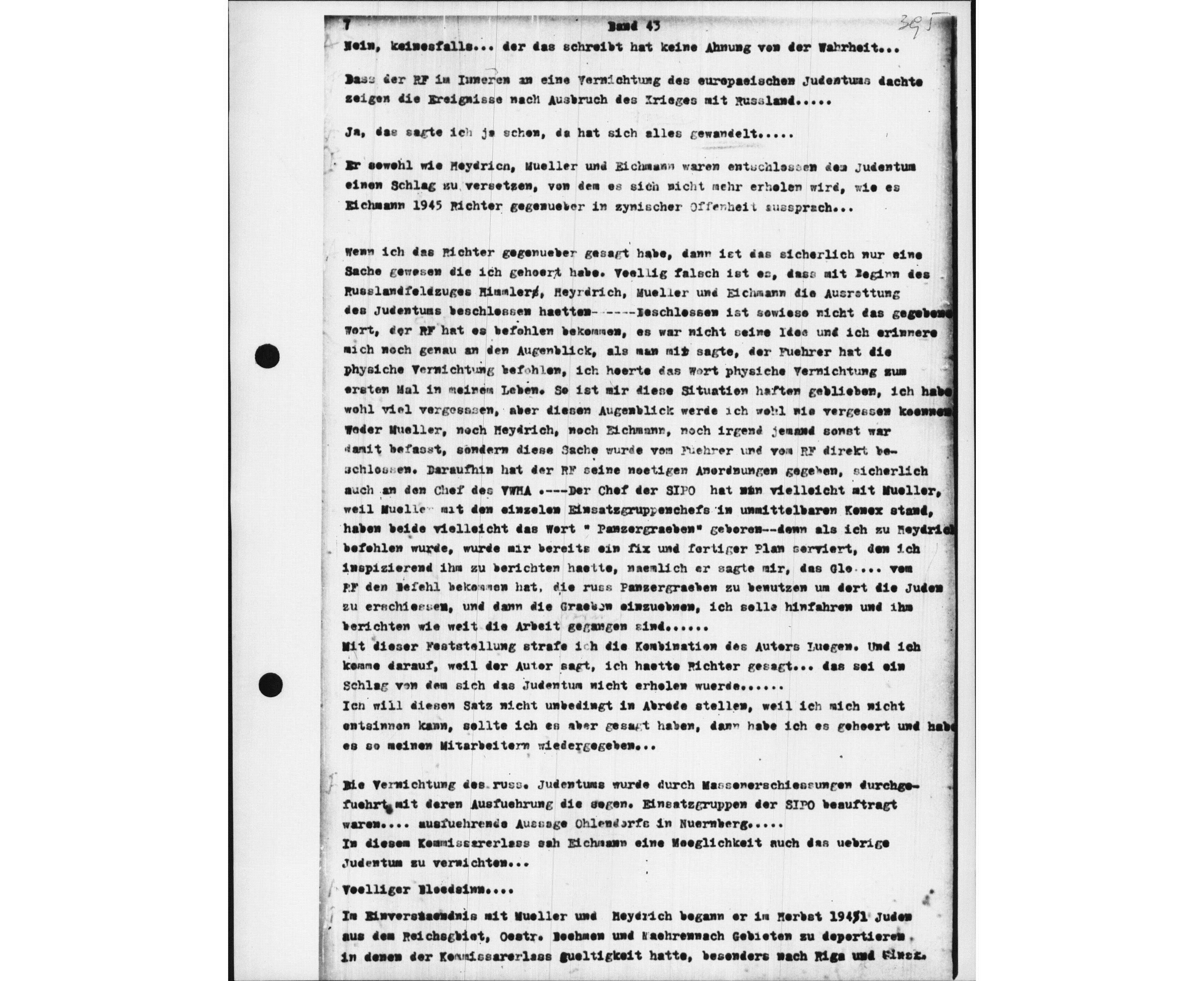
I had nothing to do with it. It was a special order. When I say I was twice sent off on a journey as a postman, then that is… When they say the General Government is free of Jews, that is a small total compared with the others. People were simply quick to say it—free of Jews; that’s that.

I knew nothing about the occupied eastern territories either. I could not even have completed a report, because I did not have the figures. I reckon the commanders of the individual task forces (Einsatzgruppen) had no figures either, because the individual group commanders, when called upon to produce such a report, probably made rough guesses and put figures in. I don’t think they actually did a count. They made rough guesses and then always put the figures very high…

Unknown speaker

At the Nuremberg trial Ohlendorf spoke of 90,000…

Questioner

And I have read an author from the opposing side who finds this figure very high…

Unknown speaker

The figure given by Ohlendorf—the Jews exterminated by the special task units (Einsatzkommandos)? No.

Eichmann

In the same book in which the same author also says that Hoess’s figure is too high—

Questioner

Then Hoettl goes on to say that,

Questioner reads from Hoettl's account

because of the events, Eichmann was in such a state of mind that he had no intention at all of telling me anything untrue.

Eichmann

At that time I was not in a depressed state of mind. I had been a pessimist all those years.

Questioner

So did this conversation take place at all?

Eichmann

As I have already said, I cannot remember being in Hoettl’s apartment in Hungary, as I am said to have been. Nor can I remember Romania’s withdrawal from the war making any particular impression on me.

Questioner

Wait a moment, if Turkey’s declaration of war, which was farther off after all, had already made such an impression on you…

Eichmann

An impression… Well, I was in Berlin, standing with Günther in front of the world map, when I said to him, “Do you still not believe that we have lost the war?”

Questioner

But can you remember nothing about having spoken with Hoettl

Open page image and German
Page 478 of the typescript, O.65 file 87.
Page 478 · Yad Vashem Archives, O.65/87

German transcription

Ich habe damit nichts zu tun gehabt, es war ein Sonderbefehl gewesen. Wenn ich sage, daß ich zweimal als Briefträger auf die Reise geschickt worden, so ist das ja… wenn es heißt das Gen Gov, ist judenfrei, so ist das ja eine kleine Summe im Vergleich mit den anderen, – man ist eben schnell bei der Hand gewesen – judenfrei – Schluß aus. Von den besetzten Ostgebieten hatte ich auch keine Ahnung gehabt, ich hätte nicht einmal einen Bericht fertig stellen können, weil ich die Zahlen nicht hatte. Ich schätze die einzelnen Einsatzgruppenchefs, die hatten auch keine Zahlen gehabt, weil wohl die einzelnen Gruppenchefs wenn sie zu solch einem Bericht aufgerufen wurden, frei über den Daumen peilten und Zahlen einsetzten Ich schätze nicht, daß die die Angelegenheit gezählt haben. Sie haben über den Daumen gepeilt und dann immer recht hoch rauf damit… Im Nürnberg. Prozeß hat ja Ohlendorf über 90 000 gesprochen… Und ich habe von einem gegnerischen Autor gelesen, daß ihm diese Zahl sehr hoch vorkommt… Die von Ohlendorf angegebene Zahl, die von den Einsatzkommandos vernichteten Juden?, nein In demselben Buch wo auch die Zahl von Höß als zu hoch angegeben wird von demselben Autor – Dann sagt Höttel also weiter; das Eichmann durch die Ereignisse in einer solchen seelischen Verfassung war, daß er gar nicht die Absicht hatte, mir etwas unwahres zu sagen In dieser Zeit war ich in keiner deprimierten, seelischen Verfassung – Pessimist war ich die ganzen Jahre über gewesen. Also dieses Gespräch, hat das überhaupt statt gefunden? Ich sagte ja schon, ich kann mich nicht erinnern, daß ich in der Wohnung von Höttel in Ungarn gewesen sein soll, ich kann mich auch genau so wenig daran erinnern, daß mich der Rum. Kriegsaustritt sonderlich beeindruckt hätte Moment, wenn Sie die Kriegserklärung der Türkei, die doch immerhin weiter lag, Sie schon so beeindruckt hat… Beeindruckt… gut ich war in Berlin gewesen und stand mit Günter vor der Weltkarte – wie ich ihm sagte; glaubt ihr es noch immer nicht, daß wir den Krieg verloren haben? Aber können Sie sich an nichts erinnern, daß Sie mit Höttel gesprochen haben

Draft translation

I had nothing to do with it, it had been a special order. When I say that I was twice sent on the journey as a letter-carrier, then that is indeed.... when it says the G[eneral] Gov[ernment] is free of Jews, then that is indeed a small sum compared with the others,----one was simply quick at hand about it--free of Jews---finished, done. Of the occupied eastern territories I also had had no idea, I could not even have completed a report, because I did not have the figures. I reckon the individual Einsatzgruppen chiefs, they too had no figures, because probably the individual group chiefs, when they were called upon for such a report, guessed freely off the cuff and inserted figures. I do not reckon that they counted the matter. They estimated off the cuff and then always [set it] quite high with it...... In the Nuremberg trial Ohlendorf indeed spoke of over 90,000.... And I have read from an opposing author that this figure seems very high to him.... The figure given by Ohlendorf, of the Jews destroyed by the Einsatzkommandos?, no In the same book where the figure from Hoess is also given as too high by the same author--- Then Hoettel further says; that Eichmann, through the events, was in such a mental/emotional state that he had no intention at all of telling me anything untrue In this period I was not in any depressed, mental/emotional state--- A pessimist I had been all those years through. So this conversation, did it take place at all? I already said, I cannot remember that I am supposed to have been in Hoettel's apartment in Hungary, I can just as little remember that the Rom[anian] withdrawal from the war particularly impressed me One moment, if the declaration of war by Turkey, which after all lay further away, already impressed you so much.... Impressed........well I had been in Berlin and stood with Guenter before the world map---as I said to him; do you [pl.] still not believe it, that we have lost the war? But can you remember nothing, that you spoke with Hoettel
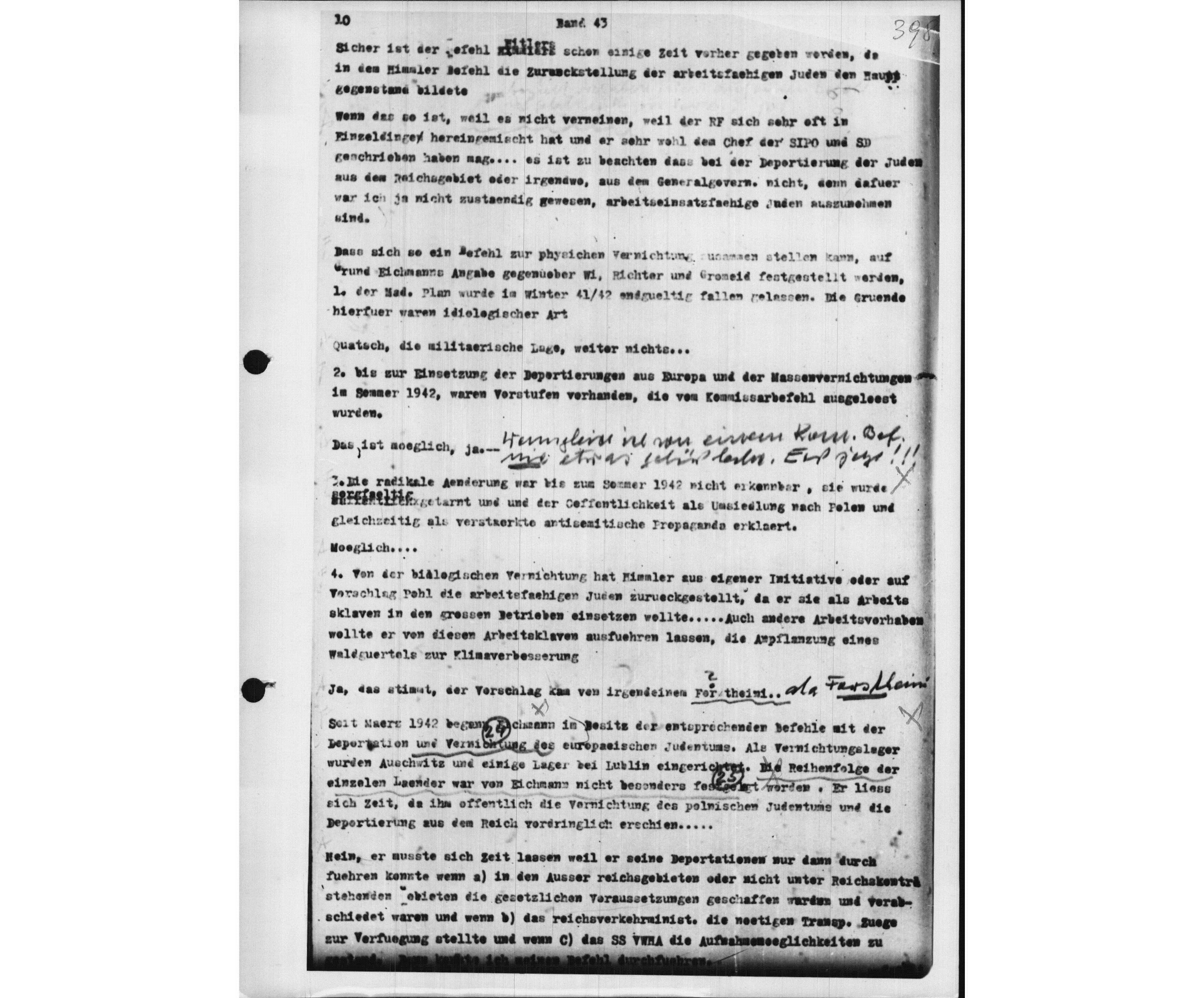
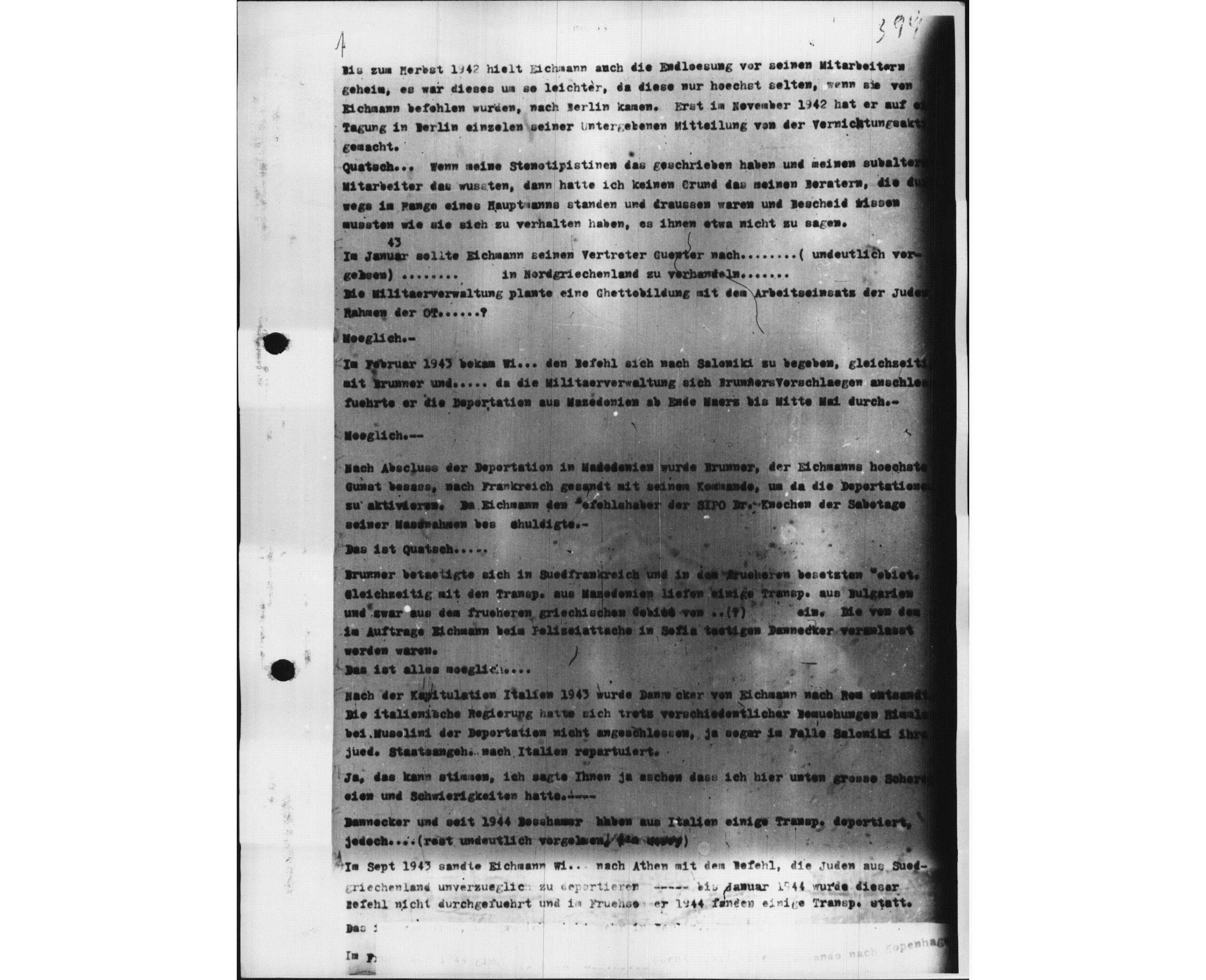
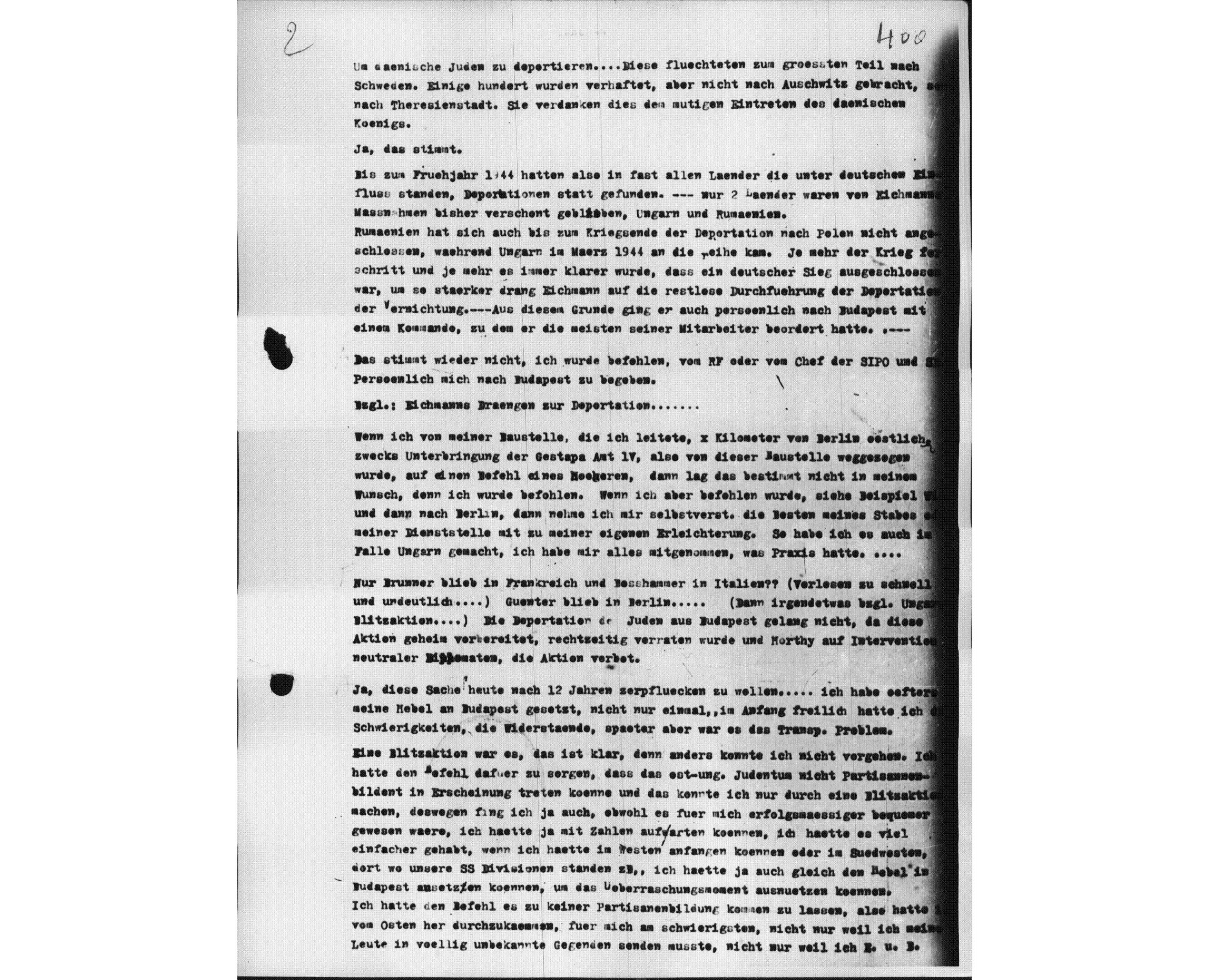
I really cannot recall it. I do not want to deny it; I would gladly admit it if I could recall it. It is true that I spoke with Hoettl very often, and probably about the extermination of the Jews as well. What else would we have talked about?
Reconstructed some figures? That is also true to some extent… People always confuse one thing—whether those people even said it that way, Hoettl and so on… In all these stories about figures, when they throw a number around, three or four million, they always forget to say one thing: that this whole figure, which the statistician produced, is made up by repeatedly adding together the individual categories—whether emigration, natural decrease, or departure for the concentration camps. Everything was included. But you cannot say that all these Jews were killed. I spoke out against that from the very beginning, because it is not true. It is just as untrue that I am supposed to have said I will jump joyfully into the grave because I have killed five million Jews. My own people would have thought me a megalomaniac fool.

Questioner

When did you have to set up a room for this statistician in your office? Was it in Berlin?

Eichmann

Yes, in Berlin, in the Kurfuerstenstrasse. This report was submitted at the end of the year, and at the end of 1944 I was in Budapest. On the other hand, it cannot have been the end of 1943. Possibly I am mistaken and he began at the end of ’44, and it was finished at the beginning of ’45. I read somewhere that this man testified and gave the exact date as well. It cannot have been ’43; it must have been the end of ’44 or the beginning of ’45.

Questioner

There is really no need to accept this man’s statement about the date just like that…

Eichmann

I cannot recall it. Conversely, it cannot have been the end of ’44 at all, because Hoettl met me in Hungary during that year, as he said here… So it must have been earlier. Nor can it have been between March and the alleged meeting with Hoettl, which I wish neither to deny nor to admit, because I can no longer recall it. If I perhaps had a second event to go by, as has so

Open page image and German
Page 479 of the typescript, O.65 file 87.
Page 479 · Yad Vashem Archives, O.65/87

German transcription

Ich kann mich dessen in der Tat nicht entsinnen, ich will es nicht abstreiten, ich würde es gerne zugeben, wenn ich mich hierdrauf entsinnen könnte Daß ich mit Höttel sehr oft gesprochen habe, daß stimmt, und wohl auch über die Judenvernichtungen, was wird man sonst schon gesprochen haben. Irgendwelche Zahlen rekonstruiert? Das stimmt ja auch einigermaßen… Die Leute verwechseln immer eins – ob die Leute da überhaupt so gesagt haben, Höttel usw… sie vergessen immer eins zu sagen bei den ganzen Zahlengeschichten wenn sie schon mit einer Zahl herumwerfen, 3 od 4 Mill, daß diese ganze Zahl. die ja der Statistiker geboren hat, daß diese Zahl sich ja zusammensetzt mit einer vielfachen Addierung der einzelnen Sparten, – sei es Auswanderung, natürlich Verminderung, Abfahrt in die KZ, alles wurde hier hereingenommen, man kann aber nicht sagen, daß alle diese Juden getötet worden sind, da stimmte ich schon von allem Anfang dagegen an, weil es nicht wahr ist – es ist genau so nicht wahr, daß ich gesagt haben soll ich springe freudig in die Grube weil ich 5 Mill Juden getötet habe – ich wäre ja bei meinen Leuten als einen größenwahnsinnigen Barr erschienen Zu welcher Zeit haben Sie diesem Statistiker ein Zimmer einrichten müssen in Ihrer Dienststelle, war es in Berlin? Ja, in Berlin, in der Kurfürstenstraße – dieser Bericht wurde zum Jahres ende gegeben und Jahresende 1944 war ich in Budapest – Auf der anderen Seite kann es Ende 1943 nicht gewesen sein, möglich daß ich mich irre und er vielleicht Ende 44 angefangen hat, und Anfang 45 die Sache fertig geworden ist – ich habe es ja irgendwo gelesen, daß dieser Mann ausgesagt hat und auch das genaue Datum genannt hat – 43 kann es nicht gewesen sein, es muß Ende 44 Anfang 45 gewesen sein. Die Aussage dieses Mannes bzgl des Datums so ohne weiteres anzunehmen, das ist gar nicht so notwendig… Ich kann mich nicht entsinnen – umgekehrt kann es ja gar nicht Ende 44 gewesen sein, dann im Laufe des Jahres traf mich ja Höttel in Ungarn wie er hier sagte… es muß also vorher gewesen sein, kann auch gar nicht in der Zeit vom März bis zum angeblichen Treffen mit Höttel gewesen sein, was ich aber weder in Abrede stellen möchte noch zugeben möchte, weil ich mich nicht mehr darauf entsinnen kann. Hätte ich vielleicht noch eine zweite Sache, wie das so

Draft translation

Band 49 [HW: 479] I really cannot recall it, I do not want to deny it, I would gladly admit it if I could recall this. That I spoke with Hoettel very often, that is correct, and probably also about the Jewish exterminations, what else would one have spoken about. Reconstructed some figures? That is also correct to some extent..... People always confuse one thing—whether the people there even said it that way, Hoettel etc......they always forget to say one thing with all these figure-stories when they already throw a figure around, 3 or 4 mill, that this whole figure, which the [DEL: illegible] statistician gave birth to, that this figure is indeed composed of a manifold addition of the individual categories, --be it emigration, of course reduction, departure to the concentration camps, everything was taken in here, but one cannot say that all these Jews were killed, I already opposed all of that from the very beginning, because it is not true--- it is exactly [thus] not true that I am supposed to have said I leap joyfully into the pit because I have killed 5 mill Jews--- I [DEL: illegible] [TS INS: would] then have appeared to my people as a megalomaniac fool At what time did you have to set up a room for this statistician in your office, was it in Berlin? Yes, in Berlin, in the Kurfuerstenstrasse-- this report was given at year's end and year's end 1944 I was in Budapest--- On the other hand it cannot have been at the end of 1943,, possible that I am mistaken and he perhaps began [at the] end of 44, and beginning of 45 the matter was finished----I did read it somewhere, that this man testified and also named the exact date--43 it cannot have been, it must have been end of 44 beginning of 45. To accept the statement of this man regarding the date just like that, that is not so necessary at all...... I cannot recall-------conversely it cannot have been end of 44 at all, then in the course of the year Hoettel met me in Hungary as he said here....so it must [DEL: illegible]xexex have been before, also cannot have been at all in the time from March to the alleged meeting with Hoettel, which however I would neither wish to deny nor wish to admit, because I can no longer recall it. Were I to have perhaps yet a second matter, how that so

often happened, then perhaps I could connect it with that. So it cannot have been 1944 at all. But it was at the end of the year; I remember that again, because I had to redictate that tome so often, and the date kept being put on it. So it must have been the end of ’43.

Questioner

When did you move out of your office in the Kurfuerstenstrasse?

Eichmann

It was probably in March 1945, when I had built all the roadblocks. That was when I received the order to burn my whole rotten outfit and then hand my entire rotten outfit over to the Berlin State Police headquarters. And on the very day the Berlin State Police headquarters was unloading emergency rations from a whole fleet of trucks into my deep cellars, I received orders to report to the RF (Reichsführer-SS). That was the business with the prominent Jews and so on… So that was the day I handed over my office.

Günther stayed there, and I met him later in Salzburg on the way back from Tyrol. So it cannot have been the end of ’44. All the indications are against it. Even though I would rather believe no one, not even myself, I still have to say: if everything is against it, if Hoettl says so, and if you check the statistician, and if I say it practically cannot have been in 1944, then I have to say it can only have been a partial account. The whole of 1944 would then be left out, with Hungary and a figure of, say, half a million given by the opposing side.

Questioner

What else was there in 1944?

Eichmann

Well, adding it all up like that also gives three quarters of a million, and—how much does it say here?

Questioner

Four million, and two million by other means.

Eichmann

So six million? And that would have been at the end of ’43? Four million killed and two million put to death in some other way?

Questioner

Now, Hoettl does not say that this was in the statistician’s report, but that you had told him on the basis of your information and…

Eichmann

When someone tells me that in forty years, I will probably just giggle in a falsetto and confirm it, because by then I will have become so feeble-minded that I believe everything. But today I am still sufficiently in my right mind to know very well what is possible and what is not. Although I cannot recall ever having spoken with Hoettl about this, I even say, so that no doubt or uncertainty arises, that it would be possible, but I do not know. In any case, it is impossible that I gave Hoettl these figures, because

Open page image and German
Page 480 of the typescript, O.65 file 87.
Page 480 · Yad Vashem Archives, O.65/87

German transcription

oftmals vorgekommen ist, dann könnte ich es vielleicht damit in Zusammenhang bringen. Es kann also gar nicht 1944 gewesen sein, es war aber Ende des Jahres gewesen, dessen entsinne ich mich wieder, weil ich ja die Schwarte sooft habe wieder umdiktieren müssen und immer wieder kam das Datum drauf. Es muß also dann Ende 43 gewesen sein. Wann sind Sie aus ihrer Dienststelle aus der Kurfürstenstraße ausgezogen? Es wird wohl im März 1945 gewesen sein, als ich die Straßensperren alle gebaut hatte… da hatte ich dann den Befehl bekommen, meinen ganzen Saftladen zu verbrennen und dann meinen gesamten Saftladen der Stapo Leit Berlin zu übergeben. Und gerade an dem Tag, an dem die Stapo Leit Berlin mit einer ganzen Anzahl von Lastwagen eiseren Verpflegung ablud in meine Tiefkeller, an dem Tag bekam ich Befehl zum RF – da war die Sache mit den prominenten Juden etc… An dem Tag also habe ich meine Dienststelle übergeben, drin blieb noch Günter und den traf ich dann in Salzburg auf dem Rückweg von Tirol Es kann also Ende 44 nicht gewesen sein, alle Indizien sprechen dagegen und wenn ich auch niemanden glauben möchte, auch mir nicht, so muß ich doch sagen, wenn alles dagegen spricht, wenn es Höttel so sagt, und wenn man die Statiker nachsieht und wenn ich sage, daß es praktisch gar nicht gewesen sein kann 1944, dann muß ich allerdings sagen, dann kann es nur eine Teilgeschichte gewesen sein, denn dann fiel ja das ganze Jahr 1944 flach, mit Ungarn, mit einer Zahl zB von der gegnerischen Seite gesagt, 1/2 Mill. – Was war denn noch 1944 gewesen, ? – Gut wenn man es so zusammenleppern will, kommt auch auf 3/4 Mill und wieviel wird hier gesagt? 4 Mill und 2 Mill auf sonstige Art und Weise. Also 6 Mill? und das wäre dann Ende 43 gewesen?? 4 Mill Getötet und 2 Mill so auf andere Art und Weise umgebracht? Nun Höttel sagt nicht, daß das in dem Bericht des Statiker gestanden hätte, sondern daß hätten Sie ihm auf Grund Ihrer Information und … Wenn man mir das in 40 Jahren erzählt werde ich wohl dann nur noch mit einer Fistelstimme kichern und die Sache bestätigen, weil ich dann schon so gehirnschwach geworden bin und dann alles glaube. Aber heute ich geistig doch noch so zurechnungsfähig, daß ich sehr wohl weiß, was möglich ist und was nicht möglich ist obgleich ich mich nicht entsinnen kann mit Höttel je über diese Sache gesprochen zu haben und ich sage sogar damit doch kein Zweifel aufkommt oder Unklarheiten, es wäre möglich, aber ich weiß es nicht. Unmöglich jedenfalls ist es daß ich Höttel diese Zahlen genannt habe, weil

Draft translation

16 Volume 49 [HW: 480] has often occurred, then perhaps I could bring it into connection with that. So it cannot have been 1944 at all, but it was at the end of the year, of that I recall again, because I did after all so often have to re-dictate the tome and again and again the date came onto it. So it must then have been the end of '43. [HW: ✓] When did you move out of your office at the Kurfuerstenstrasse? It will probably have been in March 1945, when I had built all the street barriers.........then I had received the order to burn my whole junk-shop [Saftladen] and then to hand over my entire junk-shop to the Stapo Leit Berlin. And precisely on the day on which the Stapo Leit Berlin unloaded a whole quantity of iron[?] provisions into my deep cellars with a number of trucks, on that day I received an order to the RF---that was the matter with the prominent Jews etc ......So on that day I handed over my [DEL: [illegible]] office, in it there still remained Guenter and him I then met in Salzburg on the way back from Tyrol So it cannot have been the end of '44, all the indications speak against it and even if I would like to believe no one, not even myself, so I must nonetheless say, if everything speaks against it, if Hoettel says it so, and if one looks up the statistics [Statistiker] and if I say that it practically cannot have been at all in 1944, then I must indeed say, then it can only have been a partial-story, for then the whole year 1944 fell away, with Hungary, with a figure e.g. said by the opposing side, 1/2 million.-- What was there still in 1944, then? ----- Fine, if one wants to cobble it together like that, one also comes to 3/4 million and [DEL: [illegible]] how much is said here? 4 million and 2 million [DEL: [illegible]] by other kinds of means. So 6 million? and that would then have been the end of '43?? 4 million killed and 2 million done away with in another manner? Now Hoettel does not say that this had stood in the report of the [DEL: [illegible]] [HW: statistician/Statiker], but rather that you had [said/told] it to him on the basis of your information and ..... When one tells me that in 40 years I will probably then only giggle with a falsetto voice and confirm the matter, because I will then have become so brain-weak and then believe everything. But today I am mentally still so of sound mind/accountable, that I know very well what is possible and what is not possible although I cannot recall ever having spoken with Hoettel about this matter and I say even so that no doubt indeed arises or ambiguities, it would be possible, but I do not know it. Impossible in any case is it that I named these figures to Hoettel, because

that was not yet even under discussion, and I did not know later either how many Jews had been killed. I still do not know today. Nor did I know then, when I had to give my talk in the Prussian House and Mueller told me, in answer to my question whether I should give figures—he told me it was better to say nothing at all unless you knew everything precisely and beyond doubt.

Questioner

Can you explain what a desk officer and a deputy group leader in an office of the RSHA (Reich Security Main Office) would be?

Eichmann

Office IV was run by an office chief. When he was away he had a deputy, but he had no permanent deputy. Office IV was then divided into two groups. One group was headed by Huppenkothen (?); the other was under Philrarer (?), who later died in Linz from an aerial mine. So there were two group leaders, but they had no authority to give the desk officer substantive instructions—is that clear? It was merely a loose grouping. Only when the chief of Office IV was away did a matter also have to be countersigned by the group leader as it went through the official channels.

Open page image and German
Page 481 of the typescript, O.65 file 87.
Page 481 · Yad Vashem Archives, O.65/87

German transcription

das noch gar nicht zur Debatte stand und ich auch später nicht gewußt habe, wieviel Juden getötet worden sind. Ich weiß es heute noch nicht und ich habe es auch damals nicht gewußt als ich meinen Vortrag im Preußenhaus halten mußte und mir Müller sagte, auf meine Frage hin, ob ich Zahlen nennen soll – er mir sagte, besser man sagt überhaupt nichts wenn man nicht alles exakt und stichfest weiß. Können Sie mir erklären, was ein Referent und ein stellvertr. Gruppenleiter in einem Amt des RSHA sein kann? Das Amt IV leitete ein Amtschef, wenn dieser weg war, hatte er einen Vertreter er hatte aber keinen ständigen Vertreter, – das Amt IV zerfiel dann in 2 Gruppen, die eine Gruppe leitete Hubenkoden (?) die andere Gruppe stand unter Philrarer (?) der dann später in Linz durch eine Luftmine umgekommen ist, – das waren also zwei Gruppenleiter gewesen, die hatten aber dem Referenten keine sachlichen Weisungen zu erteilen – ist das klar? Das ist lediglich ein lockeres Zusammenfassen gewesen. Nur wenn der Amtschef IV weg war, dann mußte eine Sache auf dem Dienstwege, auch vom Gruppenleiter mit abgezeichnet werden.

Draft translation

that this was not yet even up for debate and I also did not know later on how many Jews had been killed. I still do not know it today and I also did not know it at the time when I had to hold my lecture in the Prussia House and Mueller told me, in response to my question whether I should name figures—he told me it is better one says nothing at all if one does not know everything exactly and rock-solid. Can you explain to me what a desk officer [Referent] and a deputy group leader [stellvertr. Gruppenleiter] in an office/department [Amt] of the RSHA can be? Office IV [Amt IV] was directed by an office chief [Amtschef]; when he was away, he had a deputy, but he had no permanent deputy,---Office IV then split into 2 groups; the one group was directed by Hubenkoden (?), the other group [DEL: in the] stood under Philrarer (?), who then later perished in Linz through an aerial mine,---so those had been two group leaders, but they had no authority to issue substantive instructions to the desk officer [Referent]--is that clear? That was merely a loose grouping-together. Only when the office chief IV was away, then a matter, via official channels, had to be co-signed also by the group leader.

[Mysterious conversation with Hoettl in Hungary]

That is also why he had come to me, because of Romania’s war-ex…, to find out about the military situation, which I received daily from the Hungarian H. Ministry of War and the commanders of the Waffen-SS.

[August 1944]

I obtained reports on the situation—in general at first, then later every so often, and still daily—but Winkelmann had a very large, spacious house at his disposal on a hill. In one of its rooms a police captain had enormous maps lying on tables. They were situation maps, but when you have been away from the troops for so long you do not really know much about them. Now it was from this man that I obtained the military situation daily. I cannot recall obtaining it elsewhere. To find out precisely where things might stand in terms of kilometres, I went to my friend Zehender at his divisional command post.

Of course I only got his own picture from him, though he knew about the neighbouring divisions through discussions with his army commander, and naturally Zehender knew a good deal. But he did not show it to me on the map; he described it to me. So I had no need to get the military situation anywhere else, because I obtained it there probably more accurately than anywhere else. But when I was with Hoettl, I will undoubtedly have spoken with him about the military situation too. I would not deny that. But I most certainly did not obtain the military situation from Hoettl.

Questioner

Now you will understand that it is very difficult to reconcile your relationship of trust with Hoettl on the one hand with these statements of his on the other. So this statement of Hoettl’s must have a particular intention behind it… But it did not come about under pressure. The question now is: how can this account be shown to be absurd, despite that relationship of trust?

Eichmann

I must refer you to Dr. Langer, because he has offered to tell you various things about Hoettl. He calls him a shifty character. Hoettl does not want to attack me at all; he is not spiteful either. I had a cordial relationship with Hoettl. But after the collapse he must have had some reason to get into the Americans’ good graces, because Hoettl had been in Alt-Aussee. How could one get into their good graces in 1945? One had to go over to the other side from the very start, so as to remain free as far as possible, by… with the CIC (Counter Intelligence Corps) officers—there really were experienced experts among them… Here expert met expert. Naturally the CIC had an interest in giving its superiors as sensational and compelling a report as possible, because that sort of thing advances its office, its official position. So if Hoettl wanted a

Open page image and German
Page 482 of the typescript, O.65 file 87.
Page 482 · Yad Vashem Archives, O.65/87

German transcription

Mysteriöse Gespräch mit Hörtel in Ungarn; Deswegen war er auch zu mir gekommen, wegen des Kriegsaus… Rumäniens um sich über die militärische Lage zu informieren, die ich täglich von dem ungarischen H. Kriegsministerium und den Befehlshabern der Waffen SS bekam. August 1944 – Die Lage habe ich mir im Anfang überhaupt, später dann alle Daumenlang mal, weiterhin täglich eingeholt, aber auf einem Hügel hatte der Winkelmann ein sehr großes geräumiges Haus zur Verfügung und in einem von diesem Zimmer hatte ein Polizeihauptmann riesenhafte Karten auf Tischen liegen, es waren die Lagekarten, aber wenn man solange aus der Truppe heraus ist, hat man an sich wenig Ahnung davon – bei diesem Mann nun holte ich mir täglich die milit. Lage ein. Ich kann mich nicht entsinnen, daß ich die milit. Lage anderwärtig eingeholt haben sollte – um mich mal ganz genau über eventl. Kilometerlage zu erkundigen habe ich mich zu meinem Freund Zehender begeben auf seinen Divisionsgefechtsstand. Freilich habe ich von ihm nur sein Bild bekommen, allerdings wußte er über die angrenzenden Divisionen bescheid durch Besprechungen mit seinem Armeechef, und da wußte Zehender natürlich allerhand, aber er gab es mir nicht auf der Karte bekannt, er beschrieb es mir. Ich hatte es also gar nicht nötig mir die milit. Lage irgendwo anders zu holen, denn ich habe sie da so exakt bekommen, wie wohl nirgends anders. Wenn ich aber mit Hörtel zusammen war, werde ich auch zweifellos mit ihm über die milit. Lage gesprochen haben, das möchte ich nicht verneinen, aber die milit. Lage bei Hörtel eingeholt, das habe ich ganz bestimmt nicht. – Nun werden Sie verstehen, daß es einerseits sehr schwierig ist, Ihr Vertrauensverhältnis zu Hörtel zu kombinieren mit anderseits diesen Aussagen Hörtels, es muß also diese Aussage Hörtels eine bestimmte Intension haben… aber sie ist nicht unter Druck zustande gekommen – Nun ist die Frage, wie soll man diese Erklärung, trotz dieses Vertrauensverh. ad absurdum führen? Da muß ich Sie an Dr. Langer empfehlen, denn er hat sich ja bereit erklärt Ihnen über Hörtel verschiedenes zu sagen – er bezeichnet ihn als schrägen Hund. Hörtel will mir ja garnicht ans Zeug fahren, er ist ja auch nicht gehässig, mit Hörtel hatte ich ein herzliches Verhältnis gehabt – aber irgendwelche Gründe muß Hörtel nach dem Zusammenbruch gehabt haben um sich bei den Amerikanern lieb Kind zu machen – denn Hörtel war ja in Alt-Aussee gewesen, wie konnte man sich aber 1945 lieb Kind machen? – Man mußte sich also von Anbeginn auf die andere Seite stellen, damit einem nach Tunlichkeit die Freiheit blieb, in dem man mit den CIC Beamte, es waren ja auch wirklich Fachleute darunter mit Erfahrung… hier traf sich also Fachmann mit Fachmann natürlich hatte der CIC ein Interesse daran einen möglichst aufregenden und durchschlagenden Bericht an seine Vorgesetzte zu geben, denn sowas fördert ja seine Dienststelle, seine Dienststellung – Wenn Hörtel also über ein

Draft translation

Band 50 [HW: 482] Mysterious conversation with Hoettl in Hungary; That is why he had also come to me, on account of the war-exit....... of Romania, in order to inform himself about the military situation, which I received daily from the Hungarian H. War Ministry and the commanders of the Waffen SS. August 1944--- At the beginning I obtained the situation at all, later then every thumb's-length once, further on daily, but on a hill Winkelmann had a very large, spacious house at his disposal, and in one of these rooms a police captain had gigantic maps lying on tables, they were the situation maps, but when one has been out of the troops for so long, one has in itself little idea of it---from this man now I obtained daily the military situation, I cannot recall that I should have obtained the military situation elsewhere-- in order to inquire once quite exactly about the possible kilometer-position I betook myself to my friend Zehender at his division command post. Admittedly I got from him only his picture, however he knew the score about the adjoining divisions [TS INS: through discussions] with his army chief, and there Zehender naturally knew all sorts of things, but he did not make it known to me on the map, he described it to me. So I had no need at all to get the military situation from anywhere else, for I got it there so exactly as probably nowhere else. But when I was together with Hoettl, I will also doubtless have spoken with him about the military situation, that I would not want to deny, but to have obtained the military situation from Hoettl, that I quite certainly did not.-- Now you will understand that on the one hand it is very difficult to combine your relationship of trust with Hoettl with on the other hand these statements of Hoettl's, this statement of Hoettl's must therefore have a certain intention.....but it did not come about under pressure--- Now the question is, how is one to lead this declaration, despite this relationship of trust, ad absurdum? There I must refer you to Dr. Langer, for he has indeed declared himself ready to tell you various things about Hoettl----he describes him as a crooked dog. Hoettl really does not want to attack me at all, he is also not spiteful, with Hoettl I had had a cordial relationship--but Hoettl must have had some reasons after the collapse to make himself a dear child with the Americans----for Hoettl had after all been in Alt-Aussee, but how could one make oneself a dear child in 1945?--- One had therefore to put oneself on the other side from the very beginning, so that as far as possible one's freedom remained, in that one with the CIC officials, there were indeed really experts among them with experience.... here therefore expert met expert, naturally the CIC had an interest in giving as exciting and striking a report as possible to its superiors, for such a thing promotes after all its office, its official position-----If Hoettl therefore over a

substantial entrée to the enemy intelligence service, then he also had to provide material. If he came up with paltry figures, he would have achieved nothing. But if he could throw millions around, then people took notice; then Hoettl became the important person… Through that he could then put forward all his other ambitions. That is my explanation about Hoettl, but ask Dr. Langer about it, because he knows Hoettl professionally. He also knows certain particular matters that could shed more light on the affair. I myself would be careful not to attack Hoettl in any way that would harm him. I do not do so, not even if he had attacked me in a way that harmed me. I could only regret it, just as I regret it with Wi, although even there I will never repay like with like.

Questioner

Now we come to a report by a certain Kurt Gerstein, Ostf. (Obersturmführer).

Questioner reads from the Gerstein report

A man who on 27 September 1936 was removed from the higher German mining service for activities hostile to the state; who was also persecuted by the Gestapo in 1933 for activities against the Nazi state; who on 2 October 1936 was expelled from the NSDAP (Nazi Party) for religious activities hostile to the state on behalf of the Confessing Church; who on 30 January 1935 was publicly beaten up and injured for disrupting a party celebration at the municipal theatre in Hagen; who on 14 July 1938 is arrested for the second time and sent to Welsheim concentration camp for activities hostile to the state.

Questioner

How can such a man end up in Office VI?

Eichmann

Such a man can only end up in Office VI, because no other office could have had any use for him.

Questioner

That is true, but it is not quite like that.

Questioner reads from the Gerstein report

With two references from the Gestapo officers who handled the various matters—one of the two was Criminal Police Secretary Zerrer in Stuttgart, who would somehow, deep down, have sympathized with this man on religious grounds—he managed to join the SS without difficulty. He joined the SS on 10 March 1941. He received his basic training in Hamburg Langenau, in Holland, Oranienburg. Because of his dual course of study, he was soon taken into the technical medical service and assigned to the SS Leadership Main Office, Office Group D, medical services of the Waffen-SS, and the Hygiene Department.

He soon became a lieutenant and a first lieutenant. At Christmas 1941 the court that had ordered my expulsion from the NSDAP learned of my entry into the SS in a leading position. Considerable opposition followed, but because of his successes in his work his office protected him and kept him on. In January 1942 he became head of the Health (?) Department and was simultaneously taken on in a dual appointment for the same field by the Reich Physician of the SS and Police.

Open page image and German
Page 483 of the typescript, O.65 file 87.
Page 483 · Yad Vashem Archives, O.65/87

German transcription

namhaftes Entre verfügen wollte beim gegnerischem Nachrichtendienst, dann mußte er aber auch Material liefern – wenn er also mit kümmerlichen Zahlen aufwarten wollte, dann hätte er gar nicht erreicht, nun er aber mit Mill. herum schmeißen könnte – da wurde man aufmerksam, da wurde Hörtel die wichtige Person… und über diese Sache konnte er dann alle seine sonstigen Ambitionen vortragen – daß ist meine Erklärung über Hörtel, aber fragen Sie diesbzgl. Dr Langer, denn er kennt Hörtel ja dienstlich. Er weiß ja auch bestimmte Spezialsachen die dann ein besseres Licht in die Angelegenheit bringen könnte – ich selber möchte mich auch davor hüten Hörtel in irgendeiner Form schädlich anzugreifen – ich tue es nicht, auch dann nicht wenn er mich selbst schädlich angegriffen hätte, ich konnte es dann nur bedauern, so wie ich es bei Wi es bedauere, wo ich trotzdem doch nie gleiches mit gleichem vergelten werde. Jetzt kommen wir zu einem Bericht von einem gewissen Kurt Gerstein. Ostf. Ein Mann der am 27 Sept. 1936 wegen staatsfeindlicher Betätigung aus dem höheren deutschen Bergdienst entfernt wurde – der weiter 1933 von der Gestapo verfolgt wurde wegen Betätigung gegen den Nazistaat – der am 2. Okt 1936 Ausschluß aus der NSDAP wegen staatsfeindlicher religiöser Betätigung für die Bekenntniskirche – der am 30 Jan 1935 wegen Störung/einer Parteifeierlichkeit im Stadttheater Hagen öffentlich verprügelt und verletzt wurde – der am 14 Juli 1938 zum zweiten Mal verhaftet wird und in das KZ Welsheim wegen staatsfeindlicher Betätigung eingeliefert wird – wie kann so ein Mann beim Amt VI landen?????? So einer kann nur am Amt VI landen, denn kein anderes Amt hätte diesen Mann ja brauchen können – Das stimmt schon, aber es ist nicht ganz so, mit 2 Referenzen der Gestapo Beamten, die die verschiedenen Sachen bearbeiteten – einer der beiden war der Kriminalsekr. Zerrer in Stuttgart, der irgendwie religiös im Unterbewußtsein mit diesem Mann einverstanden gewesen wäre – so gelang es ihm unschwer in die SS einzutreten. – Am 10 März 1941, trat er in die SS ein. – Er erhielt die Grundausbildung in Hamburg Langenau – in Holland – Oranienburg – wegen dem doppelt Studium wurde er bald in den techn. ärztlichen Dienst übernommen und dem SS Führungshauptamt Amtsgruppe D, Sanitätswesen der Waffen SS und Abteilung Hygiene zugeteilt. – Er wurde bald Lt. und Oberlt, Weihnachten 1941 erhielt das Gericht das meinen Ausschluß aus der NSDAP verfügt hatte, Kenntnis von meinem Eintritt in die SS an führende Stelle. Es folgte ein großes Gegentreiben aber wegen seinen Erfolgen in seiner Tätigkeit wurde er von seiner Dienststelle geschützt und gehalten. Im Jan. 1942 wurde er Abteilungsleiter der Abteilung Gesundheits (?) und gleichzeitig in Doppelstellung für den gleichen Sektor vom Reichsarzt SS und Polizei übernommen.

Draft translation

[HW: 483] ...wanted to have a considerable entrée with the enemy intelligence service, but then he also had to deliver material---if he thus wanted to come up with paltry numbers, then he would not have achieved anything, but if he could throw millions around----then one became attentive, then Hoertel became the important person.... and over this matter he could then bear all his other ambitions---that is my explanation about Hoertel, but ask [HW: Dr] Langer in this regard, since he knows Hoertel professionally. He also knows certain special matters which could then bring a better light into the affair -I myself would also like to guard against attacking Hoertel harmfully in any form-- I do not do it, not even then when he had attacked me himself harmfully, I could then only regret it, just as I regret it with Wi, where I nevertheless will still never repay like with like. Now we come to a report by a certain Kurt Gerstein. Ostf. [Obersturmführer] A man who on 27 Sept. 1936 was removed from the higher German mining service on account of activity hostile to the state - who further in 1933 was persecuted by the Gestapo on account of activity against the Nazi state-- who on 2 Oct 1936 [was subject to] exclusion from the NSDAP on account of activity hostile to the state, religious, for the Confessing Church-- who on 30 May 1935 on account of disturbance/of a party festivity [HW: Jan] in the Hagen city theater was publicly beaten up and injured--- who on 14 July 1938 is arrested for the second time and is delivered into the KZ [concentration camp] Welsheim on account of activity hostile to the state--- how can such a man land at Amt VI [Office VI]?????? Such a one can only land at Amt VI, for no other office could indeed have had a use for this man-- That is indeed correct, but it is not quite so, with 2 references from the Gestapo officials who handled the various matters--one of the two was the Criminal Secretary Zerrer in Stuttgart, who somehow religiously in the subconscious would have been in agreement with this man ---thus he succeeded without difficulty in entering the SS.-- On 10 March 1941, he entered the SS.-- He received the basic training in Hamburg Langenau-in Holland-Oranienburg---on account of the double study he was soon taken over into the technical medical service and assigned to the SS Führungshauptamt [SS Leadership Main Office] Amtsgruppe D [Office Group D], Sanitätswesen [Medical/Sanitary Affairs] of the Waffen SS and the Hygiene Department.--He soon became Lt. [Leutnant] and Oberlt [Oberleutnant], Christmas 1941 the court that had ordered my exclusion from the NSDAP received knowledge of my entry into the SS at a leading position. There followed a great counter-drive but on account of his successes in his activity he was protected and held by his office. In Jan. 1942 he became department head of the Health (?) Department and simultaneously in a double position was taken over for the same sector by the Reichsarzt SS und Polizei [Reich Physician SS and Police].

Questioner reads from the Gerstein report

In that capacity he took over the entire technical disinfection service, including disinfection with highly poisonous gases.

Questioner

So despite all the back and forth and the arrests, joining the SS is possible?

Yes, why not? He had two people here who could smooth the way for him. It would even have been possible, had he had especially good connections with the …, for Office VI to reach an arrangement about his past without any harm to him. That is typical of Office VI, though I ask you not to take that as a sarcastic remark. People working in intelligence never have to ask about a man’s past, only about results. That is clear. That is why there were also many narrow-minded people in Office IV who attributed everything bad to Office VI. But anyone who could see the situation to some extent, who could get an overall picture, had to tell himself that they had to work with death and the devil. They worked with Jews too…

Questioner

It goes on to say that,

Questioner reads from the Gerstein report

in this capacity as head of department and so on, on 8 June 1942 he received a visit from SS S…f. Günther, of the Reich Security Main Office, Berlin, Kurfuerstenstrasse, whom he had not known until then.

Eichmann

I know nothing about that. But there was no such thing as an SS Stf. (Sturmführer); that existed in the SA. So it can only have been an Ustf. (Untersturmführer), Obstf. (Obersturmführer) or Hstf. (Hauptsturmführer). In 1942 it is possible that my permanent deputy was still a Hstf. (Hauptsturmführer).

Questioner reads from the Gerstein report

Günther came in civilian clothes…

Eichmann

That is possible, because we could go about as we liked.

Questioner reads from the Gerstein report

He gave orders to procure 100 kilos of prussic acid immediately for a secret assignment and to drive with it in a car to an unknown place known only to the driver. We then drove, some weeks… to Prague. Professor Pfannenstiel, SS Ostf. (Obersturmführer), full professor of hygiene at the University of Marburg, also happened to travel with us. We then drove to Lublin, where SS Grf. (Gruppenführer) Glo was waiting for us.

Glo said, “This is one of the most secret matters there is at present. Anyone who talks about it will be shot on the spot. Yesterday two blabbermouths were shot.” Then he explained to us: “At present, 17 August 1942, we have three installations in operation: Belschek, on the Lublin–Bemberg railway line, D. line, maximum daily capacity 15,000 people; Treblinka, east of Warsaw, maximum capacity 25,000 people; Sovibor, also in Poland, maximum capacity 20,000 people. Meidaneck, near Lublin, is now being prepared. The first three

Open page image and German
Page 484 of the typescript, O.65 file 87.
Page 484 · Yad Vashem Archives, O.65/87

German transcription

Er übernahm in dieser Eigenschaft den ganzen techn, Desinfektionsdienst einschließlich der Desinfektion mit hochgiftigen Gasen – Also trotzdem vielen Hin und Her und Verhaftungen ist ein Eintritt in die SS möglich? Ja, warum nicht, – er hatte ja hier 2 Leute die ihm hier Brücken bauen konnten – es wäre sogar möglich gewesen, wenn er über besonders gute Beziehungen zum …(?)… verfügt hätte, daß er ohne Schaden über sein Vorleben vom Amt VI vereinbart worden wäre. daß sieht dem Amt VI ähnlich, wobei ich das aber nicht als sarkastische Bemerkung aufzufassen bitte – weil Leute die auf dem Nachrichtengebiet arbeiteten, nie noch dem Vorleben zu fragen haben, sondern nur nach dem Erfolg. Das ist klar, deswegen hat es auch viel engstirnige Leute im Amt IV gegeben, die nun alles Schlechte dem Amt VI nachsagten – wer aber hier so einigermaßen die Sache überschauen konnte, sich global eine Vorstellung machen konnte – der mußte sich schon sagen, sie mußten mit Tod und Teufel zusammen arbeiten, sie arbeiteten ja auch mit Juden zusammen… Nun heißt es weiter, daß er nun in dieser Eigenschaft als Abteilungsleiter usw… erhielt er am 8. Juni 1942 den Besuch vom dem ihm bis dahin unbekannten SS S[unleserlich]f. Günter von dem Reichssicherheits HA Berlin. Kurfürstenstraße. Davon weiß ich nichts, aber einen SS Stf. gab es gar nicht, den gab es bei der SA – es kann sich also nur um einen Ustf. Obstf oder Hstf. gehandelt haben 1942 ist es möglich daß mein ständiger Vertreter noch Hstf, war. Günter kam in Zivil… Das ist möglich, denn wir konnten ja gehen wie wir wollten – Er gab den Auftrag sofort für einen geheimen Auftrag 100 Kilo Blausäure zu beschaffen und mit dieser mit einem Auto zu einem unbekannten Ort zu fahren der nur dem Fahrer des Wagens bekannt sei. Wir fuhren alsdann einige Wochen nach Prag. – Mit uns fuhr noch zufällig der Professor Pfannenstiel, SS Ostf. Ord. für Hygiene an der Uni Marburg, Wir fuhren alsdann nach Lublin, wo uns der SS Grf. Glo uns erwartete – Glo sagte diese Angelegenheit ist eine der geheimsten Sachen die es überhaupt zur Zeit gibt. – wer damuaber spricht wird auf der Stelle erschossen – gestern sind 2 Schwätzer schossen worden. Dann erklärte er uns; Im Augenblick, 17 Aug. 1942, haben wir drei Anstalten in Betrieb, nämlich Belschek, Bahnstrecke Lublin Bemberg, – D. Linie, Höchstleistung pro Tag; 15 000 Personen – Treblinka, östlich von Warschau, Höchstleistung 25 000 Personen, – Sovibor, auch in Polen 20 000 Personen Höchstleistung. – jetzt ist in Vorbereitung Meidaneck bei Lublin. – Die drei erst

Draft translation

3 Volume 50 [HW: 484] In this capacity he took over the entire technical disinfection service including the disinfection with highly toxic gases ---- So despite much back and forth and arrests, an entry into the SS is possible? Yes, why not,--- he had after all 3 people here who could build bridges for him here--- it would even have been possible, if he had had especially good connections to the ..(?)......, that he would have been arranged/agreed by Office VI without harm regarding his past. that is typical of Office VI, whereby I ask that this not be taken as a sarcastic remark--- because people who worked in the intelligence field never have to ask about the past, but only about the success. That is clear, that is why there were also many narrow-minded people in Office IV, who now attributed everything bad to Office VI--but whoever here could survey the matter to some extent, could form a global picture of it----he had to tell himself, they had to work together with death and the devil, they after all also worked together with Jews....... Now it says further, that he now in this capacity as department head etc...received on 8 June 1942 the visit from the until then unknown to him SS Stf. Guenter from the Reich Security Main Office Berlin. Kurfuerstenstrasse. Of that I know nothing, but an SS Stf. did not exist at all, that existed in the SA--so it can only have been a matter of a Ustf. Obstf or Hstf. 1942 it is possible that my permanent deputy was still Hstf. Guenter came in civilian clothes... That is possible, for we could indeed go about as we wanted-- He gave the order to procure immediately for a secret assignment 100 kilos of prussic acid and to drive with it in a car to an unknown place which was known only to the driver of the vehicle. We then drove a few weeks later to Prague.-- With us there also drove by chance Professor Pfannenstiel, SS Ostf. Ord. for Hygiene at the University of Marburg, We then drove to Lublin, [DEL: xkm] where the SS Grf. Glo awaited us ---Glo said this matter is one of the most secret things that exist at all at the present time.--whoever speaks about it, however, will be shot on the spot----yesterday 2 blabbermouths were shot. Then he explained to us; At the moment, 17 Aug. 1942, we have three installations in operation, namely Belschek, railway line Lublin Bemberg,- D. line, maximum capacity per day; 15,000 persons-- Treblinka, east of Warsaw, maximum capacity 25,000 persons, -- Soviber, also in Poland 20,000 persons maximum capacity.---- now in preparation is Meidaneck near Lublin.-- The three first

Questioner reads from the Gerstein report

named I inspected personally with the heads of these installations, with Police Captain Wirth. The other, far more important task is to convert the gas chambers, which now operate with diesel exhaust, to something better and faster. I am thinking above all of prussic acid. The day before yesterday the Führer and Himmler were here; at their instruction I had to take them there personally. I am to issue written entry passes to no one.

Then Pfannenstil asked, “What did the Führer say, then, Glo?” “Faster, carry out the whole operation faster…” His companion, Dr. Herbert Linden (Dr. Linden ), then asked, “Glo, do you think it right to bury all the corpses instead of burning them? A generation might come after us that does not understand the whole thing.”

Glo: “Gentlemen, if a generation ever comes after us that is so weak and spineless that it does not understand our great task, then the whole of National Socialism will indeed have been in vain. On the contrary, I think bronze tablets should be sunk, recording that we had the courage to carry out this great and so necessary work.” The answer: “Good, Glo, that is my view too…”

Ha, ha, ha, ha—

Sometimes I think, IMA, because there is no point in fighting against it. When the dogs serve up such fairy tales, such atrocity stories, I just say: let them go ahead; it serves no purpose.

Questioner reads from the Gerstein report

The hair was kept in potato sacks. That is for some special purposes for the U-boat weapons…

Driven into the gas chambers with leather whips—700 to 800 people into these gas chambers, in 25 square metres—

Eichmann

That is completely impossible…

Questioner reads from the Gerstein report

From the other side of the gas chambers, men from the work detail open the wooden door. They were promised freedom and a share of all the valuables found, reckoned in parts per thousand, for their terrible service. The dead stand upright beside one another in the chambers like pillars of salt. Two dozen dentists open the mouths with hooks and look for gold; other dentists break out the gold teeth and crowns with hammers. Captain Wirths darts about among them all; he is in his element.

Eichmann

That’s mad—so that is how Max and Moritz picture the Führer of the Greater

Open page image and German
Page 485 of the typescript, O.65 file 87.
Page 485 · Yad Vashem Archives, O.65/87

German transcription

genannten habe ich persönlich mit den Leitern dieser Anstalten mit dem Polizeihauptmann Wirth besichtigt. – Die andere noch weitwichtigere Aufgabe ist die Umstellung der Gaskammern die jetzt mit Dieselauspuffgasen arbeiten auf eine bessere und schnellere Sache, ich denke da vor allem an Blausäure. Vorgestern waren der Führer und Himmler hier, auf ihre Anweisung mußte ich sie persönlich dort hinbringen – ich soll niemand schriftliche Einlaßkarten ausstellen. – Daraufhin fragte Pfannenstil; Was hat den der Führer gesagt, Glo….? Schneller, die ganze Aktion schneller durchführen…" Sein Begleiter, der Dr. Herbert Lindner,(Dr. Linden) hat darin gefragt; Glo, halten Sie es für richtig die ganzen Leichen zu vergraben, anstatt sie zu verbrennen? Nach uns könnte eine Generation kommen, die das Ganze nicht versteht.??? Glo:" Meine Herrn wenn je nach uns eine Generation kommen soll die so schlapp und so knochenweich ist, die unsre große Aufgabe nicht versteht, dann allerdings ist der ganze NS umsonst gewesen. Ich bin im Gegenteil der Ansicht daß man die Bronzetafeln versenken soll,an denen festgehalten worden ist, daß wir den Mut gehabt haben, das große und so notwendige Werk durchzuführen." Die Antwort; Gut, Glo, das ist auch meine Ansicht……. Ha, ha, ha, ha, – Manchmal denke ich, IMA, denn es hat doch keinen Sinn dagegen anzustinken, denn wenn die Hunde solche Märchen auftischen, solche Greuelgeschichten, dann sage ich nur, sie sollen es ruhig machen, es hat doch keinen Zweck. – Die Haare wurden in Kartoffelsäcke verfährt, daß ist für irgendwelche Spezialzwecke für die U-Bootwaffen……. Mit Lederpeitschen in die Gaskammern getrieben – 700 – 800 Menschen in diese Gaskammern auf 25 qtrm. – Das ist völlig unmöglich….. Von der anderen Seite der Gaskammern öffnen Männer vom Arbeitskommando die Holztür – man hat ihnen die Freiheit versprochen und einen gewissen pro-millsatz von allen gefundenen Werten für ihren schrecklichen Dienst – wie Salzsäulen stehen die Toten aufrecht in den Kammern nebeneinander – 2 Dz. Zahnärzte öffnen mit Hacken den Mund und sehen nach Gold – andere Zahnärzte brechen mit Hämmern die Goldzähne und Kronen, unter allen springt der Hptm. Wirths herum, er ist in seinem Element. – Das ist toll – so stellt sich Max und Moritz den Führer des Groß

Draft translation

4 Volume 50 [HW: 485] named I inspected personally with the heads of these installations, together with Police Captain Wirth.-- The other, still far more important task is the conversion of the gas chambers, which now operate with diesel exhaust gases, to something better and faster; I am thinking above all of prussic acid. The day before yesterday the Fuehrer and Himmler were here; on their instruction I had to take them there personally--- I am to issue written entry passes to no one.---- Then Pfannenstil asked; What did the Fuehrer say then, Glo....? Faster, carry the whole operation through faster......" His companion, Dr. Herbert Lindner,(Dr. Linden) asked about it; Glo, do you think it right to bury all the corpses instead of burning them? After us a generation could come that does not understand the whole thing.??? Glo:" My gentlemen, if a generation should ever come after us that is so slack and so soft-boned that it does not understand our great task, then indeed the whole of National Socialism will have been for nothing. I am, on the contrary, of the view that one should sink bronze tablets on which it is set down that we had the courage to carry out the great and so necessary work." The answer; Good, Glo, that is my view too....... Ha, ha, ha, ha,----- Sometimes I think, IMA, for there is no point in kicking against it, for when the dogs dish up such fairy tales, such atrocity stories, then I only say they should go ahead; there is no point.--- ---- The hair was [?transported?] in potato sacks; that is for some special purposes for U-boat weapons........ Driven into the gas chambers with leather whips--- 700 -800 people into these gas chambers on 25 square meters.---. That is completely impossible..... -- From the other side of the gas chambers, men of the work detail open the wooden door--they were promised their freedom and a [?certain?] per-mille rate of all the valuables found for their dreadful service--- like pillars of salt the dead stand upright beside one another in the chambers-- [TS INS: 2 Dz.] Dentists open the mouth with hooks and look for gold--other dentists break out the gold teeth and crowns with hammers; among them all Capt. Wirths springs about; he is in his element.--- That is terrific------- that is how Max and Moritz picture the Fuehrer of the Great

German Reich. So the Führer is said to have been there too…

Questioner

Do you think it possible that Günther was given orders to procure the prussic acid?

Eichmann

I really do not know.

Questioner

Would that be in the nature of the business?

Eichmann

Not really, because we are not a shop for all kinds of supplies. We could just as well have procured stearin candles for… women. It does not matter what… The only answer to such filth is the grossest obscenities.

Questioner

He then adds that

Questioner reads from the Gerstein report

the same Günther again demanded large quantities of prussic acid from him at the beginning of ’44. He showed him a large shed in the Kurfuerstenstrasse where he intended to store it. It was a matter of several wagonloads of prussic acid, to kill many people with it.

Eichmann

But then I would have had to know about it. Admittedly I was not there at the beginning of ’44; I was east of Berlin setting up that fallback office for the Gestapa (Secret State Police Office), and then I was in Hungary. But if there had been a few wagonloads of prussic acid there…

Questioner

Yes, but

Questioner reads from the Gerstein report

there was then opposition to that on safety grounds. Günther himself said he did not know when the poison would be used or in what way, but it had to be kept constantly available.

Questioner

[Further reading of this report, but too fast and mumbled under the breath.]

[Typed as notes in the transcript: They wanted to kill a large part of the German people—reading rooms, club rooms—questions of technical implementation that Gunter put to Gerstein—foreign workers or prisoners of war were perhaps to be killed? But Gerstein then arranged for the prussic acid to disappear for various disinfection purposes immediately after arrival at the Auschwitz and Oranienburg concentration camps. He was certain that Günther wanted to procure the poison to kill millions of people with it. The quantity would have been sufficient for approximately sixteen million.]

Eichmann

Now at last that is a figure that impresses me… One really has to look at that with a certain sarcasm.

Questioner reads from the Gerstein report

Gerstein also avoided going to the concentration camps too often, because people were sometimes hanged in honour of visitors, or taken away for execution.

Eichmann

That is an a… with ears. Günther was such a taciturn fellow, so taciturn that over the years I was annoyed more than once

Open page image and German
Page 486 of the typescript, O.65 file 87.
Page 486 · Yad Vashem Archives, O.65/87

German transcription

Deutschen Reiches, der Führer soll also auch dort gewesen sein… Halten Sie es für möglich, daß Günter den Auftrag bekommen hat, die Blausäure zu besorgen? Das weiß ich wirklich nicht. Liegt das irgendwie in der Art der Sache? Eigentlich nicht, denn wir sind ja nicht ein Laden für irgadwelche Bedarfsgüter, wir hätten ja dann auch Sterinkerzen für … Weiber besorgen könne, das ist ja ganz egele was… hier kann man nur mit den greessten Schweinereien antworten auf eine solche Sauerei. – Er fügt dann noch hinzu, daß der selbe Günter anfang 44 nochmals große Mengen Blausäure von ihm verlangte. E r zeigte ihm in der Kurfürstenstraße einen großen Schuppen, wo er die Blausäure zu lagern gedachte. Es handelte sich um mehrere Waggons Blausäure um viele Manschen damit umzubringen. – Das hätte ich aber dann wissen müssen, alerdings war ich Anfang 44 nicht dort, da war ich ostwärts von Berlin gewesen, zur Errichtung dieser Ausweichstelle für das Gestapa, und dann war ich in Ungarn, aber wenn da ein paar Waggons Blausäure gewesen wäre….. Ja, aber man hat sich dem dann widersetzt aus Sicherheitsgründen.. Günter sagte selbst, er wisse nicht wann das Gift gebraucht wurde und auf welche Weise, es müsse aber ständig verfügbar gehalten werden. Weiteres Vorlesen dieses Berichtes, aber zu schnell und in den "Bart" gemurmelt.) Stichworte; Man wollte einen Großteil des deutschen Volkes töten – Lesesaale, Klubräume – – Fragen der techn. Durchführung die Gunter an Gerstein richtete. – Fremdarbeiter oder Kriegsgefangene sollten vielleicht umgebracht worden???? Aber Gerstein richtete es dann so ein daß die Blausäure direkt nach der Ankunft in den KZ Auschwitz und Oranienburg für irgendwelche Desinfektionszwecke verschanden. E r war sicher daß Günter das Gift beschaffen wollte, um Mill von Menschen damit umzubringen. Mengenmäßig wäre es ausreichend gewesen ungefähr für 16 Mill. Das ist nun endlich mal eine Zahl die mir imponiert….. d as muß man nun schon mit einem gewissen Sarkasmus betrachten. Gerstein hat es im übrigen vermieden all zu oft in den KZ zu erscheinen denn es war manchmal üblich zu Ehren der Besucher Leute aufzuhängen oder sie Exekutionen zuzuführen. Das ist ein A…. mit Ohren. Günter war eine so wortkarge Natur, so wortkarg daß ich mich in den Jahren mehr als einmal mich geärgert habe,

Draft translation

Band 50 [HW: 486] German Reich, the Führer is supposed to have been there too... Do you consider it possible that Günter received the order to procure the prussic acid? That I really do not know. Does that somehow lie in the nature of the matter? Actually not, for we are not a shop for whatever sort of supply goods, we could then also have procured tallow candles for ....... women, that is completely irrelevant what.... here one can only answer with the greatest filthy business [obscenities] to such a piggishness/mess.-- He then adds further that the same Günter demanded of him again large quantities of prussic acid at the beginning of '44. He showed him in the Kurfürsten- strasse a large shed where he intended to store the prussic acid. It was a matter of several wagons of prussic acid in order to kill many people with it.- But then I would have had to know that, however I was not there at the beginning of '44, at that time I had been eastward of Berlin, for the establishment of this evacuation-station [Ausweichstelle] for the Gestapa, and then I was in Hungary, but if there had been a few wagons of prussic acid there..... Yes, but one then opposed that on security grounds.. Günter himself said, he did not know when the poison was used and in what way, but it must be kept constantly available. Further reading-aloud of this report, but too fast and mumbled into the "beard".) Catchwords: One wanted to kill a large part of the German people--- reading-rooms, club-rooms-----Questions of the technical execution which Günter directed to Gerstein.--Foreign workers or prisoners of war[DEL: [illegible]] [HW: ne] were perhaps [to be] killed???? But Gerstein then arranged it so that the prussic acid disappeared directly after arrival at the concentration camp Auschwitz and Oranien- burg for some sort of disinfection purposes. He was certain that Günter wanted to procure the poison in order to kill millions of people with it. In quantity it would have been sufficient for approximately 16 million. That is now finally a figure that impresses me..... that one must now already regard with a certain [DEL: [illegible]] sarcasm. Gerstein moreover avoided appearing all too often in the concentration camps for it was sometimes customary in honor of the visitors to hang people up or to lead them to executions. That is an a.... with ears. Günter was such a taciturn nature, so taciturn that over the years I got annoyed more than once,

that nothing at all could be got out of the fellow. I do not even know about the family histories, about the parents, of these two Günthers, with whom I worked from ’38 to ’45. I know only one thing: that the Prague Günther is a North American national by birth. Both Günthers were extraordinarily reticent. Only one thing strikes me: this Gerstein named everyone, from Günther to the Führer, but he apparently forgot me entirely.

Questioner

But this fellow is also very strongly questioned in part by the enemy. Do you know whether there was an SS office at Leipzigerstrasse 31/32?

Eichmann

I cannot recall that.

[Wannsee Protocol]

Questioner reads from the Wannsee Protocol

The first is a letter from Reichsmarschall G. to the Chief of the Security Police in Berlin: “In addition to the task already assigned to you by decree of 24 January ’39, of bringing the Jewish question, through emigration or evacuation, to as favourable a solution as possible for the question of the day, I hereby charge you to make all the preparations in hand, in organizational, practical and material terms, for an overall solution of the Jewish question in the German areas of influence in Europe. Insofar as the responsibilities of other central authorities are affected, they are to be involved. I further charge you…”

[unintelligible on the recording] (The ending is indistinct.)

Eichmann

I dictated that report… Doesn’t it bear my file reference?

Unknown speaker

No.

Eichmann

But I did dictate the letter; those are my words.

Questioner

But it is a letter from Goering to Heydrich?

Eichmann

That is correct. The letter was drafted in our office and merely signed by Goering; it was submitted ready for signature.

Questioner reads from the Wannsee Protocol

At the meeting on 20 January 1942 on the Final Solution of the Jews, in Berlin at the Grosser Wannsee, the participants were:

Eichmann

A year before Stalingrad.

Questioner reads from the Wannsee Protocol

So the participants were: Gauleiter Dr. Meyer and Reichsamtleiter (Reich office leader) Dr. Leibbrandt, Reich Ministry for the Occupied Eastern Territories?

Eichmann

No, I do not know.

Questioner reads from the Wannsee Protocol

State Secretary Dr. Stukkrt, Reich Ministry of the Interior.

Eichmann

Yes.

Questioner reads from the Wannsee Protocol

State Secretary Neumann, Commissioner for the Four-Year Plan?

Eichmann

Yes.

Open page image and German
Page 487 of the typescript, O.65 file 87.
Page 487 · Yad Vashem Archives, O.65/87

German transcription

daß aus dem Kerl so gar nichts heraus zu kriegen war, ich weiß noch nicht einmal über die Familiengeschichten, über die Eltern Bescheid, von diesen beiden Günter, mit denen ich von 38 bis 45 zusammen gearbeitet habe. Ich weiß nur eine einzige Sache, daß der Prager Günter nordamerikanischer Staatsangeh. ist, und zwar von Geburt aus. Beide Günter zeichnete eine übertriebene Schweigsamkeit aus. – Mir fällt nur eines auf, daß dieser Gerstein alles genannt hat, vom Günter bis zum Führer, nur mich hat er offenbar ganz vergessen. – Aber dieser Heini wird ja auch teilweise vom Feind sehr stark angezweifelt. Wissen Sie ob es in der Leipzigerstraße 31/32 eine Dienststelle der SS gab? Darauf kann ich mich nicht entsinnen. – Wannseeprotokoll; Das erste ist ein Brief vom Reichsmarschall G. an den Chef der SIPO in Berlin; "In Ergänzung der Ihnen bereits mit Erlaß vom 24 Jan 39, übertragenen Aufgabe die Judenfrage in Form der Auswanderung oder Evakuierung einer der Zeitfrage entsprechenden möglichst günstigen Lösung zuzuführen, beauftrage ich Sie hiermit alle vorliegenden Vorbereitungen in organi. sachlicher und materieller Hinsicht zu treffen für eine gesamt Lösung der Judenfrage in den deutschen Einflußgebieten in Europa. Sofern jeweile Zuständigkeiten andere Zentralsinstanzen berührt werden, sind diese zu beteiligen. Ich beauftrage Sie weiter……….Schluß undeutlich……. Den Bericht habe ich abdiktiert….steht nicht mein Aktenzeichen dabei Nein Den Brief habe ich aber abdiktiert, es sind meine Worte. Aber es ist ein Brief von Göring an Heydrich? Und das stimmt, der Brief ist bei uns entworfen worden und wurde nur unterschrieben von Göring, er wurde unterschriftsfertig vorgelegt. An der Besprechung am 20 Jan. 1942 zur Endlösung der Juden in Berlin am großen Wannsee nahmen teil; Ein Jahr vor Stalingrad Nahmen also teil; Gauleiter Dr. Meier, und Reichsamtleiter Dr. Meibrandt, Reichsministerium für die besetzten Ostgebiete? Nein, weiß ich nicht Staatssekr. Dr. Stukkrt. Reichsministerium des Innern Ja Staatssekr. Neumann, Beauftragter für den 4 Jahresplan? Ja

Draft translation

Band 50 [HW: 487] that nothing at all could be got out of the fellow, I do not even know about the family histories, about the parents, of these two Günters, with whom I worked together from 38 to 45. I know only a single thing, that the Prague Günter is a North American citizen, and indeed by birth. Both Günters were marked by an exaggerated taciturnity.---Only one thing strikes me, that this Gerstein named everyone, from Günter up to the Führer, only me he has apparently entirely forgotten.-- But this Heini was also in part very strongly doubted by the enemy. Do you know whether at Leipzigerstrasse 31/32 there was an office of the SS? Of that I cannot recall.- Wannsee protocol; The first is a letter from Reichsmarschall G. to the Chief of the SIPO in Berlin; "In supplement to the task already assigned to you by decree of 24 Jan 39, to bring the Jewish question in the form of emigration or evacuation to a solution as favourable as possible corresponding to the circumstances of the time, I herewith charge you to make all necessary preparations in organizational, practical and material respect for a total solution of the Jewish question in the [HW: in] German sphere of influence in Europe. Insofar as the competences of other central authorities are thereby touched, these are to be involved. I charge you further...........End indistinct....... The report I dictated off....my file reference is not on it No But the letter I did dictate off, they are my words. But it is a letter from Goering to Heydrich? And that is correct, the letter was drafted at our office and was only signed by Goering, it was submitted ready for signature. At the meeting on 20 Jan. 1942 for the final solution of the Jews in Berlin at the great Wannsee there took part; One year before Stalingrad There took part then; Gauleiter Dr. Meier, and Reichsamtleiter Dr. Meibrandt, Reich Ministry for the Occupied Eastern Territories? No, that I do not know State Secretary Dr. Stuckart. Reich Ministry of the Interior Yes State Secretary Neumann, Commissioner for the Four-Year Plan? Yes

Questioner reads from the Wannsee Protocol

State Secretary Dr. Freissler, Reich Ministry of Justice.

Yes.

Questioner reads from the Wannsee Protocol

State Secretary Dr. Buehler, Office of the General Government.

Eichmann

I don’t know.

Questioner reads from the Wannsee Protocol

Undersecretary of State Luther, Foreign Office.

Eichmann

Yes.

Questioner reads from the Wannsee Protocol

SS Unterführer Klopfer, Party Chancellery.

Eichmann

I cannot recall.

Questioner reads from the Wannsee Protocol

Ministerial Director Kritzinger, Reich Chancellery.

Eichmann

I can no longer recall.

Questioner reads from the Wannsee Protocol

SS Gruppenführer Hofmann, Race and … Main Office.

Eichmann

I cannot recall.

Questioner reads from the Wannsee Protocol

SS Gruppenführer Mueller, Reich Security Main Office.

Eichmann

Yes. I drafted and copied out the invitation letters myself. I brought Heydrich a whole folder of documents for signature, and he signed them all. I sat in front of his desk and just waited until he had put his “Heydrich” underneath. I dictated all these letters, these invitations—I know that very well. Every one bears the section reference IV B 4.

Questioner reads from the Wannsee Protocol

SS Ostbf. (Obersturmbannführer) Eichmann

Questioner

—were you already an Ostf. then?

Eichmann

Yes, as I have already said, I was an Ostf. for about five years.

Questioner reads from the Wannsee Protocol

SS Oberführer Dr. Schoengarth, Commander of the Security Police and the Security Service in the General Government.

Eichmann

No.

Questioner reads from the Wannsee Protocol

SS Sturmbannführer Dr. Langer, Commander of the Security Police and Security Service for the General District of Latvia, Commander of the Security Police and Security Service in Reichs… Ostland.

Eichmann

I don’t know.

[unintelligible on the recording] (Coughing obscures the further reading.)

Questioner reads from the Wannsee Protocol

The meeting was convened to establish clarity on the fundamental issues. Responsibility for directing work on the Final Solution of the Jewish question would lie centrally with the RF (Reichsführer-SS), regardless of geographical boundaries. The Chief of the Security Police then gave a brief overview of the measures taken so far in the struggle against the opponent. The most important elements are: A) pushing the Jews out of the German people’s food-supply areas, and B) pushing the Jews out of the living space. In pursuing these efforts, as the sole provisional solution, the acceleration of the emigration of the Jews from the

Open page image and German
Page 488 of the typescript, O.65 file 87.
Page 488 · Yad Vashem Archives, O.65/87

German transcription

Staatssekr. Dr. Freissler, Reichsjustizministerium Ja Staatssekr.Dr. Bühler, Amt des Generalgovernements Weiß ich nicht Unterstaatssekr. Lutter, Ausw. Amt. Ja SS Unterführer Klopfer, Parteikanzlei Kann ich mich nicht entsinnen Ministerialdir. Kritzinger, Reichskanzlei Kann ich mich nicht mehr entsinnen SS Grpf. Hoffmann, Rassen und…… HA Kann ich mich nicht entsinnen SS Grpf. Müller, Reichssicherheits HA Ja – Die Einladungsschreiben habe ich selbst entworfen und abgeschrieben eine ganze Unterschriftsmappe habe damals Heydrich zugebracht und er hat sie alle unterschrieben, ich habe vor seinem Schreibtisch gesessen und habe nur gewartet bis er sein Heydrich darunter gemalt hatte. Diese Briefe habe ich alle abdiktiert, diese Einladungschreiben, das weiß ich ganz genau, alle tragen sie das Referatszeichen IV B 4 – SS Ostbf. Eichmann, waren Sie da schon Ostf.? Ja, ich sagte es ja schon, daß ich wohl 5 Jahre Ostf. war SS Oberführer Dr. Schöngard, Befehlshaber der SIPO und des SD im Generalgov Nein SS Stbf. Dr. Langer, Kommandeur der SIPO und SD für Generalbezirk Lettland, Befehlshaber für SIPO und SD im Reichs…… Ostland Weiß ich nicht Durch Husten ist das weitere Vorlesen unverständlich – zu dieser Besprechung wurde geladen um grundsätzliche Klarheit zu schaffen. Die Federführung bei der Bearbeitung für die Endlösung der Judenfrage läge ohne Rücksicht auf geograph. Grenzen zentral beim RF. Der Chef der SIPO gab dann einen kurzen Überlick auf die bisher durchgeführten Maßnahmen bei dem Kampf gegen den Gegner. Die wesentlichsten Momente bilden; A) die Zurückdrängung der Juden aus den Ernährungsgebieten des deutschen Volkes und die B) die Zurückdrängung der Juden aus dem Lebensraum. Im Vollzug der Bestrebungen wurde als einzige, vorläufige Lösung möglichkeit die Beschleunigung der Auswanderung der Juden aus dem

Draft translation

7 Volume 50 [HW: 488] State Secretary Dr. Freissler, Reich Ministry of Justice Yes State Secretary Dr. Buehler, Office of the General Government I don't know Under State Secretary Lutter, Foreign Office. Yes SS Unterfuehrer Klopfer, Party Chancellery I cannot recall Ministerial Director Kritzinger, Reich Chancellery I can no longer recall SS Grpf. [Gruppenfuehrer] Hoffmann, Race and...... HA [Head Office] I cannot recall SS Grpf. [Gruppenfuehrer] Mueller, Reich Security HA [Head Office] Yes------- I myself drafted and copied out the invitation letters a whole signature folder I brought to Heydrich at that time and he signed them all, I sat in front of his desk and only waited until he had painted his Heydrich under it. These letters I all dictated, these invitation letters, that I know quite exactly, all of them bear the section reference IV B 4 -- SS Ostbf. [Obersturmbannfuehrer] Eichmann, were you already an Ostf. [Obersturmfuehrer] then? Yes, I already said it, that I was probably an Ostf. for 5 years SS Oberfuehrer Dr. Schoengard, Commander of the SIPO and of the SD in the General Government No SS Stbf. [Sturmbannfuehrer] Dr. Langer, Commander of the SIPO and SD for the General District of Latvia, Commander for SIPO and SD in the Reich.......... Ostland I don't know Through coughing the further reading aloud is unintelligible---------to this meeting [people] were invited in order to create fundamental clarity. The lead responsibility in the handling for the Final Solution of the Jewish Question lay, without regard to geograph[ical].. boundaries, centrally with the RF [Reichsfuehrer]. The Chief of the SIPO then gave a short overview of the measures carried out so far in the struggle against the adversary. The most essential moments constitute; A) the pushing back of the Jews out of the food-supply areas of the German people and the B) the pushing back of the Jews out of the living space. In the execution of the[DEL: xkinxxrigxx] endeavors, as the sole, provisional solution possibility the acceleration of the emigration of the Jews out of the

Questioner reads from the Wannsee Protocol

Reich territory was undertaken more vigorously and systematically. By order of the Reichsmarschall, a Reich Central Office for Jewish Emigration was established in January ’39, and its direction was entrusted to the Chief of the Security Police and the Security Service.

Yes.

Questioner reads from the Wannsee Protocol

Its task was to take all measures for the emigration of the Jews, to direct the flow of emigration, carry it out and speed it up in individual cases. The aim was to cleanse the German living space of Jews by legal means. Everyone was aware of the disadvantages that such a demand entailed…

[Reading out the individual items.]

Despite these difficulties, from the seizure of power to the cut-off date of 31 October 1941, a total of roughly 537,000 Jews were made to emigrate. Of these, from the Old Reich since 31 January ’33, roughly 63,000; from the Ostmark since 15 March ’38, roughly 147,000; from the Protectorate of Bohemia and Moravia since 15 March 1939, roughly 30,000.

Eichmann

No, that is not right; it is a transcription error. It cannot possibly be 30,000.

Questioner

No more than 147,000 from the Ostmark either?

No more than 360,000 from the Reich.

Eichmann

I cannot tell you about the Reich. The Ostmark figure cannot really be right either. I was not listening all that closely while it was being read; they are my words, after all. So I must tell you that the figure for the Protectorate is certainly not right—that caught my attention just now. And as for the Ostmark figure, I did give you a figure of 204,000 or 205,000. The Jewish community in Vienna recorded that itself and painted it on my dummy (Tuerken). As for the Old Reich, well, I do not know the figure, but on the strength of this I would reject it.

Questioner reads from the Wannsee Protocol

Foreign Jews made a total of roughly nine and a half million dollars available in donations by October ’41.

Eichmann

Yes, I got these figures from the central Jewish bodies.

Questioner reads from the Wannsee Protocol

Meanwhile the RF (Reichsführer-SS) has forbidden Jewish emigration in view of the danger of emigration in wartime and the danger from the East.

[III]

In place of emigration, evacuation of the Jews to the East has now become a further possible solution, with the Führer’s approval. These operations must be regarded only as fallback possibilities, but practical experience is being gained here that is important for the coming solution of the Jewish question. In the course of this Final Solution of the European Jewish question, some eleven million are to be considered, distributed among the individual countries as follows:

Open page image and German
Page 489 of the typescript, O.65 file 87.
Page 489 · Yad Vashem Archives, O.65/87

German transcription

Reichsgebiet verstärkt und planmäßig in Angriff genommen. Auf Anordnung des Reichsmarsch. wurde im Jan 39 eine Reichszentral für jüd. Auswanderung eingerichtet, mit deren Leitung der Chef, der SIPO und SD betraut wurde. Ja, – Sie hatte die Aufgabe alle Maßnahmen zur Auswanderung der Juden zu treffen. den Auswanderungsstrom zu lenken, durchzuführen und im Einzelfall zu beschleunigen. Aufgabeziel war, auf legalem Weg, den deutschen Lebensraum von den Juden zu säubern.. Über die Nachteile die eine solche Forderung mit sich bringt, waren sich alle im Klaren…..(Vorlesen der einzelnen) Trotz dieser Schwierigkeiten wurden von der Machtübernahme bis zum Stichtag, 31. Okt. 1941. insgesamt rund 537 000 Juden zur Auswanderung gebracht. Davon aus dem Altreich vom 31. Jan 33, rund 63 000 15 März 38 aus Ostmark rund 147 000 15 März 1939 aus Prot. B.u. M. rund 30 000 Nein, das stimmt nicht, das ist verschrieben, 30 000 kann nie sein. Aus der Ostmark auch nicht mehr wie 147 000 ? Aus dem Reich nicht mehr wie 360 000 Aus dem Reich kann ich Ihnen nicht sagen – aus der Ostmark, das kann eigentlich auch nicht stimmen – ich habe beim Vorlesen nicht so genau hingehört, es sind ja meine Worte, deswegen muß ich Ihnen sagen, die Zahl im Prot. stimmt keinesfalls, da wurde ich jetzt hellhörig, und die Zahl der Ostmark, da habe ich Ihnen doch einer Zahl genannt von 204/205 000 – das hat die Kultusgemeinde in Wien selbst aufgezeichnet und auf meinen Türken hingemalt. Und mit dem Altreich, nun ja die Zahl weiß ich nicht, aber die Zahl möchte ich auf Grund dieser Sache ablehnen. Durch ausländische Juden auf dem Schenkungswege wurde bis zum Okt. 41 insgesamt rund 91/2 Mill Dollar zur Verfügung gestellt. Ja, diese Zahlen habe ich von den jüd. Zentralinstanzen bekommen. Inzwischen hat der RF im Hinblick auf die Gefahr einer Auswanderung im Kriege und im Hinblick auf die Gefahr des Ostens die Auswanderung der Juden verboten. III An Stelle der Auswanderung ist nun als weitere Lösungsmöglichkeit nach Genehmigung vom Führer die Evakuierung der Juden nach dem Osten getreten. Diese Aktionen sind aber lediglich als Ausweichsmöglichkeiten anzusprechen, doch werden hier praktische Erfahrungen gesammelt, die im Hinblick auf die kommende Lösung der Judenfrage bedeutend sind. Im Zuge dieser Endlösung der europäischen Judenfrage kommen rund 11 Mill in Betracht. Die sich wie folgt auf die einzelnen Länder verteilt;

Draft translation

8 Volume 50 [HW: 489] Reich territory reinforced and systematically taken in hand. By order of the Reich Marshal, in Jan[uary] 39 a Reich Central [Office] for Jewish Emigration was set up, with whose direction the Chief of the SIPO and SD was entrusted. Yes,--- It had the task of taking all measures for the emigration of the Jews, to direct the emigration stream, to carry it out and in the individual case to expedite [it]. The aim of the task was, by legal means, to cleanse the German living space of the Jews.. About the disadvantages that such a demand brings with it, everyone was clear.....(Reading out of the individual [ones]) Despite these difficulties, from the seizure of power up to the cut-off date, 31 Oct[ober] 1941, altogether around 537,000 Jews were brought to emigration. Of these, from the Old Reich from 31 Jan[uary] 33, around 63,000 15 March 38 from the Ostmark around 147,000 15 March 1939 from Prot[ectorate] B[ohemia] and M[oravia] around 30,000 No, that is not correct, that is miswritten, 30,000 can never be. From the Ostmark also not more than 147,000? From the Reich not more than 360,000 From the Reich I cannot tell you-- from the Ostmark, that actually cannot be correct either---- I did not listen so exactly during the reading out, they are indeed my words, therefore I must tell you, the figure in the Prot[ocol] is by no means correct, there I now pricked up my ears, and the figure of the Ostmark, there I did indeed name you a figure of 204/205,000---that the Kultusgemeinde [Jewish community] in Vienna itself recorded and painted onto my Turk [dummy/front]. And with the Old Reich, well yes the figure I do not know, but the figure I would like to reject on the basis of this matter. Through foreign Jews by way of donation, up to Oct[ober] 41 altogether around 9½ mill[ion] dollars was made available. Yes, these figures I received from the Jewish central authorities. Meanwhile the RF [Reichsführer], in view of the danger of an emigration in wartime and in view of the danger of the East, has forbidden the emigration of the Jews.III In place of emigration, now, after approval from the Führer, the evacuation of the Jews to the East has come as a further possibility of solution. These actions, however, are only to be addressed as fallback possibilities, yet here practical experiences are being gathered which are significant in view of the coming solution of the Jewish question. In the course of this Final Solution of the European Jewish question, around 11 mill[ion] come into consideration. Which distribute themselves as follows over the individual countries;

Questioner reads from the Wannsee Protocol

Still eleven million, excluding those who emigrated. Old Reich, 131,800; Ostmark, 43,700.

Questioner

So there were only 190,000 Jews in the whole of the Ostmark?

Questioner reads from the Wannsee Protocol

Eastern territories, 24,000; General Government, 2,284,000.

Questioner

What does “eastern territories” mean?

Questioner reads from the Wannsee Protocol

Bialistok, 400,000.

I would have named Bialistok separately—impossible; I cannot name a city.

Questioner reads from the Wannsee Protocol

Protectorate of Bohemia and Moravia, 74,200; Estonia, free of Jews; Latvia, 3,500; Lithuania, 34,000; Belgium, 43,000; Denmark, 5,600; France, occupied territory, 165,000, unoccupied territory, 700,000; Greece, 69,600; Netherlands, 160,800; Norway, 1,300. B) The countries not under German influence: Bulgaria, 48,000; England, 330,000; Finland, 2,300; Ireland, 4,000; Italy, 58,000; Albania, 200; Croatia, 40,000; Portugal, 3,000; Romania including Bessarabia, 342,000; Sweden, 8,000; Switzerland, 1800…. Serbia.

Eichmann

No, no, no, this compilation has been fraudulently inserted.

Questioner reads from the Wannsee Protocol

Slovakia, 88,000; Spain, 6,000; Turkey… 57,500; Hungary, 752,800; Soviet Union, five million; Ukraine, 2,994,684; White Russia excluding Bialistok, 446,484. Altogether over eleven million.

Questioner

Now the intention is quite clear: if there were so many and now only so many remain, then the others have been killed.

Eichmann

That has been fraudulently inserted, as surely as I stand here…

Questioner reads from the Wannsee Protocol

The Jewish numbers given in the various foreign figures concern only Jews by religion, since definitions of Jews according to racial principles are still partly lacking. The handling of the problem in the individual countries will encounter certain difficulties in view of the general attitude and outlook, especially in Hungary and Romania. Thus in Romania even today a Jew can, for money, obtain suitable documents officially certifying that he has foreign citizenship.

Eichmann

Heydrich said all that in his discussion of the fundamental issues? Then he would have been a gossiping woman, and I would have been an a…hole …. Heydrich would have told me to go to hell, thrown me out, if I had dared to put such a presentation before him when he had invited those high-ranking leading figures to a discussion of fundamental issues.

Questioner

So this paragraph has been smuggled in?

Eichmann

Yes, of course.

Open page image and German
Page 490 of the typescript, O.65 file 87.
Page 490 · Yad Vashem Archives, O.65/87

German transcription

Noch 11 Mill ausschließl. der Ausgewanderten; Altreich; 131 800 – Ostmark; 43 700 – d.h. also in der ganzen Ostmark waren nur anwesend 190 000 Juden? Ostgebiete 24 000 – Generalgovern. 2 Mill, 284 000 Was heißt Ostgebiete? Bialistok 400 000 – Bialistok hätte ich extra genannt, unmöglich, ich kann keine Stadt nennen. Prot. B.u. M. 74 200 – Esthland judenfrei – Lettland 3 500 – Litauen 34 000 – Belgien 43 000 – Dänemark 5 600 – Frankreich, besetztes Gebiet 165 000 – unbesetztes Gebiet 700 000 – Griechenland 69 600 – Niederlande 160 800 – Norwegen 1 300 – B) (die Länder die nicht unter deutschen Einfluß stehen; ) Bulgarien 48000 – England 330 000 – Finnland 2 300 – Irland 4 000 – Italien 58 000 – Albanien 200 – Kroatien 40 000 – Portugal 3 000 – Rumänien einschließl. Bessarabien 342 000 – Schweden 8 000 – Schweiz 18000 Serbien Nein, nein, nein, diese Aufstellung ist hineingeschwindelt worden. Slowakei 88 000 – Spanien 6000 – Türkei…… 57 500 – Ungarn 752800 – Sowjet Union 5 Mill – Ukraine 2 994 684 – Weißrussland ausschließlich Bialistok 446 484 – zusammen über 11 Mill. – Nun die Absicht ist ganz klar, wenn soviel da waren und es sind jetzt nur noch soviel da, dann sind die anderen getötet worden. Das ist hineingeschwindelt worden, so wahr wie ich hier stehe…. Bei den angegebenen Judenzahlen der verschied. ausländischen Zahlen handelt es sich jedoch nur um Glaubensjuden, da die Begriffsbestimmungen der Juden nach rassischen Grundsätzen teilweise ja doch noch fehlen. Die Behandlung des Problems in den einzelen Ländern wird im Hinblick auf die allgemeine Haltung und Auffassung auf gewisse Schwierigkeiten stoßen besonders in Ungarn und Rumänien, so kann sich heute noch in Rum der Jude gegen Geld entsprechende Dokumente die ihm eine fremde Staatsanggh. amtlich bescheinigen Das alles hat Heydrich in seiner grundsätzlichen Sache erzählt – dann wäre er ein Waschweib gewesen und ich wäre ein A…loch gewesen, mich hätte der der Heyrdich zum Teufel gejagt, mich rausgeschmissen, wenn ich es gewagt hätte ihm einen solchen Vortrag vorzulegen, wo er hier die hohen leitenden Persönlichkeiten zu einer grundsätzlichen Besprechung gebeten hatte Also dieser Absatz ist reingeschmuggelt? Ja, aber selbstverständlich..

Draft translation

9 Volume 50 [HW: 490] Still 11 mill. excluding those who emigrated; Altreich [Old Reich]; 131,800 -- Ostmark [Austria]; 43,700 -- i.e. so in the whole Ostmark there were only present 190,000 Jews? Eastern territories 24,000 -- Generalgovern[ment] 2 mill., 284,000 [DEL: Mxixdx] What does Eastern territories mean? Bialystok 400,000---- Bialystok I would have named separately, impossible, I cannot name any city. Prot[ectorate] B[ohemia] a[nd] M[oravia] 74,200----- Estonia free of Jews----- Latvia 3,500 --- Lithuania 34,000 -- Belgium 43,000 -- Denmark 5,600 --- France, occupied territory 165,000 -- unoccupied territory 700,000----Greece 69,600------ Netherlands 160,800----Norway 1,300------ B) (the countries that are not under German influence;) Bulgaria 48,000----England 330,000 ------- Finland 2,300 - Ireland 4,000---- Italy 58,000 -- Albania 200 -- Croatia 40,000 ----Portugal 3,000 -- Romania including Bessarabia 342,000 ----Sweden 8,000 - Switzerland 18,000 Serbia No, no, no, this compilation has been fraudulently inserted [lit.: "swindled into it"]. Slovakia 88,000 -- Spain 6,000 -- Turkey........ 57,500Ø ------Hungary 752,800----Soviet Union 5 mill------Ukraine 2,994,684----White Russia [Belarus] ex- cluding Bialystok 446,484--------- together over 11 mill. ----- Now the intention is quite clear, if so many were there and there are now only so many there, then the others have been killed. That has been fraudulently inserted, as truly as I stand here.... With the given Jewish figures of the various foreign figures, it however concerns only Jews by faith, since the definitions of the Jews according to racial principles are indeed in part still lacking. The treatment of the problem in the individual countries will, in view of the general attitude and conception, meet with certain difficulties especially in Hungary and Romania, thus today in Rom[ania] the Jew can still, against money, obtain corresponding documents that officially certify to him a foreign citizenship [Staatsangeh(örigkeit)] All this Heydrich told in his fundamental matter --- then he would have been an old wash-woman [gossip] and I would have been an a..hole, the [DEL: Rxxx] the Heydrich would have chased me to the devil, thrown me out, if I had dared to submit such a lecture to him, where he here had invited the high leading personalities to a fundamental discussion So this paragraph has been smuggled in? Yes, but of course..

Questioner reads from the Wannsee Protocol

The influence of the Jews in all spheres of the Soviet Union is well known. About five million live in the European area, and barely half a million Jews in the Asian area. The occupational breakdown of the Jews living in the European territories of the Soviet Union was roughly as follows: in agriculture, 9.1 percent; workers, 14 percent; in trade, 20 percent; employees in state employment, 23 percent; private professions, theatre… 32 percent.

That does not sound familiar to me.

Questioner reads from the Wannsee Protocol

Under appropriate leadership, the Jews are to be put to work in the East in a suitable way in the course of the Final Solution.

Eichmann

That could be right.

Questioner reads from the Wannsee Protocol

The Jews fit for work were assigned to road building in large columns, with the sexes separated, and a large proportion will undoubtedly drop out through diminution. Any final remainder will have to be treated accordingly, since it will undoubtedly be the most resilient part: they represent a natural selection and are to be regarded as the germ cell of a new Jewish reconstruction. See the experience of history.

Eichmann

Possible, yes…

Questioner reads from the Wannsee Protocol

In carrying out the Final Solution, Europe will be combed through from west to east. The Reich territory, including the Protectorate of Bohemia and Moravia, will be taken out at the outset, if only because of housing questions and other social and political necessities. The evacuated Jews were taken step by step into transit ghettos, to be transported farther east from there. An important prerequisite for carrying out the evacuation at all is an exact definition of the people to be included.

It is intended not to evacuate those aged 65, but to transfer them to an old-age ghetto; Theresienstadt is envisaged for this. Besides these age groups—of the roughly 280,000 Jews present in the Old Reich and the Ostmark on 31 October 4…, about 30 percent are over 65—these old-age ghettos also admit war-disabled people and Jews with military decorations. With these solutions the many interventions will cease at a stroke.

Eichmann

Yes, those are my words…

Questioner reads from the Wannsee Protocol

In Slovakia and Croatia the matter is not too difficult, since the most important fundamental questions there have already been resolved. An adviser on Jewish affairs has also been appointed in Romania in the meantime. To settle the question in Hungary, it is necessary in the near future for an adviser

Open page image and German
Page 491 of the typescript, O.65 file 87.
Page 491 · Yad Vashem Archives, O.65/87

German transcription

Der Einfluß der Juden auf allen Gebieten in der Sowjet Union ist bekannt, im europäischen Gebiet leben etwa 5 Mill, im asiatischen Raum knapp eine halbe Mill Juden. Die berufsständige Aufgliederung der in europ. Gebieten der Sowjet Union ansässigen Juden war etwa folgende; In der Landwirtschaft 9,1% – Arbeiter 14% – im Handel 20% – im Staatarbeit Angestellte 23% – private Berufe, Theater…… 32% Das kommt mir nicht bekannt vor Unter entsprechender Leitung sollen im Zuge der Endlösung die Juden in geeigneter Weise im Osten zum Arbeitseinsatz kommen. Das könnte stimmen In großen Kolonnen, unter Trennung der Geschlechter, wurden die arbeitsfähigen Juden Straßenbauten zugeführt, wobei zweifellos ein Großteil durch Verminderung ausfallen wird. Der allfällige endgültige Restbestand wird, da es sich bei diesen zweifellos um den widerstandfähigsten Teil handelt, entsprechend behandelt werden müssen, weil diese eine natür-Auslese darstellen und als Keimzelle eines neuen jüd. Aufbaus anzusprechen ist. (Siehe die Erfahrung der Geschichte) Möglich, ja.. Im Zuge der praktischen Endlösung wird Europa vom Westen nach Osten durchgekämmt, das Reichsgebiet, einschließl. Prot. B.u.M. wird allein schon aus Gründen der Wohnungsfragen und sonstigen sozialen poli. Notwendigkeiten von vorneherein weggenommen werden. Die evakuierten Juden wurden Durchgangs- Zug um Zug in die Ghettos verbracht um von dort aus weiter nach dem Osten transportiert zu werden. – Wichtige Voraussetzungen für die Durchführung des Evakuierung überhaupt ist die genaue Festlegung der in Betracht kommenden Personenkreis.. Es wird beabsichtigt die im Alter von 65 Jahren nicht zu evakuieren, sondern die einem Altersghetto, vorgesehen ist Theresienstadt zu überstellen. Neben diesen Alterskaassen, von denen am 31 Okt 4… sich im Altreich und in der Ostmark befindlichen etwa 280 000 Juden sind etwa 30% über 65 Jahre alt. – weiterhin finden in diesen Altersghettos, kriegsbeschädigte und Juden mit Kriegsauszeichnungen Aufnahme. Mit diesem Lösungen werden die vielen Intervention mit einem Schlag aufhören. Ja, das sind meine Worte… In der Slowakei und in Kroatien ist die Angelegenheit nicht allzu schwer da die wesentlichsten Kernfragen dort bereits einer Lösung zugeführt wurden In Rumänien hat man auch inzwischen einen Judenberater eingesetzt. Zur Regelung der Frage in Ungarn ist in Zeitkürze erforderlich einen Berater

Draft translation

The influence of the Jews in all areas in the Soviet Union is well-known, in the European area about 5 mill. live, in the Asiatic space [TS INS: europ] barely half a mill. Jews. The occupational breakdown of the [TS INS: territories] Jews resident in the Soviet Union was approximately as follows; In agriculture 9.1%--workers 14% --in commerce 20% - in state work employees 23%--private professions, theater....... 32% That does not seem known to me Under appropriate direction the Jews shall, in the course of the final solution, be brought to labor deployment in the East in a suitable manner. That could be correct In large columns, with separation of the sexes, the able-bodied Jews were led to road-building works, whereby without doubt a large part will drop out through diminution. The eventual final remnant will, since these without doubt are the most resistant part, have to be treated accordingly, because these represent a natural selection and are to be regarded as the germ-cell of a new Jewish reconstruction. (See the experience of history) Possible, yes.. In the course of the practical final solution Europe will be combed through from West to East, the Reich territory, including Prot. B.u.M. [Bohemia and Moravia], will from the outset be taken away first, already for reasons of the housing questions and other social poli[tical] necessities. The evacuated Jews were [TS INS: transit-] brought step by step into the ghettos in order from there to be transported further to the East.--Important prerequisites for the carrying out of the evacuation at all is the exact fixing of the circle of persons coming into consideration.. It is intended not to evacuate those of the age of 65 years, but rather to transfer them to an old-age ghetto, provided is Theresienstadt. Besides these age-classes, of whom on 31 Oct 4[?] about 280,000 Jews located in the Old Reich and in the Ostmark [DEL: [illegible]], about 30% are over 65 years old.-furthermore in these old-age ghettos, war-disabled and Jews with war decorations find admission. With this [DEL: [illegible]] solutions the many interventions will cease at one stroke. Yes, those are my words... In Slovakia and in Croatia the matter is not all too difficult since the most essential core questions there have already been brought to a solution. In Romania one has also in the meantime appointed a Jewish adviser. For the regulation of the question in Hungary it is in a short time necessary [to appoint] an adviser

Questioner reads from the Wannsee Protocol

on Jewish affairs to be imposed on the Hungarian government.

That is possible; those are my words too.

Questioner reads from the Wannsee Protocol

As regards beginning preparations to settle the problem in Italy, Heydrich considers contact with the police chief appropriate in these matters.

Eichmann

There is nothing to object to in substance; only the style is not quite right. The bureaucratic German is missing… There is a difference… It could also be because the man taking the minutes happened to be asleep for a moment; that must be considered too.

Questioner reads from the Wannsee Protocol

SS Gruppenführer Hoffmann intends to send a case officer from the Race and Settlement Office along to Hungary for general orientation. However, if the Chief of the Security Police also takes the matter in hand there. The Nuremberg Laws are to form the basis for carrying out the Final Solution plan; a prerequisite for clearing up the problem is also a solution to the questions of mixed marriages and persons of mixed descent (Mischlinge).

[unintelligible on the recording] (Indistinct and fast.)

1. Treatment of persons of mixed descent of the first degree. With regard to the Final Solution of the Jewish question, persons of mixed descent of the first degree are placed on the same footing as Jews. Exempt from this treatment are: a) persons of mixed descent of the first degree married to persons of German blood, if children of mixed descent of the second degree have been born of the marriage. Persons of mixed descent of the second degree are essentially placed on the same footing as Germans. Persons of mixed descent of the first degree…

[unintelligible on the recording] (Completely indistinct and very fast.)

SS Gruppenführer Hoffmann takes the view that the widest possible use must be made of sterilization, especially since a person of mixed descent, faced with the choice between evacuation and sterilization, would prefer to undergo sterilization. But to take account of the biological side as well, State Secretary Stukart proposed proceeding to compulsory sterilization.

Eichmann

That is interesting.

Questioner

Do you remember that?

Eichmann

Yes, if they are my words, then I am reminded of it. But if they are not my words, then I do not know. That is asking too much—it was 1942, after all, a long time ago… Going by the text, it could be right, of course.

Questioner reads from the Wannsee Protocol

State Secretary Dr. Buehler stated that the General Government would welcome it if the Final Solution of this question in the General Government

Open page image and German
Page 492 of the typescript, O.65 file 87.
Page 492 · Yad Vashem Archives, O.65/87

German transcription

für Judenfragen der ung. Regierung aufzuokterieren. Das ist möglich, das sind auch meine Worte Hinsichtlich zur Aufnahme der Vorbereitungen zur Regelung des Problems in Italien hält Heydrich eine Verbindung mit Polizeichef in diesen Belangen für angebracht Sachlich nicht zu beanstanden, es ist nur stilistisch nicht ganz in Ordnung. Es fehlt das Beamtendeutsch……es ist ein Unterschied…es kann auch an dem Protokollaufnehmer liegen, daß er gerade mal geschlafen hat, auch das massp man überlegen. SS Grpf. Hoffmann beabsichtigt einen Sachbearbeiter des Rassen und Siedl. Amtes zur allgemeinen Orientierung dann nach Ungarn mitsenden zu wollen. Jedoch wenn auch vom Chef der SIPO dort die Angelegenheit in Angriff genommen wird. Zum Zuge des Endlösungsvorhaben sollen die Nürnbergesetze die Grundlage bilden, wobei Voraussetzung zur Bereinigung des Problems auch die Lösung der Mischehen und Mischlingsfragen ist. – (Undeutlich schnell);; 1. Behandlung der Mischlinge 1. Grades – Mischlinge 1. Grades sind im Hinblick auf die Endlösung der Judenfrage, den Juden gleichgestellt, von diese Behandlung werden ausgenommen a) Mischlinge 1. Grades verheiratet mit deutschblütigen, wenn aus der Ehe Kinder, Mischlinge des 2. Grades hervorgegangen sind, die Mischlinge des 2. Grades sind im wesentlichen den Deutschen gleichgestellt. Mischlinge 1. Grades……… .(völlig undeutlich und sehr schnell………) SS Grpf. Hoffmann steht auf dem Standpunkt, daß von der Sterilisierung weitgehendst Gebrauch gemacht werden muß, zumal der Mischling, wenn er vor die Wahl gestellt, ob er evakuiert oder sterilisiert werden soll, sich lieber der Sterilisation unterziehen würde. Um aber auch dem biologischen Teil Rechnung zu tragen, schlug Staatssekr. Stukart vor, zur Zwangssterilisierung zu schreiten Das ist interessant Erinnern Sie sich an das? Ja, wenn es meine Worte sind, dann werde ich daran erinnert, aber wenn es nicht meine Worte sind, dann weiß ich es nicht, das ist zuviel verlangt, es war doch 1942, das ist eine lange Zeit her…Dem Text nach kann es stimmen, natürlich. Staatssekr. Dr. Bühler stellte fest, daß das Generalgovern. es begrüßen würde, wenn mit der Endlösung dieser Frage im Generalgovern.

Draft translation

[HW: Volume 50] to force upon the Hungarian government for Jewish questions. [HW: 49] That is possible, those are also my words Regarding the taking-up of the preparations for the regulation of the problem in Italy, Heydrich considers a connection with the police chief in these matters as appropriate Factually not to be objected to, it is only stylistically not entirely in order The bureaucratic German is missing......it is a difference...it can also be due to the protocol-taker, that he had just been sleeping, that too one must consider. SS Grpf. Hoffmann intends to want to then send along to Hungary a case-worker of the Race and Settlement Office for general orientation. However, even if the matter is taken in hand there by the chief of the SIPO as well. For the carrying-out of the final-solution project the Nuremberg laws are to form the basis, whereby a precondition for the clearing-up of the problem is also the solution of the mixed-marriages and half-breed questions.-- (Indistinct fast);; 1. Treatment of the half-breeds of the 1st degree--Half-breeds of the 1st degree are, with regard to the final solution of the Jewish question, placed equal to the Jews, from this treatment are excepted a) Half-breeds of the 1st degree married with German- blooded persons, when from the marriage children, half-breeds of the 2nd degree, have come forth, the half-breeds of the 2nd degree are essentially placed equal to the Germans. Half-breeds of the 1st degree........ .(completely indistinct and very fast.........) SS Grpf. Hoffmann takes the standpoint that use of sterilization must be made to the greatest extent, especially since the half-breed, when he is placed before the choice whether he shall be evacuated or sterilized, would rather undergo the sterilization. But in order also to take the biological part into account, State Secretary Stukart proposed to proceed to compulsory sterilization That is interesting Do you remember that? Yes, if they are my words, then I am reminded of it, but if it is not my words, then I do not know it, that is asking too much, it was after all 1942, that is a long time ago...According to the text it can be correct, of course. State Secretary Dr. Buehler determined that the General Government would welcome it, if with the final solution of this question in the General Government

Questioner reads from the Wannsee Protocol

would be begun…

[Cross-talk, indistinct.]

Yes, I can remember that; now I can remember Bühler.

Questioner reads from the Wannsee Protocol

that it was precisely the Jew who had to be removed from the General Government, because, as a carrier of disease, he posed an immense danger and because his constant black-market trading disrupted the country’s economy. Of those—of the 2 1/2 million Jews in question, half, moreover, were unfit for work.

Eichmann

That is exaggerated, of course. In the General Government, precisely the opposite is the case. It was precisely the General Government that supplied such an abundance of small craftsmen.

Questioner reads from the Wannsee Protocol

In conclusion, the various possible solutions were discussed. Both Gauleiter Dr. Meyer and State Secretary Dr. Bühler took the view that certain preparatory work in the course of the Final Solution should be carried out straight away in the territories concerned, but that the population must not be alarmed.

Questioner

What is that supposed to mean?

Eichmann

Perhaps liquidation. But they had already been doing that since 1941 in the occupied eastern territories. Still, that sentence must be marked; I cannot accept it, although, all in all, a large part of it consists of my own words.

So, to sum up, one has to say that, as far as the wording of this report is concerned, it is absolutely authentic. It is only where the essential part is concerned—namely, the figures and the hints about some kind of violent solution to the problem—that it is wide of the mark, or rather that this has been smuggled in… When you said “Wannsee Protocol” to me at the beginning, I said that I remembered next to nothing. But when I then heard my own words, I knew what it was about.

Now, this was how it happened. After his appointment by the Reich Marshal, Heydrich ordered me to invite this man and that man and the other one to a meeting where the matters would be examined on a general basis and where he intended to impose his will. I was ordered to draft invitation letters. He gave me key points, which I wrote down, and ordered me to work out a speech for him. I did that, but, as always with these things, a speech needs two or three rounds of

Open page image and German
Page 493 of the typescript, O.65 file 87.
Page 493 · Yad Vashem Archives, O.65/87

German transcription

begonnen werden würde…… Zwischengerede, undeutlich Ja, daran kann ich mich entsinnen, jetzt kann ich mich an Bühler entsinnen das gerade der Jude aus dem Generalgovern entfernt werden müsse, weil er als Seuchenträger eine eminente Gefahr bedeute und daß er durch dauernden Schleichhandel die Wirtschaft des Landes in Unordnung bringe. Von denen von den 21/2 Mill Juden in Frage kommenden, sei übrigens die Hälfte davon arbeitsunfähig Das ist natürlich übertrieben – gerade im Generalgovern. ist das Gegenteil der Fall – gerade das Generalgovern. hat die Fülle des kleinen Handwerkers gestellt. Abschließend wurden die verschied. Arten der Lösungsmöglichkeiten besprochen – Wobei sowohl seitens des Gauleiters Dr. Meier, also auch seitens des Staatssekr. Dr. Bühler der Standpunkt vertreten wurde, gewisse vorbereitente Arbeiten im Zuge der Endlösung gleich in den betr. Gebieten durchzuführen, wobei aber eine Beunruhigung der Bevölkerung vermieden werden müsse. Was soll das heißen? Vielleicht Liquidierung, aber das haben sie doch schon seit 41 gemacht in den besetzten Ostgebieten – aber diesen Satz muß man anstreichen, den kann ich nicht akzeptieren, obwohl es alles in allem ein Großteil meiner Worte sind Also zusammenfassend muß man sagen, daß was den textlichen Teil dieses Berichtes betrifft, daß der absolut authentisch ist, daß er nur dort wo es um den wesentlichen Teil geht, nämlich um die Zahlen und die Andeutungen über irgendwelche gewaltmäßige Lösungen des Problems, daß er dort daneben haut, bzw. das es hineingeschmuggelt worden ist….. Als Sie mir am Anfang sagten, "Wannseeprotokoll" sagte ich, daß ich mich so gut wie an nichts entsinne – aber als ich dann meine Worte hörte, da wußte ich Bescheid. Nun war die Sache folgende; Nach seiner Bestallung durch den Reichsmarschall hat Heydrich mir den Befehl gegeben, hier die und die und die einzuladen, zu einer Besprechung wo die Dinge von einer generellen Basis beleuchtet werden und wo er nun hier seine Faust durchsetzen will. Ich bekam den Befehl Einladungsschreiben zu verfassen, er gab mir Stichworte an, die ich dann aufschrieb, und den Befehl ihm eine Rede auszuarbeiten, das habe ich getan, aber wie immer bei solchen Sachen muß eine Rede zwei-dreimal ge-

Draft translation

12 Volume 50 [HW: 493] would be begun........ Cross-talk, indistinct Yes, I can recall that, now I can recall Buehler that precisely the Jew must be removed from the General Government, because he, as a carrier of epidemics, constitutes an eminent danger and that through continual black-marketeering he brings the economy of the country into disorder. Of those of the 2 1/2 million Jews coming into question, moreover, half of them are incapable of work That is of course exaggerated--precisely in the General Government the opposite is the case-precisely the General Government has furnished the abundance of the small artisan. In conclusion the various types of possible solutions were dis- cussed---Whereby both on the part of Gauleiter Dr. Meier, as well as on the part of the State Secretary Dr. Buehler the standpoint was maintained, to carry out certain prepara- tory works in the course of the Final Solution right away in the relevant territories, whereby however a disquieting of the population must be avoided. What is that supposed to mean? Perhaps liquidation, but they had after all already been doing that since 41 in the occupied Eastern territories---but this sentence one must underline, that I cannot accept, although all in all it is a large part of my words So summarizing one must say, that as far as the textual part of this report is concerned, that it is absolutely authentic, that it only there where it concerns the essential part, namely the numbers and the intimations about any kind of violent solutions of the problem, that it there strikes wide of the mark, or rather that it has been smuggled in..... When you told me at the beginning, "Wannsee Protocol" I said, that I recall as good as nothing- but when I then heard my words, then I knew what was what. Now the matter was as follows; After his appointment by the Reich Marshal Heydrich gave me the order, here to invite this one and that one and the other one to a conference where the things are illuminated from a general basis and where he now wants to push through his fist here. I received the or- der to compose invitation letters, he gave me catchwords, which I then wrote down, and the order to work out a speech for him, that I have done, but as always with such matters a speech must be two-three times

polishing, and then he finally had his speech ready. For the invitation letters I used the same text for everyone. I obtained the official titles for my information, and I also had to find out the form of address: it was either official or cordial. Then I swept in to him with a signature folder, and he scribbled his “Heydrich” underneath, one after another. Then the letters were sent off. Some people also declined and sent their deputy, for some official reason or other, or something of that sort. And then the whole thing went ahead. I still remember that, after this Wannsee Conference, Heydrich, Müller and my humble self sat comfortably by a fireplace. That was also the first time I saw Heydrich smoking—a cigar or a cigarette

[?]

and I thought, Heydrich is smoking today… And something I had never seen: he was drinking cognac. For years I had not seen Heydrich drink any alcoholic beverage. After that I saw Heydrich drinking only once more, at some comradeship celebration of the SDHA (Security Service Main Office). Heydrich, already in high spirits, demonstrated the Pappenheimer to us, which I had never known before. You sang a song and had a drink; you climbed onto a chair and had a drink; then onto the table… and so on, and back down again. It was a bit of fun I had not known; it was a north German custom… And after this Wannsee Conference we sat together peacefully, not to talk shop, but to give ourselves over to rest after the long, strenuous hours. I cannot say any more about it.

Open page image and German
Page 494 of the typescript, O.65 file 87.
Page 494 · Yad Vashem Archives, O.65/87

German transcription

feilt werden und dann hatte er endlich seine Rede zusammen. Und die Einladungsschreiben habe ich allen denselben Text genommen, die Dienstköpfe holte ich mir informatorisch ein und auch die Anrede mußte ich mir besorgen, die war entweder dienstlich oder herzlich. Ich rauschte dann mit einer Unterschriftsmappe zu ihm, wo er nun Zug um Zug sein Heydrich darunter kritzelte, dann wurden die Sachen zum Versandt gebracht – einige Leute haben auch abgelehnt und ihren Vertreter geschickt, aus irgendwelchen dienstl. Gründen oder dgl. Und dann lief also die Sache und nun weiß ich noch, daß im Anschluß an diese Wannseekonferenz, daß Heydrich, Müller und meine Wenigkeit an einem Kamin gemütlich saßen, daß ich Heydrich da auch zum ersten Mal habe rauchen sehen, Zigarre oder Zigarette (??) und ich dachte noch heute raucht ja Heydrich…. und was ich nie sah, er trank Cognac, da ich es jahrelang nicht gesehen habe, daß Heydrich mal irgendwin alkoholisches Getränk trank. Ich sah dann Heydrich nur noch einmal trinkend auf irgendeinem Kameradschaftsfest des SDHA, wo Heydrich bereits in animierter Stimmung den mir bisher unbekannten Pappenheimer uns vormachte, man sang ein Lied und trank einen, man stieg auf den Stuhl und trank einen, dann auf den Tisch… usw. und wieder runter, also ein Scherz der mir unbekannt war, es war ein norddeutscher Brauch… Und nach dieser Wannseekonferenz saßen wir also friedlich zusammen, nicht um zu fachsimpeln, sondern uns nach den langen anstrengenden Stunden der Ruhe hinzugeben. Mehr kann ich darüber nicht sagen.

Draft translation

13 Volume 50 [HW: 494] be filed and then he finally had his speech together. And the invita- tion letters, I took the same text for all of them, the official titles I obtained for my information and the form of address I also had to ob- tain, it was either official or cordial. I then swept in with a signature folder to him, where he now, one by one, scribbled his Heydrich under- neath, then the things were sent off--some people also declined and sent their deputy, for some sort of official reasons or the like. And then the thing was underway and now I still know, that following upon this Wannsee Conference, that Heydrich, Mueller and my humble self sat cozily by a fireplace, that I there also for the first time saw Heydrich smoke, cigar or cigarette (??) and I still thought today Heydrich is smoking.... and what I never saw, he drank cognac, since I had for years not seen that Heydrich ever drank any alcoholic beverage. I then saw Heydrich drinking only one more time at some comradeship celebration of the SDHA, where Heydrich already in an animated mood demonstrated to us the Pappenheimer hitherto unknown to me, one sang a song and drank one, one climbed up on the chair and drank one, then onto the table... etc. and back down again, so a jest that was unknown to me, it was a north German custom... And after this Wannsee Conference we sat thus peacefully together, not to talk shop, but to give ourselves over to rest after the long strenu- ous hours. More than that I cannot say about it. -----------

Questioner

So the task will be to draw up a report that partly takes over these sentences from the hostile Wannsee report and partly refutes, directly in the text, the things that were clearly smuggled in—for example, the figures—without formally mentioning the hostile Wannsee account. We will therefore take over individual sentence constructions characteristic of Eichmann and then comment on them, for example by having one of those present ask about the number of Jews in Switzerland, and having him point out that these figures are not available. We should also mention that the Jews within the German sphere of influence numbered this or that many, which would stand in tacit contrast to the figures given in the enemy report, without mentioning the hostile version in the slightest.

Open page image and German
Page 495 of the typescript, O.65 file 87.
Page 495 · Yad Vashem Archives, O.65/87

German transcription

EXTRABLATT Es wird also darauf ankommen, einen Bericht zu erfassen, worin teilweise diese Sätze übernommen werden aus dem feindlichen Wannseebericht und teilweise die als klar hereingeschmuggelten Sachen, zB. die Ziffern die direkt in dem Text zu widerlegen, ohne jedoch die feindliche Wannseeberichterstattung förmlich zu erwähnen. Wir werden also einzele dem Eichmann entsprechende Satzkonstruktion übernehmen, dazu dann Stellung nehmen, zB. in der Form, daß einer der Anwesenden fragt über die Ziffer der in der Schweiz vorhandenen Juden und er dann darauf hinweist, daß diese Ziffern nicht zur Verfügung stehen, auch dazu erwähnen, daß die im deutschen Einflußbereich anwesenden Juden diese oder jene Zahl ausmachen die dann in einem stillschweigenden Gegensatz zu denen im Feindbericht angegebenen Zahlen stehen, ohne auch nur die feindliche Version im geringsten zu erwähnen. –

Draft translation

Band 50 495 E X T R A E D I T I O N It will therefore be a matter of drafting a report in which partly these sentences are taken over from the enemy Wannsee repor[?t?] and partly the things smuggled in as if clear, e.g. the figures, [are] to be refuted directly within the text, without however formally mentioning the enemy Wannsee reporting. We will therefore take over individual sentence constructions corresponding to Eichmann, then take a position on them, e.g. in the form that one of those present asks about the figure of the Jews present in Switzerland and he then points out that these figures are not available, also mentioning in that connection that the Jews present in the German sphere of influence make up this or that number, which then stand in a tacit contrast to the numbers given in the enemy report, without even mentioning the enemy version in the slightest.--

Questioner

Was Müller admitted to the NSDAP (National Socialist German Workers’ Party) only in 1939, and then only on the RF (Reichsführer-SS)’s drawn-out insistence (hinhaltende Insistenz)?

No, I am hearing that for the first time. I was convinced of the opposite: that he had come into contact with the Party early on. I never asked myself that question, though. I had no reason at all to take an interest in it or to examine the matter. I could not imagine anything other than that Müller was an old Party comrade, and that was how he always presented himself.

Questioner

Do you know whether he planned to set up a central card index in which every German was to be recorded?

Eichmann

No, I am hearing that for the first time too.

Questioner

Do you know the circumstances, or rather Nebe’s connections with 20 July?

Eichmann

… haven’t I already described that? Yes, that Muell… wanted to hunt him down personally… when Nebe faked his suicide at …see. … in Hungary at that time, and I heard about it when I returned to Berlin sometime after the …. I still remember the following about it today: Müller was particularly struck that his longtime friend, Reich Criminal Police Director Nebe—there were only two, the other was Müller—that this Nebe had, in a sense, become a traitor too. Anyone who knows Müller can imagine how … chief now also went to the greatest personal trouble to hunt this man down somehow.

That is humanly understandable too. Nebe’s briefcase and other belongings were found on the shore somewhere on the Wannsee, and to an ordinary person everything must have pointed to suicide. Müller had found some catch in it, or rather he probably knew the suicide had been faked, because two top specialists were at loggerheads here and neither could fool the other. Where and how Müller finally hunted him down, I no longer remember. In any case, he was captured alive and put on trial.

Questioner

Don’t you know anything about Nebe getting caught up in it by chance?

Questioner reads from a book

He was apparently in contact with a few people involved in 20 July, for purely opportunistic reasons. When suspicion arose that the Berlin police president was somehow involved in the conspiracy, Kaltenbrunner asked Nebe, whom he knew to be friends with the police president, to summon him for a conversation. Nebe took this to mean that K. (Kaltenbrunner) had seen through him, and fled headlong.

Open page image and German
Page 496 of the typescript, O.65 file 87.
Page 496 · Yad Vashem Archives, O.65/87

German transcription

Ist Müller erst 1939 in die NSDAP aufgenommen worden und zwar nur auf hinhaltende Insistenz des RF? Nein, das höre ich zum ersten Mal – ich war vom Gegenteil überzeugt, daß er schon früh mit der Partei zusammen gekommen ist….Ich habe mir allerdings diese Frage nie gestellt, ich hatte gar keine Veranlassung dazu mich dafür zu interessieren und dieses Faktum irgendwie zu beleuchten – ich konnte mir gar nichts anderes vorstellen, als daß Müller ein alter Parteigenosse ist und so gab er sich auch stets. Wissen Sie, ob er den Plan hatte eine Zentralkartei zustande zubringen in der jeder Deutsche geführt werden sollte? Nein, auch das höre ich zum ersten Mal Kennen Sie die Umstände, bzw. Zusammenhänge Nebes mit dem 20 Juli? …habe ich das nicht schon geschildert? – Ja, das Mue[unleserlich] ihn persönlich strecke bringen wollte…als Nebe den Selbstmord am Wannsee vortäuschte. …in dieser Zeit in Ungarn und hörte das als ich irgendwann nach dem [unleserlich]en nach Berlin zurückkam, davon ist mir heute noch Folgendes in Erinnerung; Müller besonders beeindruckt, daß sein langjähriger Freund, der Reichskriminal pol Dir. Nebe, es gab nur zwei, der andere war Müller, daß dieser Nebe hier gewissermaßen mit zum Verräter wurde. Wer nun Müller kennt, kann sich ungefähr ausmalen,daß sich mein Chef nun mehr auch persönlich die aller größte Mühe gab, um diesen Mann nun irgendwie zur Strecke zu bringen, das ist auch menschlich verständlich – Festgestellt wurden Aktenmappe und sonstige Sachen von Nebe am Strand an irgendeiner Stelle am Wannsee und für einen Normalen mußte alles auf Selbstmord hindeuten. – Müller hatte irgendeinen Hacken an der Sache gefunden, resp. wußte er es wohl, daß hier ein Selbstmord vorgetäuscht war, denn hier hatten sich ja 2 Spitzenfachleute in der Wolle, wo keiner dem anderen etwas vormachen konnte,. Wo ihn und wie ihn Müller dann zur Strecke brachte, daß weiß ich heute nicht mehr, er wurde jedenfalls lebend ergriffen und es wurde ihm der Prozeß gemacht Wissen Sie nicht irgendetwas, daß Nebe zufälligerweise darein geriet, denn er stand wohl mit ein paar Leuten des 20 Juli in Verbindung und zwar aus rein opportunistischen Gründen und als der Verdacht aufkam, daß der Berliner Polizeipräs. irgendwie in die Verschwörung verwickelt sei, bat Kaltenbrunner Nebe, von dem er wußte, daß er mit dem Polizeipräs. befreundet war, diesen zu einer Unterredung zu bestellen und Nebe entnahm daraus, daß K. ihn durchschaut habe und ergriff Hals über Kopf die Flucht.

Draft translation

Band 51 [HW: Lg 990] Was Mueller only admitted into the NSDAP in 1939, and indeed only upon the delaying insistence of the RF? No, I hear that for the first time--I was convinced of the opposite, that he already came together with the Party early on....I never however posed this question to myself, I had no occasion at all to interest myself in it and to somehow illuminate this fact-- I could imagine nothing else than that Mueller is an old Party comrade and that is how he always presented himself too. Do you know whether he had the plan to bring about a central party in which every German was to be led? No, that too I hear for the first time Do you know the circumstances, or rather the connections, of Nebe with the 20 July? ..have I not already described that?--Yes, that Mue[illegible] wanted to bring him personally to bay...when Nebe faked the suicide at the [?Wannsee?]. ..at that time in Hungary and heard that when I sometime after the [illegible] returned to Berlin, of it the following is still in my memory today; Mueller especially impressed that his long-time friend, the [HW: Reichs] [HW: pol] [DEL: [illegible]]criminal Dir. Nebe, there were only two, the other was Mueller, that this Nebe here to a certain extent became a traitor too. Whoever now knows Mueller can approximately imagine that [?my?] chief now moreover also personally took the very greatest pains to somehow bring this man to bay, that too is humanly understandable---Found were briefcase and other things of Nebe on the beach at some spot at the Wannsee and for a normal [DEL: [?criminalist?]] everything had to point to suicide. --Mueller had found some hitch in the matter, or rather he probably knew, that here a suicide was faked, for here 2 top experts were at loggerheads, where neither could put anything over on the other. Where him and how Mueller then brought him to bay, that I do not know today anymore, he was in any case seized alive and he was put on trial Do you not know anything, that Nebe got into it by chance, for he was probably in contact with a couple of people of the 20 July and indeed out of purely [TS INS: opportunistic] [DEL: [illegible]] reasons and when the suspicion arose, that the Berlin police president was somehow entangled in the conspiracy, Kaltenbrunner asked Nebe, of whom he knew, that he was friends with the police president, to summon the latter for a conversation and Nebe inferred from this, that K. had seen through him and took flight head over heels.

[Further reading aloud concerning Nebe.]

I know no more than I have already said. Perhaps Müller started there, since the two of them were friends. Naturally, the whole business was discussed among us afterwards. It was also known that Nebe had not been directly involved in this stuff. In fact, I believe he had not even known anything definite. But he knew about the whole conspiracy and about all those circles, so it would have been his duty to report the whole thing. The same reproach that rightly applies to Rommel, for example, therefore applies to him in an even more aggravated form… But I know no more about this affair than I have already told you. Had I been in Berlin at the time, I would certainly know more.

Questioner

Is it true that Müller had a phenomenal memory?

Eichmann

Yes, he had a wonderful memory.

Questioner

Did you ever know Müller’s trusted friend Scholz?

Eichmann

Scholz?

Questioner

The man with whom he disappeared from the Reich Chancellery after Hitler’s death? He is said to have directed the radio-deception games with Russia on Müller’s orders?

Eichmann

No, I have never heard anything about that.

Questioner

Do you think it possible that Müller was already in contact with the Soviets at the end of 1944?

Eichmann

You see, I often spoke with my people about the different positions we held within the SS. I, for example, stood on the extreme left wing, out of my deepest inner conviction. That is to say, what we so often said among ourselves then: communism and nationalism are first cousins.

Questioner

Yes, but that is a false account of it.

Eichmann

It may be false for someone who does not take that position. I do not want to defend the position now or go into it further. I only want to answer the question. I discussed it with Müller too, and he agreed with me.

Yes, I do know the name Scholz somehow. Didn’t he also have the T.U. (telephone monitoring)?

Questioner

Yes.

Eichmann

So that is how I know him. A younger man. Yes, he had the T.U., the brown sheets. We called them brown sheets; it was brown paper

Open page image and German
Page 497 of the typescript, O.65 file 87.
Page 497 · Yad Vashem Archives, O.65/87

German transcription

Weiteres Vorlesen bzgl. Nebe; Mehr weiß ich nicht, als ich schon sagte, vielleicht hat Müller dort angesetzt, denn beide waren ja befreundet. Natürlich war nachher bei uns diese ganze Sache ein Thema gewesen und es war auch bekannt, daß Nebe nicht direkt an diesem Kram beteiligt war, ja, ich glaube noch nicht einmal etwas definitives gewußt hatte, aber er wußte von der ganzen Verschwörung und er wußte von diesen ganzen Kreisen – seine Aufgabe wäre es also gewesen, diese ganze Sache zu melden. Also trifft ihn noch im erschwerteren Maße derselbe Vorwurf, denn zB. Rommel zu Recht trifft…. Aber ich weiß nicht mehr über diese Angelegenheit wie ich Ihnen schon sagte – wäre ich damals in Berlin gewesen, wüßte ich bestimmt mehr Stimmt es das Müller ein phänomenales Gedächtnis hatte? Ja, ein wunderbares Gedächtnis hatte er Haben Sie bei Müller je gekannt seinen vertrauten Freund Scholz? Scholz? Mit dem er nach dem Tode von Hitler aus der Reichskanzlei verschwunden ist? Es soll ein Mann gewesen sein, der im Auftrag von Müller die Funkspiele mit Rußland leitete? Nein, ich habe nie etwas davon gehört – Halten Sie es für möglich daß Müller bereits Ende 44 in Verbindung mit den Sowjets gestanden hat?? Sehen Sie, ich sprach seoft auch mit meinen Leuten darüber, daß wir in der SS doch verschied. Stellungen einnahmen – ich zB. stand am äußersten linken Flügel, aus meiner tiefsten innerer Überzeugung heraus, d.h. nämlich das, was wir damals seoft unter einander sagten, nämlich das der Kommunismus und der Nationalismus sind Geschwisterkinder. – Ja, aber das ist eine falsche Darstellung…. Das mag sein falsch für den der nicht auf dem Standpunkt steht – ich will nun nicht den Standpunkt verteidigen oder näher darauf eingehen, ich will nur die Frage beantworten, ich sprach darüber auch mit Müller und er gab mir Recht. – Ja, den Namen Scholz kenne ich irgendwie, hat er nicht auch die T.U. gehabt? F: Ja – Daher also kenne ich ihn. Ein jüngerer Mann. – Ja, er hatte die T.U. gehabt, die BraunBogen, wir nannten sie braun Bogen, es war braunes Papier gewesen

Draft translation

2 Volume 51 [HW: 497] Further reading-aloud concerning Nebe; I don't know more than what I already said, perhaps Mueller made contact there, for the two were indeed friends. Of course afterwards this whole matter had been a topic among us and it was also known that Nebe was not directly involved in this stuff, yes, I believe he had not even known anything definite, but he knew about the whole conspiracy and he knew about all these circles--his task would therefore have been to report this whole matter. Thus the same reproach applies to him in an even more aggravated degree than, for example, rightly applies to Rommel.... But I don't know any more about this affair than I already told you--had I been in Berlin at that time, I would certainly know more Is it true that Mueller had a phenomenal memory? Yes, he had a wonderful memory Did you ever know at Mueller's his intimate friend Scholz? Scholz? With whom he disappeared from the Reich Chancellery after the death of Hitler? He is supposed to have been a man who directed the radio-games (Funkspiele) with Russia on Mueller's orders? No, I have never heard anything of that-- Do you consider it possible that Mueller was already in contact with the Soviets at the end of '44?? You see, I so often spoke with my people about the fact that we in the SS did indeed take up different positions--- I for example stood on the outermost left wing, out of my deepest inner conviction, that is namely, that which we so often said among one another at that time, namely that communism and nationalism are sibling-children (cousins).--- Yes, but that is a false presentation.... That may be false for the one who does not stand on the standpoint -- I do not now want to defend the standpoint or go into it more closely, I only want to answer the question, I spoke about this also with Mueller and he agreed with me.-- Yes, the name Scholz I somehow know, didn't he also have the T.U.? Yes-- So that is how I know him. A younger man.-- Yes, he had had the T.U., the BrownArcs (BraunBogen), we called them brown sheets, it had been brown paper

in blue lettering, in DIN-standard format. At the top, in red, was “Secret Reich matter (Geheime Reichssache)”, followed by the explanation why… and also the penalty to be expected if it was misused.

[Another description of the circulation of the T.U. sheets.]

These T.U. telephone-monitoring sheets were collected and put together and then circulated in a routing folder (Weisemappe). They circulated among the desk officers of Office IV. The administrative office of Office IV had marked the relevant section designations in the margins beside the individual matters under discussion. All the sections mentioned on the brown sheets were then listed, one after another, on the front of the routing folder. These brown sheets went only to the desk officers or the permanent deputy, or to both. They were then initialled, and my office was crossed off on the routing folder. It then went on, through official channels and the secret registry, to the next section for initialling. If that section thought something needed to be done, it was left to the section to decide whether or not to deal with the matter officially.

Questioner

Why was it so secret?

Eichmann

It was secret for two reasons, although every child knew about it. First, the very fact that telephone conversations were monitored had to be kept secret, because it meant an intrusion into a private person’s affairs. Second, had it not been kept secret, many a source of information would probably have dried up as a result.

Questioner

And how did that work—the listening in?

Eichmann

I do not know. I was never present when these things were done.

Questioner

Could they be monitored centrally?

Eichmann

… that was the Research Office (Forschungsamt). So many officials worked there, not from the Secret State Police. It was just like the letter-inspection offices.

Questioner

And were particular people’s conversations written down there, whether important or unimportant?

Eichmann

Yes, particular people’s. Particular numbers were monitored, and everything was written down.

Questioner

But could the other person hear that?

Eichmann

Yes, people say you can hear a click, but I once had a specialist tell me that this is not true. With the letter-inspection offices it is like this: there is a perfectly ordinary way of telling whether a letter

Open page image and German
Page 498 of the typescript, O.65 file 87.
Page 498 · Yad Vashem Archives, O.65/87

German transcription

in blauen Lettern, in Din-Form at, oben war in Rotschrift "Geheime Reichssache" und dann die Erklärung warum…… und gleichzeitig das zu erwartete Strafausmaß, falls hiermit Mißbrauch getrieben werden würde. (nochmalige Schilderung der Circulacion der T.U. Bogen) Diese TU Bogen wurden gesammelt und zusammen gestellt und circulierten dann in einer Weisemappe, circulierten innerhalb der Referenten des Amtes IV, und die Geschäftsstelle des Amtes IV hatte nun am Rande zu den einzelnen Sachen die da zur Debatte standen, die Referatsbezeichnungen ausgezeichnet. Und vorne auf der Weisemappe waren dann alle die Referate hintereinander erfaßt, die auf den Braunbogen aufgezeichnet waren und diese Braunbogen bekamen nur die Referenten oder der ständige Vertreter, oder an beide, und dann wurde das abgezeichnet und auf der Weisemappe mein Amt abgestrichen, und ging dann weiter zur Abzeichnung an das nächste Dezernat auf dem Geschäftswege ab, über die Geheimregistratur. Falls das Dezernat nun glaubte hier etwas zu unternehmen müssen, so war das dem Dezernat anheim gestellt die Sache dienstlich zu bearbeiten oder nicht…… Warum war das so geheim gewesen? Es war aus 2 Gründen geheim gewesen, obwohl es jedes Kind wußte. 1. die Tatsache, daß Telefongespräche überhaupt überwacht wurden, es mußte schon geheim gehalten werden, weil es ein Eingriff in die Belange eines Privatmenschen bedeutete – 2. wäre es nicht geheim gehalten gewesen, so wäre wohl manche Fundgrube auf diesem Weg zum versiegen gekommen Und wie ging das vor sich? Das Abhören? Das weiß ich nicht, ich war nie dabei wo diese Sachen gemacht werden sind Konnten die zentral abgehört werden? [unleserlich] das war das Forschungsamt, da saßen soundsoviele Beamte, nicht von der Geh. Stapo, es war genau wie die Briefüberprüfungsstellen. Und da wurden von bestimmten Leuten Gespräche ob wichtig oder nicht wichtig mitgeschrieben? Ja, von bestimmten, da wurden denn bestimmte Nummern überwacht und alles wurde mitgeschrieben. Konnte der andere das aber hören?… Ja, man sagt durch einen Knax, aber ich habe es mir mal von einem Fachmann sagen lassen – das stimmt nicht – bei den Briefüberprüfungsstellen ist es so, es gibt ein ganz gewöhnliches Mittel, ob zu wissen, ob ein Brief

Draft translation

3 Volume 51 [HW: 498] in blue letters, in DIN format, at the top in red script was "Secret Reich Matter" and then the declaration why....... and at the same time the punishment to be expected, if misuse were to be made hereof. (repeated description of the circulation of the T.U. sheets) These TU sheets were collected and compiled and then circulated in a white folder, circulated within the desk officers of Office IV, and the business office of Office IV now had, in the margin next to the individual matters that stood there for debate, marked the section designations. And on the front of the white folder then all the sections were recorded one after the other, which were noted down on the brown sheets, and these brown sheets re- ceived only the desk officers or the permanent deputy, or both, and then it was signed off and on the white folder my office was crossed off, and then it went further for signing to the next section on the official channel, via the secret registry. If the section now believed it had to undertake something here, then it was left to the section to process the matter officially or not...... Why had that been so secret? It had been secret for 2 reasons, although every child knew it. 1. the fact that telephone conversations were monitored at all, it had to be kept secret, because it meant an intrusion into the concerns of a private person--- 2. had it not been kept secret, then indeed many a treasure-trove would have come to dry up on this path And how did that proceed? The eavesdropping? That I do not know, I was never present where these things were done Could they be eavesdropped centrally? [illegible] that was the Research Office, there sat so-and-so-many officials, not from the Secret State Police, it was exactly like the letter-inspection offices. And there conversations, whether important or not important, were written down by certain people? Yes, by certain [ones], there then certain numbers were monitored and everything was written down. But could the other [person] hear that?... Yes, one says by a click, but I once had it told to me by an expert --that is not correct---- with the letter-inspection offices it is so, there is a quite ordinary means, of knowing, whether a letter

is being inspected or not. You have to write your name on the back, across the whole triangle, with an indelible pencil. When the letter is exposed to hot steam or opened with a steam needle, the pencil writing discolours slightly, precisely where this is done, and that is how you can tell. If this is missed, the letter is opened normally and closed again with an official stamp from the inspection office.

Questioner

Have you heard of a close friend from the Führer’s youth called Moris, who was a half-Jew? Emil Maurice.

Eichmann

No, I have never heard of that.

Questioner

He also led the SS for a time?

Eichmann

Yes, Mauris, spelt the French way. Yes, but only from the literature. He had also been the Führer’s secretary. Yes, I know that; that was known. But I have never heard that he was a half-Jew.

Questioner

Do you also know that Heydrich is said to have had a stack of secret files on the Führer as well?

Eichmann

I do not know, but I could imagine it, now that I know a substantial file was compiled on Eva Braun, which I also sT worked on myself…

Questioner

Was that Heydrich’s idea?

Eichmann

Certainly. I do not believe Müller would have opened up such a matter on his own authority. Extensive discussions were needed, and yet the matter had to be handled so delicately. You can imagine, with that man in office—in this case AH (Adolf Hitler)—and me required to establish Eva Braun’s ancestry, how delicately I had to handle it.

Questioner reads from a book

Heydrich was born in Halle an der Saale. His father was a music teacher, a half-Jew, whose mother, Sarah Heydrich, died in Leipzig. In 1934 Heydrich brought a case against a master baker from Halle an der Saale who had made these circumstances known. When a review was demanded and the church and civil registers in Halle were to be consulted, it turned out that, inexplicably, March 1904, the month of Heydrich’s birth, was missing. In 1935 and 1936 Heydrich also had to bring cases against people who asserted his Jewish ancestry. In the first case there was a written retraction and a declaration of honour, and in the second the defendant disappeared.

Open page image and German
Page 499 of the typescript, O.65 file 87.
Page 499 · Yad Vashem Archives, O.65/87

German transcription

überprüft wird oder nicht, man muß auf der Rückseite seinen Namen mit einem Tintenstift über das ganze Dreieck schreiben, und dann wenn der Brief über den Heißdampf kommt, oder mit einer Heißdampfnadel geöffnet wird, sich doch der Tintenstift in etwa verfärbt, gerade dort wo es gemacht wird und daran erkennen sie es. Und wenn das nun verpaßt wird, dann wird der Brief normal geöffnet und wieder geschlossen mit einem amtlichen Stempel dieser Überprüfungsstelle. Haben Sie von einem intimen Jugendfreund des Führers gehört der Moris hieß? der ein Halbjude war? Emil Moris Nein, habe ich nie gehört Der hat auch eine Zeitlang die SS geführt? Ja, Mauris, auf französisch geschrieben – ja, aber nur aus der Literatur. Er war auch Sekretär vom Führer gewesen, ja, das weiß ich, daß ist bekannt gewesen. Aber daß er Halbjude war, davon habe ich nie etwas gehört. Wissen Sie auch, daß Heydrich einen Stoß geheimer Akten auch über den Führer gehabt haben soll? Das weiß ich nicht, aber ich könnte es mir denken, nachdem ich heute weiß, daß über Eva Braun eine respektable Akte angelegt war, die ich auch sT/zT selbst bearbeitet habe… Das war eine Idee von Heydrich gewesen? Sicherlich, denn ich glaube nicht daß Müller aus eigener Zuständigkeit eine solche Sache aufgerollt hätte, weil doch umfangreiche Erörterungen notwendig waren und trotzdem mußte die Sache so delikat behandelt werden – es läßt sich denken, wenn hier der Mann amtiert, i.d.F. AH und ich nun die Feststellung machen soll in welchem Abstammungsverhältnis Eva Braun steht, wie delikat ich doch die Sache anfassen mußte. – Heydrich ist in Halle an der Saale geboren – sein Vater war Musiklehrer, ein Halbjude – dessen Mutter, Sarah Heydrich, ist in Leipzig gestorben. – Heydrich hat im Jahre 1934 einen Prozeß geführt gegen einen Bäckermeister aus Halle a.d.S. der diese Verhältnisse bekannt gegeben hat – als ein Revisionsverfahren gefordert wurde, daß die Kirchenbücher und Standesregister in Halle nachgeschlagen werden würden, stellt sich heraus, daß auf unerklärliche Art und Weise gerade der März 1904, der Geburtsmonat Heydrichs fehlte. Auch 35 und 36 mußte Heydrich noch Prozesse gegen Leute anstrengen, die seine jüdische Abstammung behaupten. Im ersten Fall wurde eine schriftl. Widerruf gemacht und eine Ehrerklärung, und im 2. Fall entschwand der Beklagte.

Draft translation

Band 51 [HW: 498] is being checked or not, one must write his name on the back with an ink pencil across the whole triangle, and then when the letter comes over the hot steam, or is opened with a hot-steam needle, the ink pencil does discolor somewhat, precisely there where it is done, and by that they recognize it. And if this is now missed, then the letter is opened normally and closed again with an official stamp of this checking office. Have you heard of an intimate boyhood friend of the Führer who was called Moris? who was a half-Jew? Emil Moris No, I have never heard [of it] He also led the SS for a while? Yes, Mauris, written in French--yes, but only from the literature. He had also been secretary to the Führer, yes, I know that, that was well known. But that he was a half-Jew, of that I have never heard anything. Do you also know that Heydrich is said to have had a bundle of secret files also about the Führer? That I do not know, but I could imagine it, since I know today that a respectable file was compiled about Eva Braun, which I also myself worked [on]... That had been an idea of Heydrich's? Certainly, for I do not believe that Mueller out of his own competence would have rolled up such a matter, because after all extensive discussions were necessary and nevertheless the matter had to be handled so delicately--one can imagine, if here the man [DEL: [illegible]] [HW: is in office], i.e. AH, and I now am to make the determination in what descent-relationship Eva Braun stands, how delicately I did have to handle the matter.- Heydrich was born in Halle an der Saale--his father was a music teacher, a half-Jew----[DEL: [illegible]] [HW: whose] mother, Sarah Heydrich, died in Leipzig.--Heydrich conducted a lawsuit in the year 1934 against a master baker from Halle a.d.S. who had made these circumstances known -when a revision proceeding was demanded, that the church registers and civil registry in Halle would be looked up, it turns out that in an inexplicable manner precisely March 1904, the birth month of Heydrich, was missing. In 35 and 36 too Heydrich still had to bring lawsuits against people who assert his Jewish descent. In the first case a written [DEL: [illegible]] retraction was made and a declaration of honor, and in the 2nd case the defendant vanished.

I know nothing about that.

Questioner reads from Hoettl's book

Heydrich had a trusted SS Hschf. (Hauptscharführer) whom he had known since his Hamburg days. He instructed him to carry out a break-in in Halle, obtain all the documents and registers revealing his father’s ancestry, and destroy them. There was also a gravestone for Sarah Heydrich in Leipzig, and that too was later removed. It was his grandmother’s gravestone; she was a full Jewess. He replaces it with a new gravestone bearing only “S. Heydrich”. The invoice for it remained at Heydrich’s adjutant’s office in Berlin until 1945.

Eichmann

Until 1945? But Heydrich died before that, didn’t he?

Questioner

At the former adjutant’s office.

Eichmann

Yes, well, Gscheidler was with Heydrich too… That could be right. But Gscheidler would have to know more about it.

Questioner

Is he still alive?

Eichmann

Yes, he is still alive.

Questioner

There seems to have been quite a hearty antipathy between Heydrich and Werner Best?

Eichmann

I do not know of that. As long as Heydrich was there, Best was in Office I too. He was his deputy.

Questioner

It would have been easy enough for Heydrich to push him out.

Eichmann

He did that too—later, when Heydrich came to Berlin.

Questioner

What was Heydrich’s aim?

Questioner reads from Hoettl's book

He did not open up even to his closest colleagues. Only under the influence of alcohol did he come out of himself a little, and from that one could gather that he aspired to nothing less than becoming the first man in the German Reich. He once developed the idea that the office of Reich Chancellor should be separated from that of the Führer.

Eichmann

I am hearing all this for the first time. Alcohol? I know that Heydrich was a very moderate drinker.

Questioner reads from Hoettl's book

Heydrich carried out his duties with the greatest formal skill. It is not correct to claim that he incurred the hatred of the Czech population through a bloody reign of terror. On the contrary…

[and so on]

…one could hear many appreciative words about him…

Eichmann

Yes, that is precisely why he had to die; that was known. What Czech nationalism would have needed at that time, to drive Czech resistance ever further forward, was a bloodhound. When the opposite happened and there was an imminent danger that the Czech people would start thinking about the terror, about the pressure, it was high time for

Open page image and German
Page 500 of the typescript, O.65 file 87.
Page 500 · Yad Vashem Archives, O.65/87

German transcription

Ist mir nichts davon bekannt. Heydrich hatte einen vertrauten SS Hschf. den er bereits aus seiner Hamburger Zeit kannte und damit beauftragt sich durch Einbruch in Halle in Besitz von sämtl. Dokumenten und Register zu setzen, aus denen die Abstammung seines Vaters zu erkennen war und zu vernichten. In Leipzig war auch ein Grabstein der Sarah Heydrich, später wurde auch dieser beseitigt. Es war der Grabstein seiner Großmutter, sie war Volljüdin. – Er ersetzt den Grabstein durch einen Neuen, mit nur "S. Heydrich" – die Rechnung für denselben existierte bis 1945 bei Adjutantur Heydrichs in Berlin. Bis 45, aber Heydrich starb doch vorher…? Bei der ehem. Adjutantur… Ja, nun Gscheidler war auch bei Heydrich… kann stimmen. Aber darüber müßte Gscheidler Genaueres wissen… Lebt er noch? Ja, er lebt noch. Es scheint daß eine recht herzliche Antipathie zwischen Heydrich und Werner Best bestand? Ist mir nicht bekannt, denn solange Heydrich da war, war Best auch in Amt I gewesen, – er war sein Stellvertreter. Es wäre doch auch leicht gewesen für Heydrich ihn abzuschieben. Das hat er auch gemacht – Später als Heydrich nach Berlin kam… Was war Heydrichs Ziel? Er eröffnete sich auch nicht seinen vertrautesten Mitarbeiter – nur unter Alkoholeinfluß ging er ein bißchen aus sich heraus und daraus konnte man entnehmen, daß er nach nichts anderen strebte als der erste Mann im deutschen Reich zu werden. Er entwickelte mal den Gedanken, daß man die Stellung des Reichskanzler von der des Führers abzweigen müsse. Das höre ich alles zum ersten Mal – Alkohol? ich weiß daß Heydrich ein sehr mäßiger Genießer von Alkohol gewesen ist Seine Aufgaben löste Heydrich mit größten formalen Geschick. Es ist nicht richtig zu behaupten daß er durch ein blutiges Schreckensregiment sich den Haß der tschechischen Bevölkerung zugezogen hat, im Gegenteil… usw. … man konnte viele anerkannte Worte über ihn hören… Ja, deswegen mußte er ja sterben, das war ja bekannt. Was der tsch. Nationalis um jene Zeit gebraucht hätte, um den Widerstand der Tschechen immer weiter vorwärts zu treiben, wäre ein Bluthund gewesen. Nachdem das Gegenteil eingetreten war und Gefahr im Verzuge war, daß sich das tschechische Volk hier Gedanken machte über den Terror über den Druck, da war es höchste Zeit für

Draft translation

Volume 51 5 [HW: 50] Nothing of that is known to me. Heydrich had a trusted SS Hauptscharführer whom he already knew from his Hamburg days and charged him with getting possession, by breaking into Halle, of all documents and registers from which the ancestry of his father could be recognized, and to destroy them.. In Leipzig there was also a gravestone of Sarah Heydrich, later this too was removed. It was the gravestone of his grandmother, she was a full Jewess.- He replaces the gravestone with a new one, with only "S. Heydrich"-- the invoice for the same existed until 1945 at Heydrich's adjutant's office in Berlin.-- Until 45, but Heydrich died before that though...? At the former adjutant's office...... Yes, well Gscheidler was also with Heydrich.......could be right. But about that Gscheidler would have to know more precisely... Is he still alive? Yes, he is still alive. It seems that a quite hearty antipathy existed between Heydrich and Werner Best? That is not known to me, for as long as Heydrich was there, Best had also been in Amt I, --- he was his deputy. It would surely have been easy for Heydrich to push him off. That he also did---Later when Heydrich came to Berlin.. What was Heydrich's goal? He also did not open up even to his most trusted collaborators--only under the influence of alcohol did he come a little out of himself and from that one could gather that he strove for nothing other than to become the first man in the German Reich. He once developed the thought that one must split off the position of the Reich Chancellor from that of the Führer. I am hearing all this for the first time---Alcohol? I know that Heydrich was a very moderate enjoyer of alcohol His tasks Heydrich solved with the greatest formal skill.. It is not correct to claim that he drew upon himself the hatred of the Czech population through a bloody reign of terror, on the contrary.........etc. ......one could hear many acknowledging words about him....... Yes, that is why he had to die, that was after all known. What Czech nationalism at that time would have needed, in order to drive the resistance of the Czechs ever further forward, would have been a bloodhound. After the opposite had occurred and there was danger imminent that the Czech people here made thoughts about the terror about the pressure, then it was high time for

Czech nationalism to put a stop to this. They could do that only by silencing the man who was directing things so skilfully here—simply by killing him.

Questioner

Do you know whether his wife, a schoolteacher’s daughter from the Baltic islands, was driven by pathological ambition?

Eichmann

I cannot say. She was a strikingly blonde woman, a Frisian type.

Questioner

It goes on to say here that Heydrich was very vindictive nachtraeglich.

Eichmann

Yes, he was.

Questioner

And that he also had Best on his list, and that Best was really saved from him only by his death.

Did Kaltenbrunner have no police training at all?

Eichmann

Except if you count his administrative career and the law, which he may have encountered somewhere at the edges… He was a lawyer.

[That was the answer.]

The Allies overestimated Kaltenbrunner’s activities for the Third Reich. He had to pay for Heydrich’s crimes too. One could say that he died as a substitute for Himmler.

[Doesn’t this mean Heydrich here?]

Müller and Nebe could practically do whatever they wanted under him, but they always obtained the necessary cover from Kaltenbrunner.

Questioner

Yes, that is right. Kaltenbrunner was good-natured, but they did obtain the cover, so nothing more can be proved.

Eichmann

Kaltenbrunner’s interest lay much less in the details of the police pol. apparatus than in the possibility he quite rightly recognized of intervening in high politics with the help of the domestic and foreign intelligence service.

Questioner reads from Hoettl's book

Hence the preference for Office VI.

Then there was Schellenberg’s fear that Kaltenbrunner might displace him. He therefore attached himself more closely to Himmler, creating tension between Kaltenbrunner and Himmler, or rather aggravating it.

Eichmann

That tension was never there… Otherwise Himmler would never have proposed him as chief of the Sipo (Security Police).

Questioner

Why did Kaltenbrunner delay giving his vigorous support to the German peace initiatives until it was finally too late?

Eichmann

Although he was already inclined in that direction, the reason undoubtedly lies in his attachment to AH (Adolf Hitler).

Questioner

Certainly, yes…

[Quiet reading aloud.]

Questioner reads from Hoettl's book

…but he did not have that man’s personal stature either.

Open page image and German
Page 501 of the typescript, O.65 file 87.
Page 501 · Yad Vashem Archives, O.65/87

German transcription

den tschechischen Nationalismus hier einen Riegel vorzuschieben und das konnte sie nicht anders machen, als den Mann, der hier geschickt die Dinge leitete, hier mundtot machte, indem man ihn einfach tötete. Wissen Sie ob seine Frau, eine Lehrerstochter von den Ostseeinseln von einem pathologischen Ehrgeiz getrieben wurde? Das kann ich nicht sagen, es war eine auffallend blonde Frau, ein Friesentyp. Es heißt hier weiter, daß Heydrich sehr nachträglich war. Ja, das war er Und das er eben auch Best auf seinem Programm stehen hatte und daß Best eigentlich nur durch seinen Tod vor ihm gerettet war. Kaltenbrunner hatte überhaupt keine polizeiliche Vorbildung? Außer wenn man seine Verwaltungslaufbahn und mit der Juristerei wo er doch irgendwie am Rande zusammen gestoßen sein mag… er war Jurist. (Antwort war das) Kaltenbrunner wurde von den Allii in seiner Tätigkeit für das dritte Reich überschätzt, er hat für die Verbrechen von Heydrich mitbüßen müssen, man kann sagen, daß er als einen Ersatzmann für Himmler gestorben ist. (heißt das hier nicht Heydrich???????????) Müller und Nebe konnten praktisch unter ihm machen was sie wollten, ließen sich aber immer die nötige Deckung von Kaltenbrunner geben. Ja, das stimmt, Kaltenbrunner hatte einen gutmütigen Charakter, aber sie ließen sich eben die Deckungen gebe, also kann man nichts mehr beweisen. Kaltenbrunners Interesse galt auch viel weniger den Einzelheiten des pol. Apparates, als daß er ganz richtig erkannte, die Möglichkeit mit Hilfe des Nachrichtendienstes Inlands und des Auslands in die große Politik einzugreifen. Daher auch die Bevorzugung des Amtes VI Dazu kommt noch die Sorge Schellenbergs, Kaltenbrunner könne ihn verdrängen und sich deshalb mehr an Himmler anschloß und damit eine Spannung zwischen Kaltenbrunner und Himmler erzeugte, bzw. die noch verschärfte. Die war doch nie da… Sonst hätte Himmler ihn doch nie zum Chef der Sipo vorgeschlagen Warum zögerte Kaltenbrunner den deutschen Friedensaktionen seine heftige Unterstütz zu verleihen, solange als es dann endgültig zu spät war? Obwohl er in der Richtung schon geneigt war, der Grund liegt zweifellos an seiner Bindung zu AH. Sicher ja…… (Leises Vorlesen) … er hatte aber auch nicht dessen persönl. Format

Draft translation

to bar the way here to Czech nationalism and they could not do it any other way than to silence the man who skilfully directed things here, here silence [him], by simply killing him.-- Do you know whether his wife, a schoolteacher's daughter from the Baltic islands, was driven by a pathological ambition? [HW: (probably Frau [illegible] (?[illegible]a?))] That I cannot say, she was a strikingly blonde woman, a Frisian type. It says further here that Heydrich was very vindictive/spiteful.. Yes, that he was And that he also had Best on his program and that Best was really only saved from him by his [Heydrich's] death.-- Kaltenbrunner had no police training/background at all? ------ Except when [one considers] his administrative career and with the law where he may somehow have brushed up against it at the edge....he was a jurist.(the answer was ----- that) Kaltenbrunner was overestimated by the Allies in his activity for the Third Reich, he had to atone/pay along for the crimes of Heydrich, one can say that he died as a substitute man for Himmler. (does this here not mean Heydrich???????????) Mueller and Nebe could practically do under him what they wanted, but always let themselves be given the necessary cover by Kaltenbrunner. Yes, that is correct, Kaltenbrunner had a good-natured character, but they just let themselves be given the covers, so nothing more can be proven. Kaltenbrunner's interest was also much less in the details of the pol.[itical] [TS INS: the possibility] apparatus, than that he quite rightly recognized, with the help of the domestic and of the [TS INS: intelligence service] foreign [service] to intervene in the great politics. Hence also the preference for Amt VI [Office VI]--- Added to this is Schellenberg's worry that Kaltenbrunner could dis- place him and therefore attached himself more to Himmler and thereby generated a tension between Kaltenbrunner and Himmler, or rather [that] further sharpened it.. That [tension] was never there at all.... Otherwise Himmler would never have proposed him as Chief of the Sipo German actions Why did Kaltenbrunner hesitate to lend his vehement support to the peace[DEL: [illegible]] [TS INS: German actions], as long as it was then finally too late? Although he was already inclined in that direction, the reason lies without doubt in [DEL: [illegible]] his tie/bond to AH [Adolf Hitler]. Certainly yes...... (Quiet reading aloud) ...but he had [DEL: [illegible]]also not that man's personal format/stature

Questioner

When did you work more closely with Heydrich? When were you in constant contact with Heydrich?

I saw H. (Heydrich) very often in the evenings, right at the beginning of my SD (Security Service) work, when he gave the tours in the museum. He knew nothing further about me, only what I looked like. I never had to report to him; my rank was far too low for that. I was first summoned to Heydrich when Six was my superior. So Six, as it were, introduced Heydrich and me. Six’s confidant Hagen saw me simply as a diligent case officer—which I probably was—and Hagen’s view carried over to Six.

Questioner

That was Walter Hagen … Did you use the familiar form of address with one another? Were you in closer contact with him?

Eichmann

Yes… yes… He was my superior for a time.

Questioner

Afterwards too?

Eichmann

Yes, we travelled to Palestine together, and later we were pleased to see one another whenever we met somewhere.

Questioner

And Walter Hagen stayed under Schellenberg afterwards?

Eichmann

Yes, he went to Office VI afterwards, I think—no, no, Hagen stayed with Six.

Questioner

I have asked before for an explanation of how Six worked with Schellenberg on the information side.

[Returning to the question above.]

Eichmann

So, under Six I was summoned to Heydrich more often. I had to give my lectures at the SD school in Bernau, and that was the first time I was gradually but surely lifted out of the work of a case officer. I was an Oberscharführer. I was picked up by car; I was driven over… So one already had certain privileges that belonged only to an officer. One was no longer judged by rank, but more by the position one held. That was how I came to have dealings with Heydrich constantly. He had me summoned at every turn.

His adjutant’s office, which usually kept everything off his hands and dealt with it, had to wait for days; all that could wait. When I came to Heydrich, Dr. Neumann, who came after Gscheidler, and Gscheidler too, knew: the old man needs him. I never had to wait long in Heydrich’s anteroom either. It was very interesting, though, because you met all sorts of people there. Anyone in Heydrich’s anteroom waiting to receive orders knew of the others, whatever their rank: this is a man of importance.

Open page image and German
Page 502 of the typescript, O.65 file 87.
Page 502 · Yad Vashem Archives, O.65/87

German transcription

Zu welcher Zeit haben Sie enger mit H zusammengearbeitet, wann waren Sie in ständigem Kontakt mit H Heydrich H. sah ich ganz zu Anfang meiner SD Tätigkeit sehr häufig abends, wenn er die Führungen machte im Museum. Er hatte von mir weiter keine Kenntnis, nur eben so erscheinungsmäßig, ich hatte mich ja nie bei ihm zu melden, das war ich ein viel zu kleiner Dienstgrad. – Ich wurde erstmalig zu Heydrich befohlen, als Six mein Vorgesetzter war. Six hat also sozusagen die „Bekanntschaft von Heydrich und mir vermittelt. Six Vertrauter Hagen, sah in mir ja nur einen emsig arbeitenden Sachbearbeiter, der ich ja wohl auch gewesen bin, und diese Erkenntnis Hagens schlug auf Six über Das war Walter Hagen… Duzten Sie sich mit ihm?. Haben Sie mit dem engerer Kontakt gehabt? Ja… ja… er war mein Vorgesetzter eine Zeitlang Auch nachher? Ja, wir machten die Reise zusammen nach Palästina. und später freuten wir uns wenn wir uns sahen, wenn wir uns irgendwo trafen. Und Walter Hagen blieb nachher unter Schellenberg? Ja, der ging nachher zum Amt VI, glaube ich – Nein, nein, Hagen blieb bei Six… Ich bat schon immer mal um eine Erläuterung, wie Six informatorisch mit Schellenberg zusammen arbeitete? Weiter zur Frage oben; Also unter Six wurde ich dann öfters zu Heydrich befohlen, denn in Bernau, in der SD Schule dort mußte ich meine Vorträge halten und dadurch wurde ich dann zum ersten Mal aus der Arbeit eines Sachbearbeiters, so langsam aber sicher rausgehoben, ich war Oberscharführer, ich wurde mit dem Wagen abgeholt, ich wurde geb acht,… man hatte also sehen so seine Vergünstigungen die nur sonst einem Führer Dienstgrad zustanden, man wurde also nicht mehr nach Dienstgrad, sondern mehr nach Dienststellung eingeschätzt. Und so kam es daß ich dauernd mit Heydrich zu tun hatte, Alle Schlag ließ er mich zu sich befohlen, sodaß seine Adjutantur, die gewöhnl alles von ihm abwimmelten und erledigten, die mußten tagelang warten, das alles hatte Zeit. Wenn ich zu Heydrich kam, dann wußte Dr. Neumann der nach Gscheidler kam, und Gscheidler auch, dann wußten die, der Alte braucht ihn, ich mußte auch nie lange warten im Vorzimmer von Heydrich. Obwohl es sehr interessant gewesen war, denn man traf dort alle möglichen Leute und wer einmal im Vorzimmer Heydrichs war, und man auf einen Befehlsempfang wartete, dann wußte der eine von dem anderen, egal welcher Rang, das ist ein Mann von Wichtigkeit.

Draft translation

7 Volume 51 H At what time did you work more closely with [DEL: [illegible]] [HW: H], when H were you in constant contact with [DEL: [illegible]] [HW: H] H e y d r i c h H. I saw very frequently in the very beginning of my SD activity, in the evenings, when he gave the tours in the museum. He had no further knowledge of me, only just by appearance, I never had to report to him, for that I was much too low a rank.-- I was for the first time summoned to Heydrich when Six was my superior. Six thus, so to speak, brokered the "acquaintance" of Heydrich and me.. Six's confidant Hagen saw in me only a diligently working case-officer, which I probably indeed was, and this insight of Hagen's carried over to Six That was Walter Hagen..... Were you on familiar (du) terms with him?.. Did you have closer contact with him? Yes.....yes..... he was my superior for a while Also afterward? Yes, we made the journey together to Palestine. and later we were glad when we saw each other, when we met each other somewhere. And Walter Hagen stayed afterward under Schellenberg? Yes, he went afterward to Office VI, I believe ----))) No, no, Hagen stayed with Six.......... I always asked at some point for an explanation, how Six worked together informatively with Schellenberg? Further to the question above; So under Six I was then more often summoned to Heydrich, for in Bernau, in the SD school there, I had to give my lectures and thereby I was then for the first time out of the work of a case- officer, slowly but surely lifted out, I was Oberscharführer, I was picked up with the car, I was brought,....so one had thus rather so one's privileges which only [HW: [?only?]] belonged to a leader [HW: [?rank?]], one was thus no longer assigned according to rank, but rather more according to duty-position, and by knowing. And so it came about that I constantly had to do with Heydrich, At every turn he had me summoned to him, so that his adjutant's office, who usually fended off and dispatched everything from him, they had to wait for days, that all had time. When I came to Heydrich, then Dr. Neumann, who came after Gscheidler, knew, and Gscheidler too, then they knew, the Old Man needs him, I also never had to wait long in Heydrich's anteroom. Although it was very interesting, for one met there all possible people and whoever was once in Heydrich's anteroom, and one was waiting for a receipt of orders, then the one knew of the other, no matter what rank, that is a [?man?] of importance.

Questioner

In what year was it that you could practically always get in to see Heydrich straight away?

That continued until his death. From 1937 on I had dealings with him constantly.

Questioner

How many times would you estimate? A hundred?

Eichmann

No, I would say perhaps fifty times.

Questioner

But that would not even be once a month?

Eichmann

Well, yes, that may be about right.

Questioner

Was there no period when you were with him more regularly?

Eichmann

Yes, there was a period when I went to him perhaps three times in a fortnight, when preparations were being made for something—for example, the Wannsee Conference. I was with him very often then. Something came up at every turn, if only because of the address I had to prepare for him… When he was Reich Protector, with Theresienstadt, it was more frequent too. Then there would be a period when there was nothing, depending on the circumstances…

[Now the matter of Hagen.]

In the beginning, when people did not yet really know why the man was an opponent—he might be a Communist, or a Freemason, or a Jew—that was the heyday of Office VII, namely scientific research into opponents. They traced things back into the most distant past: what was the situation with the opponent; how had he become an opponent; what aims had he pursued and what aims did he pursue today; how did he disguise himself? All these things were processed and chewed over there. If an office needed information, it turned to Office VII.

Beyond that, Office VII’s predecessor, Office I, had already tried on its own initiative to supply all the other SD (Security Service) offices with scholarly tools, by issuing guidance booklets. If an informant posted somewhere in France for some purpose came across a Jewish institution that he could make nothing of, or his leads ran there, he naturally passed this on to Office VII. Schellenberg, or the people there, did not know the situation either, so they too referred back to Office VII for information. Office VII then supplied a ready-made explanation, and they knew what it was about. Those were the points of contact between Office VI and Office VII.

Questioner

Do you know whether Hagen moved from Office VII to Office VI?

Eichmann

I cannot say. It is not entirely unfamiliar to me, but on the other hand

Open page image and German
Page 503 of the typescript, O.65 file 87.
Page 503 · Yad Vashem Archives, O.65/87

German transcription

In welchen Jahr war das so daß Sie praktisch immer gleich ran kamen bei Heydrich Das war bis zu seinem Tode. Ab 1937 hatte ich ständig mit ihm zu tun. Wieviel mal würden Sie schätzungsweise sagen? 100 Mal? Nein, ich würde sagen vielleicht 50 mal. Ja aber das wäre ja noch nicht einmal im Monat?… Nun ja, das mag hinkommen Gab es keine Zeit wo Sie ständiger mit ihm?… Ja, es gab wohl eine Zeit wo ich in 14 Tagen dreimal vielleicht zu ihm kam, wenn es Vorbereitungen gab zu irgendwelchen Sachen, zB Wannseekonferenz, da war ich sehr oft bei ihm gewesen, da war alle Augenblicke etwas, schon allein der Vortrag den ich ihm auszuarbeiten hatte… Als er Reichsprot. war, mit Theresienstadt, da war es auch öfters gewesen, dann kam mal wieder eine Zeit wo es nichts gab, je nach dem… Jetzt die Sache mit Hagen; Im Anfang, wie man noch nicht so recht wußte, warum ist der Mann ein Gegner, er ist wohl Kommunist, oder Freimaurer oder Jude… um diese Zeit war die Hochkonjunktur des Amtes VII gewesen, nämlich die wissenschaftliche Gegenererforschung. Hier wurde bis in die fernsten Zeiten zurück verfolgt, was war mit dem Gegner, wie kam es dazu, daß er Gegner wurde… welche Ziele verfolgte er und welche Ziele verfolgt er heute, wie tarnt er sich und alle diese ganzen Sache, das wurde dort verarbeitet und verkauft. Wenn nun irgend ein Amt eine Auskunft brauchte, dann wandte sich dieses Amt, an das Amt VII. Aber darüber hinaus hat der Vorläufer des Amtes VII, das Amt I von sich aus schon versucht, mit Leitheften, die herausgegeben wurden, alle diese übrigen Dienststellen im SD mit dem Rüstzeug wissenschaftlicher Natur zu versorgen. Wenn nun irgendein V-Mann der irgendwo in Frankreich angesetzt war, für irgendetwas und dem kam eine Institution über den Weg gelaufen, jüd. Art, mit der er nichts anzufangen wußte, oder seine Fäden liefen dort hin, hat er das natürlich weiter gegeben an das Amt VII, Schellenberg, oder die Leute dort, wußten nun auch nicht wie die Sache war, dann haben sie auch zurückgefragt um Auskunft an das Amt VII – und dann hat das Amt VII eine fix-fertige Erklärung abgegeben und die Leute wußten Bescheid. – Das sind so die Berührungspunkte zwischen Amt VI und Amt VII gewesen. Ist Ihnen nun bekannt ob Hagen vom Amt VII nach Amt VI übersiedelte? Das kann ich nicht sagen, ganz so fremd ist es mir nicht – aber andererseits

Draft translation

Volume 51 [HW: 503] In which year was it that you practically always came into contact with Heydrich That was until his death. From 1937 on I had constantly to do with him. How many times would you say approximately? 100 times? No, I would say perhaps 50 times. Yes but that would not even be once a month?.. Well yes, that may about fit Was there no time when you [were] more constantly with him?... Yes, there was indeed a time when in 14 days I came to him three times [HW: perhaps], when there were preparations for some matters, e.g. Wannsee Conference, then I had been with him very often., then there was something at every moment, already the report alone which I had to work out for him...... When he was Reich Protector, with Theresienstadt, then it was also more often, then again there came a time when there was nothing, according to circumstances..... Now the matter with Hagen; In the beginning, when one did not yet rightly know, why is the man an opponent, he is probably a Communist, or Freemason or Jew....around this time was the boom period of Office VII, namely the scientific [DEL: re-] [DEL: [?search of the combating of opponents?]] opponent-research. Here it was traced back into the most distant times, what was [the case] with the opponent, how did it come about that he became an opponent....which aims did he pursue and which aims does he pursue today, how does he camouflage [DEL: [?himself?]] himself and all these whole matters, that was processed and sold there. When now some office needed information, then this office turned to Office VII. But beyond that the predecessor of Office VII, Office I, had already on its own tried, with guidance-booklets which were issued, to supply all these [TS INS: remaining] agencies in the SD with the equipment of a scientific nature. When now some V-man [informant] who was posted somewhere in France, for something, and to him an institution came running across the path, of Jewish kind, with which he knew nothing to do, or his threads ran there, he of course passed that on to Office VII, Schellenberg, [DEL: [illegible]] [TS INS: or] the people there, now also did not know how the matter was, then they too asked back for information to Office VII -- and then Office VII gave a ready-made explanation and the people knew the score.- Those were more or less the points of contact between Office VI and Office VII. Is it known to you now whether Hagen moved over from Office VII to Office VI? That I cannot say, it is not entirely so foreign to me--but on the other hand

Hagen was a close colleague of Six’s, and I cannot imagine that Six would have wanted to let Hagen go just like that—unless there was a staff reduction in Office VII, since the office lost importance in the later war years. But I cannot say exactly whether Hagen then went to Office VI.

[Now the report by Höss.]

Questioner reads from the Hoess affidavit

“I, Rudolf Franz Ferdinand Hoesse, having first been duly sworn, testify and declare as follows. I am forty-six years old and have been a member of the NSDAP (National Socialist German Workers’ Party) since 1922, a member of the SS since 1934, and in the service of the Waffen-SS since 1939. From 1 December 1934 I was a member of the SS guard formation, the so-called Death’s Head formation. Since 1934 I was continuously involved in the administration of concentration camps and served at Dachau until 1938. Then I served as adjutant at Sachsenhausen from 1938 until 1 May 1940, when I was appointed commandant at Auschwitz. I commanded Auschwitz until 1 December 1943. I estimate that 2 1/2 million were exterminated there by execution and gassing.”

Eichmann

Two and a half million… Well, if the commandant of the Auschwitz concentration camp says that, it is presumptuous of me to challenge it, because I could be reproached for having been at Auschwitz only three times, at most four times, for a few hours on a visit.

Questioner

But you also stayed overnight there and had breakfast with Höss the next morning?

Eichmann

Possibly. I would not deny it; perhaps I arrived late in the evening. But that makes no difference at all. Even if it had been twenty times, it is still presumptuous to challenge a concentration camp commandant’s statement… Two and a half million—where did he get them from?

Questioner

But we are used to dealing with large figures now… Two and a half million? They must all have been Jews, I suppose?

Eichmann

No, there were 20,000 Russian prisoners of war among them. Most were probably Jews—about 100,000 German Jews, and a large proportion of inhabitants, mostly Jews, from Holland, Belgium, Greece, France, Poland, Czechoslovakia, Hungary and other countries.

Questioner

Good, shall we stay with the Jews? How many were taken to Auschwitz altogether?

Eichmann

One thing I can say straight away: it was not 2 1/2 million.

Questioner

How many transport trains would that alone have required?

Now reckon 2,500 men to a transport train.

Open page image and German
Page 504 of the typescript, O.65 file 87.
Page 504 · Yad Vashem Archives, O.65/87

German transcription

war Hagen von Six ein enger Mitarbeiter, und ich kann mir nicht denken, daß Six Hagen so ohne weiteres hat los werden wollen, – es sei denn daß im Amt VII eine Personaleinschränkung stattfand, denn in den vorgeschrittenen Kriegsjahren verlor ja das Amt an Bedeutung – aber ganz genau kann ich es nicht sagen ob Hagen dann zum Amt VI gekommen ist… Nun Bericht von Höß; Ich, Rudolf Franz, Ferdinand Höße, sage nach vorhergehender, rechtmäßiger Vereidigung aus und erkläre wie folgt; Ich bin 46 Jahre alt und Mitglied der NSDAP seit 1922, Mitglied der SS seit 1934, im Dienst der Waffen SS seit 1939, ich war Mitglied seit ab 1. Dez. 34 des SS Wachverbandes, des sogen. Totenkopfverbandes. Seit 1934 hatte ich unausgesetzt mit der Verwaltung von KZ zu tun und tat Dienst in Dachau bis 1938 Dann als Adjutant in Sachsenhausen von 38 bis 1. Mai 1940, zu welcher Zeit ich dann als Kommandant in Auschwitz benannt wurde. Ich befehligte Auschwitz bis zum 1. Dez 1943, ich schätze daß 21/2 Mill durch Hinrichtung und Vergasung dort ausgerottet worden sind, 21/2 Mill – also wenn daß der Kommandant des KZ Auschwitz sagt, dann ist es vermessen, wenn ich mir erlaube, dagegen anzustinken, weil man mir vorwerfen könnte, daß ich nur 3 mal höchstens 4 mal ein paar Stunden besuchshalber in Auschwitz gewesen bin. – Aber Sie haben dort auch übernachtet, und am nächsten Morgen mit Höß gefrühstückt?… Möglich, ich möchte das nicht in Abrede stellen, vielleicht bin ich abends spät angekommen. – Aber das spielt ja gar keine Rolle, und wenn es 20 mal gewesen wäre – es ist trotzdem vermessen, gegen diese Aussage eines KZ Kommandanten anzugehen – 21/2 Mill – wo hat er die herbekommen???? Aber wir sind es ja gewöhnt mit großen Zahlen jetzt umzugehen – 21/2 Mill? Es müssen wohl alles Juden gewesen sein? Nein, 20 000 russ Kriegsgefangene waren mit dabei – die Größtzahl waren wohl Juden. – etwa 100 000 deutsche Juden – und einen Großteil von Einwohner meistens Juden aus Holland, Belgien, Griechenland, Frankreich, Polen, Czechoslowakei, Ungarn und anderen Ländern, – Gut, wollen wir mal bei den Juden bleiben? Wieviel sind denn überhaupt nach Auschwitz gefahren worden – eines kann ich nur auf Anhieb sagen, daß sind keine 21/2 Mill gewesen. Allein wieviel Transportzüge müßten das gewesen sein?? Rechnen Sie nun mal den Transportzug mit 21/2 000 mann.

Draft translation

Band 51 9 Hagen was a close collaborator of Six, and I cannot imagine that Six would have wanted to get rid of Hagen just like that, -- unless a personnel reduction took place in Amt VII, because in the advanced war years the Amt indeed lost in importance --- but quite exactly I cannot say whether Hagen then came to Amt VI..... Now report of Hoess; I, Rudolf Franz, Ferdinand Hoesse, testify after prior, lawful swearing-in and declare as follows; I am 46 years old and a member of the NSDAP since 1922, member of the SS since 1934, in the service of the Waffen SS since 1939, I was a member since from 1 Dec. 34 of the SS Guard-formation, the so-called Death's-Head-formation. Since 1934 I had continuously to do with the administration of concentration camps and did service in Dashau until 1938. Then as adjutant in Sachsenhausen from 38 to 1 May 1940, at which time I was then named as commandant in Auschwitz. I commanded Auschwitz until 1 Dec 1943, I estimate that 2 1/2 million have been exterminated there through execution and gassing, 2 1/2 mill---- so if that is what the commandant of the Auschwitz concentration camp says, then it is presumptuous if I permit myself to rail against it, because one could reproach me that I was only 3 times at most 4 times a few hours a visitor in Auschwitz.--- But you also stayed overnight there, and the next morning had breakfast with Hoess?... Possible, I would not want to deny that, perhaps I arrived late in the evening. ---But that plays no role at all, and even if it had been 20 times--it is nevertheless presumptuous to go against this statement of a concentration camp commandant---2 1/2 mill---where did he get them from???? But we are indeed accustomed now to dealing with big numbers---2 1/2 mill? They must probably have all been Jews? No, 20,000 Russian prisoners of war were among them--- the largest number were probably Jews.--about 100,000 German Jews--- and a large part of inhabitants mostly Jews from Holland, Belgium [DEL: Denmark], Greece, France, Poland, Czechoslovakia, Hungary and other countries,-- Good, shall we for now stay with the Jews? How many were actually driven to Auschwitz at all---one thing I can only say offhand, that were no 2 1/2 mill. Alone, how many transport trains would that have had to be?? Now just reckon the transport train with 2 1/2 thousand men.

That would be a thousand transport trains. That does not add up. I never received or requested a thousand transport trains from the Reich Transport Ministry—never. But its records must show how many transport trains it made available to me. Those records must still be there. They had to keep their correspondence for years, and they had their archives…

Questioner

Unfortunately, all the records for that are missing.

Eichmann

Then they stole them; that would be the one piece of evidence for it. There is another way of proving it, of course, but I cannot do that because I do not have the records. It would require a painstaking compilation of all the evacuees, from all countries, that Section VI B 4 had anything at all to do with. Not from the General Government, of course, because nothing was taken from there to Auschwitz anyway.

Questioner

Poland is listed too.

Eichmann

But then Glo cannot have had that many either. Auschwitz was not in the General Government; it was Reich territory.

Questioner

So the best way to refute it is through the number of trains. Do you have any idea how many trains you ran there, or how many trains you ran altogether?

Eichmann

I do not know; I cannot say. But I will give a rough figure—say five hundred trains. I maintain that I am exaggerating the number immensely. Of course, it is very difficult today: put people under pressure, and you can get anything out of them if you promise them death and the devil in return. But records had to be filled out when the timetables were prepared. I can accept a figure as correct only when those records are put before me.

Questioner

What do these five hundred trains refer to?

Eichmann

Everywhere—everywhere.

Questioner

What percentage of those trains would you say went directly to Auschwitz?

Eichmann

Most of the trains. I hardly ran any trains to Lublin, and the VWHA (SS Economic and Administrative Main Office) always required Auschwitz as the destination station.

Questioner

Bergen-Belsen?

Eichmann

Very few, very few. Numerically they play no part at all. Neither do Buchenwald and Dachau. To Dachau, never—except perhaps a few trains from Bavaria to Dachau. I do not know. Individual trains too; the prominent people also went to Dachau. But none of these places carries any weight; you can

Open page image and German
Page 505 of the typescript, O.65 file 87.
Page 505 · Yad Vashem Archives, O.65/87

German transcription

Das wären also 1000 Transportzüge das kommt nicht hin – ich habe nie 1000 Transportzüge vom Reichsverkehrsminist. bekommen oder angefordert niemals. – Aber es muß auch aus den Unterlagen des Reichsverkehrsminist ersichtlich sein, wieviel Transportzüge es mir zur Verfügung gestellt hat, diese Unterlagen müssen noch da sein, sie mußten ja ihre Korrespondenz jahrelang aufheben und hatten ihre Archive… Leider fehlen dafür sämtliche Unterlagen Dann haben sie sie gestohlen, daß wäre nämlich ein einziger Beweis dafür. Es gibt natürlich auch noch eine andere Beweisführung, aber daß kann ich nicht machen, weil ich gar nicht die Unterlagen dazu habe, das wäre eine aus allen Ländern, penible Zusammentragung, alle Evakuierten, die das Referat VI B 4 nur angegend mit angelaufen haben, – Natürlich nicht aus dem Gen. Gov, denn von da wurde sowieso nichts nach Auschwitz gefahren. Polen ist auch mit aufgeführt Aber dann kann wi der der Glo nicht soviel gehabt haben – Auschwitz ist nicht Gen Gov, ist Reichsgebiet gewesen, Also die Widerlegung ist am besten zu finden in der Anzahl der Züge. Haben Sie irgendeine Ahnung wieviel Züge Sie dorthin gefahren haben, oder wieviel Züge Sie überhaupt gefahren haben? Das weiß ich nicht, kann ich nicht sagen – aber ich will mal eine Hausnummer sagen – mal 500 Züge, so behaupte ich, die Zahl ist emenz übertrieben von mir – Aber natürlich ist es heute sehr schwer, wenn man die Leute unter Druck setzt, man kann alles von ihnen haben wenn man dann Tod und Teufel dafür verspricht, aber es mußten ja bei den Fahrplanvorbereitungen Protokolle ausgefüllt werden und ich kann nur dann eine Zahl für richtig halten, wenn man mir die Protokolle vorlegt. Von diesen 500 Zügen, worauf beziehen die sich? Überall hin – überall Woeh hoch würden Sie den Prozentsatz einsetzen von diesen Zügen, die nun direkt nach Auschwitz gefahren sind? Der Größteil der Züge, denn nach Lublin habe ich ja kaum Züge gefahren und das VWHA hat von mir immer doch als Zielbahnhof Auschwitz verlangt Bergen Belsen? Wenig, wenig – die spielen gar keine Rolle zahlenmäßig Buchenwald und Dachau auch nicht, nach Dachau nie, höchstens daß aus Bayern heraus einige Züge nach Dachau gefahren sind, vielleicht. Ich weiß es nicht – Einzelzüge auch – die Prominenz ist auch nach Dachau gekommen Aber alle diese Stellen fallen gar nicht in 's Gewicht, die kann man

Draft translation

That would then be 1000 transport trains ---that doesn't add up-- I never got or requested 1000 transport trains from the Reich Transport Ministry never.--- But it must also be evident from the records of the Reich Transport Ministry, how many transport trains it placed at my disposal, these records must still be there, they surely had to keep their correspondence for years and had their archives.... Unfortunately all records for that are missing Then they stole them, that would namely be a single proof of it. There is of course also another line of proof, but that I cannot do, because I do not have the records for it at all, that would be a from all countries, meticulous compilation, all the evacuees that Referat VI B 4 only re- motely was involved with,-- Naturally not from the Gen[eral] Gov[ernment], for from there nothing was driven to Auschwitz anyway. Poland is also listed But then again the Glo[bocnik?] cannot have had so much----- Auschwitz is not Gen[eral] Gov[ernment], was Reich territory, So the refutation is best to be found in the number of trains Do you have any idea how many trains you drove there, or how many trains you drove altogether? That I do not know, I cannot say--- but let me name a ball- park figure--say 500 trains, so I claim, the number is immensely exagger- ated by me---- But of course it is very difficult today, when one puts people under pressure, one can get anything from them if one then promises death and the devil for it, but during the timetable prep- arations protocols had to be filled out and I can only then hold a number to be correct, when one presents the protocols to me. Of these 500 trains, what do they refer to? To everywhere--- everywhere How high would you set the percentage of these trains that now went directly to Auschwitz? The greatest part of the trains, for to Lublin I hardly drove trains and the VWHA always did demand Auschwitz from me as destination station Bergen Belsen? Little, little---they play no role at all in numerical terms Buchenwald and Dachau also not, to Dachau never, at most that out of Bavaria some trains were driven to Dachau, perhaps. I do not know it---Individual trains too--the prominent ones also came to Dachau But all these places do not carry any weight at all, one can them

simply file them away. Of course, a few trains also went into the General Government. But, if I am to give a figure out of those five hundred trains, without records and just from my own feeling, I will estimate high: forty to fifty trains went to the other destination stations specified by the VW HA (SS Economic and Administrative Main Office). Let it even be eighty…

Questioner

When did you start running these trains altogether?

Eichmann

To be on the safe side, I will say the beginning of 1941, after careful consideration of my earlier activities—although it should be noted that the State Police headquarters also sent Jews to the local concentration camps.

Questioner

So, over four years, that gives 125 trains a year: ten to twelve trains a month? Is that possible? Is that too low or too high?

Eichmann

Yes, that is possible. That is how it was. Often there was a month when nothing was run at all.

Questioner

Did you ever have a month with fifty trains, or thirty?

Eichmann

Fifty trains, no. In Hungary I evacuated around 300,000 in a period of—

Questioner

Two and a half months…

Eichmann

No, the period is considerably longer…

Questioner

You did not transport 300,000 either; there were still 200,000 in the ghetto.

Eichmann

There had been around 400,000 to 500,000 Jews in Hungary. So let us take 500,000: 200,000 stayed there, so I did transport 300,000 after all?

Questioner

But you had finished everything by August.

Eichmann

Yes, people are staggered by it today; we were staggered at the time that such a thing was possible at all… It really was a peak achievement, never recorded before or since.

[Typed as notes in the transcript: 300,000 people.]

Questioner

That would mean, for four months, 125 trains/per month—… then thirty trains, so practically one train every day.

Eichmann

Yes, that could well be right for Hungary. But it was done by mobilizing all available forces [handwritten addition: and all (?) “Regierungs…” (illegible)], so that even the world became agitated about it. All within March to December 1944, so nine months, and the trains must be spread over that period. So this figure of 2 1/2 million is presumptuous, and I must say presumptuous because I feel personally affected by it. But to prove it precisely one would need the original records from the Reich Transport Ministry. One would have to demand them. How else can it be proved?

Questioner

The man who would know would probably be Novak?

Open page image and German
Page 506 of the typescript, O.65 file 87.
Page 506 · Yad Vashem Archives, O.65/87

German transcription

ruhig at acta legen. Natürlich gingen auch ein paar Züge in das Gen Gov. Aber wenn ich nun hier eine Zahl nennen soll, ohne Unterlagen, aus meinem eigenen Gefühl heraus, eine Zahl von den 500 Zügen, dann will ich mal hoch rechnen und mal sagen es waren die vom VW HA angegebenen anderen Zielbahnhöfen, 40-50 Züge und lassen Sie es auch 80 sein… Sie haben im Ganzen gefahren, seit wann? Ich will mal sagen, sicherheitshalber, Anfang 1941, nach reiflicher Überlegung meiner vorherigen Tätigkeiten, – obwohl bemerkt sei, daß die Stape Leit Stellen die Juden auch in die örtlichen KZ einlieferten. Das ergibt also für 4 Jahre, im Jahr 125 Züge, d.h. daß Sie im Monat 10 -12 Züge gefahren haben? Ist das möglich, ist das nach unten oder oben. Ja, das ist möglich, es ist schon so, oft gab es auch einen Monat wo überhaupt nichts gefahren wurde. Haben Sie mal einen Monat mit 50 Zügen gehabt? oder mit 30. 50 Züge, nein – In Ungarn habe ich rund 300 000 evakuiert in einem Zeitraum von – 21/2 Monaten… Nein, der Zeitabschnitt ist bedeutend größer… Sie haben ja auch keine 300 000 gefahren, es waren ja noch 200 000 im Ghetto Nun in Ungarn waren rund 400-500 000 Juden gewesen, also nehmen wir 500 000 und 200 000 sind drin geblieben, also habe ich doch 300 000 gefahren? Aber bis August hatten Sie alles abgeschlossen. Ja, heute steht man Kopf darüber, wir haben damals Kopf gestanden, daß so etwas überhaupt möglich was, … es war tatsächlich eine Höchstleistung die nie vorher oder nachher zu verzeichnen war. Das wäre also für 4 Mon. 300 000 Menschen 125 Züge/pro Monat –, und dann 30 Züge, also praktisch jeden Tag einen Zug. Ja, das kann schon stimmen für Ungarn – daß geschah aber unter Aufbietung aller verfügbaren Kräfte – und sämtlicher Regierungs[unleserlich] ierung, so daß sich auch die Welt darüber aufregte – Alles innerhalb von März bis Dez 44, also 9 Monate und man muß also die Züge aufteilen in diese Zeit Also diese Zahl von 21/2 Mill ist vermessen und ich muß sagen vermessen, weil ich mich selbst betroffen fühle, man müßte aber um das nun genau beweisen zu können die Original Unterlagen vom Reichsverkehrminist. haben, man müßte sie verlangen, wie anders kann man es sonst beweisen. Der Mann, der das wüßte, wäre wohl Novak?

Draft translation

II [HW: [illegible]] [HW: 506] quietly file it ad acta. Of course a few trains also went into the Gen[eral] Gov[ernment]. But if I am now supposed to name a figure here, without documents, out of my own feeling, a figure of the 500 trains, then I will estimate high and say it was the other unloading-stations given by the VW HA, 40-50 trains, and let it even be 80......... You ran in total, since when? Let me say, to be safe, beginning of 1941, after mature deliber- ation of my earlier activities,--although it should be noted that the Stapo Leit Stellen [State Police Head Offices] also delivered the Jews into the local KZ [concentration camps]. That gives then for 4 years, 125 trains per year, i.e. that you ran per month 10-12 trains? Is that possible, is that too low or too high. Yes, that is possible, it is indeed so, often there was also a month where nothing at all was run. Did you ever have a month with 50 trains? or with 30.--- 50 trains, no----- In Hungary I evacuated around 300,000 in a time- frame of ---- 2 1/2 months... No, the time-span is considerably larger... [TS INS: in] You did not run 300,000 either, there were still 200,000 Ghetto Now in Hungary there had been around 400-500,000 Jews,, so let us take 500,000 and 200,000 remained inside, so I did after all run 300,000? But by August you had concluded everything.-- Yes, today one is astounded [lit. one stands on one's head] about it, we stood on our heads back then, that such a thing was even possible at all, ....it was in fact a peak achievement that was never recorded before or after. [TS INS: 300,000 people] That would then be for 4 mon[ths] 125 trains/per month-,[?and?]/ then 30 trains, so practically one train every day. Yes, that can well be correct for Hungary--but that happened under the mobilization [HW: [illegible]] of all available forces--- [DEL: it was a one-time forcing of the evacu-] ation, such that even the world got worked up about it--- All within March to Dec 44, so 9 months and one must therefore divide the trains across this period So this figure of 2 1/2 mill[ion] is presumptuous and I must say presumptuous, because I feel affected myself, but to be able to prove that now exactly one would have to have the original documents from the Reich Transport Minist[ry], one would have to demand them, how else can one otherwise prove it. The man who would know that would probably be Novak?

Reich Railway Councillor Stange and Hstf. (Hauptsturmführer) Novak. But I would suggest this—they are only human too—even if they were idealists then and remained loyal, it is possible that, over ten years, idealists have become opportunists. I do not even know whom he has to provide for today, where he is forced to go higher, and where he simply cannot do otherwise without harming himself. On this question one would have to go by the trains alone, nothing more, because that is the decisive point (palabra mayor), the main argument, if one can say that under Eichmann…

Questioner

Günther could say that quite precisely too…

Eichmann

So altogether 350 trains were run. Then we would already have proof that it is impossible that six million Jews were killed. And not all of those I transported were killed… One would have to ask the VWHA (SS Economic and Administrative Main Office) about that too. I would make an intuitive estimate: it will probably come to fifty per cent, unless I am pitching it too low.

[Continuing with Höss.]

Questioner

From 1 May 1940 to 1 December 1943, he estimates that … 2,500,000 people were exterminated by gassing and execution.

Eichmann

1940? He probably means over the whole period. But two and a half million—that is one and a quarter million a year. Let someone demonstrate to me how that could be done technically… That is forty thousand a day? I can only clutch my head; I cannot say any more than that.

Questioner

Worked out exactly, thirty-five thousand a day.

Eichmann

No one can believe that; it is not possible.

Questioner

What capacity did Auschwitz have?

Eichmann

At the very most, I would say a quarter of a million, judging by the whole site…

Questioner

Then he would have had to replace his population ten times. Do you think it possible that this happened?

Eichmann

No, at least not as far as I am concerned. Then I would have had a tenth of four years—so five months—then every five months I would have…

Open page image and German
Page 507 of the typescript, O.65 file 87.
Page 507 · Yad Vashem Archives, O.65/87

German transcription

Der Reichsbahnrat Stange und der Hstf, Novak. Wobei ich aber unterstellen möchte – es sind ja auch nur Menschen – wenn sie auch damals Idealisten waren und mit ur Stange hielten, so kann es doch sein, daß im Laufe von 10 Jahren aus Idealisten, Opportunisten geworden sind – ich weiß ja gar nicht für wen er heute zu sorgen hat, wo er gezwungen ist, nach oben zu gehen und wo er gar nicht anders kann, um sich nicht zu schädigen Man müßte sich in dieser Frage eben nur auf die Züge beziehen, mehr nicht denn das ist nun mal das palabra mayor, das Hauptargument, wenn man nämlich sagen kann, es sind unter Eichmann… Günter könnte das auch ganz genau sagen… Es sind also im Ganzen 350 Züge gefahren, dann hätten wir damit schon den Beweis, daß es unmöglich ist, daß 6 Mill Juden umgebracht worden sind. Und von all denen die ich gefahren habe, sind ja gar nicht alle getötet worden… man müßte auch da einmal das VWHA fragen – ich möchte mal mit Fingerspitzengefühl annehmen, – es wird wohl ein Prozentsatz von 50 % heraus kommen, wenn ich nicht zu tief greife, Nun weiter Höß; Vom 1. Mai 1940 bis zum 1 Dez 1943 schätzt er daß [unleserlich] 2 500 000 Menschen durch Vergasung und Hinrichtung ausgerottet worden sind – 1940? er meint das wohl in der ganzen Zeit, aber 21/2 Mill, d.h. 11/4 Mill pro Jahr, daß soll mir mal einer techn. vormachen… das sind 40 000 tägl? da kann ich mir nur an den Kopf greifen mehr kann ich dazu nicht sagen. Genau ausgerechnet 35 000 täglich. Das kann keiner glauben, das geht nicht – Wieviel Kapazität hatte Auschwitz? Wenn es hoch kommt, möchte ich mal sagen – 1/4 Mill. – nach dem gesamten Araial zu beurteilen… Dann hätte er seine Bevölkerung 10 mal erneuern müssen, halten Sie das für möglich, daß das geschehen ist? Nein, von mir aus wenigstens nicht, dann hätte ich den zehnten Teil von 4 Jahren – also 5 Monate, dann hätte ich alle 5 Monate…

Draft translation

12 Volume 51 [HW: 507] The Reichsbahnrat Stange and the Hstf. [Hauptsturmführer] Novak. Whereby I would however like to assume--- they are after all only human beings--- even if they were idealists back then and stood by ur Stange, it can still be that in the course of 10 years, idealists have become opportunists--I don't even know at all for whom he has to provide today, where he is forced to go upwards and where he simply cannot do otherwise, so as not to harm himself One would in this question simply have to refer only to the trains, nothing more, for that is after all the palabra mayor, xm the main argument, when namely one can say, there are under Eichmann...... Günter could also say that quite exactly.... So altogether 350 trains were run, then we would thereby already have the proof that it is impossible that 6 million Jews were killed. And of all those that I ran, not all were killed at all..... one would also there have to ask the VWHA [WVHA?] for once--- I would like for once with fingertip-feel [intuition] to assume,--it will probably come out a percentage of 50 %, if I do not reach too deep,--- Now further Höss; From 1 May 1940 to 1 Dec 1943 he estimates that ø 2,500,000 people were exterminated by gassing and installation--- 1940? he probably means that over the whole period, but 2½ million, i.e. 1¼ million per year, that someone should demonstrate to me technically.....that is 40,000 daily? there I can only clutch my head, more I cannot say to that. Exactly calculated 35,000 daily. That no one can believe, that is not possible---- How much capacity did Auschwitz have? At the most, I would like for once to say --¼ million.--judging by the whole area [Areal]... Then he would have had to renew his population 10 times, do you consider that possible, that that happened?-- No, at least not as far as I am concerned, then I would have had the tenth part of 4 years--that is 5 months, then I would have had every 5 months.......

The opposing literature would have to be checked carefully to see when they report stops in the deportation measures—over which pages these deportation stops extend and which countries they concern. That stop must then be factored into the arithmetic when assessing, or calculating the probability of, the number of trains used. Thus, for the deportation period, which we have calculated at four years, after deducting these stops we must set out, except for the Gen Gov (General Government), the figure the enemy gives for those killed and the train-transport capacity required for it, then divide the one by the other, and in this way arrive at a monthly average of trains made available.

Open page image and German
Page 508 of the typescript, O.65 file 87.
Page 508 · Yad Vashem Archives, O.65/87

German transcription

EXTRABLATT Es müßte in der gegnerischen Literatur genau nachgesehen werden, wann ie Stops in den Deportationsmaßnahmen angeben – auf welche Seiten sich diese Deportationsstop ausstrecken und auf welche Länder sie sich beziehen. Dieser Stop ist dann nachher rechnerisch einzuschalten bei der Beurteilung oder bei der Wahrscheinlichkeitsberechnung über die Anzahl der eingesetzten Züge sodaß wir in der Zeit der Deportationen die wir auf 4 Jahre berechnet haben, unter Abzug dieser Stops dann anführen müssen mit Ausnahme vom Gen Gov, die vom Feind angegebene getötete Zahl und der dafür benötigte Zugtransportraum und dann das eine auf das andere aufteilen und dann auf diese Art und Weise zu einem Pro-Medium kommen von zur Verfügung gestellten Zügen monatlich.

Draft translation

2 Volume 51 [HW: 508] [HW: 587] E X T R A S H E E T It would have to be checked precisely in the enemy literature, when the stops in the deportation measures are given--to which pages these deportation-stops extend and to which countries they re- late. This stop is then afterwards to be factored in arithmetically in the assessment or in the probability-calculation regarding the number of deployed trains, so that in the period of the deportations which we have calculated at 4 years, minus these stops, we must then cite, with the exception of the Gen[eral] Gov[ernment], the number given [DEL: [illegible]] [TS INS: given] by the enemy as killed and the transport-space required for it and then apportion the one against the other and then in this manner arrive at a pro-medium of trains made available monthly.

Then I would have had to transport 250,000 people to Auschwitz every month. First, that is impossible. How many transport trains alone would I have needed if I reckon 2,500 people to a train? Then I would have needed 100 transport trains every month, without a break, for four years. Every five months, 100 transport trains: that makes 1,000 transport trains altogether. Never, never. Nothing could be more untrue.

Then there is the further consideration that they would all have had to be gassed and burned in the concentration camps, every last one of them. But Pohl, or rather the RF (Reichsführer-SS), gave the order that those fit for work were to be incorporated into the labor process—and half, indeed more than half, had been fit for labor deployment. Let us take a high figure, let us say 50:50. Then I would actually have had to transport twice as many, namely half a million every five months.

So we estimate the camp’s capacity at 250,000. That was the standing population. Now the new transports arrived, and those fit for work were selected from them; or the standing population was reduced or the capacity enlarged to make room for the new arrivals. Surely you would not take a man who had been trained to work at a lathe, a Jew, and gas him to make room for a newcomer at that lathe.

Of course, that too has to be taken into account—they were not all killed. But be that as it may, I would have had to send 250,000 people to Auschwitz every five months. Where was I supposed to get these people from?

When, on the one hand, you read in the opposing literature what difficulties had to be overcome just to get hold of the people at all, everything that was done to thwart Germany’s wishes for these deportations. You also see how often there were pauses lasting months, how it then started up again in dribs and drabs, only to be stopped again suddenly.

Open page image and German
Page 510 of the typescript, O.65 file 87.
Page 510 · Yad Vashem Archives, O.65/87

German transcription

Dann hätte ich alle Monate 250 000 Menschen nach Auschwitz fahren müssen 1. Ist das ein Ding der Unmöglichkeit, wieviel Transportzüge allein hätte ich gebraucht, wenn ich den Transportzug mit 21/2 000 Menschen rechne Dann hätte ich alle Monate, stur weg, durch 4 Jahre hindurch 100 Transportzüge benötigt. – Alle 5 Maante, 100 Transportzüge, ergibt insgesamt 1000 Transportzüge, nie und nimmer – Das ist so etwas unwahres, wie es gar nichts anderes geben kann. Dazu kommt noch die Überlegung, daß die ja dann noch in den KZ mit Stumpf und Stil hätten vergast und verbrannt werden müssen. Nachdem aber Pohl, resp. der RF den Befehl gab, die Arbeitsfähigen sind dem Arbeitsprozeß einzugliedern – und die Hälfte, ja mehr waren arbeitseinsatzfähig gewesen. Rechnen wir mal eine hohe Zahl, nehmen wir 50:50, dann hätte ich ja in Wahrheit das Doppelte fahren müssen, nämlich eine halbe Mill., alle 5 Monate. Wir schätzen also die Kapazität des Lagers auf 250 000, also die waren mal die Stammbevölkerung, jetzt kamen die neuen Transporte, davon wurden die Arbeitsfähigen ausgesondert, bzw. wurde dann der Stamm verringert oder die Kapazität vergrößert, um also für die Neuen Platz zu haben. Man wird doch nicht einen Mann der eingearbeitet war an einer Drehbank, ein Jude, nun raus holen und vergasen um Platz zu haben für einen Neuankömmling an dieser Drehbank Man muß das natürlich auch mit in Betracht ziehen – sie sind nicht alle getötet worden. Aber wie dem auch sei, ich hätte alle 5 Monate 250 000 Menschen nach Auschwitz schicken müssen – Wo hätte ich diese Menschen herbekommen sollen? Wenn Sie auf der einen Seite in der gegnerischen Literatur lesen welche Schwierigkeiten zu überbrücken waren, die Leute überhaupt zu bekommen was alles gemacht wurde um diese Deportationswünsche von Deutschland zu hintertreiben. Sie sehen weiter, wie oft monatelange Pausen eintraten, wie es dann mal wieder anbröckelte und dann doch wieder plötzlich gestoppt wurde.

Draft translation

Band 52 [HW: 510] Then I would have had to transport 250,000 people to Auschwitz every month 1. Is that a thing of impossibility, how many transport trains alone would I have needed, if I reckon the transport train at 2 1/2 thousand people. Then I would have needed, straight off, through 4 years, 100 transport trains every month.-- Every 5 months, 100 transport trains, gives altogether 1000 transport trains, never and by no means------ That is something as untrue as there can be nothing else. To this comes in addition the consideration, that they then would still have had to be gassed and burned in the concentration camps root and branch. But after Pohl, resp. the RF gave the order, the fit-for-work ones are to be incorporated into the labor process----and the half, indeed more, had been fit for labor deployment. Let us reckon once a high number, let us take 50:50, then I would in truth have had to transport double, name- ly half a million, every 5 months. So we estimate the capacity of the camp at 250,000, so those were once the core population, now the new transports came, of these the fit-for-work ones were sorted out, or rather the core was then reduced or the capacity enlarged, so as to have space for the new ones. One will surely not pull out a man who had been trained in at a lathe, a Jew, now and gas him to have space for a new arrival at this lathe One must naturally also take that into consideration--they were not all killed. But be that as it may, I would have had to send 250,000 people to Auschwitz every 5 months--Where should I have gotten these people from? When on the one hand you read in the oppositional literature what difficulties had to be bridged, to get the people at all, what all was done to thwart these deportation wishes of Germany. You see further, how often pauses of months set in, how it then crumbled away again and then yet again suddenly was stopped.

As witnesses to the impossibility of such rapid transport movements I name: A) On the purely technical side of transport: Reich Railway Councillor Stange of the Reich Transport Ministry, head of the timetable department; SS Hstf. (Hauptsturmführer) Novak, the desk officer responsible for drawing up the timetables; the permanent deputy, SS Stbf. (Sturmbannführer) Günther. B) Members of the Auschwitz concentration camp’s command personnel who are still alive.

If these statements are heard independently of one another, people will recognize for themselves that my assertion is correct. It is already proved in itself; the proof only needs to be strengthened. As a further means of checking, I would cite the figures for those transported away from the various corners of Europe wherever Section IV B 4 had a hand in it in any form. Then we will arrive at the right figure. In my opinion, speaking off the cuff and purely on instinct—but an instinct that comes from knowing the subject—the figure should be reduced by 50 percent. And on top of that I maintain that even those 50 percent are exaggerated.

Questioner reads from the Hoess affidavit

… A further half million died of hunger and disease, making a total of approximately three million dead. This figure represents about 70 or 80 percent of all those sent to Auschwitz as prisoners. The remainder, 20 or 30 percent, were selected and used as slave laborers in the concentration camps’ industries.

Eichmann

So 20 to 30 percent of three million is 600,000 to 900,000. Auschwitz never took in that many, not even with its mines all around it. From that, of course, must be deducted what through natural decrease—

I recently read that almost every country has an association of former Auschwitz prisoners. I gathered from that that there are quite a number, and that there are also some who do not want to register at all, who do not want to identify themselves at all.

But where are those 600,000 to 900,000 supposed to have gone? That is a large city.

[Typed as notes in the transcript: Auschwitz capacity 350,000, in terms of area. Including the mine that was nearby, Heinkel aircraft works.]

But Auschwitz is a village, not a city.

Questioner

Have you never heard anything about the 20,000 prisoners of war?

Open page image and German
Page 511 of the typescript, O.65 file 87.
Page 511 · Yad Vashem Archives, O.65/87

German transcription

Ich gebe als Zeugen für die Unmöglichkeit einer solchen rasanten Transportbewegung an; A) Rein verkehrstechn.; Reichsbahnrat Stange, vom Reichs Verkehrs. Minist. Chef der Fahrplanabteilung. SS Hstf. Novak, Sachbearbeiter für die Fahrplanerstellung Ständiger Vertreter, SS Stbf. Günter B) Lebendes, noch, Kommandopersonal des KL Auschwitz. C) + vom VWHA Wenn man nun diese Aussagen unabhängig von einander hört, dann wird man auf die Richtigkeit von meiner Behauptung, die in sich ja schon bewiesen, es braucht ja nur der Beweis Verhärtet werden, von selbst darauf kommen. Als weitere Überprüfungsmöglichkeit nenne ich die Zahlen die dar aus den verschied. europ. Ecken und Enden, wo das Dezernat IV B 4 in irgendeiner Form seine Finger mit im Spiel hatte, abgefahren wurden. Dann werden wir auf die richtige Zahl kommen. Die Zahl ist m.E. auf Anhieb gesagt, rein gefühlsmäßig, aber das Gefühl das aus der Sachkenntnis heraus kommt um 50 % zu reduzieren und dann behaupte ich obendrein noch, daß diese 50 % übertrieben sind. … eine weitere 1/2 Mill starben durch Hunger und Krankheit, was eine Gesamtzahl von ungefähr 3 Mill Toten ausmacht. Diese Zahl stellt ungefähr 70 od 80 % aller Personen dar, die als Gefangene nach Auschwitz geschickt wurden und die übrigen, also 20 od 30 % wurden ausgesucht und als Sklavenarbeiter in den Industrien der KZ Lager verwendet. Also, 20 bis 30 % von 3 Mill sind also 600 - 900 000. – Die hat Auschwitz nie aufgenommen, samt seinen Bergwerken die ringsherum saßen nicht. – Davon muß natürlich abgezogen werden was durch natürliche Verminderung. Ich las neulich einmal, daß es fast in allen Ländern einen Verein gibt, der ehem. Auschwitzhäftlinge. – ich entnahm daraus daß es eine ganze Anzahl ist, daß es auch solche gibt, die sich gar nicht einschreiben wollen, sich gar nicht deklarieren wollen. Wo sollen aber diese 600 -900 000 geblieben sein, das ist ja eine Groß-Stadt Auschwitz Kapazität 350 000, areal mäßig, Samt dem Bergwerk, das in der Nähe war Heinkelflugzeugwerke. – Aber Auschwitz ist ja ein Dorf, ist ja keine Stadt Von den 20 000 Kriegsgefangenen haben Sie nie etwas davon gehört?

Draft translation

3 Volume 51 [HW: 511] I cite as witnesses [DEL: xix] for the impossibility of such a rapid transport movement; A) Purely traffic-technical.; Reichsbahnrat Stange, from the Reich Transport Ministry. Head of the Timetable Department. SS Hstf. Novak, desk officer for the timetable preparation Permanent deputy, SS Stbf. Guenter B) Living, still, command personnel of the KL Auschwitz. [HW: C) + from VWHA] If one now hears these statements independently of one another, then one will arrive by oneself at the correctness of my assertion, which in itself is already proven, it only needs the proof to be hardened. As [DEL: fxxuxx] a further possibility of verification I name the figures that were transported away from the various European corners and ends, where the department IV B 4 had its fingers in the game in some form. Then we will arrive at the correct figure. The figure is in my opinion, said off the cuff, purely by feeling, but the feeling that comes out of the expert knowledge, to be reduced by 50 %, and then I assert on top of that, that these 50 % are exaggerated. ........ a further 1/2 million died through hunger and illness, which makes up a total figure of approximately 3 million dead.-- This figure represents approximately 70 or 80 % of all persons who were sent as prisoners to Auschwitz, and the remaining, that is 20 or 30 %, were selected and used as slave laborers in the industries of the KZ camps. So, 20 to 30 % of 3 million is thus 600 - 900,000.---- Auschwitz never took those in, together with its mines that sat all around, it did not.----- From that of course must be subtracted what through natural decrease. I read recently once that there is in almost all countries an association, of former Auschwitz prisoners.--I inferred from that that it is a whole number, that there are also such who do not want to register themselves at all, do not want to declare themselves at all. But where are these 600 - 900,000 supposed to have gone, that is indeed a large city, Auschwitz capacity 350,000, area[?]-wise, together with the mine that was nearby Heinkel aircraft works.----- But Auschwitz is indeed a villag[?e], is indeed not a city Of the 20,000 prisoners of war you have never heard anything about that?

No, I have never heard anything about it.

Questioner

That these prisoners were selected out of the prisoner-of-war camps by the Gestapo?

Eichmann

I know nothing about that.

Questioner reads from the Hoess affidavit

Approximately 400,000 Hungarian Jews were executed by us in the summer of 1944.

Eichmann

No, that is not right. I never transported away more than about 300,000.

Questioner

And how many of them are still alive today?

Eichmann

It is impossible. I mean to say, 30,000 were transported on one occasion, but just imagine 30,000 every day—then how many Order Police men would I have needed? The regulation was 25 to 30 men. That means 30,000 people to load every day. But let us reckon only 3,000 per train, so ten trains daily. They took two days from Hungary to Auschwitz. That means 20 trains were on the way, and if a train takes two days to get there, presumably it takes two days back as well. So that is another four trains, and each train has 25 to 30 Order Police men. That means 500 men on the outward journey and 500 coming back, making 1,000 men. I think the commander of the Order Police in Hungary would have been happy to have 1,000 men available for such a thing. Utter madness.

I had roughly 250 men available, but I also name my desk officers as witnesses. Krumey himself must know it much better than I do; he handled the detailed work. So according to that I would have had 1,000 Order Police men for my directive, if everything had been so. I would also have needed a reserve of trains, because while the trains were rolling another ten trains would be loaded. I would then have needed 1,500 Order Police men. I never had that. And even if you reckon half that number of escort personnel, it would still have been around 800 Order Police men.

Questioner reads from the Hoess affidavit

Mass executions by gassing began in the course of the summer of 1941 and lasted until the autumn of 1944.

Eichmann

Let us hold on to that date for our calculations. So we must change our calculation of four years again.

Questioner

So we arrive at a daily average of 42,000 executions.

Eichmann

Impossible.

Questioner reads from the Hoess affidavit

I personally supervised the executions until 1 December 1943 and know, on the basis of my service and supervision of the camp of the VWHA (SS Economic and Administrative Main Office), that these mass executions took place as described above. All mass executions by gassing took place under the direct order, under the supervision

Open page image and German
Page 512 of the typescript, O.65 file 87.
Page 512 · Yad Vashem Archives, O.65/87

German transcription

Nein, habe ich nie etwas davon gehört. Daß diese Gefangenen von der Gestapo aus den Kriegsgefangenenlagern ausgesondert wurden? Davon weiß ich nichts, Ungefähr 400 000 ungarische Juden wurden im Sommer 1944 von uns hingerichtet Nein, das stimmt nicht, ich habe ja nie mehr abgefahren wie rund 300 000 und wieviel leben davon heute noch??? Es ist unmöglich – Ich will man sagen, es sind mal 30 000 gefahren, aber stellen Sie sich einmal vor, jeden Tag 30 000 – dann hätte ich an Ord. Po. gebraucht? ; 25 bis 30 Mann waren Vorschrift gewesen – d.h. also nun täglich 30 000 Mann zum verladen, rechnen wir aber nur mal 3 000 pro Zug, also 10 Züge täglich – die brauchten von Ungarn bis Auschwitz 2 Tage d.h. also. da sind 20 Züge unterwegs gewesen und wenn er 2 Tage hinbraucht, dann wohl auch 2 Tage zurück, das sind also wieder 4 Züge und jeder Zug hat 25 bis 30 Mann Ord. Pol. d.h. also hin, sind 500 Mann unterwegs und wied. zurück 500 Mann, gibt 1000 Mann. Ich glaube der Befehlshaber der Ord. Pol. in Ungarn wäre glücklich gewesen wenn er 1000 Mann zur Verfügung gehabt hätte für eine solche Sache – hellster Wahnsinn. – Ich hatte ungefähr rund 250 Mann zur Verfügung, aber auch nenne ich meine Sachbearbeiter als Zeugen. Gromeid selber muß es doch noch viel besser wissen, als ich er hatte ja die Detailarbeit. Also hätte ich dem nach für meine Direktive 1000 Mann Ord. Pol. gehabt, wenn alles so gewesen wäre… Ich hätte ja auch Reserve an Zügen haben müssen, denn während die Züge rollen werden ja wieder weitere 10 Züge verladen – ich hätte ja denn 1500 an Ord. Pol. haben müssen – Nie, habe ich das gehabt. Und selbst wenn sie die Hälfte rechnen an Begleitpersonal dann wären es immer noch an die 800 Mann Ord. Pol. gewesen. Massenhinrichtungen durch Vergasung begannen im Laufe des Sommers 1941 und dauerte bis 1944 Herbst Dieses Datum wollen wir doch festhalten für unsere Rechnungen. Wir müssen also unsre Rechnung von 4 Jahr wieder ändern… Wir kommen also auf eine tägliche Hinrichtung pro-medium auf 42 000 Unmöglich… Ich beaufsichtigte persönlich die Hinrichtungen bis zum 1 Dez 43 und weiß auf Grund meines Dienstes und Überwachung des Lagers des VWHA daß diese Massenhinrichtungen wie vorerwähnt sich abwickelten. Alle Massenhinrichtungen durch Vergasung fanden unter den direkten Befehl unter der Aufsicht

Draft translation

4 Volume 51 [HW: 512] No, I never heard anything about that. That these prisoners were selected out of the prisoner-of-war camps by the Gestapo? Of that I know nothing , Approximately 400,000 Hungarian Jews were executed by us in the summer of 1944 No, that is not correct, I never transported away more than around 300,000 and how many of them are still alive today??? It is impossible---I mean to say, let's say 30,000 were transported once, but just imagine, every day 30,000------then I would have needed at Ord. Po.? ; 25 to 30 men had been the regulation--that is, then daily 30,000 men for loading, but let us reckon only 3,000 rpo [per] train, so 10 trains daily--they needed from Hungary to[?] Auschwitz 2 days that is. so there were 20 trains underway and if it takes him 2 days there, then probably also 2 days back, so that is again 4 trains and each train has 25 to 30 men Ord. Pol. that is, so [going] there, are 500 men underway and again back 500 men, gives 1000 men. I believe the Commander of the Ord. Pol. in Hungary would have been happy if he had had 1000 men available for such a thing ------sheer/brightest madness.-------- I had approximately around 250 men available, but I also name my case officers as witnesses. Gromeid himself must surely know it much better still, [HW: [?that is much?]] he had the detail work. So I would accordingly have had 1000 men Ord. Pol. for my directive, if everything had been so....... I would also have had to have a reserve of trains, for while the trains roll, a further 10 trains will again be loaded ----I would then have had to have 1500 at Ord. Pol. ----Never, did I have that. And even if you reckon half as escort personnel, then it would still have been close to 800 men Ord. Pol. Mass executions by gassing began in the course of the summer of 1941 and lasted until 1944 autumn This date we do want to hold onto for our calculations. We must therefore change our calculation of 4 years again...... We arrive therefore at a daily execution per-medium [on average] of 42,000 Impossible...... I personally supervised the executions until 1 Dec 43 and know on the basis of my service and surveillance of the camp of the VWHA that these mass executions proceeded as previously mentioned. All mass executions by gassing took place under the direct order xxunder the supervision

Questioner reads from the Hoess affidavit

and responsibility of the RSHA (Reich Security Main Office). I received all orders for these mass executions directly from the Reich Security Main Office.

Questioner

From whom?

It does not say.

How can the Reich Security Main Office give orders to a subordinate of another main office at all? That is simply not possible. Pohl, as head of a main office, would have objected to that in the strongest terms.

Questioner

But can the Reich Security Main Office not request special treatment (Sonderbehandlung)?

Eichmann

Of course. That was done, as I have already said. In individual cases it went through the SS Economic and Administrative Main Office. Here Höss does not mention the RF (Reichsführer-SS) order, and he evidently wants to cover for the Reichsführer-SS.

Eichmann reads from the Hoess affidavit

On 1 December 1943 he became head of Office I in Office Group D of the SS Economic and Administrative Main Office. In that office he was responsible for bringing together all the matters that arose between the Reich Security Main Office and the concentration camps. He held that post until the end of the war.

Eichmann

That is the crux of the matter. So he was transferred to an office where, in a manner of speaking, cooperation between the Reich Security Main Office and the SS Economic and Administrative Main Office was handled. Cooperation concerning timetables and the technical arrangements for receiving people, as I have already told you. Ogrf. (Obergruppenführer) Pohl presided. His section heads or department heads sat at the table insofar as they were involved, just as I sat at the table with my timetable man, perhaps with a government councillor as well. There I told him my capacity: how many I would be given by the Hungarian government and within what period. He knew how many he had to receive and told me the destination stations. Usually that was Auschwitz.

Questioner

Was there any discussion of what percentage of them were to be exterminated?

Eichmann

No, never. That was left exclusively to the SS Economic and Administrative Main Office, certainly through an order of the RF (Reichsführer-SS): the material fit for work is to be put to work. But none of this interested the Reich Security Main Office in the slightest. I once read in the opposing literature that there were doctors who selected the personnel fit for work. The doctors were SS officers from the SS Economic and Administrative Main Office. They did that according to the instructions of the respective commandant, who perhaps said: I need so many; today we need more, today fewer; do not be so fussy. One knows how these things may have gone.

Questioner

You were responsible until the handover to the concentration camp?

Open page image and German
Page 513 of the typescript, O.65 file 87.
Page 513 · Yad Vashem Archives, O.65/87

German transcription

und Verantwortlichkeit des RSHA statt. Ich erhielt unmittelbar vom RSHA alle Befehle zu diesen Massenhinrichtungen [handschriftlich: 1.) Wer gab Befehl (RFSS) 2.) Wer hat beaufsichtigt (KL …) 3.) … RSHA war gar nicht zuständig!] Von wem? Steht nicht dabei… Wie kann überhaupt das RSHA einem Nachgeordneten eines anderen HA Befehle geben – das gibt es gar nicht, das hätte sich Pohl als HA Chef schwerstens verbeten Kann aber nicht das RSHA Sonderbehandlung beantragen – Selbstverst, das wurde ja auch gemacht, das habe ich ja auch gesagt, das ging über das VW HA in Einzelfällen – Hier erwähnt Höß den RF Befehl nicht und er will hier offenbar den RF abdecken… Er wurde am 1 Dez 43 Chef. vom Amt I in Amtgruppe D im W VHA und in diesem Amt war er verantwortlich für die Zusammenstellung aller Angelegenheiten die sich zwischen dem RSHA und den KZ's ergaben. Er hatte diese Stelle bis zum Ende des Kriegs inne. Dort liegt der Has im Pfeffer. Er wurde also in ein Amt versetzt wo gewissermaßen die Zusammenarbeit des RSHA mit dem WVHA bearbeitet worden ist. Eine Zusammenarbeit die fahrplanmäßig, aufnahmetechn durchgeführt wurde, wie ich Ihnen schon sagte – Ogrf. Pohl präsendierte, seine Dezernete oder Abteilungsleiter, soweit sie beteiligt waren saßen am Tisch, genau so wie ich am Tisch saß mit meinem Fahrplanonkel, vielleicht noch mit einem Reg Rat, und hier habe ich ihm meine Potenz gesagt wieviel ich von der ung. Reg. zur Verfügung gestellt bekommen, innerhalb welchen Zeitraumes – er hat gewußt wieviel er aufzunehmen hat und er hat mir die Zielbahnhöfe genannt Das war in der Regel Auschwitz gewesen. War da die Rede davon, wieviel Prozentsätze davon zu vernichten seien? Nein, niemals, das ist dem WVHA in ausschließl. Zuständigkeit überlassen worden, sicherlich durch einen RF Befehl – das arbeitsfähige Material ist der Arbeit zuzuführen… aber dies alles hat das RSHA in keinster Weise interessiert. – Ich las ja mal in einer gegnerischen Literatur, daß da Ärzte waren die das arbeitsfähige Personal aussortierte… die Ärzte waren SS Führer vom VWHA – sie haben das gemacht nach ihren Weisungen von dem jeweiligen Kommandanten – der vielleicht gesagt hat, ich brauche soundso viel… heute brauchen wir mehr, heute weniger, sind sie nicht so pinselig. Man weiß ja wie das so gegangen ist. – sein mag. Sie waren Verantwortlich bis zur Übergabe an das KZ?

Draft translation

and responsibility of the RSHA. I received directly from the RSHA all orders for these mass executions [HW: 1. [illegible] (RFSS)] From whom? [HW: 2. [illegible] K.L.] Is not stated alongside.... [HW: 3. [illegible] RSHA directive- / [illegible]] How can the RSHA give orders at all to a subordinate of another HA [Hauptamt]----that does not exist at all, Pohl as HA chief would have most severely forbidden that But cannot the RSHA request special treatment [Sonderbehandlung]--- Of course, that was indeed also done, that I have also said, that went through the VW HA [WVHA] in individual cases ----- Here Höss does not mention the RF [Reichsführer] order and he here evidently wants to cover for the RF... He became on 1 Dec 43 chief of Amt I in Amtsgruppe D in the W VHA [WVHA] and in this office he was responsible for the compilation of all matters that arose between the RSHA and the KZ's [concentration camps]. He held this position until the end of the war. There lies the hare in the pepper [i.e. there's the crux of the matter]. He was thus transferred into an office where in a certain manner the cooperation of the RSHA with the WVHA was handled. A cooperation which was carried out on a scheduled basis, in receiving-technical terms [aufnahmetechnisch], as I already told you--Ogrf. [Obergruppenführer] Pohl presided, his desk officers or department heads, insofar as they were involved, sat at the table, exactly as I sat at the table with my timetable-uncle [Fahrplanonkel], perhaps also with a Reg[ierungs]Rat [government councillor], and here I told him my capacity [Potenz] how many I got put at my disposal by the Hung. [Hungarian] Gov[ernment], within what time period--- he knew how many he had to take in and he named to me the destination stations That was as a rule Auschwitz. Was there any talk of how many percentages of them were to be exterminated? No, never, that was left to the WVHA in exclusive competence, certainly through an RF order---the labor-capable material is to be directed to labor....... but all this in no way interested the RSHA.. --I once read in an opposing literature, that there were doctors who sorted out the labor-capable personnel...... the doctors were SS officers from the VWHA [WVHA]-- they did that according to their directives from the respective commandant---who perhaps said, I need such-and-such many....today we need more, today less, don't be so fussy [pinselig]. One indeed knows how it went like that.-- [HW: may be.] You were responsible until the handover to the KZ [concentration camp]?

Yes, up to the handover to the concentration camp, and I have said that repeatedly. Pohl told me the destination station. The escort officer, usually a lieutenant, sometimes an Order Police sergeant—there were also a few Waffen-SS detachments whose men had been disabled in the war and could no longer perform their duties as before; there were only a few—then reported to the person receiving them in a handover procedure: so many, from such and such a place. Received and signed for. The handover record was then delivered, and Krumey kept it.

[Report continues.]

Unknown speaker reads from the Hoess affidavit

Pohl and Kaltenbrunner often conferred personally about the concentration camps.

[unintelligible on the recording]

On 15 October 1944 I submitted a detailed report to Kaltenbrunner concerning the Mauthausen concentration camp. Kaltenbrunner asked me for a short oral summary and said he would reserve any decision until he had an opportunity to examine it in every detail. This report dealt with the assignment of work from Mauthausen [?], of several hundred prisoners who had been sentenced to death, so-called nameless prisoners.

The Final Solution of the Jewish question meant the complete extermination of all Jews in Europe. I had orders to facilitate extermination in June 1942. At that time three further extermination camps already existed in the Gen Gov (General Government). Bel… (?)

These camps were under the operational detachment (Einsatzkommando) of the Security Police and the SD (Security Service). I visited Treblinka to establish how the exterminations were carried out. The camp commandant of Treblinka told me…

Unknown speaker

[Handwritten note above “operational detachment”: I know nothing about that! …]

Eichmann

We can see quite clearly here that Höss describes the matter only approximately. For we know, also from the opposing literature, that in the General Government in particular this work was not carried out by the Security Police and the Security Service. Rather, that here, that here the Higher SS and Police Leader was charged with it, and that he used the Order Police, the Waffen-SS and, of course, the Security Police as well, whereas in the occupied Russian territories everyone was involved, including the German armed forces (Wehrmacht).

Unknown speaker

He says the camp was under the operational detachment of the Security Police and the Security Service. …

Unknown speaker reads from the Hoess affidavit

The camp commandant told me that he had liquidated 80,000 in half a year. He had been mainly concerned with liquidating all the Jews from the Warsaw ghetto. He used … (?) gas, and in his opinion this method was very reliable.

When I built the extermination building at Auschwitz, I used Zyklom B (?), a crystallized hydrocyanic acid which we threw into the death chambers through a small opening.

Open page image and German
Page 514 of the typescript, O.65 file 87.
Page 514 · Yad Vashem Archives, O.65/87

German transcription

Jawohl bis zur Übergabe an das KL, und das habe ich wiederholt schon gesagt. Ich habe von Pohl den Zielbahnhof genannt bekommen. Da hat der Begleitoff. meistens ein Leutnant, auch mal ein Wachtmeister, der Ord. Pol. – es waren auch einige Kommandos der Waffen SS gewesen, die kriegsversehrt waren und ihren Dienst nicht mehr so versehen konnten, es waren wenige gewesen, die haben dann in einer Übergabeverhandlung dem Übernehmenden gemeldet, soundsoviel, von da und da… übernommen und unterschrieben und das Übergabeprotokoll ist dann abgeliefert worden und da hat dann Gromeid bei sich aufbewahrt. Bericht weiter; Pohl und Kaltenbrunner berieten sich betr. der KL oft persönlich (unverständlich) Am 15 Okt. 44 erstattete ich Kaltenbrunner einen ausführlichen Bericht, betr. das KL Mauthausen – Klatenbrunner bat mich um einen kurzen mündlichen Auszug und sagte er würde sich jede Entscheidung vorbehalten bis er Gelegenheit habe, ihn in allen Einzelheiten zu prüfen. Dieser Bericht behandelte Zuweisung von die Arbeit von Mauthausen/von mehreren 100 Gefangene, die zum Tode verurteilt waren, sogen. namenlose Gefangene. Die Endlösung der Judenfrage bedeute die vollständige Ausrottung aller Juden in Europa. Ich hatte den Befehl Ausrottungserleichterungen im Juni 42 zu schaffen. Zu jener Zeit bestand schon drei weiter Vernichtungslager im Gen Gov. Bel…(?) Diese Lager befanden sich unter dem Einsatzkommandos der Sipo und des SD. Ich besuchte Treblinka, um festzustellen wie die Vernichtungen ausgeführt werden, der Lagerkommandant von Treblinka sagte mir… Wir sehen hier ganz genau, daß Höß die Sache nur von ungefähr beschreibt, denn wir wissen, auch von der gegnerischen Literatur, daß gerade im Gen Gov. diese Arbeiten nicht vom Sipo und SD ausgeführt worden sind. Sondern das hier, daß hier der Höh. SS und Pol. Führer also damit beauftragt war und daß er dafür Ord. Pol. Waffen SS, freilich auch Sipo ansetze, während in den russ besetzten Gebieten ja alles ran gewesen ist, einschließlich der Wehrmacht Er sagt, das Lager befand sich unter dem Einsatzkommando des Sipo und SD … der Lagerkommandant sagte mir, daß er 80 000 in einem halben Jahr liquidiert hätte, er hatte hauptsächlich mit der Liquidierung aller Juden aus dem Warschauer Ghetto zu tun, er wandte…(?) gas an und nach seiner Ansicht, war diese Methode sehr sicher. Als ich das Vernichtungsgebäude in Auschwitz errichtete, gebrauchte ich das Zyklon B (?) eine kristallisierte Blausäure, die wir in die Todeskammern durch eine kleine Öffnung einwarfen.

Draft translation

Band 51 [HW: 514] Yes indeed, up to the handover to the KL [concentration camp], and I have already said that repeatedly. I got the destination station named to me by Pohl. There the escort off[icer], mostly a lieutenant, sometimes also a sergeant, of the Ord. Pol. [Order Police] ----there had also been some commandos of the Waffen SS who were war-disabled and could no longer perform their duty so [well], there had been few, they then in a handover proceeding reported to the taker-over, such-and-such-many, from here and there.... taken over and signed and the handover protocol was then delivered and there then Gromeid [?] kept it with himself. --Report continues; Pohl and Kaltenbrunner often conferred personally concerning the KL (unintelligible) On 15 Oct. 44 I rendered Kaltenbrunner a detailed report, concerning the KL Mauthausen--Kaltenbrunner asked me for a short verbal excerpt and said he would reserve every decision to himself until he had opportunity to examine it in all details. This report dealt with [TS INS: assignment of] [TS INS: he] the work of Mauthausen/of several 100 prisoners, who were condemned to death, so-called nameless prisoners. The Final Solution of the Jewish question meant the complete extermination of all Jews in Europe. I had the order to create extermination facilitations in June 42. [TS INS: en] At that time there already existed three further extermination camps in the Gen Gov. [General Government] Bel...(?) [HW: Of that nothing is known to me, [?I thought the SS soon, with the?]] These camps were located under the Einsatzkommando of the Sipo and the SD. I visited Treblinka, in order to establish how the exterminations are carried out, the camp commandant of Treblinka told me... We see here quite exactly that Hoess describes the matter only approximately, for we know, also from the opposing literature, that precisely in the Gen Gov. these works were not carried out by the Sipo and SD. But rather that here, that here the Höh. SS und Pol. Führer [Higher SS and Police Leader] was ent[rust]ed with all this and that he for it deployed Ord. Pol. [and] Waffen SS, admittedly also Sipo, while in the Russian-occupied territories indeed everything was brought in, including the Wehrmacht. He says, the camp was located under the Einsatzkommando of the Sipo and SD .........the camp commandant told me that he had liquidated 80,000 in half a year, he had mainly to do with the liquidation of all Jews from the Warsaw Ghetto, he applied..........(?) gas and in his opinion, this method was very reliable. When I erected the extermination building in Auschwitz, I used the Zyklon B (?) a crystallized prussic acid, which we threw into the death chambers through a small opening. [HW, right margin, vertical: checked [?Kai Wolff?] .SS ..... june Major 9. [?Wolff?] 44 [illegible]]

Unknown speaker reads from the Hoess affidavit

It took three to fifteen minutes, depending on the climatic conditions, to kill the people in the death chamber. We knew the people were dead when their screaming stopped. We usually waited half an hour before opening the doors and finding the bodies. We built gas chambers that could hold 2,000 people.

Unknown speaker

The maximum output of Auschwitz must have been, as we said, 40,000 a day. With 2,000 in half an hour, only one gas chamber needs to be operating. Then take ten half-hours and you already have 20,000.

No, here one must work with the Reich Transport Ministry. There would have to be, every day for three years, 20 trains a day—that is 600 trains a month—to Auschwitz alone. No, no.

Unknown speaker reads from the Hoess affidavit

The way we selected our victims was as follows. Two doctors, SS doctors, worked at Auschwitz to examine the incoming transport trains. The arrivals had to walk past the doctors, who made their decisions by gestures. Those they needed for work were sent into the camp; the others were immediately sent to the extermination camps. Young children were exterminated without distinction because their youth made them unable to work. At Auschwitz we tried to deceive the victims by making them believe they had to undergo delousing.

Of course, they sometimes recognized our true intentions, which sometimes caused unrest and difficulties. Very often the women tried to hide their children under their clothes, but when we found them they were of course sent for extermination. We were supposed to carry out the exterminations in secret, but the foul and nauseating stench from the burning bodies permeated the whole area, and people living in the surrounding communities knew that exterminations were being carried out at Auschwitz.

Yes, I said that before too: depending on which way the wind blew, you could smell it.

Unknown speaker reads from the Hoess affidavit

From time to time special prisoners arrived from the local Gestapo office. The SS doctors killed such prisoners by injections of gasoline. From time to time we carried out medical experiments on female inmates—

[unintelligible on the recording]

These people had already been sentenced to death by the Gestapo. From approximately March 1941 to September 1943, Mildner was head of the Gestapo in Kattowitz and, as such, head of the political department at Auschwitz, and directed third-degree interrogations.

Unknown speaker

What is the third degree? I have never heard of it.

Open page image and German
Page 515 of the typescript, O.65 file 87.
Page 515 · Yad Vashem Archives, O.65/87

German transcription

Es dauerte 3-15 Minuten, je nach den klimatischen Verhältnissen, die Menschen in der Todeskammer zu töten, wir wußten wann die Menschen tot waren wenn ihr Kreischen aufhörten, wir warteten gewöhnlich eine halbe Stunde bis wir die Türen öffneten und die Leichen fanden. Wir bauten Gaskammern die 2000 Menschen fassen konnten – Die Höchstleistungen müssen gewesen sein, von Auschwitz, wie wir gesagt haben 40 000 täglich. Mit 2000 in einer halben Stunde, braucht nur eine Gaskammer zu arbeiten – dann nehmen Sie 10 halbe Stunden, dann haben Sie schon 20 000. Nein, hier muß man mit dem Reichsverkehrminist. arbeiten… Da müßten jeden Tag, durch 3 Jahre hindurch, jeden Tag 20 Züge – d.s. gleich 600 Züge im Monat, allein nach Auschwitz… nein, nein… Die Art und Weise wie wir unsere Opfer auswählten war folgende; 2 Ärzte waren in Auschwitz tätig, SS Ärzte, um die einlaufenden Transportzüge zu untersuchen. Die Einlaufenden mußten an den Ärzten vorbeigehen, die durch Zeichen ihre Entscheidungen trafen, die die sie zur Arbeit brauchten, wurden in das Lager geschickt, die anderen wurden sofort in die Vernichtungslager geschickt. Kinder im zarten Alter wurden unterschiedslos vernichtet da sie auf Grund ihrer Jugend unfähig waren, zu arbeiten. In Auschwitz bemühten wir uns die Opfer zum Narren zu halten, indem sie glaubten, sie hätten eine Entlausung durchzumachen, natürlich erkannten sie auch manchmal unsere wahren Absichten, wir hatten dadurch manchmal Aufruhr und Schwierigkeiten. Sehr häufig wollten die Frauen ihre Kinder unter den Kleidern verbergen aber wenn wir sie fanden wurden sie selbstverst zur Vernichtung entsandt. Wir sollten die Vernichtungen im geheimen durchführen, aber der faule und Übelkeit erregende Gestank der von den verbrennenden Körper ausging, durchdrang die ganze Gegend und die Leute die in den umliegenden Gemeinden lebten, wußten, daß in Auschwitz Vernichtungen durchgeführt wurden. Ja, ich sagte das ja auch schon, je nach dem wie der Wind ging, roch man es. Von Zeit zu Zeit kamen Sondergefangene an aus dem örtlichen Gestapobüro. Die SS Ärzte töteten solche Gefangene durch Benzineinspritzungen. Von Zeit zu Zeit führten wir medizinische Experimente an weiblichen Insassen aus … (unverständlich) Diese Menschen waren schon von der Gestapo zum Tode verurteilt worden Mildner war ungefähr in der Zeit vom März 1941 bis zum Sept. 43, Chef von der Gestapo in Kattowitz und als solcher Leiter der politischen Abteilung in Auschwitz und die Verhörung dritten Grades leitete. – Was ist denn dritter Grad – habe nie etwas davon gehört??

Draft translation

Band 51 [HW: 515] It took 3-15 minutes, depending on the climatic conditions, to kill the people in the death chamber; we knew when the people were dead when their shrieking stopped; we usually waited half an hour before we opened the doors and found the corpses. We built gas chambers that could hold 2000 people--- The maximum outputs must have been, from Auschwitz, as we have said, 40,000 daily. With 2000 in half an hour, only one gas chamber needs to work---then you take 10 half-hours, then you already have 20,000. No, here one must work with the Reich Transport Minist[er]..... There would have to be, every day, throughout 3 years, every day 20 trains--that is, equal to 600 trains per month, to Auschwitz alone....... no, no... The manner and way in which we selected our victims was the following: 2 doctors were active in Auschwitz, SS doctors, to examine the incoming transport trains. The incoming ones had to walk past the doctors, who made their decisions by signs; those whom they needed for work were sent into the camp, the others were sent immediately into the extermination camp. Children of tender age were exterminated without distinction since they were, on account of their youth, incapable of working. In Auschwitz we made efforts to make fools of the victims, by having them believe they had to undergo a delousing; naturally they sometimes also recognized our true intentions, thereby we sometimes had uproar and difficulties. Very frequently the women wanted to hide their children under their clothes, but when we found them they were of course sent for extermination. We were supposed to carry out the exterminations in secret, but the foul and nausea-inducing stench that emanated from the burning bodies penetrated the whole area, and the people who lived in the surrounding communities knew that exterminations were being carried out in Auschwitz. Yes, I said this already too, depending on how the wind went, one smelled it. From time to time special prisoners arrived from the local Gestapo office. The SS doctors killed such prisoners by benzine injections. From time to time we carried out medical experiments on female inmates ......(unintelligible).. These people had already been sentenced to death by the Gestapo. Mildner was approximately in the time from March 1941 until Sept. 43, chief of the Gestapo in Kattowitz and as such head of the political department in Auschwitz and directed the interrogation of the third degree.- What is third degree then---never heard anything about it??

Unknown speaker reads from the Hoess affidavit

In this capacity he frequently sent prisoners to Auschwitz for imprisonment or execution. He visited Auschwitz on various occasions—

Unknown speaker

[Reading aloud too fast and indistinct.]

Unknown speaker reads from the Hoess affidavit

… and he was very interested, since he had to send Jews from his area to Auschwitz for execution. I understand English as it is written above. The above statements are true. I made these declarations voluntarily and without coercion.

I know nothing about Höss being able to speak English. That is entirely new to me.

Questioner

Page 131. Do you recognize this picture—

Questioner reads aloud

the main entrance gate to Auschwitz

Questioner

?

Eichmann

No, I have never seen it. That is not the main entrance gate.

[Sketch.]

There was no such collection of huts there. It was a smooth, precise, new National Socialist style—that was Auschwitz. Perhaps it is a side entrance, twenty kilometers farther away; I do not know.

Questioner

Page 132. This picture—

Questioner reads aloud

Auschwitz 2, the entrance to Birkensau

Questioner

?

Eichmann

No, I have never seen it.

Questioner

Page 134. This picture…

Eichmann

No, I have never seen it. It is possible that they had barbed wire. I once saw, at Auschwitz, in front of the commandant’s building, where I generally stayed—there was a female staff member with a company of women. They had scarves tied over their hair, which they probably no longer had, and one of them had a dog with her. I can still remember that. But as for such massive barbed-wire fencing, although I consider it useful—it was a concentration camp, after all; I might have done it myself—in any case I did not consciously see it.

Unknown speaker

Then, during the questioning in court, Höss says the following:

Unknown speaker reads from Hoess's Nuremberg testimony

After the victims arrived, they had to hand over everything they had, put down their clothes and surrender their valuables.

Unknown speaker

Is that correct?

Eichmann

That was the practice of the SS Economic and Administrative Main Office. They will have had their regulations.

Unknown speaker reads from Hoess's Nuremberg testimony

And then they went straight to their deaths, Höss?

Yes.

From your experience, I ask you whether these people knew what awaited them, Höss?

For the most part they did not, because precautions had been taken that left them in doubt and could not arouse the suspicion that they were to go to their deaths.

Open page image and German
Page 516 of the typescript, O.65 file 87.
Page 516 · Yad Vashem Archives, O.65/87

German transcription

In dieser Eigenschaft sandte er häufig Gefangene nach Auschwitz zur Einkerkerung oder Hinrichtung. Er besuchte Auschwitz bei verschied. Gelegenheiten (Vorlesen zu schnell und undeutlich… und er war sehr interessiert, da er Juden aus seinem Gebiet zur Hinrichtung nach Auschwitz senden mußte. – Ich verstehe englisch wie es vorstehend geschrieben steht – Die oberen Angaben sind wahr. Diese Erklärungen gab ich freiwillig und ohne Zwang ab. Ich weiß nichts davon, daß Höß englisch sprechen konnte, das ist mir ganz neu… Seite 131; Er kennen Sie dieses Bild – Haupteingangstor zu Auschwitz… Nein, nie gesehen… das ist nicht das Haupteingangstor (Skizze) So ein Hüttenzeug gab es da nicht, das war ein glatter, akkurater nationals. neuer Stil, das war Auschwitz – vielleicht ist es ein Nebeneingang, 20km weiter weg, ich weiß es nicht. Seite 132; Dieses Bild – Auschwitz 2 – Einfahrt nach Birkensau? Nein, nie gesehen… Seite 134; Dieses Bild… Nein, nie gesehen – möglich ist es daß sie Stacheldraht hatten… Ich habe einmal gesehen in Auschwitz, vor dem Kommandanturgebäude, da hielt ich mich ja meistens auf, da ist ein weibliches Personalwesen gewesen, mit einer Companie Frauen, sie hatten Kopftücher umgebunden gehabt, über ihre Haare, die sie wohl nicht mehr hatten, und da war eine, die hatte einen Hund bei sich – darauf kann ich mich noch entsinnen. Aber an so gewaltige Stacheldrahtumzäumung, obwohl ich sie für möglich halte … es war ja KL gewesen, ich hätte es vielleicht auch gemacht, jedenfalls bewußt gesehen habe ich sie nicht. Dann bei der Unterfragung bei Gericht sagt Höß folgendes aus; Nach Ankunft der Opfer mußten sie alles was sie hatten abgeben, die Kleider niederlegen, ihre Wertsachen abgeben… Ist das richtig????? Das ist Praxis des VWHA gewesen, die werden ihre Vorschriften gehabt haben Und gingen dann sofort in den Tod, Höß?? Jawohl… Ich frage Sie bei Ihrer Erfahrung, ob diese Menschen wußten, was ihnen bevorstand, Höß? Zum größten Teil nicht, denn es waren Vorkehrungen getroffen, die sie darüber im Zweifel ließen und die nicht den Verdacht erregen konnten, daß sie in den Tod gehen sollten.

Draft translation

Band 61 In this capacity he frequently sent prisoners to Auschwitz for imprisonment or execution. He visited Auschwitz on various occasions (reading aloud too fast and indistinct............... .....and he was very interested, since he had to send Jews from his area for execution to Auschwitz.----- I understand English as it is written above---- The above statements are true. These declarations I gave voluntarily and without coercion. I know nothing of Hoess being able to speak English, that is entirely new to me........ Page 131; Do you know this picture - main entrance gate to Auschwitz.... No, never seen........ that is not the main entrance gate (sketch) There was no such hut-material [shack-like stuff] there, that was a smooth, accurate national[-socialist], new style, that was Auschwitz ---perhaps it is a side entrance, 20km further away, I don't know. Page 132; This picture-- Auschwitz 2--entry into Birkenau? No, never seen...... Page 134; This picture.... No, never seen -----it is possible that they had barbed wire...... I once saw in Bachau, [HW: [?Auschütz?]] in front of the Kommandantur building, where I mostly stayed, there was a female personnel department [staff group], with a company of women, they had headscarves tied on, over their hair, which they probably no longer had, and there was one, she had a dog with her----that I can still recall. But such a massive barbed-wire fencing, although I ..... [HW: [illegible]] it had been a KL after all, I would perhaps also have done it, in any case I did not see it. Then during the questioning at court Hoess states the following; After arrival of the victims they had to hand over everything they had, lay down their clothes, hand over their valuables.... Is that correct????? That was [DEL: the] practice of the VWHA [WVHA], they will have had their regulations And then went immediately to their death, Hoess?? Yes indeed.. I ask you, from your experience, whether these people knew what awaited them, Hoess? For the most part not, for precautions had been taken which left them in doubt about it and which could not arouse the suspicion that they were to go to their death.

Reading from the court record

Thus signs were put on all the doors saying this was a delousing or a “bathing interrogation”. This was announced to the prisoners in several languages by prisoners from earlier transports who had been brought in as auxiliary crews for all these operations.

Questioner

Did you see such notices? Did Höss not point them out?

No.

Reading from the court record

And death then occurred through gassing within three to fifteen minutes, as you told me? Is that correct?

Yes.

You said further that the victims had already been rendered unconscious before death finally occurred?

Yes. From what I learned from the doctors concerned, the onset of unconsciousness or death varied greatly depending on the number of people in the rooms and the temperature. Unconsciousness occurred within a few seconds or minutes.

Questioner

So there is nothing more to say about that?

Eichmann

No. What interests me about the whole Höss matter is the numerical side. It is so outrageous that it can actually be refuted without difficulty.

Questioner

In our discussions of the measures against Jews in France, we got as far as July 1942. It says here that Eichmann found that Vichy was increasingly making difficulties. It would now be interesting to establish what role Lavalle played in all the measures against Jews. Do you have any recollections?

Eichmann

I have no further recollections except that once, when the difficulties evidently became too great, I was sent to Vi…

Questioner

Would it be better if I gave details?

Eichmann

Perhaps that would be better. But as I said, I was once sent to Vi… because the Reich Security Main Office or the Reichsführer-SS had some man stationed there, or perhaps someone from the Foreign Office. In any case, there was a man on the German side whom I had to seek out, scrutinize and give some backbone, so that he could exert greater pressure on the V-Reg (Vichy government).

Questioner

It says here that, during a conversation you had with the Foreign Office, you complained that Vi… was increasingly making difficulties for you.

Eichmann

I remember that.

Open page image and German
Page 517 of the typescript, O.65 file 87.
Page 517 · Yad Vashem Archives, O.65/87

German transcription

So war überall an den Türen eine Beschriftung angebracht, daß das eine Entlausungs, bzw. Badevernehmung sei, diese wurde in mehreren Sprachen, den Häftlingen, durch Häftlinge die früheren Transporten angehörten und zu diesen ganzen Aktionen als Hilfsmannschaften gebracht wurden verkündet. Haben Sie solche Anschlagungen gesehen, hat Höß nicht darauf hingewiesen? Nein Und der Tod trat denn durch Vergasung innerhalb von 3-15 Minuten ein, so sagten sie mir ? Ist das richtig ? Jawohl Sie sagten weiter, daß schon vor Eintreten des endgültigen Todes eine Betäubung der Opfer eingetreten wäre? – Jawohl – So wie ich es durch die jeweiligen Ärzte erfahren habe, waren je nach Zahl und Temperatur in den Räumen vorhandenen Personen der Eintritt der Betäubung bzw. des Todes sehr verschieden… Die betäubung fand in wenigen Sekunden, bzw, Minuten statt. Dazu ist also weiter nicht zu sagen? Nein… Was mich an der ganzen Sache von Höß interessiert ist das Zahlenmäßige, das so himmelschreiend, daß es eigentlich unschwer widerlegt werden kann… Bei unseren Besprechungen über die Judenmaßnahmen in Frankreich kamen wir bis zum Juli 42; Es heißt hier, daß Eichmann feststellte, daß Vichy… im zunehmenden Maße Schwierigkeiten machte – es wäre nun interessant festzustellen welche Rolle Lavalle in den gesamten Judenmaßnahmen eingenommen hat. Haben Sie irgendwelche Erinnerungen? Ich habe weiter keine Erinnerungen, als das einmal die Schwierigkeiten offenbar zu groß wurden ich nach Vi… geschickt wurde… Soll ich besser Details bringen? Vielleicht ist es besser – aber wie gesagt, ich wurde einmal nach Vi… geschickt, denn dort hatte das RSHA oder der RFSS irgendeinen Mann sitzen oder vielleicht auch vom ausw Amt, jedenfalls war es irgendein Mann von deutscher Seite, den ich aufzusuchen hatte, den ich unter die Lupe zu nehmen hatte, dem ich das Rückrat zu stärken hatte, damit er hier bei der V-Reg stärkeren Druck ausüben kann. Es heißt hier, daß Sie bei einer Unterredung die Sie mit dem ausw. Amt, daß Sie sich beschwerten, da Vi… Ihnen in zunehmenden Maße Schwierigkeiten bereitet würde. Das ist mir in Erinnerung…

Draft translation

9 Volume 51 [HW: 51] Thus everywhere on the doors an inscription was affixed that this was a delousing, or rather a bath interrogation [Badevernehmung — sic; likely for Badebehandlung/"bath treatment"], this was announced in several languages to the prisoners, by prisoners who belonged to earlier transports and were brought in as auxiliary crews [Hilfsmannschaften] for these whole actions. Did you see such postings, did Hoess not point them out? No And death then occurred through gassing within 3–15 minutes, so they told me? Is that correct? Yes indeed You further said that already before the final death occurred an anaesthetization [Betäubung — stupefaction/rendering unconscious] of the victims would have set in? -- Yes indeed---- As I learned it through the respective doctors, depending on the number and temperature of the persons present in the rooms, the onset of the anaesthetization or rather of death was very different...The anaesthetization took place within a few seconds, or rather, minutes. So there is nothing further to say about that? No...... What interests me about the whole matter of Hoess is the numerical [aspect], which [is] so crying-to-heaven [outrageous] that it can actually easily be refuted.... -------------------- In our discussions about the Jewish measures in France we got up to July '42; It says here that Eichmann established that [HW: Vichy].. made difficulties to an increasing degree----it would now be interesting to establish what role Lavalle [Laval] took on in the entire Jewish measures. Do you have any recollections? I have no further recollections, than that once when the difficulties evidently became too great I was sent to Vi...... [Vichy]..... Should I better bring [give] details? Perhaps it is better----but as I said, I was sent once to Vi...., for there the RSHA or the RFSS had some man sitting, or perhaps also from the Foreign Office, in any case it was some man from the German side, whom I had to seek out, whom I had to take under scrutiny [under the magnifying glass], whose backbone I had to strengthen, so that he could here exert stronger pressure on the V[ichy] Government. It says here that in a discussion which you [had] with the Foreign Office, that you complained that Vi... was causing you difficulties to an increasing degree. That is in my memory.....

Questioner

Now it is claimed that, in reality, Lavalle was still quite accommodating then, in 1942—perhaps precisely because A… had sent along the then Legation Councillor Rahn (later Rahn was ambassador to Musolini; he was in Tunis for a time), who …, to temper Oberg’s somewhat excessive severity. Here Lavalle agreed that he would consent to deportations of foreign and stateless Jews. He also promised to review the naturalization of Jews since 1919 and revoke it where appropriate.

Knochen told me that. Now I know it. When I—it was one day—he was busy, that is, he had someone with him just then, in a small drawing room in a French villa on the Champs del’E.

Questioner

Could that have been on 1 July? We will come back to this conversation.

Eichmann

Good.

Questioner

Regarding Rahn, it is mentioned that he was the German representative in Tunis and that he prevented the deportation of the Jews from Tunis.

Eichmann

I know nothing about that. How could I have got Jews from Tunis at all?

Questioner

Tunis was known through the operational detachments (Einsatzkommandos) of the Security Police and the Security Service.

Eichmann

But not in Jewish matters. How was I supposed to transport them? That is entirely new to me. This is the first I have heard of it.

Questioner

Here Rahn’s role is contrasted with his role in France, where he negotiated the handing over of Jews—a matter he himself kept quiet about in his book, whereas he then stresses that he prevented the deportation of the Jews in Tunis.

Eichmann

That is completely unknown to me. Ridiculous. Nowadays everyone picks out whatever in Jewish matters he can use to his advantage today.

Questioner reads from Reitlinger's book

Moreover, in the negotiations at that time, Bavalle was prepared to have children under sixteen deported from the unoccupied zone. He declared that Jewish children in the occupied zone did not concern him. Here it appears, so it says, that Lavalle used the Gestapo’s manner of speaking with a particular intention. Now a special note: one may assume that Lavalle deliberately offered the Germans stateless children in order to save the French Jews, and that this was the full extent of the protection for French Jews that Lavalle invoked in court.

Eichmann

In my opinion the matter is not so simple. On behalf of the

Open page image and German
Page 518 of the typescript, O.65 file 87.
Page 518 · Yad Vashem Archives, O.65/87

German transcription

Nun wird aber behauptet, daß in Wirklichkeit Lavalle damals noch, 1942, recht entgegenkommend war, vielleicht gerade deshalb als A… den damaligen Legi. Rat Rahn,( später war Rahn Botschafter bei Musolini, er war in Tunis, einige Zeit) der … mitgeschickt hatte, um die etwas zu große Schärfe Obergs abzuschwächen. – Und hier stimmte Lavalle zu, daß er Deportierungen von ausl. und staatenloser Juden zustimme, und außerdem versprach er die Einbürgerung von Juden seit 1919 zu überprüfen und gegebenenfalls zu widerrufen. Das sagte mir Knochen… jetzt weiß ich es… als ich, es war an einem Tag gewesen, er war beschäftigt, d.h. er hatte gerade jemanden bei sich, in einem kleinen Salon, in einer franz. Villa auf der Champs del'E. Kann das am 1. Juli… auf diese Unterredung kommen wir noch… Gut… Bgl. der Person Rahn wird erwähnt, daß er deutscher Beauftragter in Tunis war – daß er dort die Deportierung der Juden aus Tunis verhindert habe… Davon ist mir nichts bekannt, wie hätte ich Juden aus Tunis überhaupt bekommen können Tunis war bekannt durch die Einsatzkommandos der Sipo und SD Aber nicht in Judenfragen, wie hätte ich die denn transportieren sollen? Das ist mir völlig neu… höre ich zum ersten Mal. Nun hier wird die Rolle Rahn gegenüber gestellt – in Frankreich wo er wegen der Auslieferung von Juden verhandelte – eine Angelegenheit, die er selbst in seinem Buch verschwiegen hat, während er dann betont, daß er in Tunis die Deportierung der Juden verhindert habe… Ist mir völlig unbekannt… lächerlich… Ein jeder nimmt heute das auf dem Judensektor, wo er heute mit previlieren kann. Außerdem war Bavalle bereit, Kinder unter 16 Jahren aus der unbesetzten Zone zu deportieren zu lassen – bei den damaligen Verhandlungen. Er erklärte Judenkinder in der besetzten Zone interessieren ihn nicht. Hier erscheint es, so heißt, es, daß sich Lavalle mit einer bestimmten Absicht der Redeweise der Gestapo bediente. Nun eine besondere Note;;; Man kann annehmen, daß Lavalle bewußt den Deutschen staatenlose Kinder angeboten hatte,, um die frans. Juden zu retten und daß sich darauf der ganze Schutz für die franz. Juden, auf die sich Lavalle bei Gericht berufen hat, beschränkt hat. Meiner Meinung nach ist die Angelegenheit nicht so einfach, zu Gunsten der

Draft translation

10 Band 51 [HW: 518] But now it is claimed that in reality Lavalle was actually still, in 1942, quite accommodating, perhaps precisely for that reason as A... . the then Legation Councillor Rahn, (later Rahn was ambassador to Mussolini, he was in Tunis, for some time) whom the ... had sent along, in order to soften Oberg's somewhat too great harshness.-- And here Lavalle agreed, [DEL: xxxxxxxx] [TS INS: that he] agree to deportations of foreign and stateless Jews, and moreover he promised to review the naturalization of Jews since 1919 and if applicable to revoke it. That is what Knochen told me... now I know it.... when I, it had been on a day, [DEL: sixx] he was busy, i.e. he [DEL: xxx] had just had someone with him, in a little salon, in a French villa on the Champs de l'E. Can that on 1 July..... we will still come to this discussion.... Good..... Regarding the person of Rahn it is mentioned that he was German commissioner/plenipotentiary in Tunis--that he prevented the deportation of the Jews from Tunis there... Of that nothing is known to me, how could I have gotten Jews out of Tunis at all Tunis was known through the Einsatzkommandos of the Sipo and SD But not in Jewish questions, how then was I supposed to transport them? That is completely new to me.... I am hearing it for the first time. Now here the role of Rahn is contrasted-- in France where he negotiated concerning the extradition/handing over of Jews--a matter which he himself concealed in his book, while then he stresses that in Tunis he prevented the deportation of the Jews.... Is completely unknown to me... ridiculous... Everyone today takes up, in the Jewish sector, wherever he can privilege himself today. Moreover Lavalle was prepared to let children under 16 years be deported from the unoccupied zone-- at the negotiations at that time. He declared Jewish children in the occupied zone do not interest him. Here it appears, so it is said, that Lavalle made use of the Gestapo's manner of speech with a particular intention. Now a particular note;;; One may assume that Lavalle had consciously offered the Germans [DEL: xxxxxxxxxx] stateless children, in order to save the French Jews and that upon this the whole protection for the French Jews, which Lavalle invoked in court, was limited. In my opinion the matter is not so simple, in favor of the

children in the occupied zone, Lavalle could do nothing at all.

Questioner reads from Reitlinger's book

Moreover, Lavalle’s proposal to go beyond the Gestapo’s wishes and have children deported from the unoccupied zone appears only in a second-hand report from Dannecker to Eichmann. “Lavalle has proposed,” Dannecker writes to Eichmann. In fact, the round-ups in the unoccupied zone were postponed for two months and then carried out as unsystematically as possible. Children were not included. In any event, the Gestapo had no doubt that Lavalle had deceived it.

Eichmann

I cannot remember that. Dannecker never reported anything to me about children.

Questioner

We will come back to that later. Now your visit to Paris.

Questioner reads from Reitlinger's book

The Gestapo still thought that the French police would arrest French people for it—French Jews. On 1 July Eichmann came to Paris and instructed Knochen and Dannecker to insist that the relevant and necessary legal foundations be created, making it possible for Jews transferred to the destination stations to be regarded as stateless upon entering Reich territory. A failure in this area would lead to the greatest difficulties of a foreign-policy kind; the carrying out of the RF (Reichsführer-SS) order had to be avoided in any event.

Questioner

[It was a little unclear to me?]

Eichmann

Yes, those sentences could have come out of my brain.

Questioner reads from Reitlinger's book

This sentence in the communication which A… as well as Stuelpnagel and Dannecker received from Eichmann certainly comes from Eichmann personally. It shows the cautious bureaucrat whom Wi… described so aptly at Nuremberg.

Questioner

Do you remember?

Eichmann

I do not remember the matter itself, but the words I have just heard could still come out of my mouth even now. I must recognize and classify them as belonging to my own vocabulary. And I must add that I vaguely remember that we once had difficulties, or thought we had, when we had Jews of French nationality. Perhaps the matter came up with me precisely because of the immense difficulties I had with France, with unoccupied France, when I had to get the six trains across somehow, from a Gauleiter who was pressing me.

So I do not want to deny that.

Open page image and German
Page 519 of the typescript, O.65 file 87.
Page 519 · Yad Vashem Archives, O.65/87

German transcription

Kinder in der besetzten Zone konnte Lavalle auf keinen Fall etwas tun. Außerdem erscheint Lavalles Vorschlag über die Wünsche der Gestapo heraus zu gehen und Kinder aus der unbesetzten Zone deportieren zu lassen, nur aus einem, aus zweiter Hand stammenden Bericht Danneckers an Eichmann;; Lavalle hat vorgeschlagen, schreibt Dannecker an Eichmann. – Tatsächlich wurden die Razzien in der unbesetzten Zone für 2 Monate hinausgeschoben und dann so unsystematisch wie möglich vorgenommen. Kinder wurden nicht eingezogen – die Gestapo war jedenfalls nicht im Zweifel darüber, daß Lavalle sie getäuscht hatte. Daran kann ich mich nicht erinnern. Über Kinder hat mir Dannecker nie etwas berichtet Darauf kommen wir später… Nun Ihr Besuch in Paris.; Die Gestapo war immer noch der Meinung die franz Pol würde Franzosen für sie festnehmen. Franz. Juden. Am 1. Juli kam Eichmann nach Paris und beauftragte Knochen und Dannecker darauf zu bestehen, daß die allfälligen und notwendigen Gesetzlichen Untermauerungen geschaffen würden,, die es möglich machen, daß die dem Zielstationen überstellten Juden mit dem Betreten des Reichsgebietes als staatenlos anzusehen sind. – Bei einem Versagen auf diesem Gebiet wären größte Unannehmlichkeiten außenpolitischer Art zu erwarten, die Durchführung des RF Befehls auf jeden Fall vermieden werden müsse. (Es war mir ein bischen unklar?) Ja, die können meinem Hirn entsprungen sein, diese Sätze… Dieser Satz in der Mitteilung, der sowohl A…t als auch Stülpnagel und Dannecker von Eichmann erhielten, stammt sicherlich von Eichmann persönlich. Es zeigt den vorsichtigen Bürokraten, den Wi… in Nürnberg so treffend beschrieben hat… Erinnern Sie sich??? Ich erinnere mich an diese Angelegenheit als Sache nicht, aber die Worte die ich eben höre, die könnten auch jetzt noch aus meinem Munde entsprungen sein Ich muß sie als zu meinem Sprachschatz gehörend eingliedern und erkennen. Und ich muß weiter sagen, daß ich mich dunkel entsinne, daß wir mal irgendwie Schwierigkeiten hatten oder glaubten zu haben, wenn wir Juden franz Staatsangeh. hatten. Vielleicht ist die Sache auch bei mir aufgetaucht, gerade weil ich die emensen Schwierigkeiten hatte mit Frankreich mit dem unbesetzten Frankreich, als ich die 6 Züge von einem Gauleiter, der mich bedrängte, irgendwie hinüberschaffen mußte… Also ich will das nicht ableugnen.

Draft translation

11 Band 51 [HW: 519] In the occupied zone Lavalle could in no case do anything for children. Moreover Lavalle's proposal to go beyond the wishes of the Gestapo and to have children deported from the unoccupied zone appears only from a second-hand report of Dannecker to Eichmann;; Lavalle has proposed, Dannecker writes to Eichmann.-- In fact the raids in the unoccupied zone were postponed for 2 months and then carried out as unsystematically as possible. Children were not taken in--the Gestapo was at any rate in no doubt that Lavalle had deceived it. That I cannot remember. About children Dannecker never reported anything to me. We will come to that later....... Now your visit in Paris.; The Gestapo was still of the opinion the French police would arrest Frenchmen for it. French Jews. On 1 July Eichmann came to Paris and instructed Knochen and Dannecker to insist that the possible/eventual and necessary laws and [HW: [?to change?]] underpinnings be created, which make it possible that the Jews transferred to the destination stations are to be regarded as stateless upon entering Reich territory.- In case of a failure in this area the greatest unpleasantnesses of a foreign-policy nature were to be expected, [that] the execution of the RF order must in any case be avoided. (It was a bit unclear to me?) Yes, those can have sprung from my brain, these sentences..... This sentence in the communication, which both A....t [HW: 2] as well as Stülpnagel and Dannecker received from Eichmann, certainly originates from Eichmann personally. It shows the cautious bureaucrat, whom Wi... in Nuremberg described so aptly.... Do you remember??? I do not remember this matter as a matter, but the words that I just hear, they could even now still have sprung from my mouth. I must classify and recognize them as belonging to my vocabulary. And I must further say that I dimly recall that we once somehow had difficulties or believed we had, when we had Jews of French nationality. Perhaps the matter also came up with me, precisely because I had the immense difficulties with France with unoccupied France, when I somehow had to get the 6 trains across from a Gauleiter who pressed me..... So I do not want to deny this.

Questioner

It says further, concerning the discussions you had in Paris, that extraordinarily far-reaching plans were drawn up for deportation trains from Bordeaux …. A train from Marseille was also planned to carry the Jews brought over from Algiers.

I do not know that. One thing I can say for certain is that matters of detail really were not discussed while I was in Paris. I was not responsible for the details; the commander of the Security Police and Security Service in France was responsible for them.

Questioner

But in my view your presence would have been precisely the occasion to discuss these questions of detail?

Eichmann

No, I do not think so, because in Paris I dealt neither with registration nor with other matters of detail. What interested me was the fundamental issue: that France offered us the Jews. That is said in one sentence, but there is an immense array of difficulties, including the legal foundations. Achieving those things was what mattered to me. Where from and how, then—that was what Dannecker and Knochen were there for, and also a Higher SS and Police Leader who could have pushed something through if necessary, although that would not have been his task either. He had to concern himself with the fundamental issues—Oberg, that is, together with the German envoy, dealing with the responsible French authorities, in this case Lavalle.

Questioner reads from Reitlinger's book

The French response was that Pétain and Lavalle had proposed deporting the stateless Jews from the unoccupied zones. Whereas …, the new French official in charge, declared that a new registration of the Jews was necessary. Dannecker would not accept that and declared that the 10,000 Jews needed for the big round-up set for 13 July could simply be taken from the internment camps of the unoccupied zone, without getting involved in the difficulties of a new government. Dannecker then tried to obtain permission to inspect the camps in the unoccupied zones to establish what reservoir of Jews was available. He then reported—the trip had not been satisfactory, for he gave a figure of only 6,000 Jews.

Questioner

[Typed topic cue: The taking over of the so-called Buerkel operation.]

[overlapping talk]

Unknown speaker

[Saarpfalz?]

Open page image and German
Page 520 of the typescript, O.65 file 87.
Page 520 · Yad Vashem Archives, O.65/87

German transcription

Nun heißt es weiter, bzgl. der Besprechungen, die Sie in Paris hatten, daß außerordentlich weitreichende Pläne für Deportationszüge aus Bordeaux …, entworfen wurden. So war auch ein Zug aus Marseille vorgesehen, der die aus Algier herübergeschafften Juden befördern sollte Das weiß ich nicht – Eines kann ich sicher sagen, daß bei meiner Anwesenheit in Paris Detailgeschichten wirklich nicht besprochen worden sind. Denn für die Detailsachen war ich ja nicht zuständig gewesen, dafür war ja der Befehlshaber der Sipo und SD in Frankreich zuständig. Aber meiner Ansicht nach, wäre gerade Ihre Anwesenheit gelegen gewesen, um über diese Detailfragen zu sprechen? Nein, das glaube ich nicht, denn ich habe in Paris weder mit der Erfassung zu tun gehabt, noch mit anderen Detailgeschichten, mich interessierte das Grundsätzl. nämlich das, daß Frankreich uns die Juden anbot… Das ist in einem Satz gesagt, aber es ist eine so emense Fülle von Schwierigkeiten und darunter ist auch die gesetzl. Untermauerung zu verstehen, – diese Sachen zu erreichen, darauf kam es mir an, – woher und wie dann, – dazu war Dannecker, Knochen da, auch ein Höh. SS und Pol. F. der noch notfalls hätte eine Sache durch drücken können, Obwohl es auch nicht seine Aufgabe gewesen wäre… Er hatte sich um die grundsätzl. Dinge zu kümmern, und zwar Oberg mit dem deutschen Gesandten zusammen bei den zuständig. franz. Dienststellen, also in dem Fall Lavalle. Nun war die franz. Reaktion ja so, daß Petain und Lavalle vorgeschlagen hätten die staatenlosen Juden aus den nicht besetzten Zonen zu deportieren. Während … der neue franz Zuständige erklärte, es sei eine neue Registrierung der Juden notwendig. Dannecker wollte sich damit nicht zufrieden geben, und erklärte, daß für die große, auf den 13 Juli, festgesetzte Razzie für die 10 000 Juden benötigt waren, daß man die ohne weiteres aus den Internierungslager der unbesetzten Zone entnehmen könne, um sich nicht auf die Schwierigkeiten einer neuen Regierung einzulassen. Nun versuchte Dannecker, die Lager in den unbesetzten Zonen anzusehen zu dürfen, um festzustellen welches Reservoir an Juden vorhanden ist. Er erstatte dann Bericht – die Reise war nicht zufriedenstellend, denn er gab nur 6000 Juden an – Die Übernehmung der sogen. Aktion Bürkel… (Durcheinander) Saarpfalz??

Draft translation

12 Volume 51 [HW: 520] Now it says further, regarding the discussions that you had in Paris, that extraordinarily far-reaching plans for deportation trains from Bordeaux ... , were drawn up. Thus a train from Marseille was also envisaged, which was to transport the Jews brought over from Algiers [was to] That I do not know----One thing I can say for certain, that during my presence in Paris detail matters were really not discussed. For for the detail matters I was in fact not responsible, for that the Commander of the Sipo and SD in France was responsible. But in my view, precisely your presence would have been opportune, in order to speak about these detail questions? No, I do not believe that, for in Paris I had [HW: [?further?]] to do with the registration [nor] with other detail matters, what interested me was the fundamental, namely this, that France offered us the Jews... That is said in one sentence, but it is such an immense abundance of difficulties and among that is also to be understood the legal underpinning,--to achieve these things, that is what mattered to me, ---whence and how then,----for that Dannecker, Knochen were there, also a Higher SS and Pol. F. who could in case of need still have pushed a matter through, although it would also not have been his task... He had to concern himself with the fundamental things, and namely Oberg together with the German envoy at the responsible French offices, that is in this case Lavalle. Now the French reaction was indeed such, that Petain and Lavalle would have proposed to deport the stateless Jews from the unoccupied zones. While ........ the new French responsible official declared, a new registration of the Jews was necessary. Dannecker did not want to [TS INS: and declared] be content with this, that for the large raid set for the 13th of July, for the 10,000 Jews were needed, that one could without further ado take them from the internment camp of the unoccupied zone, in order not to get involved in the difficulties of a new government. Now Dannecker tried to be permitted to view the camps in the unoccupied zones, in order to determine what reservoir of Jews is present. He then made a report----the trip was not satisfactory, for he gave only 6000 Jews------ The taking over of the so-called Aktion Buerkel... .. (Confusion/cross-talk) Saarpfalz??

Questioner

[Rapid reading aloud—unclear.]

Questioner reads from Reitlinger's book

The population barely noticed the operation as it proceeded, Eichmann told Luther, full of pride?

Yes, but I hardly spoke with Luther at all— [Handwritten note: (? I certainly) did not say that!]

Questioner

So Dannecker found only 6,000, and among those 6,000 there were still survivors of the Buerkel operation.

Or rather, those who had escaped.

Questioner reads from Reitlinger's book

He also found that the Monte Carlo casino was full of Jews, and so on. When he returned to Paris after his absence, he found Heinz Röthke, a Berlin lawyer who had been appointed head of the Jewish office.

Eichmann

Yes, that is right.

Questioner

Why was Dannecker removed?

Eichmann

I would not call it removal. At the time I assigned Röthke to reinforce Dannecker, with the aim of having Röthke take the matter into his own hands. Dannecker was a thick-headed Swabian and rather awkward, and in France we needed someone more agile, someone who found his way through more elegantly, not someone who went at it with sledgehammer methods.

Questioner reads from Reitlinger's book

So Dannecker was recalled to Berlin because of the nightclubs he ran.

Eichmann

No, that is not right.

Questioner reads from Reitlinger's book

In the following January he was given a post by Eichmann in Bulgaria.

Eichmann

Could be.

Questioner reads from Reitlinger's book

In October 1943 he was transferred to Verona, and in the summer of 1944 to Hungary.

Eichmann

That is all correct. [Handwritten qualification: I (? naturally) do not know the date …]

Questioner reads from Reitlinger's book

He seems to have remained in Eichmann’s command until the last moment, but it is not known whether he appeared with the others in Alt Aussee in May 1945.

Eichmann

No. [Handwritten addition: I do not think so; but I do not know exactly!]

Questioner reads from Reitlinger's book

Nothing is known about his subsequent fate.

The French police then informed the Security Police that, on the basis of their findings, there must be 28,000 stateless Jews in Paris. That meant there was a corresponding reservoir of Jews for the big round-up after all.

Open page image and German
Page 521 of the typescript, O.65 file 87.
Page 521 · Yad Vashem Archives, O.65/87

German transcription

(Schnelles Vorlesen – unklar) Der Vorgang der Aktion wurde von der Bevölkerung kaum wahrgenommen, erklärte Eichmann Lutter voll Stolz?… Habe ich bestimmt nicht gesagt! Ja, aber ich sprach ja mit Lutter kaum, – Also Dannecker traf nur 6000 an – und in diesen 6000 waren noch z Überlebende aus der Aktion Bürkel. Besser gesagt, die Getürmten – Außerdem stellte er fest daß das Kasino von MonteCarlo voller Juden sei usw…. als er nach seiner Abwesenheit nach Paris zurückkehrt, traf er Heinz Röttke, einen Berliner Rechtsanwalt an, der zum Chef des Judenamtes ernannt war. – Ja, das stimmt Warum wurde Dannecker abgesetzt? Abgesetzt möchte ich nicht sagen, ich habe damals Röttke Dannecker zur Verstärkung zugegeben, mit dem Ziel, daß Röttke diese Sache an sich reißt. Denn Dannecker war ein dickschädiliger Schwabe und auch ein bißchen unbeholfen, und in Frankreich brauchten wir einen der wendiger war, der sich eleganter durchfechtete, forsch und nicht einen der mit Holzhammermethoden ran ging. Dannecker wurde also nach Berlin zurückgerufen, wegen den von Ihm betriebenen Nachtlokalen Nein….. das stimmt nicht. Im Januar darauf bekam er ein Amt von Eichmann in Bulgarien – Kann sein, Im Okt. 43 wurde er nach Verona versetzt und im Sommer 1944 nach Ungarn Das stimmt alles…. Das Datum … Er scheint bis zum letzten Augenblick in Eichmanns Kommando verblieben zu sein, aber es ist nicht bekannt ob er mit den übrigen im Mai 45 in Alt Aussee auftauchte. Nein… ich glaube nicht; weiß es aber nicht genau! Über sein weiteres Schicksal weiß man nichts….. Nun verständigte die franz. Pol die Sipo, daß auf Grund ihrer Feststellungen es in Paris 28000 staatenlose Juden geben müsse. D.h. also. daß für die große Razzie doch ein entsprechendes Reservoir von Juden sei.

Draft translation

13 Volume 51 (Rapid reading-aloud---- unclear) The course of the operation was hardly noticed by the population, declared Eichmann to Lutter full of pride?... [HW: [?Can apparently?] [?not said?]!] Yes, but I hardly spoke with Lutter at all,------ So Dannecker found only 6000----and among [DEL: xxxxxx] these 6000 there were still [?z?] survivors from the Bürckel operation. Better said, the ones who had escaped----- Furthermore he determined that the casino of MonteCarlo was full of Jews etc.... when he returns to Paris after his absence, he encountered Heinz Röttke, a Berlin lawyer, who had been appointed to chief of the Jewish office.-- Yes, that is correct Why was Dannecker removed? Removed I would not want to say, at the time I added Röttke to Dannecker as reinforcement, with the aim that Röttke would seize this matter to himself. For Dannecker was a thick-headed Swabian and also a bit [HW: bit] clumsy, and in [DEL: n] France we needed one who was more agile, who fought his way through more elegantly, [HW: brisk] and not one who went at it with sledgehammer methods. Dannecker was therefore recalled to Berlin, on account of the nightclubs run by him No.....that is not correct. In the following January he received an office from Eichmann in Bulgaria-- Could be, In Oct. 43 he was transferred to Verona and in the summer 1944 to Hungary That is all correct.... [HW: The date [?also?] [?probably?] [illegible]] He appears to have remained in Eichmann's command until the last moment, but it is not known whether he surfaced with the rest in May 45 in Alt Aussee. No... [HW: I don't think so; but don't know it exactly!] About his further fate nothing is known..... Now the French police informed the Sipo that, on the basis of their findings, there must be 28000 stateless Jews in Paris. That means, therefore, that for the big raid there was indeed a corresponding reservoir of Jews.

Questioner reads from Reitlinger's book

Dannecker, firmly convinced that he could count on 22,000 Jews, chose the … sports stadium, which he considered large enough for an assembly camp.

I once knew another camp near Paris whose name I cannot now remember, but this one is completely unknown to me.

Questioner reads from Reitlinger's book

The French police actually did the main work in this round-up, because the German police would by no means have been sufficient to round up these masses. That is said to have been the very last time the French police cooperated so energetically with the German police in Jewish matters. From 1943 their attitude hardened considerably.

Questioner

Do you remember nothing more specific about the big round-up?

Eichmann

No, I remember nothing more.

Questioner

Perhaps if I remind you of a few things?

Questioner reads from Reitlinger's book

The round-up was planned for 13 July, but because 14 July was the national holiday, Röthke, who by then already had rather more say than Dannecker, postponed it until 16 July. The number of prisoners was not 22,000, as Dannecker had calculated, but only 12,800. Only 3,000 of them were men of working age, but 4,000 were children. Of these, 6,000 were sent directly to Tran…, while 6,800, including all the children—

Eichmann

Trans… —what is that?

Questioner

A camp.

Eichmann

Yes, that is the one I mean. I saw it once.

Questioner

Drans… —from there the transports went straight to Auschwitz.

[overlapping talk and questions]

[Typed as notes in the transcript: Various points: children were also rounded up through the orphanages, etc., to make up the required number.]

Questioner reads from Reitlinger's book

… It took five days before H… could be cleared. Herding people together like cattle, without water, without providing for the most elementary necessities and often without a scrap of clothing—that was what the German police had been doing over the last four weeks in Poland and occupied Russia. The horrors of the ghetto were now being repeated in the most civilized city in the world.

Questioner

But were the French police not responsible for that?

Eichmann

They took part, but Dannecker was in charge.

Open page image and German
Page 522 of the typescript, O.65 file 87.
Page 522 · Yad Vashem Archives, O.65/87

German transcription

Nun, wählte Dannecker, in der festen Überzeugung, daß er mit 22 000 Juden rechnen könne, das Sportstadium, daß er für die Bedürfnisse eines Sammellagers für groß genug hielt. Ich kannte mal ein anderes Lager bei Paris, dessen Namen ich mich jetzt nicht entsänne, aber dieses ist mir völlig unbekannt. Bei dieser Razzie hat eigentlich die Hauptarbeit die franz Pol geleistet denn zur Auftreibung dieser Massen hätte die deutsche Polizei in keiner Weise genügt. – Das sei überhaupt das letzte Mal gewesen, so wird behauptet, daß die franz. Pol. tatkräftigst mit der deutschen Pol. in Judenangelegenheiten zusammengearbeitet hat. Denn ab 1943 hat sich die Haltung sehr verschärft. Über die große Razzie ist Ihnen nicht mehr näheres in Erinnerung? Nein, es ist mir nichts mehr in Erinnerung. Vielleicht wenn ich Sie an einiges erinnere? Die Razzie war vorgesehen für den 13 Juli, aber da der 14 Juli Nationalfeiertag war, hat Röttke, der damals schon etwas mehr zu sagen hatte, wie Danneker, die Razzie auf den 16 Juli verschoben. Die Zahl der Gefangenen betrug nicht, wie Dannecker sich errechnet hat, 22000, sondern nur 12 800. – Von denen nur 3000 Männer im arbeitsfähigen Alter waren, aber 4000 Kinder Davon wurden 6000 direkt nach Tran… geschickt, während 6 800, darunter alle Kinder…. Trans……was ist das? Ein Lager Ja, das meine ich, das habe ich einmal gesehen. Drans…von dort gingen die Transporte direkt nach Auschwitz…. (Durcheinandergerede und Fragen – –) Verschiedenes; Kinder wurden auch mit erfaßt durch die Waisenhäuser etc…. um die geforderte Zahl aufzufüllen….. … 5 Tage dauerte es bis das H… geräumt werden konnte, Menschen wie Vieh, ohne Wasser zusammen zu treiben, ohne für die elementarsten Notwendigkeiten und oft ohne einen Fetzen Kleidung, das hatte die deutsche Pol. in den letzten 4 Wochen in Polen und im besetzten Rußland betrieben, die Schrecken des Ghettos wiederholtesten sich jetzt in der zivilisiertesten Stadt der Welt War aber dafür nicht die franz. Polizei zuständig Die haben mitgemacht, aber Dannecker hatte die Leitung,

Draft translation

14 Volume 51 [HW: 52] Now, Dannecker chose, in the firm conviction that he could count on 22,000 Jews, the Sports Stadium which he considered large enough for the needs of a collection camp. I once knew another camp near Paris, whose name I cannot recall now, but this one is completely unknown to me. At this raid the main work was actually done by the French police, for to round up these masses the German police would in no way have sufficed.---That was said to have been the last time altogether, so it is claimed, that the French police worked most vigorously together with the German police in Jewish matters. For from 1943 on the attitude hardened very much. About the big raid nothing more detailed is in your memory? No, nothing more is in my memory. Perhaps if I remind you of a few things? The raid was planned for the 13th of July, but since the 14th of July was the national holiday, Roettke, who by then already had somewhat more to say than Dannecker, postponed the raid to the 16th of July. The number of prisoners was not, as Dannecker had calculated for himself, 22,000, but only 12,800.- Of whom only 3,000 were men of working age, but 4,000 children. Of these 6,000 were sent directly to Tran... , while 6,800, among them all the children.... Trans......what is that? A) camp Yes, that is what I mean, that I have seen once. [HW: [illegible]] Drans...from there the transports went directly to Auschwitz.... (Cross-talk and questions--) Various things; children were also caught up in this through the orphanages etc.... in order to fill up the demanded number..... XX ........5 days it took until the H............. could be cleared, to drive people together like cattle, without water, xxxxx without [providing] for the most elementary necessities and often without a shred of clothing, that is what the German police had carried out in the last 4 weeks in Poland and in occupied Russia, the horrors of the ghetto were now being repeated in the most civilized city of the world But was the French police not responsible for that They took part, but Dannecker had the leadership,

Questioner reads from Reitlinger's book

It was also Dannecker who found the sports stadium, apparently without making the slightest preparations for such numbers. When he then inspected the camp, he made some improvements.

Questioner

[Further reading aloud of a report on the conditions in this camp.]

[Read aloud quickly and indistinctly.]

I cannot remember anything. If I could remember, I would say so.

Questioner reads from Reitlinger's book

Among all the terrible things the Second World War brought, the story of the 4,051 children in H… is one of the worst. Knochen and Röthke negotiated with Pétain about the children on the second day of the round-up. … The commissioner for Jewish affairs wanted to send them to orphanages, but the Gestapo demanded that they accompany their parents to the deportation camps until a decision came from the Reich Security Main Office in Berlin. On the fourth day after …, Eichmann, the model of a German bureaucrat and the father of three little girls, telephoned Röthke to say that at the end of August enough trains would be available to take the children to the Gen. Gov. (General Government). The children were then taken from their parents and transported to Drans….

Eichmann

By telephone? I do not know of a single case. Nothing at all was arranged by telephone in our office, if only because, under the watchword “The enemy is listening”, nothing like that is ever done by telephone. I would never have arranged a matter—and this certainly fell under the category of a secret Reich matter—I would never have arranged anything like that by telephone. If anything, it would have been done by teleprinter. I must reject that.

Questioner

It is expressly asserted…

Eichmann

But I ought to be able to remember something like that involving 4,000 children. Yet what I take from this whole matter, as evidence in my favor, so to speak, is that I never dealt with such things by telephone at all.

Questioner

Could it not have happened after all because of the great urgency? The children are now sitting in H…; they get no water, there are no sanitary facilities, no doctors, and so on, and so on. Now it is arranged that the French police should take them to orphanages. The German Security Police oppose this and declare that they want to send the children to the deportation camps, and so on, and so on.

[The whole account above is read aloud again.]

Open page image and German
Page 523 of the typescript, O.65 file 87.
Page 523 · Yad Vashem Archives, O.65/87

German transcription

Dannecker war es ja auch der das Sportstadium ausfindig machte, ohne scheinbar die geringsten Vorbereitungen zu treffen für solche Mengen. Als er das Lager dann besichtigte. hat er einige Verbesserungen geschaffen. Weiteres Vorlesen eines Berichtes bzgl den Zuständen in diesem Lager (Schnell und undeutlich vorgelesen) Ich kann mich an nichts entsinnen – Wenn ich mich entsinnen könnte, würde ich es sagen Unter all den fürchterlichen Dingen, die der 2. Weltkrieg gebracht hat, ist die Geschichte der 4 051 Kinder in dem H… einer der ärgsten. Knochen und Röttke verhandelten mit Petain über die Kinder, am 2. Tag der Razzie. – der Judenkommissar wollte sie in Waisenanstalten schickten, aber die Gestapo verlangten, daß sie ihre Eltern in die Deportationslager begleiten sollten, bis eine Entscheidung aus dem RSHA Berlin käme. Am 4. Tag nach … telefonierte Eichmann, das Vorbild eines deutschen Bürokraten und der Vater von drei kleinen Mädchen, an Röttke, daß Ende August genug Züge verfügbar seien, um die Kinder nach dem Gen. Gov. zu bringen. Daraufhin wurden die Kinder ihren Eltern abgenommen und nach Drans… geschafft. Telefonisch?? Mir ist nicht ein einziger Fall bekannt – telefonisch wurde bei uns überhaupt nichts ausgemacht, schon deswegen, weil unter der Parole "Feind hört mit" nie sowas telefonisch gemacht wird. Nie hätte ich eine Sache, und die lief bestimmt unter geheimer Reichssache, nie hätte ich so etwas telefonisch ausgemacht. Das wäre überhaupt, wenn schon, doch durch Fernschreiber gemacht worden. Das muß ich von mir weisen. Es wird ausdrücklich behauptet… Aber an so etwas wie mit 4000 Kinder müßte ich mich doch entsinnen können aber ich nehme aus diesem ganzen Komplex, quasi als Beweisführung zu meinen Gunsten, daß ich telefonisch, solche Sachen überhaupt nie behandelt habe. Kann es nicht auf Grund der großen Dringlichkeit doch gewesen sein – die Kinder sitzen nun in diesem H… bekommen kein Wasser, es fehlen die sanitären Anlagen, keine Ärzte usw, usw…. Nun wird ausgemacht die franz. Pol. soll sie in Waisenhäuser bringen, die deutsche Sipo stemmt sich dagegen und erklärt daß sie die Kinder in die Deportationslager schicken will, Usw usw. (Nochmaliges Vorlesen der ganzen Geschichte oben)

Draft translation

15 Volume 51 [HW: 52o] Dannecker was indeed also the one who located the sports stadium, without apparently making the slightest preparations for such masses. When he then inspected the camp, he made some improvements. Further reading aloud of a report regarding the conditions in this camp (Read aloud quickly and indistinctly) I cannot recall anything --- If I could recall, I would say so. Among all the terrible things that the 2nd World War brought, the story of the 4,051 children in the H.. .. is one of the worst. Knochen and Roettke negotiated with Petain about the children, on the 2nd day of the raid. --- the Jewish commissar wanted to send them to orphanages, but the Gestapo demanded that they should accompany their parents to the deportation camps, until a decision came from the RSHA Berlin. On the 4th day after .... Eichmann, the model of a German bureaucrat and the father of three little girls, telephoned Roettke that at the end of August enough trains would be available to bring the children to the Gen. Gov. Thereupon the children were taken from their parents and transported to Drans........ By telephone?? Not a single case is known to me -- with us nothing at all was arranged by telephone, if only because under the watchword "The enemy is listening" something like that is never done by telephone. Never would I have arranged a matter, and it certainly ran under secret Reich matter, never would I have arranged such a thing by telephone. That would in any case, if at all, have been done by teleprinter. This I must reject. It is expressly asserted... But something like that with 4000 children I ought to be able to recall, but I take from this whole complex, quasi as evidence in my favor, that I never dealt with such matters by telephone at all. Could it not, on the basis of the great urgency, still have been so --- the children are now sitting in this H...... receiving no water, the sanitary facilities are lacking, no doctors etc, etc.... Now it is arranged that the French Police is to bring them to orphanages, the German Sipo opposes this and declares that it wants to send the children to the deportation camps, etc etc. (Repeated reading aloud of the whole story above)

Questioner

So, in practical terms, you are the instigator of the whole affair.

All I can say to that is that I cannot remember a transport with 4,000 children at all. Nor can I recall ever having a telephone conversation with Paris about such matters, and I cannot recall ever having a telephone conversation about such matters at all, because all these matters were classified as secret Reich matters. Presumably, mindful of “The enemy is listening,” such conversations were never conducted. And we had a much faster means available to us: the teleprinter. But if the author wants to claim that I telephoned Röthke, I must reject that.

[Typed cue: The following sources of evidence:]

[Handwritten addition: Furthermore: The impossible conditions described here in this assembly camp seem to me decidedly exaggerated, although I cannot recall such things at all. Be that as it may, the RSHA (Reich Security Main Office), IV B 4, was not responsible for local shortcomings. There were guidelines for everything. If these were not followed, then it is the fault of the local offices. And as I said, I cannot recall a transport of children. Believe me, during these months I have concealed nothing and]

[Handwritten continuation in the left margin: said what I know. I would admit this too without hesitation if I could remember it. Sometimes, when I was]

Open page image and German
Page 524 of the typescript, O.65 file 87.
Page 524 · Yad Vashem Archives, O.65/87

German transcription

Also praktisch sind Sie der Urheber zu der ganzen Geschichte. Dazu habe ich nur zu sagen, daß ich mich an einen Transport mit 4000 Kinder überhaupt nicht erinnern kann. Weiter kann ich mich nicht entsinnen mit Paris je ein Telefongespräch über solche Sachen geführt zu haben und ich kann mich weiter nicht entsinnen überhaupt je ein Telefongespräch in solchen Sachen geführt zu haben, weil ja alle diese Sachen unter Geheimer Reichssachen standen und man fernmündlich unter Beachtung "Feind hört mit" nie solche Gespräche geführt hat – und es stand uns ein viel schnellerer Weg zur Verfügung, der des Fernschreibers. Wenn aber der Autor behaupten will, ich hätte mit Röttke telefoniert, so muß ich das ablehnen. Folgende Beweisquellen; Ferner: die hier geschilderten Unmöglichkeiten in diesem Sammellager scheinen mir, obwohl ich mich auf solche Dinge gar nicht entsinnen kann bestimmt übertrieben. Wie dem aber auch immer sei, für örtliche Unzukömmlichkeiten war ja das RSHA, IV B 4, nicht zuständig. Es gab ja für alles Richtlinien, wenn nicht nach diesen Verfahren wurde, dann ist es Schuld der örtlichen Dienststellen. Und wie gesagt: an einen Kindertransport kann ich mich nicht entsinnen. Man mag es mir glauben: ich habe in diesen Monaten mit nichts "hinter dem Berg" gehalten und gesagt, was ich weiß. Ich würde ohne Zaudern auch dies zugeben, wenn ich mich daran entsinnen könnte. Manchesmal war es mir beim

Draft translation

16 Volume 51 [HW: 524] So practically you are the originator of the whole story. To that I have only to say that I cannot remember at all a transport with 4000 children. Further I cannot recall ever having conducted a telephone conversation with Paris about such matters and I furthermore cannot re-call ever having conducted a telephone conversation in such matters at all, because indeed all these matters were under Secret Reich Matters and one, mindful of "The enemy is listening in," never conducted such conversations orally --and there was available to us a much faster w[a]y, that of the teleprinter. But if the author wants to claim I had telephoned with Roettke, then I must reject that. The following sources of evidence; [HW: Furthermore: the impossibilities depicted here in this assembly camp I re- member, [?I also do not reflect?] things I cannot recall at all certainly [?dispute?]. But however that may be, for local improprie- ties the RSHA, IV B 4, was indeed not competent/responsible. There were indeed guidelines for everything; if not [proceeded] according to these procedures, then it is the fault of the local higher offices. And as said: a children's- transport I cannot recall. One may believe me: in these months I have with nothing "held back" [lit. "held behind the mountain"] and] [HW: [?Enough, what I know. I must without hesitation and?] [illegible] [?to give, if I can answer for myself,?] [illegible] [?, what it should one day become?]]

[Handwritten continuation: reading through it, it almost seemed as though I could recall a shipment of children. The more I thought about it, the more blurred my mental pictures became, so that it seems to me as though it was the beginning of a kind of self-suggestion.]

[Handwritten parenthesis: This has already happened to me several times during our work. It is evidently really very difficult, after so long, to work one’s way back to remembering many things. This would also have to be brought out in the book, to remain truthful. Joel Brand, or rather the writer of his account, did something similar too.]

Open page image and German
Page 525 of the typescript, O.65 file 87.
Page 525 · Yad Vashem Archives, O.65/87

German transcription

Durchlesen fast so gewesen, als ob ich mich auf eine Kindersendung entsinnen könnte. Je mehr ich nachdenke, umso verschwommener werden meine Vorstellungen, so daß es mir scheint, als ob es der Anfang einer art Selbstsuggestion gewesen ist. (Es ist mir bereits einigemale schon so gegangen während unserer Arbeit. Es ist offenbar wirklich sehr schwer sich nach so langer Zeit in vielen Dingen die Zurückerinnerung zu erarbeiten. Man müßte dies auch, damit man bei der Wahrheit bleibt, in dem Buch zum Ausdruck bringen Ähnliches tat ja Joel Brand resp. sein Verfasser auch).

Draft translation

[?live through?] [?now?] him been, as if I could re-[?member?] a [?child's soul?]. The more I reflect, the [?more blurred?] my conceptions become, so that it seems to me as though it was the beginning of a kind of [?self-biography?]. ( [DEL: It] It is a [?shown?] by me already several times during our work. It is evidently really very difficult, after such a long time, to work out the recollection in many things. One would have to do this too, so that one stays with the truth, express it in the book [?in fact?] indeed did Joel Brand resp. his author too ).
Browse by topic 54 sections
People and words 104 entries
  • Party, state, and military 5
  • SS and police 13
  • Offices and codes 11
  • Ranks and titles 21
  • People and initials 14
  • Places and occupied regions 6
  • Camps and ghettos 5
  • Laws, plans, and events 6
  • Persecution and deportation 13
  • Movements and foreign bodies 7
  • Money, equipment, and technical short forms 1
  • Unresolved short forms 2

All pages

Eichmann opens on policy and mass killing

Pages 1 to 8

  1. 1
  2. 2
  3. 3
  4. 4
  5. 5
  6. 6
  7. 7
  8. 8

Vienna, Palestine and the Madagascar plan

Pages 9 to 17

  1. 9
  2. 10
  3. 11
  4. 12
  5. 13
  6. 14
  7. 15
  8. 16
  9. 17

Offices, camps and Eichmann's view of duty

Pages 18 to 27

  1. 18
  2. 19
  3. 20
  4. 21
  5. 22
  6. 23
  7. 24
  8. 25
  9. 26
  10. 27

Nuremberg testimony, killing methods and signed orders

Pages 28 to 35

  1. 28
  2. 29
  3. 30
  4. 31
  5. 32
  6. 33
  7. 34
  8. 35

Heydrich, Müller, Schellenberg and the RSHA offices

Pages 36 to 44

  1. 36
  2. 37
  3. 38
  4. 39
  5. 40
  6. 41
  7. 42
  8. 43
  9. 44

SS correspondence and Eichmann's postwar false identity

Pages 45 to 60

  1. 45
  2. 46
  3. 47
  4. 48
  5. 49
  6. 50
  7. 51
  8. 52
  9. 53
  10. 54
  11. 55
  12. 56
  13. 57
  14. 58
  15. 59
  16. 60

The Hungarian deportations, marches and negotiations

Pages 61 to 84

  1. 61
  2. 62
  3. 63
  4. 64
  5. 65
  6. 66
  7. 67
  8. 68
  9. 69
  10. 70
  11. 71
  12. 72
  13. 73
  14. 74
  15. 75
  16. 76
  17. 77
  18. 78
  19. 79
  20. 80
  21. 81
  22. 82
  23. 83
  24. 84

The Weiss group, Becher and exchange proposals

Pages 85 to 95

  1. 85
  2. 86
  3. 87
  4. 88
  5. 89
  6. 90
  7. 91
  8. 92
  9. 93
  10. 94
  11. 95

Church interventions, Slovakia and the Jewish-affairs advisers

Pages 96 to 113

  1. 96
  2. 97
  3. 98
  4. 99
  5. 100
  6. 101
  7. 102
  8. 103
  9. 104
  10. 105
  11. 106
  12. 107
  13. 108
  14. 109
  15. 110
  16. 111
  17. 112 to 113

Death totals, conscience and Jewish leaders

Pages 114 to 121

  1. 114
  2. 115
  3. 116
  4. 117
  5. 118
  6. 119
  7. 120
  8. 121

Horthy, the transports and the Budapest ghetto

Pages 122 to 131

  1. 122
  2. 123
  3. 124
  4. 125
  5. 126
  6. 127
  7. 128
  8. 129
  9. 130
  10. 131

Höss and Auschwitz, then Belgrade

Pages 132 to 141

  1. 132
  2. 133
  3. 134
  4. 135
  5. 136
  6. 137
  7. 138
  8. 139
  9. 140
  10. 141

Orders, railway timetables and office paperwork

Pages 142 to 148

  1. 142
  2. 143
  3. 144
  4. 145
  5. 146
  6. 147
  7. 148

Who controlled the deportations in Hungary and Warsaw

Pages 149 to 187

  1. 149
  2. 150
  3. 151
  4. 152
  5. 153
  6. 154
  7. 155
  8. 156
  9. 157
  10. 158
  11. 159
  12. 160
  13. 161
  14. 162
  15. 163
  16. 164
  17. 165
  18. 166
  19. 167
  20. 168
  21. 169
  22. 170
  23. 171
  24. 172
  25. 173
  26. 174
  27. 175
  28. 176
  29. 177
  30. 178
  31. 179
  32. 180
  33. 181
  34. 182
  35. 183
  36. 184
  37. 185
  38. 186
  39. 187

Deportations from Greece, Bulgaria and Slovakia

Pages 188 to 207

  1. 188
  2. 189
  3. 190
  4. 191
  5. 192
  6. 193
  7. 194
  8. 195
  9. 196
  10. 197
  11. 198
  12. 199
  13. 200
  14. 201
  15. 202
  16. 203
  17. 204
  18. 205
  19. 206
  20. 207

Brand, Kastner and the deportation figures

Pages 208 to 233

  1. 208
  2. 209
  3. 210
  4. 211
  5. 212
  6. 213
  7. 214
  8. 215
  9. 216
  10. 217
  11. 218
  12. 219
  13. 220
  14. 221
  15. 222
  16. 223
  17. 224 to 225
  18. 226
  19. 227
  20. 228
  21. 229 · Audio
  22. 230
  23. 231
  24. 232
  25. 233

Command lines, Jewish offices, records and property

Pages 234 to 252

  1. 234
  2. 235
  3. 236
  4. 237
  5. 238
  6. 239
  7. 240
  8. 241
  9. 242
  10. 243
  11. 244
  12. 245
  13. 246
  14. 247
  15. 248
  16. 249
  17. 250
  18. 251
  19. 252

Eichmann's childhood, jobs and early SS service

Pages 253 to 271

  1. 253
  2. 254
  3. 255
  4. 256
  5. 257
  6. 258
  7. 259
  8. 260
  9. 261
  10. 262
  11. 263
  12. 264
  13. 265
  14. 266
  15. 267
  16. 268
  17. 269
  18. 270
  19. 271

Regulations, ranks and Eichmann's career

Pages 272 to 290

  1. 272
  2. 273
  3. 274
  4. 275
  5. 276
  6. 277
  7. 278
  8. 279
  9. 280
  10. 281
  11. 282
  12. 283
  13. 284
  14. 285
  15. 286
  16. 287
  17. 288
  18. 289
  19. 290

Romania, France and the SD

Pages 291 to 309

  1. 291
  2. 292
  3. 293
  4. 294
  5. 295
  6. 296 to 297
  7. 298
  8. 299
  9. 300
  10. 301
  11. 302
  12. 303
  13. 304
  14. 305
  15. 306
  16. 307
  17. 308
  18. 309

Deportation inspections, seized property and Globocnik

Pages 310 to 325

  1. 310
  2. 311
  3. 312
  4. 313
  5. 314
  6. 315
  7. 316
  8. 317
  9. 318
  10. 319
  11. 320
  12. 321
  13. 322
  14. 323
  15. 324
  16. 325

Unidentified speaker on Zionism and wartime claims

Pages 326 to 341

  1. 326
  2. 327
  3. 328
  4. 329
  5. 330
  6. 331
  7. 332 to 333
  8. 334
  9. 335
  10. 336
  11. 337
  12. 338
  13. 339
  14. 340
  15. 341

Back to Globocnik, money and records

Pages 342 to 353

  1. 342
  2. 343
  3. 344
  4. 345
  5. 346
  6. 347
  7. 348
  8. 349
  9. 350
  10. 351
  11. 352
  12. 353

Göring, economics and postwar population figures

Pages 354 to 362

  1. 354
  2. 355
  3. 356
  4. 357
  5. 358
  6. 359
  7. 360
  8. 361
  9. 362

Vienna's Jewish offices, emigration and police records

Pages 363 to 378

  1. 363
  2. 364
  3. 365
  4. 366
  5. 367
  6. 368
  7. 369
  8. 370
  9. 371
  10. 372
  11. 373
  12. 374
  13. 375
  14. 376
  15. 377
  16. 377, second copy
  17. 378

Theresienstadt, trial arguments and defense witnesses

Pages 379 to 382

  1. 379
  2. 380
  3. 381
  4. 382

Wannsee, ghettos, Nisko and Madagascar

Pages 383 to 394

  1. 383
  2. 384
  3. 385
  4. 386
  5. 387
  6. 388
  7. 389
  8. 390
  9. 391
  10. 392
  11. 393
  12. 394

Mass killing, deportation policy and police duties

Pages 395 to 405

  1. 395
  2. 396
  3. 397
  4. 398
  5. 399
  6. 400
  7. 401
  8. 402
  9. 403
  10. 404
  11. 405

Racial law, property controls and propaganda

Pages 406 to 422

  1. 406
  2. 407
  3. 408
  4. 409
  5. 410
  6. 411
  7. 412
  8. 413
  9. 414
  10. 415
  11. 416
  12. 417
  13. 418 · Audio
  14. 419
  15. 420
  16. 421
  17. 422

Authorization for mass killing and personal responsibility

Pages 423 to 453

  1. 423
  2. 424
  3. 425
  4. 426
  5. 427
  6. 428
  7. 429
  8. 430
  9. 431
  10. 432
  11. 433
  12. 434
  13. 435
  14. 436
  15. 437
  16. 438
  17. 439
  18. Blank sheet
  19. 440
  20. 441
  21. 442
  22. 443
  23. 444
  24. 445
  25. 446
  26. 447
  27. 448
  28. 449
  29. 450
  30. 451
  31. 452
  32. 453

Kaltenbrunner's last orders and Hoettel's two million

Pages 454 to 481

  1. 454
  2. 455
  3. 456
  4. 457
  5. 458
  6. 459
  7. 460
  8. 461
  9. 462
  10. 463
  11. 464
  12. 465
  13. 466
  14. 467
  15. 468
  16. 469
  17. 470
  18. 471
  19. 472
  20. 473
  21. 474
  22. 475
  23. 476
  24. 477
  25. 478
  26. 479
  27. 480
  28. 481

Hoettel, Gerstein and the records of extermination

Pages 482 to 489

  1. 482
  2. 483
  3. 484
  4. 485
  5. 486
  6. 487
  7. 488
  8. 489

Wannsee figures and mixed-marriage policy

Pages 490 to 495

  1. 490
  2. 491
  3. 492
  4. 493
  5. 494
  6. 495

Müller, Nebe, Heydrich and Höss's figures

Pages 496 to 508

  1. 496
  2. 497
  3. 498
  4. 499
  5. 500
  6. 501
  7. 502
  8. 503
  9. 504
  10. 505
  11. 506
  12. 507
  13. 508

Auschwitz transport calculations and deportations from France

Pages 510 to 525

  1. 510
  2. 511
  3. 512
  4. 513
  5. 514
  6. 515
  7. 516
  8. 517
  9. 518
  10. 519
  11. 520
  12. 521
  13. 522
  14. 523
  15. 524
  16. 525

Children deported from France, Röttke and Laval

Pages 526 to 531

  1. 526
  2. 527
  3. 528
  4. 529
  5. 530
  6. 531

Italian-occupied France and the French deportation figures

Pages 532 to 541

  1. 532
  2. 533 to 534
  3. 535
  4. 536
  5. 537
  6. 538
  7. 539
  8. 540
  9. 541

Orders, mass killing and the Einsatzgruppen

Pages 542 to 555

  1. 542
  2. 543
  3. 544
  4. 545
  5. 546
  6. 547
  7. 548
  8. 549
  9. 550
  10. 551
  11. 552
  12. 553
  13. 554
  14. 555

A Budapest telegram and the Hungarian deportations

Pages 556 to 558

  1. 556
  2. 557
  3. 558

Heydrich's authority and responsibility for extermination

Pages 560 to 573

  1. 560
  2. 561
  3. 562
  4. 563
  5. 564
  6. 565
  7. 566
  8. 567
  9. 568
  10. 569
  11. 570
  12. 571
  13. 572
  14. 573

Müller, Stahlecker, ghettos and the Lublin plan

Pages 574 to 582

  1. 574
  2. 575
  3. 576
  4. 577
  5. 578
  6. 579
  7. 580
  8. 581
  9. 582

Deportation statistics and children killed by injection

Pages 583 to 591

  1. 583
  2. 584
  3. 585
  4. 586
  5. 587
  6. 588
  7. 589
  8. 590
  9. 591

Belgium, Denmark, Norway and Swedish protection

Pages 592 to 604

  1. 592
  2. 593
  3. 594
  4. 595
  5. 596
  6. 597
  7. 598
  8. 599
  9. 600
  10. 601
  11. 602
  12. 603
  13. 604

Italy, the Netherlands and the local officials

Pages 605 to 617

  1. 605
  2. 606
  3. 607
  4. 608
  5. 609
  6. 610
  7. 611
  8. 612
  9. 613
  10. 614
  11. 615
  12. 616
  13. 617

Theresienstadt, Westerbork and the Dutch transports

Pages 618 to 636

  1. 618
  2. 619
  3. 620
  4. 621
  5. 622
  6. 623
  7. 624
  8. 625
  9. 627
  10. 628
  11. 629
  12. 630
  13. 631
  14. 632
  15. 633
  16. 634
  17. 635
  18. 636

Hadamar, euthanasia and military reports

Pages 637 to 642

  1. 637
  2. 638
  3. 639
  4. 640
  5. 641
  6. 642

Camp deaths, Himmler's speeches and Czech emigration

Pages 643 to 649

  1. 643
  2. 644
  3. 645
  4. 646
  5. 647
  6. 648
  7. 649

Löwenherz, the Mufti and population-loss figures

Pages 650 to 659

  1. 650
  2. 651
  3. 652
  4. 653
  5. 654
  6. 655
  7. 656
  8. 657
  9. 658
  10. 659

Estimates, witness statements and statistics read aloud

Pages 660 to 667

  1. 660
  2. 661
  3. 662
  4. 663
  5. 664
  6. 665
  7. 666 · Audio
  8. 667

Hoettel, Kaltenbrunner, Hungary and the Warsaw Ghetto

Pages 668 to 683

  1. 668
  2. 669
  3. 670
  4. 671
  5. 672
  6. 673
  7. 674
  8. 675
  9. 676
  10. 677
  11. 678
  12. 679
  13. 680
  14. 681
  15. 682
  16. 683

Family stories, camp administration and Operation Bernhard

Pages 684 to 693

  1. 684
  2. 685
  3. 686
  4. 687
  5. 688
  6. 689
  7. 690
  8. 691
  9. 692
  10. 693

The skeleton collection, Beger, Hirth and Sievers

Pages 694 to 697

  1. 694
  2. 695
  3. 696
  4. 697

Mixed marriages, forced divorce and asylum killings

Pages 698 to 707

  1. 698 · Audio
  2. 699
  3. 700
  4. 701
  5. 702
  6. 703
  7. 704
  8. 705
  9. 706
  10. 707 · Audio

Ancestry, Scandinavia, Wallenberg and the closing monologue

Pages 708 to 716

  1. 708
  2. 709
  3. 710
  4. 711
  5. 712
  6. 713
  7. 714
  8. 715 · Audio
  9. 716